i
COMSATS UNIVERSITY ISLAMABAD
DECLARATION OF THESIS / UNDERGRADUATE PROJECT PAPER AND COPYRIGHT
Author’s full name: Abubakar Saleem Muhammad Noman Saeed
Irfan Riaz Umair Shoaib M. Humza
Date of birth: 10-10-1998 08-01-1997
04-07-1990 12-03-1996 03-11-1994
Title: A Plant Design Report on Production of 100,000 MTPY of
Styrene from Dehydrogenation of Ethyl benzene
Academic Session: 2015 – 2019
I declare that this thesis is classified as:
CONFIDENTIAL (Contains confidential information under the Official Secret
Act 1972) *
RESTRICTED (Contains restricted information as specified by
the Organization where research/ project was done) *
OPENACCESS I agree that my thesis to be published as online
open access (full text)
I acknowledged that COMSATS University Islamabad reserves the right as follows:
1. The thesis is the property of COMSATS University Islamabad.
2. The Library of COMSATS University Islamabad has the right to make copies
for the purpose of research only.
3. The Library has the right to make copies of the thesis for academic exchange.
Certified by:
SIGNATURE SIGNATURE OF SUPERVISOR
SDP-SP15-CHE-059 Dr. Fahad Rehman
(STUDENT ID /PASSPORT NO.) NAME OF SUPERVISOR
Date: 19 December 2018 Date: 19 December 2018
ii
I hereby declare that I have read this thesis and in my opinion this thesis is sufficient in
terms of scope and quality for the award of the degree of Bachelor of Chemical
Engineering
Signature : ………………………
Name of Supervisor : Dr. Fahad Rahman
Date :……………………….
iii
PART A – Confirmation of Cooperation*
It is certified that this thesis research project was undertaken through cooperation
Between ___________________ and ___________________
Endorsed by:
(Official Seal)
* If the thesis / project involves collaboration.
PART B – For Official Use Only
This thesis has been examined and recognized by:
Name and Address of External
Examiner
___________________________________
___________________________________
___________________________________
___________________________________
Name and Address of Examiner ___________________________________
___________________________________
___________________________________
___________________________________
Approved by the Head of the Department:
Signature : __________________________ Date: ________________
Name : Dr. Asad Ullah Khan
Signature ___________________ Date ____________
Name ____________________
Post ____________________
Other Supervisor (if any)
iv
A PLANT DESIGN REPORT ON PRODUCTION OF 100,000 METRIC
TON PER YEAR OF STYRENE
Abubakar Saleem
Muhammad Noman Saeed
Irfan Riaz
Umair Shoaib
Muhammad Humza
A report submitted in partial fulfilment of the
requirements for the award of the degree of
Bachelor of Science in Chemical Engineering
Department of Chemical Engineering
COMSATS University Islamabad, Lahore Campus
JANUARY 2019
v
DECLARATION
I declare that this thesis entitled “A Plant Design Report on Production of Styrene from
Dehydrogenation of Ethyl benzene” is the result of our efforts and whatever is cited in
the references. This thesis has not been accepted for any degree and is not concurrently
submitted in candidature of any other degree.
Signature: ………………......... Signature: ……………….........
Name: Abubakar Saleem Name: Umair Shoaib
Date: 19 December 2018 Date: 19 December 2018
Signature: ………………......... Signature: ……………….........
Name: Muhammad Humza Name: Muhammad Noman Saeed
Date: 19 December 2018 Date: 19 December 2018
Signature: ……………….........
Name: Irfan Riaz
Date: 19 December 2018
vi
“This is dedicated to our Parents and Respected Teachers”.
vii
ACKNOWLEDGEMENT
We would like to express our sincere gratitude to all those who have assisted and
guided us during our project study. First of all, we would like to thank our supervisor, Dr.
Fahad Rehman for his guidance and support during the course of this project. He
provided us with invaluable supervision from the beginning until the completion of our
project. We would also like to thank the lab engineers and technicians, who have assisted
us through this project. They have catered to our equipment needs during the project. We
would also like to express our most sincere feelings of gratitude towards Chemical
Engineering Faculty who helped the group in designing the equipment’s. Last but not the
least, we also express our honest gratitude to all our colleagues, friends and family for
their endless love and support during the project
viii
ABSTRACT
Styrene, also known as ethylbenzene, vinyl benzene, and phenylethene, is an
organic compound with the chemical formula C6H5CH=CH2. Styrene is derivative
of benzene and is a colourless oily liquid that evaporates easily and has a sweet
smell, although high concentrations have a less pleasant odour. Styrene is the
precursor to polystyrene and several copolymers. Styrene is a chemical used to make
latex, synthetic rubber, and polystyrene resins.
There are many methods in producing Styrene which are: a-
• Catalytic Dehydrogenation of ethyl benzene.
• Oxidation of ethyl benzene to ethyl benzene hydro peroxide which reacts with
propylene oxide after which the alcohol is dehydrated to styrene.
• Side-chain chlorination of ethyl benzene followed by dechlorination.
• Side-chain chlorination of ethyl benzene hydrolysis to the corresponding
alcohols followed by dehydration.
• Pyrolysis of petroleum recovery from various petroleum processes.
Selected method is Catalytic Dehydrogenation of ethyl benzene because process
reaction is equilibrium limited and with the addition of steam the process can be
controlled moreover steam (used to vaporize ethyl benzene) is recycled. So, this
process is economical.
ix
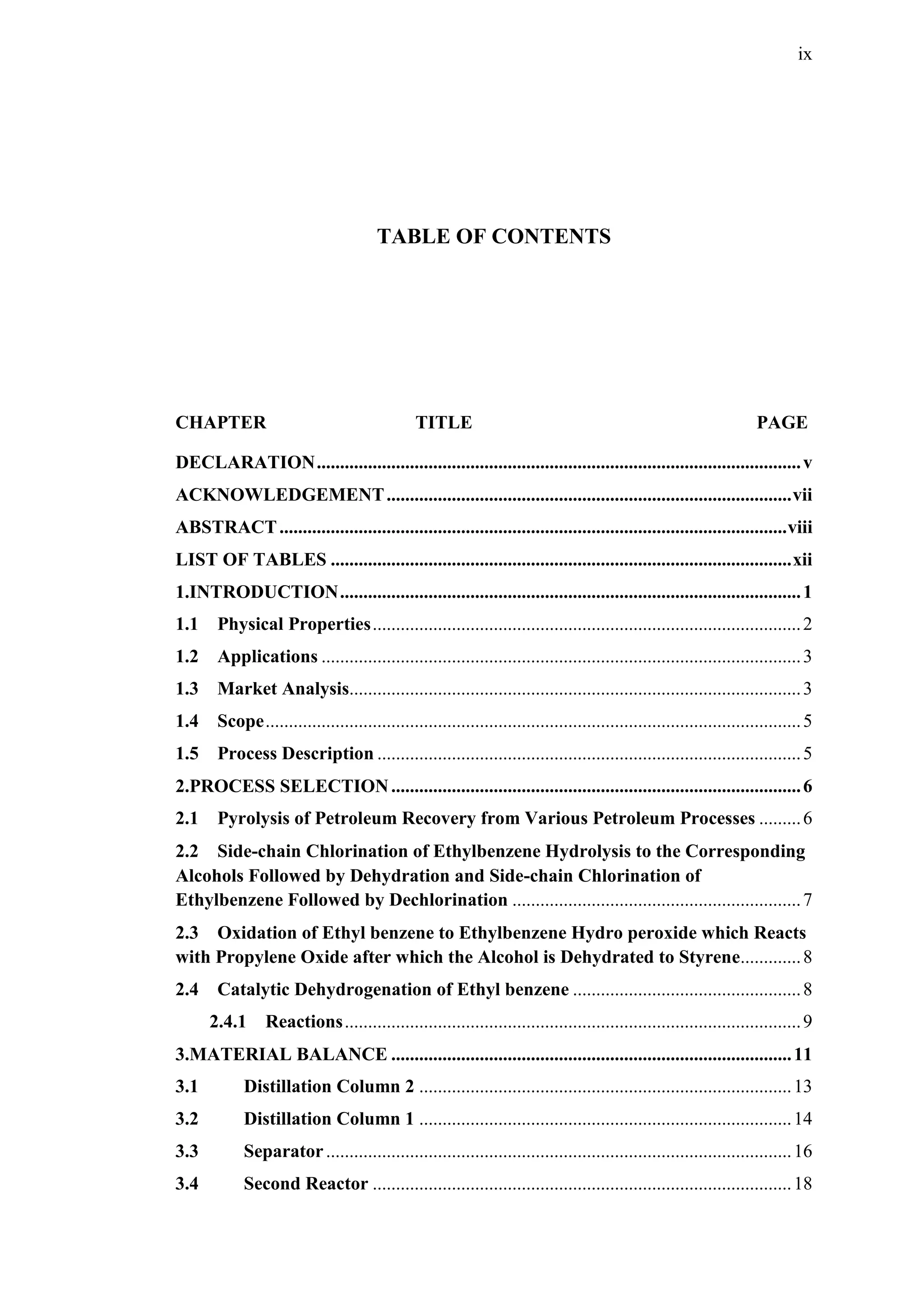
TABLE OF CONTENTS
CHAPTER TITLE PAGE
DECLARATION........................................................................................................v
ACKNOWLEDGEMENT.......................................................................................vii
ABSTRACT.............................................................................................................viii
LIST OF TABLES ...................................................................................................xii
1.INTRODUCTION...................................................................................................1
1.1 Physical Properties............................................................................................2
1.2 Applications .......................................................................................................3
1.3 Market Analysis.................................................................................................3
1.4 Scope...................................................................................................................5
1.5 Process Description ...........................................................................................5
2.PROCESS SELECTION........................................................................................6
2.1 Pyrolysis of Petroleum Recovery from Various Petroleum Processes .........6
2.2 Side-chain Chlorination of Ethylbenzene Hydrolysis to the Corresponding
Alcohols Followed by Dehydration and Side-chain Chlorination of
Ethylbenzene Followed by Dechlorination ..............................................................7
2.3 Oxidation of Ethyl benzene to Ethylbenzene Hydro peroxide which Reacts
with Propylene Oxide after which the Alcohol is Dehydrated to Styrene.............8
2.4 Catalytic Dehydrogenation of Ethyl benzene .................................................8
2.4.1 Reactions..................................................................................................9
3.MATERIAL BALANCE ......................................................................................11
3.1 Distillation Column 2 ................................................................................13
3.2 Distillation Column 1 ................................................................................14
3.3 Separator....................................................................................................16
3.4 Second Reactor ..........................................................................................18
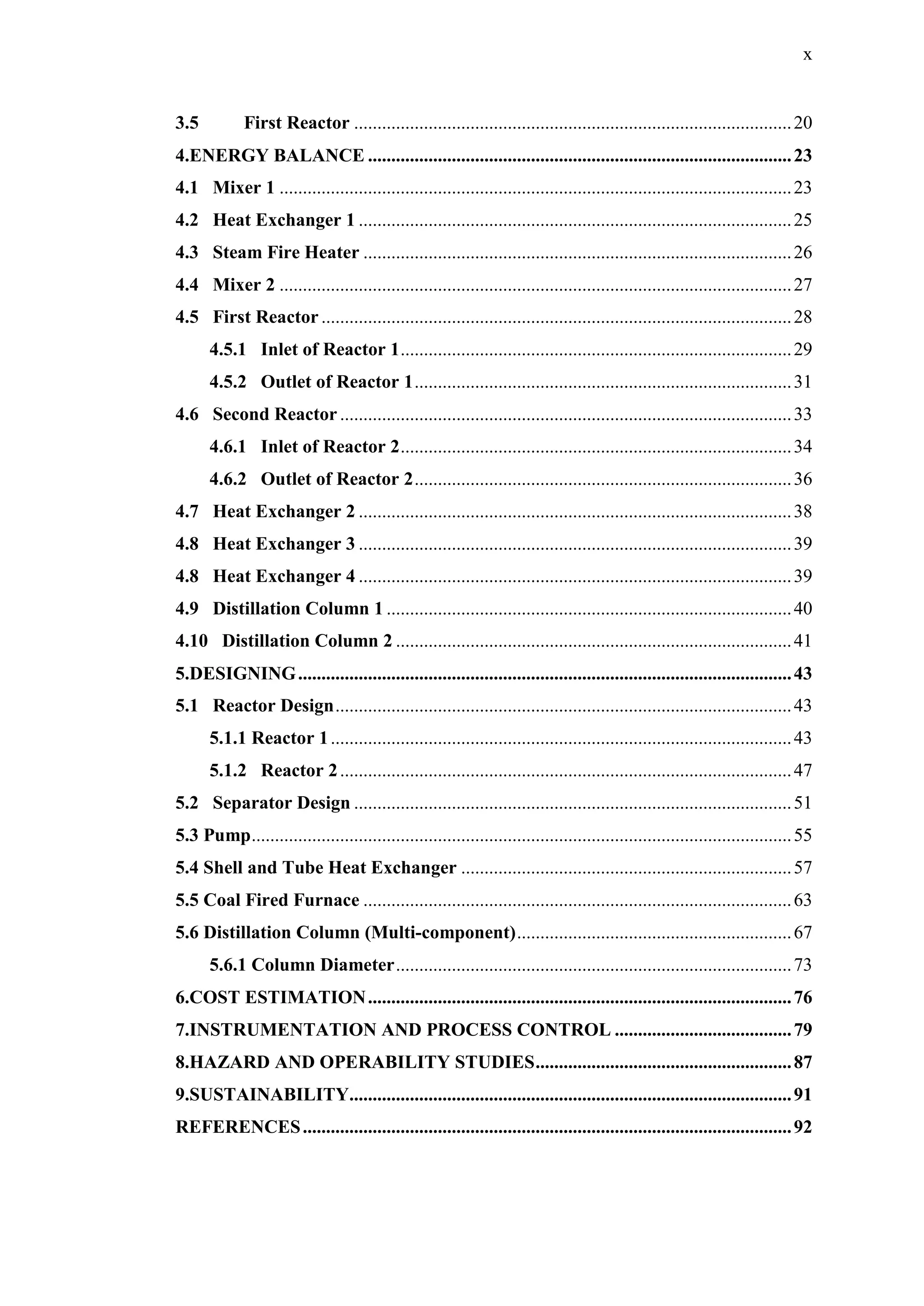
x
3.5 First Reactor ..............................................................................................20
4.ENERGY BALANCE ...........................................................................................23
4.1 Mixer 1 ..............................................................................................................23
4.2 Heat Exchanger 1 .............................................................................................25
4.3 Steam Fire Heater ............................................................................................26
4.4 Mixer 2 ..............................................................................................................27
4.5 First Reactor.....................................................................................................28
4.5.1 Inlet of Reactor 1....................................................................................29
4.5.2 Outlet of Reactor 1.................................................................................31
4.6 Second Reactor.................................................................................................33
4.6.1 Inlet of Reactor 2....................................................................................34
4.6.2 Outlet of Reactor 2.................................................................................36
4.7 Heat Exchanger 2 .............................................................................................38
4.8 Heat Exchanger 3 .............................................................................................39
4.8 Heat Exchanger 4 .............................................................................................39
4.9 Distillation Column 1 .......................................................................................40
4.10 Distillation Column 2 .....................................................................................41
5.DESIGNING..........................................................................................................43
5.1 Reactor Design..................................................................................................43
5.1.1 Reactor 1...................................................................................................43
5.1.2 Reactor 2.................................................................................................47
5.2 Separator Design ..............................................................................................51
5.3 Pump....................................................................................................................55
5.4 Shell and Tube Heat Exchanger .......................................................................57
5.5 Coal Fired Furnace ............................................................................................63
5.6 Distillation Column (Multi-component)...........................................................67
5.6.1 Column Diameter.....................................................................................73
6.COST ESTIMATION...........................................................................................76
7.INSTRUMENTATION AND PROCESS CONTROL ......................................79
8.HAZARD AND OPERABILITY STUDIES.......................................................87
9.SUSTAINABILITY...............................................................................................91
REFERENCES.........................................................................................................92
xi
LIST OF FIGURES
FIGURE NO. TITLE PAGE
Figure 1-1 Styrene Structural Formula........................................................................1
Figure 1-2 Styrene Demand ........................................................................................4
Figure 5-1 Efficiency of Furnace ..............................................................................66
Figure 5-2 Overall Exchange Factor .........................................................................67
Figure 5-3 Erbar-Maddox graph based on Underwood method ................................72
Figure 7--1 PNID Distillation Column.......................................................................85
Figure 7-2 PNID Heat Exchanger ..............................................................................86
xii
LIST OF TABLES
TABLE NO. TITLE PAGE
Table 1-1 Physical Properties of Styrene .....................................................................2
Table 3-1 Specifications of Reaction ........................................................................12
Table 4-1 Heat Capacities of Chemicals....................................................................24
Table 5-1 Reactor 1...................................................................................................46
Table 5-2 Reactor 2...................................................................................................50
Table 5-3 Pump.........................................................................................................55
Table 5-4 Furnace......................................................................................................63
Table 5-5 Antoine Equation Constants .....................................................................68
Table 5-6 Feed...........................................................................................................69
Table 5-7 Dew Point ..................................................................................................69
Table 5-8 Bubble Point ..............................................................................................70
Table 5-9 Bubble Point Trail 2...................................................................................70
Table 5-10 Minimum Reflux......................................................................................72
Table 8-1 HAZOP Guide Words...............................................................................89
Table 8-2 HAZOP of Reactor ...................................................................................90
1
CHAPTER 1
INTRODUCTION
In 1839, the German apothecary Eduard Simon isolated a volatile oil
from the resin (called storax or styrax) of the American sweetgum tree
(Liquidambar styraciflua). He called the oil "Styrol" (now: "styrene"). He also
noticed that when Styrol was exposed to air, light, or heat, it gradually transformed
into a hard, rubber-like substance, which he called "Styroloxyd" (Styrol oxide,
now: "polystyrene"). By 1845, the German chemist August Hofmann and his
student John Blyth (1814–1871) had determined Styrol's empirical formula: C8H8.
They had also determined that Simon's "Styroloxyd" which they renamed
"Metastyrol" had the same empirical formula as Styrol.
The modern method for production of styrene by dehydrogenation of
ethylbenzene was first achieved in the 1930s. The production of styrene
increased dramatically during the 1940s, when it was used as a feedstock for
synthetic rubber. Because styrene is produced on such a large scale,
ethylbenzene is in turn prepared on a prodigious scale.
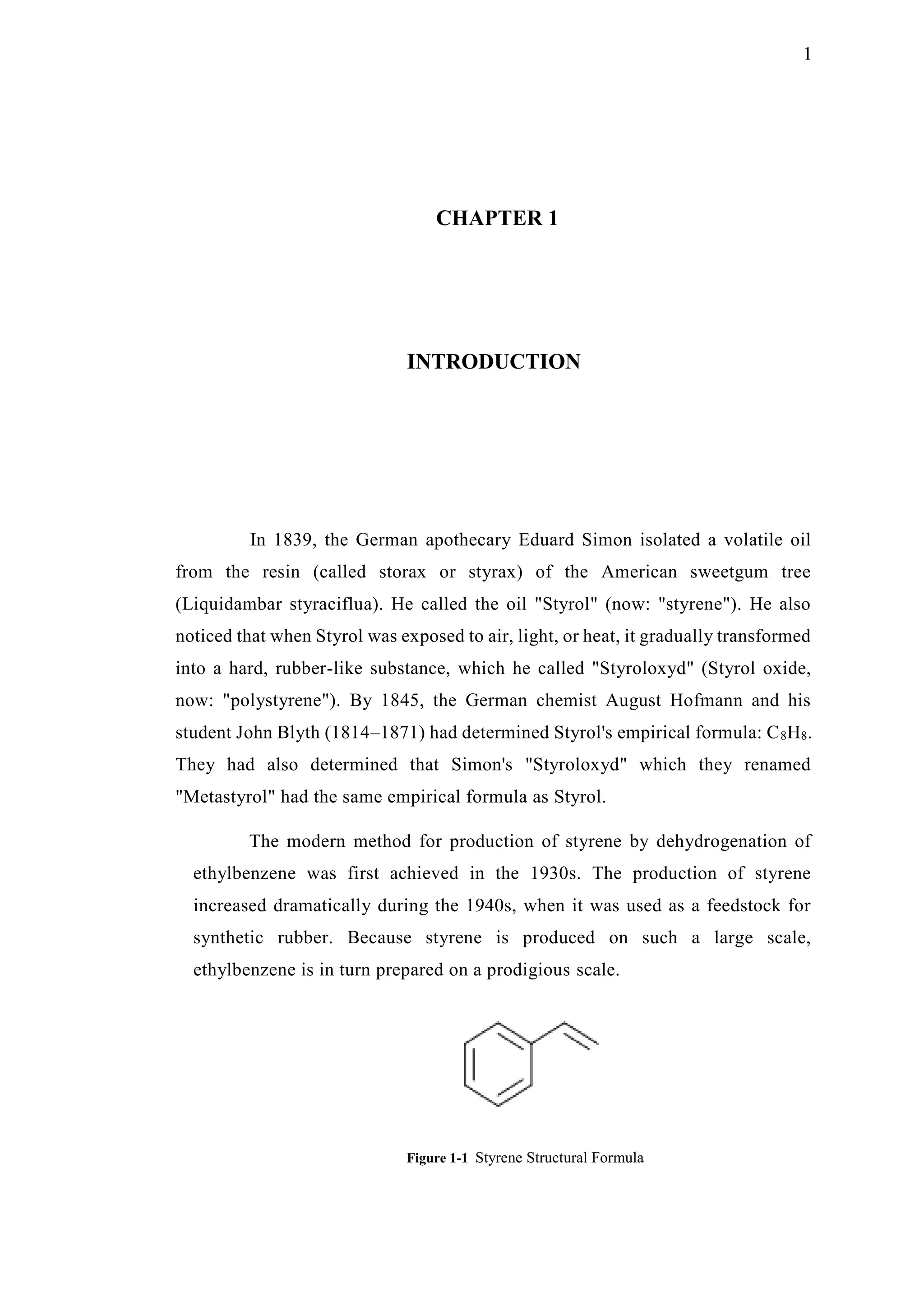
Figure 1-1 Styrene Structural Formula
2
Styrene is a colourless oily liquid that evaporates easily and has a sweet
smell, although high concentrations have a less pleasant odour; melts at -30.
6°C.Post-world war period witnessed a boom in styrene demand due to its
application in the manufacture of synthetic rubberi
. This led to a dramatic
increase in styrene capacity. Styrene has wide application in producing plastic
and synthetic rubber industry. It is mostly used in manufacturing of polystyrene
(PS), acrylonitrile-butadiene-styrene (ABS), styrene acrylonitrile (SAN),
styrene-butadiene rubber (SBR) and lattices, unsaturated polyester resins (UP
resins) and miscellaneous uses like textile auxiliaries, pigment binders polyester
resin, aromatics and intermediate industries.
1.1 Physical Properties
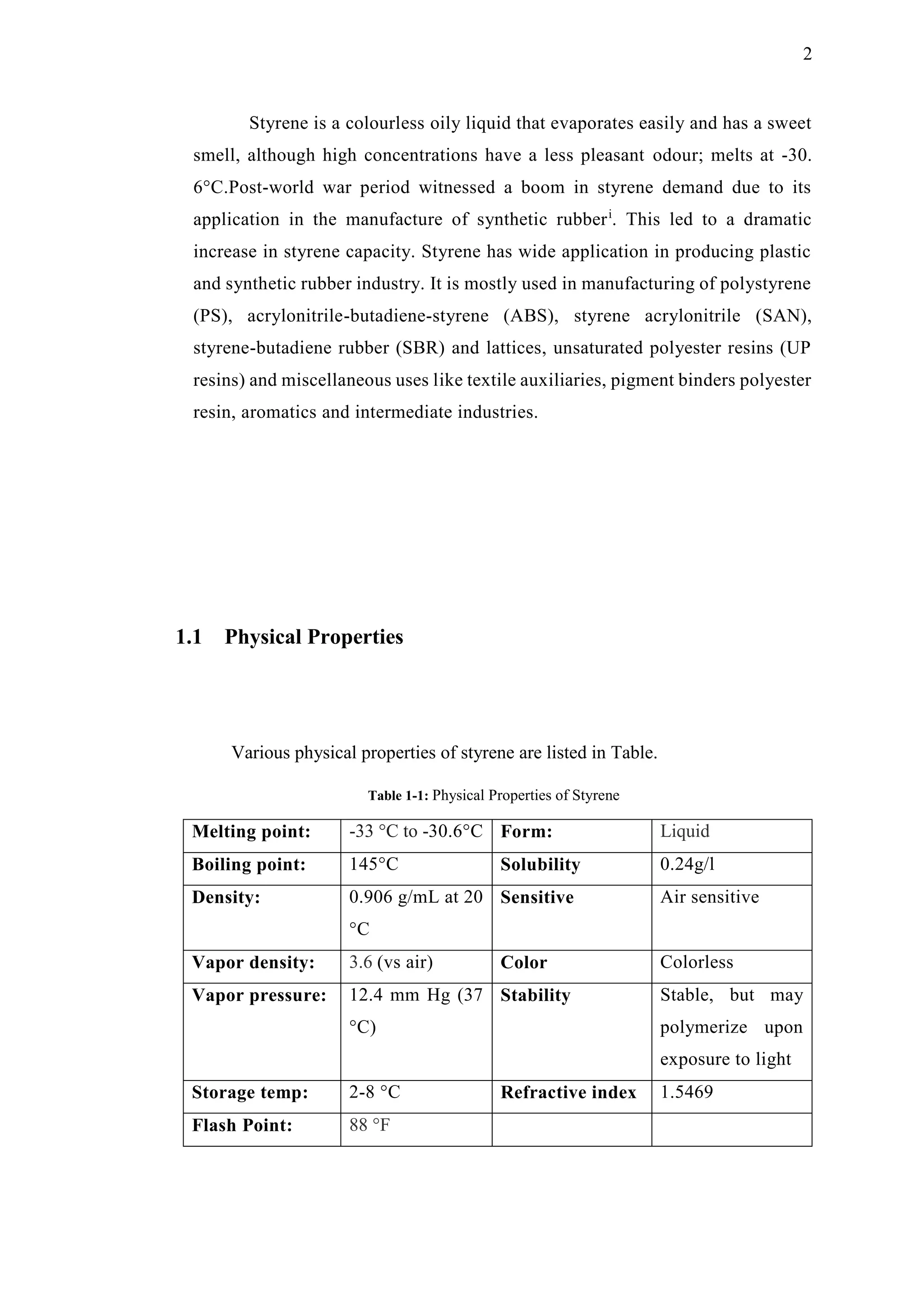
Various physical properties of styrene are listed in Table.
Table 1-1: Physical Properties of Styrene
Melting point: -33 °C to -30.6°C Form: Liquid
Boiling point: 145°C Solubility 0.24g/l
Density: 0.906 g/mL at 20
°C
Sensitive Air sensitive
Vapor density: 3.6 (vs air) Color Colorless
Vapor pressure: 12.4 mm Hg (37
°C)
Stability Stable, but may
polymerize upon
exposure to light
Storage temp: 2-8 °C Refractive index 1.5469
Flash Point: 88 °F
3
1.2 Applications
Applications of styrene are as:
• Styrene is mainly used as raw material for polystyrene, synthetic
rubber, plastics, ion exchange resins, etc.
• The most important use of styrene is as monomer for synthetic
rubber and plastics, it is used to produce styrene-butadiene rubber, polystyrene,
polystyrene foam; it is also used as other co-polymerizable monomers to
manufacture many different applications of engineering plastics.
• Styrene is used for the preparation of copper brightener, and has
effect of levelling and bright.
• Styrene is used in table food, cake food, condiments, desserts,
snacks, all kinds of canned food, candy. Variety of drinks, especially yogurt,
lactic acid bacteria drinks, carbonated drinks and other acidic beverages.
• Styrene is used for electron microscopic analysis, organic synthesis.
1.3 Market Analysis
The worldwide styrene showcase is significantly determined by
polystyrene and expandable polystyrene utilization. The market for styrene is
very enhanced, which incorporates different kinds of derivatives each having an
extensive variety of utilizations crosswise over different divisions of the
Styrene, also known as vinylbenzene, phenylethene, and ethenylbenzene, is an
4
organic compound that is colourless, flammable, water insoluble, and oily. It
evaporates easily and has a sweet odour market.
The interest for extended polystyrene (EPS) is required to drive the
worldwide styrene advertise. EPS is the quickest developing styrene derivative
and records for 25% of the worldwide utilization. The EPS showcase keeps on
becoming because of interest from the development division. Universally useful
polystyrene (PS) advertise is the biggest purchaser of styrene representing
almost 35% of the worldwide styrene utilization. The analyst’s report forecast
that the Global Styrene market to grow at a CAGR of 4.82 percent over the
period 2014-2019ii
.
(a)
(b)
Figure 1-2 Styrene Demand
5
1.4 Scope
The styrenics polymers consumption is estimated to be 35,007 kilotons
in 2013 and will grow by 4.81% annually till 2018iii
. The increasing demands
of styrenics polymers in Asia-Pacific, especially in China, and growth in end-
user applications such as construction and automotive industry are key factors
driving the global styrenic polymers market. Our goal is to meet the increasing
demand of styrene and its derivatives.
1.5 Process Description
The fresh ethyl benzene is mixed with the recycled ethylbenzene then it is
mixed with steam and is fed to the primary and secondary dehydrogenation
reactors. When steam exits the re-heater as a cool product, it is then reheated to
superheated steam which then enters the primary dehydrogenation reactor.
Superheated steam is used for heating the mixture for the reaction in the secondary
dehydrogenation reactor as well. These dehydrogenation reactors are designed to
have low pressure and an even flow distribution. The dehydrogenation reactors
liquid waste is then cooled through a number of heat exchangers which heat the
recycled and fresh ethylbenzene. The reactors liquid waste is divided and
condensed which then enters a vent gas compressor which further minimized
pressure drop. This process has three distillation towers that operate to reduce
polymer formation, to have low temperatures and to operate under vacuum
conditions.
6
CHAPTER 2
PROCESS SELECTION
Following are the methods for preparation of Styrene monomer:
• Catalytic Dehydrogenation of ethyl benzene.
• Oxidation of ethyl benzene to ethyl benzene hydro peroxide
which reacts with
Propylene oxide after which the alcohol is dehydrated to styrene.
• Side-chain chlorination of ethyl benzene followed by
dechlorination.
• Side-chain chlorination of ethyl benzene hydrolysis to the
corresponding alcohols
followed by dehydration.
• Pyrolysis of petroleum recovery from various petroleum
processes.
2.1 Pyrolysis of Petroleum Recovery from Various Petroleum
Processes
7
In this process styrene is separated from thermally cracked petroleum’s. In
the process of this invention thermally cracked petroleum is initially distilled to
recover the fraction boiling between 120o
C and 160o
Civ
. This fraction is then
subjected to extractive distillation with an organic polar solvent containing a
nitrite polymerization inhibitor in which the styrene is soluble. The solvent is
removed and the styrene containing fraction is thereafter treated with nitric acid
after which it is scrubbed with water or alkali. The resulting product is fractionated
to recover styrene of high purity which is substantially colourless.
• This process is not favourable due to the
unavailability of raw material.
• Due to carbon in petroleum, catalyst can also be
poisoned.
2.2 Side-chain Chlorination of Ethylbenzene Hydrolysis to the
Corresponding Alcohols Followed by Dehydration and Side-chain
Chlorination of Ethylbenzene Followed by Dechlorination
The process involves chlorination of ethyl benzene in the presence of heat to
form partial intermediate i.e. ethyl benzene chloride which is then treated with water
to form ethlybenzaldehyde.
These processes are not used generally because
 It suffers from high cost of raw materials.
 It forms the chlorinated contaminants in the monomer.
8
2.3 Oxidation of Ethyl benzene to Ethylbenzene Hydro peroxide
which Reacts with Propylene Oxide after which the Alcohol is
Dehydrated to Styrene
This process was introduced by Solder in late 1977, In this process ethyl
benzene oxidized and convert into the ethyl benzene hydro peroxide, after this ethyl
benzene hydro peroxide react with propene to make alcohol and propylene oxide, after
this alcohol is dehydrated to make styrenev
.
• The main drawback of this process is that it has limited product
flexibility.
• Styrene and propylene oxide produced together in a mass ratio
of around 2:1(styrene: propylene oxide) while the market demand is often
different.
2.4 Catalytic Dehydrogenation of Ethyl benzene
The majority of industrial production of styrene follows from the
dehydrogenation of ethyl benzenevi
.This dehydrogenation process involves the
catalytic reaction of ethyl benzene. Fresh ethyl benzene is mixed with a recycle steam
and vaporized. Steam is then added before feeding the effluents into a train of 2-4
reactors. This process involves a highly endothermic reaction carried out in the vapour
phase over a solid catalyst. Steam is used to provide heat of this reaction, to prevent
excessive coking or carbon formation, to shift equilibrium of the reversible reaction
towards the products, and to clean the catalyst of any carbon that does forms. The
reactors are run adiabatically in multiple reactors with steam added before each stage
with typical yields of 88-94%.
Crude styrene from reactors is then fed into a distillation train. Because of the
possibility of polymerization of styrene during distillation, small residence time,
avoidance of high temperature, and addition of inhibitor are necessary. The reaction is
9
carried out at 6000
C to 6500
C with a contact time of about 1 second between the
feedstock and the catalyst (usually iron oxide).
2.4.1 Reactions
C6H5CH2CH3 →C6H5CH=CH2 + H2(1)
• This process is favourable because the process reaction is
equilibrium limited.
• With the addition of steam, the process can be controlled
moreover steam (used to vaporize ethyl benzene) is recycled. So this process
is economical.
• Around 85% styrene is producing by this process in industrial
scales.
•
The best process to produce styrene is Catalytic dehydrogenation of ethyl
benzene viii
. This process is primary commercialize process for production of
styrene about 85% of the industrial process used nowadays. Ethyl benzene is
reacted with catalyst usually iron oxide (Fe3O4). This process reaction is
equilibrium limited and with the addition of steam, the process can be controlled.
During the process, the steam does not react with ethyl benzene and the catalyst
which prevents coking from happen. The advantages of diluting ethyl benzene
with superheated steam in this process are: -
 It lowers the partial pressure of ethyl benzene and shift of
equilibrium towards higher styrene production and minimizing the loss to
thermal cracking.
 Supplies part of the heat needed for endothermic reaction.
10
 Decrease carbonaceous deposits by steam reforming
reaction.
 Avoid catalyst over reduction and deactivation by
controlling the state of the iron.
11
CHAPTER 3
MATERIAL BALANCE
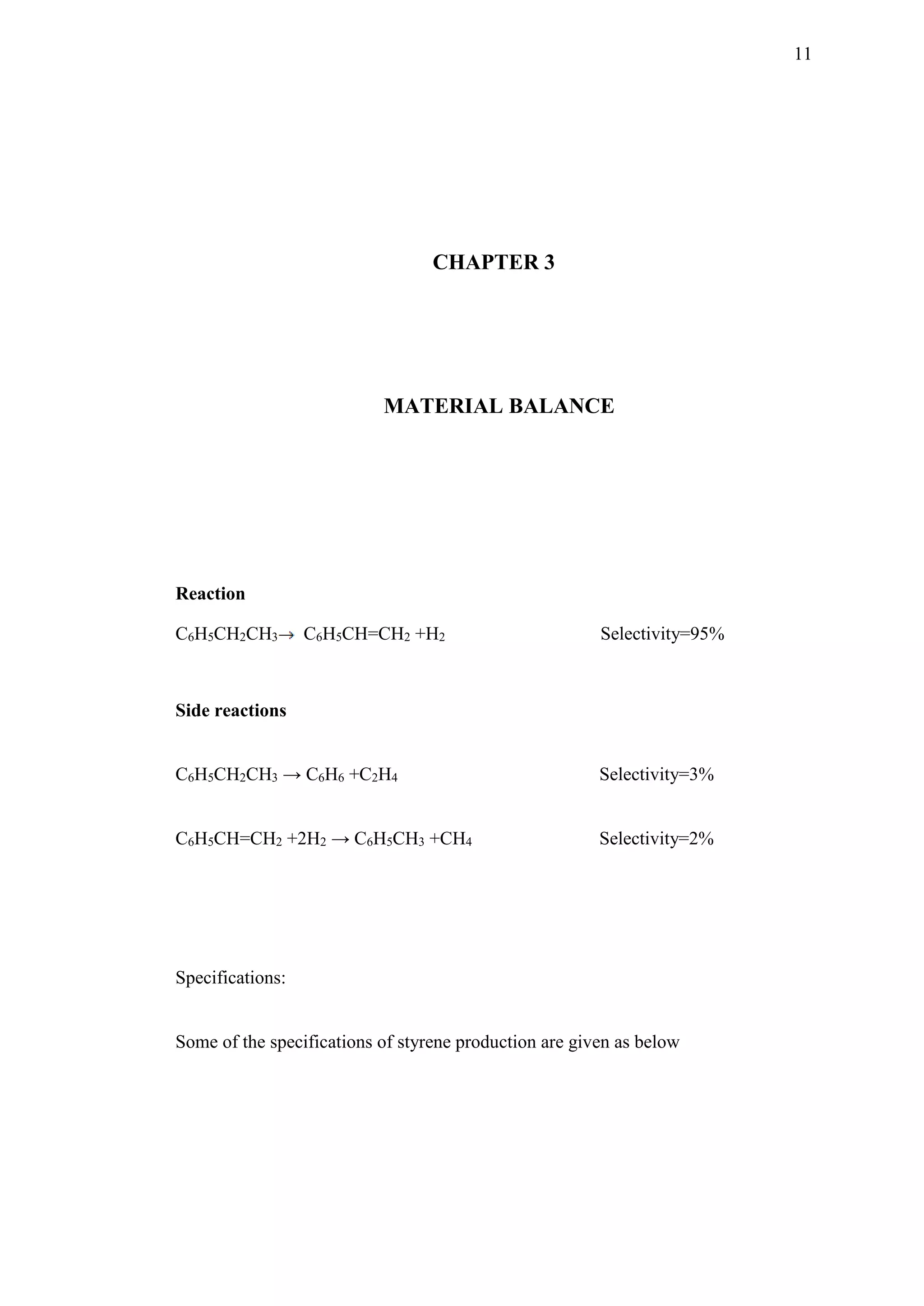
Reaction
C6H5CH2CH3 C6H5CH=CH2 +H2 Selectivity=95%
Side reactions
C6H5CH2CH3 → C6H6 +C2H4 Selectivity=3%
C6H5CH=CH2 +2H2 → C6H5CH3 +CH4 Selectivity=2%
Specifications:
Some of the specifications of styrene production are given as below
12
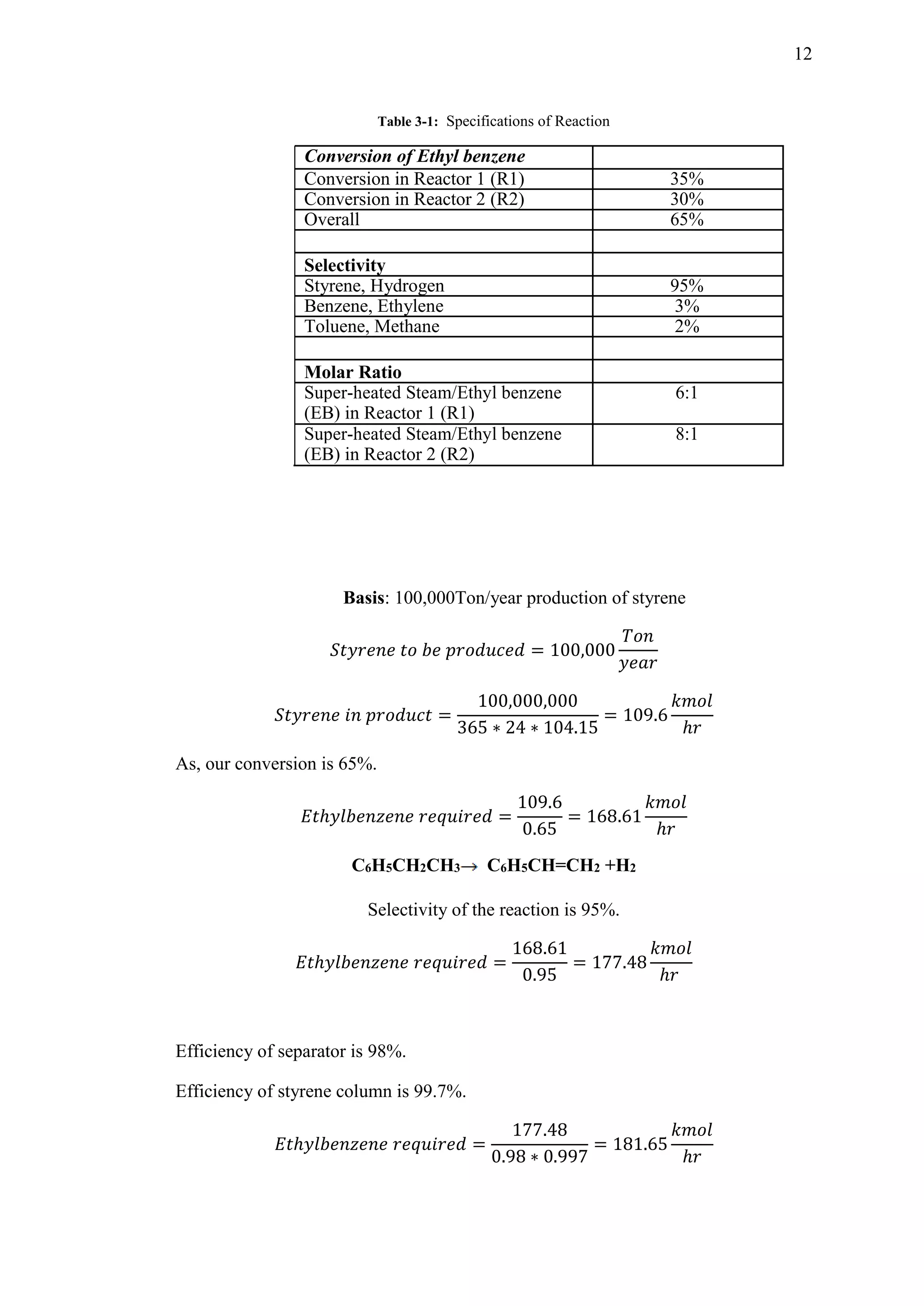
Table 3-1: Specifications of Reaction
Conversion of Ethyl benzene
Conversion in Reactor 1 (R1) 35%
Conversion in Reactor 2 (R2) 30%
Overall 65%
Selectivity
Styrene, Hydrogen 95%
Benzene, Ethylene 3%
Toluene, Methane 2%
Molar Ratio
Super-heated Steam/Ethyl benzene 6:1
(EB) in Reactor 1 (R1)
Super-heated Steam/Ethyl benzene 8:1
(EB) in Reactor 2 (R2)
Basis: 100,000Ton/year production of styrene
𝑆𝑡𝑦𝑟𝑒𝑛𝑒 𝑡𝑜 𝑏𝑒 𝑝𝑟𝑜𝑑𝑢𝑐𝑒𝑑 = 100,000
𝑇𝑜𝑛
𝑦𝑒𝑎𝑟
𝑆𝑡𝑦𝑟𝑒𝑛𝑒 𝑖𝑛 𝑝𝑟𝑜𝑑𝑢𝑐𝑡 =
100,000,000
365 ∗ 24 ∗ 104.15
= 109.6
𝑘𝑚𝑜𝑙
ℎ𝑟
As, our conversion is 65%.
𝐸𝑡ℎ𝑦𝑙𝑏𝑒𝑛𝑧𝑒𝑛𝑒 𝑟𝑒𝑞𝑢𝑖𝑟𝑒𝑑 =
109.6
0.65
= 168.61
𝑘𝑚𝑜𝑙
ℎ𝑟
C6H5CH2CH3 C6H5CH=CH2 +H2
Selectivity of the reaction is 95%.
𝐸𝑡ℎ𝑦𝑙𝑏𝑒𝑛𝑧𝑒𝑛𝑒 𝑟𝑒𝑞𝑢𝑖𝑟𝑒𝑑 =
168.61
0.95
= 177.48
𝑘𝑚𝑜𝑙
ℎ𝑟
Efficiency of separator is 98%.
Efficiency of styrene column is 99.7%.
𝐸𝑡ℎ𝑦𝑙𝑏𝑒𝑛𝑧𝑒𝑛𝑒 𝑟𝑒𝑞𝑢𝑖𝑟𝑒𝑑 =
177.48
0.98 ∗ 0.997
= 181.65
𝑘𝑚𝑜𝑙
ℎ𝑟
13
Selectivity for production of toluene, methane as side reaction is 2%.
𝑃𝑟𝑜𝑑𝑢𝑐𝑒𝑑 𝑚𝑜𝑙𝑒𝑠 𝑜𝑓 𝑡𝑜𝑙𝑢𝑒𝑛𝑒 = 181.65 ∗ 0.65 ∗ 0.02 = 2.36
kmol
ℎ𝑟
𝑃𝑟𝑜𝑑𝑢𝑐𝑒𝑑 𝑚𝑜𝑙𝑒𝑠 𝑜𝑓 𝑚𝑒𝑡ℎ𝑎𝑛𝑒 = 2.36
kmol
ℎ𝑟
Selectivity for production of benzene, ethylene as side reaction is3%.
𝑃𝑟𝑜𝑑𝑢𝑐𝑒𝑑 𝑚𝑜𝑙𝑒𝑠 𝑜𝑓 𝑏𝑒𝑛𝑧𝑒𝑛𝑒 = 181.65 ∗ 0.65 ∗ 0.03 = 3.54
𝑘𝑚𝑜𝑙
ℎ𝑟
𝑃𝑟𝑜𝑑𝑢𝑐𝑒𝑑 𝑚𝑜𝑙𝑒𝑠 𝑜𝑓 𝑒𝑡ℎ𝑦𝑙𝑒𝑛𝑒 = 3.54
𝑘𝑚𝑜𝑙
ℎ𝑟
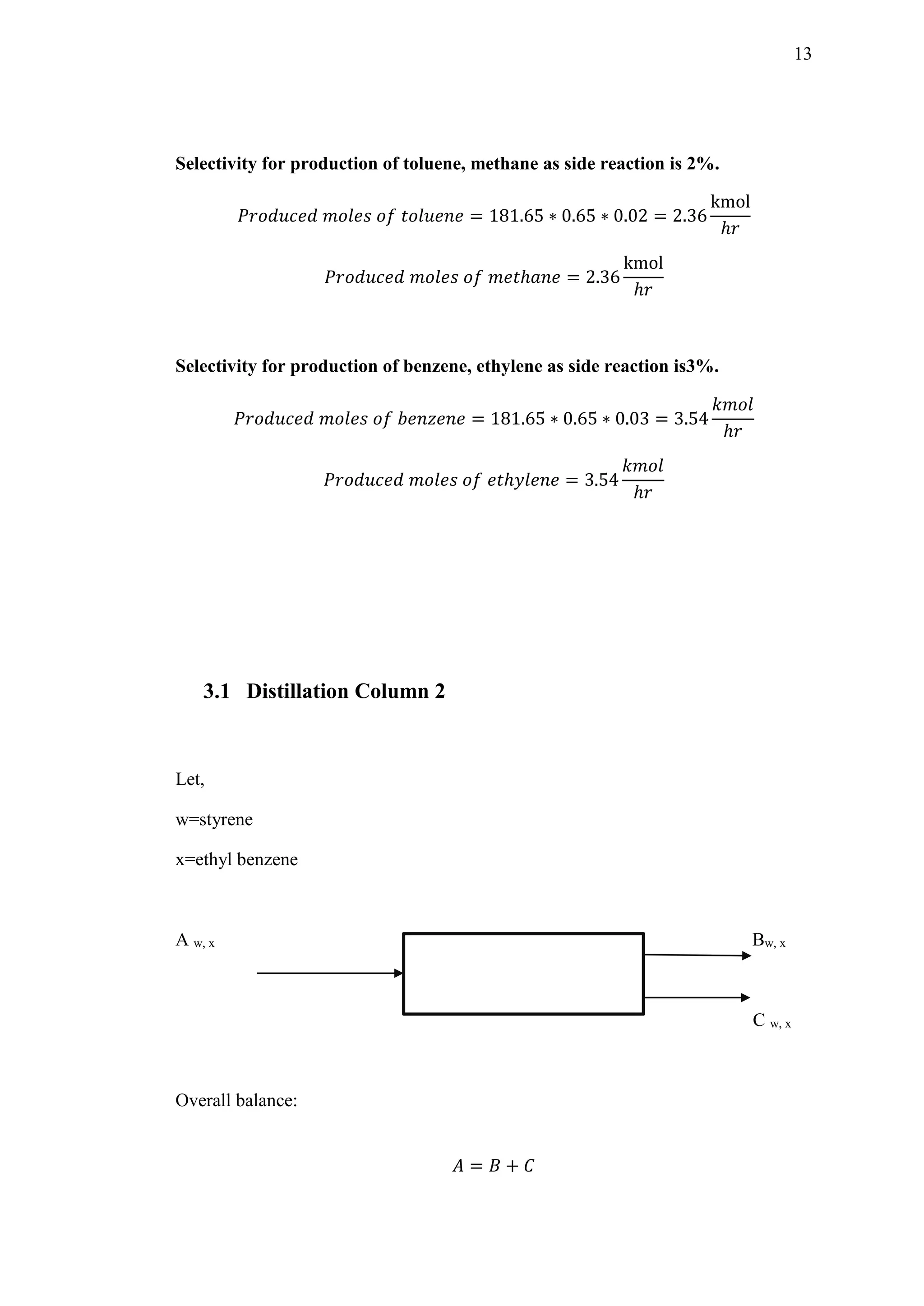
3.1 Distillation Column 2
Let,
w=styrene
x=ethyl benzene
A w, x Bw, x
C w, x
Overall balance:
𝐴 = 𝐵 + 𝐶
14
Styrene balance:
𝑤𝐴 = 𝑤𝐵 + 𝑤𝐶
Ethyl benzene balance:
𝑥𝐴 = 𝑥𝐵 + 𝑥𝐶
𝑆𝑡𝑦𝑟𝑒𝑛𝑒 𝑖𝑛 𝑝𝑟𝑜𝑑𝑢𝑐𝑡 =
100,000,000
365 ∗ 24 ∗ 104.15
= 109.6
𝑘𝑚𝑜𝑙
ℎ𝑟
Purity of styrene at bottom of column is 99.7% and Ethyl benzene at top of column is
99% pure.
Making a well-educated guess at inlet of distillation column.
As, conversion is 65%. So, in feed stream styrene is 65% and remaining (35%) is
ethyl benzene.
𝐴 = 𝐵 + 109.6 (1)
0.65𝐴 = 0.01𝐵 + 0.997 ∗ 109.6
0.65𝐴 = 0.01𝐵 + 109.27 (2)
Using equation (1) in equation (2)
0.65(𝐵 + 109.6) = 0.01𝐵 + 109.27
0.65𝐵 + 71.24 = 0.01𝐵 + 109.27
0.64𝐵 = 38.03
𝐵 =
38.03
0.64
= 59.42
𝑘𝑚𝑜𝑙
ℎ𝑟
𝐴 = 59.42 + 109.6 = 169.02
𝑘𝑚𝑜𝑙
ℎ𝑟
𝑈𝑛𝑟𝑒𝑎𝑐𝑡𝑒𝑑 𝑒𝑡ℎ𝑦𝑙 𝑏𝑒𝑛𝑧𝑒𝑛𝑒 = 59.42
𝑘𝑚𝑜𝑙
ℎ𝑟
3.2 Distillation Column 1
15
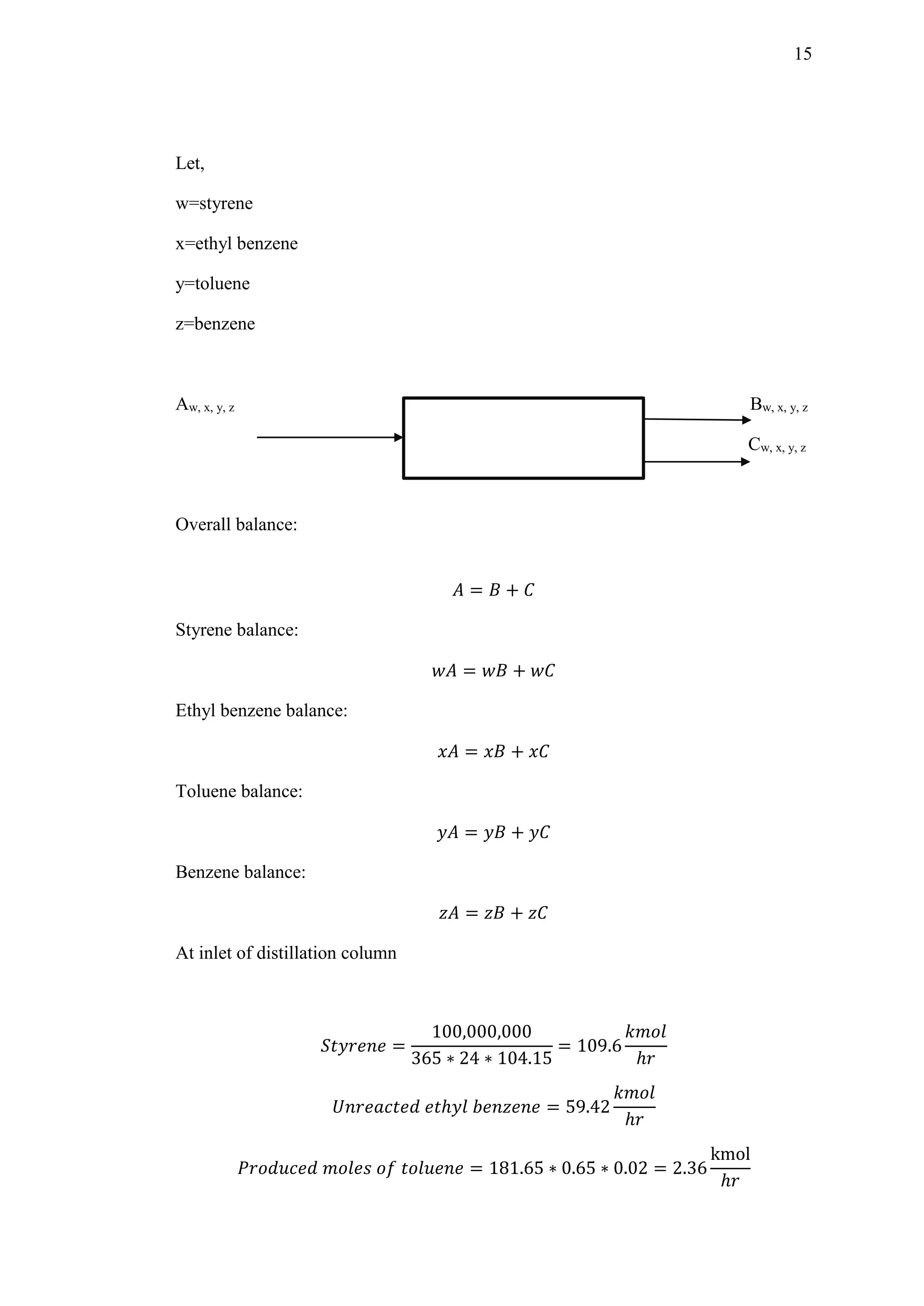
Let,
w=styrene
x=ethyl benzene
y=toluene
z=benzene
Aw, x, y, z Bw, x, y, z
Cw, x, y, z
Overall balance:
𝐴 = 𝐵 + 𝐶
Styrene balance:
𝑤𝐴 = 𝑤𝐵 + 𝑤𝐶
Ethyl benzene balance:
𝑥𝐴 = 𝑥𝐵 + 𝑥𝐶
Toluene balance:
𝑦𝐴 = 𝑦𝐵 + 𝑦𝐶
Benzene balance:
𝑧𝐴 = 𝑧𝐵 + 𝑧𝐶
At inlet of distillation column
𝑆𝑡𝑦𝑟𝑒𝑛𝑒 =
100,000,000
365 ∗ 24 ∗ 104.15
= 109.6
𝑘𝑚𝑜𝑙
ℎ𝑟
𝑈𝑛𝑟𝑒𝑎𝑐𝑡𝑒𝑑 𝑒𝑡ℎ𝑦𝑙 𝑏𝑒𝑛𝑧𝑒𝑛𝑒 = 59.42
𝑘𝑚𝑜𝑙
ℎ𝑟
𝑃𝑟𝑜𝑑𝑢𝑐𝑒𝑑 𝑚𝑜𝑙𝑒𝑠 𝑜𝑓 𝑡𝑜𝑙𝑢𝑒𝑛𝑒 = 181.65 ∗ 0.65 ∗ 0.02 = 2.36
kmol
ℎ𝑟
16
𝑃𝑟𝑜𝑑𝑢𝑐𝑒𝑑 𝑚𝑜𝑙𝑒𝑠 𝑜𝑓 𝑏𝑒𝑛𝑧𝑒𝑛𝑒 = 181.65 ∗ 0.65 ∗ 0.03 = 3.54
𝑘𝑚𝑜𝑙
ℎ𝑟
𝑇𝑜𝑡𝑎𝑙 𝑚𝑜𝑙𝑒𝑠 𝑎𝑡 𝑖𝑛𝑙𝑒𝑡 = 𝐴 = 174.92
𝑘𝑚𝑜𝑙
ℎ𝑟
Solving equations:
𝑇𝑜𝑝 𝑝𝑟𝑜𝑑𝑢𝑐𝑡 = 𝑩 = 174.92 − 169.02 = 5.9
𝑘𝑚𝑜𝑙
ℎ𝑟
3.3 Separator
u=waste water
v=gases
w=styrene
x=ethyl benzene
y=toluene
z=benzene
𝑆𝑡𝑒𝑎𝑚 𝑎𝑑𝑑𝑒𝑑 𝑡𝑜 𝑓𝑖𝑟𝑠𝑡 𝑟𝑒𝑎𝑐𝑡𝑜𝑟 = 𝑚𝑜𝑙𝑒𝑠 𝑜𝑓 𝑒𝑡ℎ𝑦𝑙 𝑏𝑒𝑛𝑧𝑒𝑛𝑒 ∗ 6 = 181.65 ∗ 6
= 1089.9
𝑘𝑚𝑜𝑙
ℎ𝑟
As, there is 35% conversion in first reactor.
𝑆𝑡𝑒𝑎𝑚 𝑎𝑑𝑑𝑒𝑑 𝑡𝑜 𝑠𝑒𝑐𝑜𝑛𝑑 𝑟𝑒𝑎𝑐𝑡𝑜𝑟 = 𝑚𝑜𝑙𝑒𝑠 𝑜𝑓 𝑒𝑡ℎ𝑦𝑙 𝑏𝑒𝑛𝑧𝑒𝑛𝑒 ∗ 8
= 181.65 − (181.65 ∗ .35) ∗ 8 = 944.58
𝑘𝑚𝑜𝑙
ℎ𝑟
17
𝑇𝑜𝑡𝑎𝑙 𝑠𝑡𝑒𝑎𝑚 𝑒𝑛𝑡𝑒𝑟𝑒𝑑 = 2034.48
𝑘𝑚𝑜𝑙
ℎ𝑟
𝑆𝑡𝑦𝑟𝑒𝑛𝑒 𝑎𝑡 𝑖𝑛𝑙𝑒𝑡 𝑜𝑓 𝑠𝑒𝑝𝑎𝑟𝑎𝑡𝑜𝑟 =
109.60
0.98 ∗ 0.997
= 112.17
𝑘𝑚𝑜𝑙
ℎ𝑟
𝐸𝑡ℎ𝑦𝑙𝑏𝑒𝑛𝑧𝑒𝑛𝑒 𝑎𝑡 𝑖𝑛𝑙𝑒𝑡 𝑜𝑓 𝑠𝑒𝑝𝑎𝑟𝑎𝑡𝑜𝑟 =
59.42
0.98 ∗ 0.997
= 60.81
𝑘𝑚𝑜𝑙
ℎ𝑟
𝑇𝑜𝑙𝑢𝑒𝑛𝑒 𝑎𝑡 𝑖𝑛𝑙𝑒𝑡 𝑜𝑓 𝑠𝑒𝑝𝑎𝑟𝑎𝑡𝑜𝑟 =
2.36
0.98
= 2.41
kmol
ℎ𝑟
𝑀𝑒𝑡ℎ𝑎𝑛𝑒 𝑎𝑡 𝑖𝑛𝑙𝑒𝑡 𝑜𝑓 𝑠𝑒𝑝𝑎𝑟𝑎𝑡𝑜𝑟 = 2.41
kmol
ℎ𝑟
𝐻𝑦𝑑𝑟𝑜𝑔𝑒𝑛 𝑎𝑡 𝑖𝑛𝑙𝑒𝑡 𝑜𝑓 𝑠𝑒𝑝𝑎𝑟𝑎𝑡𝑜𝑟 = 112.17 − 2(2.41) = 107.35
𝑘𝑚𝑜𝑙
ℎ𝑟
𝐵𝑒𝑛𝑧𝑒𝑛𝑒 𝑎𝑡 𝑖𝑛𝑙𝑒𝑡 𝑜𝑓 𝑠𝑒𝑝𝑎𝑟𝑎𝑡𝑜𝑟 =
3.54
0.98
= 3.61
𝑘𝑚𝑜𝑙
ℎ𝑟
𝐸𝑡ℎ𝑦𝑙𝑒𝑛𝑒 𝑎𝑡 𝑖𝑛𝑙𝑒𝑡 𝑜𝑓 𝑠𝑒𝑝𝑎𝑟𝑎𝑡𝑜𝑟 = 3.61
𝑘𝑚𝑜𝑙
ℎ𝑟
𝑇𝑜𝑡𝑎𝑙 𝑓𝑒𝑒𝑑 𝑜𝑓 𝑠𝑒𝑝𝑎𝑟𝑎𝑡𝑜𝑟 = 𝐴
= 112.17 + 60.81 + 107.35 + 2.41 + 2.41 + 3.61 + 3.61
+ 2034.48 = 2326.85
𝑘𝑚𝑜𝑙
ℎ𝑟
Styrene balance
𝑤𝐴 = 𝑤𝐵 + 𝑤𝐶 + 𝑤𝐷
18
B v
Au, v, w, x, y, z C w, x, y, z
Du
Total outlet of organic phase separator=C= 179
𝑘𝑚𝑜𝑙
ℎ𝑟
𝑇𝑜𝑡𝑎𝑙 𝑠𝑡𝑒𝑎𝑚 𝑒𝑛𝑡𝑒𝑟𝑒𝑑 = 𝐷 = 2034.48
𝑘𝑚𝑜𝑙
ℎ𝑟
𝑇𝑜𝑡𝑎𝑙 𝑔𝑎𝑠𝑒𝑠 𝑒𝑛𝑡𝑒𝑟𝑒𝑑 = 𝐵 = 113.37
𝑘𝑚𝑜𝑙
ℎ𝑟
3.4 Second Reactor
Conversion of second reactor is 30%. As, steam is inert in reaction so ignoring it in
reactor balance.
u=gases
w=styrene
x=ethyl benzene
y=toluene
z=benzene
A u, w, x, y, z Bu, w, x, y, z
19
𝑇𝑜𝑡𝑎𝑙 𝑎𝑚𝑜𝑢𝑛𝑡 𝑜𝑢𝑡𝑙𝑒𝑡 𝑜𝑓 𝑠𝑒𝑐𝑜𝑛𝑑 𝑟𝑒𝑎𝑐𝑡𝑜𝑟 = 𝐵
= 112.17 + 60.81 + 107.35 + 2.41 + 2.41 + 3.61 + 3.61
+ 2034.48 = 2326.85
𝑘𝑚𝑜𝑙
ℎ𝑟
As, steam is inert.
𝑆𝑡𝑦𝑟𝑒𝑛𝑒 𝑎𝑡 𝑜𝑢𝑡𝑙𝑒𝑡 𝑜𝑓 𝑠𝑒𝑐𝑜𝑛𝑑 𝑟𝑒𝑎𝑐𝑡𝑜𝑟 = 112.17
𝑘𝑚𝑜𝑙
ℎ𝑟
𝐸𝑡ℎ𝑦𝑙𝑏𝑒𝑛𝑧𝑒𝑛𝑒 𝑎𝑡 𝑜𝑢𝑡𝑙𝑒𝑡 𝑜𝑓 𝑠𝑒𝑐𝑜𝑛𝑑 𝑟𝑒𝑎𝑐𝑡𝑜𝑟 = 60.81
𝑘𝑚𝑜𝑙
ℎ𝑟
𝑇𝑜𝑙𝑢𝑒𝑛𝑒 𝑎𝑡 𝑜𝑢𝑡𝑙𝑒𝑡 𝑜𝑓 𝑠𝑒𝑐𝑜𝑛𝑑 𝑟𝑒𝑎𝑐𝑡𝑜𝑟 = 2.41
kmol
ℎ𝑟
𝑀𝑒𝑡ℎ𝑎𝑛𝑒 𝑎𝑡 𝑜𝑢𝑡𝑙𝑒𝑡 𝑜𝑓 𝑠𝑒𝑐𝑜𝑛𝑑 𝑟𝑒𝑎𝑐𝑡𝑜𝑟 = 2.41
kmol
ℎ𝑟
𝐻𝑦𝑑𝑟𝑜𝑔𝑒𝑛 𝑎𝑡 𝑜𝑢𝑡𝑙𝑒𝑡 𝑜𝑓 𝑠𝑒𝑐𝑜𝑛𝑑 𝑟𝑒𝑎𝑐𝑡𝑜𝑟 = 112.17 − 2(2.41) = 107.35
𝑘𝑚𝑜𝑙
ℎ𝑟
𝐵𝑒𝑛𝑧𝑒𝑛𝑒 𝑎𝑡 𝑜𝑢𝑡𝑙𝑒𝑡 𝑜𝑓 𝑠𝑒𝑐𝑜𝑛𝑑 𝑟𝑒𝑎𝑐𝑡𝑜𝑟 = 3.61
𝑘𝑚𝑜𝑙
ℎ𝑟
𝐸𝑡ℎ𝑦𝑙𝑒𝑛𝑒 𝑎𝑡 𝑜𝑢𝑡𝑙𝑒𝑡 𝑜𝑓 𝑠𝑒𝑐𝑜𝑛𝑑 𝑟𝑒𝑎𝑐𝑡𝑜𝑟 = 3.61
𝑘𝑚𝑜𝑙
ℎ𝑟
Inlet of second reactor
𝑆𝑡𝑦𝑟𝑒𝑛𝑒 𝑎𝑡 𝑖𝑛𝑙𝑒𝑡 𝑜𝑓 𝑠𝑒𝑐𝑜𝑛𝑑 𝑟𝑒𝑎𝑐𝑡𝑜𝑟 = 112.17 − (181.65 ∗ 0.30 ∗ 0.95)
= 60.40
𝑘𝑚𝑜𝑙
ℎ𝑟
𝑈𝑛𝑟𝑒𝑎𝑐𝑡𝑒𝑑 𝑒𝑡ℎ𝑦𝑙𝑏𝑒𝑛𝑧𝑒𝑛𝑒 = 60.81
𝑘𝑚𝑜𝑙
ℎ𝑟
20
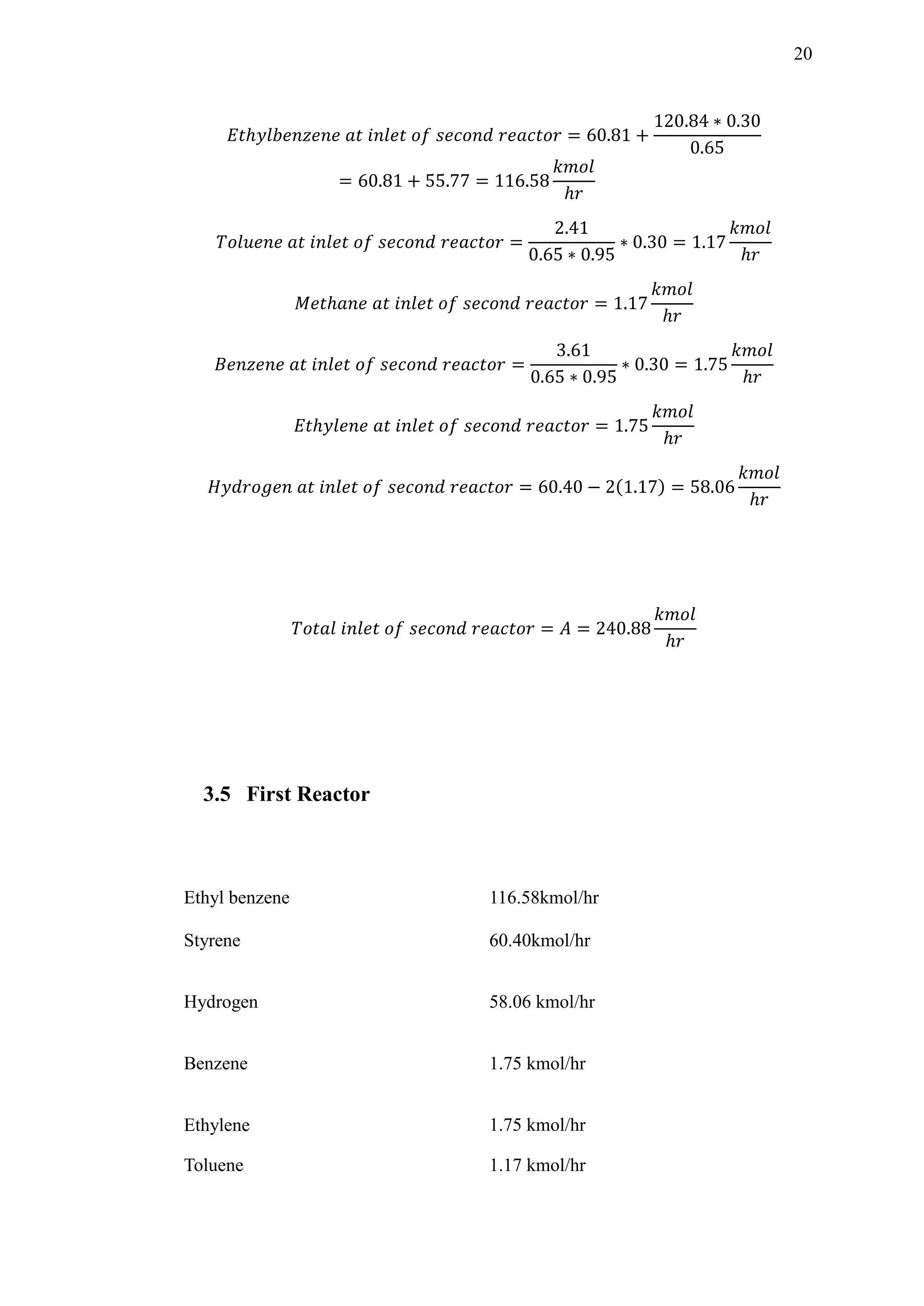
𝐸𝑡ℎ𝑦𝑙𝑏𝑒𝑛𝑧𝑒𝑛𝑒 𝑎𝑡 𝑖𝑛𝑙𝑒𝑡 𝑜𝑓 𝑠𝑒𝑐𝑜𝑛𝑑 𝑟𝑒𝑎𝑐𝑡𝑜𝑟 = 60.81 +
120.84 ∗ 0.30
0.65
= 60.81 + 55.77 = 116.58
𝑘𝑚𝑜𝑙
ℎ𝑟
𝑇𝑜𝑙𝑢𝑒𝑛𝑒 𝑎𝑡 𝑖𝑛𝑙𝑒𝑡 𝑜𝑓 𝑠𝑒𝑐𝑜𝑛𝑑 𝑟𝑒𝑎𝑐𝑡𝑜𝑟 =
2.41
0.65 ∗ 0.95
∗ 0.30 = 1.17
𝑘𝑚𝑜𝑙
ℎ𝑟
𝑀𝑒𝑡ℎ𝑎𝑛𝑒 𝑎𝑡 𝑖𝑛𝑙𝑒𝑡 𝑜𝑓 𝑠𝑒𝑐𝑜𝑛𝑑 𝑟𝑒𝑎𝑐𝑡𝑜𝑟 = 1.17
𝑘𝑚𝑜𝑙
ℎ𝑟
𝐵𝑒𝑛𝑧𝑒𝑛𝑒 𝑎𝑡 𝑖𝑛𝑙𝑒𝑡 𝑜𝑓 𝑠𝑒𝑐𝑜𝑛𝑑 𝑟𝑒𝑎𝑐𝑡𝑜𝑟 =
3.61
0.65 ∗ 0.95
∗ 0.30 = 1.75
𝑘𝑚𝑜𝑙
ℎ𝑟
𝐸𝑡ℎ𝑦𝑙𝑒𝑛𝑒 𝑎𝑡 𝑖𝑛𝑙𝑒𝑡 𝑜𝑓 𝑠𝑒𝑐𝑜𝑛𝑑 𝑟𝑒𝑎𝑐𝑡𝑜𝑟 = 1.75
𝑘𝑚𝑜𝑙
ℎ𝑟
𝐻𝑦𝑑𝑟𝑜𝑔𝑒𝑛 𝑎𝑡 𝑖𝑛𝑙𝑒𝑡 𝑜𝑓 𝑠𝑒𝑐𝑜𝑛𝑑 𝑟𝑒𝑎𝑐𝑡𝑜𝑟 = 60.40 − 2(1.17) = 58.06
𝑘𝑚𝑜𝑙
ℎ𝑟
𝑇𝑜𝑡𝑎𝑙 𝑖𝑛𝑙𝑒𝑡 𝑜𝑓 𝑠𝑒𝑐𝑜𝑛𝑑 𝑟𝑒𝑎𝑐𝑡𝑜𝑟 = 𝐴 = 240.88
𝑘𝑚𝑜𝑙
ℎ𝑟
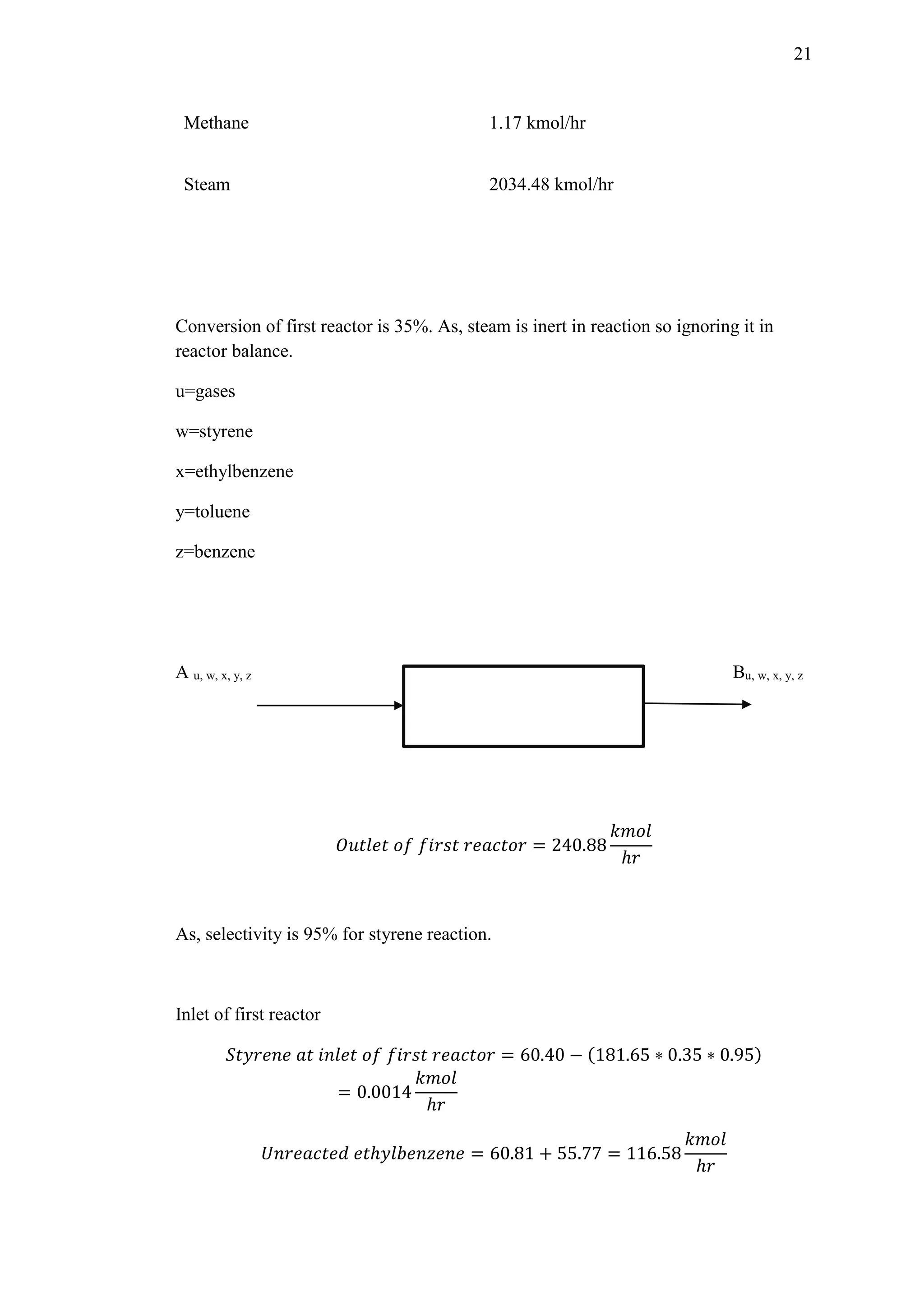
3.5 First Reactor
Ethyl benzene 116.58kmol/hr
Styrene 60.40kmol/hr
Hydrogen 58.06 kmol/hr
Benzene 1.75 kmol/hr
Ethylene 1.75 kmol/hr
Toluene 1.17 kmol/hr
21
Methane 1.17 kmol/hr
Steam 2034.48 kmol/hr
Conversion of first reactor is 35%. As, steam is inert in reaction so ignoring it in
reactor balance.
u=gases
w=styrene
x=ethylbenzene
y=toluene
z=benzene
A u, w, x, y, z Bu, w, x, y, z
𝑂𝑢𝑡𝑙𝑒𝑡 𝑜𝑓 𝑓𝑖𝑟𝑠𝑡 𝑟𝑒𝑎𝑐𝑡𝑜𝑟 = 240.88
𝑘𝑚𝑜𝑙
ℎ𝑟
As, selectivity is 95% for styrene reaction.
Inlet of first reactor
𝑆𝑡𝑦𝑟𝑒𝑛𝑒 𝑎𝑡 𝑖𝑛𝑙𝑒𝑡 𝑜𝑓 𝑓𝑖𝑟𝑠𝑡 𝑟𝑒𝑎𝑐𝑡𝑜𝑟 = 60.40 − (181.65 ∗ 0.35 ∗ 0.95)
= 0.0014
𝑘𝑚𝑜𝑙
ℎ𝑟
𝑈𝑛𝑟𝑒𝑎𝑐𝑡𝑒𝑑 𝑒𝑡ℎ𝑦𝑙𝑏𝑒𝑛𝑧𝑒𝑛𝑒 = 60.81 + 55.77 = 116.58
𝑘𝑚𝑜𝑙
ℎ𝑟
22
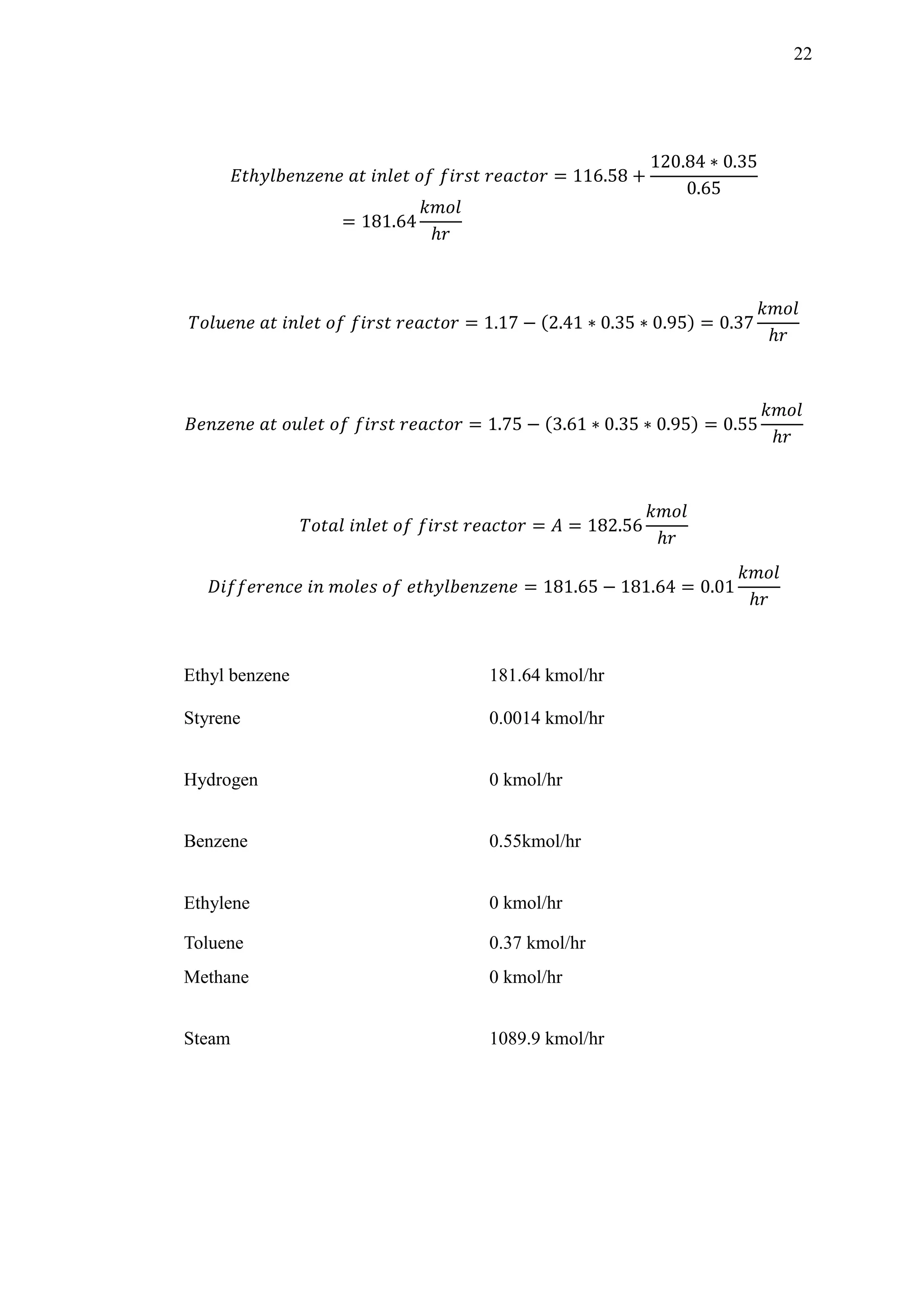
𝐸𝑡ℎ𝑦𝑙𝑏𝑒𝑛𝑧𝑒𝑛𝑒 𝑎𝑡 𝑖𝑛𝑙𝑒𝑡 𝑜𝑓 𝑓𝑖𝑟𝑠𝑡 𝑟𝑒𝑎𝑐𝑡𝑜𝑟 = 116.58 +
120.84 ∗ 0.35
0.65
= 181.64
𝑘𝑚𝑜𝑙
ℎ𝑟
𝑇𝑜𝑙𝑢𝑒𝑛𝑒 𝑎𝑡 𝑖𝑛𝑙𝑒𝑡 𝑜𝑓 𝑓𝑖𝑟𝑠𝑡 𝑟𝑒𝑎𝑐𝑡𝑜𝑟 = 1.17 − (2.41 ∗ 0.35 ∗ 0.95) = 0.37
𝑘𝑚𝑜𝑙
ℎ𝑟
𝐵𝑒𝑛𝑧𝑒𝑛𝑒 𝑎𝑡 𝑜𝑢𝑙𝑒𝑡 𝑜𝑓 𝑓𝑖𝑟𝑠𝑡 𝑟𝑒𝑎𝑐𝑡𝑜𝑟 = 1.75 − (3.61 ∗ 0.35 ∗ 0.95) = 0.55
𝑘𝑚𝑜𝑙
ℎ𝑟
𝑇𝑜𝑡𝑎𝑙 𝑖𝑛𝑙𝑒𝑡 𝑜𝑓 𝑓𝑖𝑟𝑠𝑡 𝑟𝑒𝑎𝑐𝑡𝑜𝑟 = 𝐴 = 182.56
𝑘𝑚𝑜𝑙
ℎ𝑟
𝐷𝑖𝑓𝑓𝑒𝑟𝑒𝑛𝑐𝑒 𝑖𝑛 𝑚𝑜𝑙𝑒𝑠 𝑜𝑓 𝑒𝑡ℎ𝑦𝑙𝑏𝑒𝑛𝑧𝑒𝑛𝑒 = 181.65 − 181.64 = 0.01
𝑘𝑚𝑜𝑙
ℎ𝑟
Ethyl benzene 181.64 kmol/hr
Styrene 0.0014 kmol/hr
Hydrogen 0 kmol/hr
Benzene 0.55kmol/hr
Ethylene 0 kmol/hr
Toluene 0.37 kmol/hr
Methane 0 kmol/hr
Steam 1089.9 kmol/hr
23
CHAPTER 4
ENERGY BALANCE
4.1 Mixer 1
First we have to find outlet temperature of mixer.
Recycled ethyl benzene 403K
293K
Fresh Ethyl benzene Ethyl benzene
Heat capacities are given as below for a specific range of temperature.
24
Table: 4-1: Heat Capacities of Chemicals
𝐶𝑝𝛥𝑇(𝐹𝑟𝑒𝑠ℎ 𝑒𝑡ℎ𝑦𝑙𝑏𝑒𝑛𝑧𝑒𝑛𝑒) = −20.527 ∗ (293 − 298) + (5.9578 ∗
10−1
2
) (2932
− 2982) − (3.0849 ∗
10−4
3
) ∗ (2933
− 2983) + (3.5721 ∗
10−8
4
) ∗
(2934
− 2984) = −647.549
𝐾𝐽
𝑘𝑚𝑜𝑙
𝐶𝑝ΔT(Recycled ethylbenzene)
= −20.527 ∗ (403 − 298) + (5.9578 ∗
10−1
2
) (4032
− 2982)
− (3.0849 ∗
10−4
3
) ∗ (4033
− 2983) + (3.5721 ∗
10−8
4
)
∗ (4034
− 2984) = 15926.93
𝐾𝐽
𝑘𝑚𝑜𝑙
𝑄𝐼𝑛𝑙𝑒𝑡 = 𝑚𝐶𝑝ΔT(Fresh ethylbenzene) + 𝑚𝐶𝑝ΔT(Recycled ethylbenzene)
= 106.36 ∗ −647.549 + 15926.93 ∗ 60.81 = 899643.301
𝐾𝐽
ℎ𝑟
Chemical
Name
A B C D
Temperature
(K)
Ethylbenzene -20.527 5.9578*10-1
-3.084*10-4
3.5721*10-8
200-1500
Styrene 77.201 5.67*10-2
6.4793*10-4
-6.987*10-7
100-1500
Toluene -24.097 5.2187*10-1
-2.982*10-4
6.1220*10-8
200-1500
Methane 34.942 -3.9957*10-2
1.9184*10-4
-1.530*10-7
50-1500
Benzene -31.368 4.746*10-1
-3.113*10-4
8.5237*10-8
200-1500
Etyhlene 32.083 -1.4831*10-2
2.4774*10-4
-2.376*10-7
60-1500
Hyrogen 25.399 2.0178*10-2
-3.854*10-5
3.1880*10-8
250-1500
H2O 33.933 -8.4186*10-3
2.9906*10-5
-1.782*10-8
100-1500
25
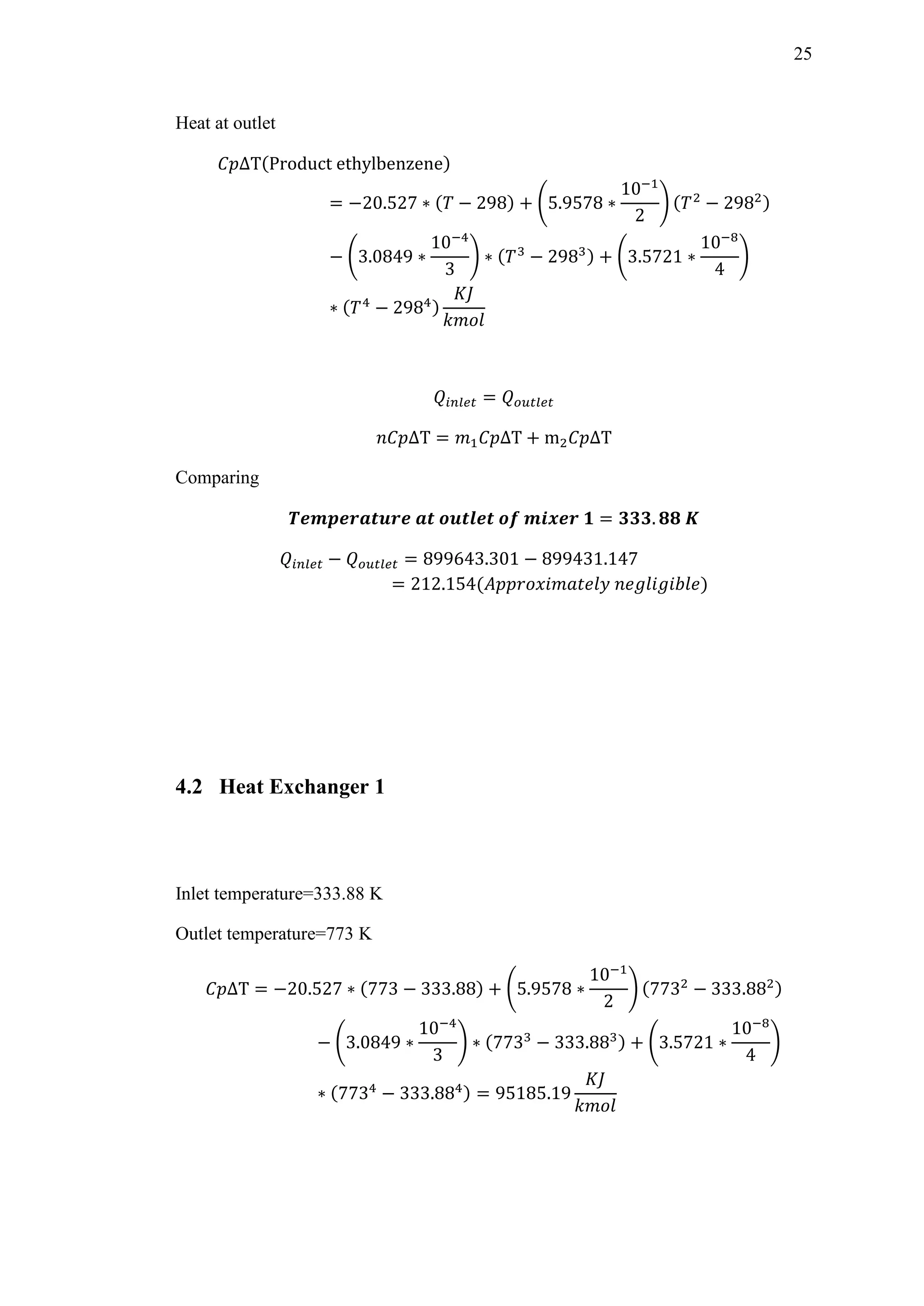
Heat at outlet
𝐶𝑝ΔT(Product ethylbenzene)
= −20.527 ∗ (𝑇 − 298) + (5.9578 ∗
10−1
2
) (𝑇2
− 2982)
− (3.0849 ∗
10−4
3
) ∗ (𝑇3
− 2983) + (3.5721 ∗
10−8
4
)
∗ (𝑇4
− 2984)
𝐾𝐽
𝑘𝑚𝑜𝑙
𝑄𝑖𝑛𝑙𝑒𝑡 = 𝑄 𝑜𝑢𝑡𝑙𝑒𝑡
𝑛𝐶𝑝ΔT = 𝑚1 𝐶𝑝ΔT + m2 𝐶𝑝ΔT
Comparing
𝑻𝒆𝒎𝒑𝒆𝒓𝒂𝒕𝒖𝒓𝒆 𝒂𝒕 𝒐𝒖𝒕𝒍𝒆𝒕 𝒐𝒇 𝒎𝒊𝒙𝒆𝒓 𝟏 = 𝟑𝟑𝟑. 𝟖𝟖 𝑲
𝑄𝑖𝑛𝑙𝑒𝑡 − 𝑄 𝑜𝑢𝑡𝑙𝑒𝑡 = 899643.301 − 899431.147
= 212.154(𝐴𝑝𝑝𝑟𝑜𝑥𝑖𝑚𝑎𝑡𝑒𝑙𝑦 𝑛𝑒𝑔𝑙𝑖𝑔𝑖𝑏𝑙𝑒)
4.2 Heat Exchanger 1
Inlet temperature=333.88 K
Outlet temperature=773 K
𝐶𝑝ΔT = −20.527 ∗ (773 − 333.88) + (5.9578 ∗
10−1
2
) (7732
− 333.882)
− (3.0849 ∗
10−4
3
) ∗ (7733
− 333.883) + (3.5721 ∗
10−8
4
)
∗ (7734
− 333.884) = 95185.19
𝐾𝐽
𝑘𝑚𝑜𝑙
26
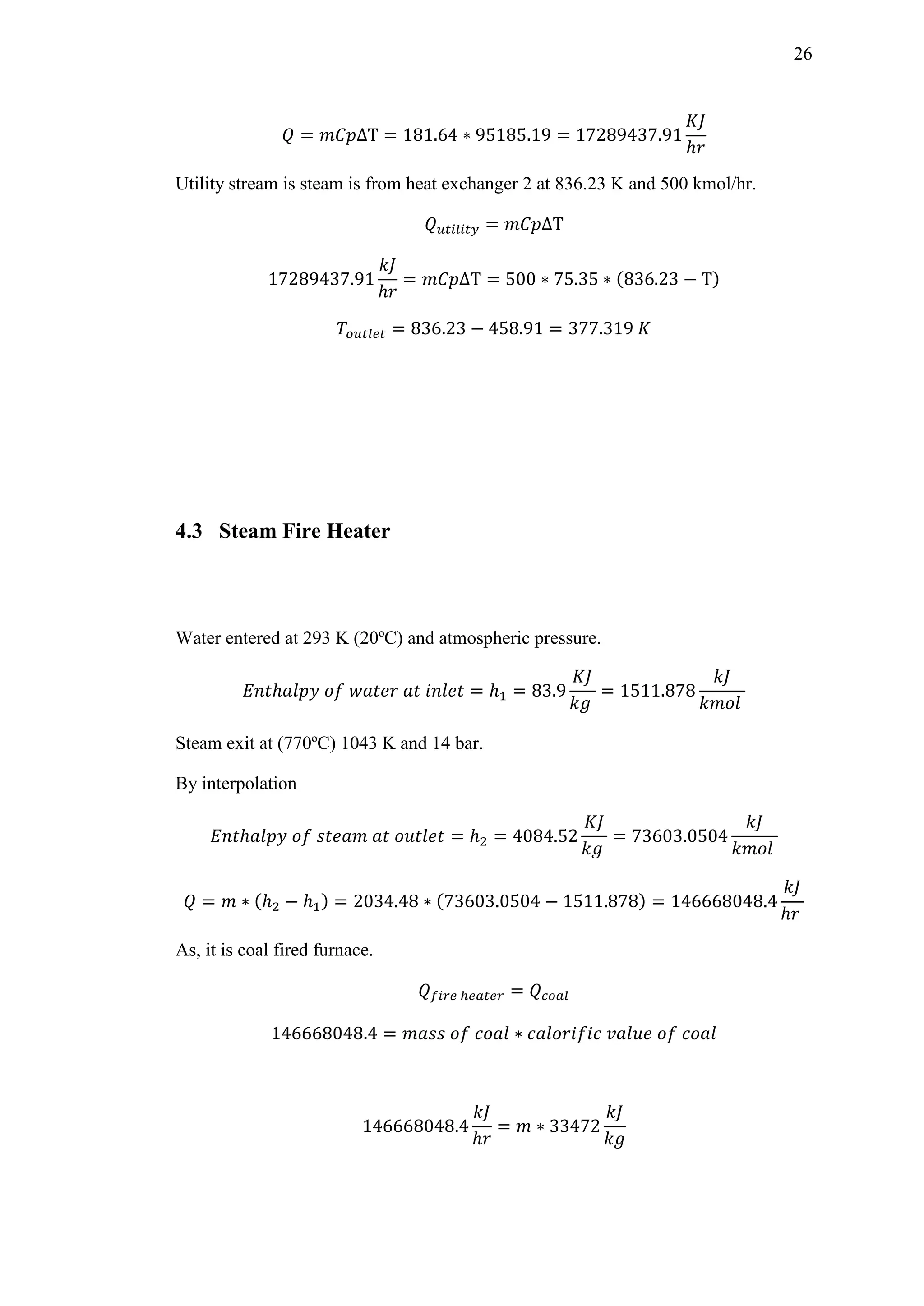
𝑄 = 𝑚𝐶𝑝ΔT = 181.64 ∗ 95185.19 = 17289437.91
𝐾𝐽
ℎ𝑟
Utility stream is steam is from heat exchanger 2 at 836.23 K and 500 kmol/hr.
𝑄 𝑢𝑡𝑖𝑙𝑖𝑡𝑦 = 𝑚𝐶𝑝ΔT
17289437.91
𝑘𝐽
ℎ𝑟
= 𝑚𝐶𝑝ΔT = 500 ∗ 75.35 ∗ (836.23 − T)
𝑇𝑜𝑢𝑡𝑙𝑒𝑡 = 836.23 − 458.91 = 377.319 𝐾
4.3 Steam Fire Heater
Water entered at 293 K (20ºC) and atmospheric pressure.
𝐸𝑛𝑡ℎ𝑎𝑙𝑝𝑦 𝑜𝑓 𝑤𝑎𝑡𝑒𝑟 𝑎𝑡 𝑖𝑛𝑙𝑒𝑡 = ℎ1 = 83.9
𝐾𝐽
𝑘𝑔
= 1511.878
𝑘𝐽
𝑘𝑚𝑜𝑙
Steam exit at (770ºC) 1043 K and 14 bar.
By interpolation
𝐸𝑛𝑡ℎ𝑎𝑙𝑝𝑦 𝑜𝑓 𝑠𝑡𝑒𝑎𝑚 𝑎𝑡 𝑜𝑢𝑡𝑙𝑒𝑡 = ℎ2 = 4084.52
𝐾𝐽
𝑘𝑔
= 73603.0504
𝑘𝐽
𝑘𝑚𝑜𝑙
𝑄 = 𝑚 ∗ (ℎ2 − ℎ1) = 2034.48 ∗ (73603.0504 − 1511.878) = 146668048.4
𝑘𝐽
ℎ𝑟
As, it is coal fired furnace.
𝑄 𝑓𝑖𝑟𝑒 ℎ𝑒𝑎𝑡𝑒𝑟 = 𝑄 𝑐𝑜𝑎𝑙
146668048.4 = 𝑚𝑎𝑠𝑠 𝑜𝑓 𝑐𝑜𝑎𝑙 ∗ 𝑐𝑎𝑙𝑜𝑟𝑖𝑓𝑖𝑐 𝑣𝑎𝑙𝑢𝑒 𝑜𝑓 𝑐𝑜𝑎𝑙
146668048.4
𝑘𝐽
ℎ𝑟
= 𝑚 ∗ 33472
𝑘𝐽
𝑘𝑔
27
𝑀𝑎𝑠𝑠 𝑜𝑓 𝑐𝑜𝑎𝑙 𝑟𝑒𝑞𝑢𝑖𝑟𝑒𝑑 = 4381.813
𝑘𝑔
ℎ𝑟
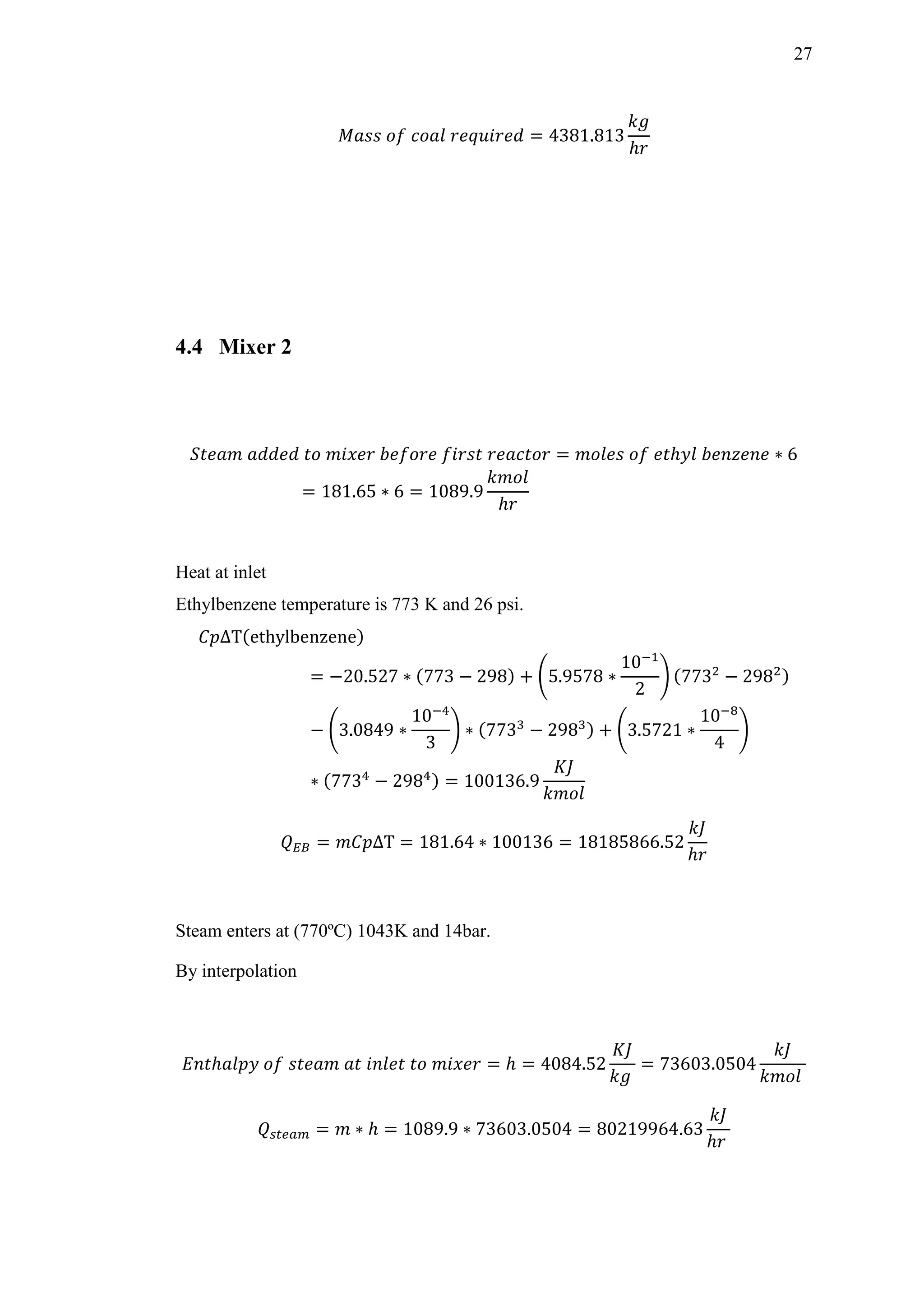
4.4 Mixer 2
𝑆𝑡𝑒𝑎𝑚 𝑎𝑑𝑑𝑒𝑑 𝑡𝑜 𝑚𝑖𝑥𝑒𝑟 𝑏𝑒𝑓𝑜𝑟𝑒 𝑓𝑖𝑟𝑠𝑡 𝑟𝑒𝑎𝑐𝑡𝑜𝑟 = 𝑚𝑜𝑙𝑒𝑠 𝑜𝑓 𝑒𝑡ℎ𝑦𝑙 𝑏𝑒𝑛𝑧𝑒𝑛𝑒 ∗ 6
= 181.65 ∗ 6 = 1089.9
𝑘𝑚𝑜𝑙
ℎ𝑟
Heat at inlet
Ethylbenzene temperature is 773 K and 26 psi.
𝐶𝑝ΔT(ethylbenzene)
= −20.527 ∗ (773 − 298) + (5.9578 ∗
10−1
2
) (7732
− 2982)
− (3.0849 ∗
10−4
3
) ∗ (7733
− 2983) + (3.5721 ∗
10−8
4
)
∗ (7734
− 2984) = 100136.9
𝐾𝐽
𝑘𝑚𝑜𝑙
𝑄 𝐸𝐵 = 𝑚𝐶𝑝ΔT = 181.64 ∗ 100136 = 18185866.52
𝑘𝐽
ℎ𝑟
Steam enters at (770ºC) 1043K and 14bar.
By interpolation
𝐸𝑛𝑡ℎ𝑎𝑙𝑝𝑦 𝑜𝑓 𝑠𝑡𝑒𝑎𝑚 𝑎𝑡 𝑖𝑛𝑙𝑒𝑡 𝑡𝑜 𝑚𝑖𝑥𝑒𝑟 = ℎ = 4084.52
𝐾𝐽
𝑘𝑔
= 73603.0504
𝑘𝐽
𝑘𝑚𝑜𝑙
𝑄𝑠𝑡𝑒𝑎𝑚 = 𝑚 ∗ ℎ = 1089.9 ∗ 73603.0504 = 80219964.63
𝑘𝐽
ℎ𝑟
28
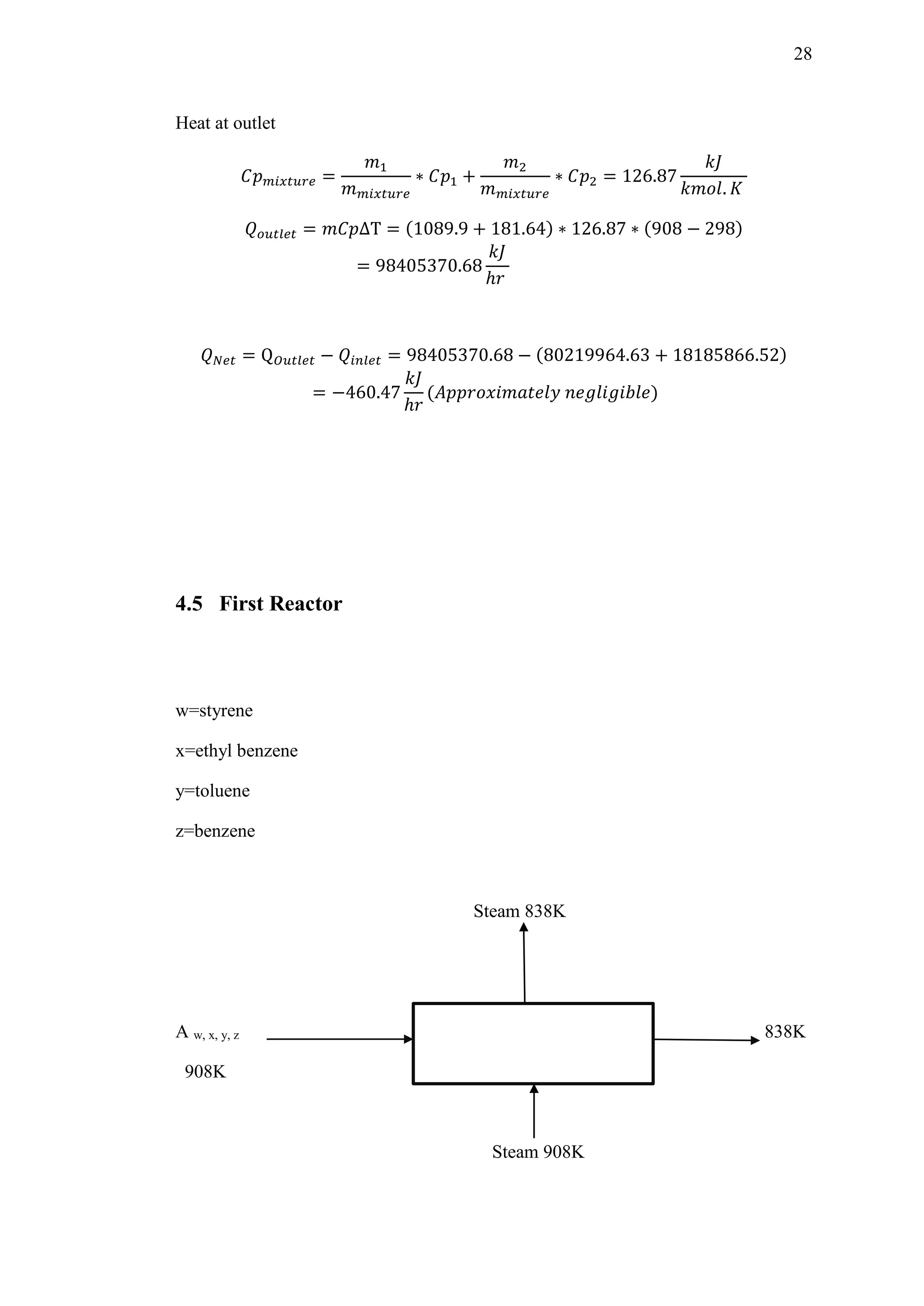
Heat at outlet
𝐶𝑝 𝑚𝑖𝑥𝑡𝑢𝑟𝑒 =
𝑚1
𝑚 𝑚𝑖𝑥𝑡𝑢𝑟𝑒
∗ 𝐶𝑝1 +
𝑚2
𝑚 𝑚𝑖𝑥𝑡𝑢𝑟𝑒
∗ 𝐶𝑝2 = 126.87
𝑘𝐽
𝑘𝑚𝑜𝑙. 𝐾
𝑄 𝑜𝑢𝑡𝑙𝑒𝑡 = 𝑚𝐶𝑝ΔT = (1089.9 + 181.64) ∗ 126.87 ∗ (908 − 298)
= 98405370.68
𝑘𝐽
ℎ𝑟
𝑄 𝑁𝑒𝑡 = Q 𝑂𝑢𝑡𝑙𝑒𝑡 − 𝑄𝑖𝑛𝑙𝑒𝑡 = 98405370.68 − (80219964.63 + 18185866.52)
= −460.47
𝑘𝐽
ℎ𝑟
(𝐴𝑝𝑝𝑟𝑜𝑥𝑖𝑚𝑎𝑡𝑒𝑙𝑦 𝑛𝑒𝑔𝑙𝑖𝑔𝑖𝑏𝑙𝑒)
4.5 First Reactor
w=styrene
x=ethyl benzene
y=toluene
z=benzene
Steam 838K
A w, x, y, z B u, w, x, y, z 838K
908K
Steam 908K
29
4.5.1 Inlet of Reactor 1
𝐶𝑝ΔT(ethylbenzene)
= −20.527 ∗ (908 − 298) + (5.9578 ∗
10−1
2
) (9082
− 2982)
− (3.0849 ∗
10−4
3
) ∗ (9083
− 2983) + (3.5721 ∗
10−8
4
)
∗ (9084
− 2984) = 138365.46
𝐾𝐽
𝑘𝑚𝑜𝑙
𝐶𝑝ΔT(styrene)
= 77.201 ∗ (908 − 298) + (5.67 ∗
10−2
2
) (9082
− 2982)
+ (6.4793 ∗
10−4
3
) ∗ (9083
− 2983) − (6.987 ∗
10−7
4
)
∗ (9084
− 2984) = 106559.83
𝐾𝐽
𝑘𝑚𝑜𝑙
𝐶𝑝ΔT(hydrogen)
= 25.399 ∗ (908 − 298) + (2.0178 ∗
10−2
2
) ∗ (9082
− 2982)
− (3.8549 ∗
10−5
3
) ∗ (9083
− 2983) + (3.1880 ∗ 10−8
/4)
∗ (9084
− 2984) = 18990.76
𝐾𝐽
𝑘𝑚𝑜𝑙
𝐶𝑝ΔT(benzene)
= −31.368 ∗ (908 − 298) + (4.7460 ∗
10−1
2
) ∗ (9082
− 2982)
− (3.1137 ∗
10−4
3
) ∗ (9083
− 2983) + (8.5237 ∗ 10−8
/4)
∗ (9084
− 2984) = 94802.439
𝐾𝐽
𝑘𝑚𝑜𝑙
30
𝐶𝑝ΔT(ethylene)
= 32.083 ∗ (908 − 298) − (1.4831 ∗
10−2
2
) ∗ (9082
− 2982)
+ (2.4774 ∗
10−4
3
) ∗ (9083
− 2983) − (2.3766 ∗
10−7
4
)
∗ (9084
− 2984) = 33832.2
𝐾𝐽
𝑘𝑚𝑜𝑙
𝐶𝑝ΔT(toluene)
= −24.097 ∗ (908 − 298) + (5.2187 ∗
10−1
2
) ∗ (9082
− 2982)
− (2.9827 ∗
10−4
3
) ∗ (9083
− 2983) + (6.1220 ∗
10−8
4
)
∗ (9084
− 2984) = 115744.47
𝐾𝐽
𝑘𝑚𝑜𝑙
𝐶𝑝ΔT(methane)
= 34.942 ∗ (908 − 298) − (3.9957 ∗
10−2
2
) ∗ (9082
− 2982)
+ (1.9184 ∗
10−4
3
) ∗ (9083
− 2983) − (1.5303 ∗ 10−7
/4)
∗ (9084
− 2984) = 27092.82
𝐾𝐽
𝑘𝑚𝑜𝑙
𝑄 𝐸𝐵 = 𝑚𝐶𝑝ΔT = 181.64 ∗ 138365.46 = 25132702.15
𝑘𝐽
ℎ𝑟
𝑄𝑠𝑡𝑦𝑟𝑒𝑛𝑒 = 𝑚𝐶𝑝ΔT = 0.0014 ∗ 106559.83 = 143.183
𝑘𝐽
ℎ𝑟
𝑄 𝑏𝑒𝑛𝑧𝑒𝑛𝑒 = 𝑚𝐶𝑝ΔT = 0.55 ∗ 94802.439 = 52141.34
𝑘𝐽
ℎ𝑟
𝑄𝑡𝑜𝑙𝑢𝑒𝑛𝑒 = 𝑚𝐶𝑝ΔT = 0.37 ∗ 115744.47 = 42825.45
𝑘𝐽
ℎ𝑟
𝑄ℎ𝑦𝑑𝑟𝑜𝑔𝑒𝑛 = 𝑚𝐶𝑝ΔT = 0.0014 ∗ 18990.76 = 26.58
𝑘𝐽
ℎ𝑟
𝑄 𝑚𝑒𝑡ℎ𝑎𝑛𝑒 = 𝑚𝐶𝑝ΔT = 0.37 ∗ 27092.82 = 10024.34
𝑘𝐽
ℎ𝑟
𝑄 𝑒𝑡ℎ𝑦𝑙𝑒𝑛𝑒 = 𝑚𝐶𝑝ΔT = 0.55 ∗ 33832.2 = 18607.71
𝑘𝐽
ℎ𝑟
31
𝑻𝒐𝒕𝒂𝒍 𝒉𝒆𝒂𝒕 𝒂𝒕 𝒊𝒏𝒍𝒆𝒕 𝒐𝒇 𝑹𝒆𝒂𝒄𝒕𝒐𝒓 𝟏 = 𝟐𝟓𝟐𝟓𝟔𝟒𝟕𝟎. 𝟕𝟓
𝒌𝑱
𝒉𝒓
4.5.2 Outlet of Reactor 1
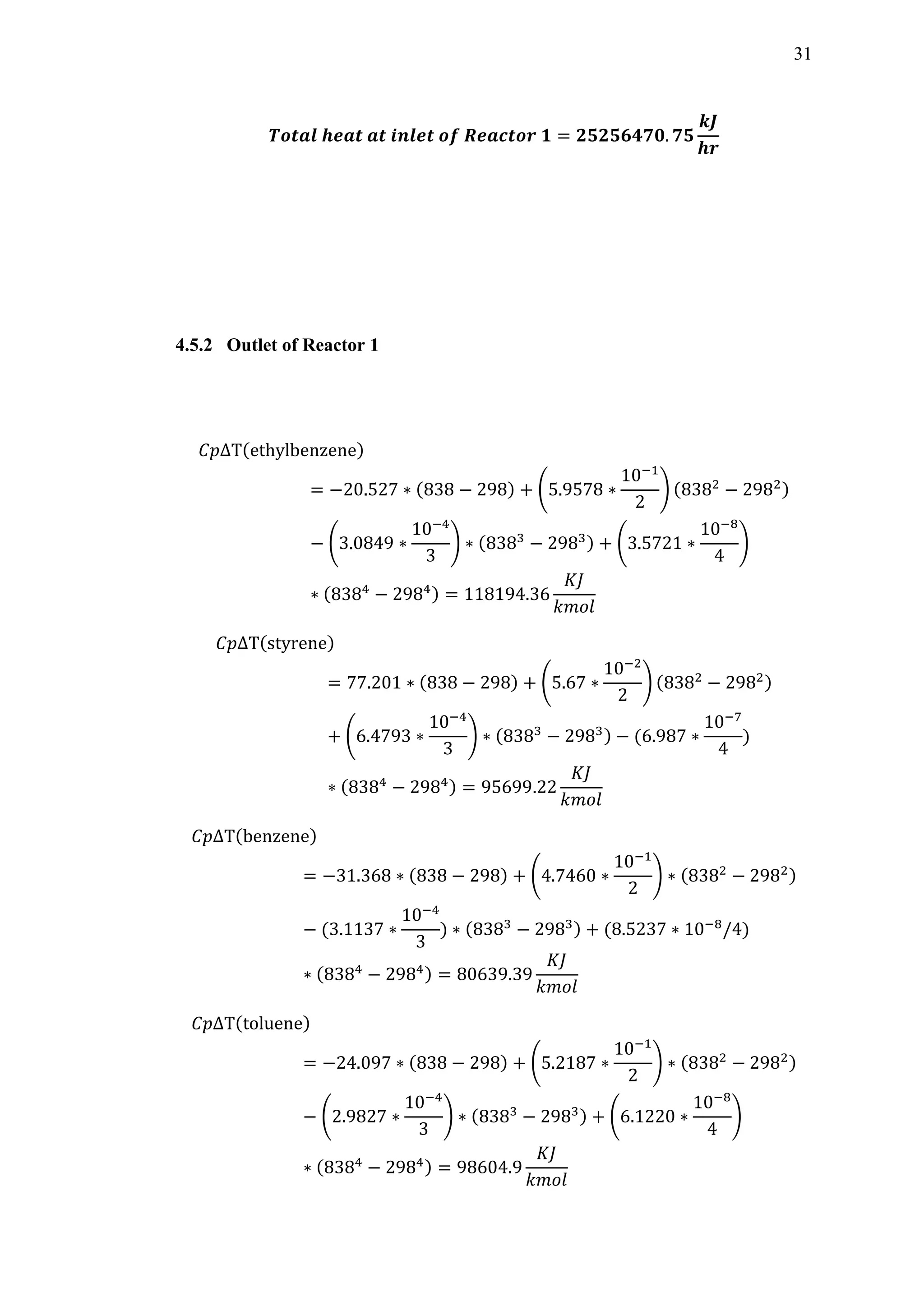
𝐶𝑝ΔT(ethylbenzene)
= −20.527 ∗ (838 − 298) + (5.9578 ∗
10−1
2
) (8382
− 2982)
− (3.0849 ∗
10−4
3
) ∗ (8383
− 2983) + (3.5721 ∗
10−8
4
)
∗ (8384
− 2984) = 118194.36
𝐾𝐽
𝑘𝑚𝑜𝑙
𝐶𝑝ΔT(styrene)
= 77.201 ∗ (838 − 298) + (5.67 ∗
10−2
2
) (8382
− 2982)
+ (6.4793 ∗
10−4
3
) ∗ (8383
− 2983) − (6.987 ∗
10−7
4
)
∗ (8384
− 2984) = 95699.22
𝐾𝐽
𝑘𝑚𝑜𝑙
𝐶𝑝ΔT(benzene)
= −31.368 ∗ (838 − 298) + (4.7460 ∗
10−1
2
) ∗ (8382
− 2982)
− (3.1137 ∗
10−4
3
) ∗ (8383
− 2983) + (8.5237 ∗ 10−8
/4)
∗ (8384
− 2984) = 80639.39
𝐾𝐽
𝑘𝑚𝑜𝑙
𝐶𝑝ΔT(toluene)
= −24.097 ∗ (838 − 298) + (5.2187 ∗
10−1
2
) ∗ (8382
− 2982)
− (2.9827 ∗
10−4
3
) ∗ (8383
− 2983) + (6.1220 ∗
10−8
4
)
∗ (8384
− 2984) = 98604.9
𝐾𝐽
𝑘𝑚𝑜𝑙
32
𝐶𝑝ΔT(hydrogen)
= 25.399 ∗ (838 − 298) + (2.0178 ∗
10−2
2
) ∗ (8382
− 2982)
− (3.8549 ∗
10−5
3
) ∗ (8383
− 2983) + (3.1880 ∗ 10−8
/4)
∗ (8384
− 2984) = 16550.25
𝐾𝐽
𝑘𝑚𝑜𝑙
𝐶𝑝ΔT(ethylene)
= 32.083 ∗ (838 − 298) − (1.4831 ∗
10−2
2
) ∗ (8382
− 2982)
+ (2.4774 ∗
10−4
3
) ∗ (8383
− 2983) − (2.3766 ∗
10−7
4
)
∗ (8384
− 2984) = 30355
𝐾𝐽
𝑘𝑚𝑜𝑙
𝐶𝑝ΔT(methane)
= 34.942 ∗ (838 − 298) − (3.9957 ∗
10−2
2
) ∗ (8382
− 2982)
+ (1.9184 ∗
10−4
3
) ∗ (8383
− 2983) − (1.5303 ∗ 10−7
/4)
∗ (8384
− 2984) = 23987
𝐾𝐽
𝑘𝑚𝑜𝑙
𝑄 𝐸𝐵 = 𝑚𝐶𝑝ΔT = 60.81 ∗ 118194.36 = 7187399.032
𝑘𝐽
ℎ𝑟
𝑄𝑠𝑡𝑦𝑟𝑒𝑛𝑒 = 𝑚𝐶𝑝ΔT = 112.17 ∗ 95699.22 = 10734581.51
𝑘𝐽
ℎ𝑟
𝑄 𝑏𝑒𝑛𝑧𝑒𝑛𝑒 = 𝑚𝐶𝑝ΔT = 3.61 ∗ 80639.39 = 291106.8
𝑘𝐽
ℎ𝑟
𝑄𝑡𝑜𝑙𝑢𝑒𝑛𝑒 = 𝑚𝐶𝑝ΔT = 2.41 ∗ 98604.9 = 23637.8
𝑘𝐽
ℎ𝑟
𝑄 𝑒𝑡ℎ𝑦𝑙𝑒𝑛𝑒 = 𝑚𝐶𝑝ΔT = 3.61 ∗ 30355 = 109581.55
𝑘𝐽
ℎ𝑟
𝑄 𝑚𝑒𝑡ℎ𝑎𝑛𝑒 = 𝑚𝐶𝑝ΔT = 2.41 ∗ 23987 = 57808.67
𝑘𝐽
ℎ𝑟
33
𝑄ℎ𝑦𝑑𝑟𝑜𝑔𝑒𝑛 = 𝑚𝐶𝑝ΔT = 107.35 ∗ 16550.25 = 1776669.338
𝑘𝐽
ℎ𝑟
𝑻𝒐𝒕𝒂𝒍 𝒉𝒆𝒂𝒕 𝒂𝒕 𝒐𝒖𝒕𝒍𝒆𝒕 𝒐𝒇 𝑹𝒆𝒂𝒄𝒕𝒐𝒓 𝟏 = 𝟐𝟎𝟏𝟖𝟎𝟕𝟖𝟒. 𝟕
𝑲𝑱
𝒉𝒓
𝐻𝑒𝑎𝑡 𝑜𝑓 𝑟𝑒𝑎𝑐𝑡𝑖𝑜𝑛
= 𝐻𝑒𝑎𝑡 𝑜𝑓 𝑓𝑜𝑟𝑚𝑎𝑡𝑖𝑜 𝑜𝑓 𝑠𝑡𝑦𝑟𝑒𝑛𝑒
+ ℎ𝑒𝑎𝑡 𝑜𝑓 𝑓𝑜𝑟𝑚𝑎𝑡𝑖𝑜𝑛 𝑜𝑓 ℎ𝑦𝑑𝑟𝑜𝑔𝑒𝑛
− ℎ𝑒𝑎𝑡 𝑜𝑓 𝑓𝑜𝑟𝑚𝑎𝑡𝑖𝑜𝑛 𝑜𝑓 𝑒𝑡ℎ𝑦𝑙𝑏𝑒𝑛𝑧𝑒𝑛𝑒
= 125.77 ∗ 60400 + 0 − 2.1854 ∗ 121240 = 7331550.1
𝐾𝐽
ℎ𝑟
Q = ∑Heat of product − ∑Heat of reactant + ∑Heat of reaction
𝑄 = 20180784.7 − 25256470.75 + 7331550.1 = 2255864
𝐾𝐽
ℎ𝑟
(Endothermic
reaction).
4.6 Second Reactor
Steam 843K
A w, x, y, z B u, w, x, y, z
908K 843K
Steam 908K
34
4.6.1 Inlet of Reactor 2
𝐶𝑝ΔT(ethylbenzene)
= −20.527 ∗ (908 − 298) + (5.9578 ∗
10−1
2
) (9082
− 2982)
− (3.0849 ∗
10−4
3
) ∗ (9083
− 2983) + (3.5721 ∗
10−8
4
)
∗ (9084
− 2984) = 138365.46
𝐾𝐽
𝑘𝑚𝑜𝑙
𝐶𝑝ΔT(styrene)
= 77.201 ∗ (908 − 298) + (5.67 ∗
10−2
2
) (9082
− 2982)
+ (6.4793 ∗
10−4
3
) ∗ (9083
− 2983) − (6.987 ∗
10−7
4
)
∗ (9084
− 2984) = 106559.83
𝐾𝐽
𝑘𝑚𝑜𝑙
𝐶𝑝ΔT(hydrogen)
= 25.399 ∗ (908 − 298) + (2.0178 ∗
10−2
2
) ∗ (9082
− 2982)
− (3.8549 ∗
10−5
3
) ∗ (9083
− 2983) + (3.1880 ∗ 10−8
/4)
∗ (9084
− 2984) = 18990.76
𝐾𝐽
𝑘𝑚𝑜𝑙
𝐶𝑝ΔT(benzene)
= −31.368 ∗ (908 − 298) + (4.7460 ∗
10−1
2
) ∗ (9082
− 2982)
− (3.1137 ∗
10−4
3
) ∗ (9083
− 2983) + (8.5237 ∗ 10−8
/4)
∗ (9084
− 2984) = 94802.439
𝐾𝐽
𝑘𝑚𝑜𝑙
35
𝐶𝑝ΔT(ethylene)
= 32.083 ∗ (908 − 298) − (1.4831 ∗
10−2
2
) ∗ (9082
− 2982)
+ (2.4774 ∗
10−4
3
) ∗ (9083
− 2983) − (2.3766 ∗
10−7
4
)
∗ (9084
− 2984) = 33832.2
𝐾𝐽
𝑘𝑚𝑜𝑙
𝐶𝑝ΔT(toluene)
= −24.097 ∗ (908 − 298) + (5.2187 ∗
10−1
2
) ∗ (9082
− 2982)
− (2.9827 ∗
10−4
3
) ∗ (9083
− 2983) + (6.1220 ∗
10−8
4
)
∗ (9084
− 2984) = 115744.47
𝐾𝐽
𝑘𝑚𝑜𝑙
𝐶𝑝ΔT(methane)
= 34.942 ∗ (908 − 298) − (3.9957 ∗
10−2
2
) ∗ (9082
− 2982)
+ (1.9184 ∗
10−4
3
) ∗ (9083
− 2983) − (1.5303 ∗ 10−7
/4)
∗ (9084
− 2984) = 27092.82
𝐾𝐽
𝑘𝑚𝑜𝑙
𝑄 𝐸𝐵 = 𝑚𝐶𝑝ΔT = 116.58 ∗ 138365.46 = 16130654.5
𝑘𝐽
ℎ𝑟
𝑄𝑠𝑡𝑦𝑟𝑒𝑛𝑒 = 𝑚𝐶𝑝ΔT = 60.40 ∗ 106559.83 = 6436213.7
𝑘𝐽
ℎ𝑟
𝑄 𝑏𝑒𝑛𝑧𝑒𝑛𝑒 = 𝑚𝐶𝑝ΔT = 1.75 ∗ 94802.439 = 165904.26
𝑘𝐽
ℎ𝑟
𝑄𝑡𝑜𝑙𝑢𝑒𝑛𝑒 = 𝑚𝐶𝑝ΔT = 1.17 ∗ 115744.47 = 135421.03
𝑘𝐽
ℎ𝑟
𝑄ℎ𝑦𝑑𝑟𝑜𝑔𝑒𝑛 = 𝑚𝐶𝑝ΔT = 58.04 ∗ 18990.76 = 1102223.71
𝑘𝐽
ℎ𝑟
𝑄 𝑚𝑒𝑡ℎ𝑎𝑛𝑒 = 𝑚𝐶𝑝ΔT = 1.17 ∗ 27092.82 = 31698.599
𝑘𝐽
ℎ𝑟
𝑄 𝑒𝑡ℎ𝑦𝑙𝑒𝑛𝑒 = 𝑚𝐶𝑝ΔT = 1.75 ∗ 33832.2 = 59206.35
𝑘𝐽
ℎ𝑟
36
𝑻𝒐𝒕𝒂𝒍 𝒉𝒆𝒂𝒕 𝒂𝒕 𝒊𝒏𝒍𝒆𝒕 𝒐𝒇 𝑹𝒆𝒂𝒄𝒕𝒐𝒓 = 𝟐𝟒𝟎𝟔𝟏𝟑𝟐𝟐. 𝟏𝟖
𝑲𝑱
𝒉𝒓
4.6.2 Outlet of Reactor 2
𝐶𝑝ΔT(ethylbenzene)
= −20.527 ∗ (843 − 298) + (5.9578 ∗
10−1
2
) (8432
− 2982)
− (3.0849 ∗
10−4
3
) ∗ (8433
− 2983) + (3.5721 ∗
10−8
4
)
∗ (8434
− 2984) = 119611.9
𝐾𝐽
𝑘𝑚𝑜𝑙
𝐶𝑝ΔT(styrene)
= 77.201 ∗ (843 − 298) + (5.67 ∗
10−2
2
) (8432
− 2982)
+ (6.4793 ∗
10−4
3
) ∗ (8433
− 2983) − (6.987 ∗
10−7
4
)
∗ (8434
− 2984) = 96537.8
𝐾𝐽
𝑘𝑚𝑜𝑙
𝐶𝑝ΔT(benzene)
= −31.368 ∗ (843 − 298) + (4.7460 ∗
10−1
2
) ∗ (8432
− 2982)
− (3.1137 ∗
10−4
3
) ∗ (8433
− 2983) + (8.5237 ∗ 10−8
/4)
∗ (8434
− 2984) = 81630.3
𝐾𝐽
𝑘𝑚𝑜𝑙
𝐶𝑝ΔT(toluene)
= −24.097 ∗ (843 − 298) + (5.2187 ∗
10−1
2
) ∗ (8432
− 2982)
− (2.9827 ∗
10−4
3
) ∗ (8433
− 2983) + (6.1220 ∗
10−8
4
)
∗ (8434
− 2984) = 99805.77
𝐾𝐽
𝑘𝑚𝑜𝑙
37
𝐶𝑝ΔT(hydrogen)
= 25.399 ∗ (843 − 298) + (2.0178 ∗
10−2
2
) ∗ (8432
− 2982)
− (3.8549 ∗
10−5
3
) ∗ (8433
− 2983) + (3.1880 ∗ 10−8
/4)
∗ (8434
− 2984) = 16720
𝐾𝐽
𝑘𝑚𝑜𝑙
𝐶𝑝ΔT(ethylene)
= 32.083 ∗ (843 − 298) − (1.4831 ∗
10−2
2
) ∗ (8432
− 2982)
+ (2.4774 ∗
10−4
3
) ∗ (8433
− 2983) − (2.3766 ∗
10−7
4
)
∗ (8434
− 2984) = 30623
𝐾𝐽
𝑘𝑚𝑜𝑙
𝐶𝑝ΔT(methane)
= 34.942 ∗ (843 − 298) − (3.9957 ∗
10−2
2
) ∗ (8432
− 2982)
+ (1.9184 ∗
10−4
3
) ∗ (8433
− 2983) − (1.5303 ∗ 10−7
/4)
∗ (8434
− 2984) = 24217
𝐾𝐽
𝑘𝑚𝑜𝑙
Outlet
𝑄 𝐸𝐵 = 𝑚𝐶𝑝ΔT = 60.81 ∗ 119611.9 = 7273599.64
𝑘𝐽
ℎ𝑟
𝑄𝑠𝑡𝑦𝑟𝑒𝑛𝑒 = 𝑚𝐶𝑝ΔT = 112.17 ∗ 96537.8 = 10828645.03
𝑘𝐽
ℎ𝑟
𝑄 𝑏𝑒𝑛𝑧𝑒𝑛𝑒 = 𝑚𝐶𝑝ΔT = 3.61 ∗ 81630.3 = 294685.38
𝑘𝐽
ℎ𝑟
𝑄𝑡𝑜𝑙𝑢𝑒𝑛𝑒 = 𝑚𝐶𝑝ΔT = 2.41 ∗ 99805.77 = 240531.90
𝑘𝐽
ℎ𝑟
𝑄 𝑒𝑡ℎ𝑦𝑙𝑒𝑛𝑒 = 𝑚𝐶𝑝ΔT = 3.61 ∗ 30623 = 110549.03
𝑘𝐽
ℎ𝑟
38
𝑄 𝑚𝑒𝑡ℎ𝑎𝑛𝑒 = 𝑚𝐶𝑝ΔT = 2.41 ∗ 24217 = 58362.97
𝑘𝐽
ℎ𝑟
𝑄ℎ𝑦𝑑𝑟𝑜𝑔𝑒𝑛 = 𝑚𝐶𝑝ΔT = 107.35 ∗ 16720 = 1794892
𝑘𝐽
ℎ𝑟
𝑻𝒐𝒕𝒂𝒍 𝒉𝒆𝒂𝒕 𝒂𝒕 𝒐𝒖𝒕𝒍𝒆𝒕 𝒐𝒇 𝑹𝒆𝒂𝒄𝒕𝒐𝒓 𝟐 = 𝟐𝟎𝟔𝟎𝟏𝟐𝟔𝟓. 𝟗𝟓
𝒌𝑱
𝒉𝒓
𝑸 = 𝑯𝒆𝒂𝒕 𝒐𝒇 𝒑𝒓𝒐𝒅𝒖𝒄𝒕 − 𝒉𝒆𝒂𝒕 𝒐𝒇 𝒓𝒆𝒂𝒄𝒕𝒂𝒏𝒕 + 𝒉𝒆𝒂𝒕 𝒐𝒇 𝒓𝒆𝒂𝒄𝒕𝒊𝒐𝒏
= 𝟐𝟎𝟔𝟎𝟏𝟐𝟔𝟓. 𝟗𝟓 − 𝟐𝟒𝟎𝟔𝟏𝟑𝟐𝟐. 𝟏𝟖 + 𝟕𝟑𝟑𝟏𝟓𝟓𝟎. 𝟏
= 𝟑𝟖𝟕𝟏𝟒𝟗𝟑. 𝟖𝟔𝟗
𝒌𝑱
𝒉𝒓
(𝑬𝒏𝒅𝒐𝒕𝒉𝒆𝒓𝒎𝒊𝒄 𝑹𝒆𝒂𝒄𝒕𝒊𝒐𝒏)
4.7 Heat Exchanger 2
Inlet stream temperature is 843K.
Outlet stream temperature is 673K.
Heat capacity of a mixture is calculated as:
𝐶𝑝 𝑚𝑖𝑥𝑡𝑢𝑟𝑒 =
𝑚1
𝑚 𝑚𝑖𝑥𝑡𝑢𝑟𝑒
∗ 𝐶𝑝1 +
𝑚2
𝑚 𝑚𝑖𝑥𝑡𝑢𝑟𝑒
∗ 𝐶𝑝2 +
𝑚3
𝑚 𝑚𝑖𝑥𝑡𝑢𝑟𝑒
∗ 𝐶𝑝3 + ⋯
𝐶𝑝 𝑚𝑖𝑥𝑡𝑢𝑟𝑒 = 0.9278 ∗ 39.59 + 0.0508 ∗ 185.382 + 0.028 ∗ 183.2
= 51.278
𝑘𝐽
𝑘𝑚𝑜𝑙. 𝐾
𝑄 = 𝑚𝐶𝑝ΔT = 2326.4 ∗ 51.278 ∗ (843 − 673) = 20280073.96
𝑘𝐽
ℎ𝑟
Utility stream is boiler feed water at 25°C 500 kmol/hr.
𝑄 𝑢𝑡𝑖𝑙𝑖𝑡𝑦 = 𝑚𝐶𝑝ΔT
39
20280073.96
𝑘𝐽
ℎ𝑟
= 𝑚𝐶𝑝ΔT = 500 ∗ 75.35 ∗ (Toutlet − 298)
𝑇𝑜𝑢𝑡𝑙𝑒𝑡 = 538.29 + 298 = 836.23 𝐾
4.8 Heat Exchanger 3
Inlet stream temperature is 673K.
Outlet stream temperature is 493K.
𝐶𝑝 𝑚𝑖𝑥𝑡𝑢𝑟𝑒 = 17.734
𝑘𝐽
𝑘𝑚𝑜𝑙. 𝐾
𝑄 = 𝑚𝐶𝑝ΔT = 2326.4 ∗ 17.734 ∗ (673 − 493) = 7426147.968
𝑘𝐽
ℎ𝑟
4.8 Heat Exchanger 4
Inlet stream temperature is 493K.
Outlet stream temperature is 293K.
𝐶𝑝 𝑚𝑖𝑥𝑡𝑢𝑟𝑒 = 17.734
𝑘𝐽
𝑘𝑚𝑜𝑙. 𝐾
40
𝑄 = 𝑚𝐶𝑝ΔT = 2326.4 ∗ 17.734 ∗ (493 − 293) = 8251275.52
𝑘𝐽
ℎ𝑟
Temperature is kept lower to avoid polymerization of styrene.
4.9 Distillation Column 1
𝑇𝑜𝑡𝑎𝑙 𝑚𝑜𝑙𝑒𝑠 𝑎𝑡 𝑖𝑛𝑙𝑒𝑡 = 𝐴 = 174.92
𝑘𝑚𝑜𝑙
ℎ𝑟
Feed temperature is 120ºC.
Top of column
𝑇𝑜𝑙𝑢𝑒𝑛𝑒 𝑎𝑡 𝑡𝑜𝑝 = 2.36
kmol
ℎ𝑟
𝐵𝑒𝑛𝑧𝑒𝑛𝑒 𝑎𝑡 𝑡𝑜𝑝 = 3.54
𝑘𝑚𝑜𝑙
ℎ𝑟
𝑄1 = 𝑚 ∗ 𝑙𝑎𝑡𝑒𝑛𝑡 ℎ𝑒𝑎𝑡 𝑜𝑓 𝑐𝑜𝑛𝑑𝑒𝑛𝑠𝑎𝑡𝑖𝑜𝑛 = 2.36 ∗ 0.03301 + 3.54 ∗ 0.0277
= 0.1759
𝑘𝐽
ℎ𝑟
Outlet temperature is 60ºC.
𝑄2 = 𝑚𝐶𝑝ΔT + mCpΔT
= 2.36 ∗ 157.2 ∗ (383.6 − 333) + 3.54 ∗ 31.35 ∗ (353 − 333)
= 20991.775
𝑘𝐽
ℎ𝑟
Bottom of column
𝐵𝑜𝑡𝑡𝑜𝑚 𝑝𝑟𝑜𝑑𝑢𝑐𝑡 = 169.02
𝑘𝑚𝑜𝑙
ℎ𝑟
41
𝑆𝑡𝑦𝑟𝑒𝑛𝑒 = 109.6
𝑘𝑚𝑜𝑙
ℎ𝑟
𝐸𝑡ℎ𝑦𝑙𝑏𝑒𝑛𝑧𝑒𝑛𝑒 = 59.42
𝑘𝑚𝑜𝑙
ℎ𝑟
𝐶𝑝(ethylbenzene) = 185.372
𝐾𝐽
𝑘𝑚𝑜𝑙
𝐶𝑝(styrene) = 183.2
𝐾𝐽
𝑘𝑚𝑜𝑙
𝑄 = 109.6 ∗ 183.2 ∗ (403 − 393) + 59.42 ∗ 185.372 ∗ (403 − 393)
= 310935.2424
𝑘𝐽
ℎ𝑟
4.10 Distillation Column 2
𝐸𝑡ℎ𝑦𝑙 𝑏𝑒𝑛𝑧𝑒𝑛𝑒 𝑎𝑡 𝑡𝑜𝑝 = 59.42
kmol
ℎ𝑟
𝑄 = 𝑚 ∗ 𝑙𝑎𝑡𝑒𝑛𝑡 ℎ𝑒𝑎𝑡 𝑜𝑓 𝑐𝑜𝑛𝑑𝑒𝑛𝑠𝑎𝑡𝑖𝑜𝑛 = 59.42 ∗ 0.40934 = 24.323
𝑘𝐽
ℎ𝑟
Outlet temperature is 130ºC.
𝑄2 = 𝑚𝐶𝑝ΔT = 59.42 ∗ 185.372 ∗ (409 − 403) = 66088.825
𝑘𝐽
ℎ𝑟
Bottom of column
𝑆𝑡𝑦𝑟𝑒𝑛𝑒 = 109.6
𝑘𝑚𝑜𝑙
ℎ𝑟
42
𝐶𝑝(styrene) = 183.2
𝐾𝐽
𝑘𝑚𝑜𝑙
𝑄 = 𝑚𝐶𝑝ΔT
𝑄 = 109.6 ∗ 183.2 ∗ (418 − 403) = 301180.8
𝑘𝐽
ℎ𝑟
43
CHAPTER 5
DESIGNING
5.1 Reactor Design
Styrene plant to be designed requires two adiabatic plug flow reactors with
axial flow to maximize conversion and minimize utility costs. The two reactors
operate at a pressure of 1.8 bar.
As fluid (gas)-solid heterogeneous reactions is taking place on the surface of
the catalyst which is potassium promoted iron oxide. So a packed bed reactor
(PBR).The reaction rate is based on mass of solid catalyst (W). Catalyst is placed in
reactor as packed bed because gas can easily diffuse through catalyst bed.
5.1.1 Reactor 1
Design equation
𝑊 = 𝐹𝐴𝑂 ∫ 𝑑𝑋/𝑟𝐴
𝑋1
𝑋0
vii
44
Reactions:
C6H5CH2CH3 C6H5CH=CH2 +H2 ----------(1)
C6H5CH2CH3 → C6H6 +C2H4 ----------(2)
C6H5CH=CH2 +2H2 → C6H5CH3 +CH4 ----------(3)
Applying stoichiometry
𝑦 =
𝑁 𝑂
𝑁 𝑇
𝑇𝑜𝑡𝑎𝑙 𝑚𝑜𝑙𝑒𝑠 𝑜𝑓 𝑟𝑒𝑎𝑐𝑡𝑎𝑛𝑡 = 1 𝑚𝑜𝑙𝑒 𝑜𝑓 𝐸𝐵 + 8 𝑚𝑜𝑙𝑒𝑠 𝑜𝑓 𝑆𝑡𝑒𝑎𝑚 = 9 𝑚𝑜𝑙𝑒𝑠
δ = −1 + 1 + 1 = 1
𝑦 𝐸𝐵 =
1 − 𝑋
9 + 𝑋
𝑦𝑆𝑇 =
𝑋
9 + 𝑋
And
𝑦 𝐻2
=
𝑋
9 + 𝑋
𝑃𝐸𝐵 = 𝑦 𝐸𝐵 ∗ 𝑃𝑇
𝑃𝑆𝑇 = 𝑦𝑆𝑇 ∗ 𝑃𝑇
And
𝑃 𝐻 = 𝑦 𝐻 ∗ 𝑃𝑇
SWhere subscripts EB, H, and ST refer to ethyl benzene, hydrogen, and styrene
respectively.
45
Energy Balance
Energy balance for adiabatic operation of packed bed reactor is given as
𝑋 =
𝛴𝜃𝑖 𝐶 𝑝 𝑖
(𝑇 − 𝑇0)
−[∆𝐻 𝑅𝑋
𝑂 (𝑇) + ∆𝐶 𝑃(𝑇 − 𝑇𝑅)]
∆𝐻 𝑅𝑋
𝑂
= 118000
𝐽
𝑚𝑜𝑙
By this relation temperature of reaction can be related to conversion.
𝜃𝑖 = 1 + 1 − 1 = 1
𝛴𝜃𝑖 𝐶 𝑝 𝑖
= 𝐶 𝑝 𝐸𝐵+ 𝜃𝑠𝑡 𝐶 𝑝 𝑠𝑡
+ 𝜃 𝐻 𝐶 𝑝 𝐻
𝐶 𝑃 𝐸𝐵
= 299
𝐽
𝑚𝑜𝑙. 𝐾
𝐶 𝑃 𝑆𝑇
= 273
𝐽
𝑚𝑜𝑙. 𝐾
𝐶 𝑃 𝐻
= 30
𝐽
𝑚𝑜𝑙. 𝐾
Overall Rate Equation
−𝑟𝐸𝐵 = 𝑘𝑖[𝑃𝑇 𝑦 𝐸𝐵 − 𝑃𝑇
2 𝑦𝑆𝑇 𝑦 𝐻2
𝐾𝑝1
]viii
Now
𝑘 𝑝1 = 8.2 ∗ 106
∗ 𝑒(
−15200
𝑇
)ix
Where Kp1 is in bar.
And
𝑘𝑖 = 𝑒
[𝐴 𝑖−
−𝐸 𝑖
𝑅
(
1
𝑇 𝑅
)]
∗ 3600
Where
𝐴 = 0.851; 𝐸𝑖 = 90891
𝐽
𝑚𝑜𝑙
46
Putting rate equation in design equation
𝑊 = 𝐹𝐴𝑂 ∫
(9 + 𝑋)2
𝐾𝑝1 𝑑𝑋
𝑘𝑖 𝑃𝑇[(1 − 𝑋)(9 + 𝑋)𝐾𝑝1 − 𝑃𝑇 𝑋2]
𝑋1
𝑋0
Table 5-1: Reactor 1
X T Kp1 ki ra 1/ra
1 0 908 0.4402 0.0497 0.0099 100.603
2 0.05 898.257 0.3671 0.0436 0.0082 121.558
3 0.10 889.014 0.3079 0.0386 0.0068 146.571
4 0.15 878.642 0.2516 0.0332 0.0054 183.939
5 0.20 869.428 0.2094 0.0291 0.0043 203.308
6 0.25 858.285 0.1669 0.0247 0.0032 307.256
7 0.30 847.842 0.1342 0.0211 0.0023 429.439
8 0.35 837.957 0.1086 0.0181 0.0015 663.020
There are two advantages of the 3/8th
rule:
1. First, the error term is smaller than Simpson's 1.3rd
rule.
2. The second more important use of the 3/8ths rule is for
uniformly sampled function integration.
Using Simpson 3/8th Rule
𝑊 = 𝐹𝐴𝑂 ∗
3ℎ
8
(𝑓1 + 3(𝑓2 + 𝑓3) + 𝑓4) = 𝐹𝐴𝑂 ∗ (20.417 + 57.682)
= 181.65 ∗ 78.09 = 14186.8 𝐾𝑔 = 14.186 𝑇𝑜𝑛
Bulk density of catalyst is 1300kg/m3
.
𝑉 =
𝑊𝑒𝑖𝑔ℎ𝑡
𝑑𝑒𝑛𝑠𝑖𝑡𝑦
=
14186.8
1300
= 10.91 𝑚3
47
Assume length to diameter ratio is 3.
𝐿 = 3𝐷
𝑉𝑜𝑙𝑢𝑚𝑒 𝑜𝑓 𝑐𝑎𝑡𝑎𝑙𝑦𝑠𝑡 = 𝐿 ∗ 𝐴𝑟𝑒𝑎
𝑉 = 3𝐷 ∗
𝜋
4
𝐷2
=
3𝜋
4
∗ 𝐷3
𝐷 = (
4𝑉
3𝜋
)
1
3
= (
4 ∗ 10.91
3𝜋
)
1
3
= 1.667 𝑚
So, diameter of reactor is 1.615m.
𝐴 = 𝜋
𝐷
4
2
= 𝜋 ∗
1.6672
4
= 2.1825 𝑚2
So, area of reactor is 1.8689 m2
.
𝐿 = 3 ∗ 𝐷 = 3 ∗ 1.667 = 5.001 𝑚
5.1.2 Reactor 2
Design equation
𝑊 = 𝐹𝐴𝑂 ∫ 𝑑𝑋/𝑟𝐴
𝑋1
𝑋0
Reactions
C6H5CH2CH3 C6H5CH=CH2 +H2 ----------(1)
C6H5CH2CH3 → C6H6 +C2H4 ----------(2)
C6H5CH=CH2 +2H2 → C6H5CH3 +CH4 ----------(3)
Applying stoichiometry
48
𝑦 =
𝑁 𝑂
𝑁 𝑇
In second reactor for 1 mole of ethyl benzene 6 moles of steam are injected.
𝑇𝑜𝑡𝑎𝑙 𝑚𝑜𝑙𝑒𝑠 𝑜𝑓 𝑟𝑒𝑎𝑐𝑡𝑎𝑛𝑡 = 1 𝑚𝑜𝑙𝑒 𝑜𝑓 𝐸𝐵 + 6 𝑚𝑜𝑙𝑒𝑠 𝑜𝑓 𝑆𝑡𝑒𝑎𝑚 = 7 𝑚𝑜𝑙𝑒𝑠
δ = −1 + 1 + 1 = 1
𝑦 𝐸𝐵 =
1 − 𝑋
7 + 𝑋
𝑦𝑆𝑇 =
𝑋
7 + 𝑋
And
𝑦 𝐻2
=
𝑋
7 + 𝑋
𝑃𝐸𝐵 = 𝑦 𝐸𝐵 ∗ 𝑃𝑇
𝑃𝑆𝑇 = 𝑦𝑆𝑇 ∗ 𝑃𝑇
And
𝑃 𝐻 = 𝑦 𝐻 ∗ 𝑃𝑇
Where subscripts EB, H, and ST refer to ethyl benzene, hydrogen, and styrene
respectively.
Energy Balance
Energy balance for adiabatic operation of packed bed reactor is given as
𝑋 =
𝛴𝜃𝑖 𝐶 𝑝 𝑖
(𝑇 − 𝑇0)
−[∆𝐻 𝑅𝑋
𝑂 (𝑇) + ∆𝐶 𝑃(𝑇 − 𝑇𝑅)]
∆𝐻 𝑅𝑋
𝑂
= 118000
𝐽
𝑚𝑜𝑙
By this relation temperature of reaction can be related to conversion.
49
𝜃𝑖 = 1 + 1 − 1 = 1
𝛴𝜃𝑖 𝐶 𝑝 𝑖
= 𝐶 𝑝 𝐸𝐵+ 𝜃𝑠𝑡 𝐶 𝑝 𝑠𝑡
+ 𝜃 𝐻 𝐶 𝑝 𝐻
𝐶 𝑃 𝐸𝐵
= 299
𝐽
𝑚𝑜𝑙. 𝐾
𝐶 𝑃 𝑆𝑇
= 273
𝐽
𝑚𝑜𝑙. 𝐾
𝐶 𝑃 𝐻
= 30
𝐽
𝑚𝑜𝑙. 𝐾
Overall Rate Equation
−𝑟𝐸𝐵 = 𝑘𝑖[𝑃𝑇 𝑦 𝐸𝐵 − 𝑃𝑇
2 𝑦𝑆𝑇 𝑦 𝐻2
𝐾𝑝1
]
Now
𝑘 𝑝1 = 8.2 ∗ 106
∗ 𝑒(
−15200
𝑇
)
Where Kp1 is in bar.
And
𝑘𝑖 = 𝑒
[𝐴 𝑖−
−𝐸 𝑖
𝑅
(
1
𝑇 𝑅
)]
∗ 3600
Where
𝐴 = 0.851; 𝐸𝑖 = 90891
𝐽
𝑚𝑜𝑙
Putting rate equation in design equation
𝑊 = 𝐹𝐴𝑂 ∫
(7 + 𝑋)2
𝐾𝑝1 𝑑𝑋
𝑘𝑖 𝑃𝑇[(1 − 𝑋)(7 + 𝑋)𝐾𝑝1 − 𝑃𝑇 𝑋2]
𝑋1
𝑋0
50
Table 5-2: Reactor 2
Using Simpson 3/8th
Rule
𝑊 = 𝐹𝐴𝑂 ∗
3ℎ
8
(𝑓1 + 3(𝑓2 + 𝑓3) + 𝑓4) = 𝐹𝐴𝑂 ∗ (27.557 + 229.52)
= 181.65 ∗ 257.07 = 46698 𝐾𝑔 = 46.698 𝑇𝑜𝑛
Bulk density of catalyst is 1300kg/m3
.
𝑉 =
𝑊𝑒𝑖𝑔ℎ𝑡
𝑑𝑒𝑛𝑠𝑖𝑡𝑦
=
46698
1300
= 35.92 𝑚3
Assume length to diameter ratio is 3.
𝐿 = 3𝐷
𝑉𝑜𝑙𝑢𝑚𝑒 𝑜𝑓 𝑐𝑎𝑡𝑎𝑙𝑦𝑠𝑡 = 𝐿 ∗ 𝐴𝑟𝑒𝑎
𝑉 = 3𝐷 ∗
𝜋
4
𝐷2
=
3𝜋
4
∗ 𝐷3
𝐷 = (
4𝑉
3𝜋
)
1
3
= (
4 ∗ 35.92
3𝜋
)
1
3
= 2.479 𝑚
So, diameter of reactor is 2.479 m.
X T Kp1 ki ra 1/ra
1 0.35 908 0.4402 0.0497 0.0070 141.204
2 0.3928 900.857 0.3855 0.0452 0.0056 178.254
3 0.4357 893.714 0.3368 0.0410 0.0042 235.487
4 0.4785 886.571 0.2937 0.0372 0.0029 334.526
5 0.5214 879.428 0.2555 0.0336 0.0018 555.283
6 0.5642 872.285 0.2218 0.0304 0.0005 1911.498
7 0.6071 865.142 0.1921 0.0274 0.0004 2439.45
8 0.65 857.963 0.1658 0.0246 0.0014 692.196
51
𝐴 = 𝜋
𝐷
4
2
= 𝜋 ∗
2.4792
4
= 4.828 𝑚2
So, area of reactor is 4.828 m2
.
𝐿 = 3 ∗ 𝐷 = 3 ∗ 2.479 = 7.437 𝑚
5.2 Separator Design
Liquids at outlet Mole fraction
𝑆𝑡𝑦𝑟𝑒𝑛𝑒 = 109.60
𝑘𝑚𝑜𝑙
ℎ
0.050
𝐸𝑡ℎ𝑦𝑙𝑏𝑒𝑛𝑧𝑒𝑛𝑒 = 59.42
𝑘𝑚𝑜𝑙
ℎ
0.03
𝑇𝑜𝑙𝑢𝑒𝑛𝑒 = 2.36
𝑘𝑚𝑜𝑙
ℎ
0.0010
𝐵𝑒𝑛𝑧𝑒𝑛𝑒 = 3.54
𝑘𝑚𝑜𝑙
ℎ
0.0016
𝑊𝑎𝑠𝑡𝑒 𝑤𝑎𝑡𝑒𝑟 = 1993.79
𝑘𝑚𝑜𝑙
ℎ
0.92
𝑇𝑜𝑡𝑎𝑙 = 2168.71
𝑘𝑚𝑜𝑙
ℎ
1
Gases at outlet Mole fraction
𝐻𝑦𝑑𝑟𝑜𝑔𝑒𝑛 = 105.20
𝑘𝑚𝑜𝑙
ℎ
0.95
𝑀𝑒𝑡ℎ𝑎𝑛𝑒 = 2.36
kmol
h
0.02
𝐸𝑡ℎ𝑦𝑙𝑒𝑛𝑒 = 3.54
𝑘𝑚𝑜𝑙
ℎ
0.03
𝑇𝑜𝑡𝑎𝑙 = 111.1
𝑘𝑚𝑜𝑙
ℎ
1
Liquid density
𝜌𝑙 = 909 ∗ 0.050 + 866 ∗ 0.03 + 867 ∗ 0.001 + 876 ∗ 0.0016 + 1000 ∗ 0.92
52
𝜌𝑙 = 993
𝑘𝑔
𝑚3
Gas density
𝜌 𝑣 = 0.082 ∗ 0.95 + 0.656 ∗ 0.02 + 1.18 ∗ 0.03
𝜌 𝑣 = 0.126
𝑘𝑔
𝑚3
As the vapours are less than 10 percent by weight so horizontal separator will
be recommended.
The settling velocity of the liquid droplets
Equation 10.10 from Coulson and Richardson volume #6
𝑈𝑡 = 𝐾√
𝜌𝑙 − 𝜌_𝑣
𝜌_𝑣
Where
𝑈𝑡 = 𝑠𝑒𝑡𝑡𝑙𝑖𝑛𝑔 𝑣𝑒𝑙𝑜𝑐𝑖𝑡𝑦,
𝑚
𝑠
𝜌𝑙 𝐿𝑖𝑞𝑢𝑖𝑑 𝑑𝑒𝑛𝑠𝑖𝑡𝑦 =
993𝑘𝑔
𝑚3
𝜌 𝑣 𝑣𝑎𝑝𝑜𝑢𝑟 𝑑𝑒𝑛𝑠𝑖𝑡𝑦 = 0.126
𝑘𝑔
𝑚3
𝑈𝑡 = 0.07√
993 − 0.126
0.126
𝑈𝑡 = 6.2
𝑚
𝑠
Demister pad is used in this separator so, 𝑈 𝑎 = 𝑈𝑡
𝑉𝑎𝑝𝑜𝑢𝑟 𝑣𝑜𝑙𝑢𝑚𝑒𝑡𝑟𝑖𝑐 𝑓𝑙𝑜𝑤𝑟𝑎𝑡𝑒 =
347.28
3600 ∗ 0.126
= 0.765
𝑚3
𝑠
Take ℎ 𝑣 = 0.5𝐷𝑣 and
𝐿 𝑣
𝐷 𝑉
= 4
𝑐𝑟𝑜𝑠𝑠 𝑠𝑒𝑐𝑡𝑖𝑜𝑛𝑎𝑙 𝑎𝑟𝑒𝑎 =
𝜋Dv
2
4
∗ 0.5 = 0.393𝐷𝑣
2
53
𝑉𝑎𝑝𝑜𝑢𝑟 𝑣𝑒𝑙𝑜𝑐𝑖𝑡𝑦, 𝑈𝑣 =
0.765
0.393𝐷𝑣
2
= 1.94𝐷𝑣
−2
Vapour residence time required for the droplets to settle to liquid surface
=
ℎ 𝑣
𝑈𝑡
=
0.5𝐷𝑣
6.2
= 0.08𝐷𝑣
Actual residence time = vessel length/vapour velocity
=
𝐿 𝑣
𝑈𝑣
=
4𝐷𝑣
1.94𝐷𝑣
−2
= 2.1𝐷𝑣
3
For satisfactory separation required residence time = actual residence time
0.08𝐷𝑣 = 2.1𝐷𝑣
3
𝐷𝑣 = 0.19 𝑚
Liquid hold-up time,
𝑙𝑖𝑞𝑢𝑖𝑑 𝑣𝑜𝑙𝑢𝑚𝑒𝑡𝑟𝑖𝑐 𝑓𝑙𝑜𝑤 − 𝑟𝑎𝑡𝑒 =
54078.38
3600 ∗ 993
= 0.015
𝑚3
𝑠
𝑙𝑖𝑞𝑢𝑖𝑑 𝑐𝑟𝑜𝑠𝑠 − 𝑠𝑒𝑐𝑡𝑖𝑜𝑛𝑎𝑙 𝑎𝑟𝑒𝑎 =
𝜋 ∗ 0.192
4
∗ 0.5
= 0.014 𝑚2
Length, 𝐿 𝑣 = 4 ∗ 0.19 = 0.76 𝑚
ℎ𝑜𝑙𝑑 𝑢𝑝 𝑣𝑜𝑙𝑢𝑚𝑒 = 0.014 ∗ 0.76 = 0.010 𝑚3
ℎ𝑜𝑙𝑑 𝑢𝑝 𝑡𝑖𝑚𝑒 =
𝑙𝑖𝑞𝑢𝑖𝑑 𝑣𝑜𝑙𝑢𝑚𝑒
𝑙𝑖𝑞𝑢𝑖𝑑 𝑓𝑙𝑜𝑤𝑟𝑎𝑡𝑒
=
0.010
0.015
= 0.66 𝑠
This is unsatisfactory very small hold up time. Need to increase the liquid volume this
is best done by increasing the vessel diameter.
54
𝐷𝑣 = 1 𝑚
𝑙𝑖𝑞𝑢𝑖𝑑 𝑐𝑟𝑜𝑠𝑠 − 𝑠𝑒𝑐𝑡𝑖𝑜𝑛𝑎𝑙 𝑎𝑟𝑒𝑎 =
𝜋 ∗ 12
4
∗ 0.5
= 0.39𝑚2
Length, 𝐿 𝑣 = 1 ∗ 4 = 4 𝑚
ℎ𝑜𝑙𝑑 𝑢𝑝 𝑣𝑜𝑙𝑢𝑚𝑒 = 0.39 ∗ 4 = 1.56𝑚3
ℎ𝑜𝑙𝑑 𝑢𝑝 𝑡𝑖𝑚𝑒 =
1.56
0.015
= 104 𝑠
Not satisfactory
𝐷𝑣 = 1.4𝑚
𝑙𝑖𝑞𝑢𝑖𝑑 𝑐𝑟𝑜𝑠𝑠 − 𝑠𝑒𝑐𝑡𝑖𝑜𝑛𝑎𝑙 𝑎𝑟𝑒𝑎 =
𝜋 ∗ 1.42
4
∗ 0.5
= 0.76 𝑚2
Length, 𝐿 𝑣 = 1.4 ∗ 4 = 5.6 𝑚
ℎ𝑜𝑙𝑑 𝑢𝑝 𝑣𝑜𝑙𝑢𝑚𝑒 = 0.76 ∗ 5.6 = 4.25 𝑚3
ℎ𝑜𝑙𝑑 𝑢𝑝 𝑡𝑖𝑚𝑒 =
4.25
0.015
= 283 𝑠
Not satisfactory,
𝐷𝑣 = 1.5 𝑚
55
𝑙𝑖𝑞𝑢𝑖𝑑 𝑐𝑟𝑜𝑠𝑠 − 𝑠𝑒𝑐𝑡𝑖𝑜𝑛𝑎𝑙 𝑎𝑟𝑒𝑎 =
𝜋 ∗ 1.52
4
∗ 0.5
= 0.88 𝑚2
Length, 𝐿 𝑣 = 1.5 ∗ 4 = 6 𝑚
ℎ𝑜𝑙𝑑 𝑢𝑝 𝑣𝑜𝑙𝑢𝑚𝑒 = 0.88 ∗ 6 = 5.28 𝑚3
ℎ𝑜𝑙𝑑 𝑢𝑝 𝑡𝑖𝑚𝑒 =
5.28
0.015
= 352 𝑠 = 𝑠𝑎𝑦 5 𝑚𝑖𝑛
5.3 Pump
Data available
Table 5-3: Pump
Flow rate of water G 10 Kg/s
Diameter of Pipe D 0.05 M
Length of Pipe L 50 M
Height of Pipe H 10 M
Absolute Roughness E 4.6*10-5
M
Pump efficiency Ղ 0.6
Viscosity µ 0.001 Ns/m
Specific gravity 1
Area of Pipe
𝐴 = 𝑐𝑟𝑜𝑠𝑠 𝑠𝑒𝑐𝑡𝑖𝑜𝑛𝑎𝑙 𝑎𝑟𝑒𝑎 𝑜𝑓 𝑝𝑖𝑝𝑒 =
𝜋d2
4
= 0.00196 m2
Density of water
𝑑𝑒𝑛𝑠𝑖𝑡𝑦 𝑜𝑓 𝑤𝑎𝑡𝑒𝑟 = 𝜌 = 1000
𝑘𝑔
𝑚3
Velocity of water
𝐺 = 𝜌𝑢𝐴
56
And
𝑢 =
𝐺
𝜌𝐴
𝑢 = 5.1
𝑚
𝑠
Reynolds number
𝑅 𝑒 =
𝜌𝑑𝑢
µ
𝑅 𝑒 =255000
e/d Ratio
𝑒
𝑑
=
0.000046
0.05
= 0.0009
From that friction factor can be calculated as
𝑓𝑟𝑖𝑐𝑡𝑖𝑜𝑛 𝑓𝑎𝑐𝑡𝑜𝑟 = 0.0025
Friction loss in Pipeline
∆𝑃𝑓 = 8 ∗ 0.0025 ∗ (
50
50 ∗ 10−3
) ∗ 1000 ∗
5.12
2
= 260100
𝑁
𝑚2
=
260100
100 ∗ 9.8
= 26.5 𝑚
Total head loss
𝐻 = 10 + 26.5 = 36.5 𝑚
NPSH
𝑁𝑃𝑆𝐻 =
10 ∗ 105
1000 ∗ 9.8
+ 10 −
260100
1000 ∗ 9.8
−
31 ∗ 103
1000 ∗ 9.8
57
= 82.3 𝑚
Power requirement
𝑃𝑜𝑤𝑒𝑟 𝑟𝑒𝑞𝑢𝑖𝑟𝑒𝑚𝑒𝑛𝑡 = ℎ𝑒𝑎𝑑 𝑙𝑜𝑠𝑠 ∗ 𝑚𝑎𝑠𝑠 𝑓𝑙𝑜𝑤 𝑟𝑎𝑡𝑒 ∗ 𝑔 = 3.6 𝑘𝑊
Actual Power requirement
𝐴𝑐𝑡𝑢𝑎𝑙 𝑝𝑜𝑤𝑒𝑟 𝑟𝑒𝑞𝑢𝑖𝑟𝑒𝑚𝑒𝑛𝑡 =
𝑝𝑜𝑤𝑒𝑟
ղ
= 6 𝑘𝑊
5.4 Shell and Tube Heat Exchanger
Plate and frame heat exchanger is only suitable for low temperature
and pressure processes, not exceeding than 200 degrees Celsius and 20 bars.
As we have high temperature so shell and tube is suitable.
Steam is kept in shell side because
 Pressure drop is directly proportional to the velocity
and in tube side velocity of fluid is higher than shell side fluid
so steam is putting on shell side for low pressure drop.
 If we are using steam it means it will condense and two
phase flow taking place. Now if we are putting steam on tube side
then water hammering is taking place and so erosion of tube is done.
After some time tubes starts to leak.
Design Calculations
Hot fluid
Inlet Temperature =T1 =836.23 K
Outlet temperature = T2 = 377.319 K
Mass flow rate=500 Kmol/hr
58
Cold Fluid
Inlet Temperature =t1 =333.88 K
Outlet temperature = t2 = 773 K
Mass flow rate = 181.64 Kmol/hr
Heat Duty
𝑄 = 𝑚𝐶𝑝ΔT = 500 ∗ 75.35 ∗ (836.23 − 377.319) = 17289471.93
𝑘𝐽
ℎ𝑟
LMTD
Flow is counter current
𝐿𝑀𝑇𝐷 =
(𝜃1) − (𝜃2)
ln(
𝜃1
𝜃2
)
And
Θ1=T2 -t1=43.439
Θ2=T1-t2=63.23
𝐿𝑀𝑇𝐷 =
(43.439) − (63.23)
ln(
43.439
63.23
)
𝐿𝑀𝑇𝐷 = 52.716 𝐾
For correction factor FT
𝑅 =
𝑇1 − 𝑇2
𝑡2 − 𝑡1
𝑅 =
836.23 − 377.319
773 − 333.88
= 1.045
𝑆 =
𝑡2 − 𝑡1
𝑇1 − 𝑡1
𝑆 =
773 − 333.88
836.23 − 333.88
= 0.874
For 6-12 Heat Exchanger
59
Thermally suitable as FT =0.77˃ 0.75
Mean temperature difference:
ΔTm = FT × LMTD
= 0.77 × 52.716
= 40.59 K
Overall heat transfer co-efficient
As, range for steam as hot fluid and ethyl benzene (medium organic) is 50-100.
First trail
For first trail take U=90 W/m2
K.
𝑈 =
𝑊
𝑚2℃
𝑄 = 𝑈𝐴ΔTm
𝐴 =
𝑄
UΔTm
=
17289471.93
90 ∗ 40.59
= 4732.82 𝑚2
Tube Dimensions
Length= 6.10 m
Do = 1 in = 0.0254 m
Tube = 18 BWG
Di = 0.902 in=0.0229 m
Taking a clearance of 0.25 in=0.00635 m
Pitch=clearance + Do = 0.03175 m
Passes = 12
Tube side Calculations
Area of single tube = π × Do × L
=0.4867 m2
Number of tubes = Total Area / Area of single Tube
𝑁𝑢𝑚𝑏𝑒𝑟 𝑜𝑓 𝑡𝑢𝑏𝑒𝑠 =
4732.82
0.4867
= 9724.3 𝑡𝑢𝑏𝑒𝑠
𝑁𝑢𝑚𝑏𝑒𝑟 𝑜𝑓 𝑇𝑢𝑏𝑒𝑠 𝑝𝑒𝑟 𝑃𝑎𝑠𝑠 =
9724.3
12
= 810 𝑡𝑢𝑏𝑒𝑠
𝑇𝑜𝑡𝑎𝑙 𝑎𝑟𝑒𝑎 𝑝𝑒𝑟 𝑝𝑎𝑠𝑠 =
𝜋
4
× (𝐷𝑖)2
× 810 =
𝜋
4
× (0.0229)2
× 810 = 0.3337 𝑚2
𝞀=354 kg/m3
and molar mass=106.17 kg/kmol.
𝑉𝑜𝑙𝑢𝑚𝑒𝑡𝑟𝑖𝑐 𝑓𝑙𝑜𝑤 𝑟𝑎𝑡𝑒 =
181.64
3600
×
106.17
354
= 0.01513
𝑚3
𝑠
60
𝑇𝑢𝑏𝑒 𝑠𝑖𝑑𝑒 𝑣𝑒𝑙𝑜𝑐𝑖𝑡𝑦 =
0.01513
0.3337
= 0.0453
𝑚
𝑠
Viscosity of ethyl benzene=0.3 cP=0.0003 kg/ms.
𝑅 𝑒 =
𝜌𝐷𝑖 𝑣
𝜇
=
354 ∗ 0.0229 ∗ 0.0453
0.0003
= 1324.1
Specific heat capacity=185.5/106.17=1.747 kJ/kg K.
Thermal conductivity=0.117 W/m K.
𝑃𝑟 =
𝐶 𝑃 × 𝜇
𝑘
=
1.747 × 0.0003 ∗ 103
0.585
= 0.895
For laminar flow Re<2100 heat transfer coefficient is calculated as:
ℎ𝑖 ∗
𝐷
𝑘
= 1.86 ∗ (
𝐷
𝐿
∗ 𝑅 𝑒 ∗ 𝑃𝑟)0.33
(
𝜇
𝜇 𝑤
)0.14
ℎ𝑖 = (1.86)(
0.0229
6.10
∗ 1324.1 ∗ 0.895)0.33
∗
0.585
0.0229
= 77.75
𝑤
𝑚2 𝐾
ℎ𝑖 ∗
𝐷𝑜
𝐷𝑖
= 77.75 ∗
0.0254
0.0229
ℎ𝑖 = 87.24
𝑊
𝑚2 𝐾
Shell Side Calculation
𝐷𝑖𝑎𝑚𝑒𝑡𝑒𝑟 𝑜𝑓 𝑏𝑢𝑛𝑑𝑙𝑒 = 𝐷 𝑏 = 𝐷𝑜(
𝑁𝑡
𝐾1
)
1
𝑛1
K1 = 0.0265 n1 = 2.775
𝐷 𝑏 = 0.0254(
9724.3
0.0265
)
1
2.775 = 2.571 𝑚
Bundle diameter clearance, BDC
= 0.0064 m
Shell diameter, DS = Db + BDC
= 2.571+ 0.0064=2.578m
Baffle spacing, lb = 0.512 m
𝐶𝑟𝑜𝑠𝑠 𝑓𝑙𝑜𝑤 𝑎𝑟𝑒𝑎 =
(𝑃𝑡 − 𝐷𝑜) 𝐷𝑆 × 𝑙 𝑏
𝑃𝑡
𝐶𝑟𝑜𝑠𝑠 𝑓𝑙𝑜𝑤 𝑎𝑟𝑒𝑎 =
(0.03175 − 0.02540) × 2.578 × 0.512
0.03175
= 0.2639 𝑚2
Shell side equivalent diameter, de
𝐷𝑒 =
1.27
𝑑0
(𝑃𝑡
2
− 0.785𝑑 𝑜
2
)
𝐷𝑒 =
1.27
0.02540
((0.03175)2
− (0.785)(0.025402)) = 0.025 𝑚
𝑁𝑢𝑚𝑏𝑒𝑟 𝑜𝑓 𝑏𝑎𝑓𝑓𝑙𝑒𝑠 + 1 =
𝐿
𝑙 𝑏
=
6.10
0.512
= 11.915
Number of Baffles = 11.915-1=11
61
𝑉𝑜𝑙𝑢𝑚𝑒𝑡𝑟𝑖𝑐 𝑓𝑙𝑜𝑤 𝑟𝑎𝑡𝑒 =
500
3600
×
18.02
1000
= 0.0025
𝑚3
𝑠
𝑆ℎ𝑒𝑙𝑙 𝑠𝑖𝑑𝑒 𝑣𝑒𝑙𝑜𝑐𝑖𝑡𝑦 =
0.0025
0.2639
= 0.00947
𝑚
𝑠
𝑅 𝑒 =
𝜌𝑑𝑖 𝑣
𝜇
𝑅 𝑒 =
1000 × 0.0175 × 0.0254
0.001
= 444.5
𝑃𝑟 =
𝐶 𝑃 × 𝜇
𝑘
= 4182 ∗
0.001
0.6
= 6.97
ℎ 𝑜 = (𝐽ℎ)(
𝑘
𝑑 𝑒
)(𝑅 𝑒)(𝑃𝑟)0.33
(
𝜇
𝜇 𝑤
)0.14
ho = (2.5 × 10⁻²) (
0.6
0.025
) (444.5)(6.97).33
= 506.16
𝑊
𝑚2 𝐾
Overall Coefficient
1
𝑈 𝑂
=
1
ℎ 𝑜
+
1
ℎ 𝑜𝑑
+
𝑑 𝑜 × 𝑙𝑛
𝑑 𝑜
𝑑𝑖
2𝑘
+
𝑑 𝑜
𝑑𝑖
×
1
ℎ𝑖𝑑
+
1
ℎ𝑖
1
ℎ 𝑜𝑑
= 0.0002
𝑊
𝑚2 ×℃
1
ℎ 𝑖𝑑
= 0.0002
𝑊
𝑚2 ×℃
1
𝑈 𝑜
=
1
506.16
+ 0.0002 +
(0.0254)ln(
0.0254
0.0229
)
2 × 23.06
+
0.0254
0.0229
× 0.0002 +
1
87.63
𝑈 𝑜 = 72.11
𝑊
𝑚2 ℃
Value is less than that of taken U, so heat exchanger is not suitable for duty.
Second trail
As, heat exchanger is not suitable for duty.
So, taking value of heat transfer coefficient 60 W/m2
K.
𝑅 𝑒 =
𝜌𝑑𝑖 𝑣
𝜇
𝑅 𝑒 =
1000 × 0.00947 × 0.0254
0.001
= 240.538
62
𝑃𝑟 =
𝐶 𝑃 × 𝜇
𝑘
= 4182 ∗
0.001
0.6
= 6.97
ℎ 𝑜 = (𝐽ℎ)(
𝑘
𝑑 𝑒
)(𝑅 𝑒)(𝑃𝑟)0.33
(
𝜇
𝜇 𝑤
)0.14
ho = (4.5 × 10⁻²) (
0.6
0.025
) (240.538)(6.97).33
= 493.068
𝑊
𝑚2 𝐾
Overall Coefficient
1
𝑈 𝑂
=
1
ℎ 𝑜
+
1
ℎ 𝑜𝑑
+
𝑑 𝑜 × 𝑙𝑛
𝑑 𝑜
𝑑𝑖
2𝑘
+
𝑑 𝑜
𝑑𝑖
×
1
ℎ𝑖𝑑
+
1
ℎ𝑖
1
ℎ 𝑜𝑑
= 0.0002
𝑊
𝑚2 ×℃
1
ℎ 𝑖𝑑
= 0.0002
𝑊
𝑚2 ×℃
1
𝑈 𝑜
=
1
493.068
+ 0.0002 +
(0.0254)ln(
0.0254
0.0229
)
2 × 23.06
+
0.0254
0.0229
× 0.0002 +
1
87.24
𝑈 𝑜 = 72.58
𝑊
𝑚2 ℃
Value is within 20% of assumed so design is satisfactory.
Pressure Drop
Shell side pressure drop
𝐺𝑠 =
𝑄𝑠
𝑎 𝑠
= 38242.78
𝑃 =
𝑓𝐺𝑠
2
𝐷𝑠(𝑁 + 1)
𝑛𝑢𝑚𝑏𝑒𝑟 𝑜𝑓𝑠ℎ𝑒𝑙𝑙 𝑝𝑎𝑠𝑠𝑒𝑠 ∗ 5.22 ∗ 1010 ∗ 𝐷𝑒 ∗ 𝑠
=
0.0018 ∗ 38242.782
∗ 2.301 ∗ (12 + 1)
6 ∗ 5.22 ∗ 1010 ∗ 0.025 ∗ 1
= 0.01 𝑎𝑡𝑚 = 0.148 𝑝𝑠𝑖
Tube side pressure drop
𝐺𝑠 =
𝑄𝑠
𝑎 𝑠
= 19284.7
63
𝑃𝑡 =
𝑓𝐺𝑠
2
𝐿 ∗ 𝑛𝑢𝑚𝑏𝑒𝑟 𝑜𝑓 𝑡𝑢𝑏𝑒 𝑝𝑎𝑠𝑠𝑒𝑠
5.22 ∗ 1010 ∗ 𝐷𝑒 ∗ 𝑠
=
0.0019 ∗ 19284.72
∗ 10 ∗ 12
5.22 ∗ 1010 ∗ 0.025 ∗ 0.354
= 0.1835 𝑎𝑡𝑚 = 2.697 𝑝𝑠𝑖
And
𝑃𝑟 = (
4𝑛
𝑠
) ∗
𝑉2
2𝑔′
= (
4 ∗ 12
0.354
) ∗ 0.001 = 0.135 𝑎𝑡𝑚 = 1.984 𝑝𝑠𝑖
𝑇𝑜𝑡𝑎𝑙 𝑝𝑟𝑒𝑠𝑠𝑢𝑟𝑒 = 2.697 + 1.984 = 4.682 𝑝𝑠𝑖
Overall pressure drop is less than 10 psi (satisfactory).
5.5 Coal Fired Furnace
Lobo Evan Method is followed for designing of fire heater.
To design the furnace, the following should be either known or initially assumed.
Table 5-4: Furnace
Total required heater duty (KW). 40272
Efficiency, η 75%
Temperature of inlet air (o
C). 25
Tubes diameters, do ,(ft) 0.6
tubes center-to-center distance, ctc, (ft) 0.71
Exposed tube length, L (ft). 42
64
𝑄𝑓 = 53696𝐾𝑊
𝑄𝑎𝑖𝑟 = 𝑚 𝑐𝑝 𝑑𝑇 = 14628𝐾𝑊
Calculate heat absorbed by the furnace wall. Usually
𝑄 𝑤𝑎𝑙𝑙 = 2% 𝑄 𝑓
𝑄 𝑤𝑎𝑙𝑙 = 805.44 𝐾𝑊
Calculate the heat of exhaust gases,
Where
TG is in o
R , G’
= air to fuel ratio and Cpaverage= 1.3
To calculate exhaust heat following equation is used
𝑄 𝐸𝑥ℎ𝑎𝑢𝑠𝑡 = 𝑚 𝑓 ∗ (1 + 𝐺) ∗ 𝐶 𝑃 ∗ (𝑇𝐺 − 520)
𝑄 = 37384 𝐾𝑊
The net heat liberated
𝑄 = 𝜎 ∗ 𝑇4
𝑄 = 30135 𝑘𝑤
The net heat liberated
𝑞 = 75 𝑘𝑤/𝑚2
𝐾4
65
Calculate the number of tubes required to exchange the desired heat,
𝑁𝑢𝑚𝑏𝑒𝑟 𝑜𝑓 𝑡𝑢𝑏𝑒𝑠 =
𝑄
𝜋𝐷𝐿𝑞
= 39
Calculate Cold Area
𝐴 𝑐𝑝 = 𝑐𝑡𝑐 ∗ 𝐿 ∗ 𝑁
𝐴 𝑐𝑝 = 106 𝑚2
Calculate total α for single raw, refractory backed surface from the
Figure Appendix B Figure:
Figure 5-2 Alpha Value
From above chart
ctc/do= 1.8
66
α = 0.98
Calculate the total area
𝐴 𝑇 = 𝑁 X πDL
𝐴 𝑇 = 178𝑚2
Calculate the effective refracting surface
𝐴 𝑅 = 𝐴 𝑇 − 𝛼𝐴 𝑐𝑝
𝐴 𝑅 = 75𝑚2
Obtain the gas emissivity, gas εbased on the product pL from the figure
Where pL is the product of the Partial Pressure of the carbon dioxide and
water times the Beam Length, in atm-ft.
Figure 5-2 Efficiency of Furnace
εbased= 0.31
Based the value of gas emissivity and the product and obtain the overall
exchangefactor
67
Figure 5-3 Overall Exchange Factor
F= 0.4
5.6 Distillation Column (Multi-component)
Mole fractions of components ethyl benzene (EB), styrene (ST), toluene
(TOL) and benzene (B) in feed, top and bottom streams are in diagram below.
Heavy key component = Styrene
Light key component = Benzene
Antoine equation is used to determine K values.
𝒍𝒐𝒈(𝑷) = 𝑨 −
𝑩
𝑻 + 𝑪
Where A, B and C are Antoine constants and P is pressure in mmHg and temperature
is taken in °C.
68
Antoine Equation constants
Table 5-5: Antoine Equation Constants
Components A B C
Benzene 6.90565 1211.033 220.79
Toluene 6.95464 1344.8 219.482
Ethyl benzene 6.95719 1424.255 213.206
Styrene 6.9571 1445.58 209.44
After passing through separator feed is maintained at atmospheric pressure to avoid
auto-polymerization of styrene. Feed is pre-heated to boiling point before distillation
column.
𝑇𝑒𝑚𝑝𝑒𝑟𝑎𝑡𝑢𝑟𝑒 𝑜𝑓 𝑓𝑒𝑒𝑑 = 128.8°𝐶
𝑃𝑟𝑒𝑠𝑠𝑢𝑟𝑒 𝑜𝑓 𝑓𝑒𝑒𝑑 = 760𝑚𝑚𝐻𝑔
EB=60.215 kmol/hr
ST=109.86 kmol/hr
TOL=2.3446 kmol/hr
BN=3.5213 kmol/hr
EB=0.3264 kmol/hr
ST=0.3199 kmol/hr
TOL=2.343 kmol/hr
BN=3.5255 kmol/hr
EB=59.847 kmol/hr
ST=109.52 kmol/hr
TOL=0.0108 kmol/hr
BN=0.0101 kmol/hr
69
𝐾 =
𝑃𝑖
𝑃𝑇
Where
Pi=Vapor pressure of component i
P=Total pressure
K values
Table 5-6: Feed
Components Vapor Pressure of each
component
Distribution Coefficient
(Ki)
Ethyl benzene 2763.7433 3.6365
Styrene 1239.9412 1.6315
Toluene 620.5471 0.8165
Benzene 482.2484 0.6345
Dew Point Calculations:
First Trail
Temperature=100°C
As, Σ Yi/Ki=1.135≠1.
Second Trail
Temperature=103°C
Table 5-7: Dew Point
Components Yi
Pressure of
each
Component
(Pi)
Distribution
Coefficient
(Ki)
Yi/Ki
Relative
volatility
(α)
Ethyl
benzene
0.050
283.78
0.373 0.134 1.327
Styrene 0.049 213.97 0.281 0.174 1
Toluene 0.359 608.81 0.801 0.448 2.850
Benzene 0.540 1463.75 1.925 0.280 6.851
Σ
Yi/Ki=1.03
70
As, Σ Yi/Ki=1.03 ≈1.So, 103°C is dew point.
Bubble Point Calculations:
First Trail
Temperature=140°C
Temperature is taken near boiling point of styrene.
Table 5-8: Bubble Point
Components Xi Pressure of
each
Component
(Pi)
Distribution
Coefficient
(Ki)
Xi*Ki
Relative
volatility
(α)
Ethyl
benzene
0.353
841.05
1.106 0.390 1.272
Styrene 0.646 661.07 0.869 0.561 1
Toluene 0.000064 1635.69 2.152 0.000073 2.476
Benzene 0.000060 3540.26 4.658 0.00028 5.360
Σ
Yi/Ki=0.951
Second Trail
Temperature=142°C
Table 5-9: Bubble Point Trail 2
Components
Xi
Pressure of
each
Component
(Pi)
Distribution
Coefficient
(Ki)
Xi*Ki
Relative
volatility
(α)
Ethyl
benzene
0.353
886.198
1.166 0.411 1.270
Styrene 0.646 697.90 0.918 0.593 1
Toluene 0.000064 1715.53 2.257 0.000144 2.458
Benzene 0.000060 3694.36 4.861 0.000291 5.295
Σ
Yi/Ki=1.004
As, Σ Xi*Ki=1.004 ≈1.So, 142°C is bubble.
Minimum number of plates is given as:
Fenske’s Equation
71
𝑁 𝑚 =
log((
𝑋 𝐿𝐾
𝑋 𝐻𝐾
)
𝐷
(
𝑋 𝐻𝐾
𝑋 𝐿𝐾
)
𝑊
)
log(𝛼 𝑚𝑒𝑎𝑛)
Where
αmean = √ 𝛼 𝐿𝐻𝑡𝑜𝑝
𝛼 𝐿𝐻 𝑏𝑜𝑡𝑡𝑜𝑚
For αLHtop and αLHbottom dew and bubble point must be known.
Putting values in Fenske’s Equation
𝑁 𝑚 =
log((
0.540
0.049
)
𝐷
(
0.646
0.00006
)
𝑊
)
log(6.022)
= 6.507 𝑆𝑡𝑎𝑔𝑒𝑠
𝑁𝑜. 𝑜𝑓 𝑚𝑖𝑛𝑖𝑚𝑢𝑚 𝑠𝑡𝑎𝑔𝑒𝑠 𝑖𝑛𝑐𝑙𝑢𝑑𝑖𝑛𝑔 𝑟𝑒𝑏𝑜𝑖𝑙𝑒𝑟 = 6.507
And
𝑁 𝑚 = 𝑁𝑜. 𝑜𝑓 𝑚𝑖𝑛𝑖𝑚𝑢𝑚 𝑠𝑡𝑎𝑔𝑒𝑠 = 6.507 − 1 = 5.507 ≈ 𝟔 𝒑𝒍𝒂𝒕𝒆𝒔
Minimum Reflux Ratio
Underwood’s Equation
𝛼 𝐴 𝑥𝑓 𝐴
𝛼 𝐴 − 𝜃
+
𝛼 𝐵 𝑥 𝑓 𝐵
𝛼 𝐵 − 𝜃
+
𝛼 𝐶 𝑥 𝑓 𝐶
𝛼 𝐶 − 𝜃
+ ⋯ = 1 − 𝑞
As, feed is pre-heater to saturation point so q=1.
So equation becomes.
𝛼 𝐴 𝑥𝑓 𝐴
𝛼 𝐴 − 𝜃
+
𝛼 𝐵 𝑥 𝑓 𝐵
𝛼 𝐵 − 𝜃
+
𝛼 𝐶 𝑥 𝑓 𝐶
𝛼 𝐶 − 𝜃
+ ⋯ = 0
For αA, αB and αc K values of feed are used.
αEB = 5.731
αST = 2.571
αTol = 1.286
And
αB = 1
72
Table 5-10: Minimum Reflux
Assumed
(θ)
Ethyl
benzene
5.731 ∗ 0.342
5.731 − θ
Styrene
2.571 ∗ 0.624
2.571 − θ
Toluene
1.286 ∗ 0.013
1.286 − θ
Benzene
1 ∗ 0.02
1 − θ
Sum
1.05 0.418 1.054 0.0707 -0.4 1.149
1.35 0.447 1.316 -0.26 -0.057
1.296 0.44196 1.258 -1.6342 -0.06 -
0.00174
So θ=1.2962.
By Underwood’s Equation
𝑆𝑢𝑚 = 𝑅 𝑚 + 1
Hence
𝑀𝑖𝑛𝑖𝑚𝑢𝑚 𝑅𝑒𝑓𝑙𝑢𝑥 = 𝑅 𝑚 = 0.99826
R=1.1(Rm) to 1.5(Rm).
𝑅 = 1.5 ∗ (𝑅 𝑚) = 1.5 ∗ 0.99826 = 1.49739
𝑅 𝑚
𝑅 𝑚 + 1
= 0.49956 𝑎𝑛𝑑
𝑅
𝑅 + 1
= 0.59958
Figure 5-0-1 Erbar-Maddox graph based on Underwood method
73
The value of Nm/N is determined based on Erbar-Maddox graph
𝑁 𝑚
𝑁
= 0.61
5.057
𝑁
= 0.61
And
𝑁 = 9.027
Efficiency of distillation column is 70%.
𝑁𝑎𝑐𝑡𝑢𝑎𝑙 =
𝑁
𝜂
=
9.027
0.7
= 12.89(𝟏𝟑 𝒑𝒍𝒂𝒕𝒆𝒔)
5.6.1 Column Diameter
The principal factor that determines the column diameter is the vapour flow-rate. The
vapour velocity is chose such that
 Not allow high liquid entrainment
 Gives less pressure drop
Souder’s and Brown equation can be used to estimate the maximum allowable
superficial vapour velocity and then column area and diameter.
𝑢 𝑣 = (−0.171 ∗ 𝑙 𝑡
2
+ 0.27 ∗ 𝑙 𝑡 − 0.047) [
(𝜌𝑙 − 𝜌 𝑣)
𝜌 𝑣
]
1/2
Where uv= maximum allowable vapour velocity, based on the total column cross-
sectional area
lt=plate spacing (range 0.5-1.5m).
Now
74
Take plate spacing=0.5m
𝜌𝑙 = 903
𝑘𝑔
𝑚3
and
𝜌 𝑣 = 1.26
𝑘𝑔
𝑚3
𝑢 𝑣 = (−0.171 ∗ 0.52
+ 0.27 ∗ 0.5 − 0.047) [
(903 − 1.26)
1.26
]
1/2
= 1.21 𝑚/𝑠
Hence
𝐷𝑐 = √
4𝑉𝑤
𝜌 𝑣 ∗ 𝜋 ∗ 𝑢 𝑣
Vw=maximum vapor flow rate, kg/s.
𝐿 𝑛 = 𝑅 ∗ 𝐷 = 1.49738 ∗ 6.5288 = 9.77
𝐾𝑚𝑜𝑙
ℎ𝑟
𝑉𝑛 = 𝐿 𝑛 + 𝐷 = 9.77 + 6.5288 = 16.304
𝐾𝑚𝑜𝑙
ℎ𝑟
𝑉𝑚 = 𝑉𝑛 = 16.304
𝐾𝑚𝑜𝑙
ℎ𝑟
Total vapors=32.608 Kmol/hr.
𝑉𝑤 =
32.608
3600
= 0.009057
𝐾𝑚𝑜𝑙
𝑠
= 0.8611
𝐾𝑔
𝑠
So, diameter can be found by substituting values
𝐷𝑐 = √
4 ∗ 0.8611
1.26 ∗ 𝜋 ∗ 1.21
= 𝟎. 𝟖𝟒 𝒎
So, diameter of distillation column is 0.84.
Feed Location
Kirkbride has given an approximate method to estimate the feed-stage location.
𝑙𝑜𝑔
𝑁𝑟
𝑁𝑠
= 0.206log[(
𝑥 𝐻𝐹
𝑥 𝐿𝐹
) (
𝑊
𝐷
) (
𝑥 𝐿𝑊
𝑥 𝐻𝐷
)
2
]
Where
75
Nr =number of stages above the feed, including any partial condenser
Ns= number of stages below the feed, including the reboiler
Putting values
𝑙𝑜𝑔
𝑁𝑟
𝑁𝑠
= 0.206 log [(
0.624
0.02
) (
169.54
6.5288
) (
0.00006
0.049
)
2
] = 0.6
𝑁𝑟
𝑁𝑠
= 3.981
𝑁𝑟 = 3.981𝑁𝑠
𝑇𝑜𝑡𝑎𝑙 𝑠𝑡𝑎𝑔𝑒𝑠 = 𝑁𝑟 + 𝑁𝑠 = 12.89
3.981𝑁𝑠 + 𝑁𝑠 = 12.89
𝑁𝑠 = 2.587
And
𝑁𝑟 = 10.303 So, feed is entered at third plate from below.
76
CHAPTER 6
COST ESTIMATION
Furnace Cost
Equipment Unit Range constant index
Furnace Kw 103
-105
560 0.77
𝐶𝑒 = 𝐶 ∗ 𝑆 𝑛
𝐶𝑒 = 560 ∗ 402720.77
𝐶𝑒 = $ 196,8069
Heat Exchanger Cost:
𝑩𝒂𝒓𝒆 𝒄𝒐𝒔𝒕 𝒇𝒓𝒐𝒎 𝒇𝒊𝒈𝒖𝒓𝒆 𝒇𝒐𝒓 𝒂𝒓𝒆𝒂 = 𝟏𝟐𝟑𝟏𝟎𝟎𝟎
𝑷𝒓𝒆𝒔𝒔𝒖𝒓𝒆 𝒇𝒂𝒄𝒕𝒐𝒓 = 𝟏
𝐶𝑜𝑠𝑡 = $1,213,000
Separator cost:
𝑀𝑎𝑡𝑒𝑟𝑖𝑎𝑙 = 𝑐𝑎𝑟𝑏𝑜𝑛 𝑠𝑡𝑒𝑒𝑙
𝑙𝑒𝑛𝑔𝑡ℎ = 6 𝑚
77
𝑑𝑖𝑎𝑚𝑒𝑡𝑒𝑟 = 1.5𝑚
𝑐𝑜𝑠𝑡 = $130000
Pump Cost
𝑃𝑜𝑤𝑒𝑟 𝑟𝑒𝑞𝑢𝑖𝑟𝑒𝑑 = 6 𝑘𝑊
𝐶𝑜𝑠𝑡 𝑜𝑓 𝑝𝑢𝑚𝑝 = $1980
Distillation Column Cost
𝐷𝑖𝑎𝑚𝑒𝑡𝑒𝑟 𝑜𝑓 𝑐𝑜𝑙𝑢𝑚𝑛 = 0.526 𝑚
𝐵𝑎𝑟𝑒 𝐶𝑜𝑠𝑡 = $16000
𝑀𝑎𝑡𝑒𝑟𝑖𝑎𝑙 𝑓𝑎𝑐𝑡𝑜𝑟 = 1
𝑃𝑟𝑒𝑠𝑠𝑢𝑟𝑒 𝑓𝑎𝑐𝑡𝑜𝑟 = 1
𝑃𝑢𝑐ℎ𝑎𝑠𝑒𝑑 𝑐𝑜𝑠𝑡 = (𝑏𝑎𝑟𝑒 𝑐𝑜𝑠𝑡) × 𝑚𝑎𝑡𝑒𝑟𝑖𝑎𝑙 𝑓𝑎𝑐𝑡𝑜𝑟 × 𝑝𝑟𝑒𝑠𝑠𝑢𝑟𝑒 𝑓𝑎𝑐𝑡𝑜𝑟
= 16000 × 1 × 1
= $16000
This is the purchase cost in 2004.
𝑃𝑢𝑟𝑐ℎ𝑎𝑠𝑒 𝑐𝑜𝑠𝑡 𝑖𝑛 2018 = 𝑝𝑢𝑟𝑐ℎ𝑎𝑠𝑒 𝑐𝑜𝑠𝑡 𝑖𝑛 2004 ×
𝑐𝑜𝑠𝑡 𝑖𝑛𝑑𝑒𝑥 𝑖𝑛 2018
𝑐𝑜𝑠𝑡 𝑖𝑛𝑑𝑒𝑥 𝑖𝑛 2004
= 16000 × (
593.7
444.2
)
= $21384.98
Cost of Plates:
𝑁𝑜. 𝑜𝑓 𝑃𝑙𝑎𝑡𝑒𝑠 = 6
𝐵𝑎𝑟𝑒 𝑐𝑜𝑠𝑡 = $200
𝑀𝑎𝑡𝑒𝑟𝑖𝑎𝑙 𝐹𝑎𝑐𝑡𝑜𝑟 = 1 (𝑐𝑎𝑟𝑏𝑜𝑛 𝑠𝑡𝑒𝑒𝑙)
𝐼𝑛𝑠𝑡𝑎𝑙𝑙𝑒𝑑 𝐶𝑜𝑠𝑡 = 200 × 1
= $200
𝑇𝑜𝑡𝑎𝑙 𝑐𝑜𝑠𝑡 𝑜𝑓 𝑝𝑙𝑎𝑡𝑒𝑠 = 6 × 200 = $1200
78
This is the installation cost in 2004.
𝑃𝑢𝑟𝑐ℎ𝑎𝑠𝑒 𝑐𝑜𝑠𝑡 𝑖𝑛 2018 = 𝑝𝑢𝑟𝑐ℎ𝑎𝑠𝑒 𝑐𝑜𝑠𝑡 𝑖𝑛 2004 ×
𝑐𝑜𝑠𝑡 𝑖𝑛𝑑𝑒𝑥 𝑖𝑛 2018
𝑐𝑜𝑠𝑡 𝑖𝑛𝑑𝑒𝑥 𝑖𝑛 2004
= 1200 × (
593.7
444.2
)
= $1603.87
𝑇𝑜𝑡𝑎𝑙 𝑝𝑢𝑟𝑐ℎ𝑎𝑠𝑒 𝑐𝑜𝑠𝑡 𝑜𝑓 𝑑𝑖𝑠𝑡𝑖𝑙𝑙𝑎𝑡𝑖𝑜𝑛 𝑐𝑜𝑢𝑙𝑚𝑛 = 21384.98 + 1603.87
= $ 22988.85
Cost of Reactor 1
Packed Bed Reactor
Volume of reactor 10.91 m3
Material of construction Carbon steel
On basis of capacity of reactor
The total weight of the reactor (W) = 14186 kg
Cost of Packed Bed Reactor in 2014 = 1*73*(W) 0.66
=$40138
Cost of Reactor 2
Packed Bed Reactor
Volume of reactor 35.92 m3
Material of construction Carbon steel
On basis of capacity of reactor
The total weight of the reactor (W) = 46698 kg
Cost of Packed Bed Reactor in 2014 = 1*73*(W) 0.66
=$88117
Total cost of reactor=$40138+$88117=$128255
79
CHAPTER 7
INSTRUMENTATION AND PROCESS CONTROL
Instrumentation
Instrumentation is provided to monitor the key process variables during plant
operation. They may be incorporated in automatic control loops or used for manual
monitoring of process operation. They may also be part of an automatic computer data
logging system. Instruments monitoring critical process variables will be fitted with
automatic alarms to alert the operators to critical and hazardous situation.
Instrumentation and Control Objectives
The primary objectives of the designer when specifying instrumentation and
control schemes are:
Safe Plant Operation
a) To keep the process variables within known safe operating limits
b) To detect dangerous situations as they develop and to provide alarms
automatic shutdown system.
Production Rate
80
To achieve the designed product output
Product Quality
To maintain the product composition within the specified quality standards
Cost
To operate at the lowest production cost
Components of the Control System
Any operation or series of operations that produces a desired final result is a process.
Measuring Means
Measuring means of all the parts of the control system the measuring element
is perhaps the most important. If measurements are not made properly the remainder
of the system cannot operate satisfactorily. The measured available is dozen to
represent the desired condition in the process.
Variables to be measured
a) Pressure Measurements
b) Temperature Measurements
c) Flow Rate Measurements
d) Level Measurements
Variables to be recorded
a) Indicated temperature
b) Composition
c) Pressure
81
Controller
The controller is the mechanism that responds to any error indicated by the
error detecting mechanism. The output of the controller is some predetermined
function of the error. In the controller there is also an error-detecting mechanism which
compares the measured variables with the desired value of the measured variable, the
difference being the error.
Final Control Element
The final control element receives the signal from the controller and by some
predetermined relationships changes the energy input to the process.
Characteristics of Controller
In general, the process controllers can be classified as:
a) Pneumatic controllers
b) Electronic controllers
c) Hydraulic controllers
Modes of Control:
The various type of control is called modes and they determine the type of
response obtained. In other words, these describe the action of the controller that is
the relationship of output signal to the input or error signal. It must be noted that it is
error that actuates the controller. The four basic modes of control are:
On-off Control
Integral Control
Proportional Control
Rate or Derivative Control
In industry purely integral, proportional or derivative modes seldom occur
alone in the control system.
82
Alarms and Safety Trips and Interlocks
Alarms are used to alert operators of serious, and potentially hazardous,
deviations in process conditions. Key instruments are fitted with switches and relays
to operate audible and visual alarms on the control panels. The basic components of
automatic trip systems are:
1. A sensor to monitor the control variable and provide an output signal
when a preset valve is exceeded (the instrument).
2. A link to transfer the signal to the actuator usually consisting of a system
of pneumatic or electric relays.
3. An actuator to carry out the required action, close or open a valve, switch
off a motor.
Interlocks
Where it is necessary to follow the fixed sequence of operations for example,
during a plant start-up and shut down, or in batch operations interlocks are included to
prevent operators departed from the required sequence. They may be incorporated in
the control system design, as pneumatic and electric relays or may be mechanical
interlocks.
Flow Controllers
These are used to control feed rate into a process unit. Orifice plates are by far
the most type of flow rate sensor. Normally, orifice plates are designed to give pressure
drops in the range of 20 to 200 inch of water. Venture tubes and turbine meters are
also used.
Temperature Controller
83
Thermocouples are the most commonly used temperature sensing devices. The
two dissimilar wires produce a mill volt emf that varies with the hot junction
temperature. Iron constricted thermocouples are commonly used over the 0 to 1300 °F
temperature range.
Pressure Controller
Bourdon tubes, bellows, and diaphragms are used to sense pressure and
differential pressure. For example, in a mechanical system the process pressure force
is balanced by the movement of a spring. The spring position can be related to process
pressure
Level Controller
Liquid levels are detected in a variety of ways. The three most common are:
 Following the position of a float that is lighter them the fluid.
 Measuring the apparent weight of a heavy cylinder as it buoyed up
more or less by the liquid (these are called displacement meters. Measuring the
difference in static pressure between two fixed elevations, one in the vapor above the
liquid and the other under the liquid surface. The differential pressure between the two
level taps is directly related to the liquid level in the vessel.
Control Valves
The interface with the process at the other end of the control loop is made by
the final control element is an automatic control valve with throttles the flow of a stem
that open or closes an orifice opening as the stem is raised or lowered. The stem is
attached to a diaphragm that is driven by changing air pressure above the diaphragm.
The force of the air pressure is opposed by a spring.
Control System for Equipment
Distillation Column Control
The primary objective of the distillation column control is to maintain the
specified composition at the top and bottom product and any side stream correcting
for the effect of disturbances in
84
1. Feed flow rates, composition and temperatures
2. Steam supply pressure
3. Ambient conditions which cause changes in internal reflux
4. Cooling water pressure and header temperature
The composition is controlled by regulating reflux and boils up. Distillation
columns have little surge capacity (hold up and the flow of distillate and bottom
product must match the feed flows.
The feed flows are set by level controller on a column. Top temperatures are
usually controlled by varying the reflux ration and the bottom temperature by varying
the boil up rate. Addition temperature indicating or recording points should be
included up in the column for monitoring column performance and troubleshooting.
85
Compressor
A throttling valve is used at the inlet of the compressor as the throttling of the
suction of centrifugal compressors waste less power than throttling the discharge. In
order to avoid surging, the flow through the compressor is maintained above the
magnitude at the peak pressure. FIG shows an automatic by pass for surge protection
which opens the principal flow falls to the critical minimum; recycle brings the total
flow above the critical.
Figure 7-0-1 PNID Distillation Column
86
Heat Exchanger
Heat exchangers are inherently stable operating units. Extensive
instrumentation is there for not usually proposed. However control on flow parameters
is necessary and proper indication and recording of the inlet and the out let conditions
is recommended. Temperature measuring elements and heat exchanger installation
should be placed as close as possible to the active heat exchanger surface, consistent
with requirements for adequate mixing of the process stream.
A thermal element is installed several feet downstream of the heat exchanger
in the process pipeline will cause a time delay in the control system. This time delay
or distance-velocity lag has a particularly noticeable effect on control performance.
Thermocouples in protective thermal well are proposed as a temperature measuring
elements. Particular care must be taken to minimize the effect of air gap between
thermo couples and thermal well by proper installation of conducting sleeves. These
elements introduce measuring lags, which may have time constant of order of
magnitude of the main time constant of the system. However, high fluid velocities past
the thermal well tend to minimize the measuring lag. For the switch condenser and
heat exchanger connected to a reactor a temperature transmitter using derivative action
for lag compensation is suggested. For the temperature control of heat exchanger
following schemes can be employed.
Figure 7-0-2 PNID Heat Exchanger
87
CHAPTER 8
HAZARD AND OPERABILITY STUDIES
HAZOP
A hazard and operability (HAZOP) study is an organized and methodical
examination of an arranged or existing process or operation to distinguish and assess
potential hazards and operability issues or to guarantee the capacity of supplies' as per
the outline expectation. The HAZOP examination method utilizes an efficient
methodology to distinguish conceivable deviations from ordinary operations and
guarantee that suitable shields are in a spot to anticipate accidents. it utilizes
extraordinary modifiers consolidated with a procedure conditions to methodically
consider all trustworthy deviations from typical conditions. The descriptive words,
called aide words, are a special peculiarity of HAZOP investigation.
Hazards and Risks
A hazard is characterized in FAA request as a "Condition, occasion or
circumstances that could prompt or help an unplanned or undesirable occasion".
Rarely does a solitary danger cause a mishap. All the more frequently, a
mischance happens as the consequence of a grouping of reasons. A hazard
investigation will consider framework state, for instance working environment, and
88
disappointments or glitches. While sometimes dangers can be killed, much of the time
a certain level of danger must be acknowledged. To measure expected mishap costs
Sbefore the truth, the potential results of a mischance, and the likelihood of event must
be considered.
Fundamental Process of Hazop Analysis
1. Isolate the framework into segments and create valid deviations.
2. Focus the reason for the deviation and assess the result/issues.
3. Discover the shields which help to diminish the event recurrence of the
deviation or to relieve its outcomes.
4. Prescribe a few activities to against the deviation all the more
adequately.
5. Record the data
6. Repeat methodology.
Parameters and guide words:
The key feature is to select appropriate parameters which apply to the design
intention. These are general words such as flow, temperature, pressure, level, time,
concentration and reaction. It can be seen that variations in these parameters could
constitute deviations from the design Intention. A set of guide words to each parameter
for each section of the process was applied in order to identify deviations. The current
standard guide words are as follows:
89
Table 8-1 HAZOP Guide Words
Guide Word Meaning
NO
Complete negation of the
design intent
MORE Quantitative increase
LESS Quantitative decrease
PART OF Qualitative decrease
REVERSE
Logical opposite of the
design intent
HAZOP on Reactor
HAZOP of adiabatic reactor using steam includes the disturbance in reactor
due to steam flow because steam is also used as heating media and as well as to lower
down the vapour pressure of ethyl benzene to achieve maximum conversion.
90
Table 8-2 HAZOP of Reactor
Process
Parameters
Guide Word
Possible
Causes
Possible
Consequences
Measures
NO No Steam
Steam valve
malfunctioning
Required
temperature
doesn’t achieve
in reactor
Install low
temperature
alarms
Reverse
Reverse
steam flow
Failure of
steam source
resulting in
backward flow
Less heating
reactor may not
achieve
required
temperature for
conversion
Install check
valve in flow
line
More
More steam
flow
Failure of
steam header
Reactor may be
over heated
Install high
temperature
alarms
Less
Less steam
temperature
Failure in
furnace
Required
temperature
doesn’t achieve
in reactor
Install low
temperature
alarms
91
CHAPTER 9
SUSTAINABILITY
The demand of styrene is increasing more than the capacity, thus new, sustainable, and
energy-saving processes are highly requested. When ethyl benzene is dehydrogenated
with CO2 to produce styrene, the process is more ecological and economical than
when water is used. The starting point is a survey to collect data from which the raw
material and the corresponding conversion reaction are selected for the product to be
made, which is styrene. Benzene and ethylene are selected as raw material and a
carbon dioxide route instead of the well-known water route is selected for the
conversion steps. A quick economic potential calculation is made to ensure a profitable
starting point. The next set of tasks help to identify the processing route (solve the
process synthesis problem) and to obtain the base case design. To reach this point, first
mass balance with simple models; then mass and energy balance to establish the
operating conditions, also with simple models; then simulation with rigorous models;
and finally, sizing and costing calculations are performed. The base case design is
found to be economically infeasible. However, the next set of tasks determine the
sustainable design through targeted improvement of the base case design through heat-
mass integration, design optimization.
The market for styrene is highly diversified which includes various types of
derivatives, each having a wide range of applications across various sectors of the
market.
Styrene is mostly used to produce 46% Polystyrene,16% EPS and 14% ABS.
92
Figure 9-1 Styrene Usage
REFERENCES
1. Woodle, G.B., Styrene. Encyclopedia of Chemical Processing 2006,
McGraw Hill Education.
2. Chen, S.-S. and S. Updated by, Styrene, in Kirk-Othmer Encyclopedia
of Chemical Technology. 2000, John Wiley & Sons, Inc.
3. James, D.H. and W.M. Castor, Styrene, in Ullmann's Encyclopedia of
Industrial Chemistry. 2000, Wiley-VCH Verlag GmbH & Co. KGaA.
4. Cavani, F. and F. Trifirò, Alternative processes for the production of
styrene. Applied Catalysis A: General, 1995. 133(2): p. 219-239.
5. Tamsilian, Y., et al., Modeling and sensitivity analysis of styrene
monomer production process and investigation of catalyst behavior.
Computers & Chemical Engineering, 2012. 40(0): p. 1-11.
6. Dautzenberg, F.M. and P.J. Angevine, Encouraging innovation in
catalysis. Catalysis Today, 2004. 93–95(0): p. 3-16.
7. Ahari, J.S., M. Kakavand, and A. Farshi, Modeling of Radial Flow
Reactors of Oxidative Reheat Process for Production of Styrene
Monomer. Chemical Engineering & Technology, 2004. 27(2): p. 139-
145.
93
8. J. M. Winterbottom, M.K., Reactor Design for Chemical Engineers.
February 5, 1999 by CRC Press p. 454.
9. Kern, D.Q., Process Heat Transfer. June 1950, McGraw Hill Education.
10. Fogler, H.S., Elements of Chemical Reaction Engineering 2006, Preseason
International.
11. Salem, A. and H. Shokrkar, Effect of Structured Packing
Characteristics on Styrene Monomer/Ethylbenzene Distillation
Process. Chemical Engineering & Technology, 2008. 31(10): p. 1453-
1461.
12. Sinnott, R.K., CHAPTER 11 - Separation Columns (Distillation and
Absorption), in Coulson and Richardson's Chemical Engineering, R.K.
Sinnott, Editor. 1993, Pergamon: Amsterdam. p. 439-564.
13. APPENDIX D - Physical Property Data Bank, in Coulson and
Richardson's Chemical Engineering, R.K. Sinnott, Editor. 1993,
Pergamon: Amsterdam. p. 857-877.

Production of styrene

  • 1.
    i COMSATS UNIVERSITY ISLAMABAD DECLARATIONOF THESIS / UNDERGRADUATE PROJECT PAPER AND COPYRIGHT Author’s full name: Abubakar Saleem Muhammad Noman Saeed Irfan Riaz Umair Shoaib M. Humza Date of birth: 10-10-1998 08-01-1997 04-07-1990 12-03-1996 03-11-1994 Title: A Plant Design Report on Production of 100,000 MTPY of Styrene from Dehydrogenation of Ethyl benzene Academic Session: 2015 – 2019 I declare that this thesis is classified as: CONFIDENTIAL (Contains confidential information under the Official Secret Act 1972) * RESTRICTED (Contains restricted information as specified by the Organization where research/ project was done) * OPENACCESS I agree that my thesis to be published as online open access (full text) I acknowledged that COMSATS University Islamabad reserves the right as follows: 1. The thesis is the property of COMSATS University Islamabad. 2. The Library of COMSATS University Islamabad has the right to make copies for the purpose of research only. 3. The Library has the right to make copies of the thesis for academic exchange. Certified by: SIGNATURE SIGNATURE OF SUPERVISOR SDP-SP15-CHE-059 Dr. Fahad Rehman (STUDENT ID /PASSPORT NO.) NAME OF SUPERVISOR Date: 19 December 2018 Date: 19 December 2018
  • 2.
    ii I hereby declarethat I have read this thesis and in my opinion this thesis is sufficient in terms of scope and quality for the award of the degree of Bachelor of Chemical Engineering Signature : ……………………… Name of Supervisor : Dr. Fahad Rahman Date :……………………….
  • 3.
    iii PART A –Confirmation of Cooperation* It is certified that this thesis research project was undertaken through cooperation Between ___________________ and ___________________ Endorsed by: (Official Seal) * If the thesis / project involves collaboration. PART B – For Official Use Only This thesis has been examined and recognized by: Name and Address of External Examiner ___________________________________ ___________________________________ ___________________________________ ___________________________________ Name and Address of Examiner ___________________________________ ___________________________________ ___________________________________ ___________________________________ Approved by the Head of the Department: Signature : __________________________ Date: ________________ Name : Dr. Asad Ullah Khan Signature ___________________ Date ____________ Name ____________________ Post ____________________ Other Supervisor (if any)
  • 4.
    iv A PLANT DESIGNREPORT ON PRODUCTION OF 100,000 METRIC TON PER YEAR OF STYRENE Abubakar Saleem Muhammad Noman Saeed Irfan Riaz Umair Shoaib Muhammad Humza A report submitted in partial fulfilment of the requirements for the award of the degree of Bachelor of Science in Chemical Engineering Department of Chemical Engineering COMSATS University Islamabad, Lahore Campus JANUARY 2019
  • 5.
    v DECLARATION I declare thatthis thesis entitled “A Plant Design Report on Production of Styrene from Dehydrogenation of Ethyl benzene” is the result of our efforts and whatever is cited in the references. This thesis has not been accepted for any degree and is not concurrently submitted in candidature of any other degree. Signature: ………………......... Signature: ………………......... Name: Abubakar Saleem Name: Umair Shoaib Date: 19 December 2018 Date: 19 December 2018 Signature: ………………......... Signature: ………………......... Name: Muhammad Humza Name: Muhammad Noman Saeed Date: 19 December 2018 Date: 19 December 2018 Signature: ………………......... Name: Irfan Riaz Date: 19 December 2018
  • 6.
    vi “This is dedicatedto our Parents and Respected Teachers”.
  • 7.
    vii ACKNOWLEDGEMENT We would liketo express our sincere gratitude to all those who have assisted and guided us during our project study. First of all, we would like to thank our supervisor, Dr. Fahad Rehman for his guidance and support during the course of this project. He provided us with invaluable supervision from the beginning until the completion of our project. We would also like to thank the lab engineers and technicians, who have assisted us through this project. They have catered to our equipment needs during the project. We would also like to express our most sincere feelings of gratitude towards Chemical Engineering Faculty who helped the group in designing the equipment’s. Last but not the least, we also express our honest gratitude to all our colleagues, friends and family for their endless love and support during the project
  • 8.
    viii ABSTRACT Styrene, also knownas ethylbenzene, vinyl benzene, and phenylethene, is an organic compound with the chemical formula C6H5CH=CH2. Styrene is derivative of benzene and is a colourless oily liquid that evaporates easily and has a sweet smell, although high concentrations have a less pleasant odour. Styrene is the precursor to polystyrene and several copolymers. Styrene is a chemical used to make latex, synthetic rubber, and polystyrene resins. There are many methods in producing Styrene which are: a- • Catalytic Dehydrogenation of ethyl benzene. • Oxidation of ethyl benzene to ethyl benzene hydro peroxide which reacts with propylene oxide after which the alcohol is dehydrated to styrene. • Side-chain chlorination of ethyl benzene followed by dechlorination. • Side-chain chlorination of ethyl benzene hydrolysis to the corresponding alcohols followed by dehydration. • Pyrolysis of petroleum recovery from various petroleum processes. Selected method is Catalytic Dehydrogenation of ethyl benzene because process reaction is equilibrium limited and with the addition of steam the process can be controlled moreover steam (used to vaporize ethyl benzene) is recycled. So, this process is economical.
  • 9.
    ix TABLE OF CONTENTS CHAPTERTITLE PAGE DECLARATION........................................................................................................v ACKNOWLEDGEMENT.......................................................................................vii ABSTRACT.............................................................................................................viii LIST OF TABLES ...................................................................................................xii 1.INTRODUCTION...................................................................................................1 1.1 Physical Properties............................................................................................2 1.2 Applications .......................................................................................................3 1.3 Market Analysis.................................................................................................3 1.4 Scope...................................................................................................................5 1.5 Process Description ...........................................................................................5 2.PROCESS SELECTION........................................................................................6 2.1 Pyrolysis of Petroleum Recovery from Various Petroleum Processes .........6 2.2 Side-chain Chlorination of Ethylbenzene Hydrolysis to the Corresponding Alcohols Followed by Dehydration and Side-chain Chlorination of Ethylbenzene Followed by Dechlorination ..............................................................7 2.3 Oxidation of Ethyl benzene to Ethylbenzene Hydro peroxide which Reacts with Propylene Oxide after which the Alcohol is Dehydrated to Styrene.............8 2.4 Catalytic Dehydrogenation of Ethyl benzene .................................................8 2.4.1 Reactions..................................................................................................9 3.MATERIAL BALANCE ......................................................................................11 3.1 Distillation Column 2 ................................................................................13 3.2 Distillation Column 1 ................................................................................14 3.3 Separator....................................................................................................16 3.4 Second Reactor ..........................................................................................18
  • 10.
    x 3.5 First Reactor..............................................................................................20 4.ENERGY BALANCE ...........................................................................................23 4.1 Mixer 1 ..............................................................................................................23 4.2 Heat Exchanger 1 .............................................................................................25 4.3 Steam Fire Heater ............................................................................................26 4.4 Mixer 2 ..............................................................................................................27 4.5 First Reactor.....................................................................................................28 4.5.1 Inlet of Reactor 1....................................................................................29 4.5.2 Outlet of Reactor 1.................................................................................31 4.6 Second Reactor.................................................................................................33 4.6.1 Inlet of Reactor 2....................................................................................34 4.6.2 Outlet of Reactor 2.................................................................................36 4.7 Heat Exchanger 2 .............................................................................................38 4.8 Heat Exchanger 3 .............................................................................................39 4.8 Heat Exchanger 4 .............................................................................................39 4.9 Distillation Column 1 .......................................................................................40 4.10 Distillation Column 2 .....................................................................................41 5.DESIGNING..........................................................................................................43 5.1 Reactor Design..................................................................................................43 5.1.1 Reactor 1...................................................................................................43 5.1.2 Reactor 2.................................................................................................47 5.2 Separator Design ..............................................................................................51 5.3 Pump....................................................................................................................55 5.4 Shell and Tube Heat Exchanger .......................................................................57 5.5 Coal Fired Furnace ............................................................................................63 5.6 Distillation Column (Multi-component)...........................................................67 5.6.1 Column Diameter.....................................................................................73 6.COST ESTIMATION...........................................................................................76 7.INSTRUMENTATION AND PROCESS CONTROL ......................................79 8.HAZARD AND OPERABILITY STUDIES.......................................................87 9.SUSTAINABILITY...............................................................................................91 REFERENCES.........................................................................................................92
  • 11.
    xi LIST OF FIGURES FIGURENO. TITLE PAGE Figure 1-1 Styrene Structural Formula........................................................................1 Figure 1-2 Styrene Demand ........................................................................................4 Figure 5-1 Efficiency of Furnace ..............................................................................66 Figure 5-2 Overall Exchange Factor .........................................................................67 Figure 5-3 Erbar-Maddox graph based on Underwood method ................................72 Figure 7--1 PNID Distillation Column.......................................................................85 Figure 7-2 PNID Heat Exchanger ..............................................................................86
  • 12.
    xii LIST OF TABLES TABLENO. TITLE PAGE Table 1-1 Physical Properties of Styrene .....................................................................2 Table 3-1 Specifications of Reaction ........................................................................12 Table 4-1 Heat Capacities of Chemicals....................................................................24 Table 5-1 Reactor 1...................................................................................................46 Table 5-2 Reactor 2...................................................................................................50 Table 5-3 Pump.........................................................................................................55 Table 5-4 Furnace......................................................................................................63 Table 5-5 Antoine Equation Constants .....................................................................68 Table 5-6 Feed...........................................................................................................69 Table 5-7 Dew Point ..................................................................................................69 Table 5-8 Bubble Point ..............................................................................................70 Table 5-9 Bubble Point Trail 2...................................................................................70 Table 5-10 Minimum Reflux......................................................................................72 Table 8-1 HAZOP Guide Words...............................................................................89 Table 8-2 HAZOP of Reactor ...................................................................................90
  • 13.
    1 CHAPTER 1 INTRODUCTION In 1839,the German apothecary Eduard Simon isolated a volatile oil from the resin (called storax or styrax) of the American sweetgum tree (Liquidambar styraciflua). He called the oil "Styrol" (now: "styrene"). He also noticed that when Styrol was exposed to air, light, or heat, it gradually transformed into a hard, rubber-like substance, which he called "Styroloxyd" (Styrol oxide, now: "polystyrene"). By 1845, the German chemist August Hofmann and his student John Blyth (1814–1871) had determined Styrol's empirical formula: C8H8. They had also determined that Simon's "Styroloxyd" which they renamed "Metastyrol" had the same empirical formula as Styrol. The modern method for production of styrene by dehydrogenation of ethylbenzene was first achieved in the 1930s. The production of styrene increased dramatically during the 1940s, when it was used as a feedstock for synthetic rubber. Because styrene is produced on such a large scale, ethylbenzene is in turn prepared on a prodigious scale. Figure 1-1 Styrene Structural Formula
  • 14.
    2 Styrene is acolourless oily liquid that evaporates easily and has a sweet smell, although high concentrations have a less pleasant odour; melts at -30. 6°C.Post-world war period witnessed a boom in styrene demand due to its application in the manufacture of synthetic rubberi . This led to a dramatic increase in styrene capacity. Styrene has wide application in producing plastic and synthetic rubber industry. It is mostly used in manufacturing of polystyrene (PS), acrylonitrile-butadiene-styrene (ABS), styrene acrylonitrile (SAN), styrene-butadiene rubber (SBR) and lattices, unsaturated polyester resins (UP resins) and miscellaneous uses like textile auxiliaries, pigment binders polyester resin, aromatics and intermediate industries. 1.1 Physical Properties Various physical properties of styrene are listed in Table. Table 1-1: Physical Properties of Styrene Melting point: -33 °C to -30.6°C Form: Liquid Boiling point: 145°C Solubility 0.24g/l Density: 0.906 g/mL at 20 °C Sensitive Air sensitive Vapor density: 3.6 (vs air) Color Colorless Vapor pressure: 12.4 mm Hg (37 °C) Stability Stable, but may polymerize upon exposure to light Storage temp: 2-8 °C Refractive index 1.5469 Flash Point: 88 °F
  • 15.
    3 1.2 Applications Applications ofstyrene are as: • Styrene is mainly used as raw material for polystyrene, synthetic rubber, plastics, ion exchange resins, etc. • The most important use of styrene is as monomer for synthetic rubber and plastics, it is used to produce styrene-butadiene rubber, polystyrene, polystyrene foam; it is also used as other co-polymerizable monomers to manufacture many different applications of engineering plastics. • Styrene is used for the preparation of copper brightener, and has effect of levelling and bright. • Styrene is used in table food, cake food, condiments, desserts, snacks, all kinds of canned food, candy. Variety of drinks, especially yogurt, lactic acid bacteria drinks, carbonated drinks and other acidic beverages. • Styrene is used for electron microscopic analysis, organic synthesis. 1.3 Market Analysis The worldwide styrene showcase is significantly determined by polystyrene and expandable polystyrene utilization. The market for styrene is very enhanced, which incorporates different kinds of derivatives each having an extensive variety of utilizations crosswise over different divisions of the Styrene, also known as vinylbenzene, phenylethene, and ethenylbenzene, is an
  • 16.
    4 organic compound thatis colourless, flammable, water insoluble, and oily. It evaporates easily and has a sweet odour market. The interest for extended polystyrene (EPS) is required to drive the worldwide styrene advertise. EPS is the quickest developing styrene derivative and records for 25% of the worldwide utilization. The EPS showcase keeps on becoming because of interest from the development division. Universally useful polystyrene (PS) advertise is the biggest purchaser of styrene representing almost 35% of the worldwide styrene utilization. The analyst’s report forecast that the Global Styrene market to grow at a CAGR of 4.82 percent over the period 2014-2019ii . (a) (b) Figure 1-2 Styrene Demand
  • 17.
    5 1.4 Scope The styrenicspolymers consumption is estimated to be 35,007 kilotons in 2013 and will grow by 4.81% annually till 2018iii . The increasing demands of styrenics polymers in Asia-Pacific, especially in China, and growth in end- user applications such as construction and automotive industry are key factors driving the global styrenic polymers market. Our goal is to meet the increasing demand of styrene and its derivatives. 1.5 Process Description The fresh ethyl benzene is mixed with the recycled ethylbenzene then it is mixed with steam and is fed to the primary and secondary dehydrogenation reactors. When steam exits the re-heater as a cool product, it is then reheated to superheated steam which then enters the primary dehydrogenation reactor. Superheated steam is used for heating the mixture for the reaction in the secondary dehydrogenation reactor as well. These dehydrogenation reactors are designed to have low pressure and an even flow distribution. The dehydrogenation reactors liquid waste is then cooled through a number of heat exchangers which heat the recycled and fresh ethylbenzene. The reactors liquid waste is divided and condensed which then enters a vent gas compressor which further minimized pressure drop. This process has three distillation towers that operate to reduce polymer formation, to have low temperatures and to operate under vacuum conditions.
  • 18.
    6 CHAPTER 2 PROCESS SELECTION Followingare the methods for preparation of Styrene monomer: • Catalytic Dehydrogenation of ethyl benzene. • Oxidation of ethyl benzene to ethyl benzene hydro peroxide which reacts with Propylene oxide after which the alcohol is dehydrated to styrene. • Side-chain chlorination of ethyl benzene followed by dechlorination. • Side-chain chlorination of ethyl benzene hydrolysis to the corresponding alcohols followed by dehydration. • Pyrolysis of petroleum recovery from various petroleum processes. 2.1 Pyrolysis of Petroleum Recovery from Various Petroleum Processes
  • 19.
    7 In this processstyrene is separated from thermally cracked petroleum’s. In the process of this invention thermally cracked petroleum is initially distilled to recover the fraction boiling between 120o C and 160o Civ . This fraction is then subjected to extractive distillation with an organic polar solvent containing a nitrite polymerization inhibitor in which the styrene is soluble. The solvent is removed and the styrene containing fraction is thereafter treated with nitric acid after which it is scrubbed with water or alkali. The resulting product is fractionated to recover styrene of high purity which is substantially colourless. • This process is not favourable due to the unavailability of raw material. • Due to carbon in petroleum, catalyst can also be poisoned. 2.2 Side-chain Chlorination of Ethylbenzene Hydrolysis to the Corresponding Alcohols Followed by Dehydration and Side-chain Chlorination of Ethylbenzene Followed by Dechlorination The process involves chlorination of ethyl benzene in the presence of heat to form partial intermediate i.e. ethyl benzene chloride which is then treated with water to form ethlybenzaldehyde. These processes are not used generally because  It suffers from high cost of raw materials.  It forms the chlorinated contaminants in the monomer.
  • 20.
    8 2.3 Oxidation ofEthyl benzene to Ethylbenzene Hydro peroxide which Reacts with Propylene Oxide after which the Alcohol is Dehydrated to Styrene This process was introduced by Solder in late 1977, In this process ethyl benzene oxidized and convert into the ethyl benzene hydro peroxide, after this ethyl benzene hydro peroxide react with propene to make alcohol and propylene oxide, after this alcohol is dehydrated to make styrenev . • The main drawback of this process is that it has limited product flexibility. • Styrene and propylene oxide produced together in a mass ratio of around 2:1(styrene: propylene oxide) while the market demand is often different. 2.4 Catalytic Dehydrogenation of Ethyl benzene The majority of industrial production of styrene follows from the dehydrogenation of ethyl benzenevi .This dehydrogenation process involves the catalytic reaction of ethyl benzene. Fresh ethyl benzene is mixed with a recycle steam and vaporized. Steam is then added before feeding the effluents into a train of 2-4 reactors. This process involves a highly endothermic reaction carried out in the vapour phase over a solid catalyst. Steam is used to provide heat of this reaction, to prevent excessive coking or carbon formation, to shift equilibrium of the reversible reaction towards the products, and to clean the catalyst of any carbon that does forms. The reactors are run adiabatically in multiple reactors with steam added before each stage with typical yields of 88-94%. Crude styrene from reactors is then fed into a distillation train. Because of the possibility of polymerization of styrene during distillation, small residence time, avoidance of high temperature, and addition of inhibitor are necessary. The reaction is
  • 21.
    9 carried out at6000 C to 6500 C with a contact time of about 1 second between the feedstock and the catalyst (usually iron oxide). 2.4.1 Reactions C6H5CH2CH3 →C6H5CH=CH2 + H2(1) • This process is favourable because the process reaction is equilibrium limited. • With the addition of steam, the process can be controlled moreover steam (used to vaporize ethyl benzene) is recycled. So this process is economical. • Around 85% styrene is producing by this process in industrial scales. • The best process to produce styrene is Catalytic dehydrogenation of ethyl benzene viii . This process is primary commercialize process for production of styrene about 85% of the industrial process used nowadays. Ethyl benzene is reacted with catalyst usually iron oxide (Fe3O4). This process reaction is equilibrium limited and with the addition of steam, the process can be controlled. During the process, the steam does not react with ethyl benzene and the catalyst which prevents coking from happen. The advantages of diluting ethyl benzene with superheated steam in this process are: -  It lowers the partial pressure of ethyl benzene and shift of equilibrium towards higher styrene production and minimizing the loss to thermal cracking.  Supplies part of the heat needed for endothermic reaction.
  • 22.
    10  Decrease carbonaceousdeposits by steam reforming reaction.  Avoid catalyst over reduction and deactivation by controlling the state of the iron.
  • 23.
    11 CHAPTER 3 MATERIAL BALANCE Reaction C6H5CH2CH3C6H5CH=CH2 +H2 Selectivity=95% Side reactions C6H5CH2CH3 → C6H6 +C2H4 Selectivity=3% C6H5CH=CH2 +2H2 → C6H5CH3 +CH4 Selectivity=2% Specifications: Some of the specifications of styrene production are given as below
  • 24.
    12 Table 3-1: Specificationsof Reaction Conversion of Ethyl benzene Conversion in Reactor 1 (R1) 35% Conversion in Reactor 2 (R2) 30% Overall 65% Selectivity Styrene, Hydrogen 95% Benzene, Ethylene 3% Toluene, Methane 2% Molar Ratio Super-heated Steam/Ethyl benzene 6:1 (EB) in Reactor 1 (R1) Super-heated Steam/Ethyl benzene 8:1 (EB) in Reactor 2 (R2) Basis: 100,000Ton/year production of styrene 𝑆𝑡𝑦𝑟𝑒𝑛𝑒 𝑡𝑜 𝑏𝑒 𝑝𝑟𝑜𝑑𝑢𝑐𝑒𝑑 = 100,000 𝑇𝑜𝑛 𝑦𝑒𝑎𝑟 𝑆𝑡𝑦𝑟𝑒𝑛𝑒 𝑖𝑛 𝑝𝑟𝑜𝑑𝑢𝑐𝑡 = 100,000,000 365 ∗ 24 ∗ 104.15 = 109.6 𝑘𝑚𝑜𝑙 ℎ𝑟 As, our conversion is 65%. 𝐸𝑡ℎ𝑦𝑙𝑏𝑒𝑛𝑧𝑒𝑛𝑒 𝑟𝑒𝑞𝑢𝑖𝑟𝑒𝑑 = 109.6 0.65 = 168.61 𝑘𝑚𝑜𝑙 ℎ𝑟 C6H5CH2CH3 C6H5CH=CH2 +H2 Selectivity of the reaction is 95%. 𝐸𝑡ℎ𝑦𝑙𝑏𝑒𝑛𝑧𝑒𝑛𝑒 𝑟𝑒𝑞𝑢𝑖𝑟𝑒𝑑 = 168.61 0.95 = 177.48 𝑘𝑚𝑜𝑙 ℎ𝑟 Efficiency of separator is 98%. Efficiency of styrene column is 99.7%. 𝐸𝑡ℎ𝑦𝑙𝑏𝑒𝑛𝑧𝑒𝑛𝑒 𝑟𝑒𝑞𝑢𝑖𝑟𝑒𝑑 = 177.48 0.98 ∗ 0.997 = 181.65 𝑘𝑚𝑜𝑙 ℎ𝑟
  • 25.
    13 Selectivity for productionof toluene, methane as side reaction is 2%. 𝑃𝑟𝑜𝑑𝑢𝑐𝑒𝑑 𝑚𝑜𝑙𝑒𝑠 𝑜𝑓 𝑡𝑜𝑙𝑢𝑒𝑛𝑒 = 181.65 ∗ 0.65 ∗ 0.02 = 2.36 kmol ℎ𝑟 𝑃𝑟𝑜𝑑𝑢𝑐𝑒𝑑 𝑚𝑜𝑙𝑒𝑠 𝑜𝑓 𝑚𝑒𝑡ℎ𝑎𝑛𝑒 = 2.36 kmol ℎ𝑟 Selectivity for production of benzene, ethylene as side reaction is3%. 𝑃𝑟𝑜𝑑𝑢𝑐𝑒𝑑 𝑚𝑜𝑙𝑒𝑠 𝑜𝑓 𝑏𝑒𝑛𝑧𝑒𝑛𝑒 = 181.65 ∗ 0.65 ∗ 0.03 = 3.54 𝑘𝑚𝑜𝑙 ℎ𝑟 𝑃𝑟𝑜𝑑𝑢𝑐𝑒𝑑 𝑚𝑜𝑙𝑒𝑠 𝑜𝑓 𝑒𝑡ℎ𝑦𝑙𝑒𝑛𝑒 = 3.54 𝑘𝑚𝑜𝑙 ℎ𝑟 3.1 Distillation Column 2 Let, w=styrene x=ethyl benzene A w, x Bw, x C w, x Overall balance: 𝐴 = 𝐵 + 𝐶
  • 26.
    14 Styrene balance: 𝑤𝐴 =𝑤𝐵 + 𝑤𝐶 Ethyl benzene balance: 𝑥𝐴 = 𝑥𝐵 + 𝑥𝐶 𝑆𝑡𝑦𝑟𝑒𝑛𝑒 𝑖𝑛 𝑝𝑟𝑜𝑑𝑢𝑐𝑡 = 100,000,000 365 ∗ 24 ∗ 104.15 = 109.6 𝑘𝑚𝑜𝑙 ℎ𝑟 Purity of styrene at bottom of column is 99.7% and Ethyl benzene at top of column is 99% pure. Making a well-educated guess at inlet of distillation column. As, conversion is 65%. So, in feed stream styrene is 65% and remaining (35%) is ethyl benzene. 𝐴 = 𝐵 + 109.6 (1) 0.65𝐴 = 0.01𝐵 + 0.997 ∗ 109.6 0.65𝐴 = 0.01𝐵 + 109.27 (2) Using equation (1) in equation (2) 0.65(𝐵 + 109.6) = 0.01𝐵 + 109.27 0.65𝐵 + 71.24 = 0.01𝐵 + 109.27 0.64𝐵 = 38.03 𝐵 = 38.03 0.64 = 59.42 𝑘𝑚𝑜𝑙 ℎ𝑟 𝐴 = 59.42 + 109.6 = 169.02 𝑘𝑚𝑜𝑙 ℎ𝑟 𝑈𝑛𝑟𝑒𝑎𝑐𝑡𝑒𝑑 𝑒𝑡ℎ𝑦𝑙 𝑏𝑒𝑛𝑧𝑒𝑛𝑒 = 59.42 𝑘𝑚𝑜𝑙 ℎ𝑟 3.2 Distillation Column 1
  • 27.
    15 Let, w=styrene x=ethyl benzene y=toluene z=benzene Aw, x,y, z Bw, x, y, z Cw, x, y, z Overall balance: 𝐴 = 𝐵 + 𝐶 Styrene balance: 𝑤𝐴 = 𝑤𝐵 + 𝑤𝐶 Ethyl benzene balance: 𝑥𝐴 = 𝑥𝐵 + 𝑥𝐶 Toluene balance: 𝑦𝐴 = 𝑦𝐵 + 𝑦𝐶 Benzene balance: 𝑧𝐴 = 𝑧𝐵 + 𝑧𝐶 At inlet of distillation column 𝑆𝑡𝑦𝑟𝑒𝑛𝑒 = 100,000,000 365 ∗ 24 ∗ 104.15 = 109.6 𝑘𝑚𝑜𝑙 ℎ𝑟 𝑈𝑛𝑟𝑒𝑎𝑐𝑡𝑒𝑑 𝑒𝑡ℎ𝑦𝑙 𝑏𝑒𝑛𝑧𝑒𝑛𝑒 = 59.42 𝑘𝑚𝑜𝑙 ℎ𝑟 𝑃𝑟𝑜𝑑𝑢𝑐𝑒𝑑 𝑚𝑜𝑙𝑒𝑠 𝑜𝑓 𝑡𝑜𝑙𝑢𝑒𝑛𝑒 = 181.65 ∗ 0.65 ∗ 0.02 = 2.36 kmol ℎ𝑟
  • 28.
    16 𝑃𝑟𝑜𝑑𝑢𝑐𝑒𝑑 𝑚𝑜𝑙𝑒𝑠 𝑜𝑓𝑏𝑒𝑛𝑧𝑒𝑛𝑒 = 181.65 ∗ 0.65 ∗ 0.03 = 3.54 𝑘𝑚𝑜𝑙 ℎ𝑟 𝑇𝑜𝑡𝑎𝑙 𝑚𝑜𝑙𝑒𝑠 𝑎𝑡 𝑖𝑛𝑙𝑒𝑡 = 𝐴 = 174.92 𝑘𝑚𝑜𝑙 ℎ𝑟 Solving equations: 𝑇𝑜𝑝 𝑝𝑟𝑜𝑑𝑢𝑐𝑡 = 𝑩 = 174.92 − 169.02 = 5.9 𝑘𝑚𝑜𝑙 ℎ𝑟 3.3 Separator u=waste water v=gases w=styrene x=ethyl benzene y=toluene z=benzene 𝑆𝑡𝑒𝑎𝑚 𝑎𝑑𝑑𝑒𝑑 𝑡𝑜 𝑓𝑖𝑟𝑠𝑡 𝑟𝑒𝑎𝑐𝑡𝑜𝑟 = 𝑚𝑜𝑙𝑒𝑠 𝑜𝑓 𝑒𝑡ℎ𝑦𝑙 𝑏𝑒𝑛𝑧𝑒𝑛𝑒 ∗ 6 = 181.65 ∗ 6 = 1089.9 𝑘𝑚𝑜𝑙 ℎ𝑟 As, there is 35% conversion in first reactor. 𝑆𝑡𝑒𝑎𝑚 𝑎𝑑𝑑𝑒𝑑 𝑡𝑜 𝑠𝑒𝑐𝑜𝑛𝑑 𝑟𝑒𝑎𝑐𝑡𝑜𝑟 = 𝑚𝑜𝑙𝑒𝑠 𝑜𝑓 𝑒𝑡ℎ𝑦𝑙 𝑏𝑒𝑛𝑧𝑒𝑛𝑒 ∗ 8 = 181.65 − (181.65 ∗ .35) ∗ 8 = 944.58 𝑘𝑚𝑜𝑙 ℎ𝑟
  • 29.
    17 𝑇𝑜𝑡𝑎𝑙 𝑠𝑡𝑒𝑎𝑚 𝑒𝑛𝑡𝑒𝑟𝑒𝑑= 2034.48 𝑘𝑚𝑜𝑙 ℎ𝑟 𝑆𝑡𝑦𝑟𝑒𝑛𝑒 𝑎𝑡 𝑖𝑛𝑙𝑒𝑡 𝑜𝑓 𝑠𝑒𝑝𝑎𝑟𝑎𝑡𝑜𝑟 = 109.60 0.98 ∗ 0.997 = 112.17 𝑘𝑚𝑜𝑙 ℎ𝑟 𝐸𝑡ℎ𝑦𝑙𝑏𝑒𝑛𝑧𝑒𝑛𝑒 𝑎𝑡 𝑖𝑛𝑙𝑒𝑡 𝑜𝑓 𝑠𝑒𝑝𝑎𝑟𝑎𝑡𝑜𝑟 = 59.42 0.98 ∗ 0.997 = 60.81 𝑘𝑚𝑜𝑙 ℎ𝑟 𝑇𝑜𝑙𝑢𝑒𝑛𝑒 𝑎𝑡 𝑖𝑛𝑙𝑒𝑡 𝑜𝑓 𝑠𝑒𝑝𝑎𝑟𝑎𝑡𝑜𝑟 = 2.36 0.98 = 2.41 kmol ℎ𝑟 𝑀𝑒𝑡ℎ𝑎𝑛𝑒 𝑎𝑡 𝑖𝑛𝑙𝑒𝑡 𝑜𝑓 𝑠𝑒𝑝𝑎𝑟𝑎𝑡𝑜𝑟 = 2.41 kmol ℎ𝑟 𝐻𝑦𝑑𝑟𝑜𝑔𝑒𝑛 𝑎𝑡 𝑖𝑛𝑙𝑒𝑡 𝑜𝑓 𝑠𝑒𝑝𝑎𝑟𝑎𝑡𝑜𝑟 = 112.17 − 2(2.41) = 107.35 𝑘𝑚𝑜𝑙 ℎ𝑟 𝐵𝑒𝑛𝑧𝑒𝑛𝑒 𝑎𝑡 𝑖𝑛𝑙𝑒𝑡 𝑜𝑓 𝑠𝑒𝑝𝑎𝑟𝑎𝑡𝑜𝑟 = 3.54 0.98 = 3.61 𝑘𝑚𝑜𝑙 ℎ𝑟 𝐸𝑡ℎ𝑦𝑙𝑒𝑛𝑒 𝑎𝑡 𝑖𝑛𝑙𝑒𝑡 𝑜𝑓 𝑠𝑒𝑝𝑎𝑟𝑎𝑡𝑜𝑟 = 3.61 𝑘𝑚𝑜𝑙 ℎ𝑟 𝑇𝑜𝑡𝑎𝑙 𝑓𝑒𝑒𝑑 𝑜𝑓 𝑠𝑒𝑝𝑎𝑟𝑎𝑡𝑜𝑟 = 𝐴 = 112.17 + 60.81 + 107.35 + 2.41 + 2.41 + 3.61 + 3.61 + 2034.48 = 2326.85 𝑘𝑚𝑜𝑙 ℎ𝑟 Styrene balance 𝑤𝐴 = 𝑤𝐵 + 𝑤𝐶 + 𝑤𝐷
  • 30.
    18 B v Au, v,w, x, y, z C w, x, y, z Du Total outlet of organic phase separator=C= 179 𝑘𝑚𝑜𝑙 ℎ𝑟 𝑇𝑜𝑡𝑎𝑙 𝑠𝑡𝑒𝑎𝑚 𝑒𝑛𝑡𝑒𝑟𝑒𝑑 = 𝐷 = 2034.48 𝑘𝑚𝑜𝑙 ℎ𝑟 𝑇𝑜𝑡𝑎𝑙 𝑔𝑎𝑠𝑒𝑠 𝑒𝑛𝑡𝑒𝑟𝑒𝑑 = 𝐵 = 113.37 𝑘𝑚𝑜𝑙 ℎ𝑟 3.4 Second Reactor Conversion of second reactor is 30%. As, steam is inert in reaction so ignoring it in reactor balance. u=gases w=styrene x=ethyl benzene y=toluene z=benzene A u, w, x, y, z Bu, w, x, y, z
  • 31.
    19 𝑇𝑜𝑡𝑎𝑙 𝑎𝑚𝑜𝑢𝑛𝑡 𝑜𝑢𝑡𝑙𝑒𝑡𝑜𝑓 𝑠𝑒𝑐𝑜𝑛𝑑 𝑟𝑒𝑎𝑐𝑡𝑜𝑟 = 𝐵 = 112.17 + 60.81 + 107.35 + 2.41 + 2.41 + 3.61 + 3.61 + 2034.48 = 2326.85 𝑘𝑚𝑜𝑙 ℎ𝑟 As, steam is inert. 𝑆𝑡𝑦𝑟𝑒𝑛𝑒 𝑎𝑡 𝑜𝑢𝑡𝑙𝑒𝑡 𝑜𝑓 𝑠𝑒𝑐𝑜𝑛𝑑 𝑟𝑒𝑎𝑐𝑡𝑜𝑟 = 112.17 𝑘𝑚𝑜𝑙 ℎ𝑟 𝐸𝑡ℎ𝑦𝑙𝑏𝑒𝑛𝑧𝑒𝑛𝑒 𝑎𝑡 𝑜𝑢𝑡𝑙𝑒𝑡 𝑜𝑓 𝑠𝑒𝑐𝑜𝑛𝑑 𝑟𝑒𝑎𝑐𝑡𝑜𝑟 = 60.81 𝑘𝑚𝑜𝑙 ℎ𝑟 𝑇𝑜𝑙𝑢𝑒𝑛𝑒 𝑎𝑡 𝑜𝑢𝑡𝑙𝑒𝑡 𝑜𝑓 𝑠𝑒𝑐𝑜𝑛𝑑 𝑟𝑒𝑎𝑐𝑡𝑜𝑟 = 2.41 kmol ℎ𝑟 𝑀𝑒𝑡ℎ𝑎𝑛𝑒 𝑎𝑡 𝑜𝑢𝑡𝑙𝑒𝑡 𝑜𝑓 𝑠𝑒𝑐𝑜𝑛𝑑 𝑟𝑒𝑎𝑐𝑡𝑜𝑟 = 2.41 kmol ℎ𝑟 𝐻𝑦𝑑𝑟𝑜𝑔𝑒𝑛 𝑎𝑡 𝑜𝑢𝑡𝑙𝑒𝑡 𝑜𝑓 𝑠𝑒𝑐𝑜𝑛𝑑 𝑟𝑒𝑎𝑐𝑡𝑜𝑟 = 112.17 − 2(2.41) = 107.35 𝑘𝑚𝑜𝑙 ℎ𝑟 𝐵𝑒𝑛𝑧𝑒𝑛𝑒 𝑎𝑡 𝑜𝑢𝑡𝑙𝑒𝑡 𝑜𝑓 𝑠𝑒𝑐𝑜𝑛𝑑 𝑟𝑒𝑎𝑐𝑡𝑜𝑟 = 3.61 𝑘𝑚𝑜𝑙 ℎ𝑟 𝐸𝑡ℎ𝑦𝑙𝑒𝑛𝑒 𝑎𝑡 𝑜𝑢𝑡𝑙𝑒𝑡 𝑜𝑓 𝑠𝑒𝑐𝑜𝑛𝑑 𝑟𝑒𝑎𝑐𝑡𝑜𝑟 = 3.61 𝑘𝑚𝑜𝑙 ℎ𝑟 Inlet of second reactor 𝑆𝑡𝑦𝑟𝑒𝑛𝑒 𝑎𝑡 𝑖𝑛𝑙𝑒𝑡 𝑜𝑓 𝑠𝑒𝑐𝑜𝑛𝑑 𝑟𝑒𝑎𝑐𝑡𝑜𝑟 = 112.17 − (181.65 ∗ 0.30 ∗ 0.95) = 60.40 𝑘𝑚𝑜𝑙 ℎ𝑟 𝑈𝑛𝑟𝑒𝑎𝑐𝑡𝑒𝑑 𝑒𝑡ℎ𝑦𝑙𝑏𝑒𝑛𝑧𝑒𝑛𝑒 = 60.81 𝑘𝑚𝑜𝑙 ℎ𝑟
  • 32.
    20 𝐸𝑡ℎ𝑦𝑙𝑏𝑒𝑛𝑧𝑒𝑛𝑒 𝑎𝑡 𝑖𝑛𝑙𝑒𝑡𝑜𝑓 𝑠𝑒𝑐𝑜𝑛𝑑 𝑟𝑒𝑎𝑐𝑡𝑜𝑟 = 60.81 + 120.84 ∗ 0.30 0.65 = 60.81 + 55.77 = 116.58 𝑘𝑚𝑜𝑙 ℎ𝑟 𝑇𝑜𝑙𝑢𝑒𝑛𝑒 𝑎𝑡 𝑖𝑛𝑙𝑒𝑡 𝑜𝑓 𝑠𝑒𝑐𝑜𝑛𝑑 𝑟𝑒𝑎𝑐𝑡𝑜𝑟 = 2.41 0.65 ∗ 0.95 ∗ 0.30 = 1.17 𝑘𝑚𝑜𝑙 ℎ𝑟 𝑀𝑒𝑡ℎ𝑎𝑛𝑒 𝑎𝑡 𝑖𝑛𝑙𝑒𝑡 𝑜𝑓 𝑠𝑒𝑐𝑜𝑛𝑑 𝑟𝑒𝑎𝑐𝑡𝑜𝑟 = 1.17 𝑘𝑚𝑜𝑙 ℎ𝑟 𝐵𝑒𝑛𝑧𝑒𝑛𝑒 𝑎𝑡 𝑖𝑛𝑙𝑒𝑡 𝑜𝑓 𝑠𝑒𝑐𝑜𝑛𝑑 𝑟𝑒𝑎𝑐𝑡𝑜𝑟 = 3.61 0.65 ∗ 0.95 ∗ 0.30 = 1.75 𝑘𝑚𝑜𝑙 ℎ𝑟 𝐸𝑡ℎ𝑦𝑙𝑒𝑛𝑒 𝑎𝑡 𝑖𝑛𝑙𝑒𝑡 𝑜𝑓 𝑠𝑒𝑐𝑜𝑛𝑑 𝑟𝑒𝑎𝑐𝑡𝑜𝑟 = 1.75 𝑘𝑚𝑜𝑙 ℎ𝑟 𝐻𝑦𝑑𝑟𝑜𝑔𝑒𝑛 𝑎𝑡 𝑖𝑛𝑙𝑒𝑡 𝑜𝑓 𝑠𝑒𝑐𝑜𝑛𝑑 𝑟𝑒𝑎𝑐𝑡𝑜𝑟 = 60.40 − 2(1.17) = 58.06 𝑘𝑚𝑜𝑙 ℎ𝑟 𝑇𝑜𝑡𝑎𝑙 𝑖𝑛𝑙𝑒𝑡 𝑜𝑓 𝑠𝑒𝑐𝑜𝑛𝑑 𝑟𝑒𝑎𝑐𝑡𝑜𝑟 = 𝐴 = 240.88 𝑘𝑚𝑜𝑙 ℎ𝑟 3.5 First Reactor Ethyl benzene 116.58kmol/hr Styrene 60.40kmol/hr Hydrogen 58.06 kmol/hr Benzene 1.75 kmol/hr Ethylene 1.75 kmol/hr Toluene 1.17 kmol/hr
  • 33.
    21 Methane 1.17 kmol/hr Steam2034.48 kmol/hr Conversion of first reactor is 35%. As, steam is inert in reaction so ignoring it in reactor balance. u=gases w=styrene x=ethylbenzene y=toluene z=benzene A u, w, x, y, z Bu, w, x, y, z 𝑂𝑢𝑡𝑙𝑒𝑡 𝑜𝑓 𝑓𝑖𝑟𝑠𝑡 𝑟𝑒𝑎𝑐𝑡𝑜𝑟 = 240.88 𝑘𝑚𝑜𝑙 ℎ𝑟 As, selectivity is 95% for styrene reaction. Inlet of first reactor 𝑆𝑡𝑦𝑟𝑒𝑛𝑒 𝑎𝑡 𝑖𝑛𝑙𝑒𝑡 𝑜𝑓 𝑓𝑖𝑟𝑠𝑡 𝑟𝑒𝑎𝑐𝑡𝑜𝑟 = 60.40 − (181.65 ∗ 0.35 ∗ 0.95) = 0.0014 𝑘𝑚𝑜𝑙 ℎ𝑟 𝑈𝑛𝑟𝑒𝑎𝑐𝑡𝑒𝑑 𝑒𝑡ℎ𝑦𝑙𝑏𝑒𝑛𝑧𝑒𝑛𝑒 = 60.81 + 55.77 = 116.58 𝑘𝑚𝑜𝑙 ℎ𝑟
  • 34.
    22 𝐸𝑡ℎ𝑦𝑙𝑏𝑒𝑛𝑧𝑒𝑛𝑒 𝑎𝑡 𝑖𝑛𝑙𝑒𝑡𝑜𝑓 𝑓𝑖𝑟𝑠𝑡 𝑟𝑒𝑎𝑐𝑡𝑜𝑟 = 116.58 + 120.84 ∗ 0.35 0.65 = 181.64 𝑘𝑚𝑜𝑙 ℎ𝑟 𝑇𝑜𝑙𝑢𝑒𝑛𝑒 𝑎𝑡 𝑖𝑛𝑙𝑒𝑡 𝑜𝑓 𝑓𝑖𝑟𝑠𝑡 𝑟𝑒𝑎𝑐𝑡𝑜𝑟 = 1.17 − (2.41 ∗ 0.35 ∗ 0.95) = 0.37 𝑘𝑚𝑜𝑙 ℎ𝑟 𝐵𝑒𝑛𝑧𝑒𝑛𝑒 𝑎𝑡 𝑜𝑢𝑙𝑒𝑡 𝑜𝑓 𝑓𝑖𝑟𝑠𝑡 𝑟𝑒𝑎𝑐𝑡𝑜𝑟 = 1.75 − (3.61 ∗ 0.35 ∗ 0.95) = 0.55 𝑘𝑚𝑜𝑙 ℎ𝑟 𝑇𝑜𝑡𝑎𝑙 𝑖𝑛𝑙𝑒𝑡 𝑜𝑓 𝑓𝑖𝑟𝑠𝑡 𝑟𝑒𝑎𝑐𝑡𝑜𝑟 = 𝐴 = 182.56 𝑘𝑚𝑜𝑙 ℎ𝑟 𝐷𝑖𝑓𝑓𝑒𝑟𝑒𝑛𝑐𝑒 𝑖𝑛 𝑚𝑜𝑙𝑒𝑠 𝑜𝑓 𝑒𝑡ℎ𝑦𝑙𝑏𝑒𝑛𝑧𝑒𝑛𝑒 = 181.65 − 181.64 = 0.01 𝑘𝑚𝑜𝑙 ℎ𝑟 Ethyl benzene 181.64 kmol/hr Styrene 0.0014 kmol/hr Hydrogen 0 kmol/hr Benzene 0.55kmol/hr Ethylene 0 kmol/hr Toluene 0.37 kmol/hr Methane 0 kmol/hr Steam 1089.9 kmol/hr
  • 35.
    23 CHAPTER 4 ENERGY BALANCE 4.1Mixer 1 First we have to find outlet temperature of mixer. Recycled ethyl benzene 403K 293K Fresh Ethyl benzene Ethyl benzene Heat capacities are given as below for a specific range of temperature.
  • 36.
    24 Table: 4-1: HeatCapacities of Chemicals 𝐶𝑝𝛥𝑇(𝐹𝑟𝑒𝑠ℎ 𝑒𝑡ℎ𝑦𝑙𝑏𝑒𝑛𝑧𝑒𝑛𝑒) = −20.527 ∗ (293 − 298) + (5.9578 ∗ 10−1 2 ) (2932 − 2982) − (3.0849 ∗ 10−4 3 ) ∗ (2933 − 2983) + (3.5721 ∗ 10−8 4 ) ∗ (2934 − 2984) = −647.549 𝐾𝐽 𝑘𝑚𝑜𝑙 𝐶𝑝ΔT(Recycled ethylbenzene) = −20.527 ∗ (403 − 298) + (5.9578 ∗ 10−1 2 ) (4032 − 2982) − (3.0849 ∗ 10−4 3 ) ∗ (4033 − 2983) + (3.5721 ∗ 10−8 4 ) ∗ (4034 − 2984) = 15926.93 𝐾𝐽 𝑘𝑚𝑜𝑙 𝑄𝐼𝑛𝑙𝑒𝑡 = 𝑚𝐶𝑝ΔT(Fresh ethylbenzene) + 𝑚𝐶𝑝ΔT(Recycled ethylbenzene) = 106.36 ∗ −647.549 + 15926.93 ∗ 60.81 = 899643.301 𝐾𝐽 ℎ𝑟 Chemical Name A B C D Temperature (K) Ethylbenzene -20.527 5.9578*10-1 -3.084*10-4 3.5721*10-8 200-1500 Styrene 77.201 5.67*10-2 6.4793*10-4 -6.987*10-7 100-1500 Toluene -24.097 5.2187*10-1 -2.982*10-4 6.1220*10-8 200-1500 Methane 34.942 -3.9957*10-2 1.9184*10-4 -1.530*10-7 50-1500 Benzene -31.368 4.746*10-1 -3.113*10-4 8.5237*10-8 200-1500 Etyhlene 32.083 -1.4831*10-2 2.4774*10-4 -2.376*10-7 60-1500 Hyrogen 25.399 2.0178*10-2 -3.854*10-5 3.1880*10-8 250-1500 H2O 33.933 -8.4186*10-3 2.9906*10-5 -1.782*10-8 100-1500
  • 37.
    25 Heat at outlet 𝐶𝑝ΔT(Productethylbenzene) = −20.527 ∗ (𝑇 − 298) + (5.9578 ∗ 10−1 2 ) (𝑇2 − 2982) − (3.0849 ∗ 10−4 3 ) ∗ (𝑇3 − 2983) + (3.5721 ∗ 10−8 4 ) ∗ (𝑇4 − 2984) 𝐾𝐽 𝑘𝑚𝑜𝑙 𝑄𝑖𝑛𝑙𝑒𝑡 = 𝑄 𝑜𝑢𝑡𝑙𝑒𝑡 𝑛𝐶𝑝ΔT = 𝑚1 𝐶𝑝ΔT + m2 𝐶𝑝ΔT Comparing 𝑻𝒆𝒎𝒑𝒆𝒓𝒂𝒕𝒖𝒓𝒆 𝒂𝒕 𝒐𝒖𝒕𝒍𝒆𝒕 𝒐𝒇 𝒎𝒊𝒙𝒆𝒓 𝟏 = 𝟑𝟑𝟑. 𝟖𝟖 𝑲 𝑄𝑖𝑛𝑙𝑒𝑡 − 𝑄 𝑜𝑢𝑡𝑙𝑒𝑡 = 899643.301 − 899431.147 = 212.154(𝐴𝑝𝑝𝑟𝑜𝑥𝑖𝑚𝑎𝑡𝑒𝑙𝑦 𝑛𝑒𝑔𝑙𝑖𝑔𝑖𝑏𝑙𝑒) 4.2 Heat Exchanger 1 Inlet temperature=333.88 K Outlet temperature=773 K 𝐶𝑝ΔT = −20.527 ∗ (773 − 333.88) + (5.9578 ∗ 10−1 2 ) (7732 − 333.882) − (3.0849 ∗ 10−4 3 ) ∗ (7733 − 333.883) + (3.5721 ∗ 10−8 4 ) ∗ (7734 − 333.884) = 95185.19 𝐾𝐽 𝑘𝑚𝑜𝑙
  • 38.
    26 𝑄 = 𝑚𝐶𝑝ΔT= 181.64 ∗ 95185.19 = 17289437.91 𝐾𝐽 ℎ𝑟 Utility stream is steam is from heat exchanger 2 at 836.23 K and 500 kmol/hr. 𝑄 𝑢𝑡𝑖𝑙𝑖𝑡𝑦 = 𝑚𝐶𝑝ΔT 17289437.91 𝑘𝐽 ℎ𝑟 = 𝑚𝐶𝑝ΔT = 500 ∗ 75.35 ∗ (836.23 − T) 𝑇𝑜𝑢𝑡𝑙𝑒𝑡 = 836.23 − 458.91 = 377.319 𝐾 4.3 Steam Fire Heater Water entered at 293 K (20ºC) and atmospheric pressure. 𝐸𝑛𝑡ℎ𝑎𝑙𝑝𝑦 𝑜𝑓 𝑤𝑎𝑡𝑒𝑟 𝑎𝑡 𝑖𝑛𝑙𝑒𝑡 = ℎ1 = 83.9 𝐾𝐽 𝑘𝑔 = 1511.878 𝑘𝐽 𝑘𝑚𝑜𝑙 Steam exit at (770ºC) 1043 K and 14 bar. By interpolation 𝐸𝑛𝑡ℎ𝑎𝑙𝑝𝑦 𝑜𝑓 𝑠𝑡𝑒𝑎𝑚 𝑎𝑡 𝑜𝑢𝑡𝑙𝑒𝑡 = ℎ2 = 4084.52 𝐾𝐽 𝑘𝑔 = 73603.0504 𝑘𝐽 𝑘𝑚𝑜𝑙 𝑄 = 𝑚 ∗ (ℎ2 − ℎ1) = 2034.48 ∗ (73603.0504 − 1511.878) = 146668048.4 𝑘𝐽 ℎ𝑟 As, it is coal fired furnace. 𝑄 𝑓𝑖𝑟𝑒 ℎ𝑒𝑎𝑡𝑒𝑟 = 𝑄 𝑐𝑜𝑎𝑙 146668048.4 = 𝑚𝑎𝑠𝑠 𝑜𝑓 𝑐𝑜𝑎𝑙 ∗ 𝑐𝑎𝑙𝑜𝑟𝑖𝑓𝑖𝑐 𝑣𝑎𝑙𝑢𝑒 𝑜𝑓 𝑐𝑜𝑎𝑙 146668048.4 𝑘𝐽 ℎ𝑟 = 𝑚 ∗ 33472 𝑘𝐽 𝑘𝑔
  • 39.
    27 𝑀𝑎𝑠𝑠 𝑜𝑓 𝑐𝑜𝑎𝑙𝑟𝑒𝑞𝑢𝑖𝑟𝑒𝑑 = 4381.813 𝑘𝑔 ℎ𝑟 4.4 Mixer 2 𝑆𝑡𝑒𝑎𝑚 𝑎𝑑𝑑𝑒𝑑 𝑡𝑜 𝑚𝑖𝑥𝑒𝑟 𝑏𝑒𝑓𝑜𝑟𝑒 𝑓𝑖𝑟𝑠𝑡 𝑟𝑒𝑎𝑐𝑡𝑜𝑟 = 𝑚𝑜𝑙𝑒𝑠 𝑜𝑓 𝑒𝑡ℎ𝑦𝑙 𝑏𝑒𝑛𝑧𝑒𝑛𝑒 ∗ 6 = 181.65 ∗ 6 = 1089.9 𝑘𝑚𝑜𝑙 ℎ𝑟 Heat at inlet Ethylbenzene temperature is 773 K and 26 psi. 𝐶𝑝ΔT(ethylbenzene) = −20.527 ∗ (773 − 298) + (5.9578 ∗ 10−1 2 ) (7732 − 2982) − (3.0849 ∗ 10−4 3 ) ∗ (7733 − 2983) + (3.5721 ∗ 10−8 4 ) ∗ (7734 − 2984) = 100136.9 𝐾𝐽 𝑘𝑚𝑜𝑙 𝑄 𝐸𝐵 = 𝑚𝐶𝑝ΔT = 181.64 ∗ 100136 = 18185866.52 𝑘𝐽 ℎ𝑟 Steam enters at (770ºC) 1043K and 14bar. By interpolation 𝐸𝑛𝑡ℎ𝑎𝑙𝑝𝑦 𝑜𝑓 𝑠𝑡𝑒𝑎𝑚 𝑎𝑡 𝑖𝑛𝑙𝑒𝑡 𝑡𝑜 𝑚𝑖𝑥𝑒𝑟 = ℎ = 4084.52 𝐾𝐽 𝑘𝑔 = 73603.0504 𝑘𝐽 𝑘𝑚𝑜𝑙 𝑄𝑠𝑡𝑒𝑎𝑚 = 𝑚 ∗ ℎ = 1089.9 ∗ 73603.0504 = 80219964.63 𝑘𝐽 ℎ𝑟
  • 40.
    28 Heat at outlet 𝐶𝑝𝑚𝑖𝑥𝑡𝑢𝑟𝑒 = 𝑚1 𝑚 𝑚𝑖𝑥𝑡𝑢𝑟𝑒 ∗ 𝐶𝑝1 + 𝑚2 𝑚 𝑚𝑖𝑥𝑡𝑢𝑟𝑒 ∗ 𝐶𝑝2 = 126.87 𝑘𝐽 𝑘𝑚𝑜𝑙. 𝐾 𝑄 𝑜𝑢𝑡𝑙𝑒𝑡 = 𝑚𝐶𝑝ΔT = (1089.9 + 181.64) ∗ 126.87 ∗ (908 − 298) = 98405370.68 𝑘𝐽 ℎ𝑟 𝑄 𝑁𝑒𝑡 = Q 𝑂𝑢𝑡𝑙𝑒𝑡 − 𝑄𝑖𝑛𝑙𝑒𝑡 = 98405370.68 − (80219964.63 + 18185866.52) = −460.47 𝑘𝐽 ℎ𝑟 (𝐴𝑝𝑝𝑟𝑜𝑥𝑖𝑚𝑎𝑡𝑒𝑙𝑦 𝑛𝑒𝑔𝑙𝑖𝑔𝑖𝑏𝑙𝑒) 4.5 First Reactor w=styrene x=ethyl benzene y=toluene z=benzene Steam 838K A w, x, y, z B u, w, x, y, z 838K 908K Steam 908K
  • 41.
    29 4.5.1 Inlet ofReactor 1 𝐶𝑝ΔT(ethylbenzene) = −20.527 ∗ (908 − 298) + (5.9578 ∗ 10−1 2 ) (9082 − 2982) − (3.0849 ∗ 10−4 3 ) ∗ (9083 − 2983) + (3.5721 ∗ 10−8 4 ) ∗ (9084 − 2984) = 138365.46 𝐾𝐽 𝑘𝑚𝑜𝑙 𝐶𝑝ΔT(styrene) = 77.201 ∗ (908 − 298) + (5.67 ∗ 10−2 2 ) (9082 − 2982) + (6.4793 ∗ 10−4 3 ) ∗ (9083 − 2983) − (6.987 ∗ 10−7 4 ) ∗ (9084 − 2984) = 106559.83 𝐾𝐽 𝑘𝑚𝑜𝑙 𝐶𝑝ΔT(hydrogen) = 25.399 ∗ (908 − 298) + (2.0178 ∗ 10−2 2 ) ∗ (9082 − 2982) − (3.8549 ∗ 10−5 3 ) ∗ (9083 − 2983) + (3.1880 ∗ 10−8 /4) ∗ (9084 − 2984) = 18990.76 𝐾𝐽 𝑘𝑚𝑜𝑙 𝐶𝑝ΔT(benzene) = −31.368 ∗ (908 − 298) + (4.7460 ∗ 10−1 2 ) ∗ (9082 − 2982) − (3.1137 ∗ 10−4 3 ) ∗ (9083 − 2983) + (8.5237 ∗ 10−8 /4) ∗ (9084 − 2984) = 94802.439 𝐾𝐽 𝑘𝑚𝑜𝑙
  • 42.
    30 𝐶𝑝ΔT(ethylene) = 32.083 ∗(908 − 298) − (1.4831 ∗ 10−2 2 ) ∗ (9082 − 2982) + (2.4774 ∗ 10−4 3 ) ∗ (9083 − 2983) − (2.3766 ∗ 10−7 4 ) ∗ (9084 − 2984) = 33832.2 𝐾𝐽 𝑘𝑚𝑜𝑙 𝐶𝑝ΔT(toluene) = −24.097 ∗ (908 − 298) + (5.2187 ∗ 10−1 2 ) ∗ (9082 − 2982) − (2.9827 ∗ 10−4 3 ) ∗ (9083 − 2983) + (6.1220 ∗ 10−8 4 ) ∗ (9084 − 2984) = 115744.47 𝐾𝐽 𝑘𝑚𝑜𝑙 𝐶𝑝ΔT(methane) = 34.942 ∗ (908 − 298) − (3.9957 ∗ 10−2 2 ) ∗ (9082 − 2982) + (1.9184 ∗ 10−4 3 ) ∗ (9083 − 2983) − (1.5303 ∗ 10−7 /4) ∗ (9084 − 2984) = 27092.82 𝐾𝐽 𝑘𝑚𝑜𝑙 𝑄 𝐸𝐵 = 𝑚𝐶𝑝ΔT = 181.64 ∗ 138365.46 = 25132702.15 𝑘𝐽 ℎ𝑟 𝑄𝑠𝑡𝑦𝑟𝑒𝑛𝑒 = 𝑚𝐶𝑝ΔT = 0.0014 ∗ 106559.83 = 143.183 𝑘𝐽 ℎ𝑟 𝑄 𝑏𝑒𝑛𝑧𝑒𝑛𝑒 = 𝑚𝐶𝑝ΔT = 0.55 ∗ 94802.439 = 52141.34 𝑘𝐽 ℎ𝑟 𝑄𝑡𝑜𝑙𝑢𝑒𝑛𝑒 = 𝑚𝐶𝑝ΔT = 0.37 ∗ 115744.47 = 42825.45 𝑘𝐽 ℎ𝑟 𝑄ℎ𝑦𝑑𝑟𝑜𝑔𝑒𝑛 = 𝑚𝐶𝑝ΔT = 0.0014 ∗ 18990.76 = 26.58 𝑘𝐽 ℎ𝑟 𝑄 𝑚𝑒𝑡ℎ𝑎𝑛𝑒 = 𝑚𝐶𝑝ΔT = 0.37 ∗ 27092.82 = 10024.34 𝑘𝐽 ℎ𝑟 𝑄 𝑒𝑡ℎ𝑦𝑙𝑒𝑛𝑒 = 𝑚𝐶𝑝ΔT = 0.55 ∗ 33832.2 = 18607.71 𝑘𝐽 ℎ𝑟
  • 43.
    31 𝑻𝒐𝒕𝒂𝒍 𝒉𝒆𝒂𝒕 𝒂𝒕𝒊𝒏𝒍𝒆𝒕 𝒐𝒇 𝑹𝒆𝒂𝒄𝒕𝒐𝒓 𝟏 = 𝟐𝟓𝟐𝟓𝟔𝟒𝟕𝟎. 𝟕𝟓 𝒌𝑱 𝒉𝒓 4.5.2 Outlet of Reactor 1 𝐶𝑝ΔT(ethylbenzene) = −20.527 ∗ (838 − 298) + (5.9578 ∗ 10−1 2 ) (8382 − 2982) − (3.0849 ∗ 10−4 3 ) ∗ (8383 − 2983) + (3.5721 ∗ 10−8 4 ) ∗ (8384 − 2984) = 118194.36 𝐾𝐽 𝑘𝑚𝑜𝑙 𝐶𝑝ΔT(styrene) = 77.201 ∗ (838 − 298) + (5.67 ∗ 10−2 2 ) (8382 − 2982) + (6.4793 ∗ 10−4 3 ) ∗ (8383 − 2983) − (6.987 ∗ 10−7 4 ) ∗ (8384 − 2984) = 95699.22 𝐾𝐽 𝑘𝑚𝑜𝑙 𝐶𝑝ΔT(benzene) = −31.368 ∗ (838 − 298) + (4.7460 ∗ 10−1 2 ) ∗ (8382 − 2982) − (3.1137 ∗ 10−4 3 ) ∗ (8383 − 2983) + (8.5237 ∗ 10−8 /4) ∗ (8384 − 2984) = 80639.39 𝐾𝐽 𝑘𝑚𝑜𝑙 𝐶𝑝ΔT(toluene) = −24.097 ∗ (838 − 298) + (5.2187 ∗ 10−1 2 ) ∗ (8382 − 2982) − (2.9827 ∗ 10−4 3 ) ∗ (8383 − 2983) + (6.1220 ∗ 10−8 4 ) ∗ (8384 − 2984) = 98604.9 𝐾𝐽 𝑘𝑚𝑜𝑙
  • 44.
    32 𝐶𝑝ΔT(hydrogen) = 25.399 ∗(838 − 298) + (2.0178 ∗ 10−2 2 ) ∗ (8382 − 2982) − (3.8549 ∗ 10−5 3 ) ∗ (8383 − 2983) + (3.1880 ∗ 10−8 /4) ∗ (8384 − 2984) = 16550.25 𝐾𝐽 𝑘𝑚𝑜𝑙 𝐶𝑝ΔT(ethylene) = 32.083 ∗ (838 − 298) − (1.4831 ∗ 10−2 2 ) ∗ (8382 − 2982) + (2.4774 ∗ 10−4 3 ) ∗ (8383 − 2983) − (2.3766 ∗ 10−7 4 ) ∗ (8384 − 2984) = 30355 𝐾𝐽 𝑘𝑚𝑜𝑙 𝐶𝑝ΔT(methane) = 34.942 ∗ (838 − 298) − (3.9957 ∗ 10−2 2 ) ∗ (8382 − 2982) + (1.9184 ∗ 10−4 3 ) ∗ (8383 − 2983) − (1.5303 ∗ 10−7 /4) ∗ (8384 − 2984) = 23987 𝐾𝐽 𝑘𝑚𝑜𝑙 𝑄 𝐸𝐵 = 𝑚𝐶𝑝ΔT = 60.81 ∗ 118194.36 = 7187399.032 𝑘𝐽 ℎ𝑟 𝑄𝑠𝑡𝑦𝑟𝑒𝑛𝑒 = 𝑚𝐶𝑝ΔT = 112.17 ∗ 95699.22 = 10734581.51 𝑘𝐽 ℎ𝑟 𝑄 𝑏𝑒𝑛𝑧𝑒𝑛𝑒 = 𝑚𝐶𝑝ΔT = 3.61 ∗ 80639.39 = 291106.8 𝑘𝐽 ℎ𝑟 𝑄𝑡𝑜𝑙𝑢𝑒𝑛𝑒 = 𝑚𝐶𝑝ΔT = 2.41 ∗ 98604.9 = 23637.8 𝑘𝐽 ℎ𝑟 𝑄 𝑒𝑡ℎ𝑦𝑙𝑒𝑛𝑒 = 𝑚𝐶𝑝ΔT = 3.61 ∗ 30355 = 109581.55 𝑘𝐽 ℎ𝑟 𝑄 𝑚𝑒𝑡ℎ𝑎𝑛𝑒 = 𝑚𝐶𝑝ΔT = 2.41 ∗ 23987 = 57808.67 𝑘𝐽 ℎ𝑟
  • 45.
    33 𝑄ℎ𝑦𝑑𝑟𝑜𝑔𝑒𝑛 = 𝑚𝐶𝑝ΔT= 107.35 ∗ 16550.25 = 1776669.338 𝑘𝐽 ℎ𝑟 𝑻𝒐𝒕𝒂𝒍 𝒉𝒆𝒂𝒕 𝒂𝒕 𝒐𝒖𝒕𝒍𝒆𝒕 𝒐𝒇 𝑹𝒆𝒂𝒄𝒕𝒐𝒓 𝟏 = 𝟐𝟎𝟏𝟖𝟎𝟕𝟖𝟒. 𝟕 𝑲𝑱 𝒉𝒓 𝐻𝑒𝑎𝑡 𝑜𝑓 𝑟𝑒𝑎𝑐𝑡𝑖𝑜𝑛 = 𝐻𝑒𝑎𝑡 𝑜𝑓 𝑓𝑜𝑟𝑚𝑎𝑡𝑖𝑜 𝑜𝑓 𝑠𝑡𝑦𝑟𝑒𝑛𝑒 + ℎ𝑒𝑎𝑡 𝑜𝑓 𝑓𝑜𝑟𝑚𝑎𝑡𝑖𝑜𝑛 𝑜𝑓 ℎ𝑦𝑑𝑟𝑜𝑔𝑒𝑛 − ℎ𝑒𝑎𝑡 𝑜𝑓 𝑓𝑜𝑟𝑚𝑎𝑡𝑖𝑜𝑛 𝑜𝑓 𝑒𝑡ℎ𝑦𝑙𝑏𝑒𝑛𝑧𝑒𝑛𝑒 = 125.77 ∗ 60400 + 0 − 2.1854 ∗ 121240 = 7331550.1 𝐾𝐽 ℎ𝑟 Q = ∑Heat of product − ∑Heat of reactant + ∑Heat of reaction 𝑄 = 20180784.7 − 25256470.75 + 7331550.1 = 2255864 𝐾𝐽 ℎ𝑟 (Endothermic reaction). 4.6 Second Reactor Steam 843K A w, x, y, z B u, w, x, y, z 908K 843K Steam 908K
  • 46.
    34 4.6.1 Inlet ofReactor 2 𝐶𝑝ΔT(ethylbenzene) = −20.527 ∗ (908 − 298) + (5.9578 ∗ 10−1 2 ) (9082 − 2982) − (3.0849 ∗ 10−4 3 ) ∗ (9083 − 2983) + (3.5721 ∗ 10−8 4 ) ∗ (9084 − 2984) = 138365.46 𝐾𝐽 𝑘𝑚𝑜𝑙 𝐶𝑝ΔT(styrene) = 77.201 ∗ (908 − 298) + (5.67 ∗ 10−2 2 ) (9082 − 2982) + (6.4793 ∗ 10−4 3 ) ∗ (9083 − 2983) − (6.987 ∗ 10−7 4 ) ∗ (9084 − 2984) = 106559.83 𝐾𝐽 𝑘𝑚𝑜𝑙 𝐶𝑝ΔT(hydrogen) = 25.399 ∗ (908 − 298) + (2.0178 ∗ 10−2 2 ) ∗ (9082 − 2982) − (3.8549 ∗ 10−5 3 ) ∗ (9083 − 2983) + (3.1880 ∗ 10−8 /4) ∗ (9084 − 2984) = 18990.76 𝐾𝐽 𝑘𝑚𝑜𝑙 𝐶𝑝ΔT(benzene) = −31.368 ∗ (908 − 298) + (4.7460 ∗ 10−1 2 ) ∗ (9082 − 2982) − (3.1137 ∗ 10−4 3 ) ∗ (9083 − 2983) + (8.5237 ∗ 10−8 /4) ∗ (9084 − 2984) = 94802.439 𝐾𝐽 𝑘𝑚𝑜𝑙
  • 47.
    35 𝐶𝑝ΔT(ethylene) = 32.083 ∗(908 − 298) − (1.4831 ∗ 10−2 2 ) ∗ (9082 − 2982) + (2.4774 ∗ 10−4 3 ) ∗ (9083 − 2983) − (2.3766 ∗ 10−7 4 ) ∗ (9084 − 2984) = 33832.2 𝐾𝐽 𝑘𝑚𝑜𝑙 𝐶𝑝ΔT(toluene) = −24.097 ∗ (908 − 298) + (5.2187 ∗ 10−1 2 ) ∗ (9082 − 2982) − (2.9827 ∗ 10−4 3 ) ∗ (9083 − 2983) + (6.1220 ∗ 10−8 4 ) ∗ (9084 − 2984) = 115744.47 𝐾𝐽 𝑘𝑚𝑜𝑙 𝐶𝑝ΔT(methane) = 34.942 ∗ (908 − 298) − (3.9957 ∗ 10−2 2 ) ∗ (9082 − 2982) + (1.9184 ∗ 10−4 3 ) ∗ (9083 − 2983) − (1.5303 ∗ 10−7 /4) ∗ (9084 − 2984) = 27092.82 𝐾𝐽 𝑘𝑚𝑜𝑙 𝑄 𝐸𝐵 = 𝑚𝐶𝑝ΔT = 116.58 ∗ 138365.46 = 16130654.5 𝑘𝐽 ℎ𝑟 𝑄𝑠𝑡𝑦𝑟𝑒𝑛𝑒 = 𝑚𝐶𝑝ΔT = 60.40 ∗ 106559.83 = 6436213.7 𝑘𝐽 ℎ𝑟 𝑄 𝑏𝑒𝑛𝑧𝑒𝑛𝑒 = 𝑚𝐶𝑝ΔT = 1.75 ∗ 94802.439 = 165904.26 𝑘𝐽 ℎ𝑟 𝑄𝑡𝑜𝑙𝑢𝑒𝑛𝑒 = 𝑚𝐶𝑝ΔT = 1.17 ∗ 115744.47 = 135421.03 𝑘𝐽 ℎ𝑟 𝑄ℎ𝑦𝑑𝑟𝑜𝑔𝑒𝑛 = 𝑚𝐶𝑝ΔT = 58.04 ∗ 18990.76 = 1102223.71 𝑘𝐽 ℎ𝑟 𝑄 𝑚𝑒𝑡ℎ𝑎𝑛𝑒 = 𝑚𝐶𝑝ΔT = 1.17 ∗ 27092.82 = 31698.599 𝑘𝐽 ℎ𝑟 𝑄 𝑒𝑡ℎ𝑦𝑙𝑒𝑛𝑒 = 𝑚𝐶𝑝ΔT = 1.75 ∗ 33832.2 = 59206.35 𝑘𝐽 ℎ𝑟
  • 48.
    36 𝑻𝒐𝒕𝒂𝒍 𝒉𝒆𝒂𝒕 𝒂𝒕𝒊𝒏𝒍𝒆𝒕 𝒐𝒇 𝑹𝒆𝒂𝒄𝒕𝒐𝒓 = 𝟐𝟒𝟎𝟔𝟏𝟑𝟐𝟐. 𝟏𝟖 𝑲𝑱 𝒉𝒓 4.6.2 Outlet of Reactor 2 𝐶𝑝ΔT(ethylbenzene) = −20.527 ∗ (843 − 298) + (5.9578 ∗ 10−1 2 ) (8432 − 2982) − (3.0849 ∗ 10−4 3 ) ∗ (8433 − 2983) + (3.5721 ∗ 10−8 4 ) ∗ (8434 − 2984) = 119611.9 𝐾𝐽 𝑘𝑚𝑜𝑙 𝐶𝑝ΔT(styrene) = 77.201 ∗ (843 − 298) + (5.67 ∗ 10−2 2 ) (8432 − 2982) + (6.4793 ∗ 10−4 3 ) ∗ (8433 − 2983) − (6.987 ∗ 10−7 4 ) ∗ (8434 − 2984) = 96537.8 𝐾𝐽 𝑘𝑚𝑜𝑙 𝐶𝑝ΔT(benzene) = −31.368 ∗ (843 − 298) + (4.7460 ∗ 10−1 2 ) ∗ (8432 − 2982) − (3.1137 ∗ 10−4 3 ) ∗ (8433 − 2983) + (8.5237 ∗ 10−8 /4) ∗ (8434 − 2984) = 81630.3 𝐾𝐽 𝑘𝑚𝑜𝑙 𝐶𝑝ΔT(toluene) = −24.097 ∗ (843 − 298) + (5.2187 ∗ 10−1 2 ) ∗ (8432 − 2982) − (2.9827 ∗ 10−4 3 ) ∗ (8433 − 2983) + (6.1220 ∗ 10−8 4 ) ∗ (8434 − 2984) = 99805.77 𝐾𝐽 𝑘𝑚𝑜𝑙
  • 49.
    37 𝐶𝑝ΔT(hydrogen) = 25.399 ∗(843 − 298) + (2.0178 ∗ 10−2 2 ) ∗ (8432 − 2982) − (3.8549 ∗ 10−5 3 ) ∗ (8433 − 2983) + (3.1880 ∗ 10−8 /4) ∗ (8434 − 2984) = 16720 𝐾𝐽 𝑘𝑚𝑜𝑙 𝐶𝑝ΔT(ethylene) = 32.083 ∗ (843 − 298) − (1.4831 ∗ 10−2 2 ) ∗ (8432 − 2982) + (2.4774 ∗ 10−4 3 ) ∗ (8433 − 2983) − (2.3766 ∗ 10−7 4 ) ∗ (8434 − 2984) = 30623 𝐾𝐽 𝑘𝑚𝑜𝑙 𝐶𝑝ΔT(methane) = 34.942 ∗ (843 − 298) − (3.9957 ∗ 10−2 2 ) ∗ (8432 − 2982) + (1.9184 ∗ 10−4 3 ) ∗ (8433 − 2983) − (1.5303 ∗ 10−7 /4) ∗ (8434 − 2984) = 24217 𝐾𝐽 𝑘𝑚𝑜𝑙 Outlet 𝑄 𝐸𝐵 = 𝑚𝐶𝑝ΔT = 60.81 ∗ 119611.9 = 7273599.64 𝑘𝐽 ℎ𝑟 𝑄𝑠𝑡𝑦𝑟𝑒𝑛𝑒 = 𝑚𝐶𝑝ΔT = 112.17 ∗ 96537.8 = 10828645.03 𝑘𝐽 ℎ𝑟 𝑄 𝑏𝑒𝑛𝑧𝑒𝑛𝑒 = 𝑚𝐶𝑝ΔT = 3.61 ∗ 81630.3 = 294685.38 𝑘𝐽 ℎ𝑟 𝑄𝑡𝑜𝑙𝑢𝑒𝑛𝑒 = 𝑚𝐶𝑝ΔT = 2.41 ∗ 99805.77 = 240531.90 𝑘𝐽 ℎ𝑟 𝑄 𝑒𝑡ℎ𝑦𝑙𝑒𝑛𝑒 = 𝑚𝐶𝑝ΔT = 3.61 ∗ 30623 = 110549.03 𝑘𝐽 ℎ𝑟
  • 50.
    38 𝑄 𝑚𝑒𝑡ℎ𝑎𝑛𝑒 =𝑚𝐶𝑝ΔT = 2.41 ∗ 24217 = 58362.97 𝑘𝐽 ℎ𝑟 𝑄ℎ𝑦𝑑𝑟𝑜𝑔𝑒𝑛 = 𝑚𝐶𝑝ΔT = 107.35 ∗ 16720 = 1794892 𝑘𝐽 ℎ𝑟 𝑻𝒐𝒕𝒂𝒍 𝒉𝒆𝒂𝒕 𝒂𝒕 𝒐𝒖𝒕𝒍𝒆𝒕 𝒐𝒇 𝑹𝒆𝒂𝒄𝒕𝒐𝒓 𝟐 = 𝟐𝟎𝟔𝟎𝟏𝟐𝟔𝟓. 𝟗𝟓 𝒌𝑱 𝒉𝒓 𝑸 = 𝑯𝒆𝒂𝒕 𝒐𝒇 𝒑𝒓𝒐𝒅𝒖𝒄𝒕 − 𝒉𝒆𝒂𝒕 𝒐𝒇 𝒓𝒆𝒂𝒄𝒕𝒂𝒏𝒕 + 𝒉𝒆𝒂𝒕 𝒐𝒇 𝒓𝒆𝒂𝒄𝒕𝒊𝒐𝒏 = 𝟐𝟎𝟔𝟎𝟏𝟐𝟔𝟓. 𝟗𝟓 − 𝟐𝟒𝟎𝟔𝟏𝟑𝟐𝟐. 𝟏𝟖 + 𝟕𝟑𝟑𝟏𝟓𝟓𝟎. 𝟏 = 𝟑𝟖𝟕𝟏𝟒𝟗𝟑. 𝟖𝟔𝟗 𝒌𝑱 𝒉𝒓 (𝑬𝒏𝒅𝒐𝒕𝒉𝒆𝒓𝒎𝒊𝒄 𝑹𝒆𝒂𝒄𝒕𝒊𝒐𝒏) 4.7 Heat Exchanger 2 Inlet stream temperature is 843K. Outlet stream temperature is 673K. Heat capacity of a mixture is calculated as: 𝐶𝑝 𝑚𝑖𝑥𝑡𝑢𝑟𝑒 = 𝑚1 𝑚 𝑚𝑖𝑥𝑡𝑢𝑟𝑒 ∗ 𝐶𝑝1 + 𝑚2 𝑚 𝑚𝑖𝑥𝑡𝑢𝑟𝑒 ∗ 𝐶𝑝2 + 𝑚3 𝑚 𝑚𝑖𝑥𝑡𝑢𝑟𝑒 ∗ 𝐶𝑝3 + ⋯ 𝐶𝑝 𝑚𝑖𝑥𝑡𝑢𝑟𝑒 = 0.9278 ∗ 39.59 + 0.0508 ∗ 185.382 + 0.028 ∗ 183.2 = 51.278 𝑘𝐽 𝑘𝑚𝑜𝑙. 𝐾 𝑄 = 𝑚𝐶𝑝ΔT = 2326.4 ∗ 51.278 ∗ (843 − 673) = 20280073.96 𝑘𝐽 ℎ𝑟 Utility stream is boiler feed water at 25°C 500 kmol/hr. 𝑄 𝑢𝑡𝑖𝑙𝑖𝑡𝑦 = 𝑚𝐶𝑝ΔT
  • 51.
    39 20280073.96 𝑘𝐽 ℎ𝑟 = 𝑚𝐶𝑝ΔT =500 ∗ 75.35 ∗ (Toutlet − 298) 𝑇𝑜𝑢𝑡𝑙𝑒𝑡 = 538.29 + 298 = 836.23 𝐾 4.8 Heat Exchanger 3 Inlet stream temperature is 673K. Outlet stream temperature is 493K. 𝐶𝑝 𝑚𝑖𝑥𝑡𝑢𝑟𝑒 = 17.734 𝑘𝐽 𝑘𝑚𝑜𝑙. 𝐾 𝑄 = 𝑚𝐶𝑝ΔT = 2326.4 ∗ 17.734 ∗ (673 − 493) = 7426147.968 𝑘𝐽 ℎ𝑟 4.8 Heat Exchanger 4 Inlet stream temperature is 493K. Outlet stream temperature is 293K. 𝐶𝑝 𝑚𝑖𝑥𝑡𝑢𝑟𝑒 = 17.734 𝑘𝐽 𝑘𝑚𝑜𝑙. 𝐾
  • 52.
    40 𝑄 = 𝑚𝐶𝑝ΔT= 2326.4 ∗ 17.734 ∗ (493 − 293) = 8251275.52 𝑘𝐽 ℎ𝑟 Temperature is kept lower to avoid polymerization of styrene. 4.9 Distillation Column 1 𝑇𝑜𝑡𝑎𝑙 𝑚𝑜𝑙𝑒𝑠 𝑎𝑡 𝑖𝑛𝑙𝑒𝑡 = 𝐴 = 174.92 𝑘𝑚𝑜𝑙 ℎ𝑟 Feed temperature is 120ºC. Top of column 𝑇𝑜𝑙𝑢𝑒𝑛𝑒 𝑎𝑡 𝑡𝑜𝑝 = 2.36 kmol ℎ𝑟 𝐵𝑒𝑛𝑧𝑒𝑛𝑒 𝑎𝑡 𝑡𝑜𝑝 = 3.54 𝑘𝑚𝑜𝑙 ℎ𝑟 𝑄1 = 𝑚 ∗ 𝑙𝑎𝑡𝑒𝑛𝑡 ℎ𝑒𝑎𝑡 𝑜𝑓 𝑐𝑜𝑛𝑑𝑒𝑛𝑠𝑎𝑡𝑖𝑜𝑛 = 2.36 ∗ 0.03301 + 3.54 ∗ 0.0277 = 0.1759 𝑘𝐽 ℎ𝑟 Outlet temperature is 60ºC. 𝑄2 = 𝑚𝐶𝑝ΔT + mCpΔT = 2.36 ∗ 157.2 ∗ (383.6 − 333) + 3.54 ∗ 31.35 ∗ (353 − 333) = 20991.775 𝑘𝐽 ℎ𝑟 Bottom of column 𝐵𝑜𝑡𝑡𝑜𝑚 𝑝𝑟𝑜𝑑𝑢𝑐𝑡 = 169.02 𝑘𝑚𝑜𝑙 ℎ𝑟
  • 53.
    41 𝑆𝑡𝑦𝑟𝑒𝑛𝑒 = 109.6 𝑘𝑚𝑜𝑙 ℎ𝑟 𝐸𝑡ℎ𝑦𝑙𝑏𝑒𝑛𝑧𝑒𝑛𝑒= 59.42 𝑘𝑚𝑜𝑙 ℎ𝑟 𝐶𝑝(ethylbenzene) = 185.372 𝐾𝐽 𝑘𝑚𝑜𝑙 𝐶𝑝(styrene) = 183.2 𝐾𝐽 𝑘𝑚𝑜𝑙 𝑄 = 109.6 ∗ 183.2 ∗ (403 − 393) + 59.42 ∗ 185.372 ∗ (403 − 393) = 310935.2424 𝑘𝐽 ℎ𝑟 4.10 Distillation Column 2 𝐸𝑡ℎ𝑦𝑙 𝑏𝑒𝑛𝑧𝑒𝑛𝑒 𝑎𝑡 𝑡𝑜𝑝 = 59.42 kmol ℎ𝑟 𝑄 = 𝑚 ∗ 𝑙𝑎𝑡𝑒𝑛𝑡 ℎ𝑒𝑎𝑡 𝑜𝑓 𝑐𝑜𝑛𝑑𝑒𝑛𝑠𝑎𝑡𝑖𝑜𝑛 = 59.42 ∗ 0.40934 = 24.323 𝑘𝐽 ℎ𝑟 Outlet temperature is 130ºC. 𝑄2 = 𝑚𝐶𝑝ΔT = 59.42 ∗ 185.372 ∗ (409 − 403) = 66088.825 𝑘𝐽 ℎ𝑟 Bottom of column 𝑆𝑡𝑦𝑟𝑒𝑛𝑒 = 109.6 𝑘𝑚𝑜𝑙 ℎ𝑟
  • 54.
    42 𝐶𝑝(styrene) = 183.2 𝐾𝐽 𝑘𝑚𝑜𝑙 𝑄= 𝑚𝐶𝑝ΔT 𝑄 = 109.6 ∗ 183.2 ∗ (418 − 403) = 301180.8 𝑘𝐽 ℎ𝑟
  • 55.
    43 CHAPTER 5 DESIGNING 5.1 ReactorDesign Styrene plant to be designed requires two adiabatic plug flow reactors with axial flow to maximize conversion and minimize utility costs. The two reactors operate at a pressure of 1.8 bar. As fluid (gas)-solid heterogeneous reactions is taking place on the surface of the catalyst which is potassium promoted iron oxide. So a packed bed reactor (PBR).The reaction rate is based on mass of solid catalyst (W). Catalyst is placed in reactor as packed bed because gas can easily diffuse through catalyst bed. 5.1.1 Reactor 1 Design equation 𝑊 = 𝐹𝐴𝑂 ∫ 𝑑𝑋/𝑟𝐴 𝑋1 𝑋0 vii
  • 56.
    44 Reactions: C6H5CH2CH3 C6H5CH=CH2 +H2----------(1) C6H5CH2CH3 → C6H6 +C2H4 ----------(2) C6H5CH=CH2 +2H2 → C6H5CH3 +CH4 ----------(3) Applying stoichiometry 𝑦 = 𝑁 𝑂 𝑁 𝑇 𝑇𝑜𝑡𝑎𝑙 𝑚𝑜𝑙𝑒𝑠 𝑜𝑓 𝑟𝑒𝑎𝑐𝑡𝑎𝑛𝑡 = 1 𝑚𝑜𝑙𝑒 𝑜𝑓 𝐸𝐵 + 8 𝑚𝑜𝑙𝑒𝑠 𝑜𝑓 𝑆𝑡𝑒𝑎𝑚 = 9 𝑚𝑜𝑙𝑒𝑠 δ = −1 + 1 + 1 = 1 𝑦 𝐸𝐵 = 1 − 𝑋 9 + 𝑋 𝑦𝑆𝑇 = 𝑋 9 + 𝑋 And 𝑦 𝐻2 = 𝑋 9 + 𝑋 𝑃𝐸𝐵 = 𝑦 𝐸𝐵 ∗ 𝑃𝑇 𝑃𝑆𝑇 = 𝑦𝑆𝑇 ∗ 𝑃𝑇 And 𝑃 𝐻 = 𝑦 𝐻 ∗ 𝑃𝑇 SWhere subscripts EB, H, and ST refer to ethyl benzene, hydrogen, and styrene respectively.
  • 57.
    45 Energy Balance Energy balancefor adiabatic operation of packed bed reactor is given as 𝑋 = 𝛴𝜃𝑖 𝐶 𝑝 𝑖 (𝑇 − 𝑇0) −[∆𝐻 𝑅𝑋 𝑂 (𝑇) + ∆𝐶 𝑃(𝑇 − 𝑇𝑅)] ∆𝐻 𝑅𝑋 𝑂 = 118000 𝐽 𝑚𝑜𝑙 By this relation temperature of reaction can be related to conversion. 𝜃𝑖 = 1 + 1 − 1 = 1 𝛴𝜃𝑖 𝐶 𝑝 𝑖 = 𝐶 𝑝 𝐸𝐵+ 𝜃𝑠𝑡 𝐶 𝑝 𝑠𝑡 + 𝜃 𝐻 𝐶 𝑝 𝐻 𝐶 𝑃 𝐸𝐵 = 299 𝐽 𝑚𝑜𝑙. 𝐾 𝐶 𝑃 𝑆𝑇 = 273 𝐽 𝑚𝑜𝑙. 𝐾 𝐶 𝑃 𝐻 = 30 𝐽 𝑚𝑜𝑙. 𝐾 Overall Rate Equation −𝑟𝐸𝐵 = 𝑘𝑖[𝑃𝑇 𝑦 𝐸𝐵 − 𝑃𝑇 2 𝑦𝑆𝑇 𝑦 𝐻2 𝐾𝑝1 ]viii Now 𝑘 𝑝1 = 8.2 ∗ 106 ∗ 𝑒( −15200 𝑇 )ix Where Kp1 is in bar. And 𝑘𝑖 = 𝑒 [𝐴 𝑖− −𝐸 𝑖 𝑅 ( 1 𝑇 𝑅 )] ∗ 3600 Where 𝐴 = 0.851; 𝐸𝑖 = 90891 𝐽 𝑚𝑜𝑙
  • 58.
    46 Putting rate equationin design equation 𝑊 = 𝐹𝐴𝑂 ∫ (9 + 𝑋)2 𝐾𝑝1 𝑑𝑋 𝑘𝑖 𝑃𝑇[(1 − 𝑋)(9 + 𝑋)𝐾𝑝1 − 𝑃𝑇 𝑋2] 𝑋1 𝑋0 Table 5-1: Reactor 1 X T Kp1 ki ra 1/ra 1 0 908 0.4402 0.0497 0.0099 100.603 2 0.05 898.257 0.3671 0.0436 0.0082 121.558 3 0.10 889.014 0.3079 0.0386 0.0068 146.571 4 0.15 878.642 0.2516 0.0332 0.0054 183.939 5 0.20 869.428 0.2094 0.0291 0.0043 203.308 6 0.25 858.285 0.1669 0.0247 0.0032 307.256 7 0.30 847.842 0.1342 0.0211 0.0023 429.439 8 0.35 837.957 0.1086 0.0181 0.0015 663.020 There are two advantages of the 3/8th rule: 1. First, the error term is smaller than Simpson's 1.3rd rule. 2. The second more important use of the 3/8ths rule is for uniformly sampled function integration. Using Simpson 3/8th Rule 𝑊 = 𝐹𝐴𝑂 ∗ 3ℎ 8 (𝑓1 + 3(𝑓2 + 𝑓3) + 𝑓4) = 𝐹𝐴𝑂 ∗ (20.417 + 57.682) = 181.65 ∗ 78.09 = 14186.8 𝐾𝑔 = 14.186 𝑇𝑜𝑛 Bulk density of catalyst is 1300kg/m3 . 𝑉 = 𝑊𝑒𝑖𝑔ℎ𝑡 𝑑𝑒𝑛𝑠𝑖𝑡𝑦 = 14186.8 1300 = 10.91 𝑚3
  • 59.
    47 Assume length todiameter ratio is 3. 𝐿 = 3𝐷 𝑉𝑜𝑙𝑢𝑚𝑒 𝑜𝑓 𝑐𝑎𝑡𝑎𝑙𝑦𝑠𝑡 = 𝐿 ∗ 𝐴𝑟𝑒𝑎 𝑉 = 3𝐷 ∗ 𝜋 4 𝐷2 = 3𝜋 4 ∗ 𝐷3 𝐷 = ( 4𝑉 3𝜋 ) 1 3 = ( 4 ∗ 10.91 3𝜋 ) 1 3 = 1.667 𝑚 So, diameter of reactor is 1.615m. 𝐴 = 𝜋 𝐷 4 2 = 𝜋 ∗ 1.6672 4 = 2.1825 𝑚2 So, area of reactor is 1.8689 m2 . 𝐿 = 3 ∗ 𝐷 = 3 ∗ 1.667 = 5.001 𝑚 5.1.2 Reactor 2 Design equation 𝑊 = 𝐹𝐴𝑂 ∫ 𝑑𝑋/𝑟𝐴 𝑋1 𝑋0 Reactions C6H5CH2CH3 C6H5CH=CH2 +H2 ----------(1) C6H5CH2CH3 → C6H6 +C2H4 ----------(2) C6H5CH=CH2 +2H2 → C6H5CH3 +CH4 ----------(3) Applying stoichiometry
  • 60.
    48 𝑦 = 𝑁 𝑂 𝑁𝑇 In second reactor for 1 mole of ethyl benzene 6 moles of steam are injected. 𝑇𝑜𝑡𝑎𝑙 𝑚𝑜𝑙𝑒𝑠 𝑜𝑓 𝑟𝑒𝑎𝑐𝑡𝑎𝑛𝑡 = 1 𝑚𝑜𝑙𝑒 𝑜𝑓 𝐸𝐵 + 6 𝑚𝑜𝑙𝑒𝑠 𝑜𝑓 𝑆𝑡𝑒𝑎𝑚 = 7 𝑚𝑜𝑙𝑒𝑠 δ = −1 + 1 + 1 = 1 𝑦 𝐸𝐵 = 1 − 𝑋 7 + 𝑋 𝑦𝑆𝑇 = 𝑋 7 + 𝑋 And 𝑦 𝐻2 = 𝑋 7 + 𝑋 𝑃𝐸𝐵 = 𝑦 𝐸𝐵 ∗ 𝑃𝑇 𝑃𝑆𝑇 = 𝑦𝑆𝑇 ∗ 𝑃𝑇 And 𝑃 𝐻 = 𝑦 𝐻 ∗ 𝑃𝑇 Where subscripts EB, H, and ST refer to ethyl benzene, hydrogen, and styrene respectively. Energy Balance Energy balance for adiabatic operation of packed bed reactor is given as 𝑋 = 𝛴𝜃𝑖 𝐶 𝑝 𝑖 (𝑇 − 𝑇0) −[∆𝐻 𝑅𝑋 𝑂 (𝑇) + ∆𝐶 𝑃(𝑇 − 𝑇𝑅)] ∆𝐻 𝑅𝑋 𝑂 = 118000 𝐽 𝑚𝑜𝑙 By this relation temperature of reaction can be related to conversion.
  • 61.
    49 𝜃𝑖 = 1+ 1 − 1 = 1 𝛴𝜃𝑖 𝐶 𝑝 𝑖 = 𝐶 𝑝 𝐸𝐵+ 𝜃𝑠𝑡 𝐶 𝑝 𝑠𝑡 + 𝜃 𝐻 𝐶 𝑝 𝐻 𝐶 𝑃 𝐸𝐵 = 299 𝐽 𝑚𝑜𝑙. 𝐾 𝐶 𝑃 𝑆𝑇 = 273 𝐽 𝑚𝑜𝑙. 𝐾 𝐶 𝑃 𝐻 = 30 𝐽 𝑚𝑜𝑙. 𝐾 Overall Rate Equation −𝑟𝐸𝐵 = 𝑘𝑖[𝑃𝑇 𝑦 𝐸𝐵 − 𝑃𝑇 2 𝑦𝑆𝑇 𝑦 𝐻2 𝐾𝑝1 ] Now 𝑘 𝑝1 = 8.2 ∗ 106 ∗ 𝑒( −15200 𝑇 ) Where Kp1 is in bar. And 𝑘𝑖 = 𝑒 [𝐴 𝑖− −𝐸 𝑖 𝑅 ( 1 𝑇 𝑅 )] ∗ 3600 Where 𝐴 = 0.851; 𝐸𝑖 = 90891 𝐽 𝑚𝑜𝑙 Putting rate equation in design equation 𝑊 = 𝐹𝐴𝑂 ∫ (7 + 𝑋)2 𝐾𝑝1 𝑑𝑋 𝑘𝑖 𝑃𝑇[(1 − 𝑋)(7 + 𝑋)𝐾𝑝1 − 𝑃𝑇 𝑋2] 𝑋1 𝑋0
  • 62.
    50 Table 5-2: Reactor2 Using Simpson 3/8th Rule 𝑊 = 𝐹𝐴𝑂 ∗ 3ℎ 8 (𝑓1 + 3(𝑓2 + 𝑓3) + 𝑓4) = 𝐹𝐴𝑂 ∗ (27.557 + 229.52) = 181.65 ∗ 257.07 = 46698 𝐾𝑔 = 46.698 𝑇𝑜𝑛 Bulk density of catalyst is 1300kg/m3 . 𝑉 = 𝑊𝑒𝑖𝑔ℎ𝑡 𝑑𝑒𝑛𝑠𝑖𝑡𝑦 = 46698 1300 = 35.92 𝑚3 Assume length to diameter ratio is 3. 𝐿 = 3𝐷 𝑉𝑜𝑙𝑢𝑚𝑒 𝑜𝑓 𝑐𝑎𝑡𝑎𝑙𝑦𝑠𝑡 = 𝐿 ∗ 𝐴𝑟𝑒𝑎 𝑉 = 3𝐷 ∗ 𝜋 4 𝐷2 = 3𝜋 4 ∗ 𝐷3 𝐷 = ( 4𝑉 3𝜋 ) 1 3 = ( 4 ∗ 35.92 3𝜋 ) 1 3 = 2.479 𝑚 So, diameter of reactor is 2.479 m. X T Kp1 ki ra 1/ra 1 0.35 908 0.4402 0.0497 0.0070 141.204 2 0.3928 900.857 0.3855 0.0452 0.0056 178.254 3 0.4357 893.714 0.3368 0.0410 0.0042 235.487 4 0.4785 886.571 0.2937 0.0372 0.0029 334.526 5 0.5214 879.428 0.2555 0.0336 0.0018 555.283 6 0.5642 872.285 0.2218 0.0304 0.0005 1911.498 7 0.6071 865.142 0.1921 0.0274 0.0004 2439.45 8 0.65 857.963 0.1658 0.0246 0.0014 692.196
  • 63.
    51 𝐴 = 𝜋 𝐷 4 2 =𝜋 ∗ 2.4792 4 = 4.828 𝑚2 So, area of reactor is 4.828 m2 . 𝐿 = 3 ∗ 𝐷 = 3 ∗ 2.479 = 7.437 𝑚 5.2 Separator Design Liquids at outlet Mole fraction 𝑆𝑡𝑦𝑟𝑒𝑛𝑒 = 109.60 𝑘𝑚𝑜𝑙 ℎ 0.050 𝐸𝑡ℎ𝑦𝑙𝑏𝑒𝑛𝑧𝑒𝑛𝑒 = 59.42 𝑘𝑚𝑜𝑙 ℎ 0.03 𝑇𝑜𝑙𝑢𝑒𝑛𝑒 = 2.36 𝑘𝑚𝑜𝑙 ℎ 0.0010 𝐵𝑒𝑛𝑧𝑒𝑛𝑒 = 3.54 𝑘𝑚𝑜𝑙 ℎ 0.0016 𝑊𝑎𝑠𝑡𝑒 𝑤𝑎𝑡𝑒𝑟 = 1993.79 𝑘𝑚𝑜𝑙 ℎ 0.92 𝑇𝑜𝑡𝑎𝑙 = 2168.71 𝑘𝑚𝑜𝑙 ℎ 1 Gases at outlet Mole fraction 𝐻𝑦𝑑𝑟𝑜𝑔𝑒𝑛 = 105.20 𝑘𝑚𝑜𝑙 ℎ 0.95 𝑀𝑒𝑡ℎ𝑎𝑛𝑒 = 2.36 kmol h 0.02 𝐸𝑡ℎ𝑦𝑙𝑒𝑛𝑒 = 3.54 𝑘𝑚𝑜𝑙 ℎ 0.03 𝑇𝑜𝑡𝑎𝑙 = 111.1 𝑘𝑚𝑜𝑙 ℎ 1 Liquid density 𝜌𝑙 = 909 ∗ 0.050 + 866 ∗ 0.03 + 867 ∗ 0.001 + 876 ∗ 0.0016 + 1000 ∗ 0.92
  • 64.
    52 𝜌𝑙 = 993 𝑘𝑔 𝑚3 Gasdensity 𝜌 𝑣 = 0.082 ∗ 0.95 + 0.656 ∗ 0.02 + 1.18 ∗ 0.03 𝜌 𝑣 = 0.126 𝑘𝑔 𝑚3 As the vapours are less than 10 percent by weight so horizontal separator will be recommended. The settling velocity of the liquid droplets Equation 10.10 from Coulson and Richardson volume #6 𝑈𝑡 = 𝐾√ 𝜌𝑙 − 𝜌_𝑣 𝜌_𝑣 Where 𝑈𝑡 = 𝑠𝑒𝑡𝑡𝑙𝑖𝑛𝑔 𝑣𝑒𝑙𝑜𝑐𝑖𝑡𝑦, 𝑚 𝑠 𝜌𝑙 𝐿𝑖𝑞𝑢𝑖𝑑 𝑑𝑒𝑛𝑠𝑖𝑡𝑦 = 993𝑘𝑔 𝑚3 𝜌 𝑣 𝑣𝑎𝑝𝑜𝑢𝑟 𝑑𝑒𝑛𝑠𝑖𝑡𝑦 = 0.126 𝑘𝑔 𝑚3 𝑈𝑡 = 0.07√ 993 − 0.126 0.126 𝑈𝑡 = 6.2 𝑚 𝑠 Demister pad is used in this separator so, 𝑈 𝑎 = 𝑈𝑡 𝑉𝑎𝑝𝑜𝑢𝑟 𝑣𝑜𝑙𝑢𝑚𝑒𝑡𝑟𝑖𝑐 𝑓𝑙𝑜𝑤𝑟𝑎𝑡𝑒 = 347.28 3600 ∗ 0.126 = 0.765 𝑚3 𝑠 Take ℎ 𝑣 = 0.5𝐷𝑣 and 𝐿 𝑣 𝐷 𝑉 = 4 𝑐𝑟𝑜𝑠𝑠 𝑠𝑒𝑐𝑡𝑖𝑜𝑛𝑎𝑙 𝑎𝑟𝑒𝑎 = 𝜋Dv 2 4 ∗ 0.5 = 0.393𝐷𝑣 2
  • 65.
    53 𝑉𝑎𝑝𝑜𝑢𝑟 𝑣𝑒𝑙𝑜𝑐𝑖𝑡𝑦, 𝑈𝑣= 0.765 0.393𝐷𝑣 2 = 1.94𝐷𝑣 −2 Vapour residence time required for the droplets to settle to liquid surface = ℎ 𝑣 𝑈𝑡 = 0.5𝐷𝑣 6.2 = 0.08𝐷𝑣 Actual residence time = vessel length/vapour velocity = 𝐿 𝑣 𝑈𝑣 = 4𝐷𝑣 1.94𝐷𝑣 −2 = 2.1𝐷𝑣 3 For satisfactory separation required residence time = actual residence time 0.08𝐷𝑣 = 2.1𝐷𝑣 3 𝐷𝑣 = 0.19 𝑚 Liquid hold-up time, 𝑙𝑖𝑞𝑢𝑖𝑑 𝑣𝑜𝑙𝑢𝑚𝑒𝑡𝑟𝑖𝑐 𝑓𝑙𝑜𝑤 − 𝑟𝑎𝑡𝑒 = 54078.38 3600 ∗ 993 = 0.015 𝑚3 𝑠 𝑙𝑖𝑞𝑢𝑖𝑑 𝑐𝑟𝑜𝑠𝑠 − 𝑠𝑒𝑐𝑡𝑖𝑜𝑛𝑎𝑙 𝑎𝑟𝑒𝑎 = 𝜋 ∗ 0.192 4 ∗ 0.5 = 0.014 𝑚2 Length, 𝐿 𝑣 = 4 ∗ 0.19 = 0.76 𝑚 ℎ𝑜𝑙𝑑 𝑢𝑝 𝑣𝑜𝑙𝑢𝑚𝑒 = 0.014 ∗ 0.76 = 0.010 𝑚3 ℎ𝑜𝑙𝑑 𝑢𝑝 𝑡𝑖𝑚𝑒 = 𝑙𝑖𝑞𝑢𝑖𝑑 𝑣𝑜𝑙𝑢𝑚𝑒 𝑙𝑖𝑞𝑢𝑖𝑑 𝑓𝑙𝑜𝑤𝑟𝑎𝑡𝑒 = 0.010 0.015 = 0.66 𝑠 This is unsatisfactory very small hold up time. Need to increase the liquid volume this is best done by increasing the vessel diameter.
  • 66.
    54 𝐷𝑣 = 1𝑚 𝑙𝑖𝑞𝑢𝑖𝑑 𝑐𝑟𝑜𝑠𝑠 − 𝑠𝑒𝑐𝑡𝑖𝑜𝑛𝑎𝑙 𝑎𝑟𝑒𝑎 = 𝜋 ∗ 12 4 ∗ 0.5 = 0.39𝑚2 Length, 𝐿 𝑣 = 1 ∗ 4 = 4 𝑚 ℎ𝑜𝑙𝑑 𝑢𝑝 𝑣𝑜𝑙𝑢𝑚𝑒 = 0.39 ∗ 4 = 1.56𝑚3 ℎ𝑜𝑙𝑑 𝑢𝑝 𝑡𝑖𝑚𝑒 = 1.56 0.015 = 104 𝑠 Not satisfactory 𝐷𝑣 = 1.4𝑚 𝑙𝑖𝑞𝑢𝑖𝑑 𝑐𝑟𝑜𝑠𝑠 − 𝑠𝑒𝑐𝑡𝑖𝑜𝑛𝑎𝑙 𝑎𝑟𝑒𝑎 = 𝜋 ∗ 1.42 4 ∗ 0.5 = 0.76 𝑚2 Length, 𝐿 𝑣 = 1.4 ∗ 4 = 5.6 𝑚 ℎ𝑜𝑙𝑑 𝑢𝑝 𝑣𝑜𝑙𝑢𝑚𝑒 = 0.76 ∗ 5.6 = 4.25 𝑚3 ℎ𝑜𝑙𝑑 𝑢𝑝 𝑡𝑖𝑚𝑒 = 4.25 0.015 = 283 𝑠 Not satisfactory, 𝐷𝑣 = 1.5 𝑚
  • 67.
    55 𝑙𝑖𝑞𝑢𝑖𝑑 𝑐𝑟𝑜𝑠𝑠 −𝑠𝑒𝑐𝑡𝑖𝑜𝑛𝑎𝑙 𝑎𝑟𝑒𝑎 = 𝜋 ∗ 1.52 4 ∗ 0.5 = 0.88 𝑚2 Length, 𝐿 𝑣 = 1.5 ∗ 4 = 6 𝑚 ℎ𝑜𝑙𝑑 𝑢𝑝 𝑣𝑜𝑙𝑢𝑚𝑒 = 0.88 ∗ 6 = 5.28 𝑚3 ℎ𝑜𝑙𝑑 𝑢𝑝 𝑡𝑖𝑚𝑒 = 5.28 0.015 = 352 𝑠 = 𝑠𝑎𝑦 5 𝑚𝑖𝑛 5.3 Pump Data available Table 5-3: Pump Flow rate of water G 10 Kg/s Diameter of Pipe D 0.05 M Length of Pipe L 50 M Height of Pipe H 10 M Absolute Roughness E 4.6*10-5 M Pump efficiency Ղ 0.6 Viscosity µ 0.001 Ns/m Specific gravity 1 Area of Pipe 𝐴 = 𝑐𝑟𝑜𝑠𝑠 𝑠𝑒𝑐𝑡𝑖𝑜𝑛𝑎𝑙 𝑎𝑟𝑒𝑎 𝑜𝑓 𝑝𝑖𝑝𝑒 = 𝜋d2 4 = 0.00196 m2 Density of water 𝑑𝑒𝑛𝑠𝑖𝑡𝑦 𝑜𝑓 𝑤𝑎𝑡𝑒𝑟 = 𝜌 = 1000 𝑘𝑔 𝑚3 Velocity of water 𝐺 = 𝜌𝑢𝐴
  • 68.
    56 And 𝑢 = 𝐺 𝜌𝐴 𝑢 =5.1 𝑚 𝑠 Reynolds number 𝑅 𝑒 = 𝜌𝑑𝑢 µ 𝑅 𝑒 =255000 e/d Ratio 𝑒 𝑑 = 0.000046 0.05 = 0.0009 From that friction factor can be calculated as 𝑓𝑟𝑖𝑐𝑡𝑖𝑜𝑛 𝑓𝑎𝑐𝑡𝑜𝑟 = 0.0025 Friction loss in Pipeline ∆𝑃𝑓 = 8 ∗ 0.0025 ∗ ( 50 50 ∗ 10−3 ) ∗ 1000 ∗ 5.12 2 = 260100 𝑁 𝑚2 = 260100 100 ∗ 9.8 = 26.5 𝑚 Total head loss 𝐻 = 10 + 26.5 = 36.5 𝑚 NPSH 𝑁𝑃𝑆𝐻 = 10 ∗ 105 1000 ∗ 9.8 + 10 − 260100 1000 ∗ 9.8 − 31 ∗ 103 1000 ∗ 9.8
  • 69.
    57 = 82.3 𝑚 Powerrequirement 𝑃𝑜𝑤𝑒𝑟 𝑟𝑒𝑞𝑢𝑖𝑟𝑒𝑚𝑒𝑛𝑡 = ℎ𝑒𝑎𝑑 𝑙𝑜𝑠𝑠 ∗ 𝑚𝑎𝑠𝑠 𝑓𝑙𝑜𝑤 𝑟𝑎𝑡𝑒 ∗ 𝑔 = 3.6 𝑘𝑊 Actual Power requirement 𝐴𝑐𝑡𝑢𝑎𝑙 𝑝𝑜𝑤𝑒𝑟 𝑟𝑒𝑞𝑢𝑖𝑟𝑒𝑚𝑒𝑛𝑡 = 𝑝𝑜𝑤𝑒𝑟 ղ = 6 𝑘𝑊 5.4 Shell and Tube Heat Exchanger Plate and frame heat exchanger is only suitable for low temperature and pressure processes, not exceeding than 200 degrees Celsius and 20 bars. As we have high temperature so shell and tube is suitable. Steam is kept in shell side because  Pressure drop is directly proportional to the velocity and in tube side velocity of fluid is higher than shell side fluid so steam is putting on shell side for low pressure drop.  If we are using steam it means it will condense and two phase flow taking place. Now if we are putting steam on tube side then water hammering is taking place and so erosion of tube is done. After some time tubes starts to leak. Design Calculations Hot fluid Inlet Temperature =T1 =836.23 K Outlet temperature = T2 = 377.319 K Mass flow rate=500 Kmol/hr
  • 70.
    58 Cold Fluid Inlet Temperature=t1 =333.88 K Outlet temperature = t2 = 773 K Mass flow rate = 181.64 Kmol/hr Heat Duty 𝑄 = 𝑚𝐶𝑝ΔT = 500 ∗ 75.35 ∗ (836.23 − 377.319) = 17289471.93 𝑘𝐽 ℎ𝑟 LMTD Flow is counter current 𝐿𝑀𝑇𝐷 = (𝜃1) − (𝜃2) ln( 𝜃1 𝜃2 ) And Θ1=T2 -t1=43.439 Θ2=T1-t2=63.23 𝐿𝑀𝑇𝐷 = (43.439) − (63.23) ln( 43.439 63.23 ) 𝐿𝑀𝑇𝐷 = 52.716 𝐾 For correction factor FT 𝑅 = 𝑇1 − 𝑇2 𝑡2 − 𝑡1 𝑅 = 836.23 − 377.319 773 − 333.88 = 1.045 𝑆 = 𝑡2 − 𝑡1 𝑇1 − 𝑡1 𝑆 = 773 − 333.88 836.23 − 333.88 = 0.874 For 6-12 Heat Exchanger
  • 71.
    59 Thermally suitable asFT =0.77˃ 0.75 Mean temperature difference: ΔTm = FT × LMTD = 0.77 × 52.716 = 40.59 K Overall heat transfer co-efficient As, range for steam as hot fluid and ethyl benzene (medium organic) is 50-100. First trail For first trail take U=90 W/m2 K. 𝑈 = 𝑊 𝑚2℃ 𝑄 = 𝑈𝐴ΔTm 𝐴 = 𝑄 UΔTm = 17289471.93 90 ∗ 40.59 = 4732.82 𝑚2 Tube Dimensions Length= 6.10 m Do = 1 in = 0.0254 m Tube = 18 BWG Di = 0.902 in=0.0229 m Taking a clearance of 0.25 in=0.00635 m Pitch=clearance + Do = 0.03175 m Passes = 12 Tube side Calculations Area of single tube = π × Do × L =0.4867 m2 Number of tubes = Total Area / Area of single Tube 𝑁𝑢𝑚𝑏𝑒𝑟 𝑜𝑓 𝑡𝑢𝑏𝑒𝑠 = 4732.82 0.4867 = 9724.3 𝑡𝑢𝑏𝑒𝑠 𝑁𝑢𝑚𝑏𝑒𝑟 𝑜𝑓 𝑇𝑢𝑏𝑒𝑠 𝑝𝑒𝑟 𝑃𝑎𝑠𝑠 = 9724.3 12 = 810 𝑡𝑢𝑏𝑒𝑠 𝑇𝑜𝑡𝑎𝑙 𝑎𝑟𝑒𝑎 𝑝𝑒𝑟 𝑝𝑎𝑠𝑠 = 𝜋 4 × (𝐷𝑖)2 × 810 = 𝜋 4 × (0.0229)2 × 810 = 0.3337 𝑚2 𝞀=354 kg/m3 and molar mass=106.17 kg/kmol. 𝑉𝑜𝑙𝑢𝑚𝑒𝑡𝑟𝑖𝑐 𝑓𝑙𝑜𝑤 𝑟𝑎𝑡𝑒 = 181.64 3600 × 106.17 354 = 0.01513 𝑚3 𝑠
  • 72.
    60 𝑇𝑢𝑏𝑒 𝑠𝑖𝑑𝑒 𝑣𝑒𝑙𝑜𝑐𝑖𝑡𝑦= 0.01513 0.3337 = 0.0453 𝑚 𝑠 Viscosity of ethyl benzene=0.3 cP=0.0003 kg/ms. 𝑅 𝑒 = 𝜌𝐷𝑖 𝑣 𝜇 = 354 ∗ 0.0229 ∗ 0.0453 0.0003 = 1324.1 Specific heat capacity=185.5/106.17=1.747 kJ/kg K. Thermal conductivity=0.117 W/m K. 𝑃𝑟 = 𝐶 𝑃 × 𝜇 𝑘 = 1.747 × 0.0003 ∗ 103 0.585 = 0.895 For laminar flow Re<2100 heat transfer coefficient is calculated as: ℎ𝑖 ∗ 𝐷 𝑘 = 1.86 ∗ ( 𝐷 𝐿 ∗ 𝑅 𝑒 ∗ 𝑃𝑟)0.33 ( 𝜇 𝜇 𝑤 )0.14 ℎ𝑖 = (1.86)( 0.0229 6.10 ∗ 1324.1 ∗ 0.895)0.33 ∗ 0.585 0.0229 = 77.75 𝑤 𝑚2 𝐾 ℎ𝑖 ∗ 𝐷𝑜 𝐷𝑖 = 77.75 ∗ 0.0254 0.0229 ℎ𝑖 = 87.24 𝑊 𝑚2 𝐾 Shell Side Calculation 𝐷𝑖𝑎𝑚𝑒𝑡𝑒𝑟 𝑜𝑓 𝑏𝑢𝑛𝑑𝑙𝑒 = 𝐷 𝑏 = 𝐷𝑜( 𝑁𝑡 𝐾1 ) 1 𝑛1 K1 = 0.0265 n1 = 2.775 𝐷 𝑏 = 0.0254( 9724.3 0.0265 ) 1 2.775 = 2.571 𝑚 Bundle diameter clearance, BDC = 0.0064 m Shell diameter, DS = Db + BDC = 2.571+ 0.0064=2.578m Baffle spacing, lb = 0.512 m 𝐶𝑟𝑜𝑠𝑠 𝑓𝑙𝑜𝑤 𝑎𝑟𝑒𝑎 = (𝑃𝑡 − 𝐷𝑜) 𝐷𝑆 × 𝑙 𝑏 𝑃𝑡 𝐶𝑟𝑜𝑠𝑠 𝑓𝑙𝑜𝑤 𝑎𝑟𝑒𝑎 = (0.03175 − 0.02540) × 2.578 × 0.512 0.03175 = 0.2639 𝑚2 Shell side equivalent diameter, de 𝐷𝑒 = 1.27 𝑑0 (𝑃𝑡 2 − 0.785𝑑 𝑜 2 ) 𝐷𝑒 = 1.27 0.02540 ((0.03175)2 − (0.785)(0.025402)) = 0.025 𝑚 𝑁𝑢𝑚𝑏𝑒𝑟 𝑜𝑓 𝑏𝑎𝑓𝑓𝑙𝑒𝑠 + 1 = 𝐿 𝑙 𝑏 = 6.10 0.512 = 11.915 Number of Baffles = 11.915-1=11
  • 73.
    61 𝑉𝑜𝑙𝑢𝑚𝑒𝑡𝑟𝑖𝑐 𝑓𝑙𝑜𝑤 𝑟𝑎𝑡𝑒= 500 3600 × 18.02 1000 = 0.0025 𝑚3 𝑠 𝑆ℎ𝑒𝑙𝑙 𝑠𝑖𝑑𝑒 𝑣𝑒𝑙𝑜𝑐𝑖𝑡𝑦 = 0.0025 0.2639 = 0.00947 𝑚 𝑠 𝑅 𝑒 = 𝜌𝑑𝑖 𝑣 𝜇 𝑅 𝑒 = 1000 × 0.0175 × 0.0254 0.001 = 444.5 𝑃𝑟 = 𝐶 𝑃 × 𝜇 𝑘 = 4182 ∗ 0.001 0.6 = 6.97 ℎ 𝑜 = (𝐽ℎ)( 𝑘 𝑑 𝑒 )(𝑅 𝑒)(𝑃𝑟)0.33 ( 𝜇 𝜇 𝑤 )0.14 ho = (2.5 × 10⁻²) ( 0.6 0.025 ) (444.5)(6.97).33 = 506.16 𝑊 𝑚2 𝐾 Overall Coefficient 1 𝑈 𝑂 = 1 ℎ 𝑜 + 1 ℎ 𝑜𝑑 + 𝑑 𝑜 × 𝑙𝑛 𝑑 𝑜 𝑑𝑖 2𝑘 + 𝑑 𝑜 𝑑𝑖 × 1 ℎ𝑖𝑑 + 1 ℎ𝑖 1 ℎ 𝑜𝑑 = 0.0002 𝑊 𝑚2 ×℃ 1 ℎ 𝑖𝑑 = 0.0002 𝑊 𝑚2 ×℃ 1 𝑈 𝑜 = 1 506.16 + 0.0002 + (0.0254)ln( 0.0254 0.0229 ) 2 × 23.06 + 0.0254 0.0229 × 0.0002 + 1 87.63 𝑈 𝑜 = 72.11 𝑊 𝑚2 ℃ Value is less than that of taken U, so heat exchanger is not suitable for duty. Second trail As, heat exchanger is not suitable for duty. So, taking value of heat transfer coefficient 60 W/m2 K. 𝑅 𝑒 = 𝜌𝑑𝑖 𝑣 𝜇 𝑅 𝑒 = 1000 × 0.00947 × 0.0254 0.001 = 240.538
  • 74.
    62 𝑃𝑟 = 𝐶 𝑃× 𝜇 𝑘 = 4182 ∗ 0.001 0.6 = 6.97 ℎ 𝑜 = (𝐽ℎ)( 𝑘 𝑑 𝑒 )(𝑅 𝑒)(𝑃𝑟)0.33 ( 𝜇 𝜇 𝑤 )0.14 ho = (4.5 × 10⁻²) ( 0.6 0.025 ) (240.538)(6.97).33 = 493.068 𝑊 𝑚2 𝐾 Overall Coefficient 1 𝑈 𝑂 = 1 ℎ 𝑜 + 1 ℎ 𝑜𝑑 + 𝑑 𝑜 × 𝑙𝑛 𝑑 𝑜 𝑑𝑖 2𝑘 + 𝑑 𝑜 𝑑𝑖 × 1 ℎ𝑖𝑑 + 1 ℎ𝑖 1 ℎ 𝑜𝑑 = 0.0002 𝑊 𝑚2 ×℃ 1 ℎ 𝑖𝑑 = 0.0002 𝑊 𝑚2 ×℃ 1 𝑈 𝑜 = 1 493.068 + 0.0002 + (0.0254)ln( 0.0254 0.0229 ) 2 × 23.06 + 0.0254 0.0229 × 0.0002 + 1 87.24 𝑈 𝑜 = 72.58 𝑊 𝑚2 ℃ Value is within 20% of assumed so design is satisfactory. Pressure Drop Shell side pressure drop 𝐺𝑠 = 𝑄𝑠 𝑎 𝑠 = 38242.78 𝑃 = 𝑓𝐺𝑠 2 𝐷𝑠(𝑁 + 1) 𝑛𝑢𝑚𝑏𝑒𝑟 𝑜𝑓𝑠ℎ𝑒𝑙𝑙 𝑝𝑎𝑠𝑠𝑒𝑠 ∗ 5.22 ∗ 1010 ∗ 𝐷𝑒 ∗ 𝑠 = 0.0018 ∗ 38242.782 ∗ 2.301 ∗ (12 + 1) 6 ∗ 5.22 ∗ 1010 ∗ 0.025 ∗ 1 = 0.01 𝑎𝑡𝑚 = 0.148 𝑝𝑠𝑖 Tube side pressure drop 𝐺𝑠 = 𝑄𝑠 𝑎 𝑠 = 19284.7
  • 75.
    63 𝑃𝑡 = 𝑓𝐺𝑠 2 𝐿 ∗𝑛𝑢𝑚𝑏𝑒𝑟 𝑜𝑓 𝑡𝑢𝑏𝑒 𝑝𝑎𝑠𝑠𝑒𝑠 5.22 ∗ 1010 ∗ 𝐷𝑒 ∗ 𝑠 = 0.0019 ∗ 19284.72 ∗ 10 ∗ 12 5.22 ∗ 1010 ∗ 0.025 ∗ 0.354 = 0.1835 𝑎𝑡𝑚 = 2.697 𝑝𝑠𝑖 And 𝑃𝑟 = ( 4𝑛 𝑠 ) ∗ 𝑉2 2𝑔′ = ( 4 ∗ 12 0.354 ) ∗ 0.001 = 0.135 𝑎𝑡𝑚 = 1.984 𝑝𝑠𝑖 𝑇𝑜𝑡𝑎𝑙 𝑝𝑟𝑒𝑠𝑠𝑢𝑟𝑒 = 2.697 + 1.984 = 4.682 𝑝𝑠𝑖 Overall pressure drop is less than 10 psi (satisfactory). 5.5 Coal Fired Furnace Lobo Evan Method is followed for designing of fire heater. To design the furnace, the following should be either known or initially assumed. Table 5-4: Furnace Total required heater duty (KW). 40272 Efficiency, η 75% Temperature of inlet air (o C). 25 Tubes diameters, do ,(ft) 0.6 tubes center-to-center distance, ctc, (ft) 0.71 Exposed tube length, L (ft). 42
  • 76.
    64 𝑄𝑓 = 53696𝐾𝑊 𝑄𝑎𝑖𝑟= 𝑚 𝑐𝑝 𝑑𝑇 = 14628𝐾𝑊 Calculate heat absorbed by the furnace wall. Usually 𝑄 𝑤𝑎𝑙𝑙 = 2% 𝑄 𝑓 𝑄 𝑤𝑎𝑙𝑙 = 805.44 𝐾𝑊 Calculate the heat of exhaust gases, Where TG is in o R , G’ = air to fuel ratio and Cpaverage= 1.3 To calculate exhaust heat following equation is used 𝑄 𝐸𝑥ℎ𝑎𝑢𝑠𝑡 = 𝑚 𝑓 ∗ (1 + 𝐺) ∗ 𝐶 𝑃 ∗ (𝑇𝐺 − 520) 𝑄 = 37384 𝐾𝑊 The net heat liberated 𝑄 = 𝜎 ∗ 𝑇4 𝑄 = 30135 𝑘𝑤 The net heat liberated 𝑞 = 75 𝑘𝑤/𝑚2 𝐾4
  • 77.
    65 Calculate the numberof tubes required to exchange the desired heat, 𝑁𝑢𝑚𝑏𝑒𝑟 𝑜𝑓 𝑡𝑢𝑏𝑒𝑠 = 𝑄 𝜋𝐷𝐿𝑞 = 39 Calculate Cold Area 𝐴 𝑐𝑝 = 𝑐𝑡𝑐 ∗ 𝐿 ∗ 𝑁 𝐴 𝑐𝑝 = 106 𝑚2 Calculate total α for single raw, refractory backed surface from the Figure Appendix B Figure: Figure 5-2 Alpha Value From above chart ctc/do= 1.8
  • 78.
    66 α = 0.98 Calculatethe total area 𝐴 𝑇 = 𝑁 X πDL 𝐴 𝑇 = 178𝑚2 Calculate the effective refracting surface 𝐴 𝑅 = 𝐴 𝑇 − 𝛼𝐴 𝑐𝑝 𝐴 𝑅 = 75𝑚2 Obtain the gas emissivity, gas εbased on the product pL from the figure Where pL is the product of the Partial Pressure of the carbon dioxide and water times the Beam Length, in atm-ft. Figure 5-2 Efficiency of Furnace εbased= 0.31 Based the value of gas emissivity and the product and obtain the overall exchangefactor
  • 79.
    67 Figure 5-3 OverallExchange Factor F= 0.4 5.6 Distillation Column (Multi-component) Mole fractions of components ethyl benzene (EB), styrene (ST), toluene (TOL) and benzene (B) in feed, top and bottom streams are in diagram below. Heavy key component = Styrene Light key component = Benzene Antoine equation is used to determine K values. 𝒍𝒐𝒈(𝑷) = 𝑨 − 𝑩 𝑻 + 𝑪 Where A, B and C are Antoine constants and P is pressure in mmHg and temperature is taken in °C.
  • 80.
    68 Antoine Equation constants Table5-5: Antoine Equation Constants Components A B C Benzene 6.90565 1211.033 220.79 Toluene 6.95464 1344.8 219.482 Ethyl benzene 6.95719 1424.255 213.206 Styrene 6.9571 1445.58 209.44 After passing through separator feed is maintained at atmospheric pressure to avoid auto-polymerization of styrene. Feed is pre-heated to boiling point before distillation column. 𝑇𝑒𝑚𝑝𝑒𝑟𝑎𝑡𝑢𝑟𝑒 𝑜𝑓 𝑓𝑒𝑒𝑑 = 128.8°𝐶 𝑃𝑟𝑒𝑠𝑠𝑢𝑟𝑒 𝑜𝑓 𝑓𝑒𝑒𝑑 = 760𝑚𝑚𝐻𝑔 EB=60.215 kmol/hr ST=109.86 kmol/hr TOL=2.3446 kmol/hr BN=3.5213 kmol/hr EB=0.3264 kmol/hr ST=0.3199 kmol/hr TOL=2.343 kmol/hr BN=3.5255 kmol/hr EB=59.847 kmol/hr ST=109.52 kmol/hr TOL=0.0108 kmol/hr BN=0.0101 kmol/hr
  • 81.
    69 𝐾 = 𝑃𝑖 𝑃𝑇 Where Pi=Vapor pressureof component i P=Total pressure K values Table 5-6: Feed Components Vapor Pressure of each component Distribution Coefficient (Ki) Ethyl benzene 2763.7433 3.6365 Styrene 1239.9412 1.6315 Toluene 620.5471 0.8165 Benzene 482.2484 0.6345 Dew Point Calculations: First Trail Temperature=100°C As, Σ Yi/Ki=1.135≠1. Second Trail Temperature=103°C Table 5-7: Dew Point Components Yi Pressure of each Component (Pi) Distribution Coefficient (Ki) Yi/Ki Relative volatility (α) Ethyl benzene 0.050 283.78 0.373 0.134 1.327 Styrene 0.049 213.97 0.281 0.174 1 Toluene 0.359 608.81 0.801 0.448 2.850 Benzene 0.540 1463.75 1.925 0.280 6.851 Σ Yi/Ki=1.03
  • 82.
    70 As, Σ Yi/Ki=1.03≈1.So, 103°C is dew point. Bubble Point Calculations: First Trail Temperature=140°C Temperature is taken near boiling point of styrene. Table 5-8: Bubble Point Components Xi Pressure of each Component (Pi) Distribution Coefficient (Ki) Xi*Ki Relative volatility (α) Ethyl benzene 0.353 841.05 1.106 0.390 1.272 Styrene 0.646 661.07 0.869 0.561 1 Toluene 0.000064 1635.69 2.152 0.000073 2.476 Benzene 0.000060 3540.26 4.658 0.00028 5.360 Σ Yi/Ki=0.951 Second Trail Temperature=142°C Table 5-9: Bubble Point Trail 2 Components Xi Pressure of each Component (Pi) Distribution Coefficient (Ki) Xi*Ki Relative volatility (α) Ethyl benzene 0.353 886.198 1.166 0.411 1.270 Styrene 0.646 697.90 0.918 0.593 1 Toluene 0.000064 1715.53 2.257 0.000144 2.458 Benzene 0.000060 3694.36 4.861 0.000291 5.295 Σ Yi/Ki=1.004 As, Σ Xi*Ki=1.004 ≈1.So, 142°C is bubble. Minimum number of plates is given as: Fenske’s Equation
  • 83.
    71 𝑁 𝑚 = log(( 𝑋𝐿𝐾 𝑋 𝐻𝐾 ) 𝐷 ( 𝑋 𝐻𝐾 𝑋 𝐿𝐾 ) 𝑊 ) log(𝛼 𝑚𝑒𝑎𝑛) Where αmean = √ 𝛼 𝐿𝐻𝑡𝑜𝑝 𝛼 𝐿𝐻 𝑏𝑜𝑡𝑡𝑜𝑚 For αLHtop and αLHbottom dew and bubble point must be known. Putting values in Fenske’s Equation 𝑁 𝑚 = log(( 0.540 0.049 ) 𝐷 ( 0.646 0.00006 ) 𝑊 ) log(6.022) = 6.507 𝑆𝑡𝑎𝑔𝑒𝑠 𝑁𝑜. 𝑜𝑓 𝑚𝑖𝑛𝑖𝑚𝑢𝑚 𝑠𝑡𝑎𝑔𝑒𝑠 𝑖𝑛𝑐𝑙𝑢𝑑𝑖𝑛𝑔 𝑟𝑒𝑏𝑜𝑖𝑙𝑒𝑟 = 6.507 And 𝑁 𝑚 = 𝑁𝑜. 𝑜𝑓 𝑚𝑖𝑛𝑖𝑚𝑢𝑚 𝑠𝑡𝑎𝑔𝑒𝑠 = 6.507 − 1 = 5.507 ≈ 𝟔 𝒑𝒍𝒂𝒕𝒆𝒔 Minimum Reflux Ratio Underwood’s Equation 𝛼 𝐴 𝑥𝑓 𝐴 𝛼 𝐴 − 𝜃 + 𝛼 𝐵 𝑥 𝑓 𝐵 𝛼 𝐵 − 𝜃 + 𝛼 𝐶 𝑥 𝑓 𝐶 𝛼 𝐶 − 𝜃 + ⋯ = 1 − 𝑞 As, feed is pre-heater to saturation point so q=1. So equation becomes. 𝛼 𝐴 𝑥𝑓 𝐴 𝛼 𝐴 − 𝜃 + 𝛼 𝐵 𝑥 𝑓 𝐵 𝛼 𝐵 − 𝜃 + 𝛼 𝐶 𝑥 𝑓 𝐶 𝛼 𝐶 − 𝜃 + ⋯ = 0 For αA, αB and αc K values of feed are used. αEB = 5.731 αST = 2.571 αTol = 1.286 And αB = 1
  • 84.
    72 Table 5-10: MinimumReflux Assumed (θ) Ethyl benzene 5.731 ∗ 0.342 5.731 − θ Styrene 2.571 ∗ 0.624 2.571 − θ Toluene 1.286 ∗ 0.013 1.286 − θ Benzene 1 ∗ 0.02 1 − θ Sum 1.05 0.418 1.054 0.0707 -0.4 1.149 1.35 0.447 1.316 -0.26 -0.057 1.296 0.44196 1.258 -1.6342 -0.06 - 0.00174 So θ=1.2962. By Underwood’s Equation 𝑆𝑢𝑚 = 𝑅 𝑚 + 1 Hence 𝑀𝑖𝑛𝑖𝑚𝑢𝑚 𝑅𝑒𝑓𝑙𝑢𝑥 = 𝑅 𝑚 = 0.99826 R=1.1(Rm) to 1.5(Rm). 𝑅 = 1.5 ∗ (𝑅 𝑚) = 1.5 ∗ 0.99826 = 1.49739 𝑅 𝑚 𝑅 𝑚 + 1 = 0.49956 𝑎𝑛𝑑 𝑅 𝑅 + 1 = 0.59958 Figure 5-0-1 Erbar-Maddox graph based on Underwood method
  • 85.
    73 The value ofNm/N is determined based on Erbar-Maddox graph 𝑁 𝑚 𝑁 = 0.61 5.057 𝑁 = 0.61 And 𝑁 = 9.027 Efficiency of distillation column is 70%. 𝑁𝑎𝑐𝑡𝑢𝑎𝑙 = 𝑁 𝜂 = 9.027 0.7 = 12.89(𝟏𝟑 𝒑𝒍𝒂𝒕𝒆𝒔) 5.6.1 Column Diameter The principal factor that determines the column diameter is the vapour flow-rate. The vapour velocity is chose such that  Not allow high liquid entrainment  Gives less pressure drop Souder’s and Brown equation can be used to estimate the maximum allowable superficial vapour velocity and then column area and diameter. 𝑢 𝑣 = (−0.171 ∗ 𝑙 𝑡 2 + 0.27 ∗ 𝑙 𝑡 − 0.047) [ (𝜌𝑙 − 𝜌 𝑣) 𝜌 𝑣 ] 1/2 Where uv= maximum allowable vapour velocity, based on the total column cross- sectional area lt=plate spacing (range 0.5-1.5m). Now
  • 86.
    74 Take plate spacing=0.5m 𝜌𝑙= 903 𝑘𝑔 𝑚3 and 𝜌 𝑣 = 1.26 𝑘𝑔 𝑚3 𝑢 𝑣 = (−0.171 ∗ 0.52 + 0.27 ∗ 0.5 − 0.047) [ (903 − 1.26) 1.26 ] 1/2 = 1.21 𝑚/𝑠 Hence 𝐷𝑐 = √ 4𝑉𝑤 𝜌 𝑣 ∗ 𝜋 ∗ 𝑢 𝑣 Vw=maximum vapor flow rate, kg/s. 𝐿 𝑛 = 𝑅 ∗ 𝐷 = 1.49738 ∗ 6.5288 = 9.77 𝐾𝑚𝑜𝑙 ℎ𝑟 𝑉𝑛 = 𝐿 𝑛 + 𝐷 = 9.77 + 6.5288 = 16.304 𝐾𝑚𝑜𝑙 ℎ𝑟 𝑉𝑚 = 𝑉𝑛 = 16.304 𝐾𝑚𝑜𝑙 ℎ𝑟 Total vapors=32.608 Kmol/hr. 𝑉𝑤 = 32.608 3600 = 0.009057 𝐾𝑚𝑜𝑙 𝑠 = 0.8611 𝐾𝑔 𝑠 So, diameter can be found by substituting values 𝐷𝑐 = √ 4 ∗ 0.8611 1.26 ∗ 𝜋 ∗ 1.21 = 𝟎. 𝟖𝟒 𝒎 So, diameter of distillation column is 0.84. Feed Location Kirkbride has given an approximate method to estimate the feed-stage location. 𝑙𝑜𝑔 𝑁𝑟 𝑁𝑠 = 0.206log[( 𝑥 𝐻𝐹 𝑥 𝐿𝐹 ) ( 𝑊 𝐷 ) ( 𝑥 𝐿𝑊 𝑥 𝐻𝐷 ) 2 ] Where
  • 87.
    75 Nr =number ofstages above the feed, including any partial condenser Ns= number of stages below the feed, including the reboiler Putting values 𝑙𝑜𝑔 𝑁𝑟 𝑁𝑠 = 0.206 log [( 0.624 0.02 ) ( 169.54 6.5288 ) ( 0.00006 0.049 ) 2 ] = 0.6 𝑁𝑟 𝑁𝑠 = 3.981 𝑁𝑟 = 3.981𝑁𝑠 𝑇𝑜𝑡𝑎𝑙 𝑠𝑡𝑎𝑔𝑒𝑠 = 𝑁𝑟 + 𝑁𝑠 = 12.89 3.981𝑁𝑠 + 𝑁𝑠 = 12.89 𝑁𝑠 = 2.587 And 𝑁𝑟 = 10.303 So, feed is entered at third plate from below.
  • 88.
    76 CHAPTER 6 COST ESTIMATION FurnaceCost Equipment Unit Range constant index Furnace Kw 103 -105 560 0.77 𝐶𝑒 = 𝐶 ∗ 𝑆 𝑛 𝐶𝑒 = 560 ∗ 402720.77 𝐶𝑒 = $ 196,8069 Heat Exchanger Cost: 𝑩𝒂𝒓𝒆 𝒄𝒐𝒔𝒕 𝒇𝒓𝒐𝒎 𝒇𝒊𝒈𝒖𝒓𝒆 𝒇𝒐𝒓 𝒂𝒓𝒆𝒂 = 𝟏𝟐𝟑𝟏𝟎𝟎𝟎 𝑷𝒓𝒆𝒔𝒔𝒖𝒓𝒆 𝒇𝒂𝒄𝒕𝒐𝒓 = 𝟏 𝐶𝑜𝑠𝑡 = $1,213,000 Separator cost: 𝑀𝑎𝑡𝑒𝑟𝑖𝑎𝑙 = 𝑐𝑎𝑟𝑏𝑜𝑛 𝑠𝑡𝑒𝑒𝑙 𝑙𝑒𝑛𝑔𝑡ℎ = 6 𝑚
  • 89.
    77 𝑑𝑖𝑎𝑚𝑒𝑡𝑒𝑟 = 1.5𝑚 𝑐𝑜𝑠𝑡= $130000 Pump Cost 𝑃𝑜𝑤𝑒𝑟 𝑟𝑒𝑞𝑢𝑖𝑟𝑒𝑑 = 6 𝑘𝑊 𝐶𝑜𝑠𝑡 𝑜𝑓 𝑝𝑢𝑚𝑝 = $1980 Distillation Column Cost 𝐷𝑖𝑎𝑚𝑒𝑡𝑒𝑟 𝑜𝑓 𝑐𝑜𝑙𝑢𝑚𝑛 = 0.526 𝑚 𝐵𝑎𝑟𝑒 𝐶𝑜𝑠𝑡 = $16000 𝑀𝑎𝑡𝑒𝑟𝑖𝑎𝑙 𝑓𝑎𝑐𝑡𝑜𝑟 = 1 𝑃𝑟𝑒𝑠𝑠𝑢𝑟𝑒 𝑓𝑎𝑐𝑡𝑜𝑟 = 1 𝑃𝑢𝑐ℎ𝑎𝑠𝑒𝑑 𝑐𝑜𝑠𝑡 = (𝑏𝑎𝑟𝑒 𝑐𝑜𝑠𝑡) × 𝑚𝑎𝑡𝑒𝑟𝑖𝑎𝑙 𝑓𝑎𝑐𝑡𝑜𝑟 × 𝑝𝑟𝑒𝑠𝑠𝑢𝑟𝑒 𝑓𝑎𝑐𝑡𝑜𝑟 = 16000 × 1 × 1 = $16000 This is the purchase cost in 2004. 𝑃𝑢𝑟𝑐ℎ𝑎𝑠𝑒 𝑐𝑜𝑠𝑡 𝑖𝑛 2018 = 𝑝𝑢𝑟𝑐ℎ𝑎𝑠𝑒 𝑐𝑜𝑠𝑡 𝑖𝑛 2004 × 𝑐𝑜𝑠𝑡 𝑖𝑛𝑑𝑒𝑥 𝑖𝑛 2018 𝑐𝑜𝑠𝑡 𝑖𝑛𝑑𝑒𝑥 𝑖𝑛 2004 = 16000 × ( 593.7 444.2 ) = $21384.98 Cost of Plates: 𝑁𝑜. 𝑜𝑓 𝑃𝑙𝑎𝑡𝑒𝑠 = 6 𝐵𝑎𝑟𝑒 𝑐𝑜𝑠𝑡 = $200 𝑀𝑎𝑡𝑒𝑟𝑖𝑎𝑙 𝐹𝑎𝑐𝑡𝑜𝑟 = 1 (𝑐𝑎𝑟𝑏𝑜𝑛 𝑠𝑡𝑒𝑒𝑙) 𝐼𝑛𝑠𝑡𝑎𝑙𝑙𝑒𝑑 𝐶𝑜𝑠𝑡 = 200 × 1 = $200 𝑇𝑜𝑡𝑎𝑙 𝑐𝑜𝑠𝑡 𝑜𝑓 𝑝𝑙𝑎𝑡𝑒𝑠 = 6 × 200 = $1200
  • 90.
    78 This is theinstallation cost in 2004. 𝑃𝑢𝑟𝑐ℎ𝑎𝑠𝑒 𝑐𝑜𝑠𝑡 𝑖𝑛 2018 = 𝑝𝑢𝑟𝑐ℎ𝑎𝑠𝑒 𝑐𝑜𝑠𝑡 𝑖𝑛 2004 × 𝑐𝑜𝑠𝑡 𝑖𝑛𝑑𝑒𝑥 𝑖𝑛 2018 𝑐𝑜𝑠𝑡 𝑖𝑛𝑑𝑒𝑥 𝑖𝑛 2004 = 1200 × ( 593.7 444.2 ) = $1603.87 𝑇𝑜𝑡𝑎𝑙 𝑝𝑢𝑟𝑐ℎ𝑎𝑠𝑒 𝑐𝑜𝑠𝑡 𝑜𝑓 𝑑𝑖𝑠𝑡𝑖𝑙𝑙𝑎𝑡𝑖𝑜𝑛 𝑐𝑜𝑢𝑙𝑚𝑛 = 21384.98 + 1603.87 = $ 22988.85 Cost of Reactor 1 Packed Bed Reactor Volume of reactor 10.91 m3 Material of construction Carbon steel On basis of capacity of reactor The total weight of the reactor (W) = 14186 kg Cost of Packed Bed Reactor in 2014 = 1*73*(W) 0.66 =$40138 Cost of Reactor 2 Packed Bed Reactor Volume of reactor 35.92 m3 Material of construction Carbon steel On basis of capacity of reactor The total weight of the reactor (W) = 46698 kg Cost of Packed Bed Reactor in 2014 = 1*73*(W) 0.66 =$88117 Total cost of reactor=$40138+$88117=$128255
  • 91.
    79 CHAPTER 7 INSTRUMENTATION ANDPROCESS CONTROL Instrumentation Instrumentation is provided to monitor the key process variables during plant operation. They may be incorporated in automatic control loops or used for manual monitoring of process operation. They may also be part of an automatic computer data logging system. Instruments monitoring critical process variables will be fitted with automatic alarms to alert the operators to critical and hazardous situation. Instrumentation and Control Objectives The primary objectives of the designer when specifying instrumentation and control schemes are: Safe Plant Operation a) To keep the process variables within known safe operating limits b) To detect dangerous situations as they develop and to provide alarms automatic shutdown system. Production Rate
  • 92.
    80 To achieve thedesigned product output Product Quality To maintain the product composition within the specified quality standards Cost To operate at the lowest production cost Components of the Control System Any operation or series of operations that produces a desired final result is a process. Measuring Means Measuring means of all the parts of the control system the measuring element is perhaps the most important. If measurements are not made properly the remainder of the system cannot operate satisfactorily. The measured available is dozen to represent the desired condition in the process. Variables to be measured a) Pressure Measurements b) Temperature Measurements c) Flow Rate Measurements d) Level Measurements Variables to be recorded a) Indicated temperature b) Composition c) Pressure
  • 93.
    81 Controller The controller isthe mechanism that responds to any error indicated by the error detecting mechanism. The output of the controller is some predetermined function of the error. In the controller there is also an error-detecting mechanism which compares the measured variables with the desired value of the measured variable, the difference being the error. Final Control Element The final control element receives the signal from the controller and by some predetermined relationships changes the energy input to the process. Characteristics of Controller In general, the process controllers can be classified as: a) Pneumatic controllers b) Electronic controllers c) Hydraulic controllers Modes of Control: The various type of control is called modes and they determine the type of response obtained. In other words, these describe the action of the controller that is the relationship of output signal to the input or error signal. It must be noted that it is error that actuates the controller. The four basic modes of control are: On-off Control Integral Control Proportional Control Rate or Derivative Control In industry purely integral, proportional or derivative modes seldom occur alone in the control system.
  • 94.
    82 Alarms and SafetyTrips and Interlocks Alarms are used to alert operators of serious, and potentially hazardous, deviations in process conditions. Key instruments are fitted with switches and relays to operate audible and visual alarms on the control panels. The basic components of automatic trip systems are: 1. A sensor to monitor the control variable and provide an output signal when a preset valve is exceeded (the instrument). 2. A link to transfer the signal to the actuator usually consisting of a system of pneumatic or electric relays. 3. An actuator to carry out the required action, close or open a valve, switch off a motor. Interlocks Where it is necessary to follow the fixed sequence of operations for example, during a plant start-up and shut down, or in batch operations interlocks are included to prevent operators departed from the required sequence. They may be incorporated in the control system design, as pneumatic and electric relays or may be mechanical interlocks. Flow Controllers These are used to control feed rate into a process unit. Orifice plates are by far the most type of flow rate sensor. Normally, orifice plates are designed to give pressure drops in the range of 20 to 200 inch of water. Venture tubes and turbine meters are also used. Temperature Controller
  • 95.
    83 Thermocouples are themost commonly used temperature sensing devices. The two dissimilar wires produce a mill volt emf that varies with the hot junction temperature. Iron constricted thermocouples are commonly used over the 0 to 1300 °F temperature range. Pressure Controller Bourdon tubes, bellows, and diaphragms are used to sense pressure and differential pressure. For example, in a mechanical system the process pressure force is balanced by the movement of a spring. The spring position can be related to process pressure Level Controller Liquid levels are detected in a variety of ways. The three most common are:  Following the position of a float that is lighter them the fluid.  Measuring the apparent weight of a heavy cylinder as it buoyed up more or less by the liquid (these are called displacement meters. Measuring the difference in static pressure between two fixed elevations, one in the vapor above the liquid and the other under the liquid surface. The differential pressure between the two level taps is directly related to the liquid level in the vessel. Control Valves The interface with the process at the other end of the control loop is made by the final control element is an automatic control valve with throttles the flow of a stem that open or closes an orifice opening as the stem is raised or lowered. The stem is attached to a diaphragm that is driven by changing air pressure above the diaphragm. The force of the air pressure is opposed by a spring. Control System for Equipment Distillation Column Control The primary objective of the distillation column control is to maintain the specified composition at the top and bottom product and any side stream correcting for the effect of disturbances in
  • 96.
    84 1. Feed flowrates, composition and temperatures 2. Steam supply pressure 3. Ambient conditions which cause changes in internal reflux 4. Cooling water pressure and header temperature The composition is controlled by regulating reflux and boils up. Distillation columns have little surge capacity (hold up and the flow of distillate and bottom product must match the feed flows. The feed flows are set by level controller on a column. Top temperatures are usually controlled by varying the reflux ration and the bottom temperature by varying the boil up rate. Addition temperature indicating or recording points should be included up in the column for monitoring column performance and troubleshooting.
  • 97.
    85 Compressor A throttling valveis used at the inlet of the compressor as the throttling of the suction of centrifugal compressors waste less power than throttling the discharge. In order to avoid surging, the flow through the compressor is maintained above the magnitude at the peak pressure. FIG shows an automatic by pass for surge protection which opens the principal flow falls to the critical minimum; recycle brings the total flow above the critical. Figure 7-0-1 PNID Distillation Column
  • 98.
    86 Heat Exchanger Heat exchangersare inherently stable operating units. Extensive instrumentation is there for not usually proposed. However control on flow parameters is necessary and proper indication and recording of the inlet and the out let conditions is recommended. Temperature measuring elements and heat exchanger installation should be placed as close as possible to the active heat exchanger surface, consistent with requirements for adequate mixing of the process stream. A thermal element is installed several feet downstream of the heat exchanger in the process pipeline will cause a time delay in the control system. This time delay or distance-velocity lag has a particularly noticeable effect on control performance. Thermocouples in protective thermal well are proposed as a temperature measuring elements. Particular care must be taken to minimize the effect of air gap between thermo couples and thermal well by proper installation of conducting sleeves. These elements introduce measuring lags, which may have time constant of order of magnitude of the main time constant of the system. However, high fluid velocities past the thermal well tend to minimize the measuring lag. For the switch condenser and heat exchanger connected to a reactor a temperature transmitter using derivative action for lag compensation is suggested. For the temperature control of heat exchanger following schemes can be employed. Figure 7-0-2 PNID Heat Exchanger
  • 99.
    87 CHAPTER 8 HAZARD ANDOPERABILITY STUDIES HAZOP A hazard and operability (HAZOP) study is an organized and methodical examination of an arranged or existing process or operation to distinguish and assess potential hazards and operability issues or to guarantee the capacity of supplies' as per the outline expectation. The HAZOP examination method utilizes an efficient methodology to distinguish conceivable deviations from ordinary operations and guarantee that suitable shields are in a spot to anticipate accidents. it utilizes extraordinary modifiers consolidated with a procedure conditions to methodically consider all trustworthy deviations from typical conditions. The descriptive words, called aide words, are a special peculiarity of HAZOP investigation. Hazards and Risks A hazard is characterized in FAA request as a "Condition, occasion or circumstances that could prompt or help an unplanned or undesirable occasion". Rarely does a solitary danger cause a mishap. All the more frequently, a mischance happens as the consequence of a grouping of reasons. A hazard investigation will consider framework state, for instance working environment, and
  • 100.
    88 disappointments or glitches.While sometimes dangers can be killed, much of the time a certain level of danger must be acknowledged. To measure expected mishap costs Sbefore the truth, the potential results of a mischance, and the likelihood of event must be considered. Fundamental Process of Hazop Analysis 1. Isolate the framework into segments and create valid deviations. 2. Focus the reason for the deviation and assess the result/issues. 3. Discover the shields which help to diminish the event recurrence of the deviation or to relieve its outcomes. 4. Prescribe a few activities to against the deviation all the more adequately. 5. Record the data 6. Repeat methodology. Parameters and guide words: The key feature is to select appropriate parameters which apply to the design intention. These are general words such as flow, temperature, pressure, level, time, concentration and reaction. It can be seen that variations in these parameters could constitute deviations from the design Intention. A set of guide words to each parameter for each section of the process was applied in order to identify deviations. The current standard guide words are as follows:
  • 101.
    89 Table 8-1 HAZOPGuide Words Guide Word Meaning NO Complete negation of the design intent MORE Quantitative increase LESS Quantitative decrease PART OF Qualitative decrease REVERSE Logical opposite of the design intent HAZOP on Reactor HAZOP of adiabatic reactor using steam includes the disturbance in reactor due to steam flow because steam is also used as heating media and as well as to lower down the vapour pressure of ethyl benzene to achieve maximum conversion.
  • 102.
    90 Table 8-2 HAZOPof Reactor Process Parameters Guide Word Possible Causes Possible Consequences Measures NO No Steam Steam valve malfunctioning Required temperature doesn’t achieve in reactor Install low temperature alarms Reverse Reverse steam flow Failure of steam source resulting in backward flow Less heating reactor may not achieve required temperature for conversion Install check valve in flow line More More steam flow Failure of steam header Reactor may be over heated Install high temperature alarms Less Less steam temperature Failure in furnace Required temperature doesn’t achieve in reactor Install low temperature alarms
  • 103.
    91 CHAPTER 9 SUSTAINABILITY The demandof styrene is increasing more than the capacity, thus new, sustainable, and energy-saving processes are highly requested. When ethyl benzene is dehydrogenated with CO2 to produce styrene, the process is more ecological and economical than when water is used. The starting point is a survey to collect data from which the raw material and the corresponding conversion reaction are selected for the product to be made, which is styrene. Benzene and ethylene are selected as raw material and a carbon dioxide route instead of the well-known water route is selected for the conversion steps. A quick economic potential calculation is made to ensure a profitable starting point. The next set of tasks help to identify the processing route (solve the process synthesis problem) and to obtain the base case design. To reach this point, first mass balance with simple models; then mass and energy balance to establish the operating conditions, also with simple models; then simulation with rigorous models; and finally, sizing and costing calculations are performed. The base case design is found to be economically infeasible. However, the next set of tasks determine the sustainable design through targeted improvement of the base case design through heat- mass integration, design optimization. The market for styrene is highly diversified which includes various types of derivatives, each having a wide range of applications across various sectors of the market. Styrene is mostly used to produce 46% Polystyrene,16% EPS and 14% ABS.
  • 104.
    92 Figure 9-1 StyreneUsage REFERENCES 1. Woodle, G.B., Styrene. Encyclopedia of Chemical Processing 2006, McGraw Hill Education. 2. Chen, S.-S. and S. Updated by, Styrene, in Kirk-Othmer Encyclopedia of Chemical Technology. 2000, John Wiley & Sons, Inc. 3. James, D.H. and W.M. Castor, Styrene, in Ullmann's Encyclopedia of Industrial Chemistry. 2000, Wiley-VCH Verlag GmbH & Co. KGaA. 4. Cavani, F. and F. Trifirò, Alternative processes for the production of styrene. Applied Catalysis A: General, 1995. 133(2): p. 219-239. 5. Tamsilian, Y., et al., Modeling and sensitivity analysis of styrene monomer production process and investigation of catalyst behavior. Computers & Chemical Engineering, 2012. 40(0): p. 1-11. 6. Dautzenberg, F.M. and P.J. Angevine, Encouraging innovation in catalysis. Catalysis Today, 2004. 93–95(0): p. 3-16. 7. Ahari, J.S., M. Kakavand, and A. Farshi, Modeling of Radial Flow Reactors of Oxidative Reheat Process for Production of Styrene Monomer. Chemical Engineering & Technology, 2004. 27(2): p. 139- 145.
  • 105.
    93 8. J. M.Winterbottom, M.K., Reactor Design for Chemical Engineers. February 5, 1999 by CRC Press p. 454. 9. Kern, D.Q., Process Heat Transfer. June 1950, McGraw Hill Education. 10. Fogler, H.S., Elements of Chemical Reaction Engineering 2006, Preseason International. 11. Salem, A. and H. Shokrkar, Effect of Structured Packing Characteristics on Styrene Monomer/Ethylbenzene Distillation Process. Chemical Engineering & Technology, 2008. 31(10): p. 1453- 1461. 12. Sinnott, R.K., CHAPTER 11 - Separation Columns (Distillation and Absorption), in Coulson and Richardson's Chemical Engineering, R.K. Sinnott, Editor. 1993, Pergamon: Amsterdam. p. 439-564. 13. APPENDIX D - Physical Property Data Bank, in Coulson and Richardson's Chemical Engineering, R.K. Sinnott, Editor. 1993, Pergamon: Amsterdam. p. 857-877.