
María Alicia Maldonado
marilimaldonado@gmail.com
www.marilimaldonado.blogspot.com
‘the phonemic -based view of
pronunciation has largely given
way to a broader, discourse-
based view, which includes the
interaction between segmental
features, voice quality settings
and prosodic features.’
Celce-Murcia, Brinton and Goodwin (1996)
Develop a deep and internally
experienced awareness of how we
produce sounds manipulating our
vocal musculature and how the
internal sensation of using the
muscles relates to what is heard
through the ears.
Underhill (1994)
Words spoken in isolation consist
of a ‘flow of sound’ which is
different from the sum of the
individual phonemes. Neighbouring
sounds modify each other as the
vocal muscles join together and
take short cuts.
Underhill (1994)
The distribution of energy across
the syllables creates an energy
profile, called word stress, that is
typical and generally characteristic
of a particular word when spoken
on its own.
Underhill (1994)
Underhill (1994)
In the stream of speech sounds are
simplified and reduced, and the
energy profile is extended from
individual words to groups of words,
that is from word stress that is
relatively fixed to prominence
(emphasis) and intonation (music)
that is chosen by the speaker.
Kelly (2000)
•A good grounding in theoretical
knowledge.
•Practical classroom skills.
•Access to good ideas for classroom
activities.
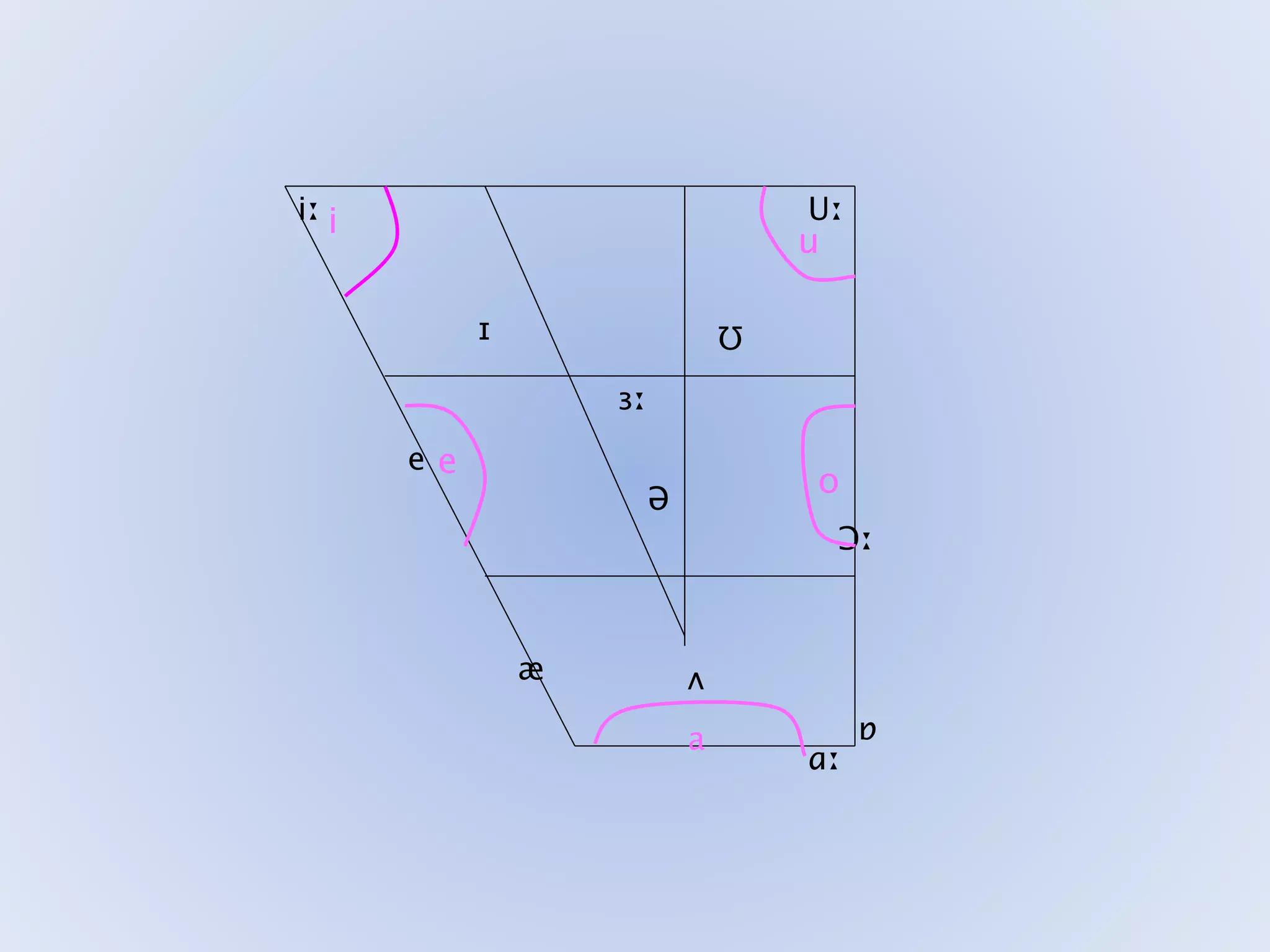
iː
e
æ ʌ
ɑː
ɒ
Ɔː
Ʊ
Uː
ɪ
ɜː
Ə
i
e
a
o
u
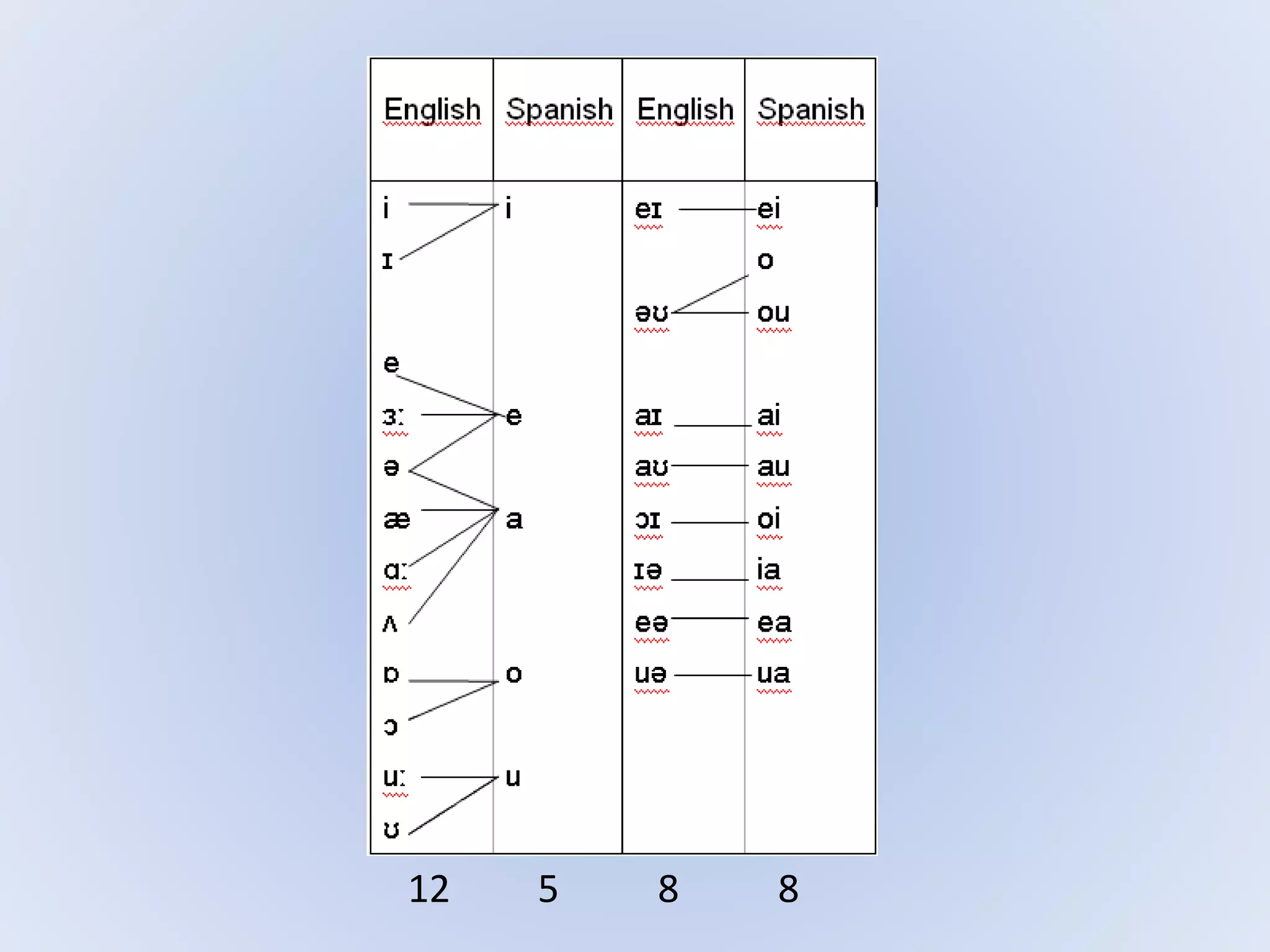
12 5 8 8
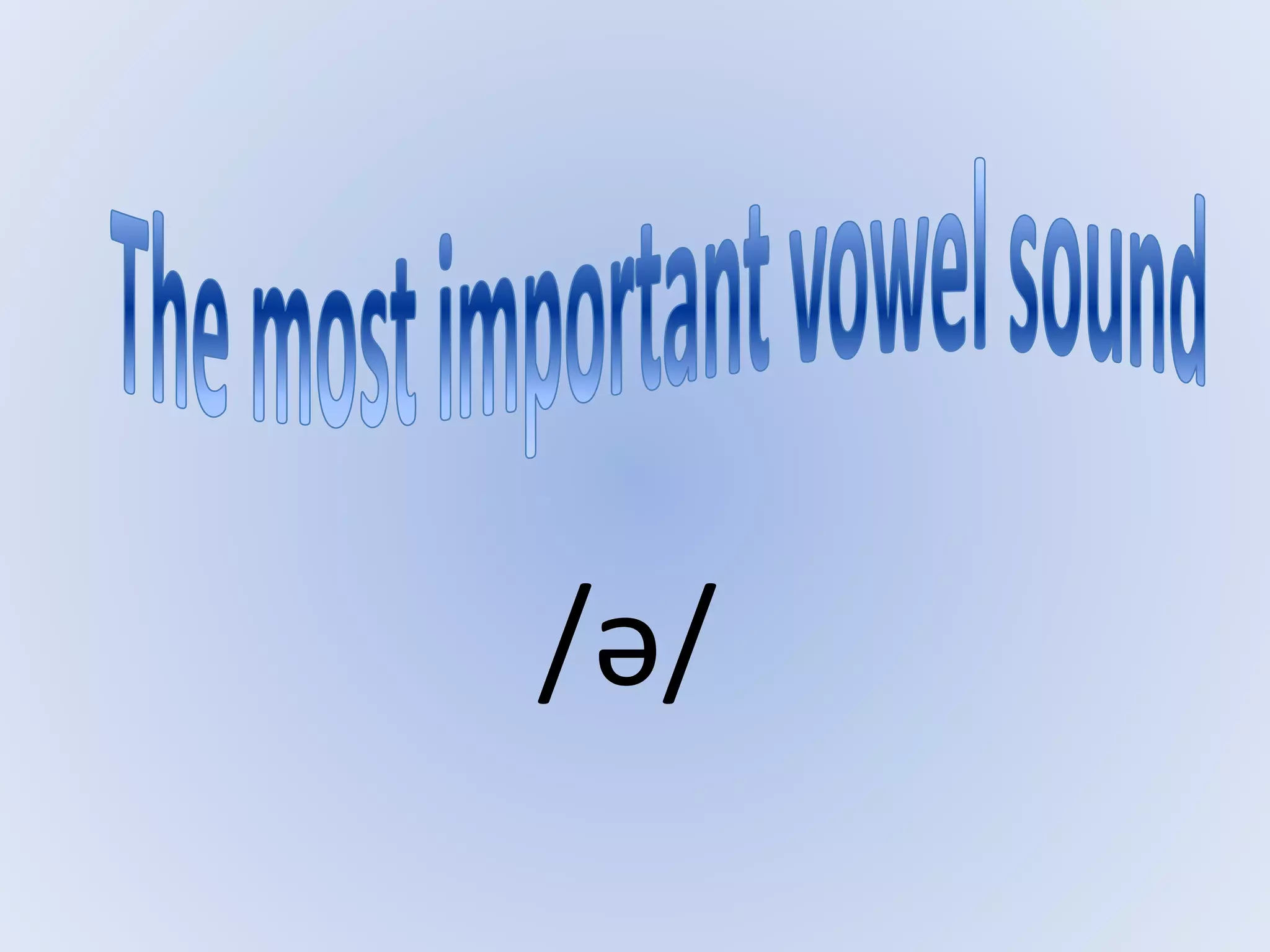
/ə/
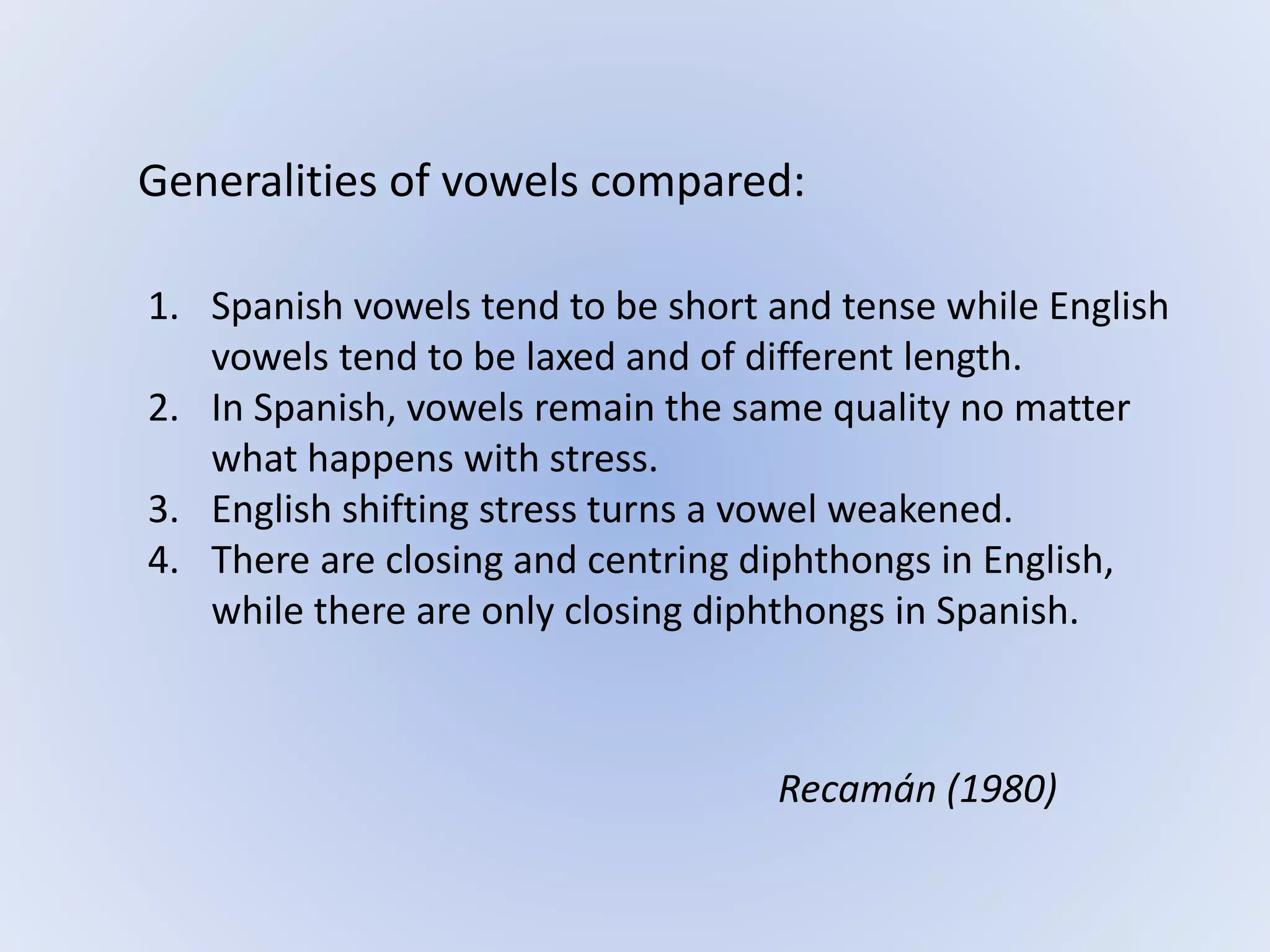
Generalities of vowels compared:
1. Spanish vowels tend to be short and tense while English
vowels tend to be laxed and of different length.
2. In Spanish, vowels remain the same quality no matter
what happens with stress.
3. English shifting stress turns a vowel weakened.
4. There are closing and centring diphthongs in English,
while there are only closing diphthongs in Spanish.
Recamán (1980)
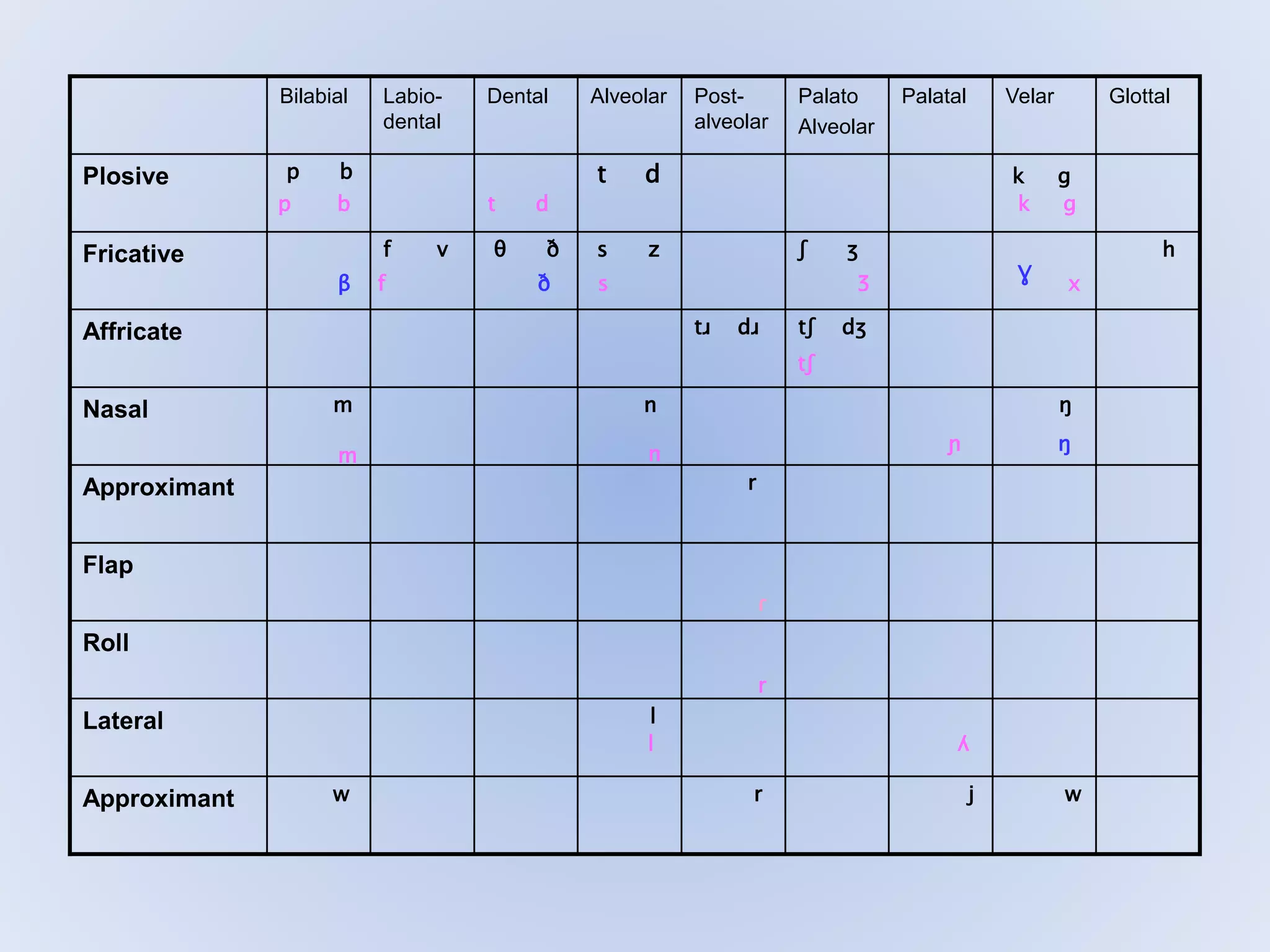
Bilabial Labio-
dental
Dental Alveolar Post-
alveolar
Palato
Alveolar
Palatal Velar Glottal
Plosive p b t d k ɡ
Fricative f v θ ð s z ʃ ʒ h
Affricate tɹ dɹ tʃ dʒ
Nasal m n ŋ
Approximant r
Flap
Roll
Lateral l
Approximant w r j w
p b t d k ɡ
r
ɲ
Ʒ
l
m n
f s
tʃ
x
ʎ
β
ŋ
ð Ɣ
ɾ
juncture
First consonant lenɡtheninɡ
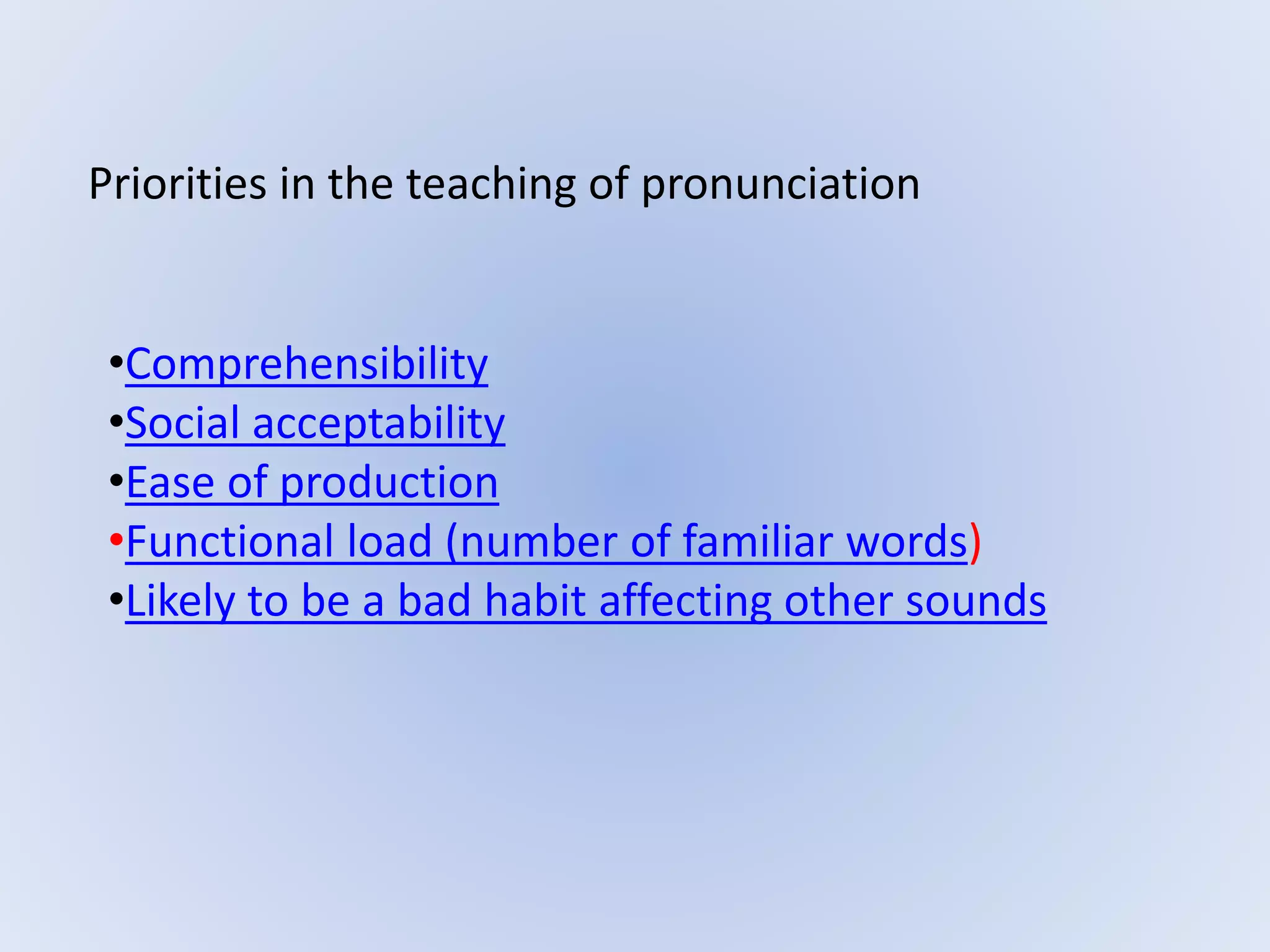
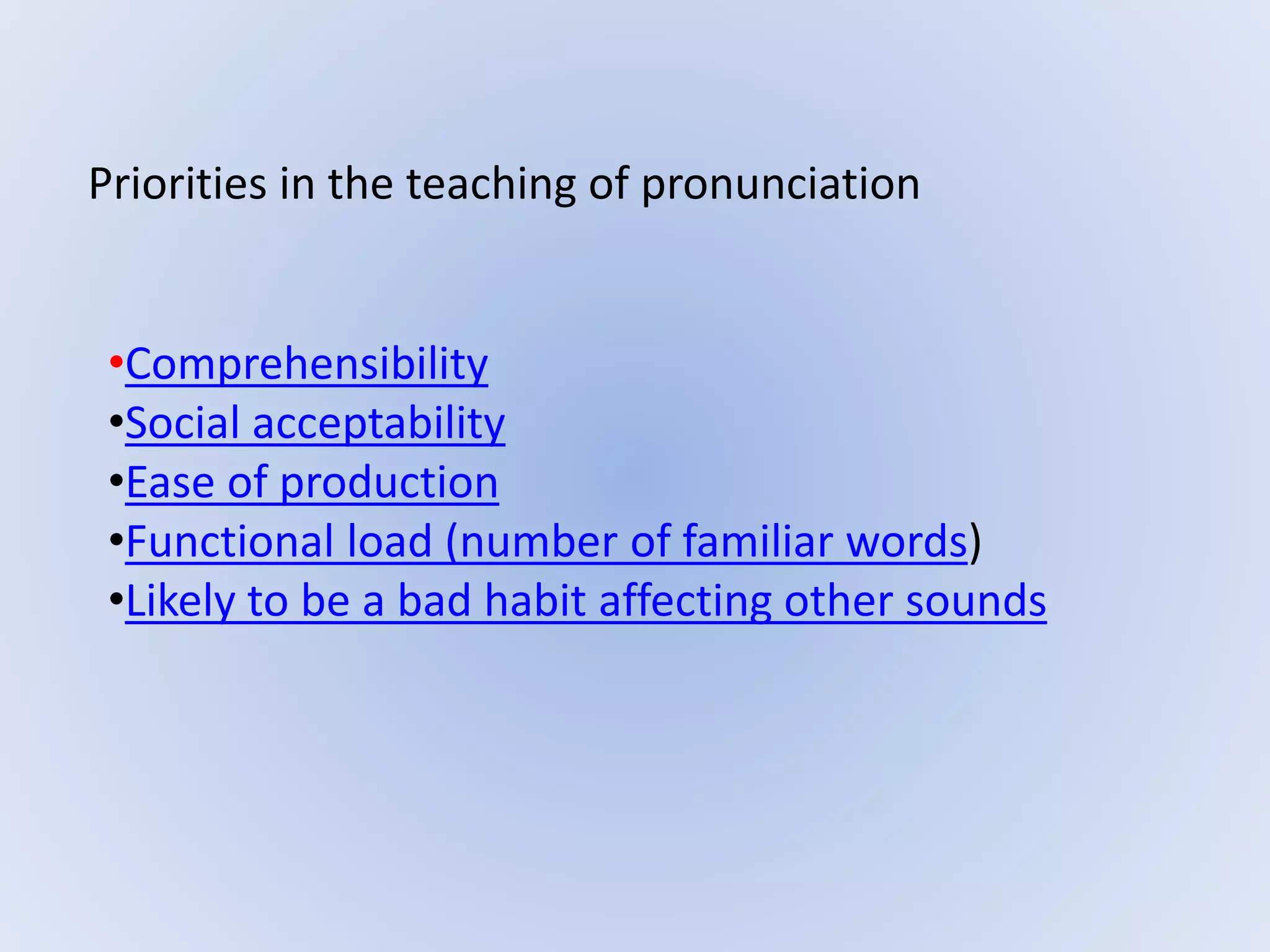
Priorities in the teaching of pronunciation
•Comprehensibility
•Social acceptability
•Ease of production
•Functional load (number of familiar words)
•Likely to be a bad habit affecting other sounds
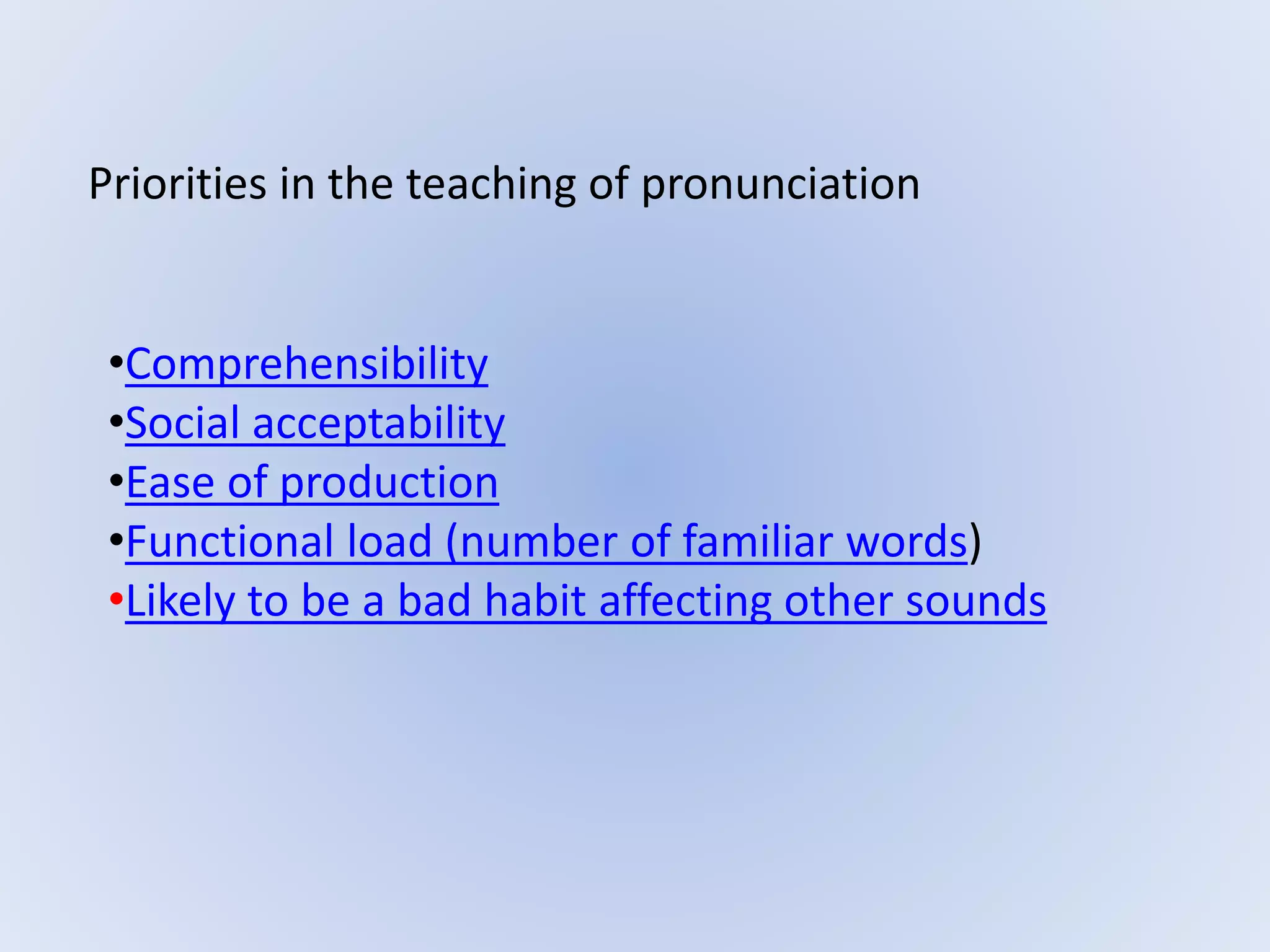
Priorities in the teaching of pronunciation
•Comprehensibility
•Social acceptability
•Ease of production
•Functional load (number of familiar words)
•Likely to be a bad habit affecting other sounds
Priorities in the teaching of pronunciation
•Comprehensibility
•Social acceptability
•Ease of production
•Functional load (number of familiar words)
•Likely to be a bad habit affecting other sounds
[pʰet]
[tʰɪn]
[kʰæt]
Priorities in the teaching of pronunciation
•Comprehensibility
•Social acceptability
•Ease of production
•Functional load (number of familiar words)
•Likely to be a bad habit affecting other sounds
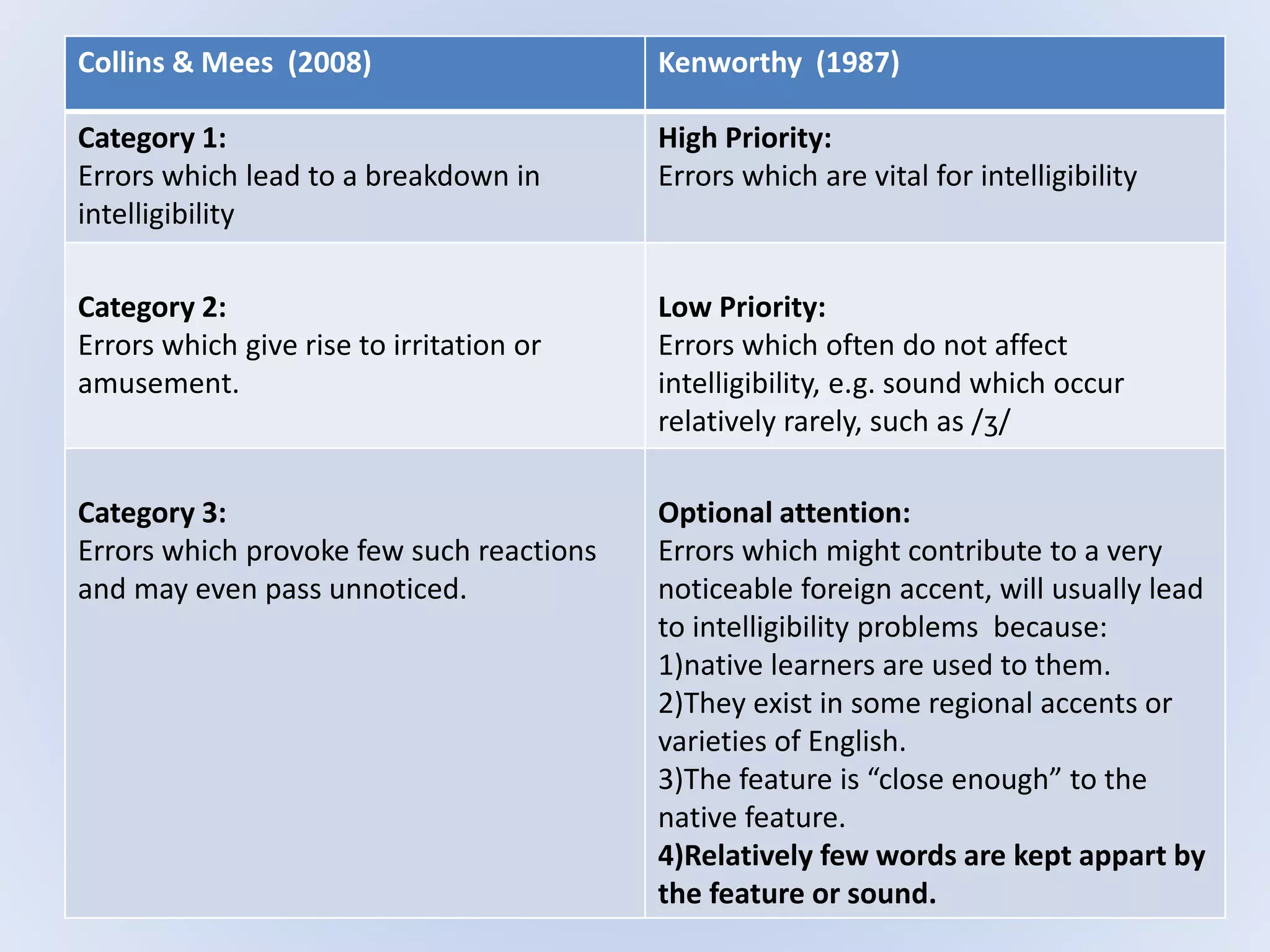
Collins & Mees (2008) Kenworthy (1987)
Category 1:
Errors which lead to a breakdown in
intelligibility
High Priority:
Errors which are vital for intelligibility
Category 2:
Errors which give rise to irritation or
amusement.
Low Priority:
Errors which often do not affect
intelligibility, e.g. sound which occur
relatively rarely, such as /ʒ/
Category 3:
Errors which provoke few such reactions
and may even pass unnoticed.
Optional attention:
Errors which might contribute to a very
noticeable foreign accent, will usually lead
to intelligibility problems because:
1)native learners are used to them.
2)They exist in some regional accents or
varieties of English.
3)The feature is “close enough” to the
native feature.
4)Relatively few words are kept appart by
the feature or sound.
Priorities in the teaching of pronunciation
•Comprehensibility
•Social acceptability
•Ease of production
•Functional load (number of familiar words)
•Likely to be a bad habit affecting other sounds
[hiː wɒz æn intʰelɪdʒənt ̚b̥ɔɪ]
[ð̥eə weə tʰeŋ ɡɜːɫz æt skuːɫ]
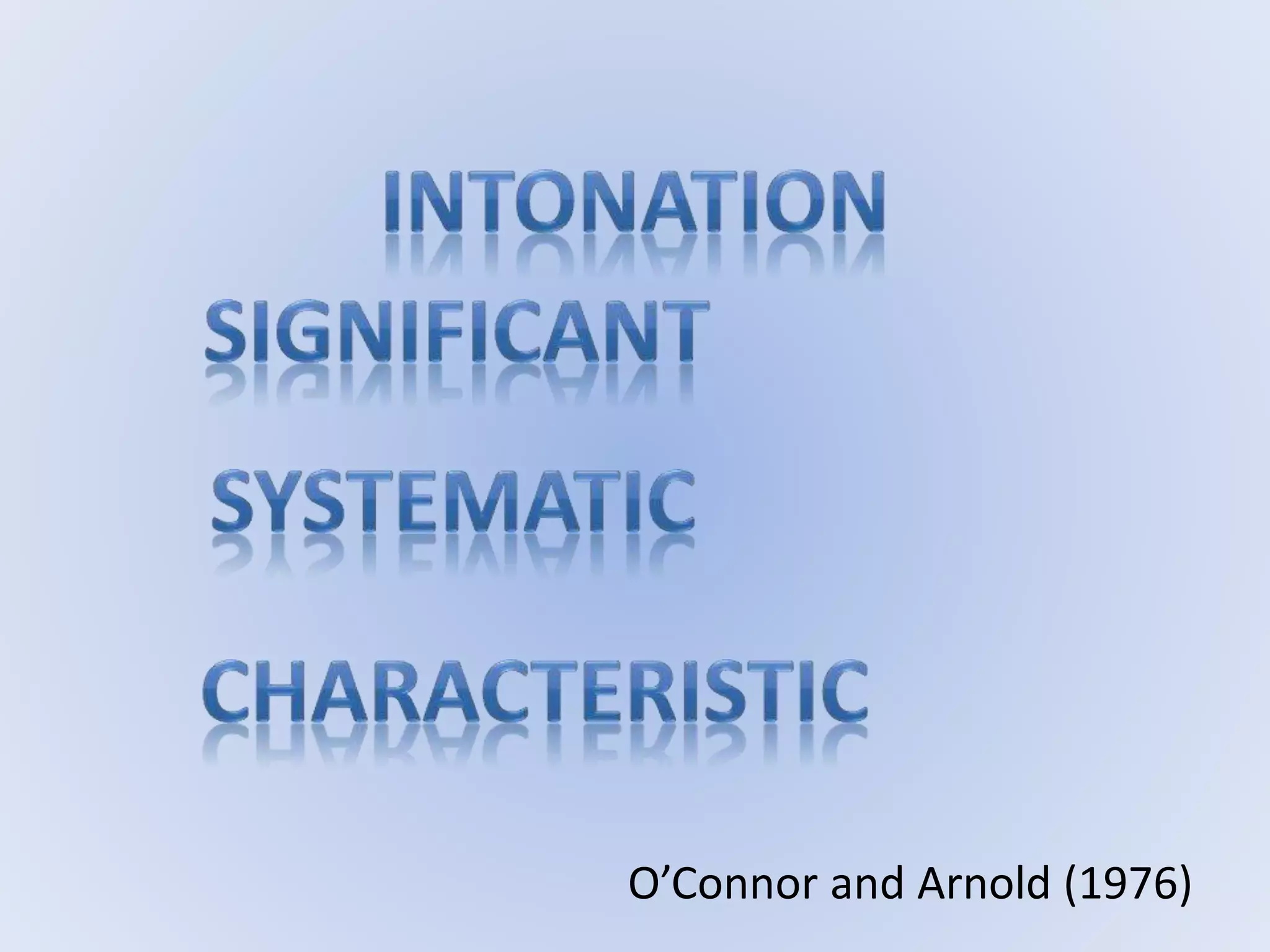
O’Connor and Arnold (1976)
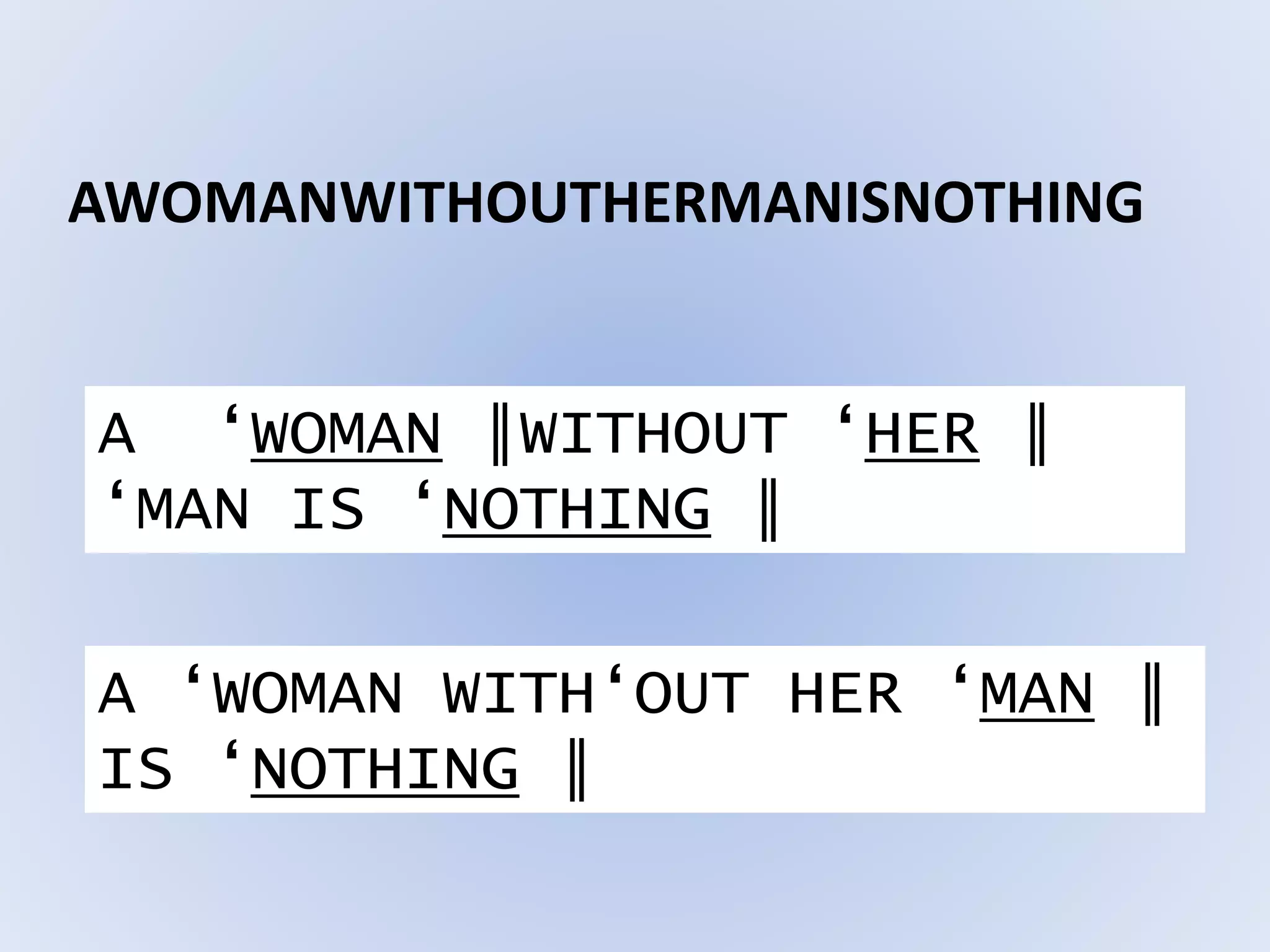
AWOMANWITHOUTHERMANISNOTHING
A ‘WOMAN ║WITHOUT ‘HER ║
‘MAN IS ‘NOTHING ║
A ‘WOMAN WITH‘OUT HER ‘MAN ║
IS ‘NOTHING ║
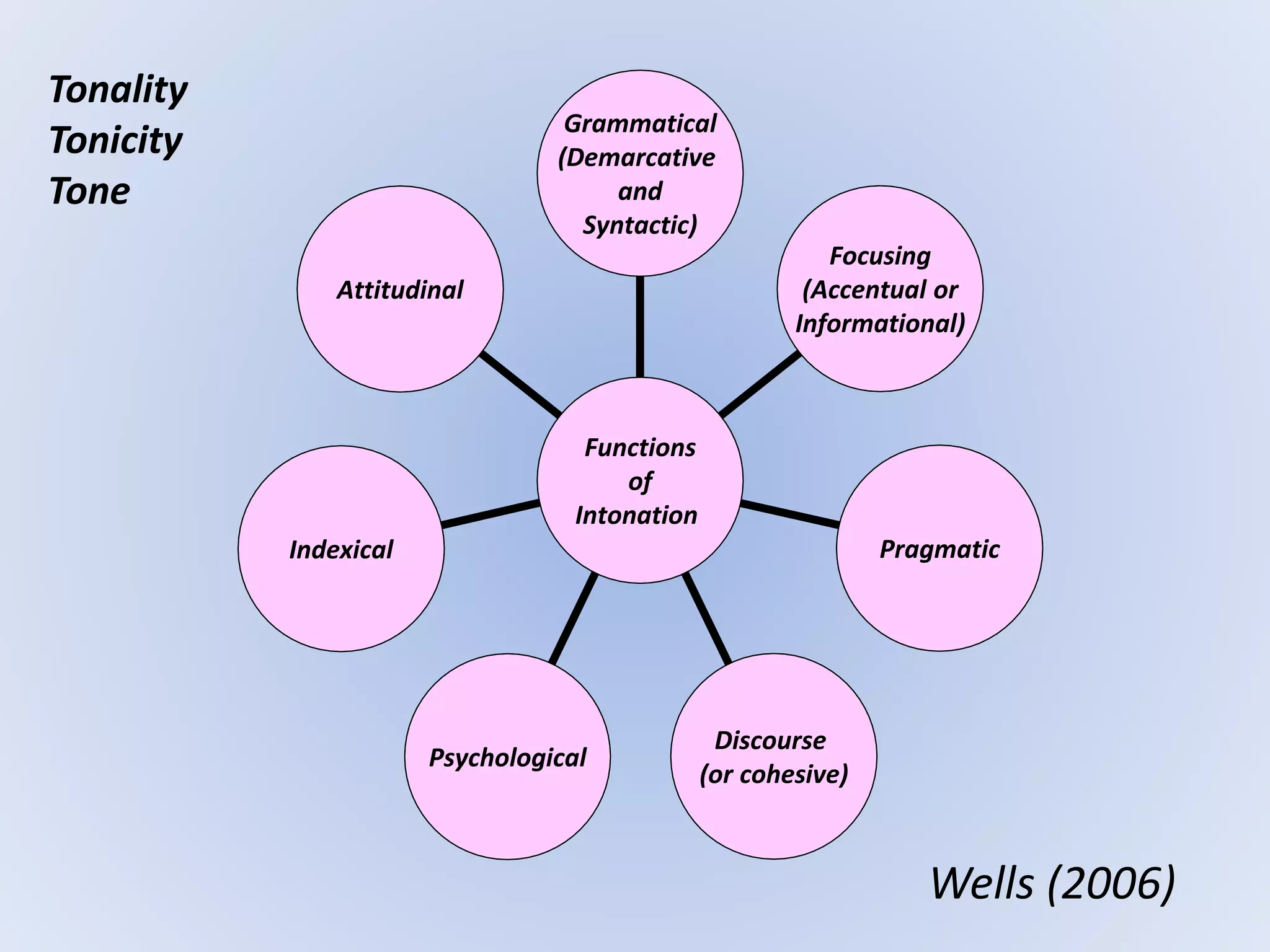
Attitudinal
Indexical
Psychological
Discourse
(or cohesive)
Pragmatic
Focusing
(Accentual or
Informational)
Grammatical
(Demarcative
and
Syntactic)
Functions
of
Intonation
Wells (2006)
Tonality
Tonicity
Tone
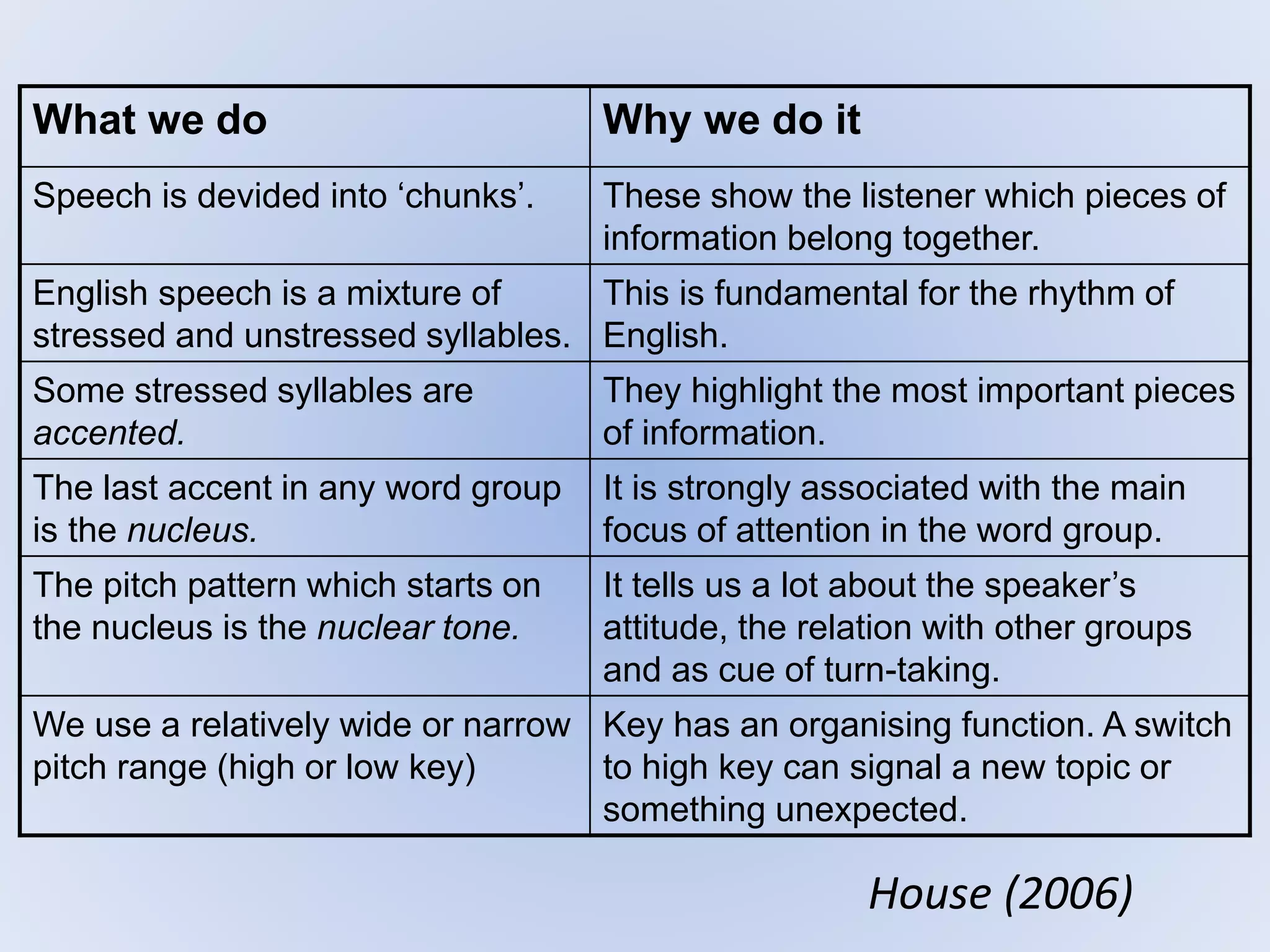
What we do Why we do it
Speech is devided into ‘chunks’. These show the listener which pieces of
information belong together.
English speech is a mixture of
stressed and unstressed syllables.
This is fundamental for the rhythm of
English.
Some stressed syllables are
accented.
They highlight the most important pieces
of information.
The last accent in any word group
is the nucleus.
It is strongly associated with the main
focus of attention in the word group.
The pitch pattern which starts on
the nucleus is the nuclear tone.
It tells us a lot about the speaker’s
attitude, the relation with other groups
and as cue of turn-taking.
We use a relatively wide or narrow
pitch range (high or low key)
Key has an organising function. A switch
to high key can signal a new topic or
something unexpected.
House (2006)
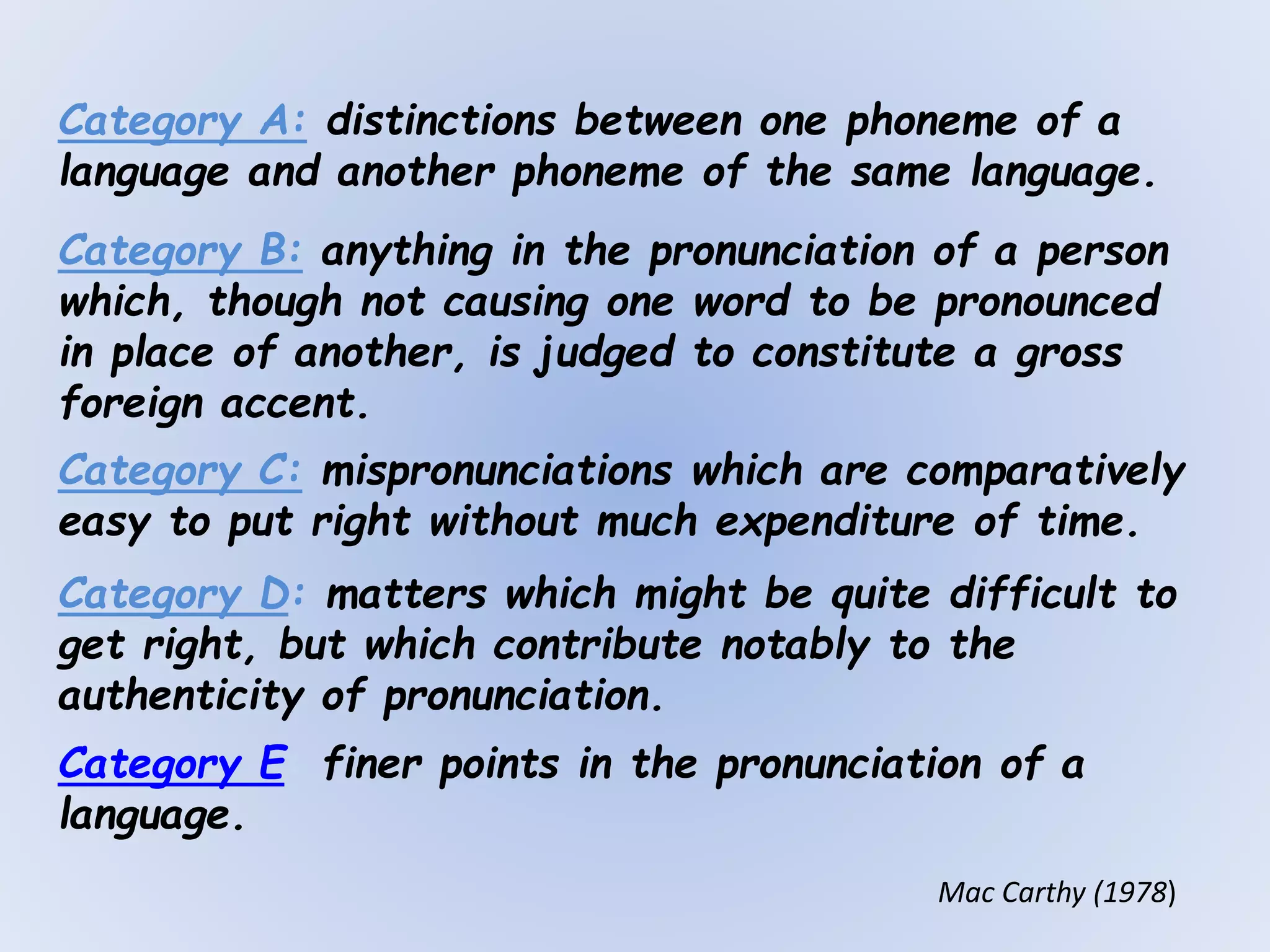
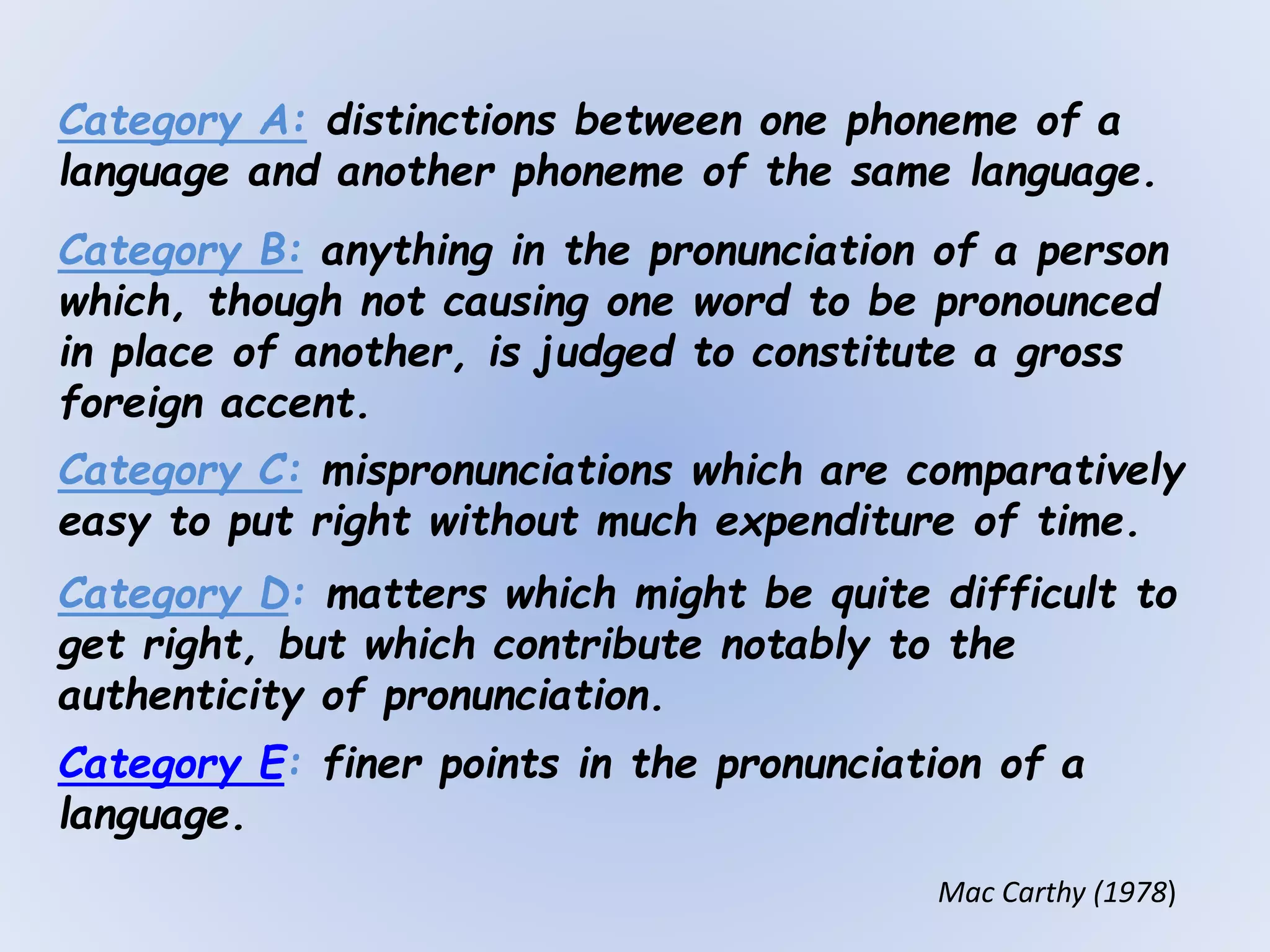
Category A: distinctions between one phoneme of a
language and another phoneme of the same language.
Category B: anything in the pronunciation of a person
which, though not causing one word to be pronounced
in place of another, is judged to constitute a gross
foreign accent.
Category C: mispronunciations which are comparatively
easy to put right without much expenditure of time.
Category D: matters which might be quite difficult to
get right, but which contribute notably to the
authenticity of pronunciation.
Category E: finer points in the pronunciation of a
language.
Mac Carthy (1978)
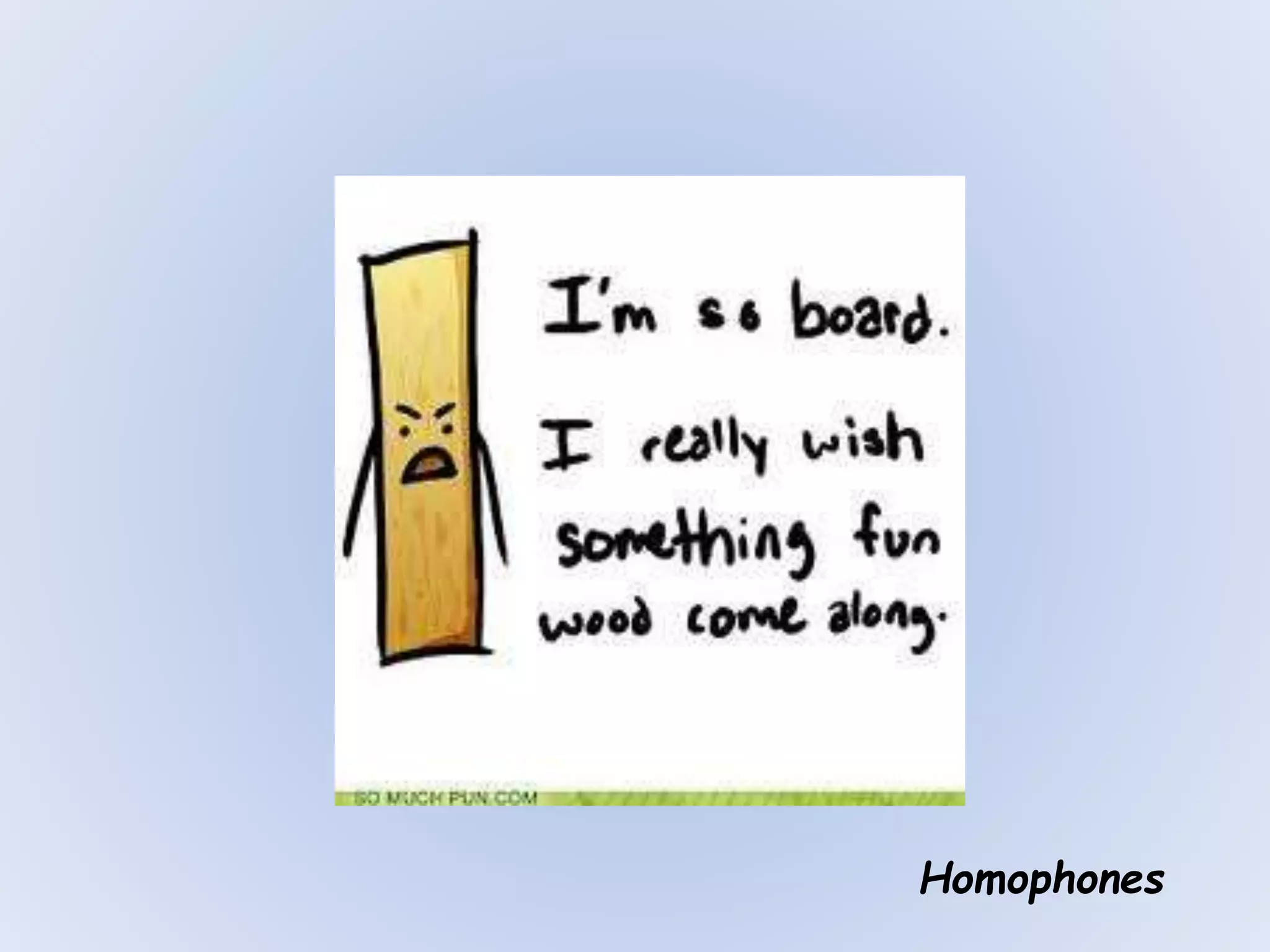
Homophones
Homophones
Homophones
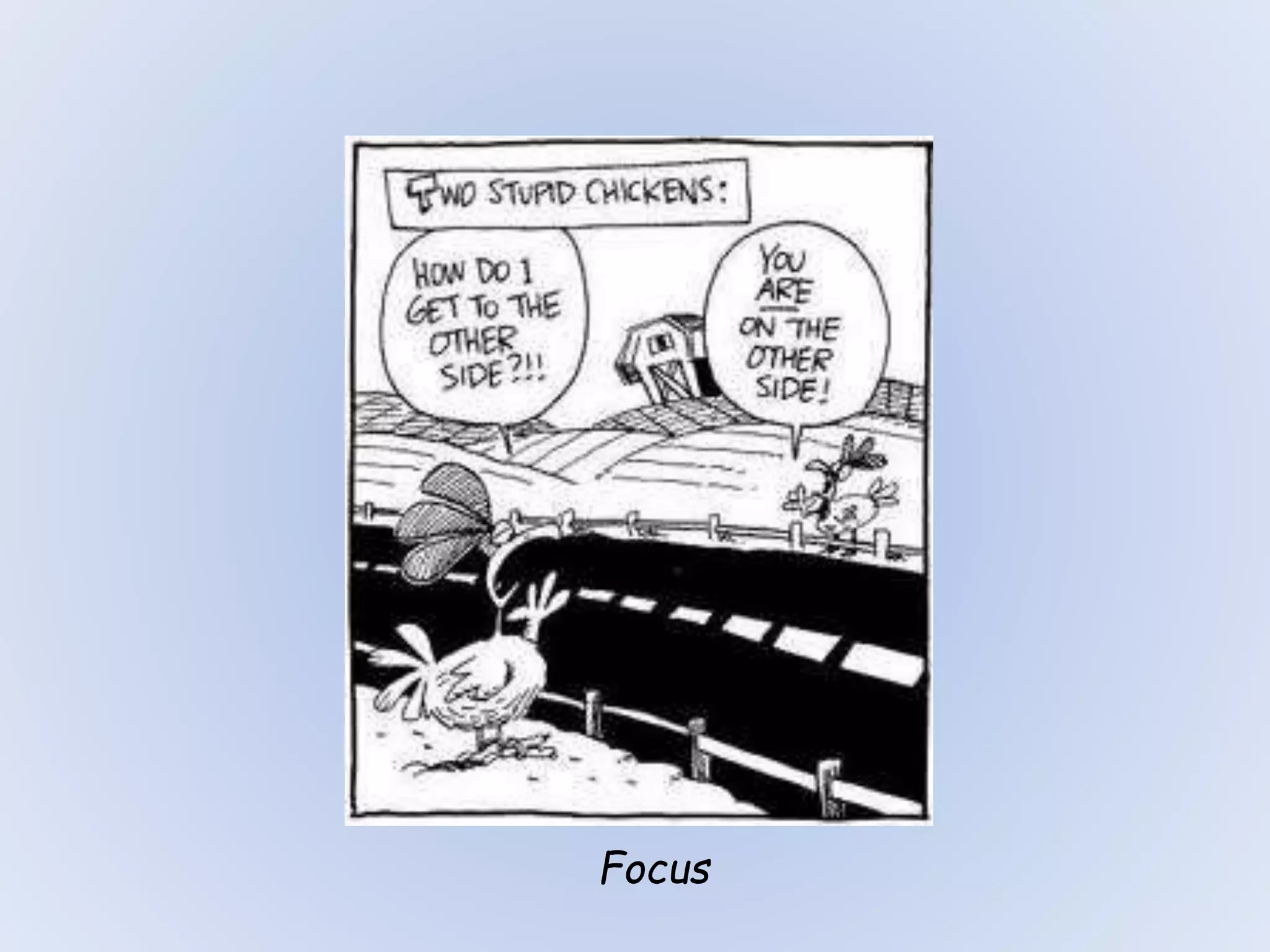
Focus
Word stress
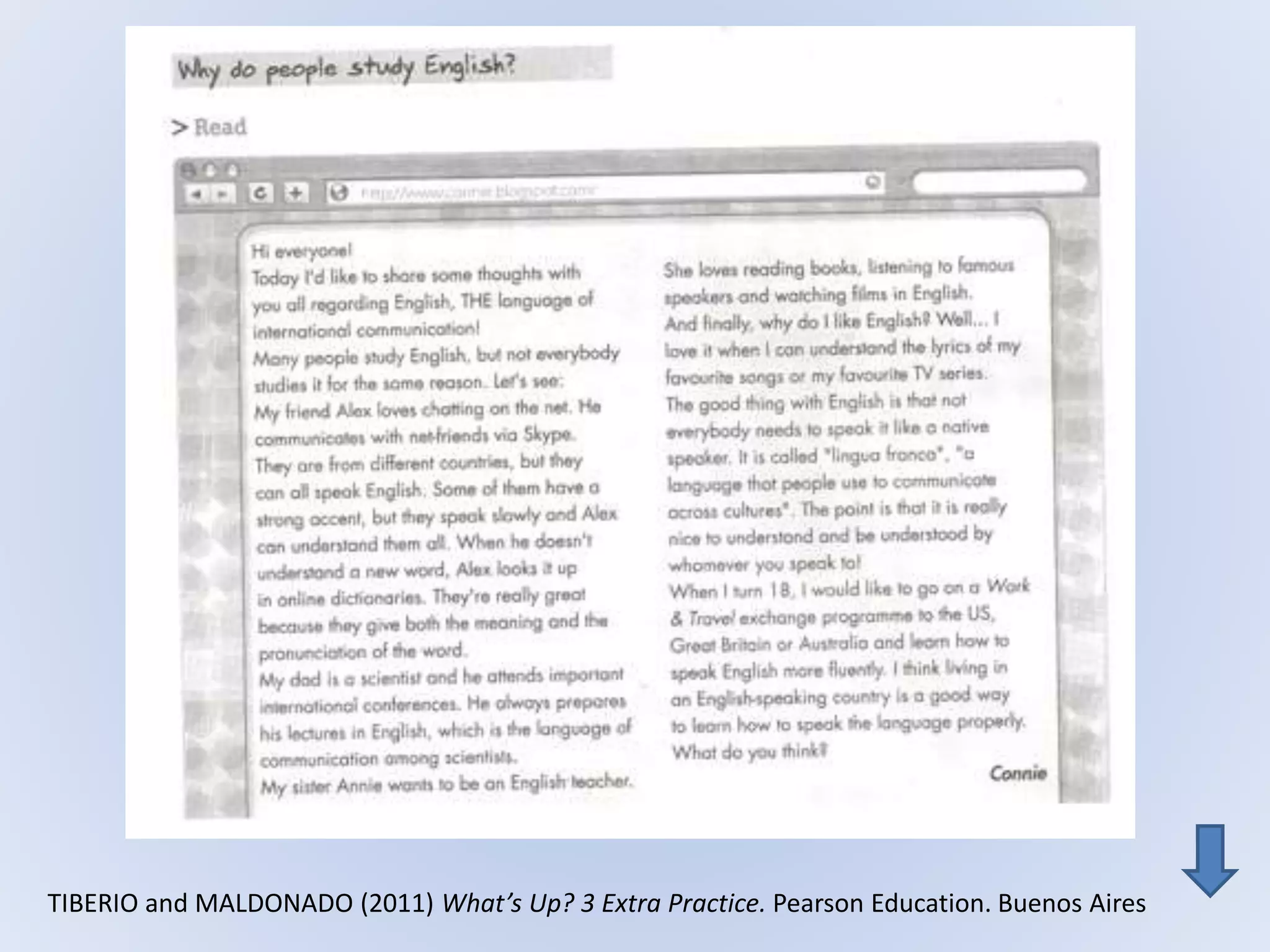
TIBERIO and MALDONADO (2011) What’s Up? 3 Extra Practice. Pearson Education. Buenos Aires
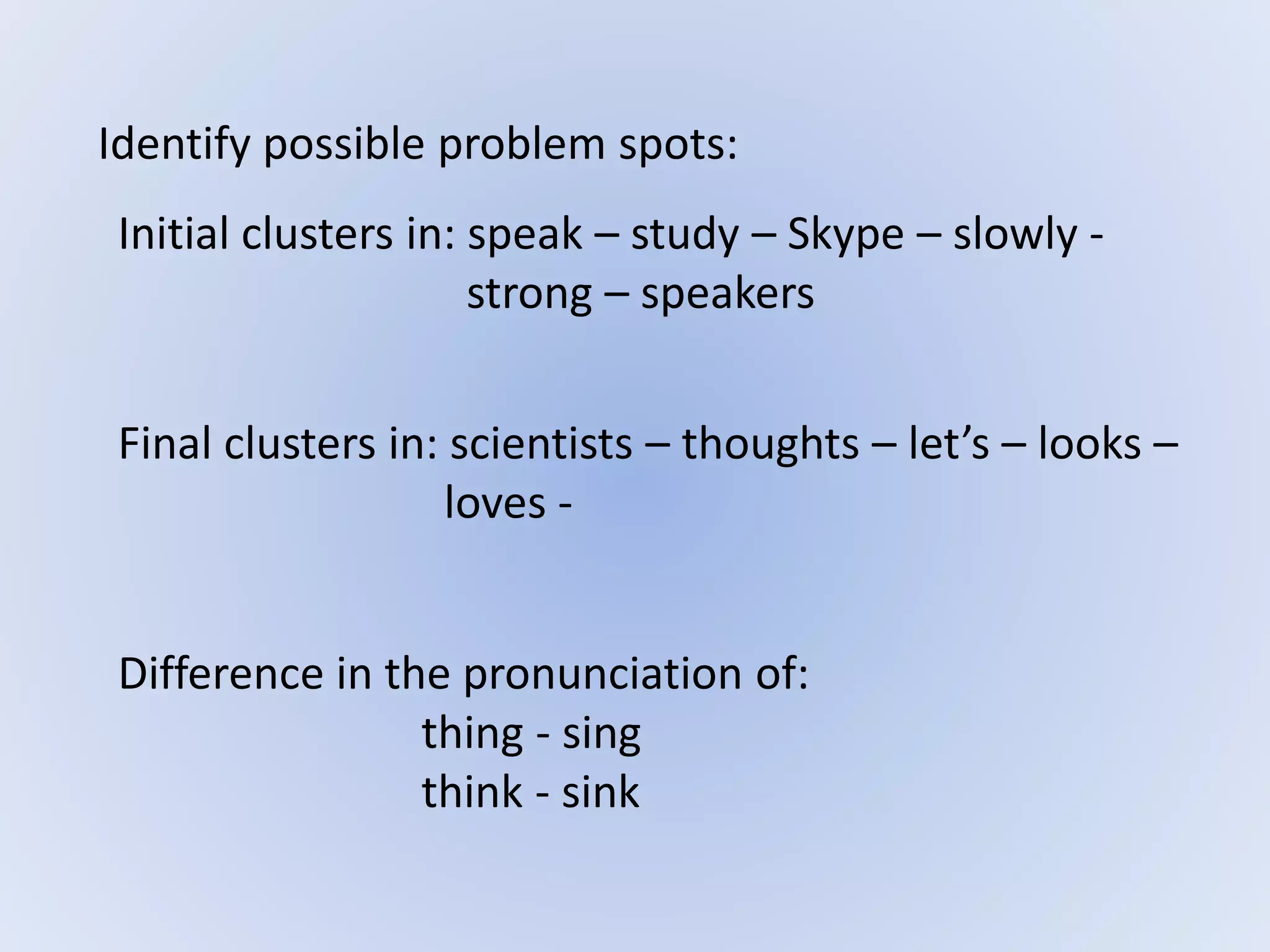
Identify possible problem spots:
Initial clusters in: speak – study – Skype – slowly -
strong – speakers
Difference in the pronunciation of:
thing - sing
think - sink
Final clusters in: scientists – thoughts – let’s – looks –
loves -
•True or false?
•Corrective feedback.
•Answer questions.
•Ask questions.
•Find the differences.
•Cloze exercise.
•Spot the words you find difficult to
pronounce.
•Brainstorming of words having those
problem sounds.
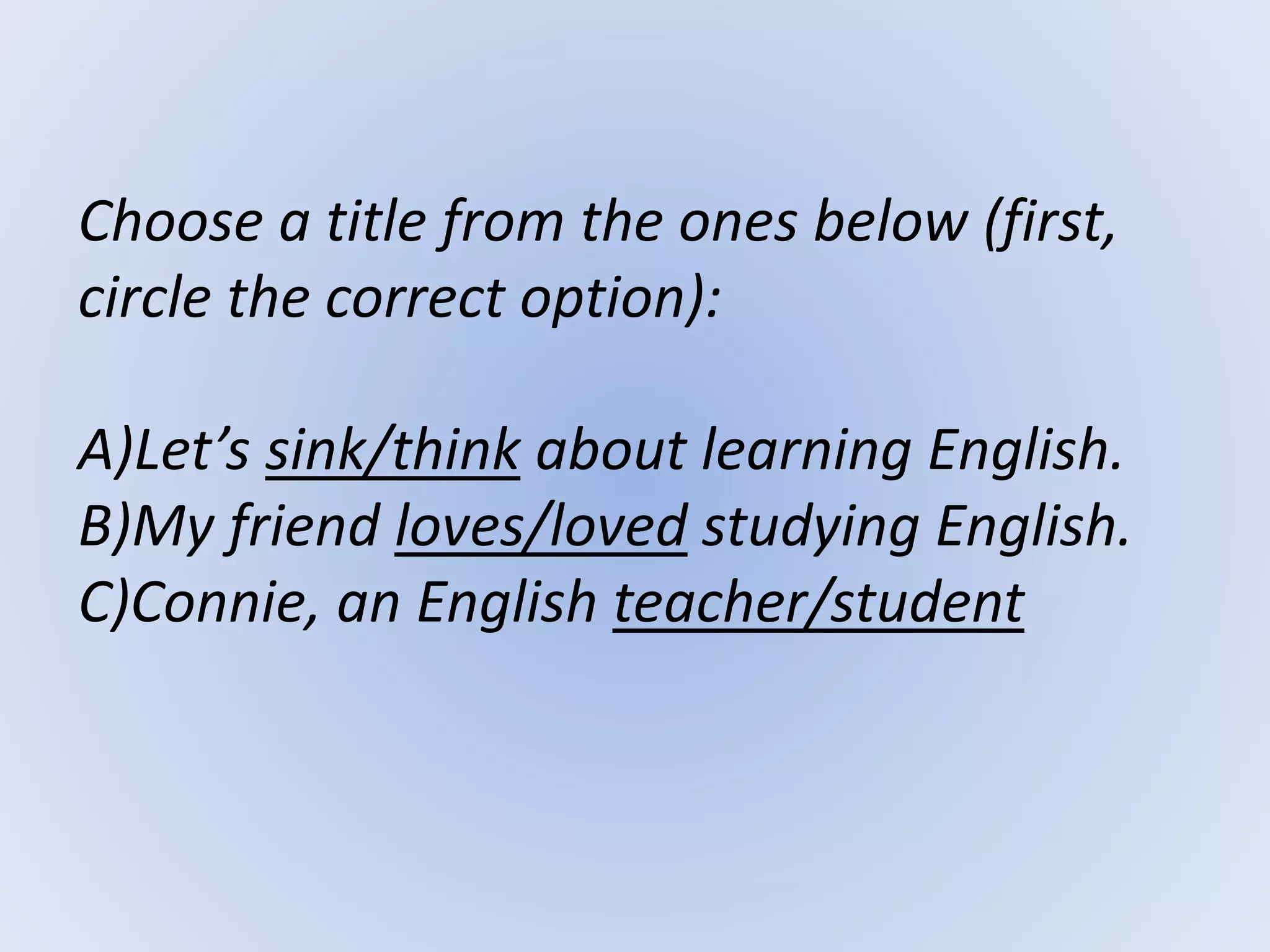
Choose a title from the ones below (first,
circle the correct option):
A)Let’s sink/think about learning English.
B)My friend loves/loved studying English.
C)Connie, an English teacher/student
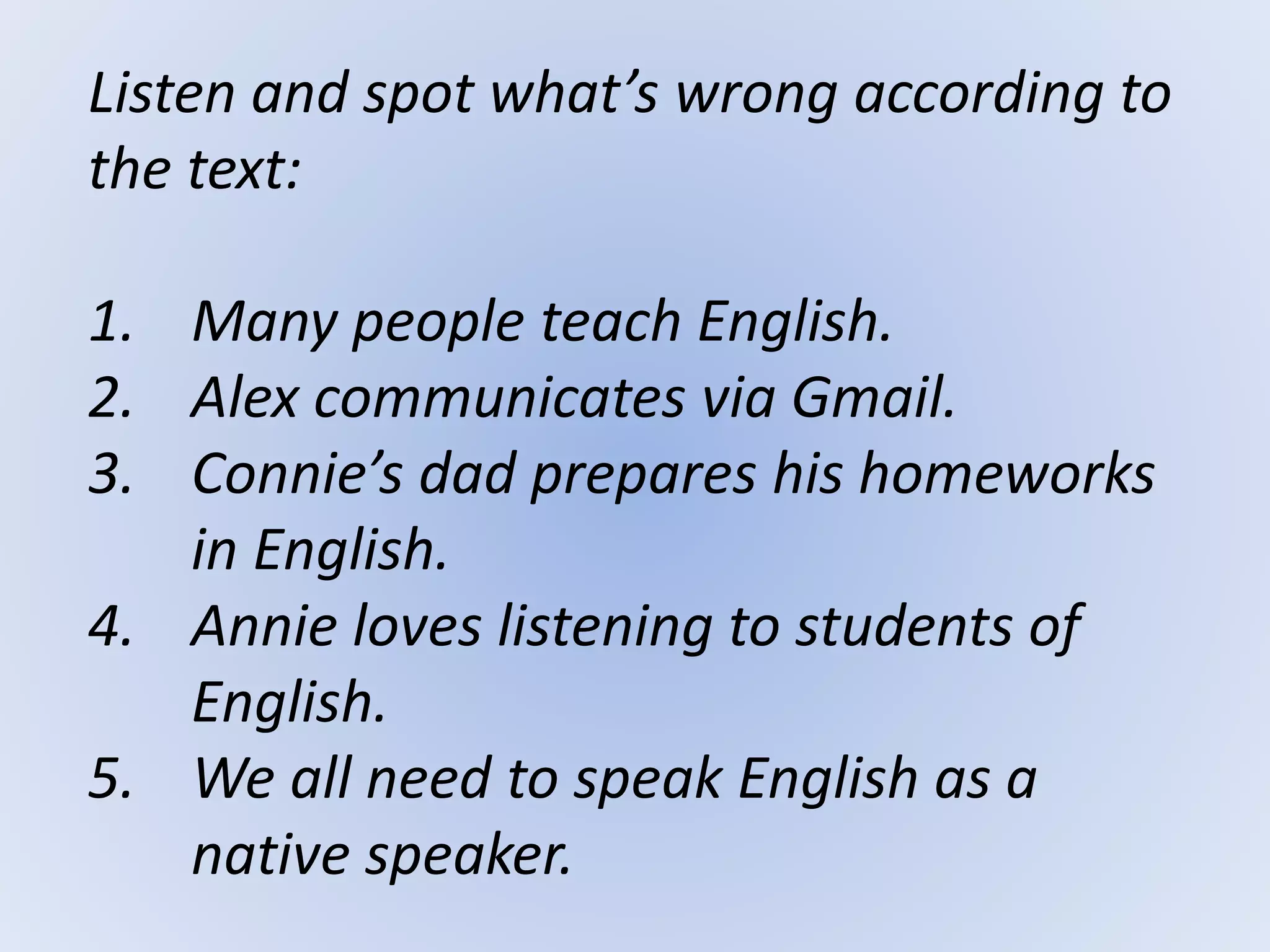
Listen and spot what’s wrong according to
the text:
1. Many people teach English.
2. Alex communicates via Gmail.
3. Connie’s dad prepares his homeworks
in English.
4. Annie loves listening to students of
English.
5. We all need to speak English as a
native speaker.
Category A: distinctions between one phoneme of a
language and another phoneme of the same language.
Category B: anything in the pronunciation of a person
which, though not causing one word to be pronounced
in place of another, is judged to constitute a gross
foreign accent.
Category C: mispronunciations which are comparatively
easy to put right without much expenditure of time.
Category D: matters which might be quite difficult to
get right, but which contribute notably to the
authenticity of pronunciation.
Category E: finer points in the pronunciation of a
language.
Mac Carthy (1978)
“A teacher training course which claims
to enable a person thoroughly to teach a
foreign language should include a
complete analysis of the would-be teacher
and his prospective students’ mother
tongue, and its corresponding practice [as
well as] a deep knowledge of the
phonetics and phonology of English”
“The [would-be teacher should] possess ‘a
sound knowledge’ of the phonological and
phonetic characteristics both of English
and Spanish, a pronunciation of the target
language close to the model chosen, and
the ability to predict errors and use
adquate techniques of correction.”

Some whys and hows of teaching pronunciation

  • 1.
  • 3.
    ‘the phonemic -basedview of pronunciation has largely given way to a broader, discourse- based view, which includes the interaction between segmental features, voice quality settings and prosodic features.’ Celce-Murcia, Brinton and Goodwin (1996)
  • 5.
    Develop a deepand internally experienced awareness of how we produce sounds manipulating our vocal musculature and how the internal sensation of using the muscles relates to what is heard through the ears. Underhill (1994)
  • 6.
    Words spoken inisolation consist of a ‘flow of sound’ which is different from the sum of the individual phonemes. Neighbouring sounds modify each other as the vocal muscles join together and take short cuts. Underhill (1994)
  • 7.
    The distribution ofenergy across the syllables creates an energy profile, called word stress, that is typical and generally characteristic of a particular word when spoken on its own. Underhill (1994)
  • 8.
    Underhill (1994) In thestream of speech sounds are simplified and reduced, and the energy profile is extended from individual words to groups of words, that is from word stress that is relatively fixed to prominence (emphasis) and intonation (music) that is chosen by the speaker.
  • 9.
    Kelly (2000) •A goodgrounding in theoretical knowledge. •Practical classroom skills. •Access to good ideas for classroom activities.
  • 10.
  • 11.
  • 12.
  • 13.
    Generalities of vowelscompared: 1. Spanish vowels tend to be short and tense while English vowels tend to be laxed and of different length. 2. In Spanish, vowels remain the same quality no matter what happens with stress. 3. English shifting stress turns a vowel weakened. 4. There are closing and centring diphthongs in English, while there are only closing diphthongs in Spanish. Recamán (1980)
  • 14.
    Bilabial Labio- dental Dental AlveolarPost- alveolar Palato Alveolar Palatal Velar Glottal Plosive p b t d k ɡ Fricative f v θ ð s z ʃ ʒ h Affricate tɹ dɹ tʃ dʒ Nasal m n ŋ Approximant r Flap Roll Lateral l Approximant w r j w p b t d k ɡ r ɲ Ʒ l m n f s tʃ x ʎ β ŋ ð Ɣ ɾ
  • 15.
  • 16.
    Priorities in theteaching of pronunciation •Comprehensibility •Social acceptability •Ease of production •Functional load (number of familiar words) •Likely to be a bad habit affecting other sounds
  • 19.
    Priorities in theteaching of pronunciation •Comprehensibility •Social acceptability •Ease of production •Functional load (number of familiar words) •Likely to be a bad habit affecting other sounds
  • 21.
    Priorities in theteaching of pronunciation •Comprehensibility •Social acceptability •Ease of production •Functional load (number of familiar words) •Likely to be a bad habit affecting other sounds
  • 22.
  • 23.
    Priorities in theteaching of pronunciation •Comprehensibility •Social acceptability •Ease of production •Functional load (number of familiar words) •Likely to be a bad habit affecting other sounds
  • 24.
    Collins & Mees(2008) Kenworthy (1987) Category 1: Errors which lead to a breakdown in intelligibility High Priority: Errors which are vital for intelligibility Category 2: Errors which give rise to irritation or amusement. Low Priority: Errors which often do not affect intelligibility, e.g. sound which occur relatively rarely, such as /ʒ/ Category 3: Errors which provoke few such reactions and may even pass unnoticed. Optional attention: Errors which might contribute to a very noticeable foreign accent, will usually lead to intelligibility problems because: 1)native learners are used to them. 2)They exist in some regional accents or varieties of English. 3)The feature is “close enough” to the native feature. 4)Relatively few words are kept appart by the feature or sound.
  • 25.
    Priorities in theteaching of pronunciation •Comprehensibility •Social acceptability •Ease of production •Functional load (number of familiar words) •Likely to be a bad habit affecting other sounds
  • 26.
    [hiː wɒz ænintʰelɪdʒənt ̚b̥ɔɪ] [ð̥eə weə tʰeŋ ɡɜːɫz æt skuːɫ]
  • 27.
  • 28.
    AWOMANWITHOUTHERMANISNOTHING A ‘WOMAN ║WITHOUT‘HER ║ ‘MAN IS ‘NOTHING ║ A ‘WOMAN WITH‘OUT HER ‘MAN ║ IS ‘NOTHING ║
  • 29.
  • 30.
    What we doWhy we do it Speech is devided into ‘chunks’. These show the listener which pieces of information belong together. English speech is a mixture of stressed and unstressed syllables. This is fundamental for the rhythm of English. Some stressed syllables are accented. They highlight the most important pieces of information. The last accent in any word group is the nucleus. It is strongly associated with the main focus of attention in the word group. The pitch pattern which starts on the nucleus is the nuclear tone. It tells us a lot about the speaker’s attitude, the relation with other groups and as cue of turn-taking. We use a relatively wide or narrow pitch range (high or low key) Key has an organising function. A switch to high key can signal a new topic or something unexpected. House (2006)
  • 31.
    Category A: distinctionsbetween one phoneme of a language and another phoneme of the same language. Category B: anything in the pronunciation of a person which, though not causing one word to be pronounced in place of another, is judged to constitute a gross foreign accent. Category C: mispronunciations which are comparatively easy to put right without much expenditure of time. Category D: matters which might be quite difficult to get right, but which contribute notably to the authenticity of pronunciation. Category E: finer points in the pronunciation of a language. Mac Carthy (1978)
  • 33.
  • 34.
  • 35.
  • 36.
  • 37.
  • 39.
    TIBERIO and MALDONADO(2011) What’s Up? 3 Extra Practice. Pearson Education. Buenos Aires
  • 40.
    Identify possible problemspots: Initial clusters in: speak – study – Skype – slowly - strong – speakers Difference in the pronunciation of: thing - sing think - sink Final clusters in: scientists – thoughts – let’s – looks – loves -
  • 41.
    •True or false? •Correctivefeedback. •Answer questions. •Ask questions. •Find the differences. •Cloze exercise. •Spot the words you find difficult to pronounce. •Brainstorming of words having those problem sounds.
  • 42.
    Choose a titlefrom the ones below (first, circle the correct option): A)Let’s sink/think about learning English. B)My friend loves/loved studying English. C)Connie, an English teacher/student
  • 43.
    Listen and spotwhat’s wrong according to the text: 1. Many people teach English. 2. Alex communicates via Gmail. 3. Connie’s dad prepares his homeworks in English. 4. Annie loves listening to students of English. 5. We all need to speak English as a native speaker.
  • 44.
    Category A: distinctionsbetween one phoneme of a language and another phoneme of the same language. Category B: anything in the pronunciation of a person which, though not causing one word to be pronounced in place of another, is judged to constitute a gross foreign accent. Category C: mispronunciations which are comparatively easy to put right without much expenditure of time. Category D: matters which might be quite difficult to get right, but which contribute notably to the authenticity of pronunciation. Category E: finer points in the pronunciation of a language. Mac Carthy (1978)
  • 45.
    “A teacher trainingcourse which claims to enable a person thoroughly to teach a foreign language should include a complete analysis of the would-be teacher and his prospective students’ mother tongue, and its corresponding practice [as well as] a deep knowledge of the phonetics and phonology of English”
  • 46.
    “The [would-be teachershould] possess ‘a sound knowledge’ of the phonological and phonetic characteristics both of English and Spanish, a pronunciation of the target language close to the model chosen, and the ability to predict errors and use adquate techniques of correction.”