ENGLISH
INTONATION
      Spring 2012
      Ms. Candice Quiñones
THE BASICS

• Intonation is a non-verbal method of expressing
  various meanings, emotions or situations.
• Intonation in American English uses the rise and fall of
  pitch to accomplish this.
INTONATION AND STRUCTURE

 Intonation is very closely linked to grammar, or more
  specifically, sentence structure.
    Because English has a fairly strictly fixed word order, it
     is not an option to rearrange the words when we want to
     make a point about something.
    Therefore, it becomes necessary to shift our intonation
     to highlight information that is key to our point.
SOME CLASSIC RULES

Sentence Level Rules
 Yes/no questions usually have a rising intonation at the
  end.
    I.E. Do you want some water?
 Information or “wh” questions usually have falling
  intonation at the end.
    I.E. When will the package arrive?
 Declarative sentences also have falling intonation at
  the end.
    I.E. Intonation makes English more interesting.
SOME CLASSIC RULES

Other Rules
 When listing items, your pitch should rise at the end of
  the word for each item, but drop after the last one.
    I.E. I need a hammer, nails, wood, and some hinges.
 It is acceptable to leave your intonation high and let
  your voice trail off when you are still thinking but plan
  to continue speaking.
    I.E. Let me see…
SOME CLASSIC RULES: THOUGHT
GROUPS
Every sentence can be divided up into a series of shorter
“thought groups”.
 For Example:
           “My brother bought me a new bicycle.”
                    Can be divided as:
         My brother / bought me / a new bicycle.

 Each of the divisions begins a new thought group.
THOUGHT GROUPS & INTONATION
 In a sentence, depending on the focus and the type of
  sentence, you will determine which words in each
  thought group to stress or emphasize by raising your
  pitch.
 However, please note, that at the end of each thought
  group, your intonation must end by falling.
 Example:
       My brother / bought me / a new bicycle.
  [Translation: My brother (not my sister) bought me (not you) a new
                         bicycle (not a pony).]

 *Exception: the end of the final thought group of yes/no questions
                               will rise.
ASPECTS OF INTONATION

 New Information
 Contrast
 Meaning
 Pronunciation
 Mood or Personality
 Cultural Understanding


*Source: http://www.americanaccent.com/intonation.html
NEW INFORMATION
 In standard English, the nouns usually carry the weight of a
  sentence, when everything else is equal.
 Although the verb carries important information, it does not receive
  the primary stress of a first-time noun.
                           Ex. Dogs eat bones.

 After the information has been introduced, or is being repeated
  through the use of pronouns, the intonation shifts over to the verb.
 The intonation changes when a sentence changes from nouns to
  pronouns:
                        Ex. Dogs eat bones.

                           They eat them.
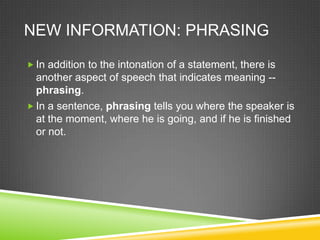
NEW INFORMATION: PHRASING

 In addition to the intonation of a statement, there is
  another aspect of speech that indicates meaning --
  phrasing.
 In a sentence, phrasing tells you where the speaker is
  at the moment, where he is going, and if he is finished
  or not.
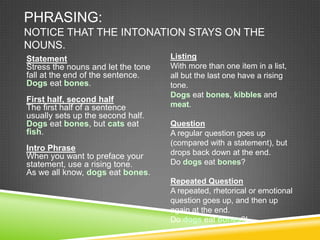
PHRASING:
NOTICE THAT THE INTONATION STAYS ON THE
NOUNS.
Statement                           Listing
Stress the nouns and let the tone   With more than one item in a list,
fall at the end of the sentence.    all but the last one have a rising
Dogs eat bones.                     tone.
                                    Dogs eat bones, kibbles and
First half, second half
The first half of a sentence        meat.
usually sets up the second half.
Dogs eat bones, but cats eat        Question
fish.                               A regular question goes up
                                    (compared with a statement), but
Intro Phrase
When you want to preface your       drops back down at the end.
statement, use a rising tone.       Do dogs eat bones?
As we all know, dogs eat bones.
                                    Repeated Question
                                    A repeated, rhetorical or emotional
                                    question goes up, and then up
                                    again at the end.
                                    Do dogs eat bones?!
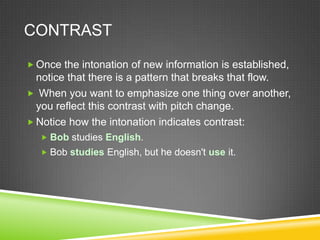
CONTRAST

 Once the intonation of new information is established,
  notice that there is a pattern that breaks that flow.
 When you want to emphasize one thing over another,
  you reflect this contrast with pitch change.
 Notice how the intonation indicates contrast:
   Bob studies English.
   Bob studies English, but he doesn't use it.
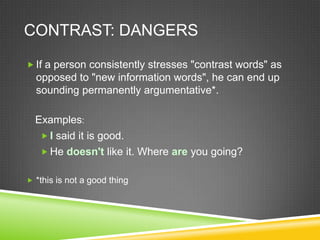
CONTRAST: DANGERS

 If a person consistently stresses "contrast words" as
  opposed to "new information words", he can end up
  sounding permanently argumentative*.

  Examples:
    I said it is good.
    He doesn't like it. Where are you going?


 *this is not a good thing
CONTRAST: DANGERS
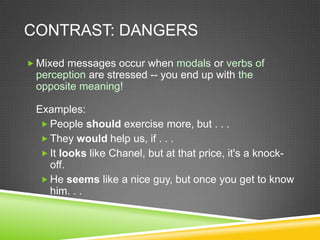
 Mixed messages occur when modals or verbs of
 perception are stressed -- you end up with the
 opposite meaning!

 Examples:
   People should exercise more, but . . .
   They would help us, if . . .
   It looks like Chanel, but at that price, it's a knock-
    off.
   He seems like a nice guy, but once you get to know
    him. . .
MEANING

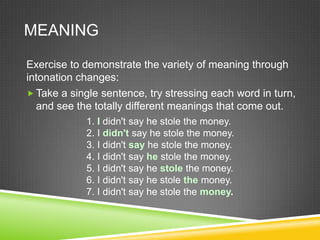
Exercise to demonstrate the variety of meaning through
intonation changes:
 Take a single sentence, try stressing each word in turn,
  and see the totally different meanings that come out.
            1. I didn't say he stole the money.
            2. I didn't say he stole the money.
            3. I didn't say he stole the money.
            4. I didn't say he stole the money.
            5. I didn't say he stole the money.
            6. I didn't say he stole the money.
            7. I didn't say he stole the money.
MEANING
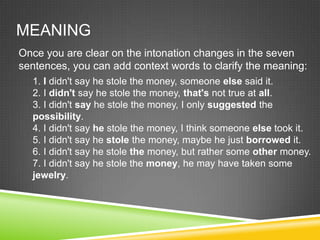
Once you are clear on the intonation changes in the seven
sentences, you can add context words to clarify the meaning:
  1. I didn't say he stole the money, someone else said it.
  2. I didn't say he stole the money, that's not true at all.
  3. I didn't say he stole the money, I only suggested the
  possibility.
  4. I didn't say he stole the money, I think someone else took it.
  5. I didn't say he stole the money, maybe he just borrowed it.
  6. I didn't say he stole the money, but rather some other money.
  7. I didn't say he stole the money, he may have taken some
  jewelry.
PRONUNCIATION
 In any language, there are areas of overlap, where one category
  has a great deal in common with a different category.
 In this case, intonation and pronunciation have two areas of
  overlap.
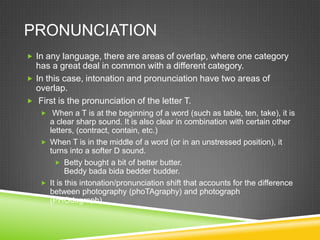
 First is the pronunciation of the letter T.
    When a T is at the beginning of a word (such as table, ten, take), it is
     a clear sharp sound. It is also clear in combination with certain other
     letters, (contract, contain, etc.)
    When T is in the middle of a word (or in an unstressed position), it
     turns into a softer D sound.
        Betty bought a bit of better butter.
           Beddy bada bida bedder budder.
    It is this intonation/pronunciation shift that accounts for the difference
     between photography (phoTAgraphy) and photograph
     (PHOdagraph).
MOOD AND PERSONALITY

 This determines if you will be considered charming or
  rude, confident or nervous, informed or unfamiliar.
 An extremely important part of intonation is inside a
  one-syllable word.
    We put in little sounds that are not in the written
     language, but that convey a great deal of
     information in terms of who we are.
MOOD AND PERSONALITY
 When we contrast two similar words, one ending with a voiced
  consonant (d, z, g, v, b) and the other with an unvoiced
  consonant (t, s, k, f, p), you will hear the difference in the
  preceding vowel, specifically in the length or duration of that
  vowel.
 In other words, words that end in a voiced consonant have a
  doubled (longer) vowel sound.
      For example, if you say bit, it is a quick, sharp sound--a
       single musical note.
    If you say bid, however, the word is stretched out, it has
       two musical notes, the first one higher than the second,
       bi-id.
MOOD AND PERSONALITY
 How you stretch a word and manipulate your pitch when you say
  it can also send various messages.
 Consider this video
MOOD AND PERSONALITY

 Sarcasm:
 The Three Little Pigs
 Sarcasm is another function of intonation, or rather the
  purposed lack of intonation to signal an opposite
  meaning.

English intonation

  • 1.
    ENGLISH INTONATION Spring 2012 Ms. Candice Quiñones
  • 2.
    THE BASICS • Intonationis a non-verbal method of expressing various meanings, emotions or situations. • Intonation in American English uses the rise and fall of pitch to accomplish this.
  • 3.
    INTONATION AND STRUCTURE Intonation is very closely linked to grammar, or more specifically, sentence structure.  Because English has a fairly strictly fixed word order, it is not an option to rearrange the words when we want to make a point about something.  Therefore, it becomes necessary to shift our intonation to highlight information that is key to our point.
  • 4.
    SOME CLASSIC RULES SentenceLevel Rules  Yes/no questions usually have a rising intonation at the end.  I.E. Do you want some water?  Information or “wh” questions usually have falling intonation at the end.  I.E. When will the package arrive?  Declarative sentences also have falling intonation at the end.  I.E. Intonation makes English more interesting.
  • 5.
    SOME CLASSIC RULES OtherRules  When listing items, your pitch should rise at the end of the word for each item, but drop after the last one.  I.E. I need a hammer, nails, wood, and some hinges.  It is acceptable to leave your intonation high and let your voice trail off when you are still thinking but plan to continue speaking.  I.E. Let me see…
  • 6.
    SOME CLASSIC RULES:THOUGHT GROUPS Every sentence can be divided up into a series of shorter “thought groups”.  For Example: “My brother bought me a new bicycle.” Can be divided as: My brother / bought me / a new bicycle.  Each of the divisions begins a new thought group.
  • 7.
    THOUGHT GROUPS &INTONATION  In a sentence, depending on the focus and the type of sentence, you will determine which words in each thought group to stress or emphasize by raising your pitch.  However, please note, that at the end of each thought group, your intonation must end by falling.  Example: My brother / bought me / a new bicycle. [Translation: My brother (not my sister) bought me (not you) a new bicycle (not a pony).] *Exception: the end of the final thought group of yes/no questions will rise.
  • 8.
    ASPECTS OF INTONATION New Information  Contrast  Meaning  Pronunciation  Mood or Personality  Cultural Understanding *Source: http://www.americanaccent.com/intonation.html
  • 9.
    NEW INFORMATION  Instandard English, the nouns usually carry the weight of a sentence, when everything else is equal.  Although the verb carries important information, it does not receive the primary stress of a first-time noun. Ex. Dogs eat bones.  After the information has been introduced, or is being repeated through the use of pronouns, the intonation shifts over to the verb.  The intonation changes when a sentence changes from nouns to pronouns: Ex. Dogs eat bones. They eat them.
  • 10.
    NEW INFORMATION: PHRASING In addition to the intonation of a statement, there is another aspect of speech that indicates meaning -- phrasing.  In a sentence, phrasing tells you where the speaker is at the moment, where he is going, and if he is finished or not.
  • 11.
    PHRASING: NOTICE THAT THEINTONATION STAYS ON THE NOUNS. Statement Listing Stress the nouns and let the tone With more than one item in a list, fall at the end of the sentence. all but the last one have a rising Dogs eat bones. tone. Dogs eat bones, kibbles and First half, second half The first half of a sentence meat. usually sets up the second half. Dogs eat bones, but cats eat Question fish. A regular question goes up (compared with a statement), but Intro Phrase When you want to preface your drops back down at the end. statement, use a rising tone. Do dogs eat bones? As we all know, dogs eat bones. Repeated Question A repeated, rhetorical or emotional question goes up, and then up again at the end. Do dogs eat bones?!
  • 12.
    CONTRAST  Once theintonation of new information is established, notice that there is a pattern that breaks that flow.  When you want to emphasize one thing over another, you reflect this contrast with pitch change.  Notice how the intonation indicates contrast:  Bob studies English.  Bob studies English, but he doesn't use it.
  • 13.
    CONTRAST: DANGERS  Ifa person consistently stresses "contrast words" as opposed to "new information words", he can end up sounding permanently argumentative*. Examples:  I said it is good.  He doesn't like it. Where are you going?  *this is not a good thing
  • 14.
    CONTRAST: DANGERS  Mixedmessages occur when modals or verbs of perception are stressed -- you end up with the opposite meaning! Examples:  People should exercise more, but . . .  They would help us, if . . .  It looks like Chanel, but at that price, it's a knock- off.  He seems like a nice guy, but once you get to know him. . .
  • 15.
    MEANING Exercise to demonstratethe variety of meaning through intonation changes:  Take a single sentence, try stressing each word in turn, and see the totally different meanings that come out. 1. I didn't say he stole the money. 2. I didn't say he stole the money. 3. I didn't say he stole the money. 4. I didn't say he stole the money. 5. I didn't say he stole the money. 6. I didn't say he stole the money. 7. I didn't say he stole the money.
  • 16.
    MEANING Once you areclear on the intonation changes in the seven sentences, you can add context words to clarify the meaning: 1. I didn't say he stole the money, someone else said it. 2. I didn't say he stole the money, that's not true at all. 3. I didn't say he stole the money, I only suggested the possibility. 4. I didn't say he stole the money, I think someone else took it. 5. I didn't say he stole the money, maybe he just borrowed it. 6. I didn't say he stole the money, but rather some other money. 7. I didn't say he stole the money, he may have taken some jewelry.
  • 17.
    PRONUNCIATION  In anylanguage, there are areas of overlap, where one category has a great deal in common with a different category.  In this case, intonation and pronunciation have two areas of overlap.  First is the pronunciation of the letter T.  When a T is at the beginning of a word (such as table, ten, take), it is a clear sharp sound. It is also clear in combination with certain other letters, (contract, contain, etc.)  When T is in the middle of a word (or in an unstressed position), it turns into a softer D sound.  Betty bought a bit of better butter. Beddy bada bida bedder budder.  It is this intonation/pronunciation shift that accounts for the difference between photography (phoTAgraphy) and photograph (PHOdagraph).
  • 18.
    MOOD AND PERSONALITY This determines if you will be considered charming or rude, confident or nervous, informed or unfamiliar.  An extremely important part of intonation is inside a one-syllable word.  We put in little sounds that are not in the written language, but that convey a great deal of information in terms of who we are.
  • 19.
    MOOD AND PERSONALITY When we contrast two similar words, one ending with a voiced consonant (d, z, g, v, b) and the other with an unvoiced consonant (t, s, k, f, p), you will hear the difference in the preceding vowel, specifically in the length or duration of that vowel.  In other words, words that end in a voiced consonant have a doubled (longer) vowel sound.  For example, if you say bit, it is a quick, sharp sound--a single musical note.  If you say bid, however, the word is stretched out, it has two musical notes, the first one higher than the second, bi-id.
  • 20.
    MOOD AND PERSONALITY How you stretch a word and manipulate your pitch when you say it can also send various messages.  Consider this video
  • 21.
    MOOD AND PERSONALITY Sarcasm:  The Three Little Pigs  Sarcasm is another function of intonation, or rather the purposed lack of intonation to signal an opposite meaning.