
ENGLISH PHONOLOGY:
         PRONUNCIATION
                LESSON 1
  FEATURES OF PRONUNCIATION
     The Description of Speech

Mgs. Nina Nesterenko
Phonemes
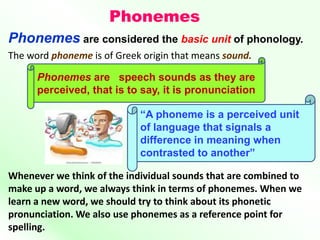
Phonemes are considered the basic unit of phonology.
The word phoneme is of Greek origin that means sound.

      Phonemes are speech sounds as they are
      perceived, that is to say, it is pronunciation

                            “A phoneme is a perceived unit
                            of language that signals a
                            difference in meaning when
                            contrasted to another”

Whenever we think of the individual sounds that are combined to
make up a word, we always think in terms of phonemes. When we
learn a new word, we should try to think about its phonetic
pronunciation. We also use phonemes as a reference point for
spelling.
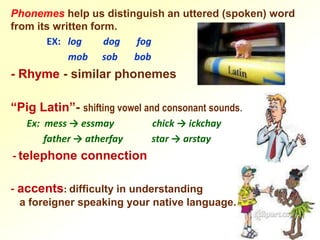
Phonemes help us distinguish an uttered (spoken) word
from its written form.
       EX: log      dog fog
            mob sob     bob
- Rhyme - similar phonemes

“Pig Latin”- shifting vowel and consonant sounds.
   Ex: mess → essmay         chick → ickchay
       father → atherfay     star → arstay
- telephone connection

- accents: difficulty in understanding
 a foreigner speaking your native language.
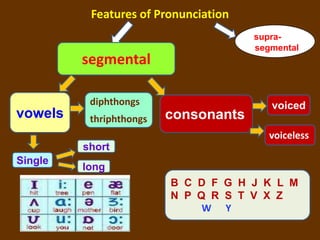
Features of Pronunciation
                                      supra-
                                      segmental
         segmental

          diphthongs                     voiced
vowels    thriphthongs   consonants
                                         voiceless
         short
Single
         long
                         B C D F G H J K L M
                         N P Q R S T V X Z
                              W Y
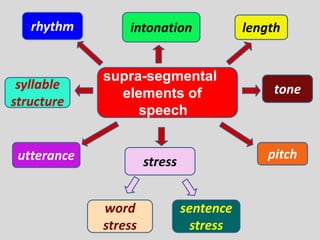
rhythm        intonation               length


             supra-segmental
 syllable                                      tone
               elements of
structure
                  speech


 utterance                                    pitch
                      stress


             word              sentence
             stress              stress
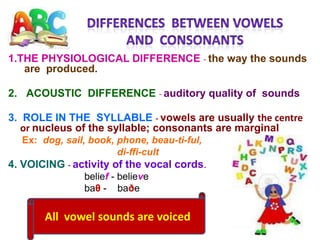
1.THE PHYSIOLOGICAL DIFFERENCE - the way the sounds
   are produced.

2. ACOUSTIC DIFFERENCE - auditory quality of sounds

3. ROLE IN THE SYLLABLE - vowels are usually the centre
   or nucleus of the syllable; consonants are marginal
  Ex: dog, sail, book, phone, beau-ti-ful,
                       di-ffi-cult
4. VOICING - activity of the vocal cords.
               belief - believe
               baθ - baðe

       All vowel sounds are voiced
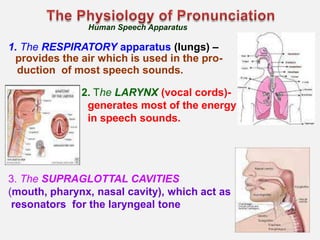
Human Speech Apparatus

1. The RESPIRATORY apparatus (lungs) –
 provides the air which is used in the pro-
  duction of most speech sounds.

              2. The LARYNX (vocal cords)-
               generates most of the energy
               in speech sounds.


3. The SUPRAGLOTTAL CAVITIES
(mouth, pharynx, nasal cavity), which act as
 resonators for the laryngeal tone
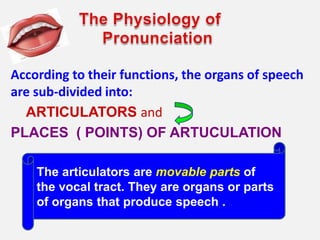
According to their functions, the organs of speech
are sub-divided into:
  ARTICULATORS and
PLACES ( POINTS) OF ARTUCULATION

    The articulators are movable parts of
    the vocal tract. They are organs or parts
    of organs that produce speech .
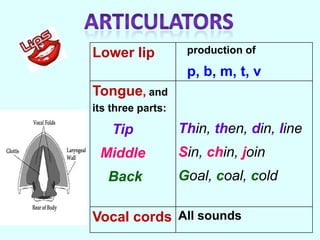
Lower lip           production of

                    p, b, m, t, v
Tongue, and
its three parts:

    Tip            Thin, then, din, line
 Middle            Sin, chin, join
   Back            Goal, coal, cold

Vocal cords All sounds
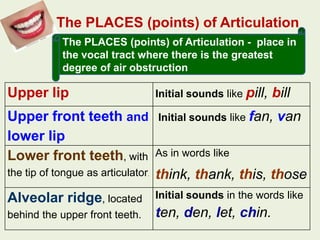
The PLACES (points) of Articulation
            The PLACES (points) of Articulation - place in
            the vocal tract where there is the greatest
            degree of air obstruction

Upper lip                           Initial sounds like pill,   bill
Upper front teeth and               Initial sounds like fan,     van
lower lip
Lower front teeth, with             As in words like
the tip of tongue as articulator.   think, thank, this, those
Alveolar ridge, located             Initial sounds in the words like
behind the upper front teeth.       ten, den, let, chin.
Thank you!


      nnesterenko@utpl.edu.ec


 To be continued!...
nnesterenko@utpl.edu.ec

Eng phon. 1st bim video lesson 1

  • 1.
    ENGLISH PHONOLOGY: PRONUNCIATION LESSON 1 FEATURES OF PRONUNCIATION The Description of Speech Mgs. Nina Nesterenko
  • 2.
    Phonemes Phonemes are consideredthe basic unit of phonology. The word phoneme is of Greek origin that means sound. Phonemes are speech sounds as they are perceived, that is to say, it is pronunciation “A phoneme is a perceived unit of language that signals a difference in meaning when contrasted to another” Whenever we think of the individual sounds that are combined to make up a word, we always think in terms of phonemes. When we learn a new word, we should try to think about its phonetic pronunciation. We also use phonemes as a reference point for spelling.
  • 3.
    Phonemes help usdistinguish an uttered (spoken) word from its written form. EX: log dog fog mob sob bob - Rhyme - similar phonemes “Pig Latin”- shifting vowel and consonant sounds. Ex: mess → essmay chick → ickchay father → atherfay star → arstay - telephone connection - accents: difficulty in understanding a foreigner speaking your native language.
  • 4.
    Features of Pronunciation supra- segmental segmental diphthongs voiced vowels thriphthongs consonants voiceless short Single long B C D F G H J K L M N P Q R S T V X Z W Y
  • 5.
    rhythm intonation length supra-segmental syllable tone elements of structure speech utterance pitch stress word sentence stress stress
  • 6.
    1.THE PHYSIOLOGICAL DIFFERENCE- the way the sounds are produced. 2. ACOUSTIC DIFFERENCE - auditory quality of sounds 3. ROLE IN THE SYLLABLE - vowels are usually the centre or nucleus of the syllable; consonants are marginal Ex: dog, sail, book, phone, beau-ti-ful, di-ffi-cult 4. VOICING - activity of the vocal cords. belief - believe baθ - baðe All vowel sounds are voiced
  • 7.
    Human Speech Apparatus 1.The RESPIRATORY apparatus (lungs) – provides the air which is used in the pro- duction of most speech sounds. 2. The LARYNX (vocal cords)- generates most of the energy in speech sounds. 3. The SUPRAGLOTTAL CAVITIES (mouth, pharynx, nasal cavity), which act as resonators for the laryngeal tone
  • 8.
    According to theirfunctions, the organs of speech are sub-divided into: ARTICULATORS and PLACES ( POINTS) OF ARTUCULATION The articulators are movable parts of the vocal tract. They are organs or parts of organs that produce speech .
  • 9.
    Lower lip production of p, b, m, t, v Tongue, and its three parts: Tip Thin, then, din, line Middle Sin, chin, join Back Goal, coal, cold Vocal cords All sounds
  • 10.
    The PLACES (points)of Articulation The PLACES (points) of Articulation - place in the vocal tract where there is the greatest degree of air obstruction Upper lip Initial sounds like pill, bill Upper front teeth and Initial sounds like fan, van lower lip Lower front teeth, with As in words like the tip of tongue as articulator. think, thank, this, those Alveolar ridge, located Initial sounds in the words like behind the upper front teeth. ten, den, let, chin.
  • 11.
    Thank you! nnesterenko@utpl.edu.ec To be continued!... nnesterenko@utpl.edu.ec