ASEPTIC PROCESS MODELLING
Pragati Singham
Ph.D(FPE)
Introduction
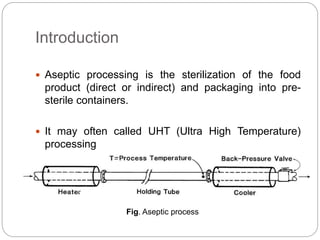
 Aseptic processing is the sterilization of the food
product (direct or indirect) and packaging into pre-
sterile containers.
 It may often called UHT (Ultra High Temperature)
processing
Fig. Aseptic process
 Three process occurs due to heat treatment
during the process
 Heat transfer
 Microbial inactivation
 Nutrient degradation
Heat transfer
 Mathematical model can be used for the heat transfer
 Among the different mathematical models explicit finite
difference method can be used
 Assume there is a liquid food (milk or juices)moving with
laminar flow inside a scraped surface heat exchanger
x = l
δx
 The liquid has uniform distribution i.e ρ, Cp, K, A will be
constant
 Heat energy
 According to Fourier law
Where,
q= rate of heat transfer
A= area
K= thermal conductivity
du= change in temperature
dx= change in distance
Based on conservation of energy,
change in heat energy(H.E) of the slice=
Input H.E – output H.E = H.E from left end - H.E from
left end
Where,
α = diffusivity (k/ρ C)
 Holding
 Cooling
Microbial inactivation
The integrated lethality of micro-organisms in the fluid
leaving a hold tube will be different at different positions
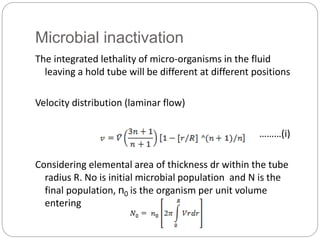
Velocity distribution (laminar flow)
………(i)
Considering elemental area of thickness dr within the tube
radius R. No is initial microbial population and N is the
final population, n0 is the organism per unit volume
entering
Volumetric flow rate
The residence time of fluid within the area element is L/V,
and the number of survivors, N = No[10−L/(VD).
Let A = (3n + 1)/(n + 1); B = (n + 1) /n; y = r/R in equation (i)
The ratio L/(D) is the lethality, Sv, based on the average
velocity
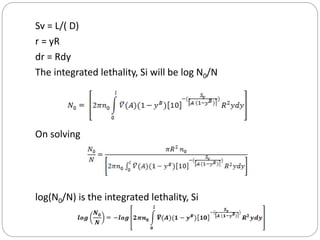
Sv = L/( D)
r = yR
dr = Rdy
The integrated lethality, Si will be log N0/N
On solving
log(N0/N) is the integrated lethality, Si
Likewise microbial inactivation
Nutrient degradation is determined
Substituting Sv for log(N0/N)
Nutrient degradation
Thank you

Aseptic process modelling

  • 1.
  • 2.
    Introduction  Aseptic processingis the sterilization of the food product (direct or indirect) and packaging into pre- sterile containers.  It may often called UHT (Ultra High Temperature) processing Fig. Aseptic process
  • 3.
     Three processoccurs due to heat treatment during the process  Heat transfer  Microbial inactivation  Nutrient degradation
  • 4.
    Heat transfer  Mathematicalmodel can be used for the heat transfer  Among the different mathematical models explicit finite difference method can be used  Assume there is a liquid food (milk or juices)moving with laminar flow inside a scraped surface heat exchanger x = l δx
  • 5.
     The liquidhas uniform distribution i.e ρ, Cp, K, A will be constant  Heat energy  According to Fourier law Where, q= rate of heat transfer A= area K= thermal conductivity du= change in temperature dx= change in distance
  • 6.
    Based on conservationof energy, change in heat energy(H.E) of the slice= Input H.E – output H.E = H.E from left end - H.E from left end Where, α = diffusivity (k/ρ C)
  • 7.
  • 8.
    Microbial inactivation The integratedlethality of micro-organisms in the fluid leaving a hold tube will be different at different positions Velocity distribution (laminar flow) ………(i) Considering elemental area of thickness dr within the tube radius R. No is initial microbial population and N is the final population, n0 is the organism per unit volume entering
  • 9.
    Volumetric flow rate Theresidence time of fluid within the area element is L/V, and the number of survivors, N = No[10−L/(VD). Let A = (3n + 1)/(n + 1); B = (n + 1) /n; y = r/R in equation (i) The ratio L/(D) is the lethality, Sv, based on the average velocity
  • 10.
    Sv = L/(D) r = yR dr = Rdy The integrated lethality, Si will be log N0/N On solving log(N0/N) is the integrated lethality, Si
  • 11.
    Likewise microbial inactivation Nutrientdegradation is determined Substituting Sv for log(N0/N) Nutrient degradation
  • 12.

Editor's Notes

  • #9 Velocity distribution for non-newtonian power law of laminar flow fluid Pseudoplastic umax n<1 ubar
  • #10 L/V =Residence time of flud withn the element area