OHMIC
PROCESSIN
GMontica Sawant
SY Tech (FET)
13FET1007
What is ohmic
heating?➜ Ohmic heating is an advanced thermal processing method wherein the food
material, which serves as an electrical resistor, is heated by passing electricity
through it.
➜ Unlike conventional heating where heat transfer occurs from a heated surface to the
product interior by means of convection and conduction, Ohmic heating has inside–
outside heat transfer pattern
➜ Electrical energy is dissipated into heat, which results in rapid and uniform heating
with minimal thermal degradation.
➜ Also called electrical resistance heating, Joule heating, or electro-heating, and may
be used for a variety of applications in the food industry.
➜ Similar to HTST processing with the added benefit of uniform and complete heating
of particulate food systems like soups.
PRINCIPLE
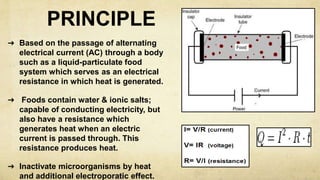
➜ Based on the passage of alternating
electrical current (AC) through a body
such as a liquid-particulate food
system which serves as an electrical
resistance in which heat is generated.
➜ Foods contain water & ionic salts;
capable of conducting electricity, but
also have a resistance which
generates heat when an electric
current is passed through. This
resistance produces heat.
➜ Inactivate microorganisms by heat
and additional electroporatic effect.
WORKING
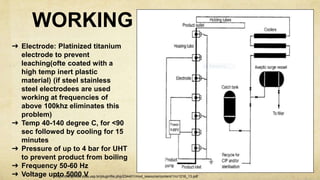
➜ Electrode: Platinized titanium
electrode to prevent
leaching(ofte coated with a
high temp inert plastic
material) (if steel stainless
steel electrodees are used
working at frequencies of
above 100khz eliminates this
problem)
➜ Temp 40-140 degree C, for <90
sec followed by cooling for 15
minutes
➜ Pressure of up to 4 bar for UHT
to prevent product from boiling
➜ Frequency 50-60 Hz
➜ Voltage upto 5000 Vhttp://disciplinas.stoa.usp.br/pluginfile.php/234401/mod_resource/content/1/cr1216_13.pdf
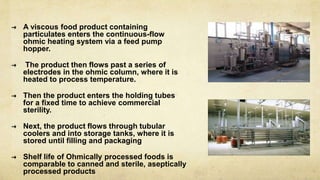
➜ A viscous food product containing
particulates enters the continuous-flow
ohmic heating system via a feed pump
hopper.
➜ The product then flows past a series of
electrodes in the ohmic column, where it is
heated to process temperature.
➜ Then the product enters the holding tubes
for a fixed time to achieve commercial
sterility.
➜ Next, the product flows through tubular
coolers and into storage tanks, where it is
stored until filling and packaging
➜ Shelf life of Ohmically processed foods is
comparable to canned and sterile, aseptically
processed products
CONTROL PARAMETERS
➜ Electrical conductivity, temperature
dependence of conductivity, design of
heating device, residence time, thermo
physical properties of food, electric field
strength.
➜ However, the most important factor is the
electrical conductivity of the product and
its temperature dependence.
➜ If the product has more than one phase
such as in the case of a mixture of liquid
and particulates, the electrical
conductivity of all the phases has to be
considered.
➜ The electrical conductivity increases with
rising temperature(resistance of food falls
by factor of 2 to 3 over temperature rise of
Factors affecting ohmic heating
➜ Electrical conductivity of food and food mixture which in turn
depends on food components: ionic components (salt), acid, and
moisture mobility increase electrical conductivity, while fats, lipids,
and alcohol decrease it
➜ Fluid viscosity : higher viscosity fluids shows faster ohmic heating
than lower viscosity fluids
➜ In case of liquid + solid mixture, the property difference of the two
components also affects ohmic heating, particulate size (upto 25mm
ideally )
➜ Density and specific heat of the food product
Applications
➜ Ohmic heating can be used for heating liquid foods containing
large particulates, such as soups, stews, and fruit slices in
syrups and sauces, and heat sensitive liquids.
➜ The technology is useful for the treatment of proteinaceous
foods, which tend to denature and coagulate when thermally
processed. For example, liquid egg can be ohmically heated in a
fraction of a second without coagulating it.
➜ Juices can be treated to inactivate enzymes without affecting
the flavor.
➜ Other potential applications of ohmic heating include blanching,
thawing, on-line detection of starch gelatinization, fermentation,
peeling, dehydration, and extraction.
➜ Currently used in a large number of fruit processing plants in
the US and Europe
Advantages Disadvantages
➜ It can heat particulate foods and Liquid–particle
mixtures. (impossible by conventional methods)
By ohmic heating, high temperatures can be rapidly
achieved(due to uniform heating). For e.g.
temperatures for ultra high temperature (UHT)
processing
➜ As there are no hot surfaces for heat transfer, there
is low risk of product damage due to burning
➜ It has high energy conversion efficiency (90%)
➜ It requires relatively low capital cost.
➜ Very clean and hygienic systems
➜ Minimal thermal deterioration of food resulting in
minimal mechanical damage and better nutrients
and vitamin retention, shorter operation time
➜ Complex relationship between
conductivity and temperature
➜ Leaching of electrode material into the
food systems
➜ ohmically processed multi-phase food
product Not yet approved by the FDA
(as of 2001)
➜ Expensive in terms of installation and
equipment manufacture
➜ Low conductivity foods cannot be
processed eg. foods having fat
globules
➜ Rapid increase of conductivity with
temperature may lead to “runaway
heating”
➜ Lack of data concerning critical
factors affecting heating, including
residence time, orientations, loading
levels, etc
➜ Lack of data correlating the

Ohmic processing

  • 1.
  • 2.
    What is ohmic heating?➜Ohmic heating is an advanced thermal processing method wherein the food material, which serves as an electrical resistor, is heated by passing electricity through it. ➜ Unlike conventional heating where heat transfer occurs from a heated surface to the product interior by means of convection and conduction, Ohmic heating has inside– outside heat transfer pattern ➜ Electrical energy is dissipated into heat, which results in rapid and uniform heating with minimal thermal degradation. ➜ Also called electrical resistance heating, Joule heating, or electro-heating, and may be used for a variety of applications in the food industry. ➜ Similar to HTST processing with the added benefit of uniform and complete heating of particulate food systems like soups.
  • 3.
    PRINCIPLE ➜ Based onthe passage of alternating electrical current (AC) through a body such as a liquid-particulate food system which serves as an electrical resistance in which heat is generated. ➜ Foods contain water & ionic salts; capable of conducting electricity, but also have a resistance which generates heat when an electric current is passed through. This resistance produces heat. ➜ Inactivate microorganisms by heat and additional electroporatic effect.
  • 4.
    WORKING ➜ Electrode: Platinizedtitanium electrode to prevent leaching(ofte coated with a high temp inert plastic material) (if steel stainless steel electrodees are used working at frequencies of above 100khz eliminates this problem) ➜ Temp 40-140 degree C, for <90 sec followed by cooling for 15 minutes ➜ Pressure of up to 4 bar for UHT to prevent product from boiling ➜ Frequency 50-60 Hz ➜ Voltage upto 5000 Vhttp://disciplinas.stoa.usp.br/pluginfile.php/234401/mod_resource/content/1/cr1216_13.pdf
  • 5.
    ➜ A viscousfood product containing particulates enters the continuous-flow ohmic heating system via a feed pump hopper. ➜ The product then flows past a series of electrodes in the ohmic column, where it is heated to process temperature. ➜ Then the product enters the holding tubes for a fixed time to achieve commercial sterility. ➜ Next, the product flows through tubular coolers and into storage tanks, where it is stored until filling and packaging ➜ Shelf life of Ohmically processed foods is comparable to canned and sterile, aseptically processed products
  • 6.
    CONTROL PARAMETERS ➜ Electricalconductivity, temperature dependence of conductivity, design of heating device, residence time, thermo physical properties of food, electric field strength. ➜ However, the most important factor is the electrical conductivity of the product and its temperature dependence. ➜ If the product has more than one phase such as in the case of a mixture of liquid and particulates, the electrical conductivity of all the phases has to be considered. ➜ The electrical conductivity increases with rising temperature(resistance of food falls by factor of 2 to 3 over temperature rise of
  • 7.
    Factors affecting ohmicheating ➜ Electrical conductivity of food and food mixture which in turn depends on food components: ionic components (salt), acid, and moisture mobility increase electrical conductivity, while fats, lipids, and alcohol decrease it ➜ Fluid viscosity : higher viscosity fluids shows faster ohmic heating than lower viscosity fluids ➜ In case of liquid + solid mixture, the property difference of the two components also affects ohmic heating, particulate size (upto 25mm ideally ) ➜ Density and specific heat of the food product
  • 9.
    Applications ➜ Ohmic heatingcan be used for heating liquid foods containing large particulates, such as soups, stews, and fruit slices in syrups and sauces, and heat sensitive liquids. ➜ The technology is useful for the treatment of proteinaceous foods, which tend to denature and coagulate when thermally processed. For example, liquid egg can be ohmically heated in a fraction of a second without coagulating it. ➜ Juices can be treated to inactivate enzymes without affecting the flavor. ➜ Other potential applications of ohmic heating include blanching, thawing, on-line detection of starch gelatinization, fermentation, peeling, dehydration, and extraction. ➜ Currently used in a large number of fruit processing plants in the US and Europe
  • 10.
    Advantages Disadvantages ➜ Itcan heat particulate foods and Liquid–particle mixtures. (impossible by conventional methods) By ohmic heating, high temperatures can be rapidly achieved(due to uniform heating). For e.g. temperatures for ultra high temperature (UHT) processing ➜ As there are no hot surfaces for heat transfer, there is low risk of product damage due to burning ➜ It has high energy conversion efficiency (90%) ➜ It requires relatively low capital cost. ➜ Very clean and hygienic systems ➜ Minimal thermal deterioration of food resulting in minimal mechanical damage and better nutrients and vitamin retention, shorter operation time ➜ Complex relationship between conductivity and temperature ➜ Leaching of electrode material into the food systems ➜ ohmically processed multi-phase food product Not yet approved by the FDA (as of 2001) ➜ Expensive in terms of installation and equipment manufacture ➜ Low conductivity foods cannot be processed eg. foods having fat globules ➜ Rapid increase of conductivity with temperature may lead to “runaway heating” ➜ Lack of data concerning critical factors affecting heating, including residence time, orientations, loading levels, etc ➜ Lack of data correlating the

Editor's Notes

  • #3 The rate of heating is directly proportional to the square of the electric field strength, E, and the electrical conductivity. The electric field strength can be varied by adjusting the electrode gap or the applied voltage. However, the most important factor is the electrical conductivity of the product and its temperature dependence. The electrical conductivity increases with rising temperature, suggesting that ohmic heating becomes more effective as temperature increases.  
  • #4 The rate of heating is directly proportional to the square of the electric field strength, E, and the electrical conductivity. The electric field strength can be varied by adjusting the electrode gap or the applied voltage. However, the most important factor is the electrical conductivity of the product and its temperature dependence. The electrical conductivity increases with rising temperature, suggesting that ohmic heating becomes more effective as temperature increases.  
  • #5 http://disciplinas.stoa.usp.br/pluginfile.php/234401/mod_resource/content/1/cr1216_13.pdf