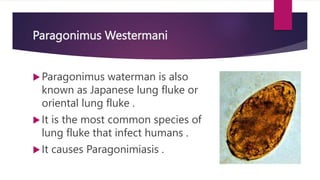
Paragonimus Westermani
Paragonimus waterman is also
known as Japanese lung fluke or
oriental lung fluke .
It is the most common species of
lung fluke that infect humans .
It causes Paragonimiasis .
Geographical Distribution
Eastern Asia
Africa
South and Central
America
History
 It was discovered by
Cornerad Kerbert in
1878
Species of paragonimus
 P. westermani filipinus
 P. westermani ichunencis
 P. westermani japonicus
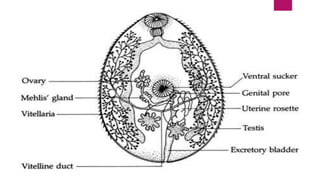
Morphology
 Paragonimus westermani resembles coffee bean in size ,
shape ,and colour .
 Adult worms are 7.5 -12 mm long and 4-6 mm wide .
 Thickness is 3.5 – 5 mm .
 Skin is thickly covered with scale like spines .
 Have oral and ventral suckers .
 Testes are located posteriorly .
Morphology
Eggs :
 80- 120 micrometres and 45-70 micrometres wide .
 Yellowish brown with thick shell
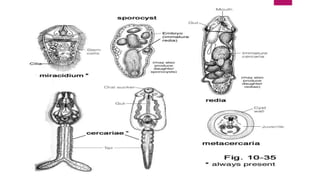
cercaria :
 Circadian are often indistinguishable between species .
 Have large posterior sucker and exterior is spine.
Metacercaria :
 They are usually encysted in tissues.
 The exterior is spined and has two suckes .
Morphology
Adult :
 Reddish-brown and ovoid .
 7-16 mm in length and 4-8 mm wide .
 Hermaphrodite
 Have oval and ventral suckers .
Discovery
 P.westermani was discovered when tow Bengal Tigers died of
paragonimiasis in zoo in Europe in 1878 .
 P.westermani was discovered in lungs of humans by Ringer in 1879
.
 Mansion proposed the snail as an intermediate host .
 From 1916- 1932 Japanese scientists describe whole life cycle in
snail.
 P.westermani was named after Pieter westerman ,a zoo keeper who
noted the trematode in Bengal Tigers in Amsterdam zoo .
Hosts
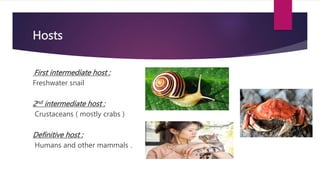
First intermediate host :
Freshwater snail
2nd intermediate host :
Crustaceans ( mostly crabs )
Definitive host :
Humans and other mammals .
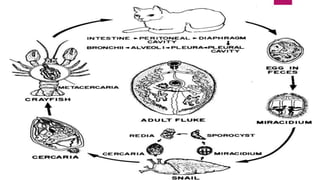
Life cycle
In snail :
 Unembryonated eggs are passed in the septum if human or feline (cats) .
 Two weeks later , miracidia develop in the egg and hatches .
 Miracidia penetrate its first intermediate host (snail ) .
 With in snail mother sporocyst form and produce many mother rediae .
 Mother rediae produce daughter rediae which shed crawling cercariae
into freshwater .
 Mature cercariae develops within 3-5 months.
Life cycle
In Crustaceans :
 The crawling cercariae penetrates freshwater crabs and encryption
in its muscles becoming meta cercaria .
 Metacercaria takes 2 months to develop .
In Humans and other mammals:
 Humans or felines then eat the infected crabs raw .
 Once eaten, the Metacercaria penetrates the gut and excess in
duodenum , penetrate through the intestinal wall into peritoneal
cavity ,then through abdominal wall and diaphragm into lungs .
Life cycle
 In lungs they encapsulate themselves and
become adults .
 But when they reach Brain and straited muscles
the eggs lid cannot exit , So , this can be life
threatening.
 Infections may persist for 20 years in Humans .
Pathogenicity
 Once in the lungs or other site , the eggs in the tissues
become Pseudotubercles ,and gets into the spinal
cord ,it’s can cause paralysis.
 This condition in Heart can cause death .
 The symptoms are localised in the pulmonary system
which include , bad cough ,bronchitis and blood in
sputum (hemoptysis ) .
Diagnosis
Stool or sputum demonstration
Antibody detection
X –Ray of chest cavity
Biopsy (lungs and other organs or
tissues)
Prevention
 More hygienic food cooking and preparation .
 Elimination of first intermediate host .
 Hand washing habits etc.
Treatment
 Paraziquantel
 Course of corticosteroids ( for cerebral
infection )
 Triclabendazole
Thank You for Your Attention 😊

paragonimus westermani.pptx

  • 1.
  • 2.
    Paragonimus Westermani Paragonimus watermanis also known as Japanese lung fluke or oriental lung fluke . It is the most common species of lung fluke that infect humans . It causes Paragonimiasis .
  • 3.
  • 4.
    History  It wasdiscovered by Cornerad Kerbert in 1878
  • 5.
    Species of paragonimus P. westermani filipinus  P. westermani ichunencis  P. westermani japonicus
  • 6.
    Morphology  Paragonimus westermaniresembles coffee bean in size , shape ,and colour .  Adult worms are 7.5 -12 mm long and 4-6 mm wide .  Thickness is 3.5 – 5 mm .  Skin is thickly covered with scale like spines .  Have oral and ventral suckers .  Testes are located posteriorly .
  • 8.
    Morphology Eggs :  80-120 micrometres and 45-70 micrometres wide .  Yellowish brown with thick shell cercaria :  Circadian are often indistinguishable between species .  Have large posterior sucker and exterior is spine. Metacercaria :  They are usually encysted in tissues.  The exterior is spined and has two suckes .
  • 10.
    Morphology Adult :  Reddish-brownand ovoid .  7-16 mm in length and 4-8 mm wide .  Hermaphrodite  Have oval and ventral suckers .
  • 11.
    Discovery  P.westermani wasdiscovered when tow Bengal Tigers died of paragonimiasis in zoo in Europe in 1878 .  P.westermani was discovered in lungs of humans by Ringer in 1879 .  Mansion proposed the snail as an intermediate host .  From 1916- 1932 Japanese scientists describe whole life cycle in snail.  P.westermani was named after Pieter westerman ,a zoo keeper who noted the trematode in Bengal Tigers in Amsterdam zoo .
  • 12.
    Hosts First intermediate host: Freshwater snail 2nd intermediate host : Crustaceans ( mostly crabs ) Definitive host : Humans and other mammals .
  • 13.
    Life cycle In snail:  Unembryonated eggs are passed in the septum if human or feline (cats) .  Two weeks later , miracidia develop in the egg and hatches .  Miracidia penetrate its first intermediate host (snail ) .  With in snail mother sporocyst form and produce many mother rediae .  Mother rediae produce daughter rediae which shed crawling cercariae into freshwater .  Mature cercariae develops within 3-5 months.
  • 14.
    Life cycle In Crustaceans:  The crawling cercariae penetrates freshwater crabs and encryption in its muscles becoming meta cercaria .  Metacercaria takes 2 months to develop . In Humans and other mammals:  Humans or felines then eat the infected crabs raw .  Once eaten, the Metacercaria penetrates the gut and excess in duodenum , penetrate through the intestinal wall into peritoneal cavity ,then through abdominal wall and diaphragm into lungs .
  • 15.
    Life cycle  Inlungs they encapsulate themselves and become adults .  But when they reach Brain and straited muscles the eggs lid cannot exit , So , this can be life threatening.  Infections may persist for 20 years in Humans .
  • 17.
    Pathogenicity  Once inthe lungs or other site , the eggs in the tissues become Pseudotubercles ,and gets into the spinal cord ,it’s can cause paralysis.  This condition in Heart can cause death .  The symptoms are localised in the pulmonary system which include , bad cough ,bronchitis and blood in sputum (hemoptysis ) .
  • 18.
    Diagnosis Stool or sputumdemonstration Antibody detection X –Ray of chest cavity Biopsy (lungs and other organs or tissues)
  • 19.
    Prevention  More hygienicfood cooking and preparation .  Elimination of first intermediate host .  Hand washing habits etc.
  • 20.
    Treatment  Paraziquantel  Courseof corticosteroids ( for cerebral infection )  Triclabendazole
  • 21.
    Thank You forYour Attention 😊