The Media Revolution

Erik Bergholm
Life Before Gutenberg
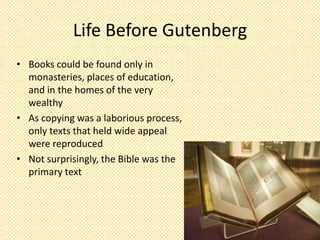
• Books could be found only in
monasteries, places of education,
and in the homes of the very
wealthy
• As copying was a laborious process,
only texts that held wide appeal
were reproduced
• Not surprisingly, the Bible was the
primary text
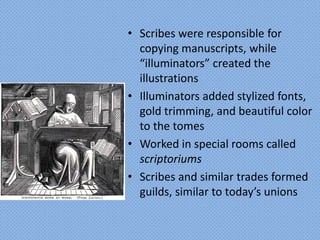
• Scribes were responsible for
copying manuscripts, while
“illuminators” created the
illustrations
• Illuminators added stylized fonts,
gold trimming, and beautiful color
to the tomes
• Worked in special rooms called
scriptoriums
• Scribes and similar trades formed
guilds, similar to today’s unions
Early Process
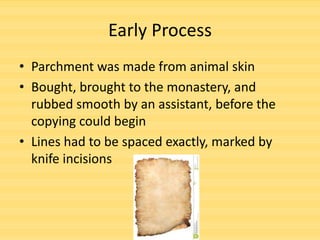
• Parchment was made from animal skin
• Bought, brought to the monastery, and
rubbed smooth by an assistant, before the
copying could begin
• Lines had to be spaced exactly, marked by
knife incisions
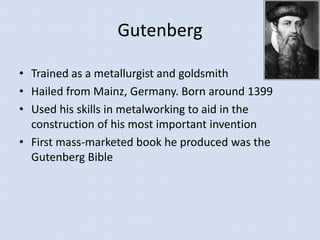
Gutenberg
• Trained as a metallurgist and goldsmith
• Hailed from Mainz, Germany. Born around 1399
• Used his skills in metalworking to aid in the
construction of his most important invention
• First mass-marketed book he produced was the
Gutenberg Bible
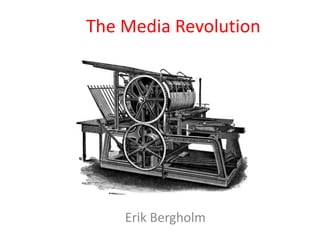
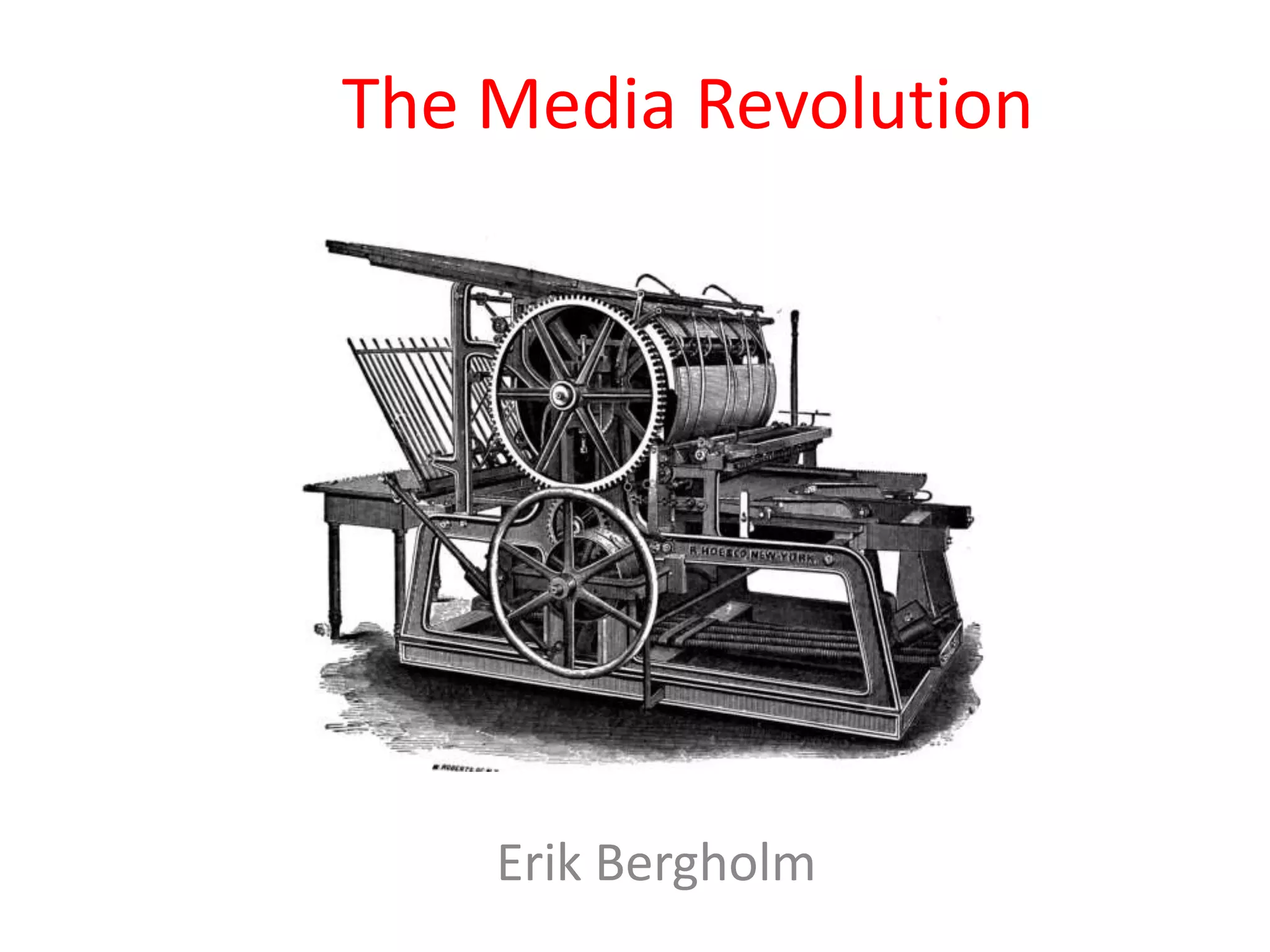
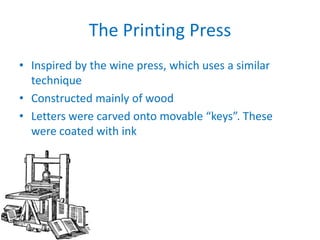
The Printing Press
• Inspired by the wine press, which uses a similar
technique
• Constructed mainly of wood
• Letters were carved onto movable “keys”. These
were coated with ink
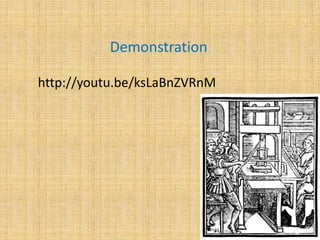
Demonstration
http://youtu.be/ksLaBnZVRnM
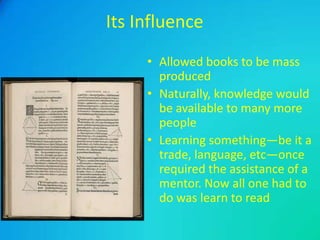
Its Influence
• Allowed books to be mass
produced
• Naturally, knowledge would
be available to many more
people
• Learning something—be it a
trade, language, etc—once
required the assistance of a
mentor. Now all one had to
do was learn to read
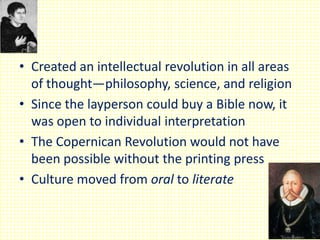
• Created an intellectual revolution in all areas
of thought—philosophy, science, and religion
• Since the layperson could buy a Bible now, it
was open to individual interpretation
• The Copernican Revolution would not have
been possible without the printing press
• Culture moved from oral to literate
Food for Thought
• The invention, and subsequent massproduction, of books allowed humanity to
store its collective knowledge
• No longer do we have to rely on heredity and
oral tradition
• Books are the new DNA. Humanity has
transcended physical evolution
• Echoes what famous astronomer said (was it
Sagan or Hawking?)
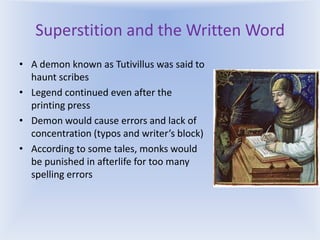
Superstition and the Written Word
• A demon known as Tutivillus was said to
haunt scribes
• Legend continued even after the
printing press
• Demon would cause errors and lack of
concentration (typos and writer’s block)
• According to some tales, monks would
be punished in afterlife for too many
spelling errors
Sources
• "A Gallimaufry." 'a Gallimaufry' N.p., 14 Mar. 2011. Web. 12 Nov. 2013.
• "End of Europe's Middle Ages - The Impact of the Printing Press." End of
Europe's Middle Ages - The Impact of the Printing Press. University
of Calgary, 6 Nov. 2001. Web. 11 Nov. 2013.
• "Harry Ransom Center the University of Texas at Austin." Harry Ransom
Center RSS. University of Texas at Austin, n.d. Web. 11 Nov. 2013.
• "Inventor of the Week: Archive." Inventor of the Week: Archive. Lemelson
MIT, Aug. 2004. Web. 11 Nov. 2013.

The printing press

  • 1.
  • 2.
    Life Before Gutenberg •Books could be found only in monasteries, places of education, and in the homes of the very wealthy • As copying was a laborious process, only texts that held wide appeal were reproduced • Not surprisingly, the Bible was the primary text
  • 3.
    • Scribes wereresponsible for copying manuscripts, while “illuminators” created the illustrations • Illuminators added stylized fonts, gold trimming, and beautiful color to the tomes • Worked in special rooms called scriptoriums • Scribes and similar trades formed guilds, similar to today’s unions
  • 4.
    Early Process • Parchmentwas made from animal skin • Bought, brought to the monastery, and rubbed smooth by an assistant, before the copying could begin • Lines had to be spaced exactly, marked by knife incisions
  • 5.
    Gutenberg • Trained asa metallurgist and goldsmith • Hailed from Mainz, Germany. Born around 1399 • Used his skills in metalworking to aid in the construction of his most important invention • First mass-marketed book he produced was the Gutenberg Bible
  • 6.
    The Printing Press •Inspired by the wine press, which uses a similar technique • Constructed mainly of wood • Letters were carved onto movable “keys”. These were coated with ink
  • 7.
  • 8.
    Its Influence • Allowedbooks to be mass produced • Naturally, knowledge would be available to many more people • Learning something—be it a trade, language, etc—once required the assistance of a mentor. Now all one had to do was learn to read
  • 9.
    • Created anintellectual revolution in all areas of thought—philosophy, science, and religion • Since the layperson could buy a Bible now, it was open to individual interpretation • The Copernican Revolution would not have been possible without the printing press • Culture moved from oral to literate
  • 10.
    Food for Thought •The invention, and subsequent massproduction, of books allowed humanity to store its collective knowledge • No longer do we have to rely on heredity and oral tradition • Books are the new DNA. Humanity has transcended physical evolution • Echoes what famous astronomer said (was it Sagan or Hawking?)
  • 11.
    Superstition and theWritten Word • A demon known as Tutivillus was said to haunt scribes • Legend continued even after the printing press • Demon would cause errors and lack of concentration (typos and writer’s block) • According to some tales, monks would be punished in afterlife for too many spelling errors
  • 12.
    Sources • "A Gallimaufry."'a Gallimaufry' N.p., 14 Mar. 2011. Web. 12 Nov. 2013. • "End of Europe's Middle Ages - The Impact of the Printing Press." End of Europe's Middle Ages - The Impact of the Printing Press. University of Calgary, 6 Nov. 2001. Web. 11 Nov. 2013. • "Harry Ransom Center the University of Texas at Austin." Harry Ransom Center RSS. University of Texas at Austin, n.d. Web. 11 Nov. 2013. • "Inventor of the Week: Archive." Inventor of the Week: Archive. Lemelson MIT, Aug. 2004. Web. 11 Nov. 2013.