Ade Wijaya, MD – January 2020
 Drugs can effect EEG interpretation
 Quantity of medication in the patient
influences the EEG. This quantity varies
according to dose, volume of distribution,
and rate of metabolism
 Systemic effects of medication, e.g.,
hyponatremia from Carbamazepine, may
diffusely perturb the EEG.
Blume WT. Drug effects on EEG. Journal of Clinical Neurophysiology. 2006 Aug 1;23(4):306-11.
 Background slower: Phenytoin and others
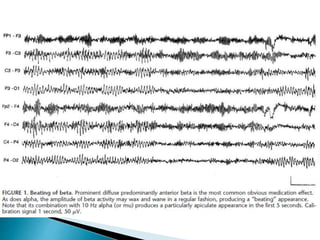
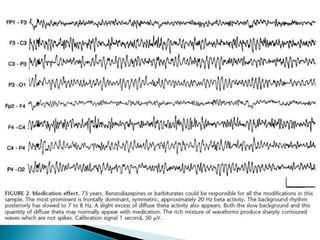
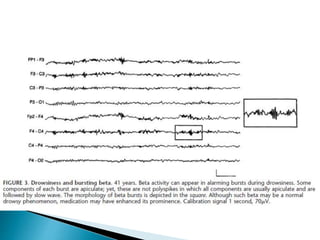
 Excess beta
 GABA agonists: barbiturates, benzodiazepines
 Epileptiform activity
 Triphasic waves
 Theta and Delta
 Coma patterns
Blume WT. Drug effects on EEG. Journal of Clinical Neurophysiology. 2006 Aug 1;23(4):306-11.
 Beta activity is more abundantly expressed by
medication in children than in adults and with
acute rather than chronic administration.
 Barbiturates and Benzodiazepines
 Cocaine, amphetamines, and
methylphenidate as well as tricyclic
antidepressants
 Withdrawal from alcohol and barbiturates
(G. Bauer and R. Bauer, 2005; Van Cott and Brenner, 2003)
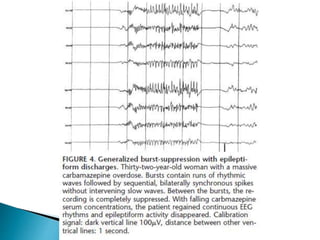
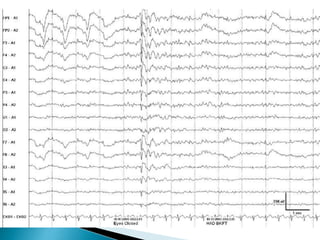
 High doses of several types of medications may
elicit spikes or poly spikes that usually appear
bisynchronously in bursts, either spontaneously
or as a photoparoxysmal response
 Clozapine, Lithium, Phenothiazines, selective
serotonin reuptake inhibitors, and tricyclic
antidepressants.
 Acute withdrawal of alcohol or barbiturates may
also elicit bursts of spikes and polyspikes,
particularly as a photoparoxysmal response
(G. Bauer and R. Bauer, 2005; Van Cott and Brenner, 2003)
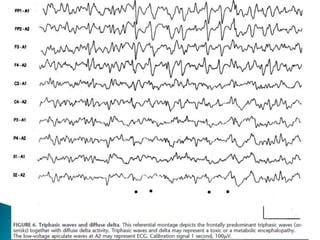
 Valproic Acid-associated hyperammonemic
encephalopathy
 Baclofen, Lithium, Levodopa, Pentobarbital,
and the serotonin syndrome
(Kifune et al., 2000)
(Chatrian and Turella, 2003; Dike 1997 Hormes et al., 1988; Kubicki and Stolzel, 1970; Lancman et al., 1997; Neufeld, 1992)
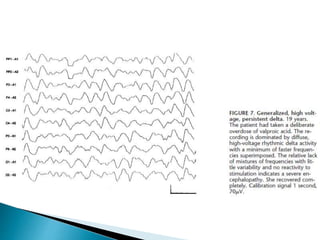
 Diffuse delta and excess theta may reflect
clinical neurotoxicity if associated with the
institution of one or more traditional AEDs
 Phenytoin
 Carbamazepine and valproate
 Clozapine, tricyclic antidepressants, and
lithium
(G. Bauer and R. Bauer, 2005; Van Cott and Brenner, 2003; Duncan 1987)
 Spindle coma
 Alpha/theta pattern
 Burst-suppression
 Electro-cerebral inactivity (ECI).
(G. Bauer and R. Bauer, 2005; Chatrian and Turella, 2003; Fisch, 1999; Ikeda et al., 2003; Young, 2002).
Drug Effects on EEG

Drug Effects on EEG

  • 1.
    Ade Wijaya, MD– January 2020
  • 2.
     Drugs caneffect EEG interpretation  Quantity of medication in the patient influences the EEG. This quantity varies according to dose, volume of distribution, and rate of metabolism  Systemic effects of medication, e.g., hyponatremia from Carbamazepine, may diffusely perturb the EEG. Blume WT. Drug effects on EEG. Journal of Clinical Neurophysiology. 2006 Aug 1;23(4):306-11.
  • 3.
     Background slower:Phenytoin and others  Excess beta  GABA agonists: barbiturates, benzodiazepines  Epileptiform activity  Triphasic waves  Theta and Delta  Coma patterns Blume WT. Drug effects on EEG. Journal of Clinical Neurophysiology. 2006 Aug 1;23(4):306-11.
  • 4.
     Beta activityis more abundantly expressed by medication in children than in adults and with acute rather than chronic administration.  Barbiturates and Benzodiazepines  Cocaine, amphetamines, and methylphenidate as well as tricyclic antidepressants  Withdrawal from alcohol and barbiturates (G. Bauer and R. Bauer, 2005; Van Cott and Brenner, 2003)
  • 8.
     High dosesof several types of medications may elicit spikes or poly spikes that usually appear bisynchronously in bursts, either spontaneously or as a photoparoxysmal response  Clozapine, Lithium, Phenothiazines, selective serotonin reuptake inhibitors, and tricyclic antidepressants.  Acute withdrawal of alcohol or barbiturates may also elicit bursts of spikes and polyspikes, particularly as a photoparoxysmal response (G. Bauer and R. Bauer, 2005; Van Cott and Brenner, 2003)
  • 11.
     Valproic Acid-associatedhyperammonemic encephalopathy  Baclofen, Lithium, Levodopa, Pentobarbital, and the serotonin syndrome (Kifune et al., 2000) (Chatrian and Turella, 2003; Dike 1997 Hormes et al., 1988; Kubicki and Stolzel, 1970; Lancman et al., 1997; Neufeld, 1992)
  • 13.
     Diffuse deltaand excess theta may reflect clinical neurotoxicity if associated with the institution of one or more traditional AEDs  Phenytoin  Carbamazepine and valproate  Clozapine, tricyclic antidepressants, and lithium (G. Bauer and R. Bauer, 2005; Van Cott and Brenner, 2003; Duncan 1987)
  • 15.
     Spindle coma Alpha/theta pattern  Burst-suppression  Electro-cerebral inactivity (ECI). (G. Bauer and R. Bauer, 2005; Chatrian and Turella, 2003; Fisch, 1999; Ikeda et al., 2003; Young, 2002).