
Angie Melissa Lizcano
           Angie Yolima Camacho Hernández
           Diana Cristina Oróstegui González


HOW TO
TEACH LISTENING
How to teach LISTENING


          ‘WE HAVE TWO EARS AND ONE
          MOUTH SO THAT WE CAN LISTEN
          TWICE AS MUCH AS WE SPEAK’
          EPICTETUS
THE WHY AND HOW OF LISTENING-
MOTIVATIONS AND MECHANICS


        We learn to listen and we listen to learn.
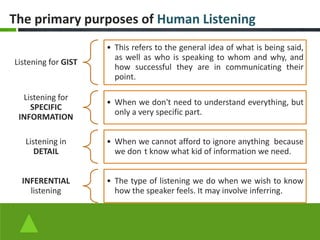
The primary purposes of Human Listening
                     • This refers to the general idea of what is being said,
                       as well as who is speaking to whom and why, and
Listening for GIST
                       how successful they are in communicating their
                       point.

  Listening for
                     • When we don't need to understand everything, but
    SPECIFIC
                       only a very specific part.
 INFORMATION

   Listening in      • When we cannot afford to ignore anything because
      DETAIL           we don t know what kid of information we need.


  INFERENTIAL        • The type of listening we do when we wish to know
    listening          how the speaker feels. It may involve inferring.
Listening for Gist


• A man speaking to a girl by phone.

• He is asking her for suggestions about movies.
Listening for Specific Information


Which are the type of movies she likes:

• Comedy
• Love stories
• Foreign films
Listening in Detail

•   A man called Kathie
•   Asked her favorite kind of movies
•   He is making a party tonight
•   Kathie doesn´t like action movies because of the
    violence.
•   She enjoys comedies
•   She is not crazy about horror movies
•   Love stories are fun to watch
•   She likes foreign films
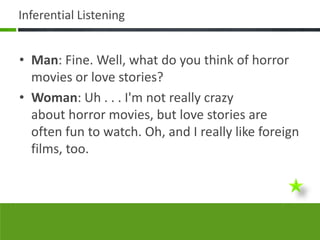
Inferential Listening


• Man: Fine. Well, what do you think of horror
  movies or love stories?
• Woman: Uh . . . I'm not really crazy
  about horror movies, but love stories are
  often fun to watch. Oh, and I really like foreign
  films, too.
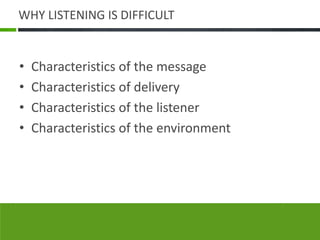
WHY LISTENING IS DIFFICULT


•   Characteristics of the message
•   Characteristics of delivery
•   Characteristics of the listener
•   Characteristics of the environment
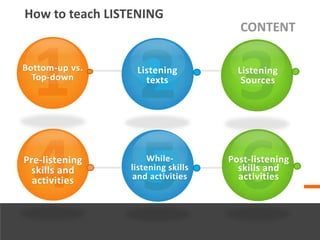
How to teach LISTENING
                                     CONTENT

Bottom-up vs.    Listening           Listening
  Top-down         texts              Sources


Pre-listening        While-        Post-listening
 skills and     listening skills     skills and
  activities     and activities      activities
Bottom-up versus top-down
  approaches to listening
Bottom-up versus top-down approaches to listening


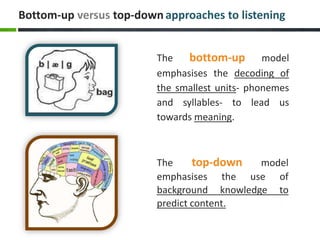
                         The   bottom-up model
                         emphasises the decoding of
                         the smallest units- phonemes
                         and syllables- to lead us
                         towards meaning.


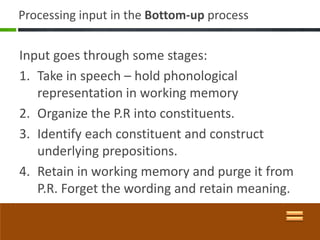
                         The     top-down   model
                         emphasises the use of
                         background knowledge to
                         predict content.
Processing input in the Bottom-up process


Input goes through some stages:
1. Take in speech – hold phonological
   representation in working memory
2. Organize the P.R into constituents.
3. Identify each constituent and construct
   underlying prepositions.
4. Retain in working memory and purge it from
   P.R. Forget the wording and retain meaning.
Processing input in the Bottom-up process

The guy I sat next to on the bus this morning on the way
to work was telling me he runs a Thai restaurant in
Chinatown. Apparently it’s very popular at the moment”

•   The guy
•   I sat next to on the bus
•   This morning
•   Was telling me
•   He runs a Thai restaurant in Chinatown
•   Apparently is very popular
•   At the moment
Processing input in the Bottom-up process

The guy I sat next to on the bus this morning on the way
to work was telling me he runs a Thai restaurant in
Chinatown. Apparently it’s very popular at the moment”

•   I was on the bus
•   There was a guy next to me
•   We talked
•   He says he runs a Thai restaurant
•   It’s in Chinatown
•   It’s very popular now
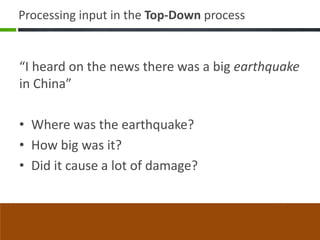
Processing input in the Top-Down process


“I heard on the news there was a big earthquake
in China”

• Where was the earthquake?
• How big was it?
• Did it cause a lot of damage?
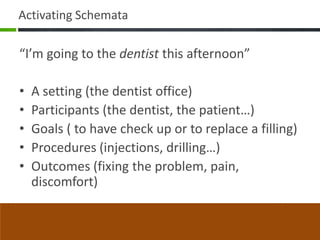
Activating Schemata

“I’m going to the dentist this afternoon”

•   A setting (the dentist office)
•   Participants (the dentist, the patient…)
•   Goals ( to have check up or to replace a filling)
•   Procedures (injections, drilling…)
•   Outcomes (fixing the problem, pain,
    discomfort)
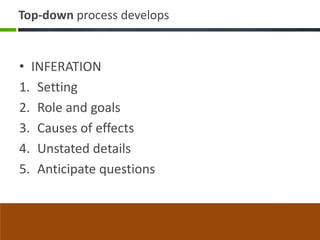
Top-down process develops


• INFERATION
1. Setting
2. Role and goals
3. Causes of effects
4. Unstated details
5. Anticipate questions
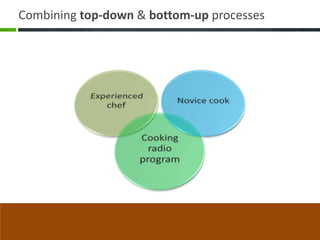
Combining top-down & bottom-up processes
Listening texts

‘Language is powerful not only because there are competent speakers but because
                                 there are competent listeners’ (Sweden Graphics)
Listening texts


         What makes a good
           listening text?

             Authentic versus Pedagogic
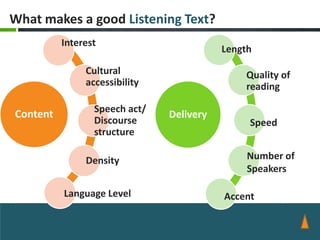
What makes a good Listening Text?
          Interest
                                          Length

               Cultural                       Quality of
               accessibility                  reading

                 Speech act/
Content                        Delivery
                 Discourse                     Speed
                 structure

               Density                         Number of
                                               Speakers

          Language Level                  Accent
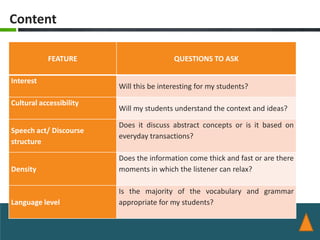
Content

            FEATURE                       QUESTIONS TO ASK

Interest
                         Will this be interesting for my students?

Cultural accessibility
                         Will my students understand the context and ideas?

                         Does it discuss abstract concepts or is it based on
Speech act/ Discourse
                         everyday transactions?
structure

                         Does the information come thick and fast or are there
Density                  moments in which the listener can relax?

                         Is the majority of the vocabulary and grammar
Language level           appropriate for my students?
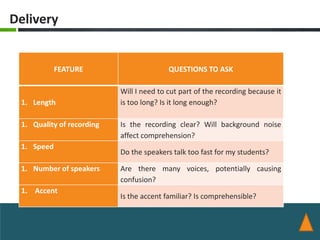
Delivery


            FEATURE                       QUESTIONS TO ASK

                           Will I need to cut part of the recording because it
 1. Length                 is too long? Is it long enough?

 1. Quality of recording   Is the recording clear? Will background noise
                           affect comprehension?
 1. Speed
                           Do the speakers talk too fast for my students?

 1. Number of speakers     Are there many voices, potentially causing
                           confusion?
 1. Accent
                           Is the accent familiar? Is comprehensible?
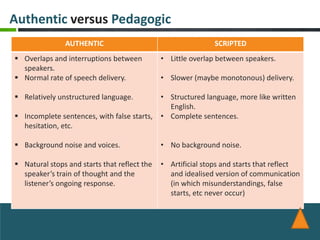
Authentic versus Pedagogic
               AUTHENTIC                                      SCRIPTED
 Overlaps and interruptions between          • Little overlap between speakers.
  speakers.
 Normal rate of speech delivery.             • Slower (maybe monotonous) delivery.

 Relatively unstructured language.           • Structured language, more like written
                                                English.
 Incomplete sentences, with false starts,    • Complete sentences.
  hesitation, etc.

 Background noise and voices.                • No background noise.

 Natural stops and starts that reflect the   • Artificial stops and starts that reflect
  speaker’s train of thought and the            and idealised version of communication
  listener’s ongoing response.                  (in which misunderstandings, false
                                                starts, etc never occur)
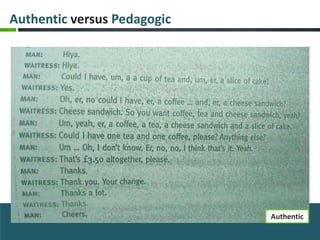
Authentic versus Pedagogic


                             Authentic
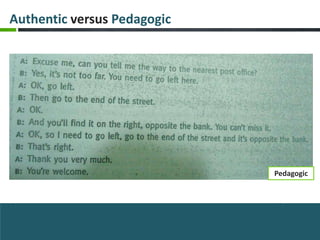
Authentic versus Pedagogic


                             Pedagogic
Listening Sources

‘A wise man listening to a fool will learn more than a fool listening to a wise man’
                                                                       (Anonymous)
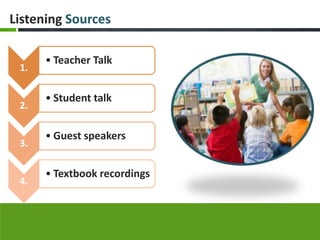
Listening Sources

      • Teacher Talk
 1.

      • Student talk
 2.

      • Guest speakers
 3.

      • Textbook recordings
 4.
Listening Sources

                         • Television, video,
                    5.     DVD and radio

                         • Songs
                    6.

                         • The Internet
                    7.
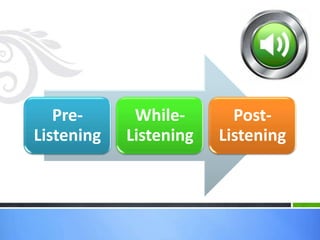
Pre-      While-       Post-
Listening   Listening   Listening
Pre- listening
                          skills and
                          activities
‘People never listen without a purpose , except perhaps in a language class’
                                                                (Gary Buck)
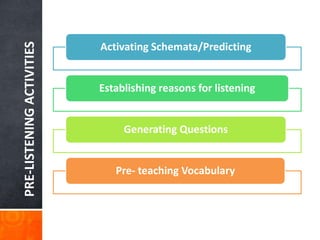
PRE-LISTENING ACTIVITIES
                           Activating Schemata/Predicting


                           Establishing reasons for listening


                                Generating Questions


                              Pre- teaching Vocabulary
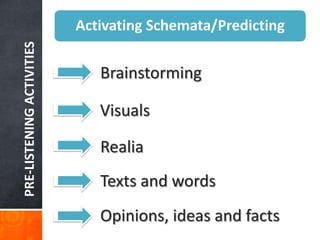
PRE-LISTENING ACTIVITIES   Activating Schemata/Predicting

                              Brainstorming

                              Visuals

                              Realia
                              Texts and words
                              Opinions, ideas and facts
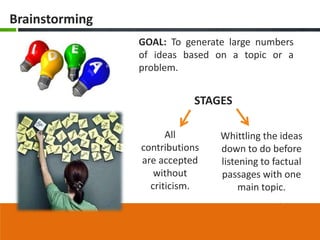
Brainstorming
                GOAL: To generate large numbers
                of ideas based on a topic or a
                problem.


                           STAGES

                      All       Whittling the ideas
                contributions   down to do before
                are accepted    listening to factual
                   without      passages with one
                  criticism.         main topic.
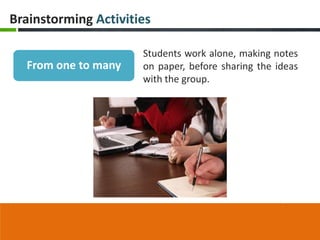
Brainstorming Activities

                      Students work alone, making notes
  From one to many    on paper, before sharing the ideas
                      with the group.
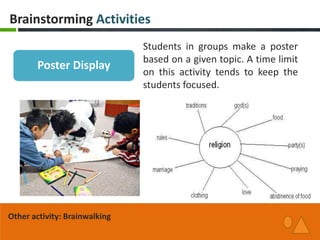
Brainstorming Activities
                               Students in groups make a poster
                               based on a given topic. A time limit
       Poster Display
                               on this activity tends to keep the
                               students focused.


Other activity: Brainwalking
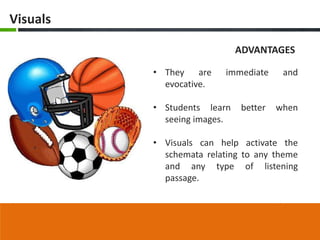
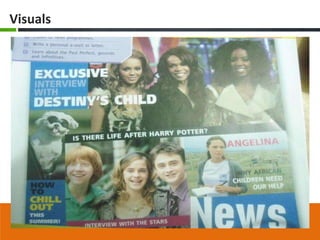
Visuals

                             ADVANTAGES

          • They are      immediate    and
            evocative.

          • Students learn   better   when
            seeing images.

          • Visuals can help activate the
            schemata relating to any theme
            and any type of listening
            passage.
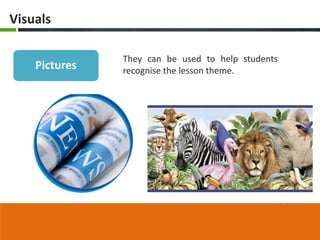
Visuals

               They can be used to help students
    Pictures   recognise the lesson theme.
Visuals
Visuals

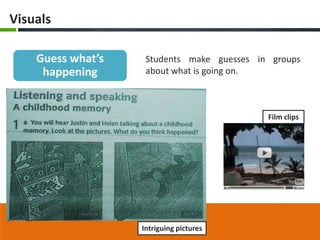
    Guess what’s    Students make guesses in groups
     happening      about what is going on.


                                            Film clips


                   Intriguing pictures
Visuals


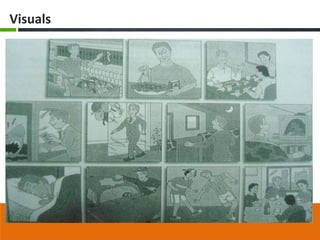
                    Students are given a story told in
    Picture Story   pictures. Their task is to tell the story
                    in groups.
Visuals


    Picture Story
Visuals

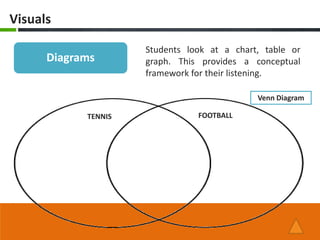
                     Students look at a chart, table or
      Diagrams       graph. This provides a conceptual
                     framework for their listening.

                                             Venn Diagram

            TENNIS              FOOTBALL
Realia
  It acts as a link between the
   world of the classroom and
   the outside world.

  It is especially well suited to
   listening to anecdotes and
   stories.

  Objects in general bring with
   them      memories       and
   associations are aspects of
   our schemata.
Realia

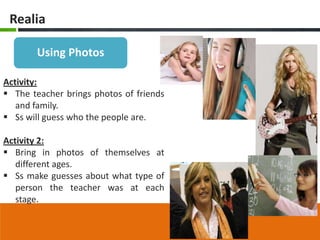
       Using Photos

Activity:
 The teacher brings photos of friends
   and family.
 Ss will guess who the people are.

Activity 2:
 Bring in photos of themselves at
   different ages.
 Ss make guesses about what type of
   person the teacher was at each
   stage.
Realia
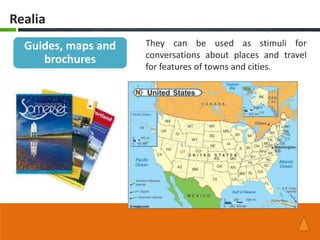
  Guides, maps and   They can be used as stimuli for
                     conversations about places and travel
     brochures
                     for features of towns and cities.
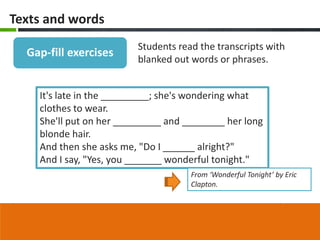
Texts and words
                         Students read the transcripts with
  Gap-fill exercises
                         blanked out words or phrases.


    It's late in the _________; she's wondering what
    clothes to wear.
    She'll put on her _________ and ________ her long
    blonde hair.
    And then she asks me, "Do I ______ alright?"
    And I say, "Yes, you _______ wonderful tonight."
                                     From ‘Wonderful Tonight’ by Eric
                                     Clapton.
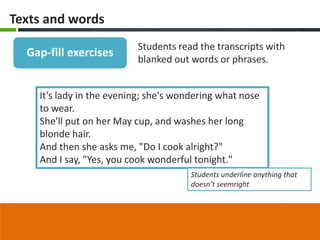
Texts and words
                          Students read the transcripts with
  Gap-fill exercises
                          blanked out words or phrases.


    It's lady in the evening; she's wondering what nose
    to wear.
    She'll put on her May cup, and washes her long
    blonde hair.
    And then she asks me, "Do I cook alright?"
    And I say, "Yes, you cook wonderful tonight."
                                       Students underline anything that
                                       doesn’t seemright
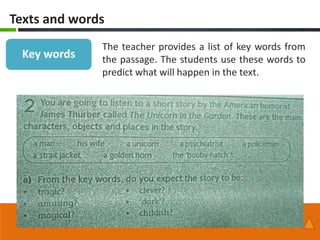
Texts and words
              The teacher provides a list of key words from
 Key words    the passage. The students use these words to
              predict what will happen in the text.
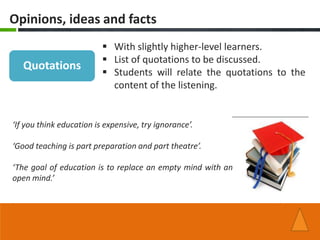
Opinions, ideas and facts
                           With slightly higher-level learners.
                           List of quotations to be discussed.
   Quotations
                           Students will relate the quotations to the
                            content of the listening.


‘If you think education is expensive, try ignorance’.

‘Good teaching is part preparation and part theatre’.

‘The goal of education is to replace an empty mind with an
open mind.’
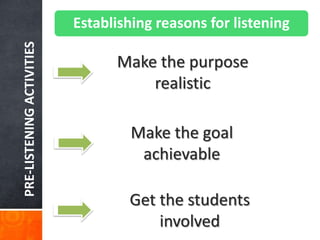
PRE-LISTENING ACTIVITIES   Establishing reasons for listening

                                 Make the purpose
                                     realistic

                                    Make the goal
                                     achievable

                                   Get the students
                                       involved
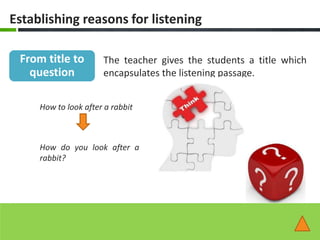
Establishing reasons for listening

 From title to        The teacher gives the students a title which
   question           encapsulates the listening passage.


     How to look after a rabbit


     How do you look after a
     rabbit?
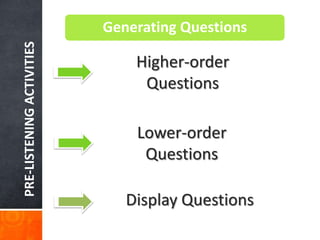
PRE-LISTENING ACTIVITIES   Generating Questions

                               Higher-order
                                Questions

                               Lower-order
                                Questions

                              Display Questions
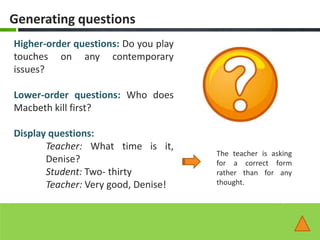
Generating questions
Higher-order questions: Do you play
touches on any contemporary
issues?

Lower-order questions: Who does
Macbeth kill first?

Display questions:
       Teacher: What time is it,
                                      The teacher is asking
       Denise?                        for a correct form
       Student: Two- thirty           rather than for any
       Teacher: Very good, Denise!    thought.
PRE-LISTENING ACTIVITIES   Pre- teaching Vocabulary
                            Pre- teach words that are
                            essential to the meaning of the
                            passage or to the completion of
                            the set task.

                            Pre-teaching words may also
                            give students confidence as well
                            as potentially useful information
                            about the topic.
While- listening
     skills and
     activities
‘No man ever listened himself out of a job’ (Calvin Coolidge)
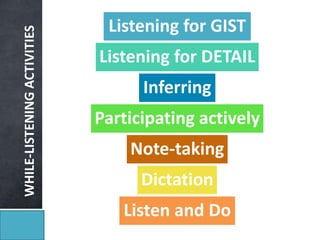
WHILE-LISTENING ACTIVITIES    Listening for GIST
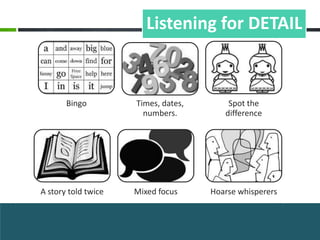
                             Listening for DETAIL
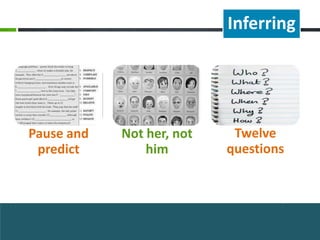
                                   Inferring
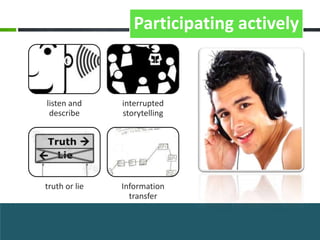
                             Participating actively
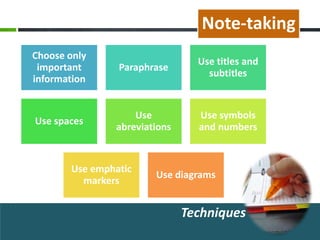
                                 Note-taking
                                   Dictation
                                Listen and Do
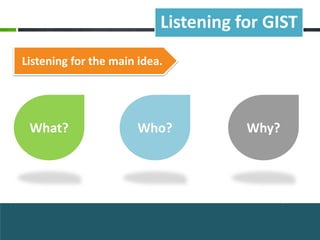
Listening for GIST
Listening for the main idea.


 What?                 Who?           Why?
Listening for DETAIL


       Bingo         Times, dates,       Spot the
                       numbers.         difference


A story told twice   Mixed focus     Hoarse whisperers
Inferring


Pause and   Not her, not    Twelve
 predict        him        questions
Participating actively


listen and     interrupted
 describe      storytelling


truth or lie   Information
                 transfer
Note-taking
Choose only
                                Use titles and
 important      Paraphrase
                                  subtitles
information


                   Use          Use symbols
Use spaces
               abreviations     and numbers


       Use emphatic
                       Use diagrams
         markers


                              Techniques
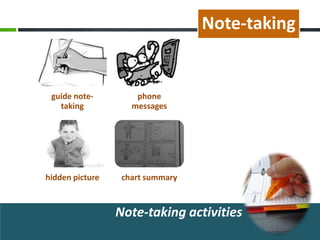
Note-taking


 guide note-         phone
   taking           messages


hidden picture    chart summary


                 Note-taking activities
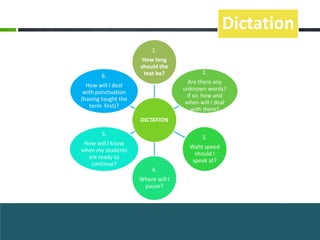
Dictation
                          1.
                      How long
                     should the
                      text be?             2.
        6.
                                      Are there any
  How will I deal
                                    unknown words?
 with punctuation
                                     If so, how and
(having taught the
                                     when will I deal
   term first)?
                                       with them?
                     DICTATION

        5.
                                           3.
 How will I know
                                      Waht speed
when my students
                                        should I
  are ready to
                                       speak at?
   continue?
                          4.
                     Where will I
                      pause?
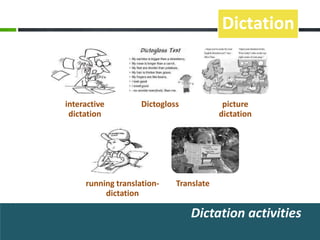
Dictation


interactive         Dictogloss            picture
 dictation                               dictation


     running translation-    Translate
          dictation

                                 Dictation activities
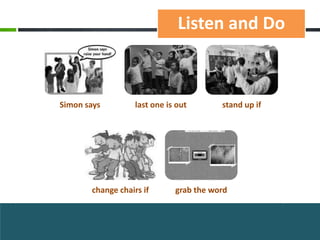
Listen and Do


Simon says         last one is out       stand up if


       change chairs if       grab the word
Post- listening
           skills and
           activities
‘Listen a hundred times; ponder a thousand times; speak once’
                                             (Turkish proverb)
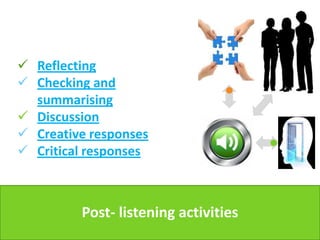
 Reflecting
 Checking and
  summarising
 Discussion
 Creative responses
 Critical responses


         Post- listening activities
Reflecting

   If there is any problem we must look at:

   •   Pronunciation (can-can´t)
   •   Unknown vocabulary
   •   Speed of speech (whaddayathinkaboutit)
   •   Syntax
   •   World knowledge (acronym, name or
       place)
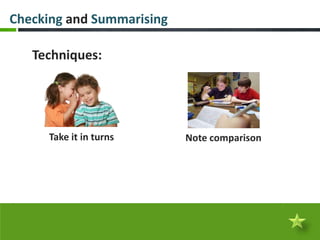
Checking and Summarising

   Techniques:


     Take it in turns      Note comparison
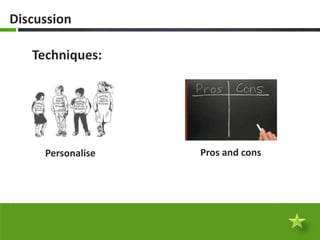
Discussion

   Techniques:


     Personalise   Pros and cons
Creative Responses

   Techniques:


   • Genre transfer
   • Write on
   • Sound effect story
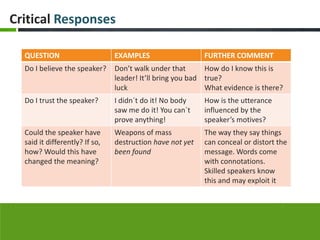
Critical Responses

  QUESTION                      EXAMPLES                   FURTHER COMMENT
  Do I believe the speaker?     Don’t walk under that       How do I know this is
                                leader! It’ll bring you bad true?
                                luck                        What evidence is there?
  Do I trust the speaker?       I didn´t do it! No body    How is the utterance
                                saw me do it! You can´t    influenced by the
                                prove anything!            speaker’s motives?
  Could the speaker have        Weapons of mass            The way they say things
  said it differently? If so,   destruction have not yet   can conceal or distort the
  how? Would this have          been found                 message. Words come
  changed the meaning?                                     with connotations.
                                                           Skilled speakers know
                                                           this and may exploit it
LISTENING
ACTIVITIES
Purposes of the activity

1. To develop imaginative skills.

2. To promote discussions among students.

3. To focus students on the contextual, lexical and grammatical
aspects of the lyrics.

4. To relate students’ thoughts to world issues.

5. To allow students to compare a song and a poem.

6. To encourage students to explore further on the theme and
write creatively.
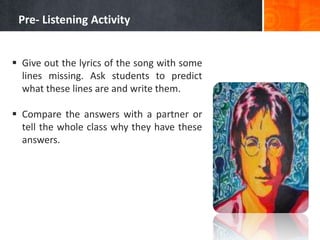
Pre- Listening Activity


 Give out the lyrics of the song with some
  lines missing. Ask students to predict
  what these lines are and write them.

 Compare the answers with a partner or
  tell the whole class why they have these
  answers.
While-listening activity
1. Play the song and ask
students to write down the
missing parts of the lyrics.
Compare the lyrics with their
previous answers.


2. Play another music video of ‘Imagine’ (A perfect
circle – Imagine)
(Remind the students that there may be some scenes
which make them sick or uncomfortable.)
Post-listening activity
3. Ask students to choose one scene from the music video which can best
represent their feeling when they listen to the song/ which impresses
them most (e.g. wars, protests, starvation, injured children, the Pope,
space programme, luxury cars, etc.) Explain their answers. (Variation:
Show pictures of world issues from magazines, newspapers or other
websites while students are listening to the song.)


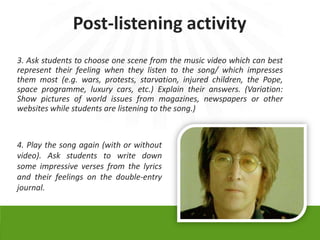
4. Play the song again (with or without
video). Ask students to write down
some impressive verses from the lyrics
and their feelings on the double-entry
journal.
Post-listening activity
5. Show students the poem ‘Imagine’ by Mike Murphy.
(Worksheet                                      2).

6. Ask students to write down some impressive verses from
the poem and their feelings on the double-entry journal.


7. Ask students to compare the two journals. Which (the
song or the poem) do they like most and why?
Ask students to try to sing the poem when the teacher plays
the music of ‘Imagine’ by John Lennon.
Post-listening activity

8. Ask students to write a review or a reflection on the song
or the poem. What are their dreams? Are they the same as
the song writer’s or the poet’s? (Variation: Ask students to
rewrite one or two stanzas (or more) of the song lyrics and
sing aloud.)
• Anderson, A and Lynch, T (1988)
            Listening, Oxford University Press.
          • Brown, G (1990) Listening to Spoken
            English (2nd edition) Longman.
          • Harmer, Jeremy (2008). How to teach
            listening. Pearson Education Limited.
FURTHER   • Rixon, S (1986) Developing listening
            skills, ELT.
READING   • Rost, M (2002) Teaching and
            Researching       Listening,    Pearson
            Education.
          • Ur, P. (1984) Teaching Listening
            Comprehension, Cambridge University
            Press.
          • White, G (1998) Listening, Oxford
            University Press
How to teach listening