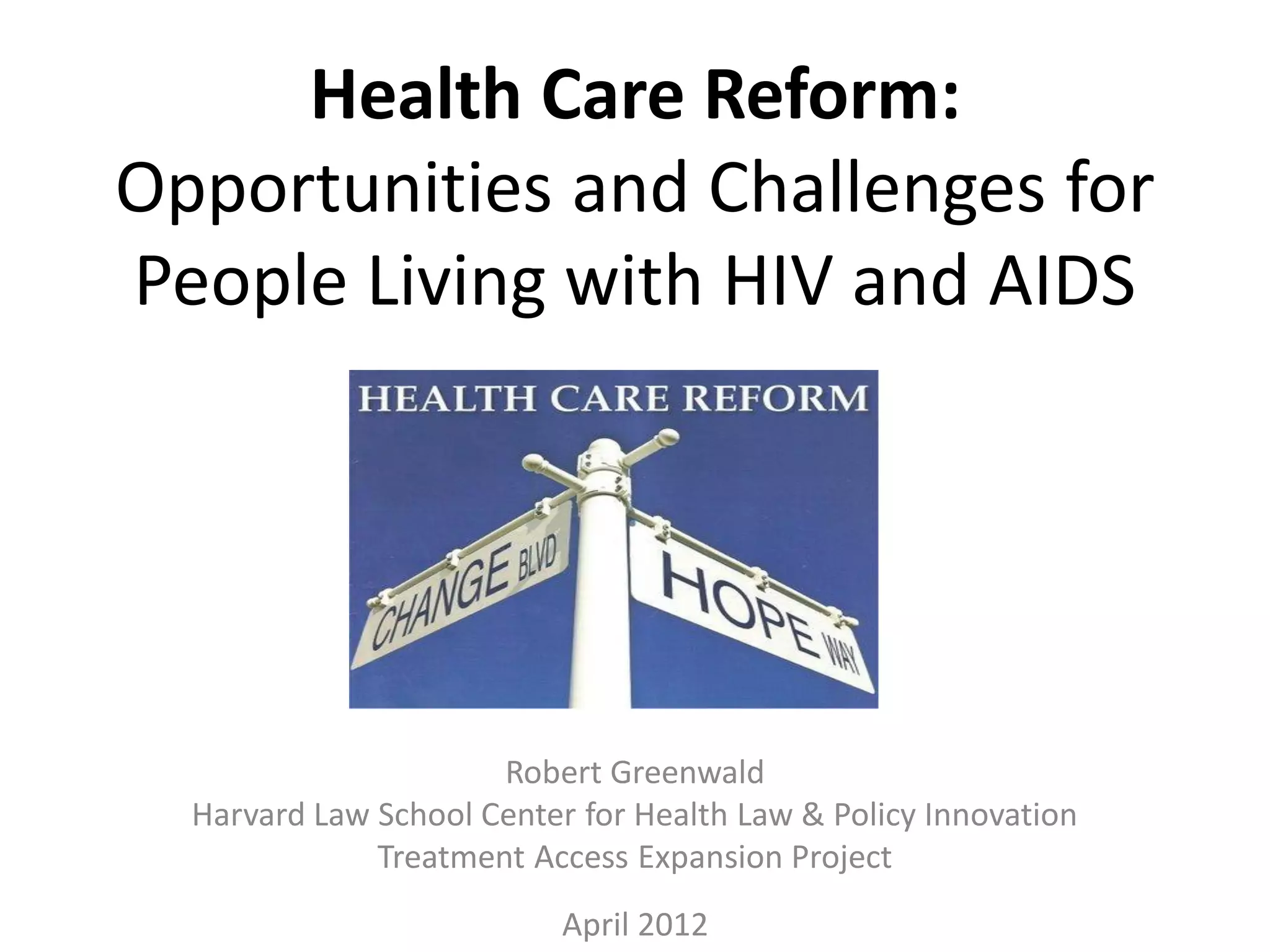
Health Care Reform:
Opportunities and Challenges for
People Living with HIV and AIDS


                      Robert Greenwald
  Harvard Law School Center for Health Law & Policy Innovation
              Treatment Access Expansion Project
                           April 2012
PresentationOutline
        Presentation Outline

Part 1:
Why We Need Health Care Reform:
  The Current Access to Care Crisis
Part 2:
Major Health Care Reform Opportunities:
  The Changing Health Care Landscape
Part 3:
Key Health Care Reform Challenges:
  Turning Opportunities into Realities
Part 4:
Next Steps
Part 1:
Why We Need Health Care Reform:
 The Current Access to Care Crisis
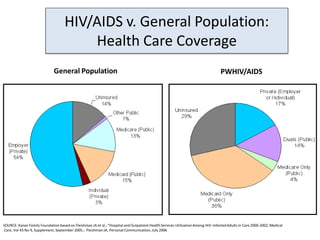
HIV/AIDS v. General Population:
                                        Health Care Coverage
                              General Population                                                                                  PWHIV/AIDS


SOURCE: Kaiser Family Foundation based on Fleishman JA et al., “Hospital and Outpatient Health Services Utilization Among HIV-Infected Adults in Care 2000-2002, Medical
Care, Vol 43 No 9, Supplement, September 2005.; Fleishman JA, Personal Communication, July 2006
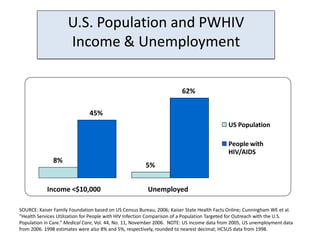
U.S. Population and PWHIV
                     Income & Unemployment

                                                                       62%

                               45%
                                                                                            US Population

                                                                                            People with
                                                                                            HIV/AIDS
               8%
                                                       5%


            Income <$10,000                             Unemployed

SOURCE: Kaiser Family Foundation based on US Census Bureau, 2006; Kaiser State Health Facts Online; Cunningham WE et al.
“Health Services Utilization for People with HIV Infection Comparison of a Population Targeted for Outreach with the U.S.
Population in Care.” Medical Care, Vol. 44, No. 11, November 2006. NOTE: US income data from 2005, US unemployment data
from 2006. 1998 estimates were also 8% and 5%, respectively, rounded to nearest decimal; HCSUS data from 1998.
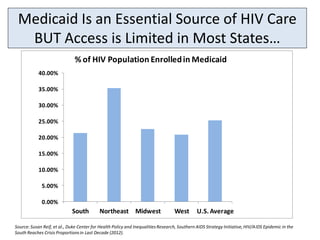
Medicaid Is an Essential Source of HIV Care
  BUT Access is Limited in Most States…
                              % of HIV Population Enrolled in Medicaid
            40.00%

            35.00%

            30.00%

            25.00%

            20.00%

            15.00%

            10.00%

             5.00%

             0.00%
                             South         Northeast Midwest                      West        U.S. Average

Source: Susan Reif, et al., Duke Center for Health Policy and Inequalities Research, Southern AIDS Strategy Initiative, HIV/AIDS Epidemic in the
South Reaches Crisis Proportions in Last Decade (2012).
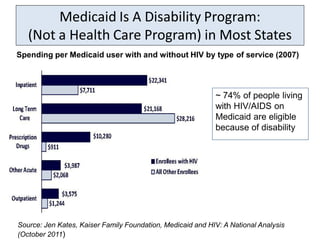
Medicaid Is A Disability Program:
   (Not a Health Care Program) in Most States
Spending per Medicaid user with and without HIV by type of service (2007)


                                                            ~ 74% of people living
                                                            with HIV/AIDS on
                                                            Medicaid are eligible
                                                            because of disability


Source: Jen Kates, Kaiser Family Foundation, Medicaid and HIV: A National Analysis
(October 2011)
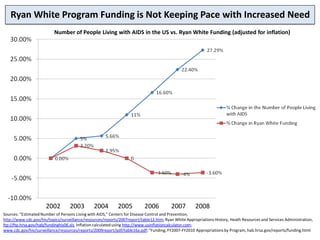
Ryan White Program Funding is Not Keeping Pace with Increased Need
                           Number of People Living with AIDS in the US vs. Ryan White Funding (adjusted for inflation)


                      2002         2003         2004        2005          2006          2007         2008
Sources: “Estimated Number of Persons Living with AIDS,” Centers for Disease Control and Prevention,
http://www.cdc.gov/hiv/topics/surveillance/resources/reports/2007report/table12.htm; Ryan White Appropriations History, Heath Resources and Services Administration,
ftp://ftp.hrsa.gov/hab/fundinghis06.xls. Inflation calculated using http://www.usinflationcalculator.com;
www.cdc.gov/hiv/surveillance/resources/reports/2009report/pdf/table16a.pdf; “Funding, FY2007-FY2010 Appropriations by Program, hab.hrsa.gov/reports/funding.html
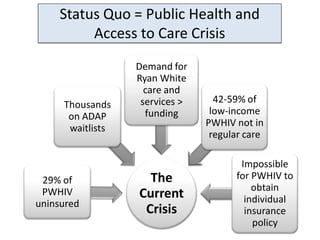
Status Quo = Public Health and
         Access to Care Crisis
                  Demand for
                  Ryan White
                    care and
                   services >     42-59% of
     Thousands
                    funding      low-income
      on ADAP
                                PWHIV not in
      waitlists
                                 regular care

                                       Impossible
 29% of             The               for PWHIV to
                                          obtain
 PWHIV            Current               individual
uninsured
                   Crisis               insurance
                                          policy
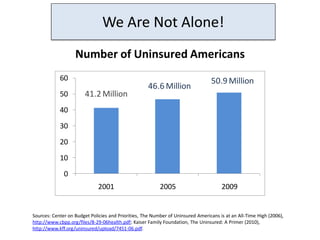
We Are Not Alone!
                   Number of Uninsured Americans
            60                                                                   50.9 Million
                                                    46.6 Million
            50         41.2 Million
            40
            30
            20
            10
              0
                              2001                        2005                        2009


Sources: Center on Budget Policies and Priorities, The Number of Uninsured Americans is at an All-Time High (2006),
http://www.cbpp.org/files/8-29-06health.pdf; Kaiser Family Foundation, The Uninsured: A Primer (2010),
http://www.kff.org/uninsured/upload/7451-06.pdf.
Part 2:
Major Health Care Reform Opportunities:
 The Changing Health Care Landscape
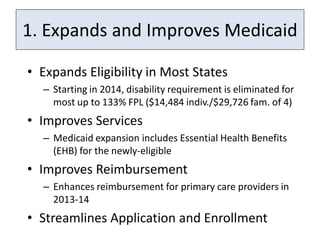
1. Expands and Improves Medicaid

• Expands Eligibility in Most States
  – Starting in 2014, disability requirement is eliminated for
    most up to 133% FPL ($14,484 indiv./$29,726 fam. of 4)
• Improves Services
  – Medicaid expansion includes Essential Health Benefits
    (EHB) for the newly-eligible
• Improves Reimbursement
  – Enhances reimbursement for primary care providers in
    2013-14
• Streamlines Application and Enrollment
2. Supports Enhanced & Coordinated Care
   Through Medicaid Health Home Program
• Gives states the option to provide cost-effective, coordinated
  and enhanced care and services to people living with chronic
  medical conditions*
• States are eligible for planning grants and increased federal
  support – 90% FMAP for first two years of the program
• Reduces inpatient and emergency room costs while improving
  health outcomes through both enhanced care coordination and
  service integration
   – high intensity care/service management, integrated physical and
     behavioral health services, health promotion, patient and family support,
     and prioritized housing

   * Successful advocacy led to inclusion of people living with HIV/AIDS
3. Increases Access to
     Medicare Prescription Drugs

• 50% discount on all brand-name
  prescription drugs
• AIDS Drug Assistance Program (ADAP)
  contributions now count toward
  copayment obligations
• Part D “donut hole” phased-out by 2020
4. Reforms Private Insurance and
Reduces Discriminatory Insurance Practices

  • Cannot be denied insurance because of
    HIV (or other chronic condition) (2014)
  • Health plans cannot drop people from coverage
    when they get sick (in effect)
  • No lifetime limits on coverage (in effect)
  • No annual limits on coverage (2014)
Promotes Access to Private Insurance
   Through State-Based Exchanges
• Starting in 2014, creation of consumer-friendly
  exchanges to purchase private insurance

• Federal subsidies for people with income up to
  400% FPL ($43, 560 single/$89,400 for family of four)

• Plans cannot charge higher premiums based on
  gender or health status

• Plans must include Essential Health Benefits

• Plans have to contract with “community
  providers,” including Ryan White Programs
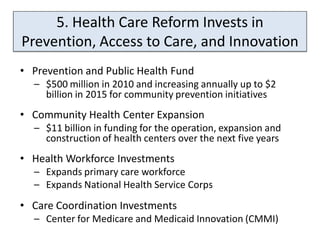
5. Health Care Reform Invests in
Prevention, Access to Care, and Innovation
• Prevention and Public Health Fund
  – $500 million in 2010 and increasing annually up to $2
    billion in 2015 for community prevention initiatives
• Community Health Center Expansion
  – $11 billion in funding for the operation, expansion and
    construction of health centers over the next five years
• Health Workforce Investments
  – Expands primary care workforce
  – Expands National Health Service Corps
• Care Coordination Investments
  – Center for Medicare and Medicaid Innovation (CMMI)
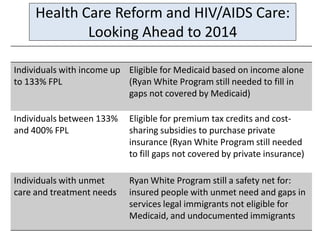
Health Care Reform and HIV/AIDS Care:
             Looking Ahead to 2014

Individuals with income up Eligible for Medicaid based on income alone
to 133% FPL                (Ryan White Program still needed to fill in
                           gaps not covered by Medicaid)

Individuals between 133%   Eligible for premium tax credits and cost-
and 400% FPL               sharing subsidies to purchase private
                           insurance (Ryan White Program still needed
                           to fill gaps not covered by private insurance)

Individuals with unmet     Ryan White Program still a safety net for:
care and treatment needs   insured people with unmet need and gaps in
                           services legal immigrants not eligible for
                           Medicaid, and undocumented immigrants
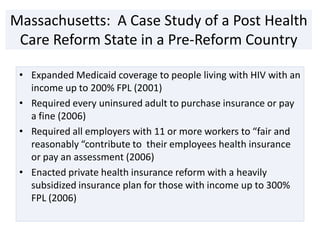
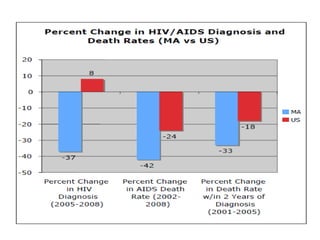
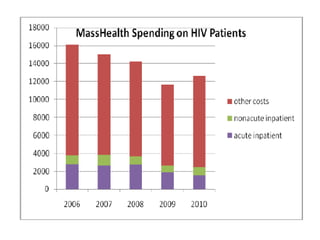
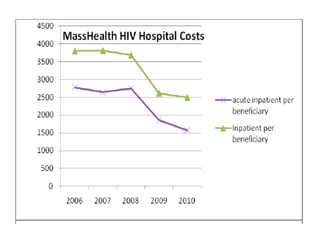
Massachusetts: A Case Study of a Post Health
 Care Reform State in a Pre-Reform Country

 • Expanded Medicaid coverage to people living with HIV with an
   income up to 200% FPL (2001)
 • Required every uninsured adult to purchase insurance or pay
   a fine (2006)
 • Required all employers with 11 or more workers to “fair and
   reasonably “contribute to their employees health insurance
   or pay an assessment (2006)
 • Enacted private health insurance reform with a heavily
   subsidized insurance plan for those with income up to 300%
   FPL (2006)
Part 3:
Key Health Care Reform Challenges:
Turning Opportunities into Realities
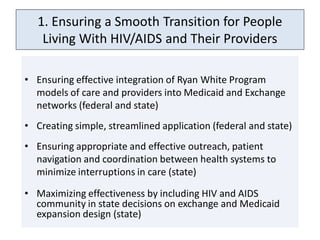
1. Ensuring a Smooth Transition for People
    Living With HIV/AIDS and Their Providers

• Ensuring effective integration of Ryan White Program
  models of care and providers into Medicaid and Exchange
  networks (federal and state)
• Creating simple, streamlined application (federal and state)
• Ensuring appropriate and effective outreach, patient
  navigation and coordination between health systems to
  minimize interruptions in care (state)

• Maximizing effectiveness by including HIV and AIDS
  community in state decisions on exchange and Medicaid
  expansion design (state)
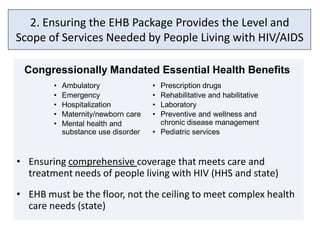
2. Ensuring the EHB Package Provides the Level and
Scope of Services Needed by People Living with HIV/AIDS

 Congressionally Mandated Essential Health Benefits
        •   Ambulatory               • Prescription drugs
        •   Emergency                • Rehabilitative and habilitative
        •   Hospitalization          • Laboratory
        •   Maternity/newborn care   • Preventive and wellness and
        •   Mental health and          chronic disease management
            substance use disorder   • Pediatric services


• Ensuring comprehensive coverage that meets care and
  treatment needs of people living with HIV (HHS and state)
• EHB must be the floor, not the ceiling to meet complex health
  care needs (state)
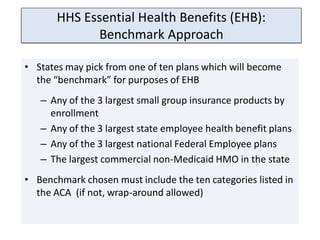
HHS Essential Health Benefits (EHB):
             Benchmark Approach

• States may pick from one of ten plans which will become
  the “benchmark” for purposes of EHB
   – Any of the 3 largest small group insurance products by
     enrollment
   – Any of the 3 largest state employee health benefit plans
   – Any of the 3 largest national Federal Employee plans
   – The largest commercial non-Medicaid HMO in the state
• Benchmark chosen must include the ten categories listed in
  the ACA (if not, wrap-around allowed)
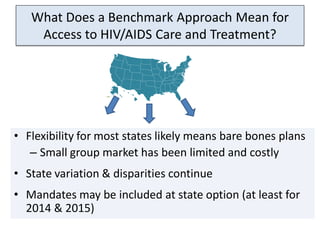
What Does a Benchmark Approach Mean for
    Access to HIV/AIDS Care and Treatment?


• Flexibility for most states likely means bare bones plans
   – Small group market has been limited and costly
• State variation & disparities continue
• Mandates may be included at state option (at least for
  2014 & 2015)
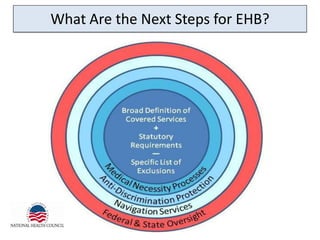
What Are the Next Steps for EHB?
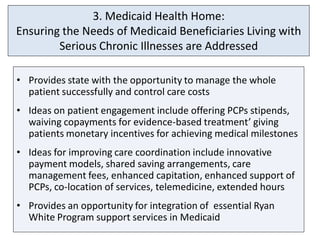
3. Medicaid Health Home:
Ensuring the Needs of Medicaid Beneficiaries Living with
        Serious Chronic Illnesses are Addressed

• Provides state with the opportunity to manage the whole
  patient successfully and control care costs
• Ideas on patient engagement include offering PCPs stipends,
  waiving copayments for evidence-based treatment’ giving
  patients monetary incentives for achieving medical milestones
• Ideas for improving care coordination include innovative
  payment models, shared saving arrangements, care
  management fees, enhanced capitation, enhanced support of
  PCPs, co-location of services, telemedicine, extended hours
• Provides an opportunity for integration of essential Ryan
  White Program support services in Medicaid
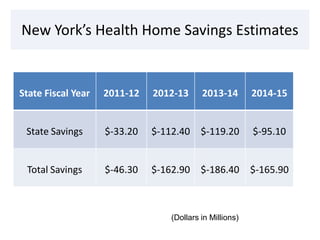
New York’s Health Home Savings Estimates


State Fiscal Year   2011-12   2012-13      2013-14        2014-15


 State Savings      $-33.20   $-112.40     $-119.20       $-95.10


 Total Savings      $-46.30   $-162.90     $-186.40       $-165.90


                                  (Dollars in Millions)
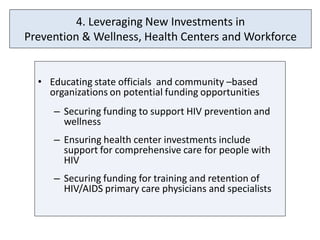
4. Leveraging New Investments in
Prevention & Wellness, Health Centers and Workforce


  • Educating state officials and community –based
    organizations on potential funding opportunities
     – Securing funding to support HIV prevention and
       wellness
     – Ensuring health center investments include
       support for comprehensive care for people with
       HIV
     – Securing funding for training and retention of
       HIV/AIDS primary care physicians and specialists
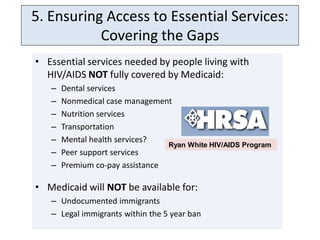
5. Ensuring Access to Essential Services:
           Covering the Gaps
• Essential services needed by people living with
  HIV/AIDS NOT fully covered by Medicaid:
   –   Dental services
   –   Nonmedical case management
   –   Nutrition services
   –   Transportation
   –   Mental health services?
                                 Ryan White HIV/AIDS Program
   –   Peer support services
   –   Premium co-pay assistance

• Medicaid will NOT be available for:
   – Undocumented immigrants
   – Legal immigrants within the 5 year ban
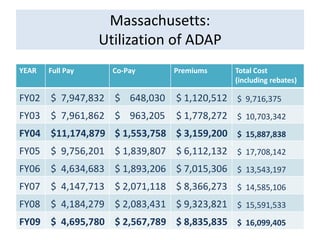
Massachusetts:
                  Utilization of ADAP
YEAR   Full Pay     Co-Pay    Premiums     Total Cost
                                           (including rebates)

FY02 $ 7,947,832 $ 648,030     $ 1,120,512 $ 9,716,375
FY03 $ 7,961,862 $ 963,205     $ 1,778,272 $ 10,703,342
FY04 $11,174,879 $ 1,553,758 $ 3,159,200 $ 15,887,838
FY05 $ 9,756,201 $ 1,839,807 $ 6,112,132 $ 17,708,142
FY06 $ 4,634,683 $ 1,893,206 $ 7,015,306 $ 13,543,197
FY07 $ 4,147,713 $ 2,071,118 $ 8,366,273 $ 14,585,106
FY08 $ 4,184,279 $ 2,083,431 $ 9,323,821 $ 15,591,533
FY09 $ 4,695,780 $ 2,567,789 $ 8,835,835 $ 16,099,405
Part 4:
Next Steps
Know the Facts: Health Care Reform Will
         Reduce the Federal Deficit
Federal v. State Share of                                        From the Congressional
  Medicaid Expansion                                                Budget Office and the Joint
                                                                    Committee on Taxation:

                                                                 “The effects . . . [of health care
                                                                    reform] on direct spending and
                                                                    revenues related to health care
                                                                    will reduce federal deficits by
                                                                    $210 billion over the 2012-2021
                                                                    period.”


 Sources: Center on Budget Policies and Priorities, Hatch-Upton Report on Costs to States of Expanding Medicaid Relies on
 Seriously Flawed Estimates (2011), http://www.cbpp.org/files/3-16-11health.pdf.
 Congressional Budget Office , CBO’s Analysis of the Major Health Care Legislation Enacted in March 2010, (March 2011),
 http://www.cbo.gov/ftpdocs/121xx/doc12119/03-30-HealthCareLegislation.pdf
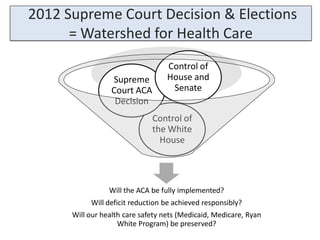
2012 Supreme Court Decision & Elections
      = Watershed for Health Care
                                   Control of
                  Supreme          House and
                  Court ACA         Senate
                   Decision
                              Control of
                              the White
                                House


                 Will the ACA be fully implemented?
           Will deficit reduction be achieved responsibly?
      Will our health care safety nets (Medicaid, Medicare, Ryan
                    White Program) be preserved?
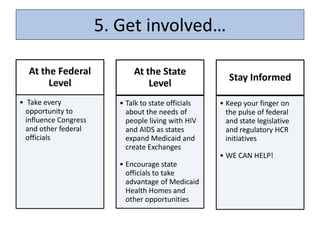
5. Get involved…

  At the Federal              At the State
                                                         Stay Informed
       Level                      Level
• Take every              • Talk to state officials   • Keep your finger on
  opportunity to            about the needs of          the pulse of federal
  influence Congress        people living with HIV      and state legislative
  and other federal         and AIDS as states          and regulatory HCR
  officials                 expand Medicaid and         initiatives
                            create Exchanges
                                                      • WE CAN HELP!
                          • Encourage state
                            officials to take
                            advantage of Medicaid
                            Health Homes and
                            other opportunities
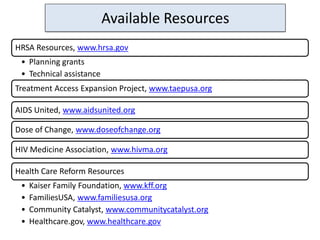
Available Resources
HRSA Resources, www.hrsa.gov
 • Planning grants
 • Technical assistance
Treatment Access Expansion Project, www.taepusa.org

AIDS United, www.aidsunited.org

Dose of Change, www.doseofchange.org

HIV Medicine Association, www.hivma.org

Health Care Reform Resources
 •   Kaiser Family Foundation, www.kff.org
 •   FamiliesUSA, www.familiesusa.org
 •   Community Catalyst, www.communitycatalyst.org
 •   Healthcare.gov, www.healthcare.gov

Syn cing chronic disease advocacy greewald

  • 1.
    Health Care Reform: Opportunitiesand Challenges for People Living with HIV and AIDS Robert Greenwald Harvard Law School Center for Health Law & Policy Innovation Treatment Access Expansion Project April 2012
  • 2.
    PresentationOutline Presentation Outline Part 1: Why We Need Health Care Reform: The Current Access to Care Crisis Part 2: Major Health Care Reform Opportunities: The Changing Health Care Landscape Part 3: Key Health Care Reform Challenges: Turning Opportunities into Realities Part 4: Next Steps
  • 3.
    Part 1: Why WeNeed Health Care Reform: The Current Access to Care Crisis
  • 4.
    HIV/AIDS v. GeneralPopulation: Health Care Coverage General Population PWHIV/AIDS SOURCE: Kaiser Family Foundation based on Fleishman JA et al., “Hospital and Outpatient Health Services Utilization Among HIV-Infected Adults in Care 2000-2002, Medical Care, Vol 43 No 9, Supplement, September 2005.; Fleishman JA, Personal Communication, July 2006
  • 5.
    U.S. Population andPWHIV Income & Unemployment 62% 45% US Population People with HIV/AIDS 8% 5% Income <$10,000 Unemployed SOURCE: Kaiser Family Foundation based on US Census Bureau, 2006; Kaiser State Health Facts Online; Cunningham WE et al. “Health Services Utilization for People with HIV Infection Comparison of a Population Targeted for Outreach with the U.S. Population in Care.” Medical Care, Vol. 44, No. 11, November 2006. NOTE: US income data from 2005, US unemployment data from 2006. 1998 estimates were also 8% and 5%, respectively, rounded to nearest decimal; HCSUS data from 1998.
  • 6.
    Medicaid Is anEssential Source of HIV Care BUT Access is Limited in Most States… % of HIV Population Enrolled in Medicaid 40.00% 35.00% 30.00% 25.00% 20.00% 15.00% 10.00% 5.00% 0.00% South Northeast Midwest West U.S. Average Source: Susan Reif, et al., Duke Center for Health Policy and Inequalities Research, Southern AIDS Strategy Initiative, HIV/AIDS Epidemic in the South Reaches Crisis Proportions in Last Decade (2012).
  • 7.
    Medicaid Is ADisability Program: (Not a Health Care Program) in Most States Spending per Medicaid user with and without HIV by type of service (2007) ~ 74% of people living with HIV/AIDS on Medicaid are eligible because of disability Source: Jen Kates, Kaiser Family Foundation, Medicaid and HIV: A National Analysis (October 2011)
  • 8.
    Ryan White ProgramFunding is Not Keeping Pace with Increased Need Number of People Living with AIDS in the US vs. Ryan White Funding (adjusted for inflation) 2002 2003 2004 2005 2006 2007 2008 Sources: “Estimated Number of Persons Living with AIDS,” Centers for Disease Control and Prevention, http://www.cdc.gov/hiv/topics/surveillance/resources/reports/2007report/table12.htm; Ryan White Appropriations History, Heath Resources and Services Administration, ftp://ftp.hrsa.gov/hab/fundinghis06.xls. Inflation calculated using http://www.usinflationcalculator.com; www.cdc.gov/hiv/surveillance/resources/reports/2009report/pdf/table16a.pdf; “Funding, FY2007-FY2010 Appropriations by Program, hab.hrsa.gov/reports/funding.html
  • 9.
    Status Quo =Public Health and Access to Care Crisis Demand for Ryan White care and services > 42-59% of Thousands funding low-income on ADAP PWHIV not in waitlists regular care Impossible 29% of The for PWHIV to obtain PWHIV Current individual uninsured Crisis insurance policy
  • 10.
    We Are NotAlone! Number of Uninsured Americans 60 50.9 Million 46.6 Million 50 41.2 Million 40 30 20 10 0 2001 2005 2009 Sources: Center on Budget Policies and Priorities, The Number of Uninsured Americans is at an All-Time High (2006), http://www.cbpp.org/files/8-29-06health.pdf; Kaiser Family Foundation, The Uninsured: A Primer (2010), http://www.kff.org/uninsured/upload/7451-06.pdf.
  • 11.
    Part 2: Major HealthCare Reform Opportunities: The Changing Health Care Landscape
  • 12.
    1. Expands andImproves Medicaid • Expands Eligibility in Most States – Starting in 2014, disability requirement is eliminated for most up to 133% FPL ($14,484 indiv./$29,726 fam. of 4) • Improves Services – Medicaid expansion includes Essential Health Benefits (EHB) for the newly-eligible • Improves Reimbursement – Enhances reimbursement for primary care providers in 2013-14 • Streamlines Application and Enrollment
  • 13.
    2. Supports Enhanced& Coordinated Care Through Medicaid Health Home Program • Gives states the option to provide cost-effective, coordinated and enhanced care and services to people living with chronic medical conditions* • States are eligible for planning grants and increased federal support – 90% FMAP for first two years of the program • Reduces inpatient and emergency room costs while improving health outcomes through both enhanced care coordination and service integration – high intensity care/service management, integrated physical and behavioral health services, health promotion, patient and family support, and prioritized housing * Successful advocacy led to inclusion of people living with HIV/AIDS
  • 14.
    3. Increases Accessto Medicare Prescription Drugs • 50% discount on all brand-name prescription drugs • AIDS Drug Assistance Program (ADAP) contributions now count toward copayment obligations • Part D “donut hole” phased-out by 2020
  • 15.
    4. Reforms PrivateInsurance and Reduces Discriminatory Insurance Practices • Cannot be denied insurance because of HIV (or other chronic condition) (2014) • Health plans cannot drop people from coverage when they get sick (in effect) • No lifetime limits on coverage (in effect) • No annual limits on coverage (2014)
  • 16.
    Promotes Access toPrivate Insurance Through State-Based Exchanges • Starting in 2014, creation of consumer-friendly exchanges to purchase private insurance • Federal subsidies for people with income up to 400% FPL ($43, 560 single/$89,400 for family of four) • Plans cannot charge higher premiums based on gender or health status • Plans must include Essential Health Benefits • Plans have to contract with “community providers,” including Ryan White Programs
  • 17.
    5. Health CareReform Invests in Prevention, Access to Care, and Innovation • Prevention and Public Health Fund – $500 million in 2010 and increasing annually up to $2 billion in 2015 for community prevention initiatives • Community Health Center Expansion – $11 billion in funding for the operation, expansion and construction of health centers over the next five years • Health Workforce Investments – Expands primary care workforce – Expands National Health Service Corps • Care Coordination Investments – Center for Medicare and Medicaid Innovation (CMMI)
  • 18.
    Health Care Reformand HIV/AIDS Care: Looking Ahead to 2014 Individuals with income up Eligible for Medicaid based on income alone to 133% FPL (Ryan White Program still needed to fill in gaps not covered by Medicaid) Individuals between 133% Eligible for premium tax credits and cost- and 400% FPL sharing subsidies to purchase private insurance (Ryan White Program still needed to fill gaps not covered by private insurance) Individuals with unmet Ryan White Program still a safety net for: care and treatment needs insured people with unmet need and gaps in services legal immigrants not eligible for Medicaid, and undocumented immigrants
  • 19.
    Massachusetts: A CaseStudy of a Post Health Care Reform State in a Pre-Reform Country • Expanded Medicaid coverage to people living with HIV with an income up to 200% FPL (2001) • Required every uninsured adult to purchase insurance or pay a fine (2006) • Required all employers with 11 or more workers to “fair and reasonably “contribute to their employees health insurance or pay an assessment (2006) • Enacted private health insurance reform with a heavily subsidized insurance plan for those with income up to 300% FPL (2006)
  • 23.
    Part 3: Key HealthCare Reform Challenges: Turning Opportunities into Realities
  • 24.
    1. Ensuring aSmooth Transition for People Living With HIV/AIDS and Their Providers • Ensuring effective integration of Ryan White Program models of care and providers into Medicaid and Exchange networks (federal and state) • Creating simple, streamlined application (federal and state) • Ensuring appropriate and effective outreach, patient navigation and coordination between health systems to minimize interruptions in care (state) • Maximizing effectiveness by including HIV and AIDS community in state decisions on exchange and Medicaid expansion design (state)
  • 25.
    2. Ensuring theEHB Package Provides the Level and Scope of Services Needed by People Living with HIV/AIDS Congressionally Mandated Essential Health Benefits • Ambulatory • Prescription drugs • Emergency • Rehabilitative and habilitative • Hospitalization • Laboratory • Maternity/newborn care • Preventive and wellness and • Mental health and chronic disease management substance use disorder • Pediatric services • Ensuring comprehensive coverage that meets care and treatment needs of people living with HIV (HHS and state) • EHB must be the floor, not the ceiling to meet complex health care needs (state)
  • 26.
    HHS Essential HealthBenefits (EHB): Benchmark Approach • States may pick from one of ten plans which will become the “benchmark” for purposes of EHB – Any of the 3 largest small group insurance products by enrollment – Any of the 3 largest state employee health benefit plans – Any of the 3 largest national Federal Employee plans – The largest commercial non-Medicaid HMO in the state • Benchmark chosen must include the ten categories listed in the ACA (if not, wrap-around allowed)
  • 27.
    What Does aBenchmark Approach Mean for Access to HIV/AIDS Care and Treatment? • Flexibility for most states likely means bare bones plans – Small group market has been limited and costly • State variation & disparities continue • Mandates may be included at state option (at least for 2014 & 2015)
  • 28.
    What Are theNext Steps for EHB?
  • 29.
    3. Medicaid HealthHome: Ensuring the Needs of Medicaid Beneficiaries Living with Serious Chronic Illnesses are Addressed • Provides state with the opportunity to manage the whole patient successfully and control care costs • Ideas on patient engagement include offering PCPs stipends, waiving copayments for evidence-based treatment’ giving patients monetary incentives for achieving medical milestones • Ideas for improving care coordination include innovative payment models, shared saving arrangements, care management fees, enhanced capitation, enhanced support of PCPs, co-location of services, telemedicine, extended hours • Provides an opportunity for integration of essential Ryan White Program support services in Medicaid
  • 30.
    New York’s HealthHome Savings Estimates State Fiscal Year 2011-12 2012-13 2013-14 2014-15 State Savings $-33.20 $-112.40 $-119.20 $-95.10 Total Savings $-46.30 $-162.90 $-186.40 $-165.90 (Dollars in Millions)
  • 31.
    4. Leveraging NewInvestments in Prevention & Wellness, Health Centers and Workforce • Educating state officials and community –based organizations on potential funding opportunities – Securing funding to support HIV prevention and wellness – Ensuring health center investments include support for comprehensive care for people with HIV – Securing funding for training and retention of HIV/AIDS primary care physicians and specialists
  • 32.
    5. Ensuring Accessto Essential Services: Covering the Gaps • Essential services needed by people living with HIV/AIDS NOT fully covered by Medicaid: – Dental services – Nonmedical case management – Nutrition services – Transportation – Mental health services? Ryan White HIV/AIDS Program – Peer support services – Premium co-pay assistance • Medicaid will NOT be available for: – Undocumented immigrants – Legal immigrants within the 5 year ban
  • 33.
    Massachusetts: Utilization of ADAP YEAR Full Pay Co-Pay Premiums Total Cost (including rebates) FY02 $ 7,947,832 $ 648,030 $ 1,120,512 $ 9,716,375 FY03 $ 7,961,862 $ 963,205 $ 1,778,272 $ 10,703,342 FY04 $11,174,879 $ 1,553,758 $ 3,159,200 $ 15,887,838 FY05 $ 9,756,201 $ 1,839,807 $ 6,112,132 $ 17,708,142 FY06 $ 4,634,683 $ 1,893,206 $ 7,015,306 $ 13,543,197 FY07 $ 4,147,713 $ 2,071,118 $ 8,366,273 $ 14,585,106 FY08 $ 4,184,279 $ 2,083,431 $ 9,323,821 $ 15,591,533 FY09 $ 4,695,780 $ 2,567,789 $ 8,835,835 $ 16,099,405
  • 34.
  • 35.
    Know the Facts:Health Care Reform Will Reduce the Federal Deficit Federal v. State Share of From the Congressional Medicaid Expansion Budget Office and the Joint Committee on Taxation: “The effects . . . [of health care reform] on direct spending and revenues related to health care will reduce federal deficits by $210 billion over the 2012-2021 period.” Sources: Center on Budget Policies and Priorities, Hatch-Upton Report on Costs to States of Expanding Medicaid Relies on Seriously Flawed Estimates (2011), http://www.cbpp.org/files/3-16-11health.pdf. Congressional Budget Office , CBO’s Analysis of the Major Health Care Legislation Enacted in March 2010, (March 2011), http://www.cbo.gov/ftpdocs/121xx/doc12119/03-30-HealthCareLegislation.pdf
  • 36.
    2012 Supreme CourtDecision & Elections = Watershed for Health Care Control of Supreme House and Court ACA Senate Decision Control of the White House Will the ACA be fully implemented? Will deficit reduction be achieved responsibly? Will our health care safety nets (Medicaid, Medicare, Ryan White Program) be preserved?
  • 37.
    5. Get involved… At the Federal At the State Stay Informed Level Level • Take every • Talk to state officials • Keep your finger on opportunity to about the needs of the pulse of federal influence Congress people living with HIV and state legislative and other federal and AIDS as states and regulatory HCR officials expand Medicaid and initiatives create Exchanges • WE CAN HELP! • Encourage state officials to take advantage of Medicaid Health Homes and other opportunities
  • 38.
    Available Resources HRSA Resources,www.hrsa.gov • Planning grants • Technical assistance Treatment Access Expansion Project, www.taepusa.org AIDS United, www.aidsunited.org Dose of Change, www.doseofchange.org HIV Medicine Association, www.hivma.org Health Care Reform Resources • Kaiser Family Foundation, www.kff.org • FamiliesUSA, www.familiesusa.org • Community Catalyst, www.communitycatalyst.org • Healthcare.gov, www.healthcare.gov