COST MINIMIZATION
ANALYSIS
(CMA)
GROUP 2:
PETER PEDO AKOL
NAOME TURYAHABWE
JOHN BOSCO NINSIIMA
ALIYU HISHAM SULEIMAN
COST MINIMISATION
ANALYSIS
Cost minimization analysis:
Refers to comparison of two interventions or
strategies which are assumed to have the same
outcome or effects to find out which of the two is
the least costly option. It focuses on costing each of
the options being compared in order to find out
which of them has the least cost. Its main aim is
therefore to find the most desirable option.
The fundamental assumptions underlying this
method are:
 The two options being compared have exactly the
same effect (identical benefits).
 That important alternatives have not been left out.
CMA (2)
 It is a tool used in pharmacoeconomics and is
applied when comparing multiple drugs of
equal efficacy and equal tolerability.
Pharmacoeconomics which is a sub-discipline
of Health economics refers to the scientific
discipline that compares the value of one
pharmaceutical drug or drug therapy to
another.
CMA (3)
 From a broader perspective, it is used to
compare two interventions/strategies (not
necessarily drugs) with equivalent
effectiveness and efficacy.
 Of two medicines with equal efficacy, which
one is least expensive.
 It is the most used cost evaluation method.
 Most accurate method when comparing cost
between two therapeutically equivalent
medicines.
KEY DEFINITIONS
 Pharmacoeconomics—the description and analysis of
the cost of pharmaceutical therapy to health care
systems
 Cost—the total resources consumed in producing a
good or service
 Price—the amount of money required to purchase an
item
KEY DEFINITIONS (2)
 Medicine effectiveness—the effects of a medicine
when used in real-life situations
 Medicine efficacy—the effects of a medicine under
clinical trial conditions
DIRECT COSTS OF A
MEDICINE
 Acquisition cost
 Transportation cost
 Supply management cost (i.e., storage facility cost)
 Cost of supplies and equipment to administer
medicines, such as syringes and needles
 Personnel costs to prepare and administer such as
physicians, pharmacists, and nurses
 Other direct costs (e.g., ADRs, hospital room
charges, laboratory fees)
 Nonmedical cost (e.g., patient travel expenses)
INDIRECT COSTS OF A
MEDICINE (2)
 Indirect costs—examples
 Cost of illness to the patient
 Lost time from work
 Time required to care for somebody
 Intangible costs
 Costs associated with pain and suffering usually
incorporated into utilities assigned to health states
which reflect quality of life
PROCESS OF CMA
 Obtain acquisition price for each medicine and
calculate the price for the course of treatment
to be compared- dose per day, number of days
of treatment.
 Calculate pharmacy, nursing and physician
cost associated with the use of each medicine.
Process 2
 Calculate equipment cost associated with
each medicine.
 Calculate laboratory costs associated with
each medicine.
 Calculate cost of any other significant factor
 Calculate and compare total medicine costs
for each medicine.
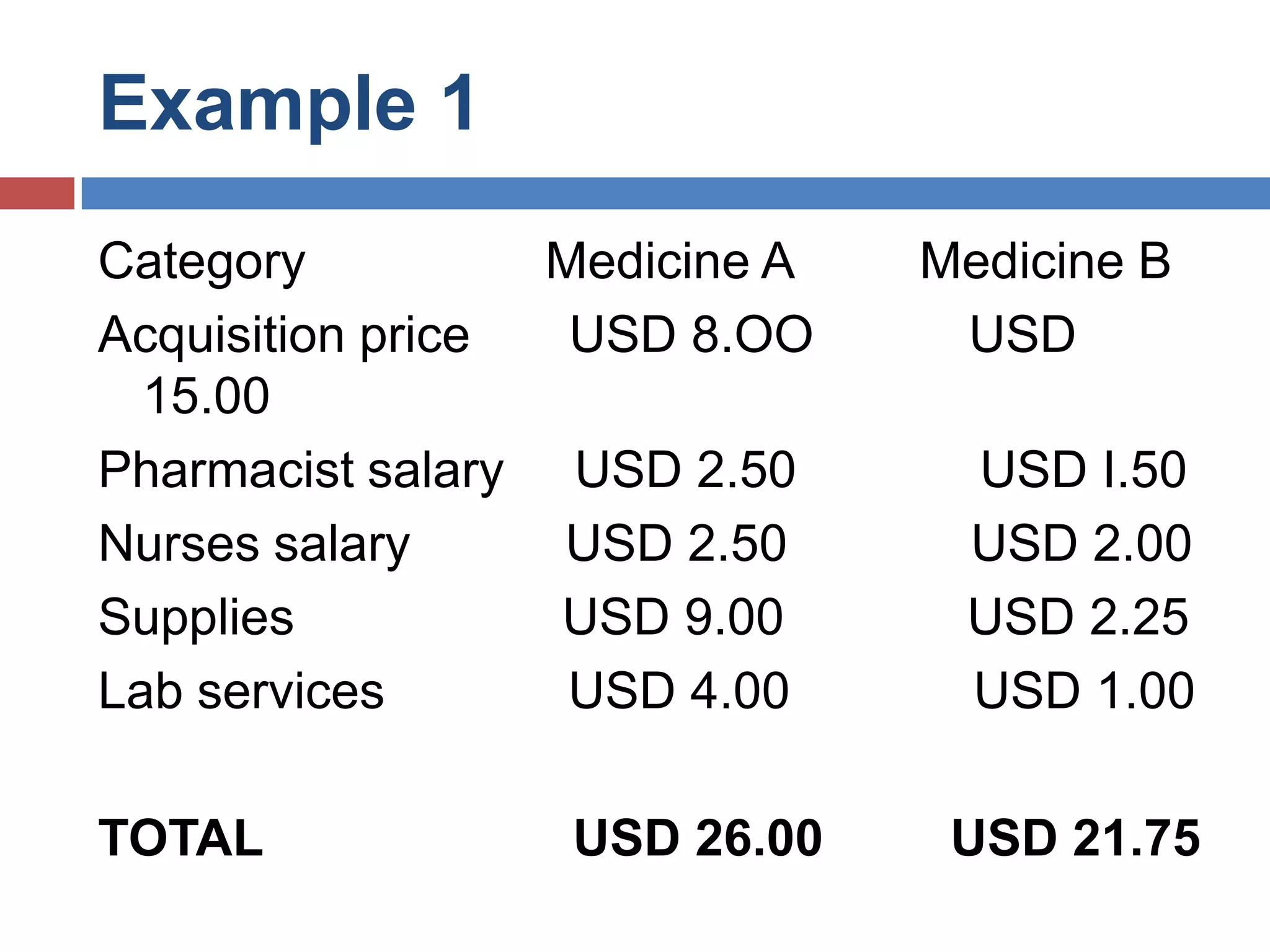
Example 1
Category Medicine A Medicine B
Acquisition price USD 8.OO USD
15.00
Pharmacist salary USD 2.50 USD I.50
Nurses salary USD 2.50 USD 2.00
Supplies USD 9.00 USD 2.25
Lab services USD 4.00 USD 1.00
TOTAL USD 26.00 USD 21.75
Example 2
 For example, we may wish to compare the
cost of organizing communal days for periodic
impregnation of mosquito nets with distributing
individual kits for home use in order to find
which of the two options is cheaper. The
expected outcome is the treated net for both
strategies. The study would now try to
establish which of the two options is cheaper.
APPLICATION OF CMA
 In situations where the benefits of alternative
treatments have been proven to be identical
and as such this methodology is perceived as
being easy to apply.
 It is used in supporting and justifying the
introduction of cheaper drugs in the same
therapeutic class.
 It is used when finding out the activity or output
with the lowest cost
Advantages
 It facilitates selection of cheaper yet effective
drugs or interventions.
 It is the simplest of the four types of
pharmacoeconomics analysis because the focus
is on measuring the left hand side (cost) of the
pharmacoeconomics equation.
 It is very useful in evaluating the cost of a specific
drug
 Because it compares the cost of two alternatives,
it helps identify the cheapest method/drug to use
hence maximized profits/benefits.
 It is most useful for comparing generic and
therapeutic equivalents or «me too» drugs
Disadvantages
 It can only be used to compare two products that have
been shown to be equivalent in dose and therapeutic
effect.
 In many cases, there is no reliable equivalence
between two products and if therapeutic equivalence
cannot be demonstrated, then cost-minimization
analysis is inappropriate (WHO, 2003)
 It turns to the assessment of costs only after the
benefits of the competing health care technologies
have been demonstrated to be clinically equivalent.
 It only compares alternatives of the same outcomes.
 Its more time consuming since in-order to use it one
has to find out the cost of the two different outputs for
purposes of comparison
REFERENCES
1. Gold MR, et al, 1996: Cost effectiveness in
Health and Medicine, Oxford press, New
York.
2. Maynard A, et al, 1994: Something rotten in
the state of clinical and economic evaluation?
Intern. J of health economic.
3. Span MM, et al, 2006; None inferiority
testing in cost minimization studies; practical
issues concerning power analysis. Int. J int. J
technol assessment healthcare.

Cost minimisation analysis in health economics

  • 1.
    COST MINIMIZATION ANALYSIS (CMA) GROUP 2: PETERPEDO AKOL NAOME TURYAHABWE JOHN BOSCO NINSIIMA ALIYU HISHAM SULEIMAN
  • 2.
    COST MINIMISATION ANALYSIS Cost minimizationanalysis: Refers to comparison of two interventions or strategies which are assumed to have the same outcome or effects to find out which of the two is the least costly option. It focuses on costing each of the options being compared in order to find out which of them has the least cost. Its main aim is therefore to find the most desirable option. The fundamental assumptions underlying this method are:  The two options being compared have exactly the same effect (identical benefits).  That important alternatives have not been left out.
  • 3.
    CMA (2)  Itis a tool used in pharmacoeconomics and is applied when comparing multiple drugs of equal efficacy and equal tolerability. Pharmacoeconomics which is a sub-discipline of Health economics refers to the scientific discipline that compares the value of one pharmaceutical drug or drug therapy to another.
  • 4.
    CMA (3)  Froma broader perspective, it is used to compare two interventions/strategies (not necessarily drugs) with equivalent effectiveness and efficacy.  Of two medicines with equal efficacy, which one is least expensive.  It is the most used cost evaluation method.  Most accurate method when comparing cost between two therapeutically equivalent medicines.
  • 5.
    KEY DEFINITIONS  Pharmacoeconomics—thedescription and analysis of the cost of pharmaceutical therapy to health care systems  Cost—the total resources consumed in producing a good or service  Price—the amount of money required to purchase an item
  • 6.
    KEY DEFINITIONS (2) Medicine effectiveness—the effects of a medicine when used in real-life situations  Medicine efficacy—the effects of a medicine under clinical trial conditions
  • 7.
    DIRECT COSTS OFA MEDICINE  Acquisition cost  Transportation cost  Supply management cost (i.e., storage facility cost)  Cost of supplies and equipment to administer medicines, such as syringes and needles  Personnel costs to prepare and administer such as physicians, pharmacists, and nurses  Other direct costs (e.g., ADRs, hospital room charges, laboratory fees)  Nonmedical cost (e.g., patient travel expenses)
  • 8.
    INDIRECT COSTS OFA MEDICINE (2)  Indirect costs—examples  Cost of illness to the patient  Lost time from work  Time required to care for somebody  Intangible costs  Costs associated with pain and suffering usually incorporated into utilities assigned to health states which reflect quality of life
  • 9.
    PROCESS OF CMA Obtain acquisition price for each medicine and calculate the price for the course of treatment to be compared- dose per day, number of days of treatment.  Calculate pharmacy, nursing and physician cost associated with the use of each medicine.
  • 10.
    Process 2  Calculateequipment cost associated with each medicine.  Calculate laboratory costs associated with each medicine.  Calculate cost of any other significant factor  Calculate and compare total medicine costs for each medicine.
  • 11.
    Example 1 Category MedicineA Medicine B Acquisition price USD 8.OO USD 15.00 Pharmacist salary USD 2.50 USD I.50 Nurses salary USD 2.50 USD 2.00 Supplies USD 9.00 USD 2.25 Lab services USD 4.00 USD 1.00 TOTAL USD 26.00 USD 21.75
  • 12.
    Example 2  Forexample, we may wish to compare the cost of organizing communal days for periodic impregnation of mosquito nets with distributing individual kits for home use in order to find which of the two options is cheaper. The expected outcome is the treated net for both strategies. The study would now try to establish which of the two options is cheaper.
  • 13.
    APPLICATION OF CMA In situations where the benefits of alternative treatments have been proven to be identical and as such this methodology is perceived as being easy to apply.  It is used in supporting and justifying the introduction of cheaper drugs in the same therapeutic class.  It is used when finding out the activity or output with the lowest cost
  • 14.
    Advantages  It facilitatesselection of cheaper yet effective drugs or interventions.  It is the simplest of the four types of pharmacoeconomics analysis because the focus is on measuring the left hand side (cost) of the pharmacoeconomics equation.  It is very useful in evaluating the cost of a specific drug  Because it compares the cost of two alternatives, it helps identify the cheapest method/drug to use hence maximized profits/benefits.  It is most useful for comparing generic and therapeutic equivalents or «me too» drugs
  • 15.
    Disadvantages  It canonly be used to compare two products that have been shown to be equivalent in dose and therapeutic effect.  In many cases, there is no reliable equivalence between two products and if therapeutic equivalence cannot be demonstrated, then cost-minimization analysis is inappropriate (WHO, 2003)  It turns to the assessment of costs only after the benefits of the competing health care technologies have been demonstrated to be clinically equivalent.  It only compares alternatives of the same outcomes.  Its more time consuming since in-order to use it one has to find out the cost of the two different outputs for purposes of comparison
  • 16.
    REFERENCES 1. Gold MR,et al, 1996: Cost effectiveness in Health and Medicine, Oxford press, New York. 2. Maynard A, et al, 1994: Something rotten in the state of clinical and economic evaluation? Intern. J of health economic. 3. Span MM, et al, 2006; None inferiority testing in cost minimization studies; practical issues concerning power analysis. Int. J int. J technol assessment healthcare.