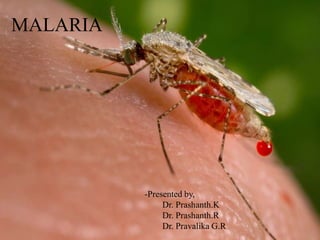
MALARIA
-Presented by,
Dr. Prashanth.K
Dr. Prashanth.R
Dr. Pravalika G.R
Contents
• Introduction
• Epidemiology
• Vectors of Malaria and transmission
• Clinical features
• Diagnosis of Malaria
• Management of uncomplicated Malaria
• Management of severe Malaria
• Vaccination
• Prevention of Malaria
• National vector borne disease control program
(NVBDCP)
Introduction
 Malaria is a protozoal disease caused by infection with
Plasmodium.
 Transmitted to man by infected female Anopheline mosquito.
 Globally in 2021, there were an estimated 247 million malaria
cases.
 An increase of 2 million cases compared with 2020.
 In India about 21.98% population lives in malaria high
transmission areas and about 67% in low transmission areas.
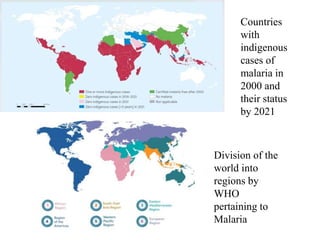
Countries
with
indigenous
cases of
malaria in
2000 and
their status
by 2021
Division of the
world into
regions by
WHO
pertaining to
Malaria
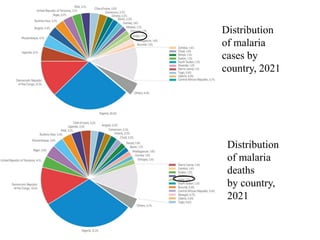
Distribution
of malaria
cases by
country, 2021
Distribution
of malaria
deaths
by country,
2021
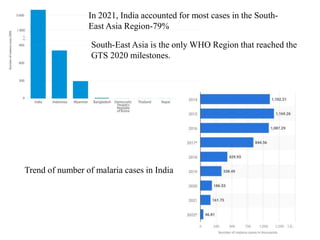
In 2021, India accounted for most cases in the South-
East Asia Region-79%
South-East Asia is the only WHO Region that reached the
GTS 2020 milestones.
Trend of number of malaria cases in India
Epidemiology
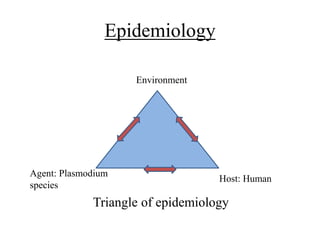
Triangle of epidemiology
Environment
Host: Human
Agent: Plasmodium
species
Agent factors
 Agent:
• Plasmodium vivax (most common in the world)
• Plasmodium falciparum (most common in India)
• Plasmodium malariae (< 1% of India- Tumkur and Hassan)
• Plasmodium ovale (rare- Tropical Africa)
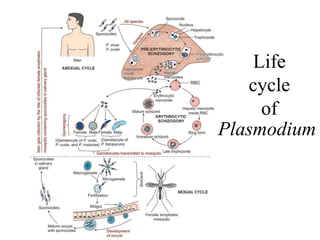
 Life cycle:
Two cycles of development:
• Asexual cycle in human (intermediate host)
• Sexual cycle in mosquito (definitive host)
Life
cycle
of
Plasmodium
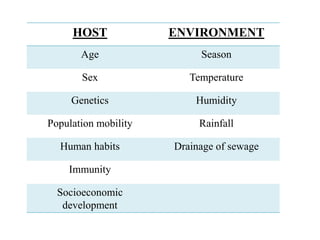
HOST ENVIRONMENT
Age Season
Sex Temperature
Genetics Humidity
Population mobility Rainfall
Human habits Drainage of sewage
Immunity
Socioeconomic
development
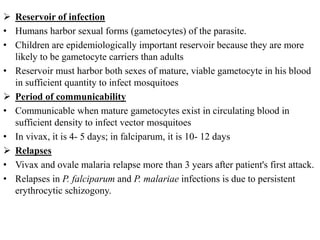
 Reservoir of infection
• Humans harbor sexual forms (gametocytes) of the parasite.
• Children are epidemiologically important reservoir because they are more
likely to be gametocyte carriers than adults
• Reservoir must harbor both sexes of mature, viable gametocyte in his blood
in sufficient quantity to infect mosquitoes
 Period of communicability
• Communicable when mature gametocytes exist in circulating blood in
sufficient density to infect vector mosquitoes
• In vivax, it is 4- 5 days; in falciparum, it is 10- 12 days
 Relapses
• Vivax and ovale malaria relapse more than 3 years after patient's first attack.
• Relapses in P. falciparum and P. malariae infections is due to persistent
erythrocytic schizogony.
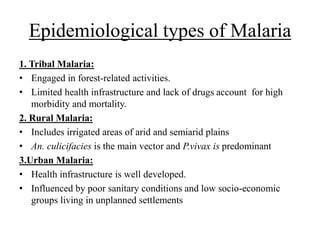
Epidemiological types of Malaria
1. Tribal Malaria:
• Engaged in forest-related activities.
• Limited health infrastructure and lack of drugs account for high
morbidity and mortality.
2. Rural Malaria:
• Includes irrigated areas of arid and semiarid plains
• An. culicifacies is the main vector and P.vivax is predominant
3.Urban Malaria:
• Health infrastructure is well developed.
• Influenced by poor sanitary conditions and low socio-economic
groups living in unplanned settlements
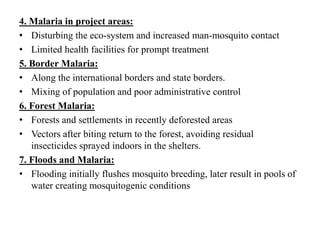
4. Malaria in project areas:
• Disturbing the eco-system and increased man-mosquito contact
• Limited health facilities for prompt treatment
5. Border Malaria:
• Along the international borders and state borders.
• Mixing of population and poor administrative control
6. Forest Malaria:
• Forests and settlements in recently deforested areas
• Vectors after biting return to the forest, avoiding residual
insecticides sprayed indoors in the shelters.
7. Floods and Malaria:
• Flooding initially flushes mosquito breeding, later result in pools of
water creating mosquitogenic conditions
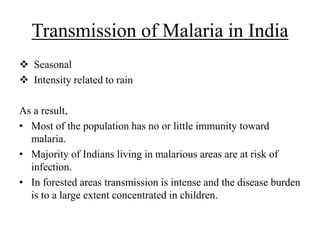
Transmission of Malaria in India
 Seasonal
 Intensity related to rain
As a result,
• Most of the population has no or little immunity toward
malaria.
• Majority of Indians living in malarious areas are at risk of
infection.
• In forested areas transmission is intense and the disease burden
is to a large extent concentrated in children.
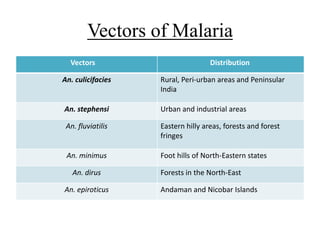
Vectors of Malaria
Vectors Distribution
An. culicifacies Rural, Peri-urban areas and Peninsular
India
An. stephensi Urban and industrial areas
An. fluviatilis Eastern hilly areas, forests and forest
fringes
An. minimus Foot hills of North-Eastern states
An. dirus Forests in the North-East
An. epiroticus Andaman and Nicobar Islands
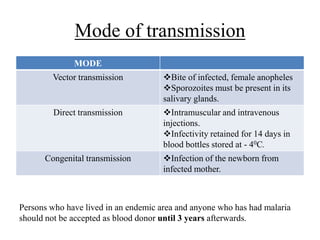
Mode of transmission
MODE
Vector transmission Bite of infected, female anopheles
Sporozoites must be present in its
salivary glands.
Direct transmission Intramuscular and intravenous
injections.
Infectivity retained for 14 days in
blood bottles stored at - 40C.
Congenital transmission Infection of the newborn from
infected mother.
Persons who have lived in an endemic area and anyone who has had malaria
should not be accepted as blood donor until 3 years afterwards.
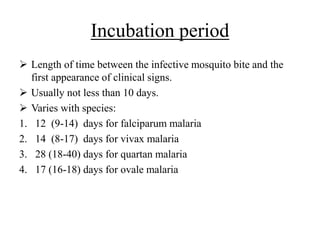
Incubation period
 Length of time between the infective mosquito bite and the
first appearance of clinical signs.
 Usually not less than 10 days.
 Varies with species:
1. 12 (9-14) days for falciparum malaria
2. 14 (8-17) days for vivax malaria
3. 28 (18-40) days for quartan malaria
4. 17 (16-18) days for ovale malaria
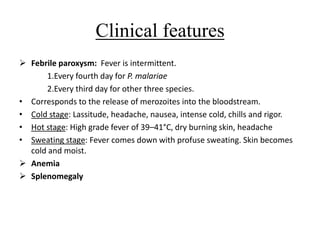
Clinical features
 Febrile paroxysm: Fever is intermittent.
1.Every fourth day for P. malariae
2.Every third day for other three species.
• Corresponds to the release of merozoites into the bloodstream.
• Cold stage: Lassitude, headache, nausea, intense cold, chills and rigor.
• Hot stage: High grade fever of 39–41°C, dry burning skin, headache
• Sweating stage: Fever comes down with profuse sweating. Skin becomes
cold and moist.
 Anemia
 Splenomegaly
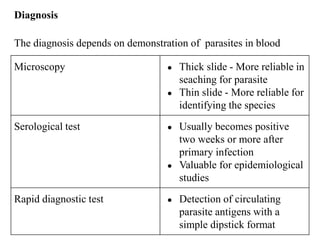
Diagnosis
The diagnosis depends on demonstration of parasites in blood
Microscopy ● Thick slide - More reliable in
seaching for parasite
● Thin slide - More reliable for
identifying the species
Serological test ● Usually becomes positive
two weeks or more after
primary infection
● Valuable for epidemiological
studies
Rapid diagnostic test ● Detection of circulating
parasite antigens with a
simple dipstick format
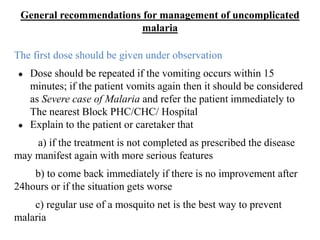
General recommendations for management of uncomplicated
malaria
The first dose should be given under observation
● Dose should be repeated if the vomiting occurs within 15
minutes; if the patient vomits again then it should be considered
as Severe case of Malaria and refer the patient immediately to
The nearest Block PHC/CHC/ Hospital
● Explain to the patient or caretaker that
a) if the treatment is not completed as prescribed the disease
may manifest again with more serious features
b) to come back immediately if there is no improvement after
24hours or if the situation gets worse
c) regular use of a mosquito net is the best way to prevent
malaria
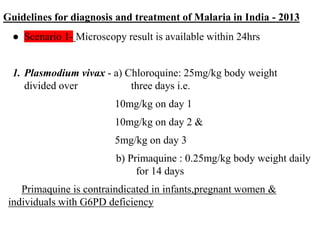
Guidelines for diagnosis and treatment of Malaria in India - 2013
● Scenario 1- Microscopy result is available within 24hrs
1. Plasmodium vivax - a) Chloroquine: 25mg/kg body weight
divided over three days i.e.
10mg/kg on day 1
10mg/kg on day 2 &
5mg/kg on day 3
b) Primaquine : 0.25mg/kg body weight daily
for 14 days
Primaquine is contraindicated in infants,pregnant women &
individuals with G6PD deficiency
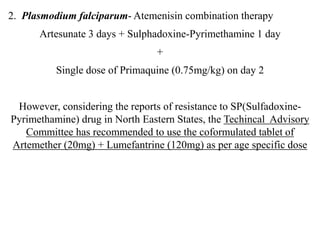
2. Plasmodium falciparum- Atemenisin combination therapy
Artesunate 3 days + Sulphadoxine-Pyrimethamine 1 day
+
Single dose of Primaquine (0.75mg/kg) on day 2
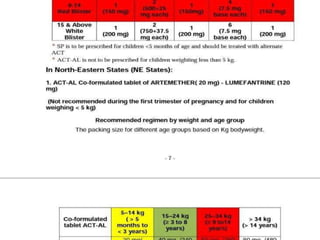
However, considering the reports of resistance to SP(Sulfadoxine-
Pyrimethamine) drug in North Eastern States, the Techincal Advisory
Committee has recommended to use the coformulated tablet of
Artemether (20mg) + Lumefantrine (120mg) as per age specific dose
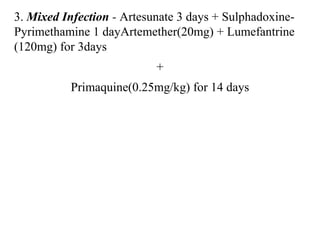
3. Mixed Infection - Artesunate 3 days + Sulphadoxine-
Pyrimethamine 1 dayArtemether(20mg) + Lumefantrine
(120mg) for 3days
+
Primaquine(0.25mg/kg) for 14 days
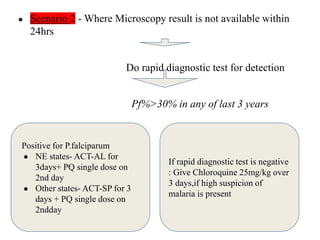
● Scenario 2 - Where Microscopy result is not available within
24hrs
Do rapid diagnostic test for detection
Pf%>30% in any of last 3 years
Positive for P.falciparum
● NE states- ACT-AL for
3days+ PQ single dose on
2nd day
● Other states- ACT-SP for 3
days + PQ single dose on
2ndday
If rapid diagnostic test is negative
: Give Chloroquine 25mg/kg over
3 days,if high suspicion of
malaria is present
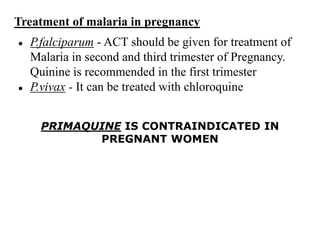
Treatment of malaria in pregnancy
● P.falciparum - ACT should be given for treatment of
Malaria in second and third trimester of Pregnancy.
Quinine is recommended in the first trimester
● P.vivax - It can be treated with chloroquine
PRIMAQUINE IS CONTRAINDICATED IN
PREGNANT WOMEN
Treatment of severe Malaria
C/F : Severe manifestations can develop in P.falciparum
infection over a span of time as short as 12-24 hours and
may lead to death, if not treated promptly and adequately.
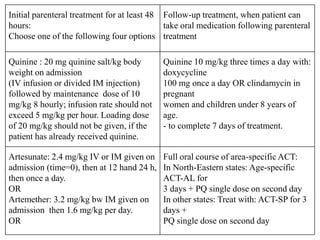
Initial parenteral treatment for at least 48
hours:
Choose one of the following four options
Follow-up treatment, when patient can
take oral medication following parenteral
treatment
Quinine : 20 mg quinine salt/kg body
weight on admission
(IV infusion or divided IM injection)
followed by maintenance dose of 10
mg/kg 8 hourly; infusion rate should not
exceed 5 mg/kg per hour. Loading dose
of 20 mg/kg should not be given, if the
patient has already received quinine.
Quinine 10 mg/kg three times a day with:
doxycycline
100 mg once a day OR clindamycin in
pregnant
women and children under 8 years of
age.
- to complete 7 days of treatment.
Artesunate: 2.4 mg/kg IV or IM given on
admission (time=0), then at 12 hand 24 h,
then once a day.
OR
Artemether: 3.2 mg/kg bw IM given on
admission then 1.6 mg/kg per day.
OR
Full oral course of area-specific ACT:
In North-Eastern states: Age-specific
ACT-AL for
3 days + PQ single dose on second day
In other states: Treat with: ACT-SP for 3
days +
PQ single dose on second day
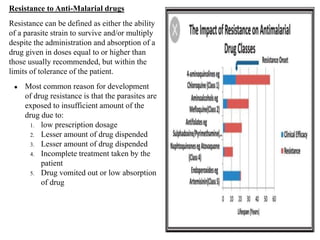
Resistance to Anti-Malarial drugs
Resistance can be defined as either the ability
of a parasite strain to survive and/or multiply
despite the administration and absorption of a
drug given in doses equal to or higher than
those usually recommended, but within the
limits of tolerance of the patient.
● Most common reason for development
of drug resistance is that the parasites are
exposed to insufficient amount of the
drug due to:
1. low prescription dosage
2. Lesser amount of drug dispended
3. Lesser amount of drug dispended
4. Incomplete treatment taken by the
patient
5. Drug vomited out or low absorption
of drug
Treatment failure
After treatment patient is considered cured if he/she does not have fever or
parasitaemia till day 28th
Early treatment failure [ETF]
● Development of danger signs or
severe Malaria on Day 1, 2 or 3
in the presence of parasitaemia
● Parasitaemia on Day 2 higher
than on Day 0, irrespective of
axillary temperature
● Parasitaemia on day 3 with
axillary temperature >37.5 c
Late parasitological failure
[LPF]
● Presence of parasitaemia on any
day between day 7 and day 28
with axillary temperature <37.5c
in patients who did not
previously meet any of the
criteria of early treatment failure
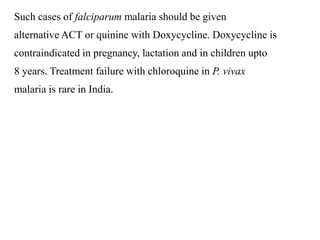
Such cases of falciparum malaria should be given
alternative ACT or quinine with Doxycycline. Doxycycline is
contraindicated in pregnancy, lactation and in children upto
8 years. Treatment failure with chloroquine in P. vivax
malaria is rare in India.
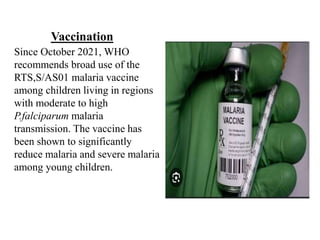
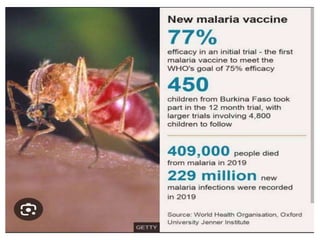
Vaccination
Since October 2021, WHO
recommends broad use of the
RTS,S/AS01 malaria vaccine
among children living in regions
with moderate to high
P.falciparum malaria
transmission. The vaccine has
been shown to significantly
reduce malaria and severe malaria
among young children.
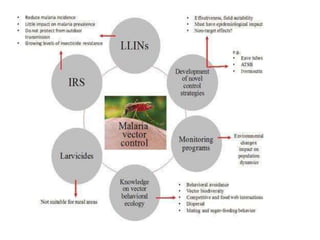
PREVENTION OF MALARIA
Neither chemotherapy nor chemoprophylaxis will be able to
reduce significantly the malaria prevalence or transmission.
It can be obtained only when proper anti mosquito measures
are introduced.
Active Intervention Measures-
1.STRATIFICATION OF THE PROBLEM
2.VECTOR CONTROL STARTEGIES
a)Anti-adult measures
(i)Residual spraying
(ii)Space application
(iii)Individual protection
b)Anti-larval measures
(i)Larvicides
(ii)Source reduction
(iii)Integrated control
NATIONAL VECTOR BORNE
DISEASE CONTROL PROGRAM
Launched in 2003-04 by convergence of three
ongoing programs on malaria,filaria & kala Azar
and inclusion of Japanese encephalitis and
dengue.
In 2007 Chikungunya fever added to this
programme due to re-emergence of the disease in
2006.
This program is now runs under the umbrella of
NHM.
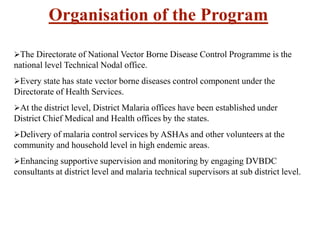
Organisation of the Program
The Directorate of National Vector Borne Disease Control Programme is the
national level Technical Nodal office.
Every state has state vector borne diseases control component under the
Directorate of Health Services.
At the district level, District Malaria offices have been established under
District Chief Medical and Health offices by the states.
Delivery of malaria control services by ASHAs and other volunteers at the
community and household level in high endemic areas.
Enhancing supportive supervision and monitoring by engaging DVBDC
consultants at district level and malaria technical supervisors at sub district level.
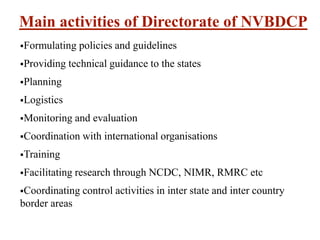
Main activities of Directorate of NVBDCP
Formulating policies and guidelines
Providing technical guidance to the states
Planning
Logistics
Monitoring and evaluation
Coordination with international organisations
Training
Facilitating research through NCDC, NIMR, RMRC etc
Coordinating control activities in inter state and inter country
border areas
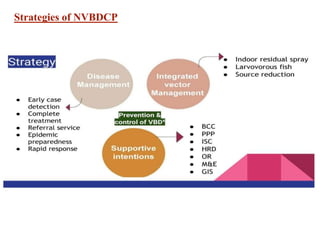
Strategies of NVBDCP
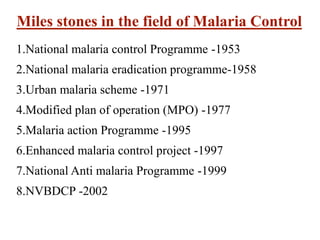
Miles stones in the field of Malaria Control
1.National malaria control Programme -1953
2.National malaria eradication programme-1958
3.Urban malaria scheme -1971
4.Modified plan of operation (MPO) -1977
5.Malaria action Programme -1995
6.Enhanced malaria control project -1997
7.National Anti malaria Programme -1999
8.NVBDCP -2002
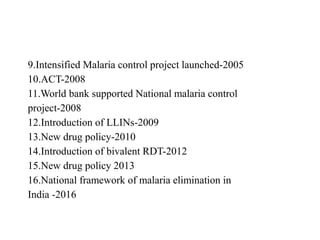
9.Intensified Malaria control project launched-2005
10.ACT-2008
11.World bank supported National malaria control
project-2008
12.Introduction of LLINs-2009
13.New drug policy-2010
14.Introduction of bivalent RDT-2012
15.New drug policy 2013
16.National framework of malaria elimination in
India -2016
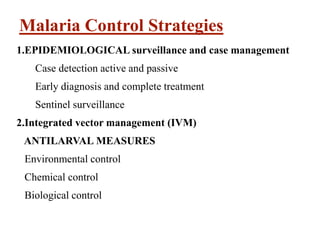
Malaria Control Strategies
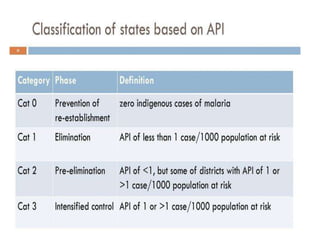
1.EPIDEMIOLOGICAL surveillance and case management
Case detection active and passive
Early diagnosis and complete treatment
Sentinel surveillance
2.Integrated vector management (IVM)
ANTILARVAL MEASURES
Environmental control
Chemical control
Biological control
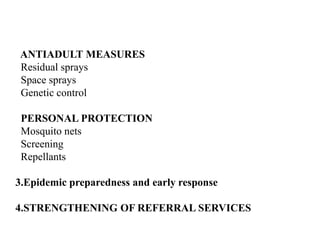
ANTIADULT MEASURES
Residual sprays
Space sprays
Genetic control
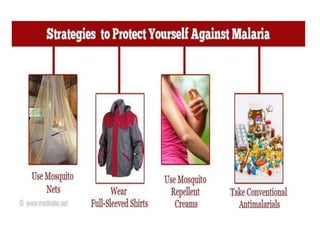
PERSONAL PROTECTION
Mosquito nets
Screening
Repellants
3.Epidemic preparedness and early response
4.STRENGTHENING OF REFERRAL SERVICES
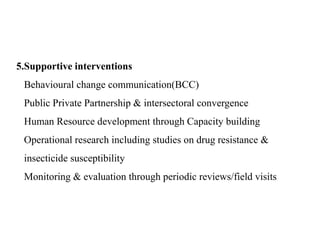
5.Supportive interventions
Behavioural change communication(BCC)
Public Private Partnership & intersectoral convergence
Human Resource development through Capacity building
Operational research including studies on drug resistance &
insecticide susceptibility
Monitoring & evaluation through periodic reviews/field visits
Early diagnosis and treatment of
Malaria aims at
1.Complete cure
2.Prevention of progression of uncomplicated malaria to severe
diseases
3.Prevention of deaths
4.Interruption of transmission
5.Minimizing risk of selection and spread of drug resistant malaria
parasite
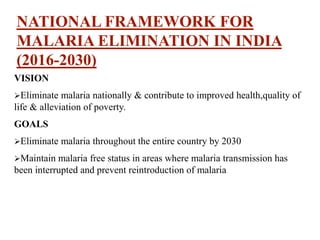
NATIONAL FRAMEWORK FOR
MALARIA ELIMINATION IN INDIA
(2016-2030)
VISION
Eliminate malaria nationally & contribute to improved health,quality of
life & alleviation of poverty.
GOALS
Eliminate malaria throughout the entire country by 2030
Maintain malaria free status in areas where malaria transmission has
been interrupted and prevent reintroduction of malaria
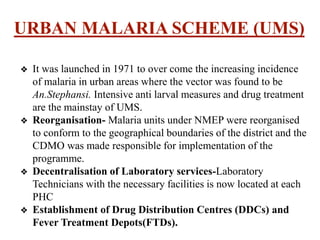
URBAN MALARIA SCHEME (UMS)
❖ It was launched in 1971 to over come the increasing incidence
of malaria in urban areas where the vector was found to be
An.Stephansi. Intensive anti larval measures and drug treatment
are the mainstay of UMS.
❖ Reorganisation- Malaria units under NMEP were reorganised
to conform to the geographical boundaries of the district and the
CDMO was made responsible for implementation of the
programme.
❖ Decentralisation of Laboratory services-Laboratory
Technicians with the necessary facilities is now located at each
PHC
❖ Establishment of Drug Distribution Centres (DDCs) and
Fever Treatment Depots(FTDs).
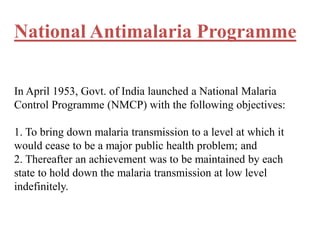
National Antimalaria Programme
In April 1953, Govt. of India launched a National Malaria
Control Programme (NMCP) with the following objectives:
1. To bring down malaria transmission to a level at which it
would cease to be a major public health problem; and
2. Thereafter an achievement was to be maintained by each
state to hold down the malaria transmission at low level
indefinitely.
Strategies under NMCP were:
1. Principal operational activities under the control
programme comprised of residual insecticide spray of
human dwelling and cattle sheds;
2. Malaria control teams were organised and directed by
the state anti-malaria organisation to carry out surveys
and to monitor the malaria incidence in the control areas;
and
3. Anti-malarial drugs were made available for patients
reporting to an Institution.
Modified Plan of operation
In 1977 attempts at malaria eradication were given up and under the
review policy, a Modified Plan of Operation (MPO) was adopted.
Objectives
1. Elimination of malaria deaths
2. Reduction of malaria morbidity
3. Maintenance of the gains achieved so far by reducing
transmission of malaria
Areas were divided on the basis of API into two groups and
separate strategies were suggested accordingly.
Malaria Action Program
Due to occurrence of many epidemics of malaria in the country,
an expert committee was formulated to identify epidemiological
parameters for high risk areas. Following areas were identified:
Problem Area A. Hardcore areas (Tribal Areas)
B. Epidemic Prone Areas
C. Project Areas
D. Triple Insecticide resistant Areas
E. Urban Areas
REFERENCES
1. CodeHunk. National ANTI-MALARIA programme [Internet].
[cited 2023 Jun 27]. Available from:
http://www.nihfw.org/NationalHealthProgramme/NATIONALANTI
_MALARIAPROGRAMME.html
2. World Malaria Report 2022 [Internet]. World Health
Organization; [cited 2023 Jun 27]. Available from:
https://www.who.int/news-room/fact-sheets/detail/malaria
3. Park K. Epidemiology of communicable diseases. In: Park’s
textbook of Preventive and Social Medicine. 26th edition ed. India:
Bhanot Publishers; 2022.

Malaria vector and management final.pptx

  • 1.
    MALARIA -Presented by, Dr. Prashanth.K Dr.Prashanth.R Dr. Pravalika G.R
  • 2.
    Contents • Introduction • Epidemiology •Vectors of Malaria and transmission • Clinical features • Diagnosis of Malaria • Management of uncomplicated Malaria • Management of severe Malaria • Vaccination • Prevention of Malaria • National vector borne disease control program (NVBDCP)
  • 3.
    Introduction  Malaria isa protozoal disease caused by infection with Plasmodium.  Transmitted to man by infected female Anopheline mosquito.  Globally in 2021, there were an estimated 247 million malaria cases.  An increase of 2 million cases compared with 2020.  In India about 21.98% population lives in malaria high transmission areas and about 67% in low transmission areas.
  • 4.
    Countries with indigenous cases of malaria in 2000and their status by 2021 Division of the world into regions by WHO pertaining to Malaria
  • 5.
    Distribution of malaria cases by country,2021 Distribution of malaria deaths by country, 2021
  • 6.
    In 2021, Indiaaccounted for most cases in the South- East Asia Region-79% South-East Asia is the only WHO Region that reached the GTS 2020 milestones. Trend of number of malaria cases in India
  • 7.
  • 8.
    Agent factors  Agent: •Plasmodium vivax (most common in the world) • Plasmodium falciparum (most common in India) • Plasmodium malariae (< 1% of India- Tumkur and Hassan) • Plasmodium ovale (rare- Tropical Africa)  Life cycle: Two cycles of development: • Asexual cycle in human (intermediate host) • Sexual cycle in mosquito (definitive host)
  • 9.
  • 10.
    HOST ENVIRONMENT Age Season SexTemperature Genetics Humidity Population mobility Rainfall Human habits Drainage of sewage Immunity Socioeconomic development
  • 11.
     Reservoir ofinfection • Humans harbor sexual forms (gametocytes) of the parasite. • Children are epidemiologically important reservoir because they are more likely to be gametocyte carriers than adults • Reservoir must harbor both sexes of mature, viable gametocyte in his blood in sufficient quantity to infect mosquitoes  Period of communicability • Communicable when mature gametocytes exist in circulating blood in sufficient density to infect vector mosquitoes • In vivax, it is 4- 5 days; in falciparum, it is 10- 12 days  Relapses • Vivax and ovale malaria relapse more than 3 years after patient's first attack. • Relapses in P. falciparum and P. malariae infections is due to persistent erythrocytic schizogony.
  • 12.
    Epidemiological types ofMalaria 1. Tribal Malaria: • Engaged in forest-related activities. • Limited health infrastructure and lack of drugs account for high morbidity and mortality. 2. Rural Malaria: • Includes irrigated areas of arid and semiarid plains • An. culicifacies is the main vector and P.vivax is predominant 3.Urban Malaria: • Health infrastructure is well developed. • Influenced by poor sanitary conditions and low socio-economic groups living in unplanned settlements
  • 13.
    4. Malaria inproject areas: • Disturbing the eco-system and increased man-mosquito contact • Limited health facilities for prompt treatment 5. Border Malaria: • Along the international borders and state borders. • Mixing of population and poor administrative control 6. Forest Malaria: • Forests and settlements in recently deforested areas • Vectors after biting return to the forest, avoiding residual insecticides sprayed indoors in the shelters. 7. Floods and Malaria: • Flooding initially flushes mosquito breeding, later result in pools of water creating mosquitogenic conditions
  • 14.
    Transmission of Malariain India  Seasonal  Intensity related to rain As a result, • Most of the population has no or little immunity toward malaria. • Majority of Indians living in malarious areas are at risk of infection. • In forested areas transmission is intense and the disease burden is to a large extent concentrated in children.
  • 15.
    Vectors of Malaria VectorsDistribution An. culicifacies Rural, Peri-urban areas and Peninsular India An. stephensi Urban and industrial areas An. fluviatilis Eastern hilly areas, forests and forest fringes An. minimus Foot hills of North-Eastern states An. dirus Forests in the North-East An. epiroticus Andaman and Nicobar Islands
  • 16.
    Mode of transmission MODE Vectortransmission Bite of infected, female anopheles Sporozoites must be present in its salivary glands. Direct transmission Intramuscular and intravenous injections. Infectivity retained for 14 days in blood bottles stored at - 40C. Congenital transmission Infection of the newborn from infected mother. Persons who have lived in an endemic area and anyone who has had malaria should not be accepted as blood donor until 3 years afterwards.
  • 17.
    Incubation period  Lengthof time between the infective mosquito bite and the first appearance of clinical signs.  Usually not less than 10 days.  Varies with species: 1. 12 (9-14) days for falciparum malaria 2. 14 (8-17) days for vivax malaria 3. 28 (18-40) days for quartan malaria 4. 17 (16-18) days for ovale malaria
  • 18.
    Clinical features  Febrileparoxysm: Fever is intermittent. 1.Every fourth day for P. malariae 2.Every third day for other three species. • Corresponds to the release of merozoites into the bloodstream. • Cold stage: Lassitude, headache, nausea, intense cold, chills and rigor. • Hot stage: High grade fever of 39–41°C, dry burning skin, headache • Sweating stage: Fever comes down with profuse sweating. Skin becomes cold and moist.  Anemia  Splenomegaly
  • 19.
    Diagnosis The diagnosis dependson demonstration of parasites in blood Microscopy ● Thick slide - More reliable in seaching for parasite ● Thin slide - More reliable for identifying the species Serological test ● Usually becomes positive two weeks or more after primary infection ● Valuable for epidemiological studies Rapid diagnostic test ● Detection of circulating parasite antigens with a simple dipstick format
  • 20.
    General recommendations formanagement of uncomplicated malaria The first dose should be given under observation ● Dose should be repeated if the vomiting occurs within 15 minutes; if the patient vomits again then it should be considered as Severe case of Malaria and refer the patient immediately to The nearest Block PHC/CHC/ Hospital ● Explain to the patient or caretaker that a) if the treatment is not completed as prescribed the disease may manifest again with more serious features b) to come back immediately if there is no improvement after 24hours or if the situation gets worse c) regular use of a mosquito net is the best way to prevent malaria
  • 21.
    Guidelines for diagnosisand treatment of Malaria in India - 2013 ● Scenario 1- Microscopy result is available within 24hrs 1. Plasmodium vivax - a) Chloroquine: 25mg/kg body weight divided over three days i.e. 10mg/kg on day 1 10mg/kg on day 2 & 5mg/kg on day 3 b) Primaquine : 0.25mg/kg body weight daily for 14 days Primaquine is contraindicated in infants,pregnant women & individuals with G6PD deficiency
  • 22.
    2. Plasmodium falciparum-Atemenisin combination therapy Artesunate 3 days + Sulphadoxine-Pyrimethamine 1 day + Single dose of Primaquine (0.75mg/kg) on day 2 However, considering the reports of resistance to SP(Sulfadoxine- Pyrimethamine) drug in North Eastern States, the Techincal Advisory Committee has recommended to use the coformulated tablet of Artemether (20mg) + Lumefantrine (120mg) as per age specific dose
  • 25.
    3. Mixed Infection- Artesunate 3 days + Sulphadoxine- Pyrimethamine 1 dayArtemether(20mg) + Lumefantrine (120mg) for 3days + Primaquine(0.25mg/kg) for 14 days
  • 26.
    ● Scenario 2- Where Microscopy result is not available within 24hrs Do rapid diagnostic test for detection Pf%>30% in any of last 3 years Positive for P.falciparum ● NE states- ACT-AL for 3days+ PQ single dose on 2nd day ● Other states- ACT-SP for 3 days + PQ single dose on 2ndday If rapid diagnostic test is negative : Give Chloroquine 25mg/kg over 3 days,if high suspicion of malaria is present
  • 27.
    Treatment of malariain pregnancy ● P.falciparum - ACT should be given for treatment of Malaria in second and third trimester of Pregnancy. Quinine is recommended in the first trimester ● P.vivax - It can be treated with chloroquine PRIMAQUINE IS CONTRAINDICATED IN PREGNANT WOMEN
  • 28.
    Treatment of severeMalaria C/F : Severe manifestations can develop in P.falciparum infection over a span of time as short as 12-24 hours and may lead to death, if not treated promptly and adequately.
  • 29.
    Initial parenteral treatmentfor at least 48 hours: Choose one of the following four options Follow-up treatment, when patient can take oral medication following parenteral treatment Quinine : 20 mg quinine salt/kg body weight on admission (IV infusion or divided IM injection) followed by maintenance dose of 10 mg/kg 8 hourly; infusion rate should not exceed 5 mg/kg per hour. Loading dose of 20 mg/kg should not be given, if the patient has already received quinine. Quinine 10 mg/kg three times a day with: doxycycline 100 mg once a day OR clindamycin in pregnant women and children under 8 years of age. - to complete 7 days of treatment. Artesunate: 2.4 mg/kg IV or IM given on admission (time=0), then at 12 hand 24 h, then once a day. OR Artemether: 3.2 mg/kg bw IM given on admission then 1.6 mg/kg per day. OR Full oral course of area-specific ACT: In North-Eastern states: Age-specific ACT-AL for 3 days + PQ single dose on second day In other states: Treat with: ACT-SP for 3 days + PQ single dose on second day
  • 30.
    Resistance to Anti-Malarialdrugs Resistance can be defined as either the ability of a parasite strain to survive and/or multiply despite the administration and absorption of a drug given in doses equal to or higher than those usually recommended, but within the limits of tolerance of the patient. ● Most common reason for development of drug resistance is that the parasites are exposed to insufficient amount of the drug due to: 1. low prescription dosage 2. Lesser amount of drug dispended 3. Lesser amount of drug dispended 4. Incomplete treatment taken by the patient 5. Drug vomited out or low absorption of drug
  • 33.
    Treatment failure After treatmentpatient is considered cured if he/she does not have fever or parasitaemia till day 28th Early treatment failure [ETF] ● Development of danger signs or severe Malaria on Day 1, 2 or 3 in the presence of parasitaemia ● Parasitaemia on Day 2 higher than on Day 0, irrespective of axillary temperature ● Parasitaemia on day 3 with axillary temperature >37.5 c Late parasitological failure [LPF] ● Presence of parasitaemia on any day between day 7 and day 28 with axillary temperature <37.5c in patients who did not previously meet any of the criteria of early treatment failure
  • 34.
    Such cases offalciparum malaria should be given alternative ACT or quinine with Doxycycline. Doxycycline is contraindicated in pregnancy, lactation and in children upto 8 years. Treatment failure with chloroquine in P. vivax malaria is rare in India.
  • 35.
    Vaccination Since October 2021,WHO recommends broad use of the RTS,S/AS01 malaria vaccine among children living in regions with moderate to high P.falciparum malaria transmission. The vaccine has been shown to significantly reduce malaria and severe malaria among young children.
  • 37.
    PREVENTION OF MALARIA Neitherchemotherapy nor chemoprophylaxis will be able to reduce significantly the malaria prevalence or transmission. It can be obtained only when proper anti mosquito measures are introduced. Active Intervention Measures- 1.STRATIFICATION OF THE PROBLEM 2.VECTOR CONTROL STARTEGIES
  • 40.
    a)Anti-adult measures (i)Residual spraying (ii)Spaceapplication (iii)Individual protection b)Anti-larval measures (i)Larvicides (ii)Source reduction (iii)Integrated control
  • 41.
  • 42.
    Launched in 2003-04by convergence of three ongoing programs on malaria,filaria & kala Azar and inclusion of Japanese encephalitis and dengue. In 2007 Chikungunya fever added to this programme due to re-emergence of the disease in 2006. This program is now runs under the umbrella of NHM.
  • 43.
    Organisation of theProgram The Directorate of National Vector Borne Disease Control Programme is the national level Technical Nodal office. Every state has state vector borne diseases control component under the Directorate of Health Services. At the district level, District Malaria offices have been established under District Chief Medical and Health offices by the states. Delivery of malaria control services by ASHAs and other volunteers at the community and household level in high endemic areas. Enhancing supportive supervision and monitoring by engaging DVBDC consultants at district level and malaria technical supervisors at sub district level.
  • 44.
    Main activities ofDirectorate of NVBDCP Formulating policies and guidelines Providing technical guidance to the states Planning Logistics Monitoring and evaluation Coordination with international organisations Training Facilitating research through NCDC, NIMR, RMRC etc Coordinating control activities in inter state and inter country border areas
  • 45.
  • 46.
    Miles stones inthe field of Malaria Control 1.National malaria control Programme -1953 2.National malaria eradication programme-1958 3.Urban malaria scheme -1971 4.Modified plan of operation (MPO) -1977 5.Malaria action Programme -1995 6.Enhanced malaria control project -1997 7.National Anti malaria Programme -1999 8.NVBDCP -2002
  • 47.
    9.Intensified Malaria controlproject launched-2005 10.ACT-2008 11.World bank supported National malaria control project-2008 12.Introduction of LLINs-2009 13.New drug policy-2010 14.Introduction of bivalent RDT-2012 15.New drug policy 2013 16.National framework of malaria elimination in India -2016
  • 48.
    Malaria Control Strategies 1.EPIDEMIOLOGICALsurveillance and case management Case detection active and passive Early diagnosis and complete treatment Sentinel surveillance 2.Integrated vector management (IVM) ANTILARVAL MEASURES Environmental control Chemical control Biological control
  • 49.
    ANTIADULT MEASURES Residual sprays Spacesprays Genetic control PERSONAL PROTECTION Mosquito nets Screening Repellants 3.Epidemic preparedness and early response 4.STRENGTHENING OF REFERRAL SERVICES
  • 50.
    5.Supportive interventions Behavioural changecommunication(BCC) Public Private Partnership & intersectoral convergence Human Resource development through Capacity building Operational research including studies on drug resistance & insecticide susceptibility Monitoring & evaluation through periodic reviews/field visits
  • 51.
    Early diagnosis andtreatment of Malaria aims at 1.Complete cure 2.Prevention of progression of uncomplicated malaria to severe diseases 3.Prevention of deaths 4.Interruption of transmission 5.Minimizing risk of selection and spread of drug resistant malaria parasite
  • 52.
    NATIONAL FRAMEWORK FOR MALARIAELIMINATION IN INDIA (2016-2030) VISION Eliminate malaria nationally & contribute to improved health,quality of life & alleviation of poverty. GOALS Eliminate malaria throughout the entire country by 2030 Maintain malaria free status in areas where malaria transmission has been interrupted and prevent reintroduction of malaria
  • 54.
    URBAN MALARIA SCHEME(UMS) ❖ It was launched in 1971 to over come the increasing incidence of malaria in urban areas where the vector was found to be An.Stephansi. Intensive anti larval measures and drug treatment are the mainstay of UMS. ❖ Reorganisation- Malaria units under NMEP were reorganised to conform to the geographical boundaries of the district and the CDMO was made responsible for implementation of the programme. ❖ Decentralisation of Laboratory services-Laboratory Technicians with the necessary facilities is now located at each PHC ❖ Establishment of Drug Distribution Centres (DDCs) and Fever Treatment Depots(FTDs).
  • 55.
    National Antimalaria Programme InApril 1953, Govt. of India launched a National Malaria Control Programme (NMCP) with the following objectives: 1. To bring down malaria transmission to a level at which it would cease to be a major public health problem; and 2. Thereafter an achievement was to be maintained by each state to hold down the malaria transmission at low level indefinitely.
  • 56.
    Strategies under NMCPwere: 1. Principal operational activities under the control programme comprised of residual insecticide spray of human dwelling and cattle sheds; 2. Malaria control teams were organised and directed by the state anti-malaria organisation to carry out surveys and to monitor the malaria incidence in the control areas; and 3. Anti-malarial drugs were made available for patients reporting to an Institution.
  • 57.
    Modified Plan ofoperation In 1977 attempts at malaria eradication were given up and under the review policy, a Modified Plan of Operation (MPO) was adopted. Objectives 1. Elimination of malaria deaths 2. Reduction of malaria morbidity 3. Maintenance of the gains achieved so far by reducing transmission of malaria Areas were divided on the basis of API into two groups and separate strategies were suggested accordingly.
  • 58.
    Malaria Action Program Dueto occurrence of many epidemics of malaria in the country, an expert committee was formulated to identify epidemiological parameters for high risk areas. Following areas were identified: Problem Area A. Hardcore areas (Tribal Areas) B. Epidemic Prone Areas C. Project Areas D. Triple Insecticide resistant Areas E. Urban Areas
  • 59.
    REFERENCES 1. CodeHunk. NationalANTI-MALARIA programme [Internet]. [cited 2023 Jun 27]. Available from: http://www.nihfw.org/NationalHealthProgramme/NATIONALANTI _MALARIAPROGRAMME.html 2. World Malaria Report 2022 [Internet]. World Health Organization; [cited 2023 Jun 27]. Available from: https://www.who.int/news-room/fact-sheets/detail/malaria 3. Park K. Epidemiology of communicable diseases. In: Park’s textbook of Preventive and Social Medicine. 26th edition ed. India: Bhanot Publishers; 2022.