Presentation
On
Chikungunuya
Fever
Prepared By:
Surbhi Sharma
INTRODUCTION
Chikungunya virus (CHIKV) is the aetiological agent of the
mosquito-borne disease chikungunya fever, a
debilitating arthritic disease that, during the past 7 years,
has caused immeasurable morbidity and some
mortality in humans, including newborn babies. The name
‘‘Chikungunya’’ in the Bantu language of the Makonde
people refers to the stooped posture due to the frequent
and
debilitating joint pain induced during chikungunya fever It
is
transmitted by Aedes (Ae) mosquitoes. It was first isolated
in
1952 in the Makonde Plateau of the southern province of
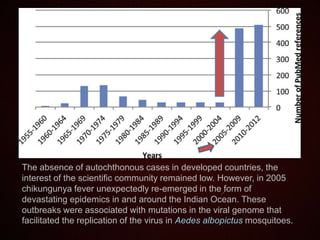
The absence of autochthonous cases in developed countries, the
interest of the scientific community remained low. However, in 2005
chikungunya fever unexpectedly re-emerged in the form of
devastating epidemics in and around the Indian Ocean. These
outbreaks were associated with mutations in the viral genome that
facilitated the replication of the virus in Aedes albopictus mosquitoes.
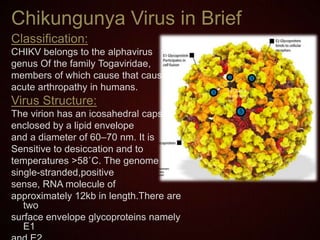
Chikungunya Virus in Brief
Classification:
CHIKV belongs to the alphavirus
genus Of the family Togaviridae,
members of which cause that cause
acute arthropathy in humans.
Virus Structure:
The virion has an icosahedral capsid
enclosed by a lipid envelope
and a diameter of 60–70 nm. It is
Sensitive to desiccation and to
temperatures >58˚C. The genome is a
single-stranded,positive
sense, RNA molecule of
approximately 12kb in length.There are
two
surface envelope glycoproteins namely
E1
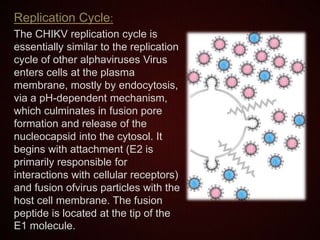
Replication Cycle:
The CHIKV replication cycle is
essentially similar to the replication
cycle of other alphaviruses Virus
enters cells at the plasma
membrane, mostly by endocytosis,
via a pH-dependent mechanism,
which culminates in fusion pore
formation and release of the
nucleocapsid into the cytosol. It
begins with attachment (E2 is
primarily responsible for
interactions with cellular receptors)
and fusion ofvirus particles with the
host cell membrane. The fusion
peptide is located at the tip of the
E1 molecule.
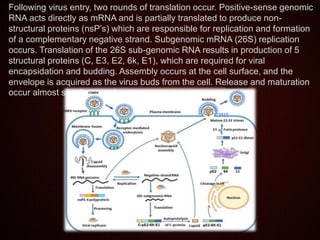
Following virus entry, two rounds of translation occur. Positive-sense genomic
RNA acts directly as mRNA and is partially translated to produce non-
structural proteins (nsP’s) which are responsible for replication and formation
of a complementary negative strand. Subgenomic mRNA (26S) replication
occurs. Translation of the 26S sub-genomic RNA results in production of 5
structural proteins (C, E3, E2, 6k, E1), which are required for viral
encapsidation and budding. Assembly occurs at the cell surface, and the
envelope is acquired as the virus buds from the cell. Release and maturation
occur almost simultaneously.
Clinical Syndrome
Incubation Period
The incubation period of chikungunya fever has never been. Investigated in
great detail, but a range of 1–12 days is often cited.
Clinical Features of the chikungunya fever
Two stages of the disease are now described: acute illness and the late stage of
illness, with persistent arthropathy.
ACUTE ILLNESS: Symptomatic patients generally report an abrupt
onset of disease characterised by high fever, polyarthralgia,
backache,headache,
and fatigue. Fever and characteristic clinical symptoms appear within 4–7 days.
Poly-arthralgia is reported in 87–98% of cases and represents the most
characteristic symptom. Joint pain is mostly polyarticular,bilateral, symmetrical
and occurs mainly in peripheral joints(wrists, ankles, and phalanges) and some
large joints (shoulders,elbows and knees).Joint swelling is less frequent. Pain in
the
ligaments and Myalgia (predominantly in the arms, thighs and calves) has also
been
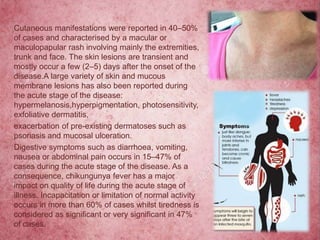
Cutaneous manifestations were reported in 40–50%
of cases and characterised by a macular or
maculopapular rash involving mainly the extremities,
trunk and face. The skin lesions are transient and
mostly occur a few (2–5) days after the onset of the
disease.A large variety of skin and mucous
membrane lesions has also been reported during
the acute stage of the disease:
hypermelanosis,hyperpigmentation, photosensitivity,
exfoliative dermatitis,
exacerbation of pre-existing dermatoses such as
psoriasis and mucosal ulceration.
Digestive symptoms such as diarrhoea, vomiting,
nausea or abdominal pain occurs in 15–47% of
cases during the acute stage of the disease. As a
consequence, chikungunya fever has a major
impact on quality of life during the acute stage of
illness. Incapacitation or limitation of normal activity
occurs in more than 60% of cases whilst tiredness is
considered as significant or very significant in 47%
of cases.
LATEILLNESS: After the acute stage, some patients experience relapse or
persistent symptoms. Amongst the symptoms declared during the late stage,
arthralgia or
musculoskeletal pains were the most frequent long-lasting signs. In West India after
the
2006 epidemic,12% and 5% suffered from musculoskeletal pains and arthritis at 1
and
2years after the disease onset respectively. Others symptoms were less frequently
reported
such as fever, fatigue,headaches, digestive disorders, skin rash, alopecia, joint
stiffness,
bursitis,tenosynovitis and synovitis with or without effusions. As a consequence, the
quality
of life & psychological health could be impaired at the late stage. Increased age was
associated with a longer duration of illness and the presence of joint pain at the late
stages
of infection.
Chikungunya fever in children
The main clinical characteristics in infants are the high prevalence of
dermatological manifestations (hyperpigmentation, generalised erythema,
maculopapular rash and vesiculobullous lesions) and neurological complications.
Other clinical features are also described such as digestive disorder
Diagnosis
VIRAEMIA:The acute stage of chikungunya fever is characterised by a very
high viraemic load (107 pfu/ml on average) with a median duration of
viraemia of 6 days (range 3–10 days). Other less common biological
abnormalities have been observed such as leukopenia, elevated liver
enzymes, anemia, elevated creatinine, elevated creatinine kinase and
hypocalcemia.
Differential diagnosis:Differentiating chikungunya fever from other possible
etiologies is important for physicians, notably to ensure good management
of outpatients. In a retrospective study aiming to compare dengue and
chikungunya fever , chikungunya was independently associated with
arthralgia and rash, while dengue was associated with myalgia, raised
aspartate transaminase, and leucopaenia.Also, CHIKV positive patients
had an increased frequency of skin rashes, arthralgia on the feet and wrist,
asthenia, a higher temperature and a lower frequency of digestive
symptoms and pruritus than CHIKV negative patients.
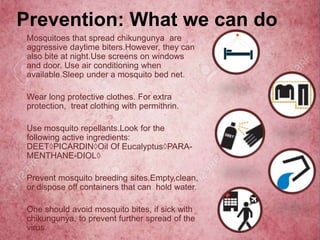
Prevention: What we can do
Mosquitoes that spread chikungunya are
aggressive daytime biters.However, they can
also bite at night.Use screens on windows
and door. Use air conditioning when
available.Sleep under a mosquito bed net.
Wear long protective clothes. For extra
protection, treat clothing with permithrin.
Use mosquito repellants.Look for the
following active ingredients:
DEET◊PICARDIN◊Oil Of Eucalyptus◊PARA-
MENTHANE-DIOL◊
Prevent mosquito breeding sites.Empty,clean,
or dispose off containers that can hold water.
One should avoid mosquito bites, if sick with
chikungunya, to prevent further spread of the
virus.
EPIDEMIOLOGY
Arthropod Vectors:
The main CHIKV mosquito vectors are Ae. aegypti (Stegomya aegypti) and Ae. Albopict
(Stegomya albopicta). Until recently, Ae. Aegypti was considered the primary vector for
CHIKV transmission but in 2006, Ae. albopictus was surprisingly identified as a second
major
vector of the virus. This emergence of Ae. albopictus as a major vector of CHIKV was
largely
attributable to a single mutation in the E1 protein of CHIKV which facilitated enhanced v
uptake, replication and transmission by the vector. Ae. albopictus has recently shown a
remarkable capacity to adapt to peridomestic environments, enabling it to displace Ae.
aegypti in some places and to become a significant vector of CHIKV.
Vertebrate reservoirs and transmission
Human beings serve as reservoir hosts for the virus during epidemic periods whereas d
inter-epidemic periods, several other reservoir hosts have been incriminated such as
monkeys,
rodents and birds. In Asia, CHIKV is maintained in human-mosquito-human urban cycles
involving both Ae. aegypti and Ae. albopictus. In Africa, CHIKV is maintained in a sylva
cycle Involving wild non-human primates and a variety of forest-dwelling mosquito
species such as Ae. africanus in Uganda and Bangui and Ae. cordellieri in South Africa.
PREVENTION AND TREATMENT
Vaccines
No licenced vaccine against chikungunya is commercially available,but several
strategies are under study. available. The first attempts to develop an inactivated
vaccine involved detergent treatment of virus. Unfortunately, these formalin-killed
vaccines which showed promise appeared to be moderately immunogenic and
limited to short time effects .Live vaccines are better at inducing rapid protection.
Treatment
Treatment of standard presentations of chikungunya fever currently relies on
paracetamol/acetaminophen and non-steroidal anti-inflammatory drugs.
Chloroquine is not recommended at the acute phase of the disease. Ribavirin has
been used in some severe cases but very limited information is available to
confirm its efficacy. Recent investigations may lead to the identification of new
antiviral candidates with a clearly defined mechanism of viral inhibition in cell
based systems and significant activity in animal models. infection. For chronic
rheumatic
manifestation and inflammatory polyarthritis lasting more
than 2–3 months, disease-modifying anti-rheumatic drugs such as methotrexate are
recommended.
ANTIVIRAL THERAPY
Antibody-based therapies
Passive immunotherapy has been used for over a century in the
treatment of
Viral infectious disease. In a recent study, monkeys were immunised with
a
Vaccine based on CHIKV VLPs. The immunoglobulin G (IgG) extracted
from
the sera of these monkeys was administered passively to mice, which
were
then infected with CHIKV. The immune IgG protected the mice from
infection
by CHIKV.
Interferon
IFN system is capable of inhibiting virus infections in the
absence
of adaptive immunity. Treatment of cells with IFN-a/b
Ribavirin.
Ribavirin, the nucleoside analogue 1-b-D-ribofuranosyl-1,2,4-triazole-3
carboxamide, along with interferon therapy is known to inhibit in cellulo a
large
range of RNA viruses and notably viruses in the genus Alphavirus, such as
Semliki
forest virus (SFV) and CHIKV
Chloroquine.
Chloroquine and its hydroxy-analogue,
hydroxychloroquine are weak bases that can impair the replication of several
Viruses by interacting with the endosome-mediated viral entry or the late
stages of
replication of enveloped viruses
Arbidol
The antiviral drug Arbidol (ARB) (1-methyl-2-phenyl-thiomethyl-3-carbotoxy-4
dimetylaminomethyl-5-hydroxy-6-bromoindolehydrochloride monohydrate)
was
developed for use in respiratory viral infections. process. A recent study
found that
Furin Inhibitors
The basic amino acid-specific furin or furin-like proprotein convertases (PCs) are
known to be involved in surface glycoprotein cleavage in alpha viruses. Since
uncleaved glycoprotein precursors induce defects in viral production for other
alphaviruses such as SINV and SFV, a recent study tested the hypothesis that
an
irreversible furin-inhibiting peptide (decanoyl-RVKR-chloromethyl ketone (dec
RVKRcmk)) could inhibit CHIKV infection.
siRNA
Small Interfering RNA (siRNA) is a highly conserved and natural mechanism that
is
induced by dsRNA.It defends cellular genomes against infection by viruses and
transposons. SiRNA specifically degrades RNA in the cytoplasm of eukaryotic
cells. It
has been successfully Utilised to inhibit replication of many RNA and DNA
viruses and
notably alphaviruses. In 2008, two siRNAs were developed that bind to
conserved
Chikungunya fever

Chikungunya fever

  • 1.
  • 2.
    INTRODUCTION Chikungunya virus (CHIKV)is the aetiological agent of the mosquito-borne disease chikungunya fever, a debilitating arthritic disease that, during the past 7 years, has caused immeasurable morbidity and some mortality in humans, including newborn babies. The name ‘‘Chikungunya’’ in the Bantu language of the Makonde people refers to the stooped posture due to the frequent and debilitating joint pain induced during chikungunya fever It is transmitted by Aedes (Ae) mosquitoes. It was first isolated in 1952 in the Makonde Plateau of the southern province of
  • 3.
    The absence ofautochthonous cases in developed countries, the interest of the scientific community remained low. However, in 2005 chikungunya fever unexpectedly re-emerged in the form of devastating epidemics in and around the Indian Ocean. These outbreaks were associated with mutations in the viral genome that facilitated the replication of the virus in Aedes albopictus mosquitoes.
  • 4.
    Chikungunya Virus inBrief Classification: CHIKV belongs to the alphavirus genus Of the family Togaviridae, members of which cause that cause acute arthropathy in humans. Virus Structure: The virion has an icosahedral capsid enclosed by a lipid envelope and a diameter of 60–70 nm. It is Sensitive to desiccation and to temperatures >58˚C. The genome is a single-stranded,positive sense, RNA molecule of approximately 12kb in length.There are two surface envelope glycoproteins namely E1
  • 5.
    Replication Cycle: The CHIKVreplication cycle is essentially similar to the replication cycle of other alphaviruses Virus enters cells at the plasma membrane, mostly by endocytosis, via a pH-dependent mechanism, which culminates in fusion pore formation and release of the nucleocapsid into the cytosol. It begins with attachment (E2 is primarily responsible for interactions with cellular receptors) and fusion ofvirus particles with the host cell membrane. The fusion peptide is located at the tip of the E1 molecule.
  • 6.
    Following virus entry,two rounds of translation occur. Positive-sense genomic RNA acts directly as mRNA and is partially translated to produce non- structural proteins (nsP’s) which are responsible for replication and formation of a complementary negative strand. Subgenomic mRNA (26S) replication occurs. Translation of the 26S sub-genomic RNA results in production of 5 structural proteins (C, E3, E2, 6k, E1), which are required for viral encapsidation and budding. Assembly occurs at the cell surface, and the envelope is acquired as the virus buds from the cell. Release and maturation occur almost simultaneously.
  • 7.
    Clinical Syndrome Incubation Period Theincubation period of chikungunya fever has never been. Investigated in great detail, but a range of 1–12 days is often cited. Clinical Features of the chikungunya fever Two stages of the disease are now described: acute illness and the late stage of illness, with persistent arthropathy. ACUTE ILLNESS: Symptomatic patients generally report an abrupt onset of disease characterised by high fever, polyarthralgia, backache,headache, and fatigue. Fever and characteristic clinical symptoms appear within 4–7 days. Poly-arthralgia is reported in 87–98% of cases and represents the most characteristic symptom. Joint pain is mostly polyarticular,bilateral, symmetrical and occurs mainly in peripheral joints(wrists, ankles, and phalanges) and some large joints (shoulders,elbows and knees).Joint swelling is less frequent. Pain in the ligaments and Myalgia (predominantly in the arms, thighs and calves) has also been
  • 8.
    Cutaneous manifestations werereported in 40–50% of cases and characterised by a macular or maculopapular rash involving mainly the extremities, trunk and face. The skin lesions are transient and mostly occur a few (2–5) days after the onset of the disease.A large variety of skin and mucous membrane lesions has also been reported during the acute stage of the disease: hypermelanosis,hyperpigmentation, photosensitivity, exfoliative dermatitis, exacerbation of pre-existing dermatoses such as psoriasis and mucosal ulceration. Digestive symptoms such as diarrhoea, vomiting, nausea or abdominal pain occurs in 15–47% of cases during the acute stage of the disease. As a consequence, chikungunya fever has a major impact on quality of life during the acute stage of illness. Incapacitation or limitation of normal activity occurs in more than 60% of cases whilst tiredness is considered as significant or very significant in 47% of cases.
  • 9.
    LATEILLNESS: After theacute stage, some patients experience relapse or persistent symptoms. Amongst the symptoms declared during the late stage, arthralgia or musculoskeletal pains were the most frequent long-lasting signs. In West India after the 2006 epidemic,12% and 5% suffered from musculoskeletal pains and arthritis at 1 and 2years after the disease onset respectively. Others symptoms were less frequently reported such as fever, fatigue,headaches, digestive disorders, skin rash, alopecia, joint stiffness, bursitis,tenosynovitis and synovitis with or without effusions. As a consequence, the quality of life & psychological health could be impaired at the late stage. Increased age was associated with a longer duration of illness and the presence of joint pain at the late stages of infection. Chikungunya fever in children The main clinical characteristics in infants are the high prevalence of dermatological manifestations (hyperpigmentation, generalised erythema, maculopapular rash and vesiculobullous lesions) and neurological complications. Other clinical features are also described such as digestive disorder
  • 10.
    Diagnosis VIRAEMIA:The acute stageof chikungunya fever is characterised by a very high viraemic load (107 pfu/ml on average) with a median duration of viraemia of 6 days (range 3–10 days). Other less common biological abnormalities have been observed such as leukopenia, elevated liver enzymes, anemia, elevated creatinine, elevated creatinine kinase and hypocalcemia. Differential diagnosis:Differentiating chikungunya fever from other possible etiologies is important for physicians, notably to ensure good management of outpatients. In a retrospective study aiming to compare dengue and chikungunya fever , chikungunya was independently associated with arthralgia and rash, while dengue was associated with myalgia, raised aspartate transaminase, and leucopaenia.Also, CHIKV positive patients had an increased frequency of skin rashes, arthralgia on the feet and wrist, asthenia, a higher temperature and a lower frequency of digestive symptoms and pruritus than CHIKV negative patients.
  • 11.
    Prevention: What wecan do Mosquitoes that spread chikungunya are aggressive daytime biters.However, they can also bite at night.Use screens on windows and door. Use air conditioning when available.Sleep under a mosquito bed net. Wear long protective clothes. For extra protection, treat clothing with permithrin. Use mosquito repellants.Look for the following active ingredients: DEET◊PICARDIN◊Oil Of Eucalyptus◊PARA- MENTHANE-DIOL◊ Prevent mosquito breeding sites.Empty,clean, or dispose off containers that can hold water. One should avoid mosquito bites, if sick with chikungunya, to prevent further spread of the virus.
  • 12.
    EPIDEMIOLOGY Arthropod Vectors: The mainCHIKV mosquito vectors are Ae. aegypti (Stegomya aegypti) and Ae. Albopict (Stegomya albopicta). Until recently, Ae. Aegypti was considered the primary vector for CHIKV transmission but in 2006, Ae. albopictus was surprisingly identified as a second major vector of the virus. This emergence of Ae. albopictus as a major vector of CHIKV was largely attributable to a single mutation in the E1 protein of CHIKV which facilitated enhanced v uptake, replication and transmission by the vector. Ae. albopictus has recently shown a remarkable capacity to adapt to peridomestic environments, enabling it to displace Ae. aegypti in some places and to become a significant vector of CHIKV. Vertebrate reservoirs and transmission Human beings serve as reservoir hosts for the virus during epidemic periods whereas d inter-epidemic periods, several other reservoir hosts have been incriminated such as monkeys, rodents and birds. In Asia, CHIKV is maintained in human-mosquito-human urban cycles involving both Ae. aegypti and Ae. albopictus. In Africa, CHIKV is maintained in a sylva cycle Involving wild non-human primates and a variety of forest-dwelling mosquito species such as Ae. africanus in Uganda and Bangui and Ae. cordellieri in South Africa.
  • 13.
  • 14.
    Vaccines No licenced vaccineagainst chikungunya is commercially available,but several strategies are under study. available. The first attempts to develop an inactivated vaccine involved detergent treatment of virus. Unfortunately, these formalin-killed vaccines which showed promise appeared to be moderately immunogenic and limited to short time effects .Live vaccines are better at inducing rapid protection. Treatment Treatment of standard presentations of chikungunya fever currently relies on paracetamol/acetaminophen and non-steroidal anti-inflammatory drugs. Chloroquine is not recommended at the acute phase of the disease. Ribavirin has been used in some severe cases but very limited information is available to confirm its efficacy. Recent investigations may lead to the identification of new antiviral candidates with a clearly defined mechanism of viral inhibition in cell based systems and significant activity in animal models. infection. For chronic rheumatic manifestation and inflammatory polyarthritis lasting more than 2–3 months, disease-modifying anti-rheumatic drugs such as methotrexate are recommended.
  • 15.
  • 16.
    Antibody-based therapies Passive immunotherapyhas been used for over a century in the treatment of Viral infectious disease. In a recent study, monkeys were immunised with a Vaccine based on CHIKV VLPs. The immunoglobulin G (IgG) extracted from the sera of these monkeys was administered passively to mice, which were then infected with CHIKV. The immune IgG protected the mice from infection by CHIKV. Interferon IFN system is capable of inhibiting virus infections in the absence of adaptive immunity. Treatment of cells with IFN-a/b
  • 17.
    Ribavirin. Ribavirin, the nucleosideanalogue 1-b-D-ribofuranosyl-1,2,4-triazole-3 carboxamide, along with interferon therapy is known to inhibit in cellulo a large range of RNA viruses and notably viruses in the genus Alphavirus, such as Semliki forest virus (SFV) and CHIKV Chloroquine. Chloroquine and its hydroxy-analogue, hydroxychloroquine are weak bases that can impair the replication of several Viruses by interacting with the endosome-mediated viral entry or the late stages of replication of enveloped viruses Arbidol The antiviral drug Arbidol (ARB) (1-methyl-2-phenyl-thiomethyl-3-carbotoxy-4 dimetylaminomethyl-5-hydroxy-6-bromoindolehydrochloride monohydrate) was developed for use in respiratory viral infections. process. A recent study found that
  • 18.
    Furin Inhibitors The basicamino acid-specific furin or furin-like proprotein convertases (PCs) are known to be involved in surface glycoprotein cleavage in alpha viruses. Since uncleaved glycoprotein precursors induce defects in viral production for other alphaviruses such as SINV and SFV, a recent study tested the hypothesis that an irreversible furin-inhibiting peptide (decanoyl-RVKR-chloromethyl ketone (dec RVKRcmk)) could inhibit CHIKV infection. siRNA Small Interfering RNA (siRNA) is a highly conserved and natural mechanism that is induced by dsRNA.It defends cellular genomes against infection by viruses and transposons. SiRNA specifically degrades RNA in the cytoplasm of eukaryotic cells. It has been successfully Utilised to inhibit replication of many RNA and DNA viruses and notably alphaviruses. In 2008, two siRNAs were developed that bind to conserved