STUDY GUIDE CHAPTER 16

WORKS

MASACCIO, Holy Trinity.
Donatello. MARY MAGDALEN.
DONATELLO, David.
SANDRO BOTTICELLI, Birth of Venus.
LEONARDO DA VINCI, Mona Lisa,
MICHELANGELO BUONARROTI, David.
MICHELANGELO BUONARROTI, The Creation of Adam.
PAOLO VERONESE, Christ in the House of Levi.
JAN VAN EYCK, Giovanni Arnolfini and His Bride.
PIETER BRUEGEL THE ELDER, Hunters in the Snow.
GIANLORENZO BERNINI, David.
GIANLORENZO BERNINI, Ecstasy of Saint Teresa.
CARAVAGGIO, Conversion of Saint Paul,
DIEGO VELÁZQUEZ, Las Meninas (The Maids of Honor).
PETER PAUL RUBENS, Elevation of the Cross.
REMBRANDT VAN RIJN, Return of the Prodigal Son.
JAN VERMEER, The Kitchen Maid
JEAN-HONORÉ FRAGONARD, The Swing.

Artists and Works
Giotto
         Feelings and physical nature of human beings.
         New sense of realism by using light and space.
         Re-inventor of “naturalistic” painting.

Masaccio
      Used perspective to construct an illusion of figures in three-dimensional space.
         o I once was what you are and what I am you also will be.

Donatello
       Incorporates Greek idealism into Christian context.
       Goes beyond Classical Idealism by incorporating the dimension of personal expression.

Botticelli
        Byzantine influence shown in lyrical use of line.
        Decorative and flat space, little illusion of depth.
        Strong focus on Classical Mythology.

Leonard da Vinci
      Motivated by intense curiosity and a optimistic belief in the human ability to understand
      the world.
      Art and science are two means to the same end: knowledge.

Michelangelo
       Human beings are unique, almost godlike.
       In an artists hands, “life” could be created through inspiration from God.
       The Creation of Adam
       •Expresses the Humanist concept of God: an idealized, rational man who actively tends
       every aspect of human creation and has a special interest in humans.
Movements and “Schools”
Renaissance
Period in Europe from the late fourteenth through the sixteenth centuries, which was
characterized by a renewed interest in human-centered classical art, literature, and learning.
        Early Renaissance in Italy:
        Giotto
        Masaccio
        Donatello
        Boticelli
        High Renaissance
        Da Vinci
        Michelangelo

    Northern European Artists
           Concerned with depicting life in the real world.
           Artists like Jan van Eyck used linseed oil paint to achieve a brilliance and
           transparency of color that were previously unattainable.
           Van Eyck
           Bruegel
           The Limbourg Brothers

Venetian School
In the sixteenth century, artists such as Giorgione and Titian preferred a gentler, more sensuous
approach to oil painting than had been adopted by the Florentine School. The Venetians used
warm atmospheric tones.
Distant from the influence of the Papacy, Venetian artists did not shy away from controversial
(erotic/pagan) themes.
         Veronese
         Titian
         Giorgione

Mannerism
A style that developed in the sixteenth century as a reaction to the classical rationality and
balanced harmony of the high Renaissance; characterized by dramatic use of space and light;
exaggerated color, elongation of figures, and distortions of perspective, scale, and proportion.

Baroque
The seventeenth-century period in Europe characterized in the visual arts by dramatic light and
shade, turbulent composition, and exaggerated expression.
        Caravaggio
        Bernini
        Rubens
        Velazquez
        Rembrandt
        Vermeer


Rococo
From the French “rocaille” meaning “rock work.” This late Baroque style used in interior
decoration and painting was characteristically playful, pretty, romantic, and visually loose or soft;
it used small scale and ornate decoration, pastel colors, and asymmetrical arrangement of
curves. Rococo was popular in France and southern Germany in the eighteenth century.
         Fragonard
         Watteau
Boucher

Methods and Techniques:
Camera Obscura
A technical aid, widelv used in the seventeenth and eighteenth centuries, which consisted of a
darkened box or tent containing lenses and a mirror. The artist could project the image of an
object or landscape onto the oil painting surface and then trace it out in charcoal or graphite.

Chiaroscuro
Italian word meaning “light-dark.” The gradations of light and dark values in two-dimensional
imagery; especially the illusion of rounded, three-dimensional form created through gradations of
light and shade rather than line. Highly developed by Renaissance painters.

Contrapossto
Italian for “counterpose.” The counterpositioning of parts of the human figure about a central
vertical axis, as when the weight is placed on one foot causing the hip and shoulder lines to
counter balance each other-often in a graceful s-curve.

Fete Galante
 A term first used in. the eighteenth centurv to describe an oil painting of a dreamlike pastoral
setting which shows people, often in extravagant costume, amusing themselves with dancing,
music-making and courtship. Watteau is referred to as a painter of 'fetes galantes'.

Fresco
A method of wall-painting on a plasterground.Buon fresco, or true fresco, was much used in Italv
from the thirteenth to the sixteenth centuries.
First, the arriccio is applied and upon this the design, or sinopia, is traced. An area.small enough
to be completed in one day - the giornata - is covered with a final layer of plaster, the inionaco.
The design is then redrawn and painted with pigments mixed with water. Fresco secco is painting
on dry plaster and suffers, like distemper, from impermanence.

Glazing
An oil painting technique by which thin, transparent layers of oil paint are applied over an opaque
layer to modify that layer's color. It is sometimes difficult to determine exactly the glazes used by
the Old Masters because of previous restoration or cleaning, and also because of the similarity
between the appearance of a glazed paint layer and varnish.

Genre Painting
A term used to loosely categorize paintings depicting scenes of everyday life, including domestic
interiors, merry companies, inn scenes, and street scenes.

Memento Mori
A visual reminder of human mortality.

Pieta
A work in which the Virgin is supporting and mourning the death of Jesus.

Sfumato
A painting technique using an imperceptable, subtle transition from light to dark, without any clear
break or line. The theory was developed and mastered by Leonardo da Vinci, and the term
derives from the Italian word fumo, meaning vapor, or smoke.

Tenebrism,
From the Italiantenebroso ("murky"), (also called dramatic illumination) is a style of painting using
very pronounced chiaroscuro, where there are violent contrasts of light and dark, and darkness
becomes a dominating feature of the image. Spanish painters in the early seventeenth century
who were influenced by the work of Caravaggio have been called Tenebrists, although they did
not form a distinct group.

Historical Events/Philosophical Movements
•The Black Death is estimated to have killed 30% – 60% of Europe's population, reducing the
world’s population from an estimated 450 million to between 350 and 375 million in 1400. This
has been seen as creating a series of religious, social and economic upheavals which had
profound effects on the course of European History. It took 150 years for Europe's population to
recover.

•Because the plague killed so many of the poor population, wealthy land owners were forced to
pay the remaining workers what they asked, in terms of wages.

• Because there was now a surplus in consumer goods, luxury crops could now be grown. This
meant that for the first time in history, many, formerly of the peasant population, now had a
chance to live a better life. Most historians now feel that this was the start of the middle class in
Europe and England.

Humanism
A cultural and intellectual movement during the Renaissance, following the rediscovery of the art
and literature of ancient Greece and Rome. A philosophy or attitude concerned with the interests,
achievements, and capabilities of human beings rather than with the abstract concepts and
problems of theology and science.

Neoplatonism

A compilation of Platonic, Aristotelian and Stoic ideas that experienced a strong revival during the
late Middle Ages and the Renaissance. Central to the philosophy is the notion that spiritual things
are real and that material things are not. The freeing of the spiritual element, the soul, from the
material element, the body, should be the ultimate goal of all of mankind and could be achieved
through knowledge and contemplation.

All sources of inspiration, whether Biblical or Classical (Pagan)
mythology, represent a means of ascending earthly existence to a
mystical union with “the One”.


Protestant Reformation
•By the early 1500s, many people in Western Europe were growing increasingly dissatisfied with
the Christian Church. Many found the Pope too involved with secular (worldly) matters, rather
than with his flocks spiritual well-being. Lower church officials were poorly educated and broke
vows by living richly and keeping mistresses. Some officials practiced simony, or passing down
their title as priest or bishop to their illegitimate sons. In keeping with the many social changes of
the Renaissance people began to boldly challenge the authority of the Christian Church.

The Counter Reformation
Attempts by the Catholic church and secular Catholic authorities to stem the flow of Protestantism
and reform some of the worst excesses of medieval Catholicism.Art was used as a tool of
persuasion.

Terms Ch 16

  • 1.
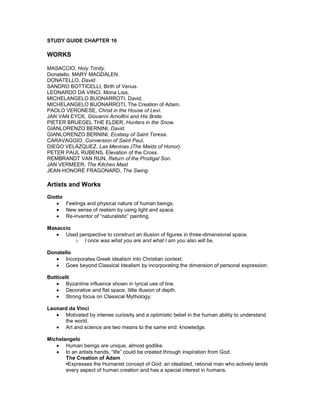
    STUDY GUIDE CHAPTER16 WORKS MASACCIO, Holy Trinity. Donatello. MARY MAGDALEN. DONATELLO, David. SANDRO BOTTICELLI, Birth of Venus. LEONARDO DA VINCI, Mona Lisa, MICHELANGELO BUONARROTI, David. MICHELANGELO BUONARROTI, The Creation of Adam. PAOLO VERONESE, Christ in the House of Levi. JAN VAN EYCK, Giovanni Arnolfini and His Bride. PIETER BRUEGEL THE ELDER, Hunters in the Snow. GIANLORENZO BERNINI, David. GIANLORENZO BERNINI, Ecstasy of Saint Teresa. CARAVAGGIO, Conversion of Saint Paul, DIEGO VELÁZQUEZ, Las Meninas (The Maids of Honor). PETER PAUL RUBENS, Elevation of the Cross. REMBRANDT VAN RIJN, Return of the Prodigal Son. JAN VERMEER, The Kitchen Maid JEAN-HONORÉ FRAGONARD, The Swing. Artists and Works Giotto Feelings and physical nature of human beings. New sense of realism by using light and space. Re-inventor of “naturalistic” painting. Masaccio Used perspective to construct an illusion of figures in three-dimensional space. o I once was what you are and what I am you also will be. Donatello Incorporates Greek idealism into Christian context. Goes beyond Classical Idealism by incorporating the dimension of personal expression. Botticelli Byzantine influence shown in lyrical use of line. Decorative and flat space, little illusion of depth. Strong focus on Classical Mythology. Leonard da Vinci Motivated by intense curiosity and a optimistic belief in the human ability to understand the world. Art and science are two means to the same end: knowledge. Michelangelo Human beings are unique, almost godlike. In an artists hands, “life” could be created through inspiration from God. The Creation of Adam •Expresses the Humanist concept of God: an idealized, rational man who actively tends every aspect of human creation and has a special interest in humans.
  • 2.
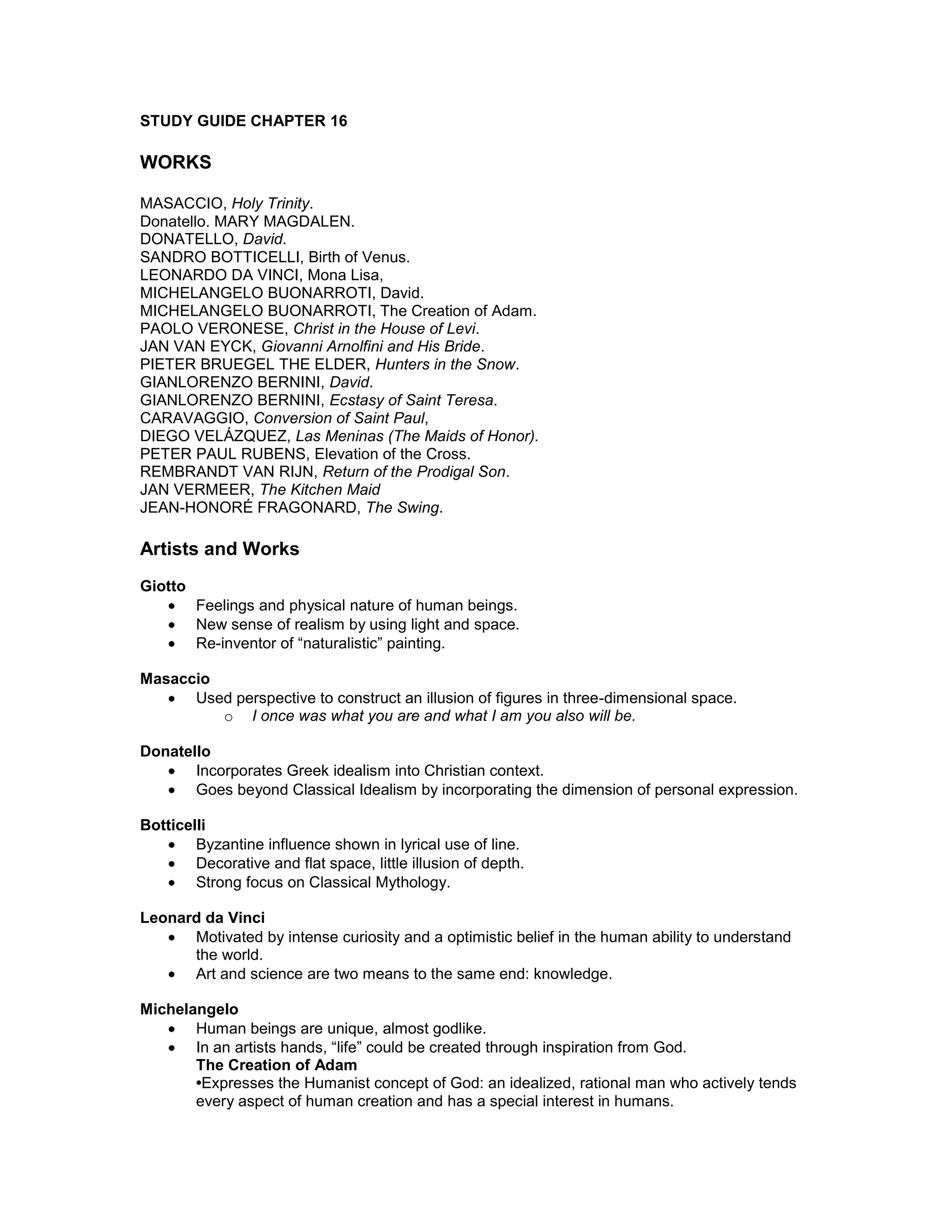
    Movements and “Schools” Renaissance Periodin Europe from the late fourteenth through the sixteenth centuries, which was characterized by a renewed interest in human-centered classical art, literature, and learning. Early Renaissance in Italy: Giotto Masaccio Donatello Boticelli High Renaissance Da Vinci Michelangelo Northern European Artists Concerned with depicting life in the real world. Artists like Jan van Eyck used linseed oil paint to achieve a brilliance and transparency of color that were previously unattainable. Van Eyck Bruegel The Limbourg Brothers Venetian School In the sixteenth century, artists such as Giorgione and Titian preferred a gentler, more sensuous approach to oil painting than had been adopted by the Florentine School. The Venetians used warm atmospheric tones. Distant from the influence of the Papacy, Venetian artists did not shy away from controversial (erotic/pagan) themes. Veronese Titian Giorgione Mannerism A style that developed in the sixteenth century as a reaction to the classical rationality and balanced harmony of the high Renaissance; characterized by dramatic use of space and light; exaggerated color, elongation of figures, and distortions of perspective, scale, and proportion. Baroque The seventeenth-century period in Europe characterized in the visual arts by dramatic light and shade, turbulent composition, and exaggerated expression. Caravaggio Bernini Rubens Velazquez Rembrandt Vermeer Rococo From the French “rocaille” meaning “rock work.” This late Baroque style used in interior decoration and painting was characteristically playful, pretty, romantic, and visually loose or soft; it used small scale and ornate decoration, pastel colors, and asymmetrical arrangement of curves. Rococo was popular in France and southern Germany in the eighteenth century. Fragonard Watteau
  • 3.
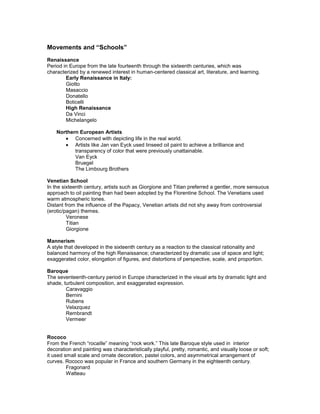
    Boucher Methods and Techniques: CameraObscura A technical aid, widelv used in the seventeenth and eighteenth centuries, which consisted of a darkened box or tent containing lenses and a mirror. The artist could project the image of an object or landscape onto the oil painting surface and then trace it out in charcoal or graphite. Chiaroscuro Italian word meaning “light-dark.” The gradations of light and dark values in two-dimensional imagery; especially the illusion of rounded, three-dimensional form created through gradations of light and shade rather than line. Highly developed by Renaissance painters. Contrapossto Italian for “counterpose.” The counterpositioning of parts of the human figure about a central vertical axis, as when the weight is placed on one foot causing the hip and shoulder lines to counter balance each other-often in a graceful s-curve. Fete Galante A term first used in. the eighteenth centurv to describe an oil painting of a dreamlike pastoral setting which shows people, often in extravagant costume, amusing themselves with dancing, music-making and courtship. Watteau is referred to as a painter of 'fetes galantes'. Fresco A method of wall-painting on a plasterground.Buon fresco, or true fresco, was much used in Italv from the thirteenth to the sixteenth centuries. First, the arriccio is applied and upon this the design, or sinopia, is traced. An area.small enough to be completed in one day - the giornata - is covered with a final layer of plaster, the inionaco. The design is then redrawn and painted with pigments mixed with water. Fresco secco is painting on dry plaster and suffers, like distemper, from impermanence. Glazing An oil painting technique by which thin, transparent layers of oil paint are applied over an opaque layer to modify that layer's color. It is sometimes difficult to determine exactly the glazes used by the Old Masters because of previous restoration or cleaning, and also because of the similarity between the appearance of a glazed paint layer and varnish. Genre Painting A term used to loosely categorize paintings depicting scenes of everyday life, including domestic interiors, merry companies, inn scenes, and street scenes. Memento Mori A visual reminder of human mortality. Pieta A work in which the Virgin is supporting and mourning the death of Jesus. Sfumato A painting technique using an imperceptable, subtle transition from light to dark, without any clear break or line. The theory was developed and mastered by Leonardo da Vinci, and the term derives from the Italian word fumo, meaning vapor, or smoke. Tenebrism, From the Italiantenebroso ("murky"), (also called dramatic illumination) is a style of painting using very pronounced chiaroscuro, where there are violent contrasts of light and dark, and darkness
  • 4.
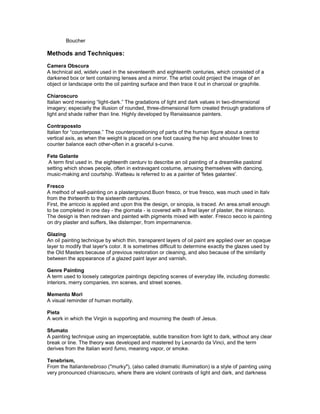
    becomes a dominatingfeature of the image. Spanish painters in the early seventeenth century who were influenced by the work of Caravaggio have been called Tenebrists, although they did not form a distinct group. Historical Events/Philosophical Movements •The Black Death is estimated to have killed 30% – 60% of Europe's population, reducing the world’s population from an estimated 450 million to between 350 and 375 million in 1400. This has been seen as creating a series of religious, social and economic upheavals which had profound effects on the course of European History. It took 150 years for Europe's population to recover. •Because the plague killed so many of the poor population, wealthy land owners were forced to pay the remaining workers what they asked, in terms of wages. • Because there was now a surplus in consumer goods, luxury crops could now be grown. This meant that for the first time in history, many, formerly of the peasant population, now had a chance to live a better life. Most historians now feel that this was the start of the middle class in Europe and England. Humanism A cultural and intellectual movement during the Renaissance, following the rediscovery of the art and literature of ancient Greece and Rome. A philosophy or attitude concerned with the interests, achievements, and capabilities of human beings rather than with the abstract concepts and problems of theology and science. Neoplatonism
 A compilation of Platonic, Aristotelian and Stoic ideas that experienced a strong revival during the late Middle Ages and the Renaissance. Central to the philosophy is the notion that spiritual things are real and that material things are not. The freeing of the spiritual element, the soul, from the material element, the body, should be the ultimate goal of all of mankind and could be achieved through knowledge and contemplation. All sources of inspiration, whether Biblical or Classical (Pagan) mythology, represent a means of ascending earthly existence to a mystical union with “the One”. Protestant Reformation •By the early 1500s, many people in Western Europe were growing increasingly dissatisfied with the Christian Church. Many found the Pope too involved with secular (worldly) matters, rather than with his flocks spiritual well-being. Lower church officials were poorly educated and broke vows by living richly and keeping mistresses. Some officials practiced simony, or passing down their title as priest or bishop to their illegitimate sons. In keeping with the many social changes of the Renaissance people began to boldly challenge the authority of the Christian Church. The Counter Reformation Attempts by the Catholic church and secular Catholic authorities to stem the flow of Protestantism and reform some of the worst excesses of medieval Catholicism.Art was used as a tool of persuasion.