Presented By:
Arun Brijwasi
MCA/25021/18
Heap data structure
Array implementation of heap
Constructing heap
Application of heap
A Heap is a special Tree-based data
structure in which the tree is a complete
binary tree.
Generally, Heaps can be of two types:
1. Max-Heap:
• In a Max-Heap the key present at the root node
must be greatest among the keys present at all of
it’s children.
• The same property must be recursively true for all
sub-trees in that Binary Tree.
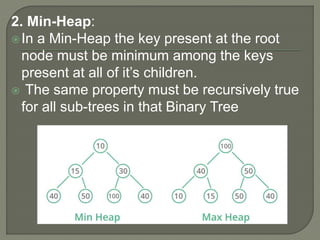
2. Min-Heap:
In a Min-Heap the key present at the root
node must be minimum among the keys
present at all of it’s children.
 The same property must be recursively true
for all sub-trees in that Binary Tree
A Binary Heap is a Complete Binary Tree.
A binary heap is typically represented as
array.
The representation is done as:
• The root element will be at Arr[0].
• Indexes of other nodes :
 Arr[(i-1)/2] Returns the parent node
 Arr[(2*i)+1] Returns the left child node
 Arr[(2*i)+2] Returns the right child node
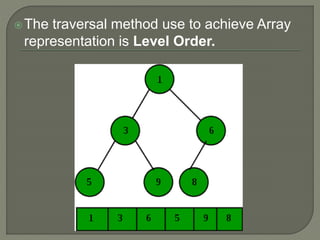
The traversal method use to achieve Array
representation is Level Order.
Construction of heap can be:
• Max heap construction
• Min heap construction
Both trees are constructed using the same
input and order of arrival.
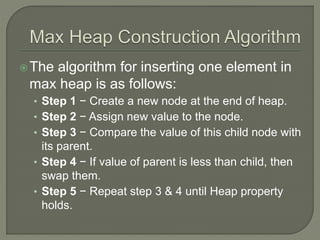
The algorithm for inserting one element in
max heap is as follows:
• Step 1 − Create a new node at the end of heap.
• Step 2 − Assign new value to the node.
• Step 3 − Compare the value of this child node with
its parent.
• Step 4 − If value of parent is less than child, then
swap them.
• Step 5 − Repeat step 3 & 4 until Heap property
holds.
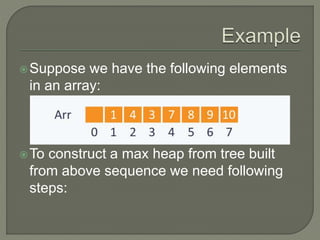
Suppose we have the following elements
in an array:
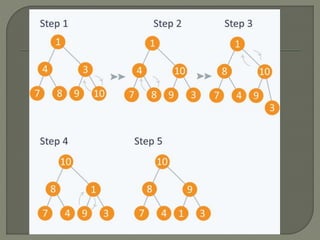
To construct a max heap from tree built
from above sequence we need following
steps:
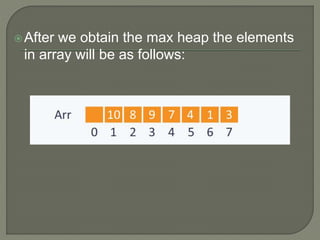
After we obtain the max heap the elements
in array will be as follows:
The algorithm for inserting one element in
max heap is as follows:
• Step 1 − Create a new node at the end of heap.
• Step 2 − Assign new value to the node.
• Step 3 − Compare the value of this child node
with its parent.
• Step 4 − If value of parent is more than child, then
swap them.
• Step 5 − Repeat step 3 & 4 until Heap property
holds.
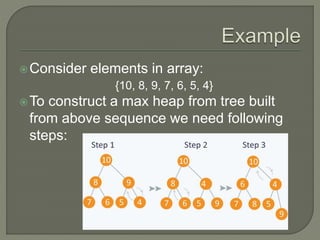
Consider elements in array:
{10, 8, 9, 7, 6, 5, 4}
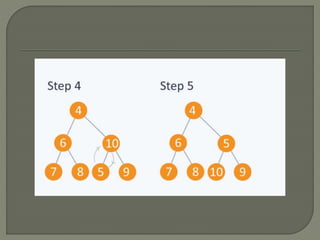
To construct a max heap from tree built
from above sequence we need following
steps:
Heaps can be used in sorting the elements
in a specific order in efficient time. It is
known as Heap sort.
Priority queues can be efficiently
implemented using Binary Heap.
Array implementation & Construction of Heap

Array implementation & Construction of Heap

  • 1.
  • 2.
    Heap data structure Arrayimplementation of heap Constructing heap Application of heap
  • 3.
    A Heap isa special Tree-based data structure in which the tree is a complete binary tree. Generally, Heaps can be of two types: 1. Max-Heap: • In a Max-Heap the key present at the root node must be greatest among the keys present at all of it’s children. • The same property must be recursively true for all sub-trees in that Binary Tree.
  • 4.
    2. Min-Heap: In aMin-Heap the key present at the root node must be minimum among the keys present at all of it’s children.  The same property must be recursively true for all sub-trees in that Binary Tree
  • 5.
    A Binary Heapis a Complete Binary Tree. A binary heap is typically represented as array. The representation is done as: • The root element will be at Arr[0]. • Indexes of other nodes :  Arr[(i-1)/2] Returns the parent node  Arr[(2*i)+1] Returns the left child node  Arr[(2*i)+2] Returns the right child node
  • 6.
    The traversal methoduse to achieve Array representation is Level Order.
  • 7.
    Construction of heapcan be: • Max heap construction • Min heap construction Both trees are constructed using the same input and order of arrival.
  • 8.
    The algorithm forinserting one element in max heap is as follows: • Step 1 − Create a new node at the end of heap. • Step 2 − Assign new value to the node. • Step 3 − Compare the value of this child node with its parent. • Step 4 − If value of parent is less than child, then swap them. • Step 5 − Repeat step 3 & 4 until Heap property holds.
  • 9.
    Suppose we havethe following elements in an array: To construct a max heap from tree built from above sequence we need following steps:
  • 11.
    After we obtainthe max heap the elements in array will be as follows:
  • 12.
    The algorithm forinserting one element in max heap is as follows: • Step 1 − Create a new node at the end of heap. • Step 2 − Assign new value to the node. • Step 3 − Compare the value of this child node with its parent. • Step 4 − If value of parent is more than child, then swap them. • Step 5 − Repeat step 3 & 4 until Heap property holds.
  • 13.
    Consider elements inarray: {10, 8, 9, 7, 6, 5, 4} To construct a max heap from tree built from above sequence we need following steps:
  • 15.
    Heaps can beused in sorting the elements in a specific order in efficient time. It is known as Heap sort. Priority queues can be efficiently implemented using Binary Heap.