Analysis of
Algorithms
Presentation
Of
Analysis of
Algorithms
Submitted by:
Maryam Saeed 1330296
Zara 1330355
Aqsa butt 1330359
Ana 1330360
Submitted to: Miss Amna
Dilawar
Group # 9
Heap SortHeap Sort
• Def: A heap is a nearly complete binary tree
4
TYPES:
•Max-heaps (largest element at root), have the max-heap
property:
– for all nodes i, excluding the root:
A[PARENT(i)] ≥ A[i]
•Min-heaps (smallest element at root), have the min-heap
property:
– for all nodes i, excluding the root:
A[PARENT(i)] ≤ A[i]
The Heap Data Structure
5
The Heap Data Structure
• Def: A heap is a nearly complete binary tree with
the following two properties:
– Structural property: all levels are full, except
possibly the last one, which is filled from left to right
– Order (heap) property: for any node x
Parent(x) ≥ x
Heap
5
7
8
4
2
From the heap property, it
follows that:
“The root is the maximum
element of the heap!”
A heap is a binary tree that is filled in order
Why study Heapsort?
• It is a well-known, traditional sorting
algorithm you will be expected to know
• Heapsort is always O(n log n)
– Quicksort is usually O(n log n) but in the worst
case slows to O(n2
)
– Quicksort is generally faster, but Heapsort is
better in time-critical applications
• Heapsort is a really cool algorithm!
7
Heapsort
• Goal:
– Sort an array using heap representations
• Idea:
– Build a max-heap from the array
– Swap the root (the maximum element) with the last
element in the array
– “Discard” this last node by decreasing the heap size
– Call MAX-HEAPIFY on the new root
– Repeat this process until only one node remains
8
Operations on Heaps
Insertion.
Heapify.
Deletion.
9
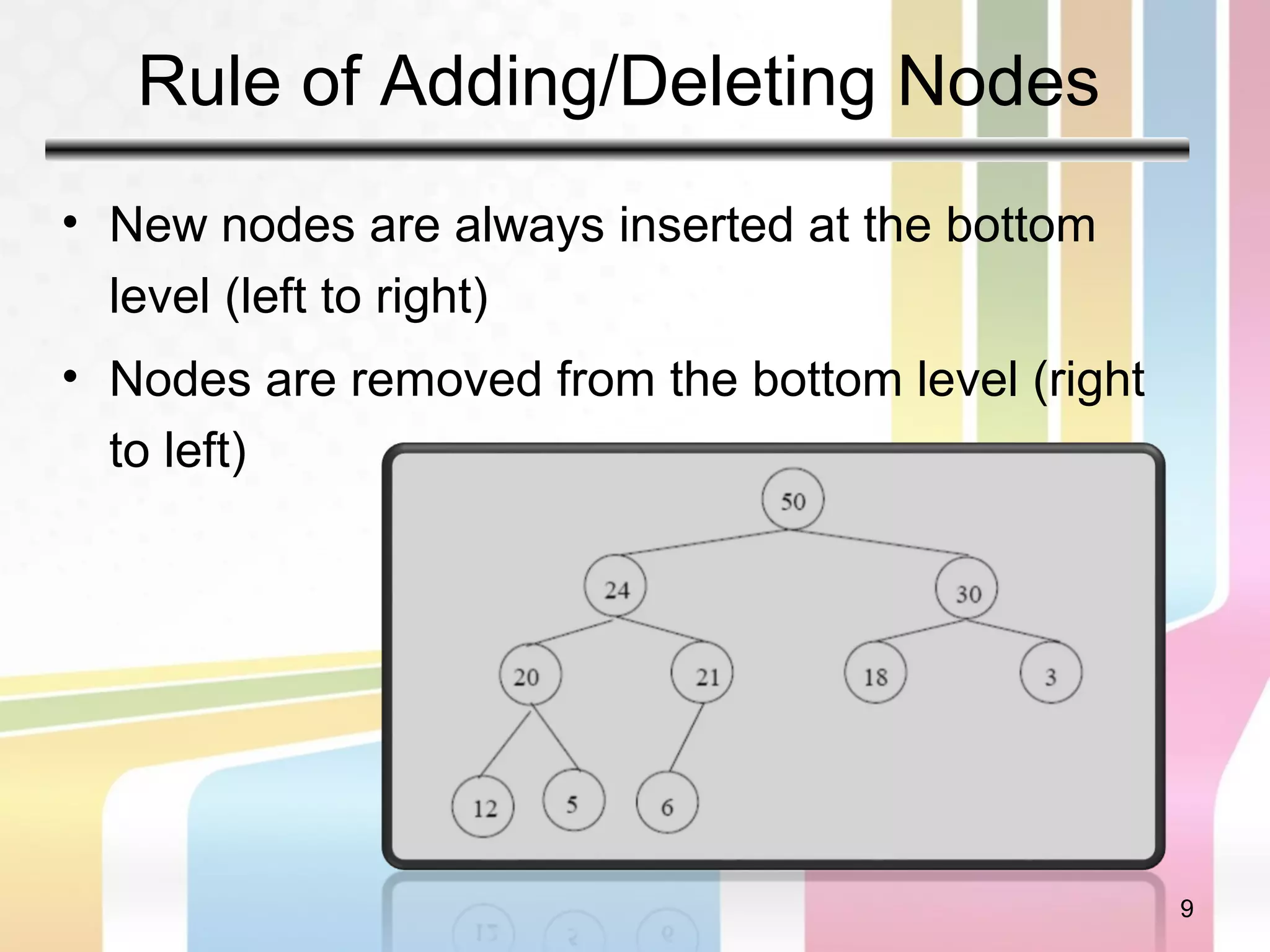
Rule of Adding/Deleting Nodes
• New nodes are always inserted at the bottom
level (left to right)
• Nodes are removed from the bottom level (right
to left)
10
Array Representation of Heaps
• A heap can be stored as an
array A.
– Root of tree is A[1]
– Left child of A[i] = A[2i]
– Right child of A[i] = A[2i + 1]
– Parent of A[i] = A[ i/2 ]
– Heapsize[A] ≤ length[A]
• The elements in the subarray
A[(n/2+1) .. n] are leaves
shiftUp
• Given a node that does not have the heap property,
you can give it the heap property by exchanging its
value with the value of the larger child
• This is sometimes called sifting up
• Notice that the child may have lost the heap property
14
8 12
Blue node has
heap property
12
8 14
Blue node does not
have heap property
Problem during Constructing a heap
• Each time we add a node, we may destroy the
heap property of its parent node
• To fix this, we sift up
• We repeat the sifting up process, moving up in
the tree, until either
– We reach nodes whose values don’t need to be
swapped (because the parent is still larger than both
children), or
– We reach the root
13
Maintaining the Heap Property
• Assumptions:
– Left and Right
subtrees of i are
max-heaps
– A[i] may be
smaller than its
children
Alg: MAX-HEAPIFY(A, i, n)
1. l ← LEFT(i)
2. r ← RIGHT(i)
3. if l ≤ n and A[l] > A[i]
4. then largest l←
5. else largest i←
6. if r ≤ n and A[r] > A[largest]
7. then largest r←
8. if largest ≠ i
9. then exchange A[i] A[largest]↔
10. MAX-HEAPIFY(A, largest, n)
14
Building a Heap
Alg: BUILD-MAX-HEAP(A)
1. n = length[A]
2. for i ← n/2 downto 1
3. do MAX-HEAPIFY(A, i, n)
• Convert an array A[1 … n] into a max-heap (n = length[A])
• The elements in the subarray A[(n/2+1) .. n] are leaves
• Apply MAX-HEAPIFY on elements between 1 and n/2
O(logn)
O(n)
⇒ Running time: O(nlgn)
• This is not an asymptotically tight upper bound
Example
Make a tree from Array
15
8
10 6
9
Left Justify TreeLeft Justify Tree
10
9 6
8
Max Heap-Max Heap-
Sort TreeSort Tree
8 10 6 9
6
8 10
9
Min Heap-Min Heap-
Sort TreeSort Tree
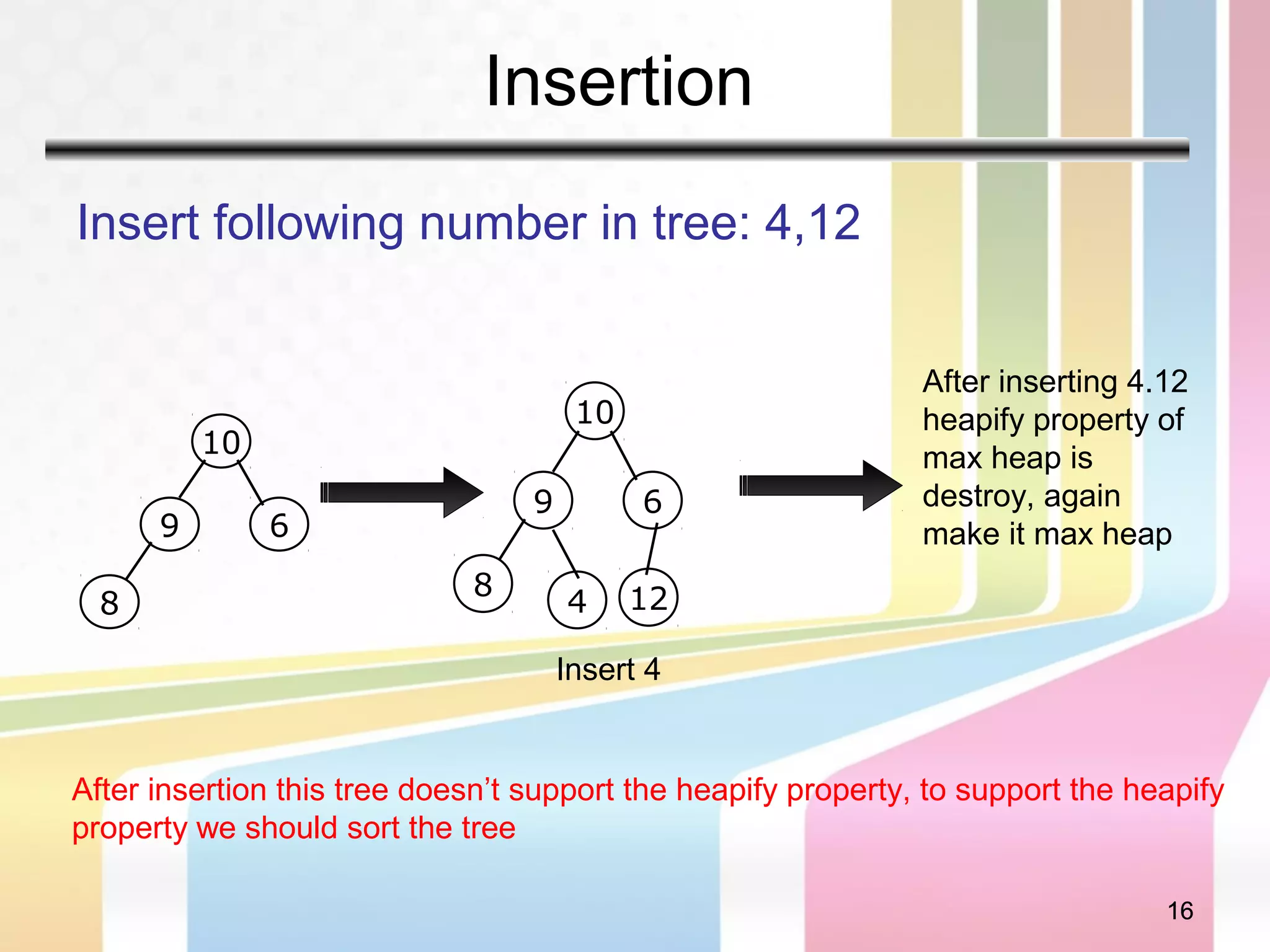
Insertion
16
Insert following number in tree: 4,12
16
10
9 6
8
10
9 6
8
4
Insert 4
After insertion this tree doesn’t support the heapify property, to support the heapify
property we should sort the tree
After inserting 4.12
heapify property of
max heap is
destroy, again
make it max heap
12
Insertion
1717
10
9 6
8
4
10
9 12
48
Sorted Tree in Max-
heap.
12
6
12
9 10
48
6
12
9 10
48
6
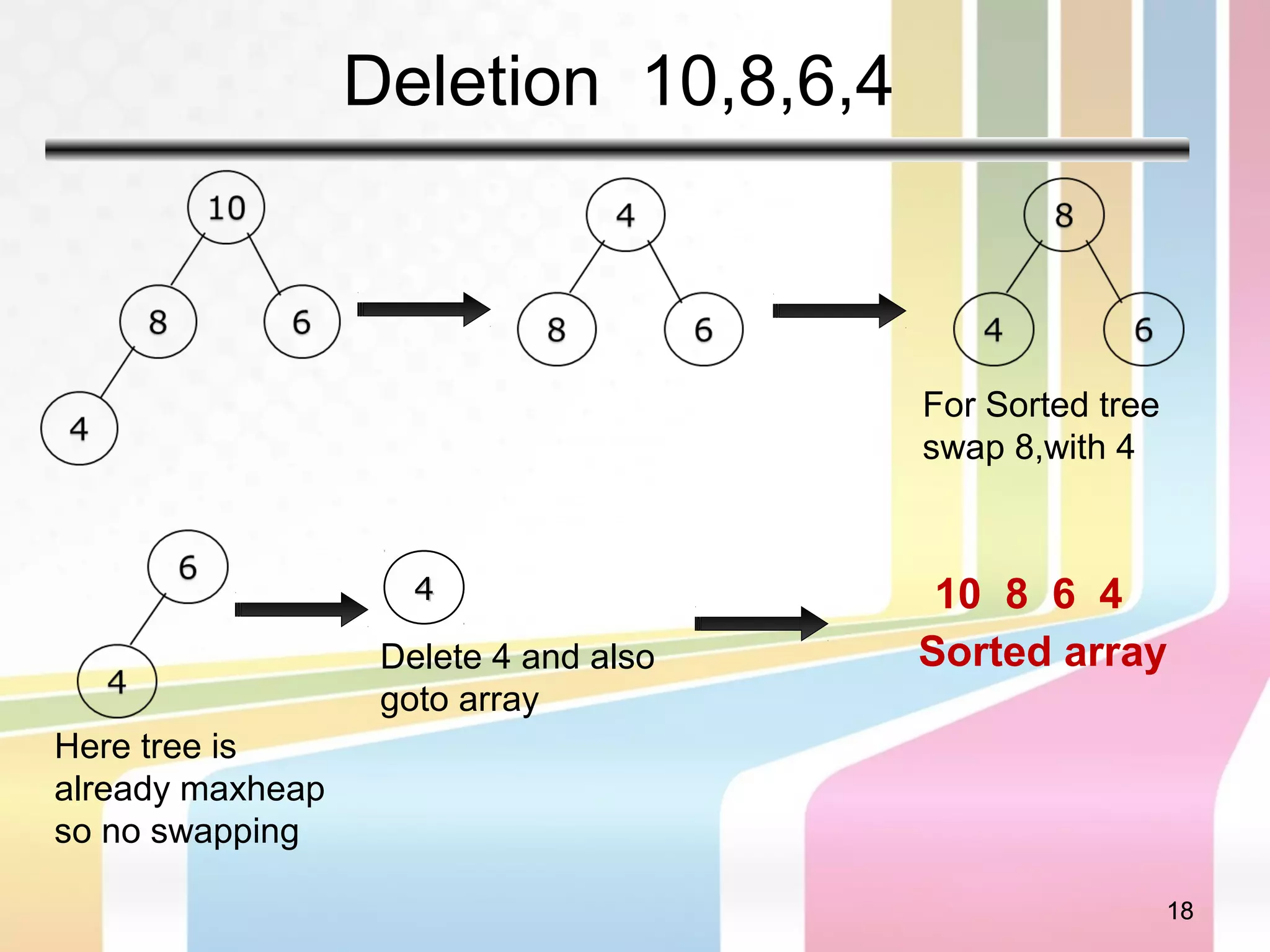
Deletion 10,8,6,4
1818
Sorted array
For Sorted tree
swap 8,with 4
10 8 6 444
Here tree is
already maxheap
so no swapping
Delete 4 and also
goto array
19
MAX-HEAP-INSERT
• Goal:
– Inserts a new element into a max-
heap
• Idea:
– Expand the max-heap with a new
element whose key is x
– Calls HEAP-INCREASE-KEY to
set the key of the new node to its
correct value and maintain the
max-heap property
Heapify()
• What do heaps have to do with sorting an array?
• Here’s the neat part:
– Because the binary tree is balanced and left justified,
it can be represented as an array
– All our operations on binary trees can be represented
as operations on arrays
– To sort:
heapify the array;
while the array isn’t empty {
remove and replace the root;
reheap the new root node;
}
21
Time complexity
• We can perform Major operations on
heaps:
heapyify which runs in O(log n) time.
Build-heap which returns in linear time.
Heap sort, which runs in O(n log n) time.
Any
Question…
??? 22

Heapsort ppt

  • 1.
  • 2.
    Submitted by: Maryam Saeed1330296 Zara 1330355 Aqsa butt 1330359 Ana 1330360 Submitted to: Miss Amna Dilawar Group # 9
  • 3.
  • 4.
    • Def: Aheap is a nearly complete binary tree 4 TYPES: •Max-heaps (largest element at root), have the max-heap property: – for all nodes i, excluding the root: A[PARENT(i)] ≥ A[i] •Min-heaps (smallest element at root), have the min-heap property: – for all nodes i, excluding the root: A[PARENT(i)] ≤ A[i] The Heap Data Structure
  • 5.
    5 The Heap DataStructure • Def: A heap is a nearly complete binary tree with the following two properties: – Structural property: all levels are full, except possibly the last one, which is filled from left to right – Order (heap) property: for any node x Parent(x) ≥ x Heap 5 7 8 4 2 From the heap property, it follows that: “The root is the maximum element of the heap!” A heap is a binary tree that is filled in order
  • 6.
    Why study Heapsort? •It is a well-known, traditional sorting algorithm you will be expected to know • Heapsort is always O(n log n) – Quicksort is usually O(n log n) but in the worst case slows to O(n2 ) – Quicksort is generally faster, but Heapsort is better in time-critical applications • Heapsort is a really cool algorithm!
  • 7.
    7 Heapsort • Goal: – Sortan array using heap representations • Idea: – Build a max-heap from the array – Swap the root (the maximum element) with the last element in the array – “Discard” this last node by decreasing the heap size – Call MAX-HEAPIFY on the new root – Repeat this process until only one node remains
  • 8.
  • 9.
    9 Rule of Adding/DeletingNodes • New nodes are always inserted at the bottom level (left to right) • Nodes are removed from the bottom level (right to left)
  • 10.
    10 Array Representation ofHeaps • A heap can be stored as an array A. – Root of tree is A[1] – Left child of A[i] = A[2i] – Right child of A[i] = A[2i + 1] – Parent of A[i] = A[ i/2 ] – Heapsize[A] ≤ length[A] • The elements in the subarray A[(n/2+1) .. n] are leaves
  • 11.
    shiftUp • Given anode that does not have the heap property, you can give it the heap property by exchanging its value with the value of the larger child • This is sometimes called sifting up • Notice that the child may have lost the heap property 14 8 12 Blue node has heap property 12 8 14 Blue node does not have heap property
  • 12.
    Problem during Constructinga heap • Each time we add a node, we may destroy the heap property of its parent node • To fix this, we sift up • We repeat the sifting up process, moving up in the tree, until either – We reach nodes whose values don’t need to be swapped (because the parent is still larger than both children), or – We reach the root
  • 13.
    13 Maintaining the HeapProperty • Assumptions: – Left and Right subtrees of i are max-heaps – A[i] may be smaller than its children Alg: MAX-HEAPIFY(A, i, n) 1. l ← LEFT(i) 2. r ← RIGHT(i) 3. if l ≤ n and A[l] > A[i] 4. then largest l← 5. else largest i← 6. if r ≤ n and A[r] > A[largest] 7. then largest r← 8. if largest ≠ i 9. then exchange A[i] A[largest]↔ 10. MAX-HEAPIFY(A, largest, n)
  • 14.
    14 Building a Heap Alg:BUILD-MAX-HEAP(A) 1. n = length[A] 2. for i ← n/2 downto 1 3. do MAX-HEAPIFY(A, i, n) • Convert an array A[1 … n] into a max-heap (n = length[A]) • The elements in the subarray A[(n/2+1) .. n] are leaves • Apply MAX-HEAPIFY on elements between 1 and n/2 O(logn) O(n) ⇒ Running time: O(nlgn) • This is not an asymptotically tight upper bound
  • 15.
    Example Make a treefrom Array 15 8 10 6 9 Left Justify TreeLeft Justify Tree 10 9 6 8 Max Heap-Max Heap- Sort TreeSort Tree 8 10 6 9 6 8 10 9 Min Heap-Min Heap- Sort TreeSort Tree
  • 16.
    Insertion 16 Insert following numberin tree: 4,12 16 10 9 6 8 10 9 6 8 4 Insert 4 After insertion this tree doesn’t support the heapify property, to support the heapify property we should sort the tree After inserting 4.12 heapify property of max heap is destroy, again make it max heap 12
  • 17.
    Insertion 1717 10 9 6 8 4 10 9 12 48 SortedTree in Max- heap. 12 6 12 9 10 48 6 12 9 10 48 6
  • 18.
    Deletion 10,8,6,4 1818 Sorted array ForSorted tree swap 8,with 4 10 8 6 444 Here tree is already maxheap so no swapping Delete 4 and also goto array
  • 19.
    19 MAX-HEAP-INSERT • Goal: – Insertsa new element into a max- heap • Idea: – Expand the max-heap with a new element whose key is x – Calls HEAP-INCREASE-KEY to set the key of the new node to its correct value and maintain the max-heap property
  • 20.
    Heapify() • What doheaps have to do with sorting an array? • Here’s the neat part: – Because the binary tree is balanced and left justified, it can be represented as an array – All our operations on binary trees can be represented as operations on arrays – To sort: heapify the array; while the array isn’t empty { remove and replace the root; reheap the new root node; }
  • 21.
    21 Time complexity • Wecan perform Major operations on heaps: heapyify which runs in O(log n) time. Build-heap which returns in linear time. Heap sort, which runs in O(n log n) time.
  • 22.