Chapter 8 - Heaps
 Binary Heap. Min-heap. Max-heap.
 Efficient implementation of heap ADT: use of array
 Basic heap algorithms: ReheapUp, ReheapDown, Insert Heap,
Delete Heap, Built Heap
 d-heaps
 Heap Applications:
 Select Algorithm
 Priority Queues
 Heap sort
 Advanced implementations of heaps: use of pointers
 Leftist heap
 Skew heap
 Binomial queues 1
Binary Heaps
DEFINITION: A max-heap is a binary tree
structure with the following properties:
• The tree is complete or nearly complete.
• The key value of each node is greater than
or equal to the key value
2
DEFINITION: A min-heap is a binary tree
structure with the following properties:
• The tree is complete or nearly complete.
• The key value of each node is less than or
equal to the key value in each of its
descendents.
all<=K all<=K
K
all>=K all>=K
K
max-heap
min-heap
Properties of Binary Heaps
 Structure property of heaps
 Key value order of heaps
3
Properties of Binary Heaps
Structure property of heaps:
• A complete or nearly complete binary tree.
• If the height is h, the number of nodes n is between
2h-1 and (2h -1)
• Complete tree: n = 2h -1 when last level is full.
• Nearly complete: All nodes in the last level are on the left.
• h = |log2 n| + 1
• Can be represented in an array and no pointers are necessary.
4
Properties of Binary Heaps
Key value order of max-heap:
(max-heap is often called as heap)
5
Basic heap algorithms
ReheapUp: repairs a "broken" heap by floating the last
element up the tree until it is in its correct location.
6
Basic heap algorithms
ReheapDown: repairs a "broken" heap by pushing the root of
the subtree down until it is in its correct location.
7
Contiguous Implementation of Heaps
0 1 2 3 4 5 6
A B C D E F G ...
8
Conceptual
Physical
Heap
data <Array of <DataType> >
count <int> //number of elements in heap
End Heap
2i+1 2i+2
i
|(i-1)/2|
ReheapUp
Algorithm ReheapUp (val position <int>)
Reestablishes heap by moving data in position up to its correct location.
Pre All data in the heap above this position satisfy key value order of a heap,
except the data in position.
Post Data in position has been moved up to its correct location.
Uses Recursive function ReheapUp.
1. if (position <> 0) // the parent of position exists.
1. parent = (position-1)/2
2. if (data[position].key > data[parent].key)
1. swap(position, parent) // swap data at position with data at parent.
2. ReheapUp(parent)
2. return
End ReheapUp
9
ReheapDown
Algorithm ReheapDown (val position <int>, val lastPosition <int>)
Reestablishes heap by moving data in position down to its correct location.
Pre All data in the subtree of position satisfy key value order of a heap, except the
data in position.
Post Data in position has been moved down to its correct location.
Uses Recursive function ReheapDown.
1. leftChild = position *2 + 1
2. rightChild = position *2 + 2
3. if ( leftChild <= lastPosition ) // the left child of position exists.
1. if ( rightChild <= lastPosition) AND ( data[rightChild].key > data[leftChild].key )
1. child = rightChild
2. else
1. child = leftChild // choose larger child to compare with data in position
3. if ( data[child].key > data[position].key )
1. swap(child, position) // swap data at position with data at child.
2. ReheapDown(child, lastPosition)
4. return
10
Insert new element into min-heap
The new element is put to the last position, and ReheapUp is called for
that position. 11
Insert 14:
14
14
14
<ErrorCode> InsertHeap (val DataIn <DataType>) // Recursive version.
Inserts new data into the min-heap.
Post DataIn has been inserted into the heap and the heap order property
is maintained.
Return overflow or success
Uses recursive function ReheapUp.
1. if (heap is full)
1. return overflow
2. else
1. data[count ] = DataIn
2. ReheapUp(count )
3. count = count + 1
4. return success
End InsertHeap
12
<ErrorCode> InsertHeap (val DataIn <DataType>) // Iterative version
Inserts new data into the min-heap.
Post DataIn has been inserted into the heap and the heap order property
is maintained.
Return overflow or success
1. if (heap is full)
1. return overflow
2. else
1. current_position = count - 1
2. loop (the parent of the element at the current_position is exists) AND
(parent.key > DataIn .key)
1. data[current_position] = parent
2. current_position = position of parent
3. data[current_position] = DataIn
4. count = count + 1
5. return success
End InsertHeap 13
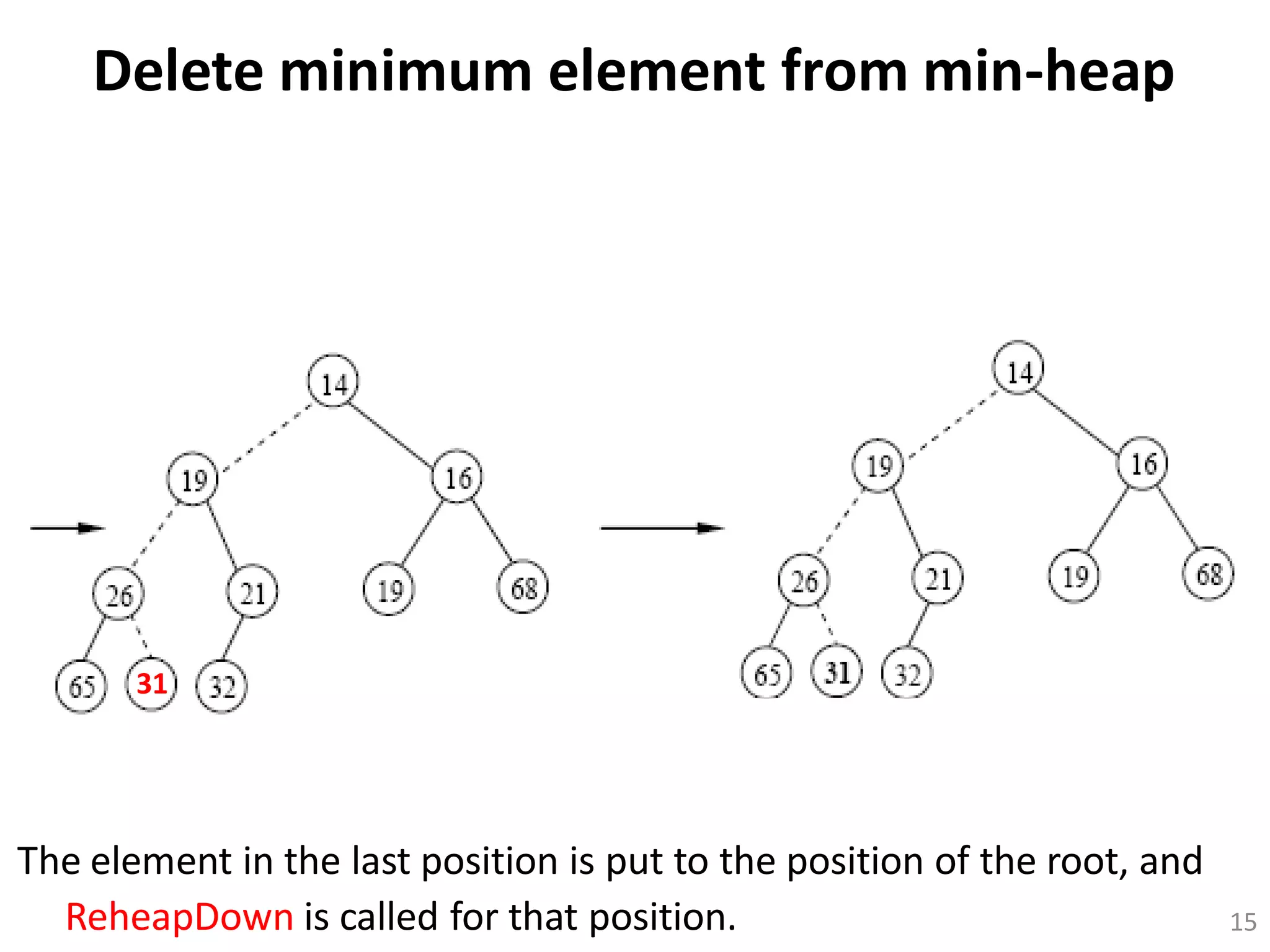
Delete minimum element from min-heap
14
The element in the last position is put to the position of the root, and
ReheapDown is called for that position.
31
31
31
31
Delete minimum element from min-heap
15
The element in the last position is put to the position of the root, and
ReheapDown is called for that position.
31
<ErrorCode> DeleteHeap (ref MinData <DataType>) // Recursive version
Removes the minimum element from the min-heap.
Post MinData receives the minimum data in the heap and this data
has been removed. The heap has been rearranged.
Return underflow or success
Uses recursive function ReheapDown.
1. if (heap is empty)
1. return underflow
2. else
1. MinData = Data[0]
2. Data[0] = Data[count -1]
3. count = count - 1
4. ReheapDown(0, count -1)
5. return success
End DeleteHeap
16
<ErrorCode> DeleteHeap (ref MinData <DataType>) // Iterative version
Removes the minimum element from the min-heap.
Post MinData receives the minimum data in the heap and this data
has been removed. The heap has been rearranged.
Return underflow or success
1. if (heap is empty)
1. return underflow
2. else
1. MinData = Data[0]
2. lastElement = Data[count – 1] // The number of elements in the
// heap is decreased so the last
// element must be moved
// somewhere in the heap.
17
// DeleteHeap(cont.) // Iterative version
3. current_position = 0
4. continue = TRUE
5. loop (the element at the current_position has children) AND
(continue = TRUE)
1. Let child is the smaller of two children
2. if (lastElement.key > child.key )
1. Data[current_position] = child
2. current_position = current_position of child
3. else
1. continue = FALSE
6. Data[current_position] = lastElement
7. count = count - 1
8. return success
End DeleteHeap
18
Build heap
<ErrorCode> BuildHeap (val listOfData <List>)
Builds a heap from data from listOfData.
Pre listOfData contains data need to be inserted into an empty heap.
Post Heap has been built.
Return overflow or success
Uses Recursive function ReheapUp.
1. count = 0
2. loop (heap is not full) AND (more data in listOfData)
1. listOfData.Retrieve(count, newData)
2. data[count] = newData
3. ReheapUp( count)
4. count = count + 1
3. if (count < listOfData.Size() )
1. return overflow
4. else
1. return success
End BuildHeap 19
Build heap
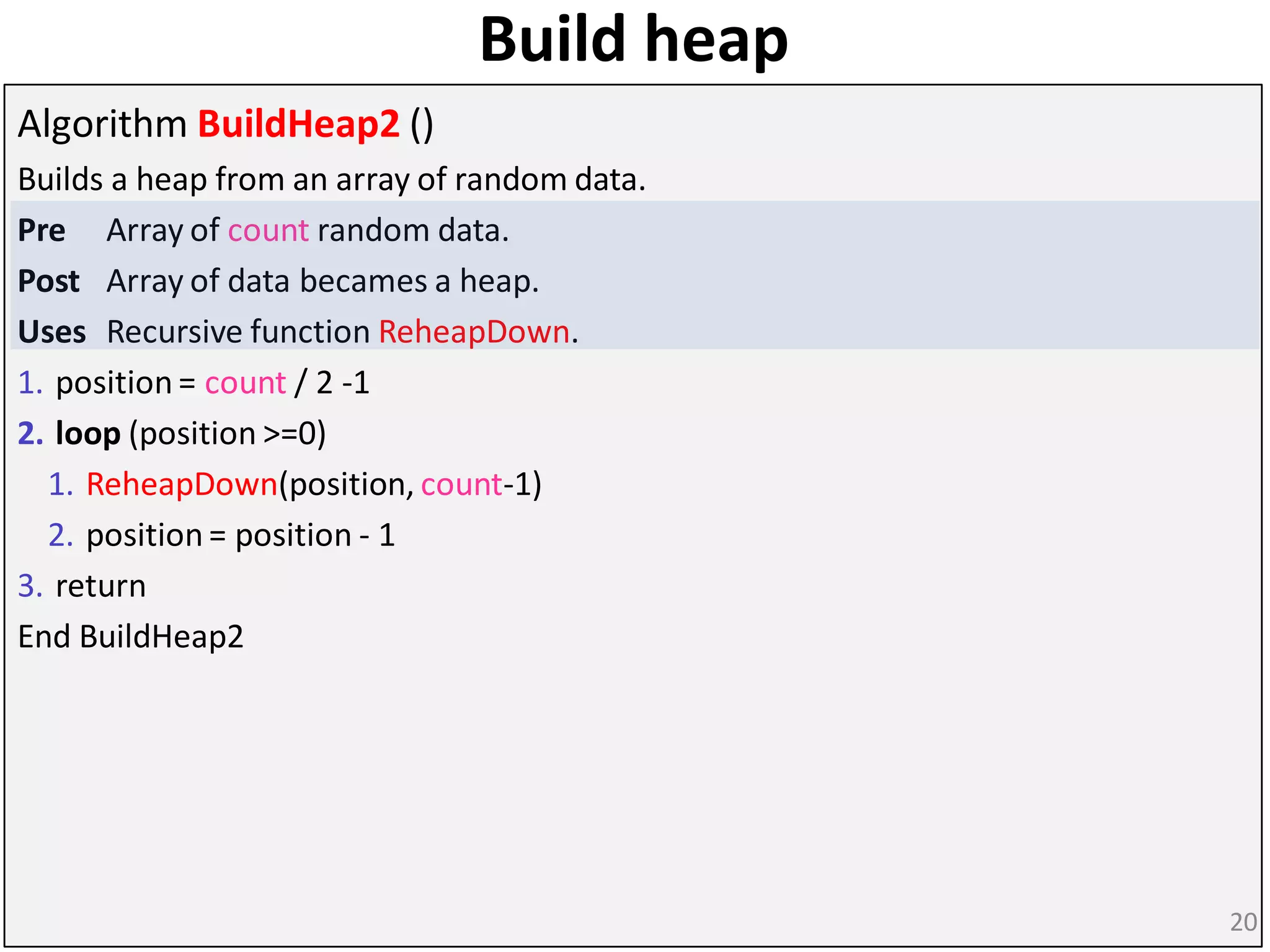
Algorithm BuildHeap2 ()
Builds a heap from an array of random data.
Pre Array of count random data.
Post Array of data becames a heap.
Uses Recursive function ReheapDown.
1. position = count / 2 -1
2. loop (position >=0)
1. ReheapDown(position, count-1)
2. position = position - 1
3. return
End BuildHeap2
20
Complexity of Binary Heap Operations
21
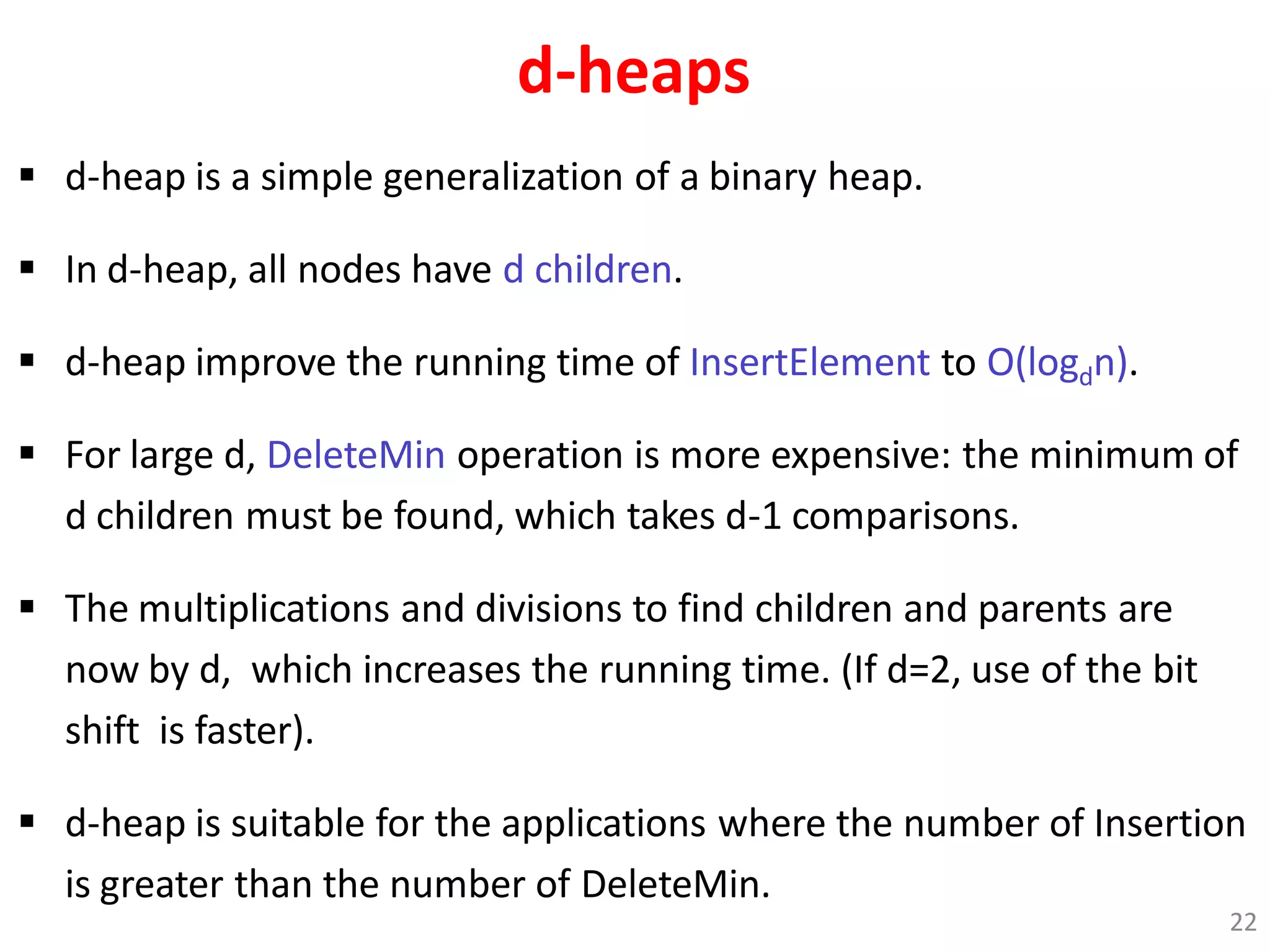
d-heaps
 d-heap is a simple generalization of a binary heap.
 In d-heap, all nodes have d children.
 d-heap improve the running time of InsertElement to O(logdn).
 For large d, DeleteMin operation is more expensive: the minimum of
d children must be found, which takes d-1 comparisons.
 The multiplications and divisions to find children and parents are
now by d, which increases the running time. (If d=2, use of the bit
shift is faster).
 d-heap is suitable for the applications where the number of Insertion
is greater than the number of DeleteMin.
22
Heap Applications
Select Algorithms.
Priority Queues.
Heap sort (we will see in the Sorting Chapter).
23
Select Algorithms
Determine the kth largest element in an unsorted list
Algorithm 1a:
• Read the elements into an array, sort them.
• Return the appropriate element.
The running time of a simple sorting algorithm is O(n2)
24
Select Algorithms
Determine the kth largest element in an unsorted list
Algorithm 1b:
• Read k elements into an array, sort them.
• The smallest of these is in the kth position.
• Process the remaining elements one by one.
• Compare the coming element with the kth element in
the array.
• If the coming element is large, the kth element is
removed, the new element is placed in the correct
place.
The running time is O(n2) 25
Select Algorithms
Determine the kth largest element in an unsorted list
Algorithm 2a:
• Build a max-heap.
• Detele k-1 elements from the heap.
• The desired element will be at the top.
The running time is O(nlog2n)
26
Select Algorithms
Determine the kth largest element in an unsorted list
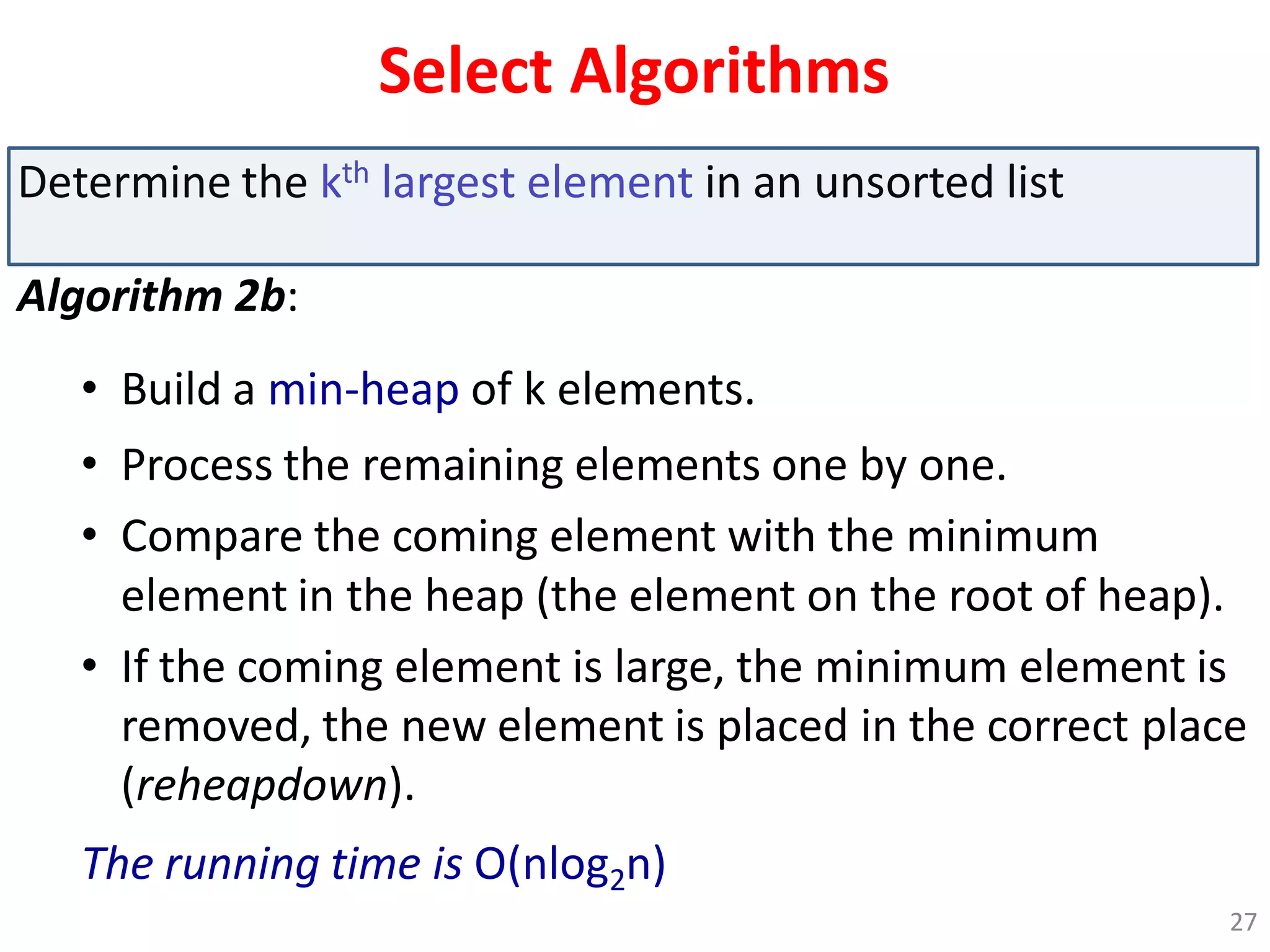
Algorithm 2b:
• Build a min-heap of k elements.
• Process the remaining elements one by one.
• Compare the coming element with the minimum
element in the heap (the element on the root of heap).
• If the coming element is large, the minimum element is
removed, the new element is placed in the correct place
(reheapdown).
The running time is O(nlog2n)
27
Priority Queue ADT
• Jobs are generally placed on a queue to wait for the services.
• In the multiuser environment, the operating system scheduler must
decide which of several processes to run.
• Short jobs finish as fast as possible, so they should have precedence
over other jobs.
• Otherwise, some jobs are still very important and should also have
precedence.
These applications require a special kind of queue: a priority queue.
28
Priority Queue ADT
DEFINITION of Priority Queue ADT:
Elements are enqueued accordingly to their priorities.
Minimum element is dequeued first.
Basic Operations:
• Create
• InsertElement: Inserts new data to the position accordingly to its
priority order in queue.
• DeleteMin: Removes the data with highest priority order.
• RetrieveMin: Retrieves the data with highest priority order.
29
• Each element has a priority to be dequeued.
• Minimum value of key has highest priority order.
Priority Queue ADT
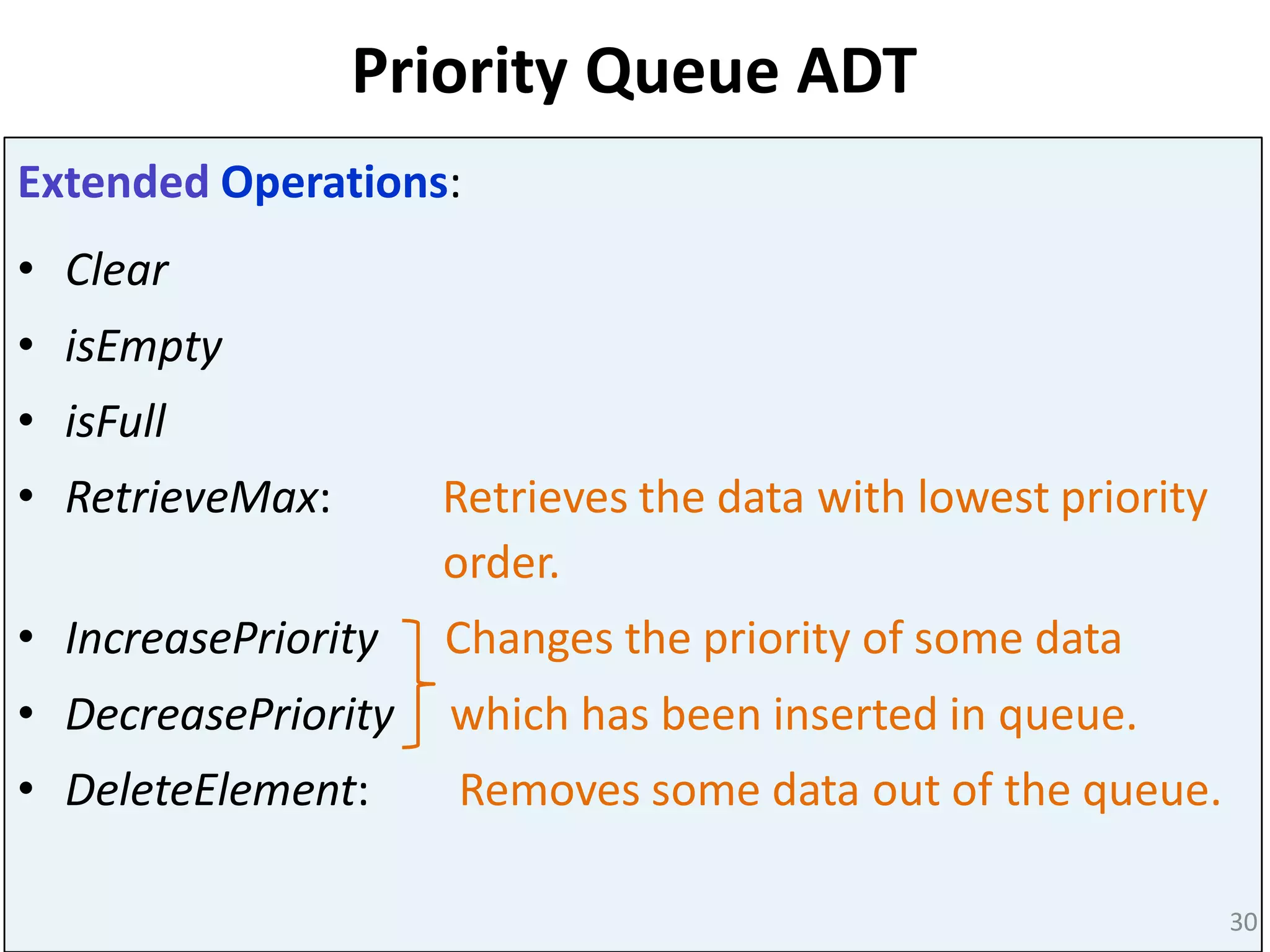
Extended Operations:
• Clear
• isEmpty
• isFull
• RetrieveMax: Retrieves the data with lowest priority
order.
• IncreasePriority Changes the priority of some data
• DecreasePriority which has been inserted in queue.
• DeleteElement: Removes some data out of the queue.
30
Specifications for Priority Queue ADT
<ErrorCode> InsertElement (val DataIn <DataType>)
<ErrorCode> DeleteMin (ref MinData <DataType>)
<ErrorCode> RetrieveMin (ref MinData <DataType>)
<ErrorCode> RetrieveMax (ref MaxData <DataType>)
<ErrorCode> IncreasePriority (val position <int>,
val PriorityDelta <KeyType>)
<ErrorCode> DecreasePriority (val position <int>,
val PriorityDelta <KeyType>)
<ErrorCode> DeleteElement (val position <int>,
ref DataOut <DataType>)
<bool> isEmpty()
<bool> isFull()
<void> clear() 31
Implementations of Priority Queue
 Use linked list:
 Simple linked list:
• Insertion performs at the front, requires O(1).
• DeleteMin requires O(n) for searching of the minimum data.
 Sorted linked list:
• Insertion requires O(n) for searching of the appropriate
position.
• DeleteMin requires O(1).
32
Implementations of Priority Queue
 Use BST:
• Insertion requires O(log2 n).
• DeleteMin requires O(log2 n).
• But DeleteMin , repeatedly removing node in the left subtree,
seem to hurt balance of the tree.
33
Implementations of Priority Queue
 Use min-heap:
• Insertion requires O(log2 n).
• DeleteMin requires O(log2 n).
34
Insert and Remove element into/from
priority queue
<ErrorCode> InsertElement (val DataIn <DataType>):
InsertHeap Algorithm
<ErrorCode> DeleteMin (ref MinData <DataType>):
DeleteHeap Algorithm
35
Retrieve minimum element in priority queue
<ErrorCode> RetrieveMin (ref MinData <DataType>)
Retrieves the minimum element in the heap.
Post MinData receives the minimum data in the heap and the heap
remains unchanged.
Return underflow or success
1. if (heap is empty)
1. return underflow
2. else
1. MinData = Data[0]
2. return success
End RetrieveMin 36
Retrieve maximum element in priority queue
<ErrorCode> RetrieveMax (ref MaxData <DataType>)
Retrieves the maximum element in the heap.
Post MaxData receives the maximum data in the heap and the heap
remains unchanged.
Return underflow or success
1. if (heap is empty)
1. return underflow
2. else
1. Sequential search the maximum data in the right half elements
of the heap (the leaves of the heap). The first leaf is at the
position count/2.
2. return success
End RetrieveMax 37
Change the priority of an element in
priority queue
<ErrorCode> IncreasePriority (val position <int>,
val PriorityDelta <KeyType>)
Increases priority of an element in the heap.
Post Element at position has its priority increased by PriorityDelta
and has been moved to correct position.
Return rangeError or success
Uses ReheapDown.
38
Change the priority of an element in
priority queue
<ErrorCode> DecreasePriority (val position <int>,
val PriorityDelta <KeyType>)
Decreases priority of an element in the heap.
Post Element at position has its priority decreased by PriorityDelta
and has been moved to correct position.
Return rangeError or success
Uses ReheapUp.
39
Remove an element out of priority queue
<ErrorCode> DeleteElement (val position <int>,
ref DataOut <DataType>)
Removes an element out of the min-heap.
Post DataOut contains data in the element at position, this element
has been removed. The heap has been rearranged.
Return rangeError or success
1. if (position>=count ) OR (position <0)
1. return rangeError
2. else
1. DataOut = Data[position]
2. DecreasePriority(position, VERY_LARGE_VALUE),
3. DeleteMin(MinData)
4. return success
End DeleteElement 40
Advanced implementations of heaps
 Advanced implementations of heaps: use of pointers
 Leftist heap
 Skew heap
 Binomial queues
Use of pointers allows the merge operations (combine two heaps
into one) to perform easily.
41

Heaps

  • 1.
    Chapter 8 -Heaps  Binary Heap. Min-heap. Max-heap.  Efficient implementation of heap ADT: use of array  Basic heap algorithms: ReheapUp, ReheapDown, Insert Heap, Delete Heap, Built Heap  d-heaps  Heap Applications:  Select Algorithm  Priority Queues  Heap sort  Advanced implementations of heaps: use of pointers  Leftist heap  Skew heap  Binomial queues 1
  • 2.
    Binary Heaps DEFINITION: Amax-heap is a binary tree structure with the following properties: • The tree is complete or nearly complete. • The key value of each node is greater than or equal to the key value 2 DEFINITION: A min-heap is a binary tree structure with the following properties: • The tree is complete or nearly complete. • The key value of each node is less than or equal to the key value in each of its descendents. all<=K all<=K K all>=K all>=K K max-heap min-heap
  • 3.
    Properties of BinaryHeaps  Structure property of heaps  Key value order of heaps 3
  • 4.
    Properties of BinaryHeaps Structure property of heaps: • A complete or nearly complete binary tree. • If the height is h, the number of nodes n is between 2h-1 and (2h -1) • Complete tree: n = 2h -1 when last level is full. • Nearly complete: All nodes in the last level are on the left. • h = |log2 n| + 1 • Can be represented in an array and no pointers are necessary. 4
  • 5.
    Properties of BinaryHeaps Key value order of max-heap: (max-heap is often called as heap) 5
  • 6.
    Basic heap algorithms ReheapUp:repairs a "broken" heap by floating the last element up the tree until it is in its correct location. 6
  • 7.
    Basic heap algorithms ReheapDown:repairs a "broken" heap by pushing the root of the subtree down until it is in its correct location. 7
  • 8.
    Contiguous Implementation ofHeaps 0 1 2 3 4 5 6 A B C D E F G ... 8 Conceptual Physical Heap data <Array of <DataType> > count <int> //number of elements in heap End Heap 2i+1 2i+2 i |(i-1)/2|
  • 9.
    ReheapUp Algorithm ReheapUp (valposition <int>) Reestablishes heap by moving data in position up to its correct location. Pre All data in the heap above this position satisfy key value order of a heap, except the data in position. Post Data in position has been moved up to its correct location. Uses Recursive function ReheapUp. 1. if (position <> 0) // the parent of position exists. 1. parent = (position-1)/2 2. if (data[position].key > data[parent].key) 1. swap(position, parent) // swap data at position with data at parent. 2. ReheapUp(parent) 2. return End ReheapUp 9
  • 10.
    ReheapDown Algorithm ReheapDown (valposition <int>, val lastPosition <int>) Reestablishes heap by moving data in position down to its correct location. Pre All data in the subtree of position satisfy key value order of a heap, except the data in position. Post Data in position has been moved down to its correct location. Uses Recursive function ReheapDown. 1. leftChild = position *2 + 1 2. rightChild = position *2 + 2 3. if ( leftChild <= lastPosition ) // the left child of position exists. 1. if ( rightChild <= lastPosition) AND ( data[rightChild].key > data[leftChild].key ) 1. child = rightChild 2. else 1. child = leftChild // choose larger child to compare with data in position 3. if ( data[child].key > data[position].key ) 1. swap(child, position) // swap data at position with data at child. 2. ReheapDown(child, lastPosition) 4. return 10
  • 11.
    Insert new elementinto min-heap The new element is put to the last position, and ReheapUp is called for that position. 11 Insert 14: 14 14 14
  • 12.
    <ErrorCode> InsertHeap (valDataIn <DataType>) // Recursive version. Inserts new data into the min-heap. Post DataIn has been inserted into the heap and the heap order property is maintained. Return overflow or success Uses recursive function ReheapUp. 1. if (heap is full) 1. return overflow 2. else 1. data[count ] = DataIn 2. ReheapUp(count ) 3. count = count + 1 4. return success End InsertHeap 12
  • 13.
    <ErrorCode> InsertHeap (valDataIn <DataType>) // Iterative version Inserts new data into the min-heap. Post DataIn has been inserted into the heap and the heap order property is maintained. Return overflow or success 1. if (heap is full) 1. return overflow 2. else 1. current_position = count - 1 2. loop (the parent of the element at the current_position is exists) AND (parent.key > DataIn .key) 1. data[current_position] = parent 2. current_position = position of parent 3. data[current_position] = DataIn 4. count = count + 1 5. return success End InsertHeap 13
  • 14.
    Delete minimum elementfrom min-heap 14 The element in the last position is put to the position of the root, and ReheapDown is called for that position. 31 31 31 31
  • 15.
    Delete minimum elementfrom min-heap 15 The element in the last position is put to the position of the root, and ReheapDown is called for that position. 31
  • 16.
    <ErrorCode> DeleteHeap (refMinData <DataType>) // Recursive version Removes the minimum element from the min-heap. Post MinData receives the minimum data in the heap and this data has been removed. The heap has been rearranged. Return underflow or success Uses recursive function ReheapDown. 1. if (heap is empty) 1. return underflow 2. else 1. MinData = Data[0] 2. Data[0] = Data[count -1] 3. count = count - 1 4. ReheapDown(0, count -1) 5. return success End DeleteHeap 16
  • 17.
    <ErrorCode> DeleteHeap (refMinData <DataType>) // Iterative version Removes the minimum element from the min-heap. Post MinData receives the minimum data in the heap and this data has been removed. The heap has been rearranged. Return underflow or success 1. if (heap is empty) 1. return underflow 2. else 1. MinData = Data[0] 2. lastElement = Data[count – 1] // The number of elements in the // heap is decreased so the last // element must be moved // somewhere in the heap. 17
  • 18.
    // DeleteHeap(cont.) //Iterative version 3. current_position = 0 4. continue = TRUE 5. loop (the element at the current_position has children) AND (continue = TRUE) 1. Let child is the smaller of two children 2. if (lastElement.key > child.key ) 1. Data[current_position] = child 2. current_position = current_position of child 3. else 1. continue = FALSE 6. Data[current_position] = lastElement 7. count = count - 1 8. return success End DeleteHeap 18
  • 19.
    Build heap <ErrorCode> BuildHeap(val listOfData <List>) Builds a heap from data from listOfData. Pre listOfData contains data need to be inserted into an empty heap. Post Heap has been built. Return overflow or success Uses Recursive function ReheapUp. 1. count = 0 2. loop (heap is not full) AND (more data in listOfData) 1. listOfData.Retrieve(count, newData) 2. data[count] = newData 3. ReheapUp( count) 4. count = count + 1 3. if (count < listOfData.Size() ) 1. return overflow 4. else 1. return success End BuildHeap 19
  • 20.
    Build heap Algorithm BuildHeap2() Builds a heap from an array of random data. Pre Array of count random data. Post Array of data becames a heap. Uses Recursive function ReheapDown. 1. position = count / 2 -1 2. loop (position >=0) 1. ReheapDown(position, count-1) 2. position = position - 1 3. return End BuildHeap2 20
  • 21.
    Complexity of BinaryHeap Operations 21
  • 22.
    d-heaps  d-heap isa simple generalization of a binary heap.  In d-heap, all nodes have d children.  d-heap improve the running time of InsertElement to O(logdn).  For large d, DeleteMin operation is more expensive: the minimum of d children must be found, which takes d-1 comparisons.  The multiplications and divisions to find children and parents are now by d, which increases the running time. (If d=2, use of the bit shift is faster).  d-heap is suitable for the applications where the number of Insertion is greater than the number of DeleteMin. 22
  • 23.
    Heap Applications Select Algorithms. PriorityQueues. Heap sort (we will see in the Sorting Chapter). 23
  • 24.
    Select Algorithms Determine thekth largest element in an unsorted list Algorithm 1a: • Read the elements into an array, sort them. • Return the appropriate element. The running time of a simple sorting algorithm is O(n2) 24
  • 25.
    Select Algorithms Determine thekth largest element in an unsorted list Algorithm 1b: • Read k elements into an array, sort them. • The smallest of these is in the kth position. • Process the remaining elements one by one. • Compare the coming element with the kth element in the array. • If the coming element is large, the kth element is removed, the new element is placed in the correct place. The running time is O(n2) 25
  • 26.
    Select Algorithms Determine thekth largest element in an unsorted list Algorithm 2a: • Build a max-heap. • Detele k-1 elements from the heap. • The desired element will be at the top. The running time is O(nlog2n) 26
  • 27.
    Select Algorithms Determine thekth largest element in an unsorted list Algorithm 2b: • Build a min-heap of k elements. • Process the remaining elements one by one. • Compare the coming element with the minimum element in the heap (the element on the root of heap). • If the coming element is large, the minimum element is removed, the new element is placed in the correct place (reheapdown). The running time is O(nlog2n) 27
  • 28.
    Priority Queue ADT •Jobs are generally placed on a queue to wait for the services. • In the multiuser environment, the operating system scheduler must decide which of several processes to run. • Short jobs finish as fast as possible, so they should have precedence over other jobs. • Otherwise, some jobs are still very important and should also have precedence. These applications require a special kind of queue: a priority queue. 28
  • 29.
    Priority Queue ADT DEFINITIONof Priority Queue ADT: Elements are enqueued accordingly to their priorities. Minimum element is dequeued first. Basic Operations: • Create • InsertElement: Inserts new data to the position accordingly to its priority order in queue. • DeleteMin: Removes the data with highest priority order. • RetrieveMin: Retrieves the data with highest priority order. 29 • Each element has a priority to be dequeued. • Minimum value of key has highest priority order.
  • 30.
    Priority Queue ADT ExtendedOperations: • Clear • isEmpty • isFull • RetrieveMax: Retrieves the data with lowest priority order. • IncreasePriority Changes the priority of some data • DecreasePriority which has been inserted in queue. • DeleteElement: Removes some data out of the queue. 30
  • 31.
    Specifications for PriorityQueue ADT <ErrorCode> InsertElement (val DataIn <DataType>) <ErrorCode> DeleteMin (ref MinData <DataType>) <ErrorCode> RetrieveMin (ref MinData <DataType>) <ErrorCode> RetrieveMax (ref MaxData <DataType>) <ErrorCode> IncreasePriority (val position <int>, val PriorityDelta <KeyType>) <ErrorCode> DecreasePriority (val position <int>, val PriorityDelta <KeyType>) <ErrorCode> DeleteElement (val position <int>, ref DataOut <DataType>) <bool> isEmpty() <bool> isFull() <void> clear() 31
  • 32.
    Implementations of PriorityQueue  Use linked list:  Simple linked list: • Insertion performs at the front, requires O(1). • DeleteMin requires O(n) for searching of the minimum data.  Sorted linked list: • Insertion requires O(n) for searching of the appropriate position. • DeleteMin requires O(1). 32
  • 33.
    Implementations of PriorityQueue  Use BST: • Insertion requires O(log2 n). • DeleteMin requires O(log2 n). • But DeleteMin , repeatedly removing node in the left subtree, seem to hurt balance of the tree. 33
  • 34.
    Implementations of PriorityQueue  Use min-heap: • Insertion requires O(log2 n). • DeleteMin requires O(log2 n). 34
  • 35.
    Insert and Removeelement into/from priority queue <ErrorCode> InsertElement (val DataIn <DataType>): InsertHeap Algorithm <ErrorCode> DeleteMin (ref MinData <DataType>): DeleteHeap Algorithm 35
  • 36.
    Retrieve minimum elementin priority queue <ErrorCode> RetrieveMin (ref MinData <DataType>) Retrieves the minimum element in the heap. Post MinData receives the minimum data in the heap and the heap remains unchanged. Return underflow or success 1. if (heap is empty) 1. return underflow 2. else 1. MinData = Data[0] 2. return success End RetrieveMin 36
  • 37.
    Retrieve maximum elementin priority queue <ErrorCode> RetrieveMax (ref MaxData <DataType>) Retrieves the maximum element in the heap. Post MaxData receives the maximum data in the heap and the heap remains unchanged. Return underflow or success 1. if (heap is empty) 1. return underflow 2. else 1. Sequential search the maximum data in the right half elements of the heap (the leaves of the heap). The first leaf is at the position count/2. 2. return success End RetrieveMax 37
  • 38.
    Change the priorityof an element in priority queue <ErrorCode> IncreasePriority (val position <int>, val PriorityDelta <KeyType>) Increases priority of an element in the heap. Post Element at position has its priority increased by PriorityDelta and has been moved to correct position. Return rangeError or success Uses ReheapDown. 38
  • 39.
    Change the priorityof an element in priority queue <ErrorCode> DecreasePriority (val position <int>, val PriorityDelta <KeyType>) Decreases priority of an element in the heap. Post Element at position has its priority decreased by PriorityDelta and has been moved to correct position. Return rangeError or success Uses ReheapUp. 39
  • 40.
    Remove an elementout of priority queue <ErrorCode> DeleteElement (val position <int>, ref DataOut <DataType>) Removes an element out of the min-heap. Post DataOut contains data in the element at position, this element has been removed. The heap has been rearranged. Return rangeError or success 1. if (position>=count ) OR (position <0) 1. return rangeError 2. else 1. DataOut = Data[position] 2. DecreasePriority(position, VERY_LARGE_VALUE), 3. DeleteMin(MinData) 4. return success End DeleteElement 40
  • 41.
    Advanced implementations ofheaps  Advanced implementations of heaps: use of pointers  Leftist heap  Skew heap  Binomial queues Use of pointers allows the merge operations (combine two heaps into one) to perform easily. 41