HEAP SORT
Sunawar Khan
International Islamic University
Islamabad
January 04, 2016
INTRODUCTION
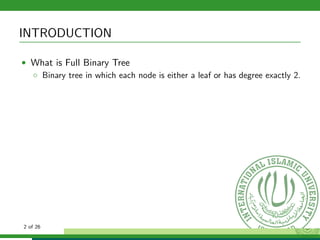
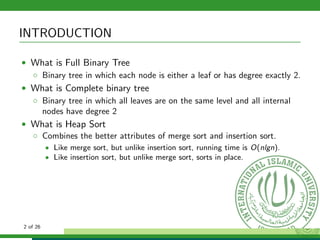
• What is Full Binary Tree
◦ Binary tree in which each node is either a leaf or has degree exactly 2.
2 of 26
INTRODUCTION
• What is Full Binary Tree
◦ Binary tree in which each node is either a leaf or has degree exactly 2.
• What is Complete binary tree
◦ Binary tree in which all leaves are on the same level and all internal
nodes have degree 2
2 of 26
INTRODUCTION
• What is Full Binary Tree
◦ Binary tree in which each node is either a leaf or has degree exactly 2.
• What is Complete binary tree
◦ Binary tree in which all leaves are on the same level and all internal
nodes have degree 2
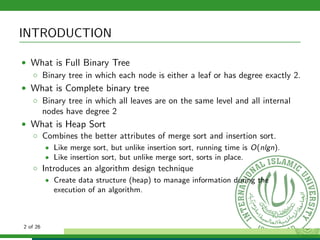
• What is Heap Sort
◦ Combines the better attributes of merge sort and insertion sort.
• Like merge sort, but unlike insertion sort, running time is O(nlgn).
• Like insertion sort, but unlike merge sort, sorts in place.
2 of 26
INTRODUCTION
• What is Full Binary Tree
◦ Binary tree in which each node is either a leaf or has degree exactly 2.
• What is Complete binary tree
◦ Binary tree in which all leaves are on the same level and all internal
nodes have degree 2
• What is Heap Sort
◦ Combines the better attributes of merge sort and insertion sort.
• Like merge sort, but unlike insertion sort, running time is O(nlgn).
• Like insertion sort, but unlike merge sort, sorts in place.
◦ Introduces an algorithm design technique
• Create data structure (heap) to manage information during the
execution of an algorithm.
2 of 26
INTRODUCTION
• What is Full Binary Tree
◦ Binary tree in which each node is either a leaf or has degree exactly 2.
• What is Complete binary tree
◦ Binary tree in which all leaves are on the same level and all internal
nodes have degree 2
• What is Heap Sort
◦ Combines the better attributes of merge sort and insertion sort.
• Like merge sort, but unlike insertion sort, running time is O(nlgn).
• Like insertion sort, but unlike merge sort, sorts in place.
◦ Introduces an algorithm design technique
• Create data structure (heap) to manage information during the
execution of an algorithm.
◦ The heap has other applications beside sorting.
• Priority Queues
2 of 26
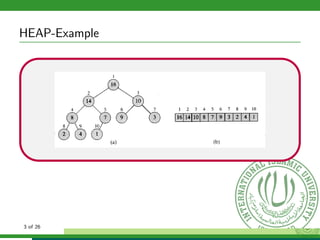
HEAP-Example
3 of 26
What is Heap-Properties
• Properties of Heap is
◦ Completeness Property
◦ Order Proprty
4 of 26
What is Heap-Properties
• Properties of Heap is
◦ Completeness Property
◦ Order Proprty
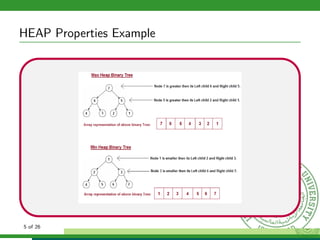
• Types of Heap is
◦ Max Heap
A[PARENT(i)] A[i]
◦ Min Heap
A[PARENT(i)] ≤ A[i]
4 of 26
What is Heap-Properties
• Properties of Heap is
◦ Completeness Property
◦ Order Proprty
• Types of Heap is
◦ Max Heap
A[PARENT(i)] A[i]
◦ Min Heap
A[PARENT(i)] ≤ A[i]
4 of 26
HEAP Properties Example
5 of 26
What is Heap-Characteristic
• Height of a node = the number of edges on the longest simple
path from the node down to a leaf lgn .
6 of 26
What is Heap-Characteristic
• Height of a node = the number of edges on the longest simple
path from the node down to a leaf lgn .
• Level of a node = the length of a path from the root to the node.
n/2 .
6 of 26
What is Heap-Characteristic
• Height of a node = the number of edges on the longest simple
path from the node down to a leaf lgn .
• Level of a node = the length of a path from the root to the node.
n/2 .
• Height of tree = height of root node. height h ≤ n/2h + 1
6 of 26
Heap Representations
• Heap can Be Represented As
◦ Root of tree is A[1]
7 of 26
Heap Representations
• Heap can Be Represented As
◦ Root of tree is A[1]
◦ Left
A[i] = A[2i]
7 of 26
Heap Representations
• Heap can Be Represented As
◦ Root of tree is A[1]
◦ Left
A[i] = A[2i]
◦ Right
A[i] = A[2i + 1]
7 of 26
Heap Representations
• Heap can Be Represented As
◦ Root of tree is A[1]
◦ Left
A[i] = A[2i]
◦ Right
A[i] = A[2i + 1]
◦ Parent
A[i] = A[ i/2 ]
7 of 26
Heap Representations
• Heap can Be Represented As
◦ Root of tree is A[1]
◦ Left
A[i] = A[2i]
◦ Right
A[i] = A[2i + 1]
◦ Parent
A[i] = A[ i/2 ]
◦ Heapsize[A] ≤ Length[A]
7 of 26
Problems
• What are the minimum and maximum numbers of elements in a
heap of height h?
• Show that an n-element heap has height lgn .
• Where in a max-heap might the smallest element reside, assuming
that all elements are distinct?
• Is an array that is in sorted order a min-heap?
• Is the array with values 23, 17, 14, 6, 13, 10, 1, 5, 7, 12 a
max-heap?
8 of 26
Maintaining The Heap Property
MAXIMUM-HEAPIFY PROCEDURE
MAX-HEAPIFY(A,i )
1. l ← LEFT(i)
2. r ← RIGHT(i)
3. if l ≤ A.heap-size and A[l]>A[i]
4. largest ← l
5. else largest ← i
6. if r ≤ A.heap-size and A[r]>A[largest]
7. largest ← r
8. if largest ← i
9. exchange A[i] ↔ A[largest]
10. MAX-HEAPIFY(A, largest)
9 of 26
Maintain Heap Example
10 of 26
Running Time of MAX-HEAPIFY
• Running time of MAX-HEAPIFY is O(lgn)
11 of 26
Running Time of MAX-HEAPIFY
• Running time of MAX-HEAPIFY is O(lgn)
• Can be written in terms of the height of the heap, as being O(h)
Since the height of the heap is lgn
11 of 26
Running Time of MAX-HEAPIFY
• Running time of MAX-HEAPIFY is O(lgn)
• Can be written in terms of the height of the heap, as being O(h)
Since the height of the heap is lgn
• MaxHeapify takes O(h) where h is the height of the node where
MaxHeapify is applied.
T(n) = O(lgn)
11 of 26
Problems
• What is the effect of calling MAX-HEAPIFY(A, i) when the
element A[i] is larger than its children?
• What is the effect of calling MAX-HEAPIFY(A, i) for
i>A.heap-size/2?
• Show that the worst-case running time of MAX-HEAPIFY on a
heap of size n is Ω(lgn).
12 of 26
Building a heap
Building Max Heap PROCEDURE
BuildMaxHeap(A)
1. heap-size[A] ← length[A]
2. for i ← length[A]/2 downto 1
3. do MaxHeapify(A, i)
13 of 26
Build Heap-Example
14 of 26
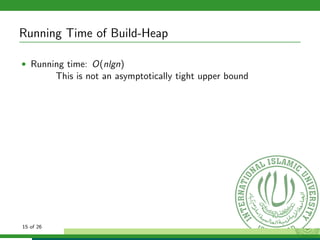
Running Time of Build-Heap
• Running time: O(nlgn)
This is not an asymptotically tight upper bound
15 of 26
HEAP SORT
• Goal:
◦ Sort an array using heap representations
16 of 26
HEAP SORT
• Goal:
◦ Sort an array using heap representations
• Idea:
◦ Build a max-heap from the array
◦ Swap the root (the maximum element) with the last element in the
array
◦ Discard this last node by decreasing the heap size
◦ Call MAX-HEAPIFY on the new root
◦ Repeat this process until only one node remains
16 of 26
HEAP SORT PROCEDURE
• Sort by maintaining the as yet unsorted elements as a max-heap.
17 of 26
HEAP SORT PROCEDURE
• Sort by maintaining the as yet unsorted elements as a max-heap.
• Start by building a max-heap on all elements in A.
17 of 26
HEAP SORT PROCEDURE
• Sort by maintaining the as yet unsorted elements as a max-heap.
• Start by building a max-heap on all elements in A.
Maximum element is in the root, A[1].
17 of 26
HEAP SORT PROCEDURE
• Sort by maintaining the as yet unsorted elements as a max-heap.
• Start by building a max-heap on all elements in A.
Maximum element is in the root, A[1].
• Move the maximum element to its correct final position.
Exchange A[1] with A[n].
17 of 26
HEAP SORT PROCEDURE
• Sort by maintaining the as yet unsorted elements as a max-heap.
• Start by building a max-heap on all elements in A.
Maximum element is in the root, A[1].
• Move the maximum element to its correct final position.
Exchange A[1] with A[n].
• Discard A[n] it is now sorted.
Decrement heap-size[A].
17 of 26
HEAP SORT PROCEDURE
• Sort by maintaining the as yet unsorted elements as a max-heap.
• Start by building a max-heap on all elements in A.
Maximum element is in the root, A[1].
• Move the maximum element to its correct final position.
Exchange A[1] with A[n].
• Discard A[n] it is now sorted.
Decrement heap-size[A].
• Restore the max-heap property on A[1..n1].
Call MaxHeapify(A, 1).
17 of 26
HEAP SORT PROCEDURE
• Sort by maintaining the as yet unsorted elements as a max-heap.
• Start by building a max-heap on all elements in A.
Maximum element is in the root, A[1].
• Move the maximum element to its correct final position.
Exchange A[1] with A[n].
• Discard A[n] it is now sorted.
Decrement heap-size[A].
• Restore the max-heap property on A[1..n1].
Call MaxHeapify(A, 1).
• Repeat until heap-size[A] is reduced to 2.
17 of 26
HEAP SORT
// Input: A: an (unsorted) array
// Output: A modifed to be sorted from smallest to largest
// Running Time: O(nlogn) where n = length[A]
HeapSort(A)
1. Build-Max-Heap(A)
2. for i ← length[A] downto 2
3. do exchange A[1] ↔ A[i]
4. heap-size[A] ← heap-size[A] 1
5. MaxHeapify(A, 1)
18 of 26
Heap Sort Example
19 of 26
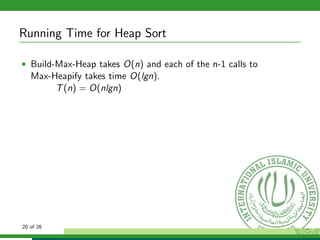
Running Time for Heap Sort
• Build-Max-Heap takes O(n) and each of the n-1 calls to
Max-Heapify takes time O(lgn).
T(n) = O(nlgn)
20 of 26
Running Time for Heap Sort
• Build-Max-Heap takes O(n) and each of the n-1 calls to
Max-Heapify takes time O(lgn).
T(n) = O(nlgn)
• The heap sorting algorithm uses two procedures : BUILD-HEAP
and HEAPIFY. Thus, total running time Tsort(n) to sort an array
of size n is
20 of 26
Problems
• What is the running time of HEAPSORT on an array A of length n
that is already sorted in increasing order? What about decreasing
order?
• Show that the worst-case running time of HEAPSORT is Ω(nlgn).
21 of 26
Complexity
• To insert a single node in an empty heap is : O(1).
• To insert a single element in a n node heap is : O(logn).
• To insert n elements in a n node heap is : O(nlogn).
• To delete the largest element in a max heap tree : O(1).
• To delete the smallest element in a max heap tree : O(logn).
• To delete n elements in a max heap tree : O(nlogn).
• To create a heap, time complexity will be : O(nlogn).
22 of 26
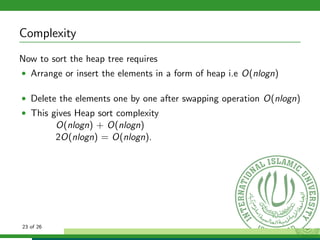
Complexity
Now to sort the heap tree requires
• Arrange or insert the elements in a form of heap i.e O(nlogn)
• Delete the elements one by one after swapping operation O(nlogn)
• This gives Heap sort complexity
O(nlogn) + O(nlogn)
2O(nlogn) = O(nlogn).
23 of 26
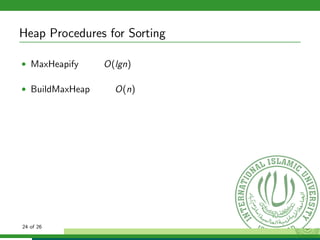
Heap Procedures for Sorting
• MaxHeapify O(lgn)
24 of 26
Heap Procedures for Sorting
• MaxHeapify O(lgn)
• BuildMaxHeap O(n)
24 of 26
Heap Procedures for Sorting
• MaxHeapify O(lgn)
• BuildMaxHeap O(n)
• HeapSort O(nlgn)
24 of 26
SUMMARY
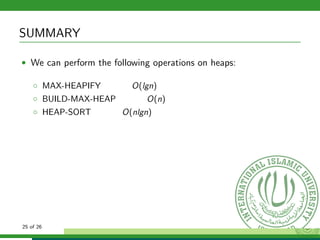
• We can perform the following operations on heaps:
◦ MAX-HEAPIFY O(lgn)
25 of 26
SUMMARY
• We can perform the following operations on heaps:
◦ MAX-HEAPIFY O(lgn)
◦ BUILD-MAX-HEAP O(n)
25 of 26
SUMMARY
• We can perform the following operations on heaps:
◦ MAX-HEAPIFY O(lgn)
◦ BUILD-MAX-HEAP O(n)
◦ HEAP-SORT O(nlgn)
25 of 26
SUMMARY
• We can perform the following operations on heaps:
◦ MAX-HEAPIFY O(lgn)
◦ BUILD-MAX-HEAP O(n)
◦ HEAP-SORT O(nlgn)
◦ MAX-HEAP-INSERT O(lgn)
25 of 26
SUMMARY
• We can perform the following operations on heaps:
◦ MAX-HEAPIFY O(lgn)
◦ BUILD-MAX-HEAP O(n)
◦ HEAP-SORT O(nlgn)
◦ MAX-HEAP-INSERT O(lgn)
◦ HEAP-EXTRACT-MAX O(lgn)
25 of 26
SUMMARY
• We can perform the following operations on heaps:
◦ MAX-HEAPIFY O(lgn)
◦ BUILD-MAX-HEAP O(n)
◦ HEAP-SORT O(nlgn)
◦ MAX-HEAP-INSERT O(lgn)
◦ HEAP-EXTRACT-MAX O(lgn)
◦ HEAP-INCREASE-KEY O(lgn)
25 of 26
SUMMARY
• We can perform the following operations on heaps:
◦ MAX-HEAPIFY O(lgn)
◦ BUILD-MAX-HEAP O(n)
◦ HEAP-SORT O(nlgn)
◦ MAX-HEAP-INSERT O(lgn)
◦ HEAP-EXTRACT-MAX O(lgn)
◦ HEAP-INCREASE-KEY O(lgn)
◦ HEAP-MAXIMUM O(1)
25 of 26
Building a heap
• Presented To:- Dr. Arshad Aewan
• Presented By:- SK Ahsan
• Reg No:- 813/FBAS/MSCS/F14
• Topic:- Heap Sort(Procedure)
• My Dreams Are My Own Drems(Me)
26 of 26

Heap sort

  • 1.
    HEAP SORT Sunawar Khan InternationalIslamic University Islamabad January 04, 2016
  • 2.
    INTRODUCTION • What isFull Binary Tree ◦ Binary tree in which each node is either a leaf or has degree exactly 2. 2 of 26
  • 3.
    INTRODUCTION • What isFull Binary Tree ◦ Binary tree in which each node is either a leaf or has degree exactly 2. • What is Complete binary tree ◦ Binary tree in which all leaves are on the same level and all internal nodes have degree 2 2 of 26
  • 4.
    INTRODUCTION • What isFull Binary Tree ◦ Binary tree in which each node is either a leaf or has degree exactly 2. • What is Complete binary tree ◦ Binary tree in which all leaves are on the same level and all internal nodes have degree 2 • What is Heap Sort ◦ Combines the better attributes of merge sort and insertion sort. • Like merge sort, but unlike insertion sort, running time is O(nlgn). • Like insertion sort, but unlike merge sort, sorts in place. 2 of 26
  • 5.
    INTRODUCTION • What isFull Binary Tree ◦ Binary tree in which each node is either a leaf or has degree exactly 2. • What is Complete binary tree ◦ Binary tree in which all leaves are on the same level and all internal nodes have degree 2 • What is Heap Sort ◦ Combines the better attributes of merge sort and insertion sort. • Like merge sort, but unlike insertion sort, running time is O(nlgn). • Like insertion sort, but unlike merge sort, sorts in place. ◦ Introduces an algorithm design technique • Create data structure (heap) to manage information during the execution of an algorithm. 2 of 26
  • 6.
    INTRODUCTION • What isFull Binary Tree ◦ Binary tree in which each node is either a leaf or has degree exactly 2. • What is Complete binary tree ◦ Binary tree in which all leaves are on the same level and all internal nodes have degree 2 • What is Heap Sort ◦ Combines the better attributes of merge sort and insertion sort. • Like merge sort, but unlike insertion sort, running time is O(nlgn). • Like insertion sort, but unlike merge sort, sorts in place. ◦ Introduces an algorithm design technique • Create data structure (heap) to manage information during the execution of an algorithm. ◦ The heap has other applications beside sorting. • Priority Queues 2 of 26
  • 7.
  • 8.
    What is Heap-Properties •Properties of Heap is ◦ Completeness Property ◦ Order Proprty 4 of 26
  • 9.
    What is Heap-Properties •Properties of Heap is ◦ Completeness Property ◦ Order Proprty • Types of Heap is ◦ Max Heap A[PARENT(i)] A[i] ◦ Min Heap A[PARENT(i)] ≤ A[i] 4 of 26
  • 10.
    What is Heap-Properties •Properties of Heap is ◦ Completeness Property ◦ Order Proprty • Types of Heap is ◦ Max Heap A[PARENT(i)] A[i] ◦ Min Heap A[PARENT(i)] ≤ A[i] 4 of 26
  • 11.
  • 12.
    What is Heap-Characteristic •Height of a node = the number of edges on the longest simple path from the node down to a leaf lgn . 6 of 26
  • 13.
    What is Heap-Characteristic •Height of a node = the number of edges on the longest simple path from the node down to a leaf lgn . • Level of a node = the length of a path from the root to the node. n/2 . 6 of 26
  • 14.
    What is Heap-Characteristic •Height of a node = the number of edges on the longest simple path from the node down to a leaf lgn . • Level of a node = the length of a path from the root to the node. n/2 . • Height of tree = height of root node. height h ≤ n/2h + 1 6 of 26
  • 15.
    Heap Representations • Heapcan Be Represented As ◦ Root of tree is A[1] 7 of 26
  • 16.
    Heap Representations • Heapcan Be Represented As ◦ Root of tree is A[1] ◦ Left A[i] = A[2i] 7 of 26
  • 17.
    Heap Representations • Heapcan Be Represented As ◦ Root of tree is A[1] ◦ Left A[i] = A[2i] ◦ Right A[i] = A[2i + 1] 7 of 26
  • 18.
    Heap Representations • Heapcan Be Represented As ◦ Root of tree is A[1] ◦ Left A[i] = A[2i] ◦ Right A[i] = A[2i + 1] ◦ Parent A[i] = A[ i/2 ] 7 of 26
  • 19.
    Heap Representations • Heapcan Be Represented As ◦ Root of tree is A[1] ◦ Left A[i] = A[2i] ◦ Right A[i] = A[2i + 1] ◦ Parent A[i] = A[ i/2 ] ◦ Heapsize[A] ≤ Length[A] 7 of 26
  • 20.
    Problems • What arethe minimum and maximum numbers of elements in a heap of height h? • Show that an n-element heap has height lgn . • Where in a max-heap might the smallest element reside, assuming that all elements are distinct? • Is an array that is in sorted order a min-heap? • Is the array with values 23, 17, 14, 6, 13, 10, 1, 5, 7, 12 a max-heap? 8 of 26
  • 21.
    Maintaining The HeapProperty MAXIMUM-HEAPIFY PROCEDURE MAX-HEAPIFY(A,i ) 1. l ← LEFT(i) 2. r ← RIGHT(i) 3. if l ≤ A.heap-size and A[l]>A[i] 4. largest ← l 5. else largest ← i 6. if r ≤ A.heap-size and A[r]>A[largest] 7. largest ← r 8. if largest ← i 9. exchange A[i] ↔ A[largest] 10. MAX-HEAPIFY(A, largest) 9 of 26
  • 22.
  • 23.
    Running Time ofMAX-HEAPIFY • Running time of MAX-HEAPIFY is O(lgn) 11 of 26
  • 24.
    Running Time ofMAX-HEAPIFY • Running time of MAX-HEAPIFY is O(lgn) • Can be written in terms of the height of the heap, as being O(h) Since the height of the heap is lgn 11 of 26
  • 25.
    Running Time ofMAX-HEAPIFY • Running time of MAX-HEAPIFY is O(lgn) • Can be written in terms of the height of the heap, as being O(h) Since the height of the heap is lgn • MaxHeapify takes O(h) where h is the height of the node where MaxHeapify is applied. T(n) = O(lgn) 11 of 26
  • 26.
    Problems • What isthe effect of calling MAX-HEAPIFY(A, i) when the element A[i] is larger than its children? • What is the effect of calling MAX-HEAPIFY(A, i) for i>A.heap-size/2? • Show that the worst-case running time of MAX-HEAPIFY on a heap of size n is Ω(lgn). 12 of 26
  • 27.
    Building a heap BuildingMax Heap PROCEDURE BuildMaxHeap(A) 1. heap-size[A] ← length[A] 2. for i ← length[A]/2 downto 1 3. do MaxHeapify(A, i) 13 of 26
  • 28.
  • 29.
    Running Time ofBuild-Heap • Running time: O(nlgn) This is not an asymptotically tight upper bound 15 of 26
  • 30.
    HEAP SORT • Goal: ◦Sort an array using heap representations 16 of 26
  • 31.
    HEAP SORT • Goal: ◦Sort an array using heap representations • Idea: ◦ Build a max-heap from the array ◦ Swap the root (the maximum element) with the last element in the array ◦ Discard this last node by decreasing the heap size ◦ Call MAX-HEAPIFY on the new root ◦ Repeat this process until only one node remains 16 of 26
  • 32.
    HEAP SORT PROCEDURE •Sort by maintaining the as yet unsorted elements as a max-heap. 17 of 26
  • 33.
    HEAP SORT PROCEDURE •Sort by maintaining the as yet unsorted elements as a max-heap. • Start by building a max-heap on all elements in A. 17 of 26
  • 34.
    HEAP SORT PROCEDURE •Sort by maintaining the as yet unsorted elements as a max-heap. • Start by building a max-heap on all elements in A. Maximum element is in the root, A[1]. 17 of 26
  • 35.
    HEAP SORT PROCEDURE •Sort by maintaining the as yet unsorted elements as a max-heap. • Start by building a max-heap on all elements in A. Maximum element is in the root, A[1]. • Move the maximum element to its correct final position. Exchange A[1] with A[n]. 17 of 26
  • 36.
    HEAP SORT PROCEDURE •Sort by maintaining the as yet unsorted elements as a max-heap. • Start by building a max-heap on all elements in A. Maximum element is in the root, A[1]. • Move the maximum element to its correct final position. Exchange A[1] with A[n]. • Discard A[n] it is now sorted. Decrement heap-size[A]. 17 of 26
  • 37.
    HEAP SORT PROCEDURE •Sort by maintaining the as yet unsorted elements as a max-heap. • Start by building a max-heap on all elements in A. Maximum element is in the root, A[1]. • Move the maximum element to its correct final position. Exchange A[1] with A[n]. • Discard A[n] it is now sorted. Decrement heap-size[A]. • Restore the max-heap property on A[1..n1]. Call MaxHeapify(A, 1). 17 of 26
  • 38.
    HEAP SORT PROCEDURE •Sort by maintaining the as yet unsorted elements as a max-heap. • Start by building a max-heap on all elements in A. Maximum element is in the root, A[1]. • Move the maximum element to its correct final position. Exchange A[1] with A[n]. • Discard A[n] it is now sorted. Decrement heap-size[A]. • Restore the max-heap property on A[1..n1]. Call MaxHeapify(A, 1). • Repeat until heap-size[A] is reduced to 2. 17 of 26
  • 39.
    HEAP SORT // Input:A: an (unsorted) array // Output: A modifed to be sorted from smallest to largest // Running Time: O(nlogn) where n = length[A] HeapSort(A) 1. Build-Max-Heap(A) 2. for i ← length[A] downto 2 3. do exchange A[1] ↔ A[i] 4. heap-size[A] ← heap-size[A] 1 5. MaxHeapify(A, 1) 18 of 26
  • 40.
  • 41.
    Running Time forHeap Sort • Build-Max-Heap takes O(n) and each of the n-1 calls to Max-Heapify takes time O(lgn). T(n) = O(nlgn) 20 of 26
  • 42.
    Running Time forHeap Sort • Build-Max-Heap takes O(n) and each of the n-1 calls to Max-Heapify takes time O(lgn). T(n) = O(nlgn) • The heap sorting algorithm uses two procedures : BUILD-HEAP and HEAPIFY. Thus, total running time Tsort(n) to sort an array of size n is 20 of 26
  • 43.
    Problems • What isthe running time of HEAPSORT on an array A of length n that is already sorted in increasing order? What about decreasing order? • Show that the worst-case running time of HEAPSORT is Ω(nlgn). 21 of 26
  • 44.
    Complexity • To inserta single node in an empty heap is : O(1). • To insert a single element in a n node heap is : O(logn). • To insert n elements in a n node heap is : O(nlogn). • To delete the largest element in a max heap tree : O(1). • To delete the smallest element in a max heap tree : O(logn). • To delete n elements in a max heap tree : O(nlogn). • To create a heap, time complexity will be : O(nlogn). 22 of 26
  • 45.
    Complexity Now to sortthe heap tree requires • Arrange or insert the elements in a form of heap i.e O(nlogn) • Delete the elements one by one after swapping operation O(nlogn) • This gives Heap sort complexity O(nlogn) + O(nlogn) 2O(nlogn) = O(nlogn). 23 of 26
  • 46.
    Heap Procedures forSorting • MaxHeapify O(lgn) 24 of 26
  • 47.
    Heap Procedures forSorting • MaxHeapify O(lgn) • BuildMaxHeap O(n) 24 of 26
  • 48.
    Heap Procedures forSorting • MaxHeapify O(lgn) • BuildMaxHeap O(n) • HeapSort O(nlgn) 24 of 26
  • 49.
    SUMMARY • We canperform the following operations on heaps: ◦ MAX-HEAPIFY O(lgn) 25 of 26
  • 50.
    SUMMARY • We canperform the following operations on heaps: ◦ MAX-HEAPIFY O(lgn) ◦ BUILD-MAX-HEAP O(n) 25 of 26
  • 51.
    SUMMARY • We canperform the following operations on heaps: ◦ MAX-HEAPIFY O(lgn) ◦ BUILD-MAX-HEAP O(n) ◦ HEAP-SORT O(nlgn) 25 of 26
  • 52.
    SUMMARY • We canperform the following operations on heaps: ◦ MAX-HEAPIFY O(lgn) ◦ BUILD-MAX-HEAP O(n) ◦ HEAP-SORT O(nlgn) ◦ MAX-HEAP-INSERT O(lgn) 25 of 26
  • 53.
    SUMMARY • We canperform the following operations on heaps: ◦ MAX-HEAPIFY O(lgn) ◦ BUILD-MAX-HEAP O(n) ◦ HEAP-SORT O(nlgn) ◦ MAX-HEAP-INSERT O(lgn) ◦ HEAP-EXTRACT-MAX O(lgn) 25 of 26
  • 54.
    SUMMARY • We canperform the following operations on heaps: ◦ MAX-HEAPIFY O(lgn) ◦ BUILD-MAX-HEAP O(n) ◦ HEAP-SORT O(nlgn) ◦ MAX-HEAP-INSERT O(lgn) ◦ HEAP-EXTRACT-MAX O(lgn) ◦ HEAP-INCREASE-KEY O(lgn) 25 of 26
  • 55.
    SUMMARY • We canperform the following operations on heaps: ◦ MAX-HEAPIFY O(lgn) ◦ BUILD-MAX-HEAP O(n) ◦ HEAP-SORT O(nlgn) ◦ MAX-HEAP-INSERT O(lgn) ◦ HEAP-EXTRACT-MAX O(lgn) ◦ HEAP-INCREASE-KEY O(lgn) ◦ HEAP-MAXIMUM O(1) 25 of 26
  • 56.
    Building a heap •Presented To:- Dr. Arshad Aewan • Presented By:- SK Ahsan • Reg No:- 813/FBAS/MSCS/F14 • Topic:- Heap Sort(Procedure) • My Dreams Are My Own Drems(Me) 26 of 26