1
Chapter 6 : Antenna Arrays
• Introduction
• Two-Element Array
• N-element Linear Array: Uniform
Amplitude and Spacing
• N-element Linear Array: Directivity
• N-element Linear Array: Uniform spacing,
Non-uniform Amplitude
• Planar Array
2
Antenna Array: Introduction
• Array is an assembly of antenna elements
arranged in an orderly fashion. The
elements are usually identical.
• Why array? When high gain and/or
narrow beam are required:
– Single element -> Wide beam (low directivity)
– Increasing size -> difficult to build and
expensive
– Useful especially when the element gain is low.
3
Antenna Array: Introduction (2)
• Advantages
– Higher directivity
– Narrower beam
– Lower sidelobes
– Electronic steerable beam
• Types
– Fix direction
– Steerable : Mechanical or Electronic (phased
arrays)
4
Antenna Array: Introduction (3)
• In an array of identical elements, there
are in general five controls that can be
used to shape the overall pattern of the
antenna:
1. Geometrical configuration (linear, circular, etc.)
2. Relative displacement between elements
3. Excitation amplitude of individual elements
4. Excitation phase of individual elements
5. Relative pattern of individual elements
The linked image cannot be displayed. The file may have been moved, renamed, or deleted. Verify that the link points to the correct file and location.
5
Examples
Very Large Antenna (VLA)
Airborne Warning and
Control System (AWACS)
6
Two-element Array
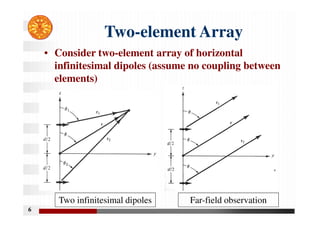
• Consider two-element array of horizontal
infinitesimal dipoles (assume no coupling between
elements)
Far-field observation
Two infinitesimal dipoles
7
Two-element Array (2)



 cos
4
ˆ
0
r
e
l
I
jk
jkr


E
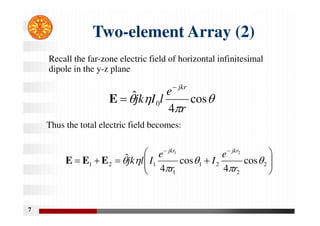
Recall the far-zone electric field of horizontal infinitesimal
dipole in the y-z plane














2
2
2
1
1
1
2
1 cos
4
cos
4
ˆ
2
1






r
e
I
r
e
I
l
jk
jkr
jkr
E
E
E
Thus the total electric field becomes:
8
Two-Element Array (3)

cos
2
1
d
r
r 
 
cos
2
2
d
r
r 

r
r
r 
 2
1
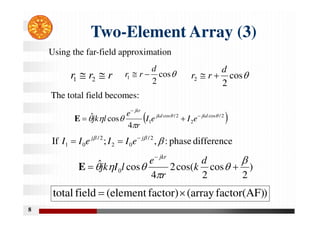
Using the far-field approximation
 
2
/
cos
2
2
/
cos
1
4
cos
ˆ 




 jkd
jkd
jkr
e
I
e
I
r
e
l
jk 



E
The total field becomes:
)
2
cos
2
cos(
2
4
cos
ˆ
0





 


d
k
r
e
l
I
jk
jkr
E
difference
phase
:
,
;
If 2
/
0
2
2
/
0
1 

 j
j
e
I
I
e
I
I 


)
factor(AF)
(array
factor)
(element
field
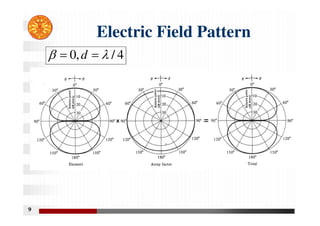
total 

9
Electric Field Pattern
4
/
,
0 
 
 d
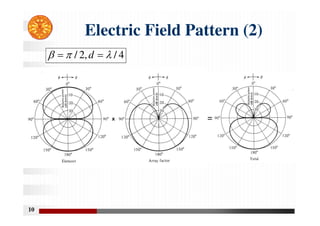
10
Electric Field Pattern (2)
4
/
,
2
/ 

 
 d
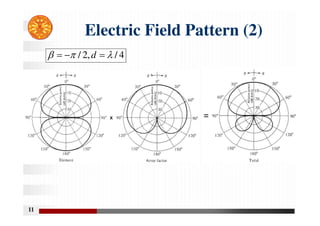
11
Electric Field Pattern (2)
4
/
,
2
/ 

 

 d
12
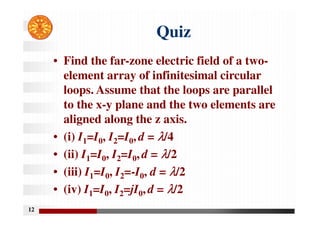
Quiz
• Find the far-zone electric field of a two-
element array of infinitesimal circular
loops. Assume that the loops are parallel
to the x-y plane and the two elements are
aligned along the z axis.
• (i) I1=I0, I2=I0, d = λ
λ
λ
λ/4
• (ii) I1=I0, I2=I0, d = λ
λ
λ
λ/2
• (iii) I1=I0, I2=-I0, d = λ
λ
λ
λ/2
• (iv) I1=I0, I2=jI0, d = λ
λ
λ
λ/2
13
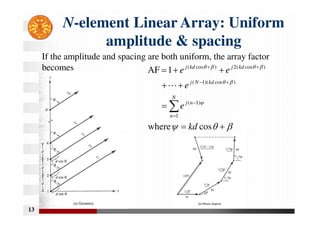
N-element Linear Array: Uniform
amplitude & spacing

























cos
where
1
AF
1
)
1
(
)
cos
)(
1
(
)
cos
(
2
)
cos
(
kd
e
e
e
e
N
n
n
j
kd
N
j
kd
j
kd
j
L
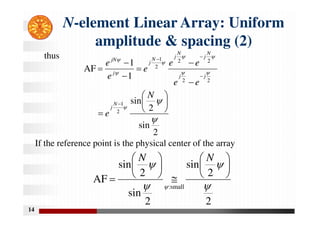
If the amplitude and spacing are both uniform, the array factor
becomes
14
N-element Linear Array: Uniform
amplitude & spacing (2)
2
sin
2
sin
1
1
AF
2
1
2
2
2
2
2
1



























N
e
e
e
e
e
e
e
e
N
j
j
j
N
j
N
j
N
j
j
jN
thus
If the reference point is the physical center of the array
2
2
sin
2
sin
2
sin
AF
small
: 


















N
N
15
N-element Linear Array: Uniform
amplitude & spacing (3)




















 




 2
sinc
2
2
sin
2
sin
2
sin
(AF)
small
:
n
N
N
N
N
N
K
K ,
3
,
2
,
;
,
3
,
2
,
1
2
2
cos
2
0
2
sin
1
N
N
N
n
n
N
n
d
n
N
N
n
n





































 

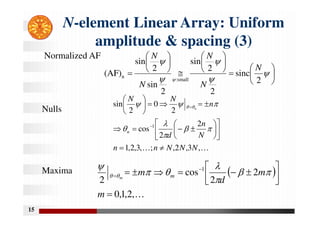
Normalized AF
Nulls
 
K
,
2
,
1
,
0
2
2
cos
2
1












 

m
m
d
m m
m









Maxima
16
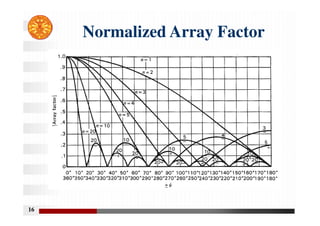
Normalized Array Factor
17
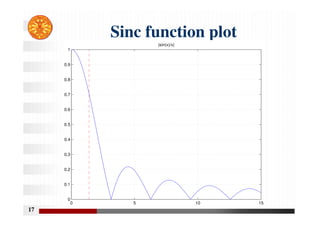
Sinc function plot
0 5 10 15
0
0.1
0.2
0.3
0.4
0.5
0.6
0.7
0.8
0.9
1
|sin(x)/x|
18
N-element Linear Array: Uniform
amplitude & spacing (4)













































N
d
N
d
N
N
h
h
782
.
2
2
sin
2
782
.
2
2
cos
391
.
1
2
2
1
2
sin
2
sin
1
1













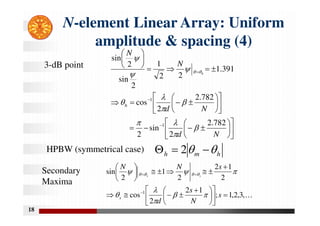
HPBW (symmetrical case)
3-dB point
Secondary
Maxima
h
m
h 
 

 2
K
,
3
,
2
,
1
;
1
2
2
cos
2
1
2
2
1
2
sin
1












 



















s
N
s
d
s
N
N
s
s
s







 



19
N-element Linear Array: Uniform
amplitude & spacing (5)
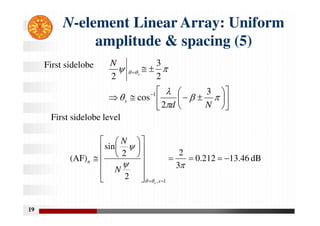
First sidelobe


























 

N
d
N
s
s
3
2
cos
2
3
2
1
dB
46
.
13
212
.
0
3
2
2
2
sin
(AF)
1
,
n 




























 s
s
N
N
First sidelobe level
20
Example
#2
#1
#3
d
d
z
y
0
2 I
I 

2
/
0
1

j
e
I
I 

0
3 I
I 
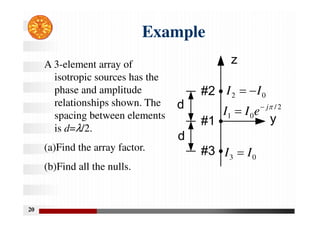
A 3-element array of
isotropic sources has the
phase and amplitude
relationships shown. The
spacing between elements
is d=λ/2.
(a)Find the array factor.
(b)Find all the nulls.
21
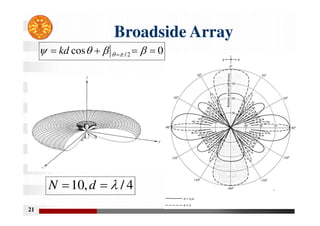
Broadside Array
0
cos 2
/ 


  


 

kd
4
/
,
10 

 d
N
22
Grating Lobes










n
n
kd
n
n
d
2
cos
2
cos
,
0
,
3
,
2
,
1
0
,









K


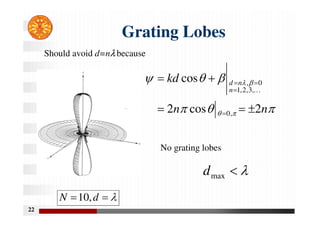
max
d
No grating lobes
Should avoid d=nλ because


 d
N ,
10
23
24
25
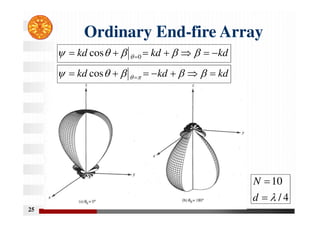
Ordinary End-fire Array
kd
kd
kd 





  



 

cos
4
/
10



d
N
kd
kd
kd 





  



  0
cos
26
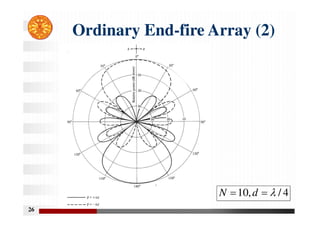
Ordinary End-fire Array (2)
4
/
,
10 

 d
N
27
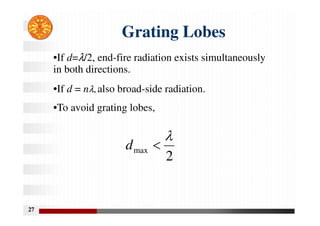
Grating Lobes
•If d=λ/2, end-fire radiation exists simultaneously
in both directions.
•If d = nλ, also broad-side radiation.
•To avoid grating lobes,
2
max


d
28
29
30
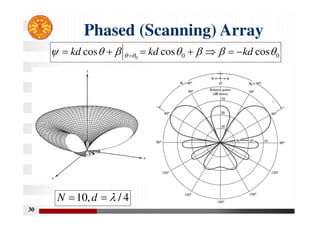
Phased (Scanning) Array
0
0 cos
cos
cos 0






 
 kd
kd
kd 





 
4
/
,
10 

 d
N
31
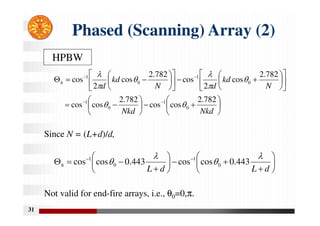
Phased (Scanning) Array (2)

















































Nkd
Nkd
N
kd
d
N
kd
d
h
782
.
2
cos
cos
782
.
2
cos
cos
782
.
2
cos
2
cos
782
.
2
cos
2
cos
0
1
0
1
0
1
0
1








HPBW


















 

d
L
d
L
h



 443
.
0
cos
cos
443
.
0
cos
cos 0
1
0
1
Since N = (L+d)/d,
Not valid for end-fire arrays, i.e., θ0=0,π.
32
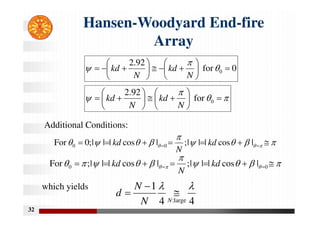
Hansen-Woodyard End-fire
Array
0
for
92
.
2
0 

















 


N
kd
N
kd



 















 0
for
92
.
2
N
kd
N
kd








 

 





 
 |
cos
|
|
|
;
|
cos
|
|
|
;
0
For 0
0 kd
N
kd
Additional Conditions:









 

 





 
 0
0 |
cos
|
|
|
;
|
cos
|
|
|
;
For kd
N
kd
which yields
4
4
1
large
:


N
N
N
d 


33
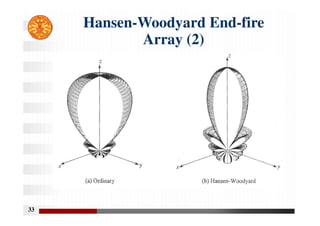
Hansen-Woodyard End-fire
Array (2)
34
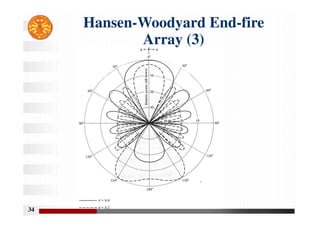
Hansen-Woodyard End-fire
Array (3)
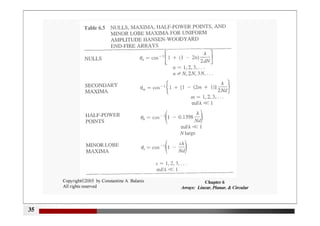
35
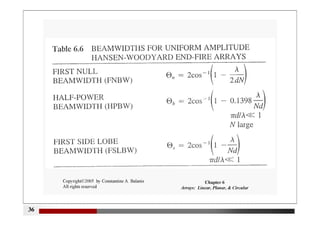
36
37
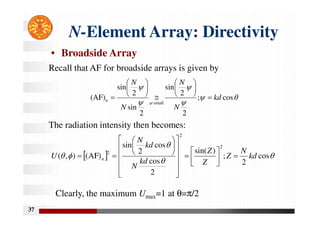
N-Element Array: Directivity
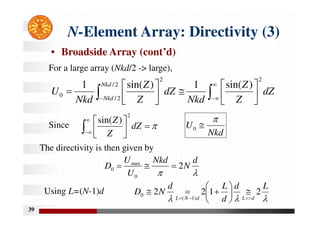
• Broadside Array







cos
;
2
2
sin
2
sin
2
sin
(AF)
small
:
n kd
N
N
N
N















  



 cos
2
;
)
sin(
2
cos
cos
2
sin
)
AF
(
)
,
(
2
2
2
kd
N
Z
Z
Z
kd
N
kd
N
U n 



























Recall that AF for broadside arrays is given by
The radiation intensity then becomes:
Clearly, the maximum Umax=1 at θ=π/2
38
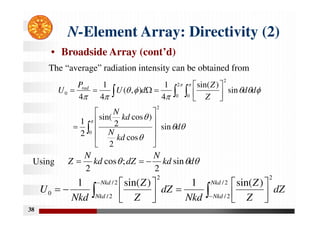
N-Element Array: Directivity (2)
• Broadside Array (cont’d)
The “average” radiation intensity can be obtained from
Using

 























 












0
2
2
0 0
2
0
sin
cos
2
)
cos
2
sin(
2
1
sin
)
sin(
4
1
)
,
(
4
1
4
d
kd
N
kd
N
d
d
Z
Z
d
U
P
U rad


 d
kd
N
dZ
kd
N
Z sin
2
;
cos
2



 

 














2
/
2
/
2
/
2
/
2
2
0
)
sin(
1
)
sin(
1 Nkd
Nkd
Nkd
Nkd
dZ
Z
Z
Nkd
dZ
Z
Z
Nkd
U
39
N-Element Array: Directivity (3)
• Broadside Array (cont’d)





 












 dZ
Z
Z
Nkd
dZ
Z
Z
Nkd
U
Nkd
Nkd
2
2
/
2
/
2
0
)
sin(
1
)
sin(
1
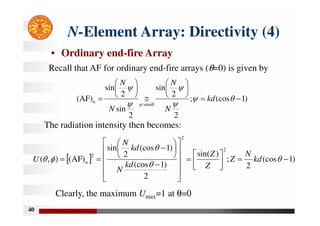
For a large array (Nkd/2 -> large),
The directivity is then given by


d
N
Nkd
U
U
D 2
0
max
0 














dZ
Z
Z
2
)
sin(
Nkd
U


0



L
d
d
L
d
N
D
d
L
d
N
L
2
1
2
2
)
1
(
0













Using L=(N-1)d
Since
40
N-Element Array: Directivity (4)
• Ordinary end-fire Array
)
1
(cos
;
2
2
sin
2
sin
2
sin
(AF)
small
:
n 














 






kd
N
N
N
N
  )
1
(cos
2
;
)
sin(
2
)
1
(cos
)
1
(cos
2
sin
)
AF
(
)
,
(
2
2
2






























 



 kd
N
Z
Z
Z
kd
N
kd
N
U n
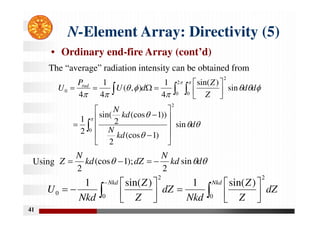
Recall that AF for ordinary end-fire arrays (θ=0) is given by
The radiation intensity then becomes:
Clearly, the maximum Umax=1 at θ=0
41
N-Element Array: Directivity (5)
• Ordinary end-fire Array (cont’d)
The “average” radiation intensity can be obtained from
Using

 

























 












0
2
2
0 0
2
0
sin
)
1
(cos
2
))
1
(cos
2
sin(
2
1
sin
)
sin(
4
1
)
,
(
4
1
4
d
kd
N
kd
N
d
d
Z
Z
d
U
P
U rad


 d
kd
N
dZ
kd
N
Z sin
2
);
1
(cos
2




 
















Nkd Nkd
dZ
Z
Z
Nkd
dZ
Z
Z
Nkd
U
0 0
2
2
0
)
sin(
1
)
sin(
1
42
N-Element Array: Directivity (6)
• Ordinary end-fire Array (cont’d)

















0
2
0
2
0
)
sin(
1
)
sin(
1
dZ
Z
Z
Nkd
dZ
Z
Z
Nkd
U
Nkd
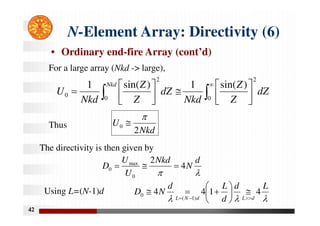
For a large array (Nkd -> large),
The directivity is then given by


d
N
Nkd
U
U
D 4
2
0
max
0 


Nkd
U
2
0





L
d
d
L
d
N
D
d
L
d
N
L
4
1
4
4
)
1
(
0













Using L=(N-1)d
Thus
43
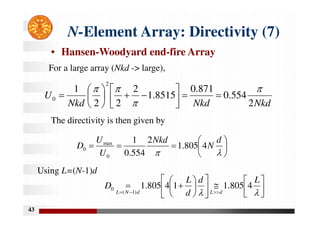
N-Element Array: Directivity (7)
• Hansen-Woodyard end-fire Array
Nkd
Nkd
Nkd
U
2
554
.
0
871
.
0
8515
.
1
2
2
2
1
2
0





















For a large array (Nkd -> large),
The directivity is then given by











d
N
Nkd
U
U
D 4
805
.
1
2
554
.
0
1
0
max
0























 

L
d
d
L
D
d
L
d
N
L
4
805
.
1
1
4
805
.
1
)
1
(
0
Using L=(N-1)d
44
45
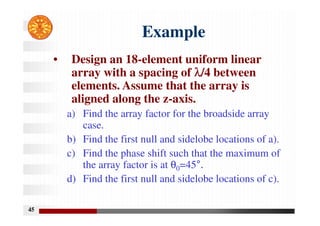
Example
• Design an 18-element uniform linear
array with a spacing of λ
λ
λ
λ/4 between
elements. Assume that the array is
aligned along the z-axis.
a) Find the array factor for the broadside array
case.
b) Find the first null and sidelobe locations of a).
c) Find the phase shift such that the maximum of
the array factor is at θ0=45°.
d) Find the first null and sidelobe locations of c).
46
18-element AF (broadside array)
0 20 40 60 80 100 120 140 160 180
−50
−45
−40
−35
−30
−25
−20
−15
−10
−5
0
θ [Degree]
|(AF)
n
|
[dB]
18−element array factor (Broadside scan
47
18-element AF (scan array)
0 20 40 60 80 100 120 140 160 180
−50
−45
−40
−35
−30
−25
−20
−15
−10
−5
0
θ [Degree]
|(AF)
n
|
[dB]
18−element array factor
48
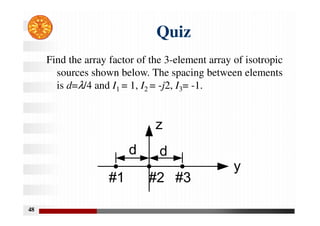
Quiz
Find the array factor of the 3-element array of isotropic
sources shown below. The spacing between elements
is d=λ/4 and I1 = 1, I2 = -j2, I3= -1.
49
N-element Array: Non-uniform
amplitude, uniform spacing
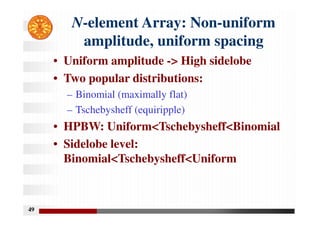
• Uniform amplitude -> High sidelobe
• Two popular distributions:
– Binomial (maximally flat)
– Tschebysheff (equiripple)
• HPBW: Uniform<Tschebysheff<Binomial
• Sidelobe level:
Binomial<Tschebysheff<Uniform
50
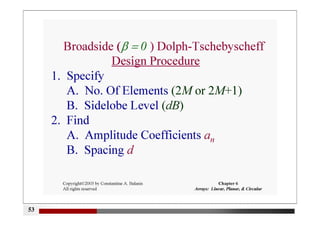
51
52
53
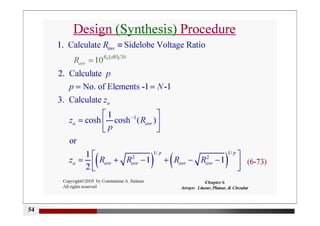
54
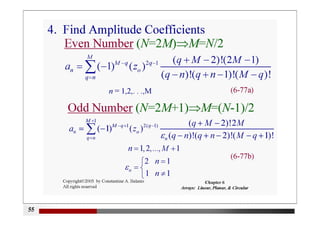
55
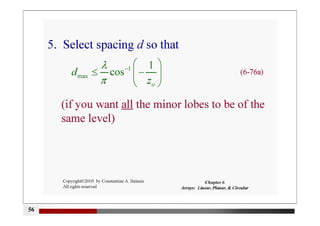
56
57
58
59
Planar Array
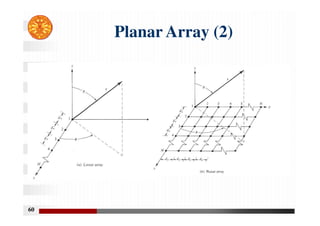
• Linear Array = one-dimensional array,
i.e., can scan the beam only in one plane.
• In order to be able to scan the beam in
any direction, two-dimensional arrays are
needed. Geometries can be planar, circle,
cylindrical, spherical and so on.
60
Planar Array (2)
61
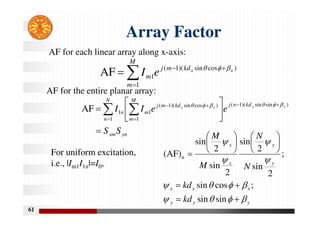
Array Factor





M
m
kd
m
j
m
x
x
e
I
1
)
cos
sin
)(
1
(
1
AF 


yn
xm
kd
n
j
M
m
kd
m
j
m
N
n
n
S
S
e
e
I
I y
y
x
x
















)
sin
sin
)(
1
(
1
)
cos
sin
)(
1
(
1
1
1
AF






y
y
y
x
x
x
y
y
x
x
kd
kd
N
N
M
M





























sin
sin
;
cos
sin
;
2
sin
2
sin
2
sin
2
sin
(AF)n
AF for each linear array along x-axis:
AF for the entire planar array:
For uniform excitation,
i.e., |Im1I1n|=I0,
62
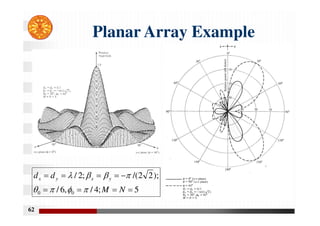
Planar Array Example
5
;
4
/
,
6
/
);
2
2
/(
;
2
/
0
0 








N
M
d
d y
x
y
x









Chapter Chapter Chapter Chapter Chapter 6.pdf

  • 1.
    1 Chapter 6 :Antenna Arrays • Introduction • Two-Element Array • N-element Linear Array: Uniform Amplitude and Spacing • N-element Linear Array: Directivity • N-element Linear Array: Uniform spacing, Non-uniform Amplitude • Planar Array
  • 2.
    2 Antenna Array: Introduction •Array is an assembly of antenna elements arranged in an orderly fashion. The elements are usually identical. • Why array? When high gain and/or narrow beam are required: – Single element -> Wide beam (low directivity) – Increasing size -> difficult to build and expensive – Useful especially when the element gain is low.
  • 3.
    3 Antenna Array: Introduction(2) • Advantages – Higher directivity – Narrower beam – Lower sidelobes – Electronic steerable beam • Types – Fix direction – Steerable : Mechanical or Electronic (phased arrays)
  • 4.
    4 Antenna Array: Introduction(3) • In an array of identical elements, there are in general five controls that can be used to shape the overall pattern of the antenna: 1. Geometrical configuration (linear, circular, etc.) 2. Relative displacement between elements 3. Excitation amplitude of individual elements 4. Excitation phase of individual elements 5. Relative pattern of individual elements
  • 5.
    The linked imagecannot be displayed. The file may have been moved, renamed, or deleted. Verify that the link points to the correct file and location. 5 Examples Very Large Antenna (VLA) Airborne Warning and Control System (AWACS)
  • 6.
    6 Two-element Array • Considertwo-element array of horizontal infinitesimal dipoles (assume no coupling between elements) Far-field observation Two infinitesimal dipoles
  • 7.
    7 Two-element Array (2)    cos 4 ˆ 0 r e l I jk jkr   E Recall the far-zone electric field of horizontal infinitesimal dipole in the y-z plane               2 2 2 1 1 1 2 1 cos 4 cos 4 ˆ 2 1       r e I r e I l jk jkr jkr E E E Thus the total electric field becomes:
  • 8.
    8 Two-Element Array (3)  cos 2 1 d r r   cos 2 2 d r r   r r r   2 1 Using the far-field approximation   2 / cos 2 2 / cos 1 4 cos ˆ       jkd jkd jkr e I e I r e l jk     E The total field becomes: ) 2 cos 2 cos( 2 4 cos ˆ 0          d k r e l I jk jkr E difference phase : , ; If 2 / 0 2 2 / 0 1    j j e I I e I I    ) factor(AF) (array factor) (element field total  
  • 9.
  • 10.
    10 Electric Field Pattern(2) 4 / , 2 /      d
  • 11.
    11 Electric Field Pattern(2) 4 / , 2 /       d
  • 12.
    12 Quiz • Find thefar-zone electric field of a two- element array of infinitesimal circular loops. Assume that the loops are parallel to the x-y plane and the two elements are aligned along the z axis. • (i) I1=I0, I2=I0, d = λ λ λ λ/4 • (ii) I1=I0, I2=I0, d = λ λ λ λ/2 • (iii) I1=I0, I2=-I0, d = λ λ λ λ/2 • (iv) I1=I0, I2=jI0, d = λ λ λ λ/2
  • 13.
    13 N-element Linear Array:Uniform amplitude & spacing                          cos where 1 AF 1 ) 1 ( ) cos )( 1 ( ) cos ( 2 ) cos ( kd e e e e N n n j kd N j kd j kd j L If the amplitude and spacing are both uniform, the array factor becomes
  • 14.
    14 N-element Linear Array:Uniform amplitude & spacing (2) 2 sin 2 sin 1 1 AF 2 1 2 2 2 2 2 1                            N e e e e e e e e N j j j N j N j N j j jN thus If the reference point is the physical center of the array 2 2 sin 2 sin 2 sin AF small :                    N N
  • 15.
    15 N-element Linear Array:Uniform amplitude & spacing (3)                            2 sinc 2 2 sin 2 sin 2 sin (AF) small : n N N N N N K K , 3 , 2 , ; , 3 , 2 , 1 2 2 cos 2 0 2 sin 1 N N N n n N n d n N N n n                                         Normalized AF Nulls   K , 2 , 1 , 0 2 2 cos 2 1                m m d m m m          Maxima
  • 16.
  • 17.
    17 Sinc function plot 05 10 15 0 0.1 0.2 0.3 0.4 0.5 0.6 0.7 0.8 0.9 1 |sin(x)/x|
  • 18.
    18 N-element Linear Array:Uniform amplitude & spacing (4)                                              N d N d N N h h 782 . 2 2 sin 2 782 . 2 2 cos 391 . 1 2 2 1 2 sin 2 sin 1 1              HPBW (symmetrical case) 3-dB point Secondary Maxima h m h      2 K , 3 , 2 , 1 ; 1 2 2 cos 2 1 2 2 1 2 sin 1                                  s N s d s N N s s s            
  • 19.
    19 N-element Linear Array:Uniform amplitude & spacing (5) First sidelobe                              N d N s s 3 2 cos 2 3 2 1 dB 46 . 13 212 . 0 3 2 2 2 sin (AF) 1 , n                               s s N N First sidelobe level
  • 20.
    20 Example #2 #1 #3 d d z y 0 2 I I   2 / 0 1  j e I I  0 3 I I  A 3-element array of isotropic sources has the phase and amplitude relationships shown. The spacing between elements is d=λ/2. (a)Find the array factor. (b)Find all the nulls.
  • 21.
    21 Broadside Array 0 cos 2 /           kd 4 / , 10    d N
  • 22.
  • 23.
  • 24.
  • 25.
    25 Ordinary End-fire Array kd kd kd               cos 4 / 10    d N kd kd kd               0 cos
  • 26.
    26 Ordinary End-fire Array(2) 4 / , 10    d N
  • 27.
    27 Grating Lobes •If d=λ/2,end-fire radiation exists simultaneously in both directions. •If d = nλ, also broad-side radiation. •To avoid grating lobes, 2 max   d
  • 28.
  • 29.
  • 30.
    30 Phased (Scanning) Array 0 0cos cos cos 0          kd kd kd         4 / , 10    d N
  • 31.
    31 Phased (Scanning) Array(2)                                                  Nkd Nkd N kd d N kd d h 782 . 2 cos cos 782 . 2 cos cos 782 . 2 cos 2 cos 782 . 2 cos 2 cos 0 1 0 1 0 1 0 1         HPBW                      d L d L h     443 . 0 cos cos 443 . 0 cos cos 0 1 0 1 Since N = (L+d)/d, Not valid for end-fire arrays, i.e., θ0=0,π.
  • 32.
    32 Hansen-Woodyard End-fire Array 0 for 92 . 2 0                      N kd N kd                      0 for 92 . 2 N kd N kd                      | cos | | | ; | cos | | | ; 0 For 0 0 kd N kd Additional Conditions:                       0 0 | cos | | | ; | cos | | | ; For kd N kd which yields 4 4 1 large :   N N N d   
  • 33.
  • 34.
  • 35.
  • 36.
  • 37.
    37 N-Element Array: Directivity •Broadside Array        cos ; 2 2 sin 2 sin 2 sin (AF) small : n kd N N N N                       cos 2 ; ) sin( 2 cos cos 2 sin ) AF ( ) , ( 2 2 2 kd N Z Z Z kd N kd N U n                             Recall that AF for broadside arrays is given by The radiation intensity then becomes: Clearly, the maximum Umax=1 at θ=π/2
  • 38.
    38 N-Element Array: Directivity(2) • Broadside Array (cont’d) The “average” radiation intensity can be obtained from Using                                         0 2 2 0 0 2 0 sin cos 2 ) cos 2 sin( 2 1 sin ) sin( 4 1 ) , ( 4 1 4 d kd N kd N d d Z Z d U P U rad    d kd N dZ kd N Z sin 2 ; cos 2                       2 / 2 / 2 / 2 / 2 2 0 ) sin( 1 ) sin( 1 Nkd Nkd Nkd Nkd dZ Z Z Nkd dZ Z Z Nkd U
  • 39.
    39 N-Element Array: Directivity(3) • Broadside Array (cont’d)                     dZ Z Z Nkd dZ Z Z Nkd U Nkd Nkd 2 2 / 2 / 2 0 ) sin( 1 ) sin( 1 For a large array (Nkd/2 -> large), The directivity is then given by   d N Nkd U U D 2 0 max 0                dZ Z Z 2 ) sin( Nkd U   0    L d d L d N D d L d N L 2 1 2 2 ) 1 ( 0              Using L=(N-1)d Since
  • 40.
    40 N-Element Array: Directivity(4) • Ordinary end-fire Array ) 1 (cos ; 2 2 sin 2 sin 2 sin (AF) small : n                        kd N N N N   ) 1 (cos 2 ; ) sin( 2 ) 1 (cos ) 1 (cos 2 sin ) AF ( ) , ( 2 2 2                                     kd N Z Z Z kd N kd N U n Recall that AF for ordinary end-fire arrays (θ=0) is given by The radiation intensity then becomes: Clearly, the maximum Umax=1 at θ=0
  • 41.
    41 N-Element Array: Directivity(5) • Ordinary end-fire Array (cont’d) The “average” radiation intensity can be obtained from Using                                           0 2 2 0 0 2 0 sin ) 1 (cos 2 )) 1 (cos 2 sin( 2 1 sin ) sin( 4 1 ) , ( 4 1 4 d kd N kd N d d Z Z d U P U rad    d kd N dZ kd N Z sin 2 ); 1 (cos 2                       Nkd Nkd dZ Z Z Nkd dZ Z Z Nkd U 0 0 2 2 0 ) sin( 1 ) sin( 1
  • 42.
    42 N-Element Array: Directivity(6) • Ordinary end-fire Array (cont’d)                  0 2 0 2 0 ) sin( 1 ) sin( 1 dZ Z Z Nkd dZ Z Z Nkd U Nkd For a large array (Nkd -> large), The directivity is then given by   d N Nkd U U D 4 2 0 max 0    Nkd U 2 0      L d d L d N D d L d N L 4 1 4 4 ) 1 ( 0              Using L=(N-1)d Thus
  • 43.
    43 N-Element Array: Directivity(7) • Hansen-Woodyard end-fire Array Nkd Nkd Nkd U 2 554 . 0 871 . 0 8515 . 1 2 2 2 1 2 0                      For a large array (Nkd -> large), The directivity is then given by            d N Nkd U U D 4 805 . 1 2 554 . 0 1 0 max 0                           L d d L D d L d N L 4 805 . 1 1 4 805 . 1 ) 1 ( 0 Using L=(N-1)d
  • 44.
  • 45.
    45 Example • Design an18-element uniform linear array with a spacing of λ λ λ λ/4 between elements. Assume that the array is aligned along the z-axis. a) Find the array factor for the broadside array case. b) Find the first null and sidelobe locations of a). c) Find the phase shift such that the maximum of the array factor is at θ0=45°. d) Find the first null and sidelobe locations of c).
  • 46.
    46 18-element AF (broadsidearray) 0 20 40 60 80 100 120 140 160 180 −50 −45 −40 −35 −30 −25 −20 −15 −10 −5 0 θ [Degree] |(AF) n | [dB] 18−element array factor (Broadside scan
  • 47.
    47 18-element AF (scanarray) 0 20 40 60 80 100 120 140 160 180 −50 −45 −40 −35 −30 −25 −20 −15 −10 −5 0 θ [Degree] |(AF) n | [dB] 18−element array factor
  • 48.
    48 Quiz Find the arrayfactor of the 3-element array of isotropic sources shown below. The spacing between elements is d=λ/4 and I1 = 1, I2 = -j2, I3= -1.
  • 49.
    49 N-element Array: Non-uniform amplitude,uniform spacing • Uniform amplitude -> High sidelobe • Two popular distributions: – Binomial (maximally flat) – Tschebysheff (equiripple) • HPBW: Uniform<Tschebysheff<Binomial • Sidelobe level: Binomial<Tschebysheff<Uniform
  • 50.
  • 51.
  • 52.
  • 53.
  • 54.
  • 55.
  • 56.
  • 57.
  • 58.
  • 59.
    59 Planar Array • LinearArray = one-dimensional array, i.e., can scan the beam only in one plane. • In order to be able to scan the beam in any direction, two-dimensional arrays are needed. Geometries can be planar, circle, cylindrical, spherical and so on.
  • 60.
  • 61.
    61 Array Factor      M m kd m j m x x e I 1 ) cos sin )( 1 ( 1 AF    yn xm kd n j M m kd m j m N n n S S e e I Iy y x x                 ) sin sin )( 1 ( 1 ) cos sin )( 1 ( 1 1 1 AF       y y y x x x y y x x kd kd N N M M                              sin sin ; cos sin ; 2 sin 2 sin 2 sin 2 sin (AF)n AF for each linear array along x-axis: AF for the entire planar array: For uniform excitation, i.e., |Im1I1n|=I0,
  • 62.
    62 Planar Array Example 5 ; 4 / , 6 / ); 2 2 /( ; 2 / 0 0         N M d d y x y x        