SEQUENCE AND SERIES
Introduction:
The succession of quantities each of which is formed
according to some definite rule or law is called a sequence.
In short, sequence is set of numbers arranged in a definite
order.
Progression : A sequence with a constant difference
or constant ratio between successive terms is called a
progression eg.
(i) 2, 4, 6, 8, .....................
(ii) 2, 4, 8, 16, ....................
There are three types of progression. These are as follows.
(i) Arithmetic progression. (A.P.)
(ii) Geometric progression. (G.P.)
(iii) Harmonic progression. (H.P.)
Series : A series is the algebraic sum of a sequence in
which each term is connected by plus or minus e.g.
(i) 1 + 2 + 3 + 4 + 5 +..................
(ii) 2 + 4 + 6 + 8 + ........................
(iii) 2 + 4 + 8 + 16 + ......................
(iv) 1 + + ....................
(v) 1 – + ....................
Kinds of series :
A series may be finite or infinite.
1. Finite series : A series with finite number of terms is
called finite series. In this case, the last term is definite and
can be determined.
For example : 2 + 4 + 6 +8 +10 + 12 is a finite series.
2. Infinite series: A series with infinite number of terms is
said to be an infinite series. In this case, the last term can
never be determined. For example : The series of natural
numbers
i.e. 1+ 2 + 3 + 4 +....... is infinite.
Arithmetic Progression
(Arithematic Sequence)
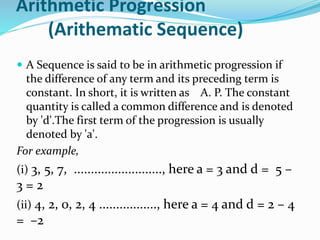
 A Sequence is said to be in arithmetic progression if
the difference of any term and its preceding term is
constant. In short, it is written as A. P. The constant
quantity is called a common difference and is denoted
by 'd'.The first term of the progression is usually
denoted by 'a'.
For example,
(i) 3, 5, 7, .........................., here a = 3 and d = 5 –
3 = 2
(ii) 4, 2, 0, 2, 4 ................., here a = 4 and d = 2 – 4
= –2
nth term of an A. P.
Let a be the first term and d be the common difference.
Then
The first term, t1 = a = a + (1 – 1) d
The second term, t2 = a + d = a + (2 – 1) d
The third term, t3 = a + 2d = a + (3 – 1) d
The fourth term, t4 = a + 3d = a + (4 –1) d
...................................................................
...................................................................
The nth term, tn = a + ( n –1) d
Sometimes, the nth term or last term is denoted by l
 tn = a + ( n –1) d
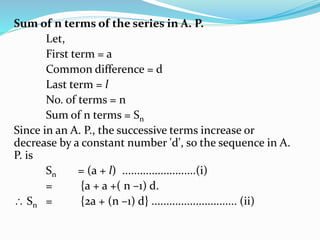
Sum of n terms of the series in A. P.
Let,
First term = a
Common difference = d
Last term = l
No. of terms = n
Sum of n terms = Sn
Since in an A. P., the successive terms increase or
decrease by a constant number 'd', so the sequence in A.
P. is
Sn = (a + l) .........................(i)
= {a + a +( n –1) d.
 Sn = {2a + (n –1) d} ............................. (ii)
Arithmetic mean
If three numbers are in A. P. Then the middle term is
called the arithmetic mean (A. M.) of the other two.
Let m be the A. M. between two quantities a and b, then
a, m, b are in A. P.
So, by the definition of A. P.
m – a = b – m
or, 2m = a + b
or, m = (a+b)/2
 A.M. = ( a+b)/2
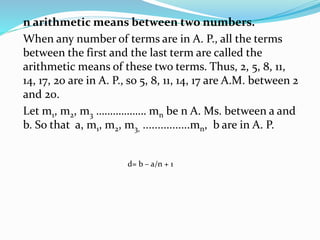
n arithmetic means between two numbers.
When any number of terms are in A. P., all the terms
between the first and the last term are called the
arithmetic means of these two terms. Thus, 2, 5, 8, 11,
14, 17, 20 are in A. P., so 5, 8, 11, 14, 17 are A.M. between 2
and 20.
Let m1, m2, m3 ……………… mn be n A. Ms. between a and
b. So that a, m1, m2, m3, ................mn, b are in A. P.
d= b – a/n + 1
A Useful Device
In A. P., we denote the terms as follows:
Three numbers in A. P. a – d, a , a + d
Four numbers in A. P. a – 3d, a – d, a + d, a + 3d
Five numbers in A. P. a – 2d, a – d, a , a + d, a + 2d
and so on.

Chapter 3 sequence and series

  • 1.
  • 2.
    Introduction: The succession ofquantities each of which is formed according to some definite rule or law is called a sequence. In short, sequence is set of numbers arranged in a definite order. Progression : A sequence with a constant difference or constant ratio between successive terms is called a progression eg. (i) 2, 4, 6, 8, ..................... (ii) 2, 4, 8, 16, .................... There are three types of progression. These are as follows. (i) Arithmetic progression. (A.P.) (ii) Geometric progression. (G.P.) (iii) Harmonic progression. (H.P.)
  • 3.
    Series : Aseries is the algebraic sum of a sequence in which each term is connected by plus or minus e.g. (i) 1 + 2 + 3 + 4 + 5 +.................. (ii) 2 + 4 + 6 + 8 + ........................ (iii) 2 + 4 + 8 + 16 + ...................... (iv) 1 + + .................... (v) 1 – + ....................
  • 4.
    Kinds of series: A series may be finite or infinite. 1. Finite series : A series with finite number of terms is called finite series. In this case, the last term is definite and can be determined. For example : 2 + 4 + 6 +8 +10 + 12 is a finite series. 2. Infinite series: A series with infinite number of terms is said to be an infinite series. In this case, the last term can never be determined. For example : The series of natural numbers i.e. 1+ 2 + 3 + 4 +....... is infinite.
  • 5.
    Arithmetic Progression (Arithematic Sequence) A Sequence is said to be in arithmetic progression if the difference of any term and its preceding term is constant. In short, it is written as A. P. The constant quantity is called a common difference and is denoted by 'd'.The first term of the progression is usually denoted by 'a'. For example, (i) 3, 5, 7, .........................., here a = 3 and d = 5 – 3 = 2 (ii) 4, 2, 0, 2, 4 ................., here a = 4 and d = 2 – 4 = –2
  • 6.
    nth term ofan A. P. Let a be the first term and d be the common difference. Then The first term, t1 = a = a + (1 – 1) d The second term, t2 = a + d = a + (2 – 1) d The third term, t3 = a + 2d = a + (3 – 1) d The fourth term, t4 = a + 3d = a + (4 –1) d ................................................................... ................................................................... The nth term, tn = a + ( n –1) d Sometimes, the nth term or last term is denoted by l  tn = a + ( n –1) d
  • 7.
    Sum of nterms of the series in A. P. Let, First term = a Common difference = d Last term = l No. of terms = n Sum of n terms = Sn Since in an A. P., the successive terms increase or decrease by a constant number 'd', so the sequence in A. P. is Sn = (a + l) .........................(i) = {a + a +( n –1) d.  Sn = {2a + (n –1) d} ............................. (ii)
  • 8.
    Arithmetic mean If threenumbers are in A. P. Then the middle term is called the arithmetic mean (A. M.) of the other two. Let m be the A. M. between two quantities a and b, then a, m, b are in A. P. So, by the definition of A. P. m – a = b – m or, 2m = a + b or, m = (a+b)/2  A.M. = ( a+b)/2
  • 9.
    n arithmetic meansbetween two numbers. When any number of terms are in A. P., all the terms between the first and the last term are called the arithmetic means of these two terms. Thus, 2, 5, 8, 11, 14, 17, 20 are in A. P., so 5, 8, 11, 14, 17 are A.M. between 2 and 20. Let m1, m2, m3 ……………… mn be n A. Ms. between a and b. So that a, m1, m2, m3, ................mn, b are in A. P. d= b – a/n + 1
  • 10.
    A Useful Device InA. P., we denote the terms as follows: Three numbers in A. P. a – d, a , a + d Four numbers in A. P. a – 3d, a – d, a + d, a + 3d Five numbers in A. P. a – 2d, a – d, a , a + d, a + 2d and so on.