LINEAR EQUATIONS
IN TWO VARIABLES
BY: DR. VIVEK NAITHANI
TGT MATHS
KENDRIYA VIDYALAYA SANGATHAN
Copyright Information: CC by SA 4.0
DEFINITION:
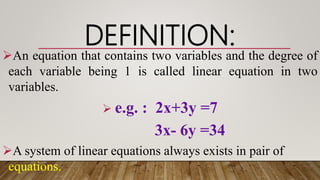
An equation that contains two variables and the degree of
each variable being 1 is called linear equation in two
variables.
 e.g. : 2x+3y =7
3x- 6y =34
A system of linear equations always exists in pair of
equations.
GENERAL LINEAR EQUATION IN TWO
VARIABLES
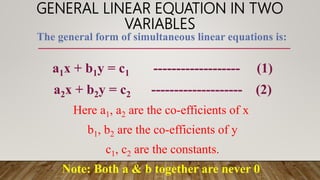
The general form of simultaneous linear equations is:
a1x + b1y = c1 ------------------- (1)
a2x + b2y = c2 -------------------- (2)
Here a1, a2 are the co-efficients of x
b1, b2 are the co-efficients of y
c1, c2 are the constants.
Note: Both a & b together are never 0
FRAMING A LINEAR EQUATION IN TWO
VARIABLES
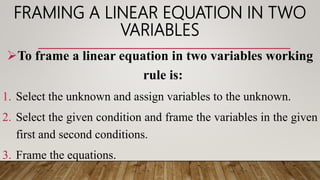
To frame a linear equation in two variables working
rule is:
1. Select the unknown and assign variables to the unknown.
2. Select the given condition and frame the variables in the given
first and second conditions.
3. Frame the equations.
EXAMPLE:
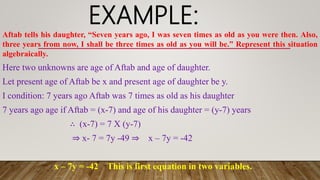
Aftab tells his daughter, ā€œSeven years ago, I was seven times as old as you were then. Also,
three years from now, I shall be three times as old as you will be.ā€ Represent this situation
algebraically.
Here two unknowns are age of Aftab and age of daughter.
Let present age of Aftab be x and present age of daughter be y.
I condition: 7 years ago Aftab was 7 times as old as his daughter
7 years ago age if Aftab = (x-7) and age of his daughter = (y-7) years
∓ (x-7) = 7 X (y-7)
⇒ x- 7 = 7y -49 ⇒ x – 7y = -42
x – 7y = -42 This is first equation in two variables.
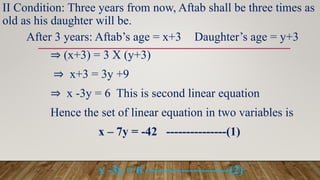
II Condition: Three years from now, Aftab shall be three times as
old as his daughter will be.
After 3 years: Aftab’s age = x+3 Daughter’s age = y+3
⇒ (x+3) = 3 X (y+3)
⇒ x+3 = 3y +9
⇒ x -3y = 6 This is second linear equation
Hence the set of linear equation in two variables is
x – 7y = -42 ---------------(1)
x -3y = 6 ---------------------(2)
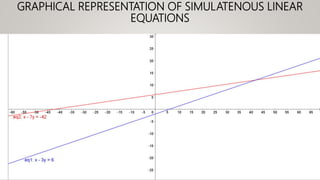
GRAPHICAL REPRESENTATION OF SIMULATENOUS LINEAR
EQUATIONS
• A pair of simultaneous linear equation represents a pair of straight lines on a graph sheet.
CRITERIA OF CONSISTENCY OF SOLUTION OF
SIMULTANEOUS LINEAR EQUATIONS
For a given set of pair of linear equations in two variables:
a1x + b1y = c1 ------------------- (1)
a2x + b2y = c2 -------------------- (2)
The following cases arise as solution of the given set of
equations:
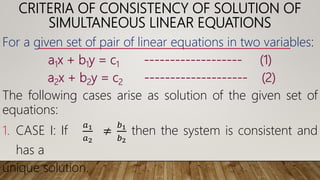
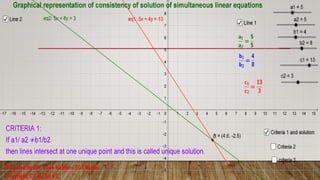
1. CASE I: If
š‘Ž1
š‘Ž2
≠
š‘1
š‘2
then the system is consistent and
has a
unique solution.
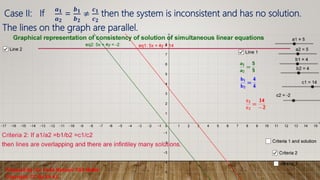
Case II: If
š’‚šŸ
š’‚šŸ
=
š’ƒšŸ
š’ƒšŸ
≠
š’„šŸ
š’„šŸ
then the system is inconsistent and has no solution.
The lines on the graph are parallel.
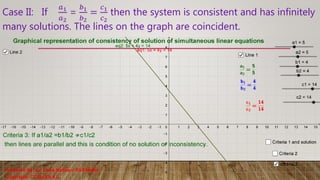
Case II: If
š‘Ž1
š‘Ž2
=
š‘1
š‘2
=
š‘1
š‘2
then the system is consistent and has infinitely
many solutions. The lines on the graph are coincident.
ALGEBRAIC SOLUTION OF SIMULATNEOUS
LINEAR EQUATIONS
The following methods are being used to solve simultaneous linear equations
algebraically:
1.Elimination Method.
2.Substitution Method.
3.Cross multiplication method.
ELIMINATION METHOD:
In this method we eliminate one of the two variables to achieve the
desired results
Solve the equations 2x+y = 5 and 3x+2y =8.
2x+y = 5 --------(1) X 3 [ Here we multiply the equations with the suitable non-zero
3x+2y = 8 -------(II) X 2 constants to make co-efficients of the variable to be
eliminated equal.]
So our equations become 6x +3y = 15 {Here we are eliminating x and now
6x +4y = 16 subtracting the new equations we get}
-y = -1 ⇒ y = 1
Substituting y =1 in any of the equations (Here we are substituting in eqn. 1) we get 2x
+1= 5
⇒ 2x = 4 ⇒ x= 2.
SUBSTITUTION METHOD:
STEP 1: In this method we first choose an equation and then express
any one of the two variables in terms of the other.
STEP 2: Then we substitute the function obtained in step 1 in the another
equation.
STEP 3: Now we get an equation in a single variable which on solving will
give value of one variable.
STEP 4: The value obtained in step 3 will be substituted in the another
equation to get the value of another variable.
EXAMPLE
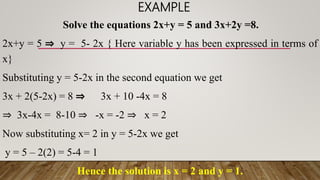
Solve the equations 2x+y = 5 and 3x+2y =8.
2x+y = 5 ⇒ y = 5- 2x { Here variable y has been expressed in terms of
x}
Substituting y = 5-2x in the second equation we get
3x + 2(5-2x) = 8 ⇒ 3x + 10 -4x = 8
⇒ 3x-4x = 8-10 ⇒ -x = -2 ⇒ x = 2
Now substituting x= 2 in y = 5-2x we get
y = 5 – 2(2) = 5-4 = 1
Hence the solution is x = 2 and y = 1.
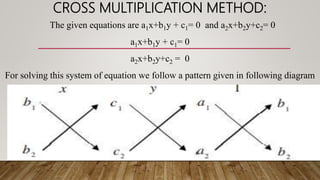
CROSS MULTIPLICATION METHOD:
The given equations are a1x+b1y + c1= 0 and a2x+b2y+c2= 0
a1x+b1y + c1= 0
a2x+b2y+c2 = 0
For solving this system of equation we follow a pattern given in following diagram
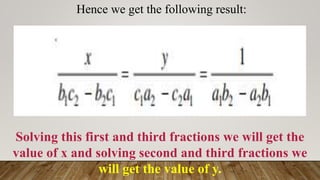
Hence we get the following result:
Solving this first and third fractions we will get the
value of x and solving second and third fractions we
will get the value of y.
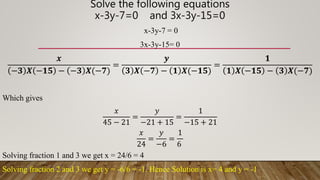
Solve the following equations
x-3y-7=0 and 3x-3y-15=0
x-3y-7 = 0
3x-3y-15= 0
š’™
āˆ’šŸ‘ š‘æ āˆ’šŸšŸ“ āˆ’ āˆ’šŸ‘ š‘æ(āˆ’šŸ•)
=
š’š
šŸ‘ š‘æ āˆ’šŸ• āˆ’ šŸ š‘æ(āˆ’šŸšŸ“)
=
šŸ
šŸ š‘æ āˆ’šŸšŸ“ āˆ’ šŸ‘ š‘æ(āˆ’šŸ•)
Which gives
š‘„
45 āˆ’ 21
=
š‘¦
āˆ’21 + 15
=
1
āˆ’15 + 21
š‘„
24
=
š‘¦
āˆ’6
=
1
6
Solving fraction 1 and 3 we get x = 24/6 = 4
Solving fraction 2 and 3 we get y = -6/6 = -1. Hence Solution is x= 4 and y = -1
Linear equations in two variables

Linear equations in two variables

  • 1.
    LINEAR EQUATIONS IN TWOVARIABLES BY: DR. VIVEK NAITHANI TGT MATHS KENDRIYA VIDYALAYA SANGATHAN Copyright Information: CC by SA 4.0
  • 2.
    DEFINITION: An equation thatcontains two variables and the degree of each variable being 1 is called linear equation in two variables.  e.g. : 2x+3y =7 3x- 6y =34 A system of linear equations always exists in pair of equations.
  • 3.
    GENERAL LINEAR EQUATIONIN TWO VARIABLES The general form of simultaneous linear equations is: a1x + b1y = c1 ------------------- (1) a2x + b2y = c2 -------------------- (2) Here a1, a2 are the co-efficients of x b1, b2 are the co-efficients of y c1, c2 are the constants. Note: Both a & b together are never 0
  • 4.
    FRAMING A LINEAREQUATION IN TWO VARIABLES To frame a linear equation in two variables working rule is: 1. Select the unknown and assign variables to the unknown. 2. Select the given condition and frame the variables in the given first and second conditions. 3. Frame the equations.
  • 5.
    EXAMPLE: Aftab tells hisdaughter, ā€œSeven years ago, I was seven times as old as you were then. Also, three years from now, I shall be three times as old as you will be.ā€ Represent this situation algebraically. Here two unknowns are age of Aftab and age of daughter. Let present age of Aftab be x and present age of daughter be y. I condition: 7 years ago Aftab was 7 times as old as his daughter 7 years ago age if Aftab = (x-7) and age of his daughter = (y-7) years ∓ (x-7) = 7 X (y-7) ⇒ x- 7 = 7y -49 ⇒ x – 7y = -42 x – 7y = -42 This is first equation in two variables.
  • 6.
    II Condition: Threeyears from now, Aftab shall be three times as old as his daughter will be. After 3 years: Aftab’s age = x+3 Daughter’s age = y+3 ⇒ (x+3) = 3 X (y+3) ⇒ x+3 = 3y +9 ⇒ x -3y = 6 This is second linear equation Hence the set of linear equation in two variables is x – 7y = -42 ---------------(1) x -3y = 6 ---------------------(2)
  • 7.
    GRAPHICAL REPRESENTATION OFSIMULATENOUS LINEAR EQUATIONS • A pair of simultaneous linear equation represents a pair of straight lines on a graph sheet.
  • 8.
    CRITERIA OF CONSISTENCYOF SOLUTION OF SIMULTANEOUS LINEAR EQUATIONS For a given set of pair of linear equations in two variables: a1x + b1y = c1 ------------------- (1) a2x + b2y = c2 -------------------- (2) The following cases arise as solution of the given set of equations: 1. CASE I: If š‘Ž1 š‘Ž2 ≠ š‘1 š‘2 then the system is consistent and has a unique solution.
  • 10.
    Case II: If š’‚šŸ š’‚šŸ = š’ƒšŸ š’ƒšŸ ≠ š’„šŸ š’„šŸ thenthe system is inconsistent and has no solution. The lines on the graph are parallel.
  • 11.
    Case II: If š‘Ž1 š‘Ž2 = š‘1 š‘2 = š‘1 š‘2 thenthe system is consistent and has infinitely many solutions. The lines on the graph are coincident.
  • 12.
    ALGEBRAIC SOLUTION OFSIMULATNEOUS LINEAR EQUATIONS The following methods are being used to solve simultaneous linear equations algebraically: 1.Elimination Method. 2.Substitution Method. 3.Cross multiplication method.
  • 13.
    ELIMINATION METHOD: In thismethod we eliminate one of the two variables to achieve the desired results Solve the equations 2x+y = 5 and 3x+2y =8. 2x+y = 5 --------(1) X 3 [ Here we multiply the equations with the suitable non-zero 3x+2y = 8 -------(II) X 2 constants to make co-efficients of the variable to be eliminated equal.] So our equations become 6x +3y = 15 {Here we are eliminating x and now 6x +4y = 16 subtracting the new equations we get} -y = -1 ⇒ y = 1 Substituting y =1 in any of the equations (Here we are substituting in eqn. 1) we get 2x +1= 5 ⇒ 2x = 4 ⇒ x= 2.
  • 14.
    SUBSTITUTION METHOD: STEP 1:In this method we first choose an equation and then express any one of the two variables in terms of the other. STEP 2: Then we substitute the function obtained in step 1 in the another equation. STEP 3: Now we get an equation in a single variable which on solving will give value of one variable. STEP 4: The value obtained in step 3 will be substituted in the another equation to get the value of another variable.
  • 15.
    EXAMPLE Solve the equations2x+y = 5 and 3x+2y =8. 2x+y = 5 ⇒ y = 5- 2x { Here variable y has been expressed in terms of x} Substituting y = 5-2x in the second equation we get 3x + 2(5-2x) = 8 ⇒ 3x + 10 -4x = 8 ⇒ 3x-4x = 8-10 ⇒ -x = -2 ⇒ x = 2 Now substituting x= 2 in y = 5-2x we get y = 5 – 2(2) = 5-4 = 1 Hence the solution is x = 2 and y = 1.
  • 16.
    CROSS MULTIPLICATION METHOD: Thegiven equations are a1x+b1y + c1= 0 and a2x+b2y+c2= 0 a1x+b1y + c1= 0 a2x+b2y+c2 = 0 For solving this system of equation we follow a pattern given in following diagram
  • 17.
    Hence we getthe following result: Solving this first and third fractions we will get the value of x and solving second and third fractions we will get the value of y.
  • 18.
    Solve the followingequations x-3y-7=0 and 3x-3y-15=0 x-3y-7 = 0 3x-3y-15= 0 š’™ āˆ’šŸ‘ š‘æ āˆ’šŸšŸ“ āˆ’ āˆ’šŸ‘ š‘æ(āˆ’šŸ•) = š’š šŸ‘ š‘æ āˆ’šŸ• āˆ’ šŸ š‘æ(āˆ’šŸšŸ“) = šŸ šŸ š‘æ āˆ’šŸšŸ“ āˆ’ šŸ‘ š‘æ(āˆ’šŸ•) Which gives š‘„ 45 āˆ’ 21 = š‘¦ āˆ’21 + 15 = 1 āˆ’15 + 21 š‘„ 24 = š‘¦ āˆ’6 = 1 6 Solving fraction 1 and 3 we get x = 24/6 = 4 Solving fraction 2 and 3 we get y = -6/6 = -1. Hence Solution is x= 4 and y = -1