Area and Volume

This presentation is about drawing to the
scale, measuring area and volume of the
object and to understand why it is
important.

In order to understand this lesson, students need
to be aware of the units like metres and
centimetres and they should also know how to
convert them. They must also understand how to
multiply and divide, as well as having access to a
calculator, pencil and compass.
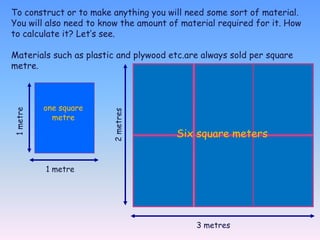
To construct or to make anything you will need some sort of material.
You will also need to know the amount of material required for it. How
to calculate it? Let’s see.

Materials such as plastic and plywood etc.are always sold per square
metre.


          one square
1 metre


            metre       2 metres
                                       Six square meters


          1 metre


                                            3 metres
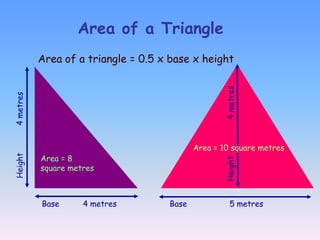
Area of a Triangle
           Area of a triangle = 0.5 x base x height


                                                   4 metres
4 metres


                                            Area = 10 square metres
           Area = 8
Height


                                                   Height
           square metres


           Base      4 metres        Base             5 metres
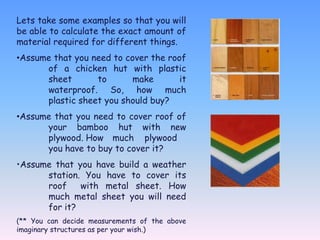
Lets take some examples so that you will
be able to calculate the exact amount of
material required for different things.
•Assume that you need to cover the roof
      of a chicken hut with plastic
      sheet       to       make       it
      waterproof. So, how much
      plastic sheet you should buy?
•Assume that you need to cover roof of
      your bamboo hut with new
      plywood. How much plywood
      you have to buy to cover it?
•Assume that you have build a weather
      station. You have to cover its
      roof    with metal sheet. How
      much metal sheet you will need
      for it?
(** You can decide measurements of the above
imaginary structures as per your wish.)
Activity
You are asked to paint all the four sides of a bamboo hut
and a weather station.


•How many pots of paint you will need?
•How much will it cost to paint both the things?


 ** 1 pot of paint
 paints 2 square
 metres

                                         ** Price of the paint
                                         is Rs. 50 per pot
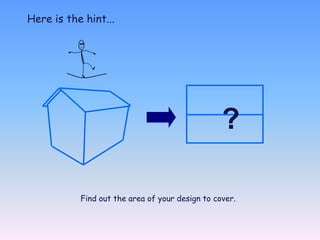
Here is the hint...


                                                 ?

           Find out the area of your design to cover.
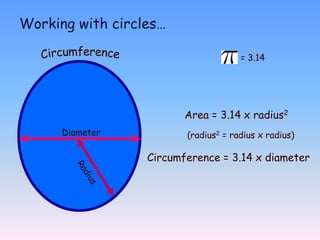
Working with circles…

                                      = 3.14


                         Area = 3.14 x radius2
      Diameter           (radius2 = radius x radius)

                  Circumference = 3.14 x diameter
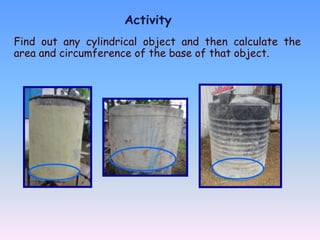
Activity
Find out any cylindrical object and then calculate the
area and circumference of the base of that object.
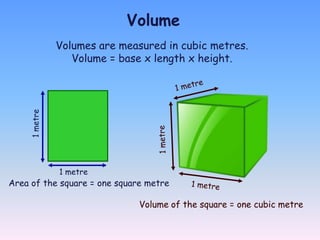
Volume
              Volumes are measured in cubic metres.
                 Volume = base x length x height.
    1 metre


              1 metre
Area of the square = one square metre

                              Volume of the square = one cubic metre
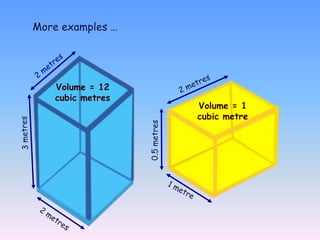
More examples …


   Volume = 12
   cubic metres
                               Volume = 1
                               cubic metre


                  0.5 metres
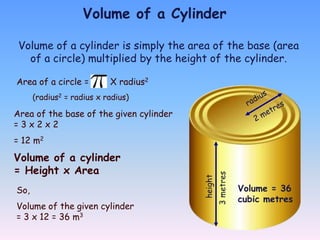
Volume of a Cylinder

 Volume of a cylinder is simply the area of the base (area
   of a circle) multiplied by the height of the cylinder.

Area of a circle =         X radius2
      (radius2 = radius x radius)

Area of the base of the given cylinder
=3x2x2
= 12 m2
Volume of a cylinder
= Height x Area


                                                  3 metres
                                         height
So,                                                          Volume = 36
                                                             cubic metres
Volume of the given cylinder
= 3 x 12 = 36 m3
Volume is useful, particularly when finding out how much
water or liquid a tank can hold. This would also be useful
when seeing how much food could be packed into crates,
or how much liquid a bottle can hold.

Activity
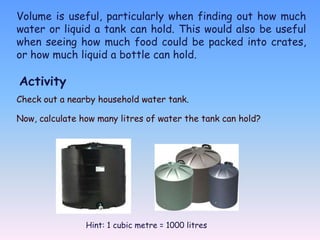
Check out a nearby household water tank.

Now, calculate how many litres of water the tank can hold?


                Hint: 1 cubic metre = 1000 litres

Area and Volume

  • 1.
    Area and Volume Thispresentation is about drawing to the scale, measuring area and volume of the object and to understand why it is important. In order to understand this lesson, students need to be aware of the units like metres and centimetres and they should also know how to convert them. They must also understand how to multiply and divide, as well as having access to a calculator, pencil and compass.
  • 2.
    To construct orto make anything you will need some sort of material. You will also need to know the amount of material required for it. How to calculate it? Let’s see. Materials such as plastic and plywood etc.are always sold per square metre. one square 1 metre metre 2 metres Six square meters 1 metre 3 metres
  • 3.
    Area of aTriangle Area of a triangle = 0.5 x base x height 4 metres 4 metres Area = 10 square metres Area = 8 Height Height square metres Base 4 metres Base 5 metres
  • 4.
    Lets take someexamples so that you will be able to calculate the exact amount of material required for different things. •Assume that you need to cover the roof of a chicken hut with plastic sheet to make it waterproof. So, how much plastic sheet you should buy? •Assume that you need to cover roof of your bamboo hut with new plywood. How much plywood you have to buy to cover it? •Assume that you have build a weather station. You have to cover its roof with metal sheet. How much metal sheet you will need for it? (** You can decide measurements of the above imaginary structures as per your wish.)
  • 5.
    Activity You are askedto paint all the four sides of a bamboo hut and a weather station. •How many pots of paint you will need? •How much will it cost to paint both the things? ** 1 pot of paint paints 2 square metres ** Price of the paint is Rs. 50 per pot
  • 6.
    Here is thehint... ? Find out the area of your design to cover.
  • 7.
    Working with circles… = 3.14 Area = 3.14 x radius2 Diameter (radius2 = radius x radius) Circumference = 3.14 x diameter
  • 8.
    Activity Find out anycylindrical object and then calculate the area and circumference of the base of that object.
  • 9.
    Volume Volumes are measured in cubic metres. Volume = base x length x height. 1 metre 1 metre Area of the square = one square metre Volume of the square = one cubic metre
  • 10.
    More examples … Volume = 12 cubic metres Volume = 1 cubic metre 0.5 metres
  • 11.
    Volume of aCylinder Volume of a cylinder is simply the area of the base (area of a circle) multiplied by the height of the cylinder. Area of a circle = X radius2 (radius2 = radius x radius) Area of the base of the given cylinder =3x2x2 = 12 m2 Volume of a cylinder = Height x Area 3 metres height So, Volume = 36 cubic metres Volume of the given cylinder = 3 x 12 = 36 m3
  • 12.
    Volume is useful,particularly when finding out how much water or liquid a tank can hold. This would also be useful when seeing how much food could be packed into crates, or how much liquid a bottle can hold. Activity Check out a nearby household water tank. Now, calculate how many litres of water the tank can hold? Hint: 1 cubic metre = 1000 litres