Letting go...
                                                on design in a time of disruption


http://creativecommons.org/licenses/by/2.0     http://www.flickr.com/photos/basheertome/5557362895
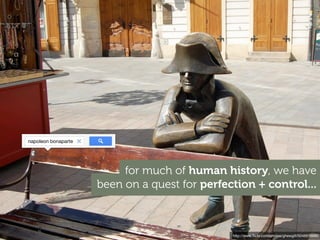
napoleon bonaparte


                          for much of human history, we have
                     been on a quest for perfection + control...


                                               http://www.flickr.com/photos/ghewgill/5046616680
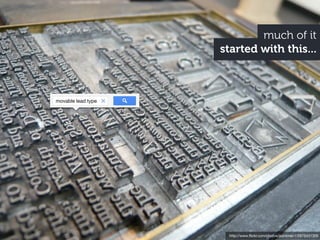
much of it
                    started with this...


movable lead type


                     http://www.flickr.com/photos/purdman1/2875431305
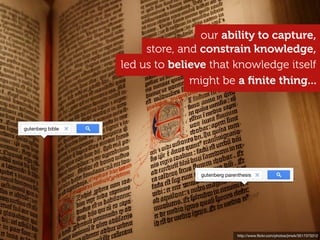
our ability to capture,
                       store, and constrain knowledge,
                  led us to believe that knowledge itself
                                might be a finite thing...


gutenberg bible


                                  gutenberg parenthesis


                                                 http://www.flickr.com/photos/jmwk/3517373312
...that if we experimented
    long enough, we could discover
"the truth" about all sorts of things...


                    http://www.flickr.com/photos/smithsonian/4127624763
iso certified

                        ...and "the best way"
               to do just about everything...


                            http://www.flickr.com/photos/bigbirdz/4507266406
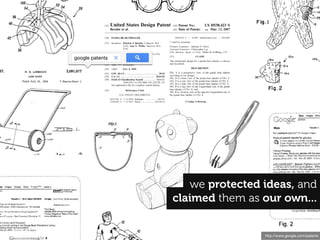
google patents


                    we protected ideas, and
                 claimed them as our own...


                                 http://www.google.com/patents
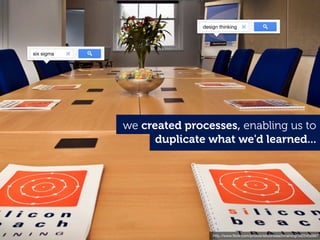
design thinking


six sigma


            we created processes, enabling us to
                  duplicate what we'd learned...


                              http://www.flickr.com/photos/siliconbeachtraining/3925458997
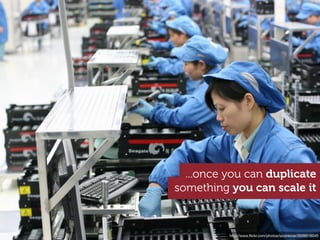
industrialisation, automation and
                  globalisation further amplified this...


chongqing china


                                       http://www.flickr.com/photos/fungleo/4771589650
...once you can duplicate
something you can scale it


          http://www.flickr.com/photos/scobleizer/3009516045
...and if you can scale it,
   you can make money


       http://www.flickr.com/photos/daverugby83/4478007023
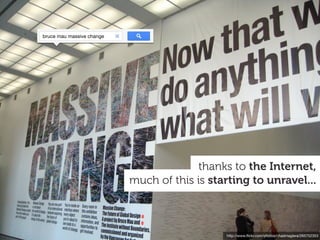
bruce mau massive change


                                         thanks to the Internet,
                           much of this is starting to unravel...


                                              http://www.flickr.com/photos/chadmagiera/265752353
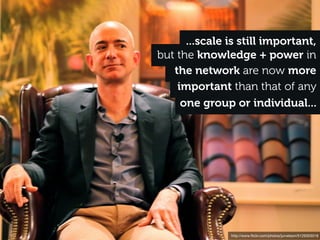
...scale is still important,
but the knowledge + power in
   the network are now more
    important than that of any
     one group or individual...


               http://www.flickr.com/photos/jurvetson/5129303018
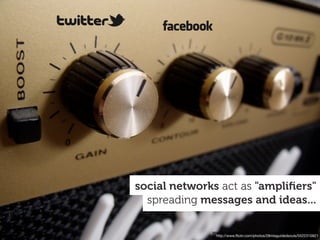
social networks act as "amplifiers"
  spreading messages and ideas...

               http://www.flickr.com/photos/28misguidedsouls/5522310921
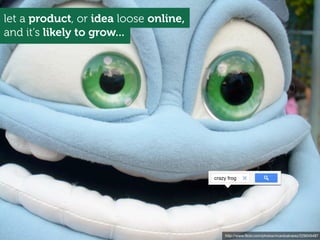
let a product, or idea loose online,
and it's likely to grow...


                                       crazy frog


                                           http://www.flickr.com/photos/ricardoalvarez/229045487
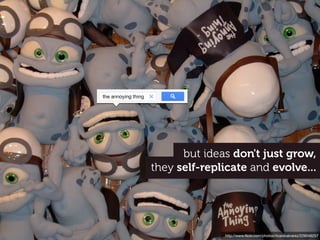
the annoying thing


                           but ideas don't just grow,
                     they self-replicate and evolve...


                                   http://www.flickr.com/photos/ricardoalvarez/229046257
swine flu mexico


                      often at a pace and intensity that
                  is normally associated with viruses...

                                        http://www.flickr.com/photos/eneas/3479302322
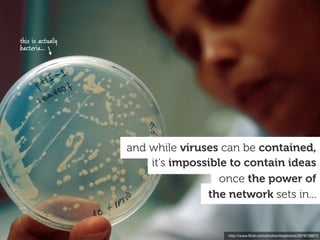
this is actually
bacteria...


                   and while viruses can be contained,
                       it's impossible to contain ideas
                                     once the power of
                                  the network sets in...


                                      http://www.flickr.com/photos/ricephotos/2679758872
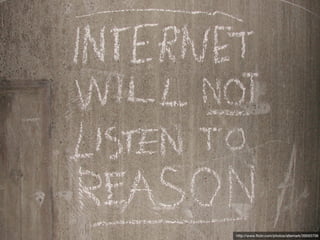
http://www.flickr.com/photos/altemark/39593706
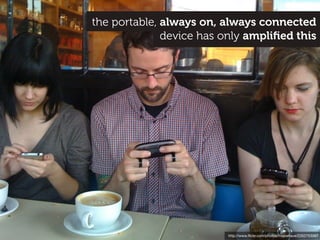
the portable, always on, always connected
              device has only amplified this


                          http://www.flickr.com/photos/misbehave/2352753067
combine all these things and
you have the perfect storm...


                                http://www.flickr.com/photos/nebraskasc/3659328702
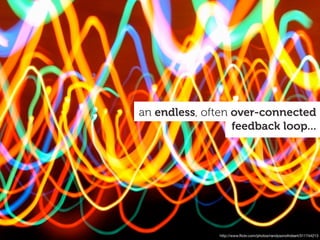
an endless, often over-connected
                  feedback loop...


               http://www.flickr.com/photos/randysonofrobert/311744213
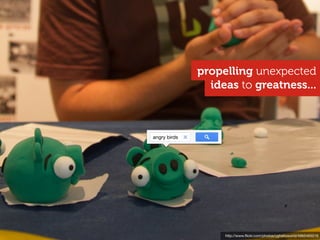
propelling unexpected
                ideas to greatness...


angry birds


                   http://www.flickr.com/photos/yghelloworld/4965465016
http://www.youtube.com/watch?v=7IcVyvg2Qlo


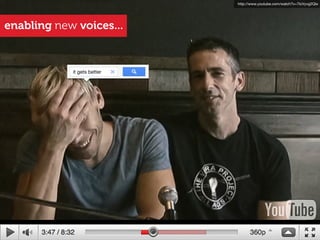
enabling new voices...


            it gets better
egyptian revolution


...accelerating change


                                      http://www.flickr.com/photos/ahmadhammoudphotography/5410375058
market crash 2011


economic crisis 2008
                                      ...or causing chaos
                                         on a global scale


                                           http://www.flickr.com/photos/mccun934/2899155411
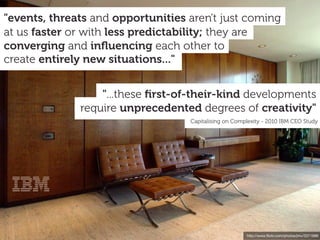
"events, threats and opportunities aren't just coming
at us faster or with less predictability; they are
converging and influencing each other to
create entirely new situations..."


                  "...these first-of-their-kind developments
              require unprecedented degrees of creativity"
                                   Capitalising on Complexity - 2010 IBM CEO Study


                                                       http://www.flickr.com/photos/jmv/3371886
and...
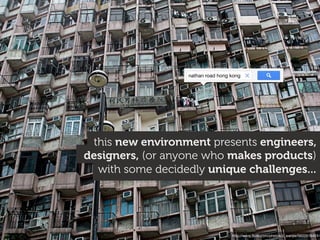
nathan road hong kong


 this new environment presents engineers,
designers, (or anyone who makes products)
  with some decidedly unique challenges...


                                   http://www.flickr.com/photos/z_wenjie/5602616401
the balance of power
is shifting...


           always connected
                              always on


                                          http://www.flickr.com/photos/jenny-pics/5661879987
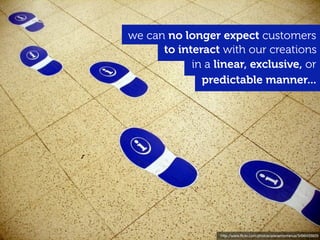
we can no longer expect customers
      to interact with our creations
            in a linear, exclusive, or
              predictable manner...


                  http://www.flickr.com/photos/arenamontanus/3496433929
users no longer have to wait for us
   to create experiences for them...


                    http://www.flickr.com/photos/ncanup/3526550845
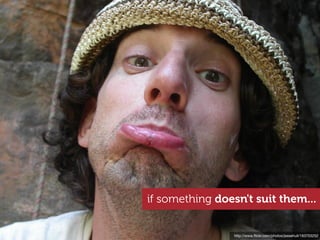
if something doesn't suit them...


                http://www.flickr.com/photos/jessehull/163703252
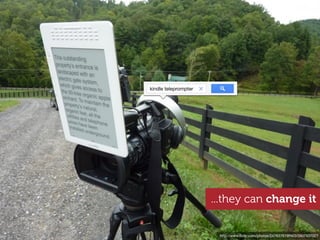
kindle teleprompter


                      ...they can change it


                       http://www.flickr.com/photos/24763767@N03/3907937027
flipboard


readability


              instapaper


                                      ...improve it


                            http://www.flickr.com/photos/johanl/4818276266
...enhance it


http://www.flickr.com/photos/bramus/5222185714
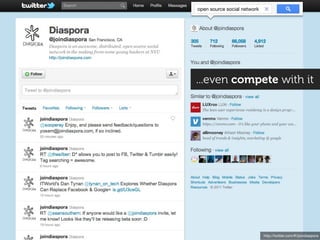
open source social network


...even compete with it.


                             http://twitter.com/#!/joindiaspora
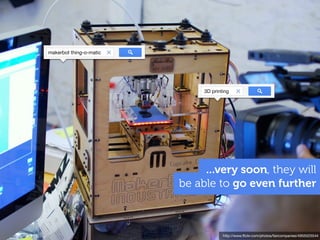
makerbot thing-o-matic


                              3D printing


                              ...very soon, they will
                         be able to go even further


                                      http://www.flickr.com/photos/faircompanies/4955025544
...this is not
necessarily a bad thing


       http://www.flickr.com/photos/salty_soul/4737350118
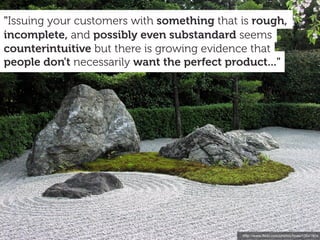
"Issuing your customers with something that is rough,
incomplete, and possibly even substandard seems
counterintuitive but there is growing evidence that
people don't necessarily want the perfect product..."


                                            http://www.flickr.com/photos/tiseb/13541804
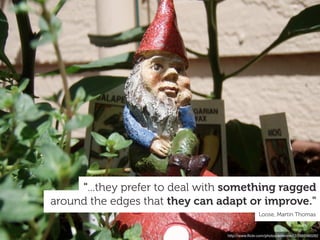
"...they prefer to deal with something ragged
around the edges that they can adapt or improve."
                                                 Loose, Martin Thomas


                                 http://www.flickr.com/photos/emerson12/2682480262
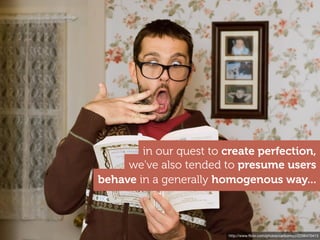
in our quest to create perfection,
     we've also tended to presume users
behave in a generally homogenous way...


                         http://www.flickr.com/photos/carbonnyc/2206470413
...but this is increasingly
        far from the truth

       http://www.flickr.com/photos/pagedooley/3832910201
so...
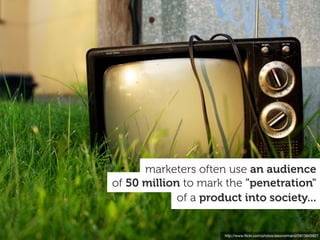
marketers often use an audience
of 50 million to mark the "penetration"
             of a product into society...


                      http://www.flickr.com/photos/alexnormand/5913845927
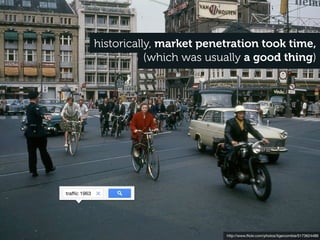
historically, market penetration took time,
                         (which was usually a good thing)


traffic 1963


                                       http://www.flickr.com/photos/tigerzombie/5173624489
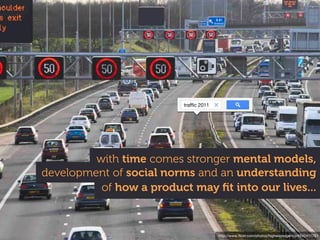
traffic 2011


         with time comes stronger mental models,
development of social norms and an understanding
          of how a product may fit into our lives...


                                        http://www.flickr.com/photos/highwaysagency/4542411761
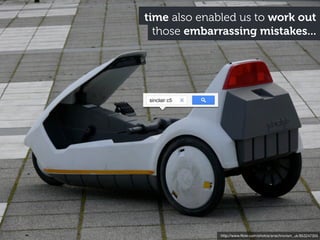
time also enabled us to work out
  those embarrassing mistakes...


sinclair c5


              http://www.flickr.com/photos/anachronism_uk/853247355
for better or worse
         time is now a luxury...


                      http://www.flickr.com/photos/vvvracer/4436798901
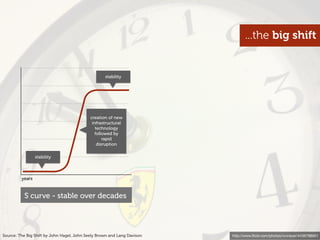
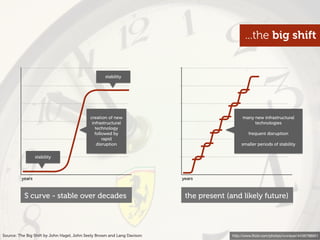
...the big shift


                                                   stability


                                            creation of new
                                             infrastructural
                                               technology
                                               followed by
                                                   rapid
                                                disruption

                 stability


         years


          S curve - stable over decades


Source: The Big Shift by John Hagel, John Seely Brown and Lang Davison   http://www.flickr.com/photos/vvvracer/4436798901
...the big shift


                                                   stability


                                            creation of new                                  many new infrastructural
                                             infrastructural                                      technologies
                                               technology
                                               followed by                                      frequent disruption
                                                   rapid
                                                disruption                                   smaller periods of stability

                 stability


         years                                                           years


          S curve - stable over decades                                   the present (and likely future)


Source: The Big Shift by John Hagel, John Seely Brown and Lang Davison                  http://www.flickr.com/photos/vvvracer/4436798901
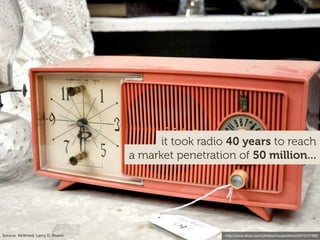
it took radio 40 years to reach
                                  a market penetration of 50 million...


Source: ReWired, Larry D. Rosen                      http://www.flickr.com/photos/houseofsims/5510707992
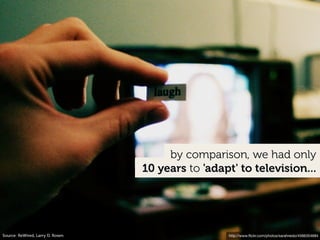
by comparison, we had only
                                  10 years to 'adapt' to television...


Source: ReWired, Larry D. Rosen                    http://www.flickr.com/photos/sarahreido/4566354684
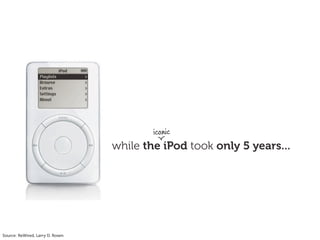
iconic
                                  while the iPod took only 5 years...


Source: ReWired, Larry D. Rosen
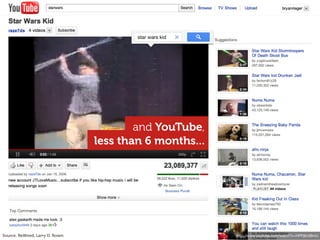
star wars kid


                                          and YouTube,
                                  less than 6 months...


Source: ReWired, Larry D. Rosen                           http://www.youtube.com/watch?v=HPPj6viIBmU
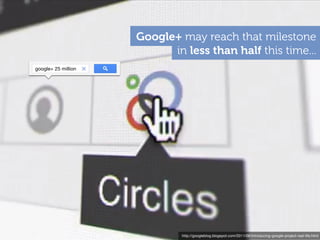
Google+ may reach that milestone
                           in less than half this time...
google+ 25 million


                              http://googleblog.blogspot.com/2011/06/introducing-google-project-real-life.html
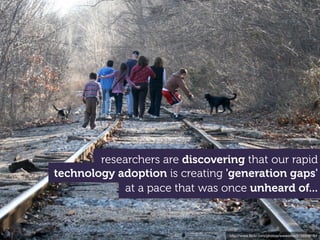
researchers are discovering that our rapid
technology adoption is creating 'generation gaps'
            at a pace that was once unheard of...


                                 http://www.flickr.com/photos/wwworks/3156948184
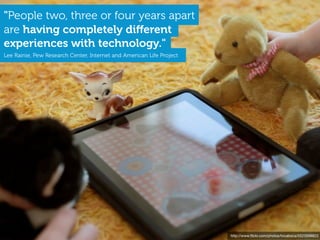
"People two, three or four years apart
are having completely different
experiences with technology."
Lee Rainie, Pew Research Center, Internet and American Life Project


                                                                      http://www.flickr.com/photos/tocaboca/5523598823
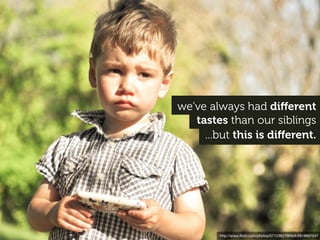
we've always had different
   tastes than our siblings
     ...but this is different.


        http://www.flickr.com/photos/57123627@N04/5818687047
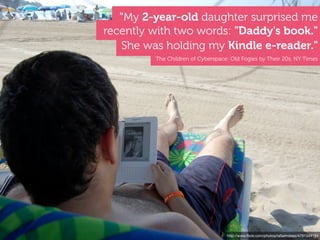
"My 2-year-old daughter surprised me
recently with two words: "Daddy's book."
   She was holding my Kindle e-reader."
         The Children of Cyberspace: Old Fogies by Their 20s, NY Times


                                   http://www.flickr.com/photos/rafaelrobles/4791344184
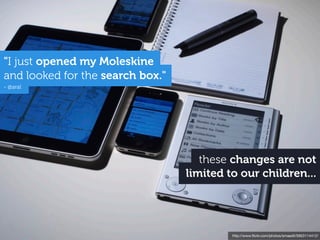
"I just opened my Moleskine
and looked for the search box."
- @aral


                                     these changes are not
                                  limited to our children...


                                           http://www.flickr.com/photos/smaedli/5953114412/
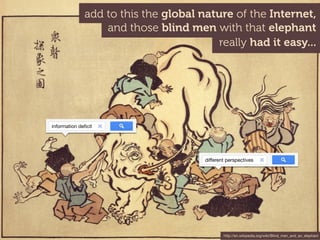
add to this the global nature of the Internet,
                  and those blind men with that elephant
                                         really had it easy...


information deficit


                                      different perspectives


                                              http://en.wikipedia.org/wiki/Blind_men_and_an_elephant
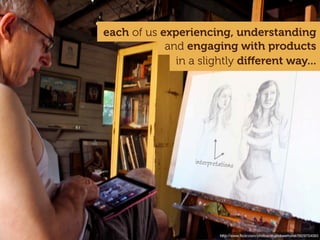
each of us experiencing, understanding
            and engaging with products
              in a slightly different way...


                  interpretations


                           http://www.flickr.com/photos/studiobeerhorst/5929704093
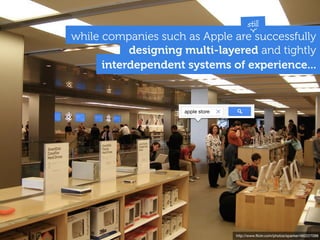
still
while companies such as Apple are successfully
           designing multi-layered and tightly
      interdependent systems of experience...


                     apple store


                                   http://www.flickr.com/photos/sparker/460227098
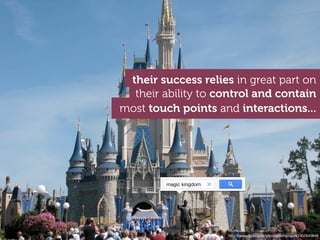
their success relies in great part on
  their ability to control and contain
most touch points and interactions...


         magic kingdom


                         http://www.flickr.com/photos/cdharrison/2407640646
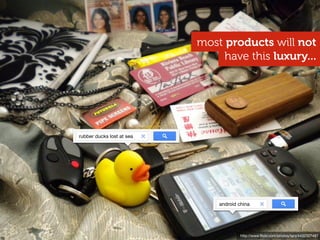
most products will not
                                have this luxury...


rubber ducks lost at sea


                               android china


                                        http://www.flickr.com/photos/tanj/4432327487
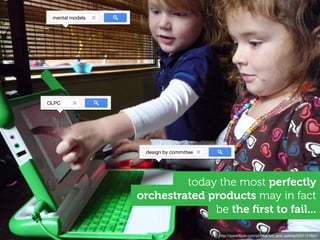
mental models


OLPC


                  design by committee


                          today the most perfectly
                 orchestrated products may in fact
                               be the first to fail...

                                        http://www.flickr.com/photos/tim_and_selena/5051157647/
in fact...
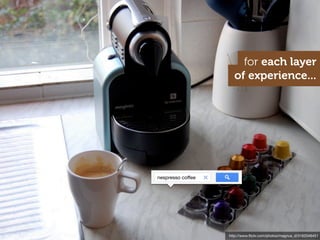
for each layer
                     of experience...


nespresso coffee


                   http://www.flickr.com/photos/magnus_d/3162046451
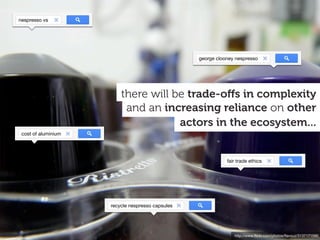
nespresso vs


                                                  george clooney nespresso


                         there will be trade-offs in complexity
                          and an increasing reliance on other
                                     actors in the ecosystem...
 cost of aluminium


                                                             fair trade ethics


                     recycle nespresso capsules


                                                                http://www.flickr.com/photos/flavouz/3137171590
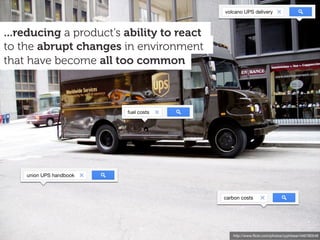
volcano UPS delivery


...reducing a product's ability to react
to the abrupt changes in environment
that have become all too common


                         fuel costs


    union UPS handbook


                                           carbon costs


                                              http://www.flickr.com/photos/zyphbear/446780548
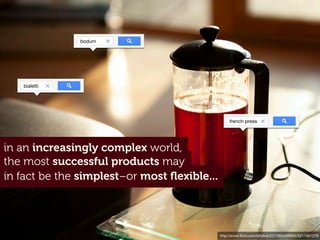
bodum


   bialetti


                                                 french press


in an increasingly complex world,
the most successful products may
in fact be the simplest–or most flexible...


                                             http://www.flickr.com/photos/22179048@N05/5211091279
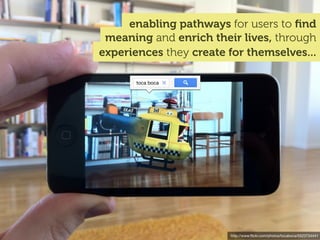
enabling pathways for users to find
 meaning and enrich their lives, through
experiences they create for themselves...

       toca boca


                        http://www.flickr.com/photos/tocaboca/5523734441
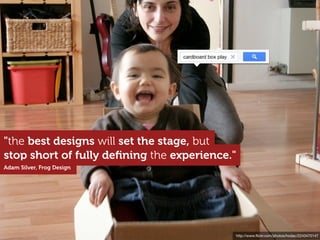
cardboard box play


"the best designs will set the stage, but
stop short of fully defining the experience."
Adam Silver, Frog Design


                                                      http://www.flickr.com/photos/hodac/2243470147
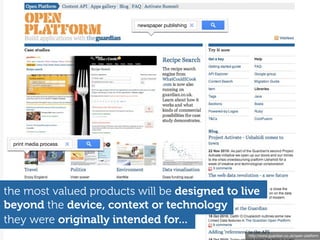
newspaper publishing


 print media process


the most valued products will be designed to live
beyond the device, context or technology
they were originally intended for...
                                                http://www.guardian.co.uk/open-platform
they may even be designed
with no primary context at all...


                http://www.flickr.com/photos/dalbera/3151369718
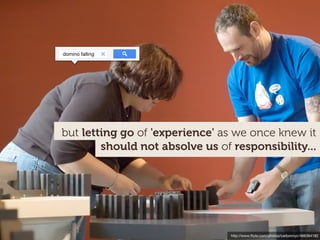
domino falling


but letting go of 'experience' as we once knew it
        should not absolve us of responsibility...


                                 http://www.flickr.com/photos/carbonnyc/466394182
and developers
in fact, as designers we now have more
         responsibility than ever before...


                                  http://www.flickr.com/photos/seier/2455551478
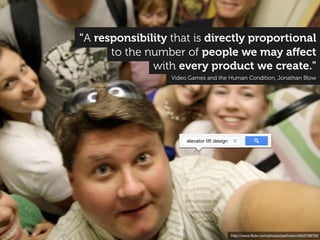
"A responsibility that is directly proportional
      to the number of people we may affect
              with every product we create."
                  Video Games and the Human Condition, Jonathan Blow


                       elevator lift design


                                              http://www.flickr.com/photos/particlem/3953768763
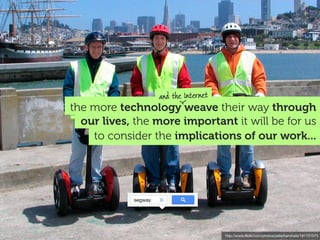
and the Internet
the more technology weave their way through
  our lives, the more important it will be for us
    to consider the implications of our work...


            segway


                                        http://www.flickr.com/photos/peterkaminski/181721075
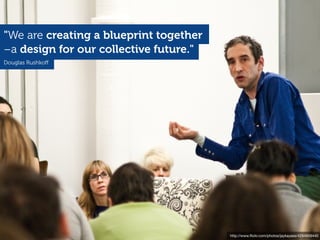
"We are creating a blueprint together
–a design for our collective future."
Douglas Rushkoff


                                        http://www.flickr.com/photos/jaykayess/4294959440
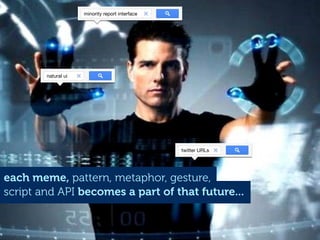
minority report interface


        natural ui


                                                 twitter URLs


each meme, pattern, metaphor, gesture,
script and API becomes a part of that future...
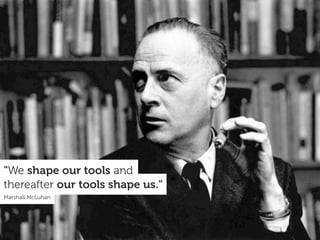
"We shape our tools and
thereafter our tools shape us."
Marshall McLuhan
...what future do we
     wish to create?


 http://www.flickr.com/photos/clickflashphotos/3393880262
there's no guarantee the work
 we do will have any impact...


            http://www.flickr.com/photos/stickwithjosh/5288115744
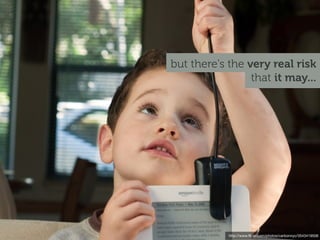
but there's the very real risk
                 that it may...


            http://www.flickr.com/photos/carbonnyc/3543419506
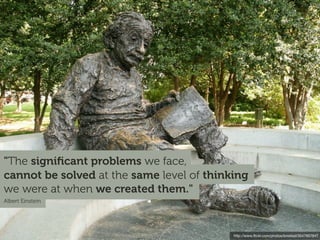
"The significant problems we face,
cannot be solved at the same level of thinking
we were at when we created them."
Albert Einstein


                                           http://www.flickr.com/photos/brostad/3547607847
@yiibu


         s
contact u
at
              hello@yiibu.com                                               thank you


             many thanks to the
             amazing photographers
             on

                 http://www.flickr.com/creativecommons/by-2.0

             licensed under

                 http://creativecommons.org/licenses/by/2.0


                 available on
                 http://www.slideshare.net/yiibu/letting-go


                                                               http://www.flickr.com/photos/tinou/453593446

Letting go

  • 1.
    Letting go... on design in a time of disruption http://creativecommons.org/licenses/by/2.0 http://www.flickr.com/photos/basheertome/5557362895
  • 2.
    napoleon bonaparte for much of human history, we have been on a quest for perfection + control... http://www.flickr.com/photos/ghewgill/5046616680
  • 3.
    much of it started with this... movable lead type http://www.flickr.com/photos/purdman1/2875431305
  • 4.
    our ability tocapture, store, and constrain knowledge, led us to believe that knowledge itself might be a finite thing... gutenberg bible gutenberg parenthesis http://www.flickr.com/photos/jmwk/3517373312
  • 5.
    ...that if weexperimented long enough, we could discover "the truth" about all sorts of things... http://www.flickr.com/photos/smithsonian/4127624763
  • 6.
    iso certified ...and "the best way" to do just about everything... http://www.flickr.com/photos/bigbirdz/4507266406
  • 7.
    google patents we protected ideas, and claimed them as our own... http://www.google.com/patents
  • 8.
    design thinking six sigma we created processes, enabling us to duplicate what we'd learned... http://www.flickr.com/photos/siliconbeachtraining/3925458997
  • 9.
    industrialisation, automation and globalisation further amplified this... chongqing china http://www.flickr.com/photos/fungleo/4771589650
  • 10.
    ...once you canduplicate something you can scale it http://www.flickr.com/photos/scobleizer/3009516045
  • 11.
    ...and if youcan scale it, you can make money http://www.flickr.com/photos/daverugby83/4478007023
  • 12.
    bruce mau massivechange thanks to the Internet, much of this is starting to unravel... http://www.flickr.com/photos/chadmagiera/265752353
  • 13.
    ...scale is stillimportant, but the knowledge + power in the network are now more important than that of any one group or individual... http://www.flickr.com/photos/jurvetson/5129303018
  • 14.
    social networks actas "amplifiers" spreading messages and ideas... http://www.flickr.com/photos/28misguidedsouls/5522310921
  • 15.
    let a product,or idea loose online, and it's likely to grow... crazy frog http://www.flickr.com/photos/ricardoalvarez/229045487
  • 16.
    the annoying thing but ideas don't just grow, they self-replicate and evolve... http://www.flickr.com/photos/ricardoalvarez/229046257
  • 17.
    swine flu mexico often at a pace and intensity that is normally associated with viruses... http://www.flickr.com/photos/eneas/3479302322
  • 18.
    this is actually bacteria... and while viruses can be contained, it's impossible to contain ideas once the power of the network sets in... http://www.flickr.com/photos/ricephotos/2679758872
  • 19.
  • 20.
    the portable, alwayson, always connected device has only amplified this http://www.flickr.com/photos/misbehave/2352753067
  • 21.
    combine all thesethings and you have the perfect storm... http://www.flickr.com/photos/nebraskasc/3659328702
  • 22.
    an endless, oftenover-connected feedback loop... http://www.flickr.com/photos/randysonofrobert/311744213
  • 23.
    propelling unexpected ideas to greatness... angry birds http://www.flickr.com/photos/yghelloworld/4965465016
  • 24.
  • 25.
    egyptian revolution ...accelerating change http://www.flickr.com/photos/ahmadhammoudphotography/5410375058
  • 26.
    market crash 2011 economiccrisis 2008 ...or causing chaos on a global scale http://www.flickr.com/photos/mccun934/2899155411
  • 27.
    "events, threats andopportunities aren't just coming at us faster or with less predictability; they are converging and influencing each other to create entirely new situations..." "...these first-of-their-kind developments require unprecedented degrees of creativity" Capitalising on Complexity - 2010 IBM CEO Study http://www.flickr.com/photos/jmv/3371886
  • 28.
  • 29.
    nathan road hongkong this new environment presents engineers, designers, (or anyone who makes products) with some decidedly unique challenges... http://www.flickr.com/photos/z_wenjie/5602616401
  • 30.
    the balance ofpower is shifting... always connected always on http://www.flickr.com/photos/jenny-pics/5661879987
  • 31.
    we can nolonger expect customers to interact with our creations in a linear, exclusive, or predictable manner... http://www.flickr.com/photos/arenamontanus/3496433929
  • 32.
    users no longerhave to wait for us to create experiences for them... http://www.flickr.com/photos/ncanup/3526550845
  • 33.
    if something doesn'tsuit them... http://www.flickr.com/photos/jessehull/163703252
  • 34.
    kindle teleprompter ...they can change it http://www.flickr.com/photos/24763767@N03/3907937027
  • 35.
    flipboard readability instapaper ...improve it http://www.flickr.com/photos/johanl/4818276266
  • 36.
  • 37.
    open source socialnetwork ...even compete with it. http://twitter.com/#!/joindiaspora
  • 38.
    makerbot thing-o-matic 3D printing ...very soon, they will be able to go even further http://www.flickr.com/photos/faircompanies/4955025544
  • 39.
    ...this is not necessarilya bad thing http://www.flickr.com/photos/salty_soul/4737350118
  • 40.
    "Issuing your customerswith something that is rough, incomplete, and possibly even substandard seems counterintuitive but there is growing evidence that people don't necessarily want the perfect product..." http://www.flickr.com/photos/tiseb/13541804
  • 41.
    "...they prefer todeal with something ragged around the edges that they can adapt or improve." Loose, Martin Thomas http://www.flickr.com/photos/emerson12/2682480262
  • 42.
    in our questto create perfection, we've also tended to presume users behave in a generally homogenous way... http://www.flickr.com/photos/carbonnyc/2206470413
  • 43.
    ...but this isincreasingly far from the truth http://www.flickr.com/photos/pagedooley/3832910201
  • 44.
  • 45.
    marketers often usean audience of 50 million to mark the "penetration" of a product into society... http://www.flickr.com/photos/alexnormand/5913845927
  • 46.
    historically, market penetrationtook time, (which was usually a good thing) traffic 1963 http://www.flickr.com/photos/tigerzombie/5173624489
  • 47.
    traffic 2011 with time comes stronger mental models, development of social norms and an understanding of how a product may fit into our lives... http://www.flickr.com/photos/highwaysagency/4542411761
  • 48.
    time also enabledus to work out those embarrassing mistakes... sinclair c5 http://www.flickr.com/photos/anachronism_uk/853247355
  • 49.
    for better orworse time is now a luxury... http://www.flickr.com/photos/vvvracer/4436798901
  • 50.
    ...the big shift stability creation of new infrastructural technology followed by rapid disruption stability years S curve - stable over decades Source: The Big Shift by John Hagel, John Seely Brown and Lang Davison http://www.flickr.com/photos/vvvracer/4436798901
  • 51.
    ...the big shift stability creation of new many new infrastructural infrastructural technologies technology followed by frequent disruption rapid disruption smaller periods of stability stability years years S curve - stable over decades the present (and likely future) Source: The Big Shift by John Hagel, John Seely Brown and Lang Davison http://www.flickr.com/photos/vvvracer/4436798901
  • 52.
    it took radio40 years to reach a market penetration of 50 million... Source: ReWired, Larry D. Rosen http://www.flickr.com/photos/houseofsims/5510707992
  • 53.
    by comparison, wehad only 10 years to 'adapt' to television... Source: ReWired, Larry D. Rosen http://www.flickr.com/photos/sarahreido/4566354684
  • 54.
    iconic while the iPod took only 5 years... Source: ReWired, Larry D. Rosen
  • 55.
    star wars kid and YouTube, less than 6 months... Source: ReWired, Larry D. Rosen http://www.youtube.com/watch?v=HPPj6viIBmU
  • 56.
    Google+ may reachthat milestone in less than half this time... google+ 25 million http://googleblog.blogspot.com/2011/06/introducing-google-project-real-life.html
  • 57.
    researchers are discoveringthat our rapid technology adoption is creating 'generation gaps' at a pace that was once unheard of... http://www.flickr.com/photos/wwworks/3156948184
  • 58.
    "People two, threeor four years apart are having completely different experiences with technology." Lee Rainie, Pew Research Center, Internet and American Life Project http://www.flickr.com/photos/tocaboca/5523598823
  • 59.
    we've always haddifferent tastes than our siblings ...but this is different. http://www.flickr.com/photos/57123627@N04/5818687047
  • 60.
    "My 2-year-old daughtersurprised me recently with two words: "Daddy's book." She was holding my Kindle e-reader." The Children of Cyberspace: Old Fogies by Their 20s, NY Times http://www.flickr.com/photos/rafaelrobles/4791344184
  • 61.
    "I just openedmy Moleskine and looked for the search box." - @aral these changes are not limited to our children... http://www.flickr.com/photos/smaedli/5953114412/
  • 62.
    add to thisthe global nature of the Internet, and those blind men with that elephant really had it easy... information deficit different perspectives http://en.wikipedia.org/wiki/Blind_men_and_an_elephant
  • 63.
    each of usexperiencing, understanding and engaging with products in a slightly different way... interpretations http://www.flickr.com/photos/studiobeerhorst/5929704093
  • 64.
    still while companies suchas Apple are successfully designing multi-layered and tightly interdependent systems of experience... apple store http://www.flickr.com/photos/sparker/460227098
  • 65.
    their success reliesin great part on their ability to control and contain most touch points and interactions... magic kingdom http://www.flickr.com/photos/cdharrison/2407640646
  • 66.
    most products willnot have this luxury... rubber ducks lost at sea android china http://www.flickr.com/photos/tanj/4432327487
  • 67.
    mental models OLPC design by committee today the most perfectly orchestrated products may in fact be the first to fail... http://www.flickr.com/photos/tim_and_selena/5051157647/
  • 68.
  • 69.
    for each layer of experience... nespresso coffee http://www.flickr.com/photos/magnus_d/3162046451
  • 70.
    nespresso vs george clooney nespresso there will be trade-offs in complexity and an increasing reliance on other actors in the ecosystem... cost of aluminium fair trade ethics recycle nespresso capsules http://www.flickr.com/photos/flavouz/3137171590
  • 71.
    volcano UPS delivery ...reducinga product's ability to react to the abrupt changes in environment that have become all too common fuel costs union UPS handbook carbon costs http://www.flickr.com/photos/zyphbear/446780548
  • 72.
    bodum bialetti french press in an increasingly complex world, the most successful products may in fact be the simplest–or most flexible... http://www.flickr.com/photos/22179048@N05/5211091279
  • 73.
    enabling pathways forusers to find meaning and enrich their lives, through experiences they create for themselves... toca boca http://www.flickr.com/photos/tocaboca/5523734441
  • 74.
    cardboard box play "thebest designs will set the stage, but stop short of fully defining the experience." Adam Silver, Frog Design http://www.flickr.com/photos/hodac/2243470147
  • 75.
    newspaper publishing printmedia process the most valued products will be designed to live beyond the device, context or technology they were originally intended for... http://www.guardian.co.uk/open-platform
  • 76.
    they may evenbe designed with no primary context at all... http://www.flickr.com/photos/dalbera/3151369718
  • 77.
    domino falling but lettinggo of 'experience' as we once knew it should not absolve us of responsibility... http://www.flickr.com/photos/carbonnyc/466394182
  • 78.
    and developers in fact,as designers we now have more responsibility than ever before... http://www.flickr.com/photos/seier/2455551478
  • 79.
    "A responsibility thatis directly proportional to the number of people we may affect with every product we create." Video Games and the Human Condition, Jonathan Blow elevator lift design http://www.flickr.com/photos/particlem/3953768763
  • 80.
    and the Internet themore technology weave their way through our lives, the more important it will be for us to consider the implications of our work... segway http://www.flickr.com/photos/peterkaminski/181721075
  • 81.
    "We are creatinga blueprint together –a design for our collective future." Douglas Rushkoff http://www.flickr.com/photos/jaykayess/4294959440
  • 82.
    minority report interface natural ui twitter URLs each meme, pattern, metaphor, gesture, script and API becomes a part of that future...
  • 83.
    "We shape ourtools and thereafter our tools shape us." Marshall McLuhan
  • 84.
    ...what future dowe wish to create? http://www.flickr.com/photos/clickflashphotos/3393880262
  • 85.
    there's no guaranteethe work we do will have any impact... http://www.flickr.com/photos/stickwithjosh/5288115744
  • 86.
    but there's thevery real risk that it may... http://www.flickr.com/photos/carbonnyc/3543419506
  • 87.
    "The significant problemswe face, cannot be solved at the same level of thinking we were at when we created them." Albert Einstein http://www.flickr.com/photos/brostad/3547607847
  • 88.
    @yiibu s contact u at hello@yiibu.com thank you many thanks to the amazing photographers on http://www.flickr.com/creativecommons/by-2.0 licensed under http://creativecommons.org/licenses/by/2.0 available on http://www.slideshare.net/yiibu/letting-go http://www.flickr.com/photos/tinou/453593446