Starter
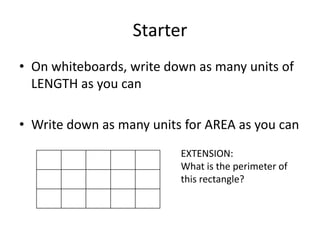
• On whiteboards, write down as many units of
  LENGTH as you can

• Write down as many units for AREA as you can
                          EXTENSION:
                          What is the perimeter of
                          this rectangle?
Perimeter           25/02/2013


Learning Objectives:

   Know the key words for perimeter and
   the units used
   Able to calculate the perimeter of a
   rectangle
   Able to calculate the perimeter of a
   compound shape
Perimeter
• Perimeter: The distance around the outside of
  a shape

• To calculate the perimeter, you add together
  all the sides of a shape
Perimeter
                           10cm
• Example:
                                  3cm


     P = 10 + 3 + 10 + 3

     P = 26cm
Perimeter
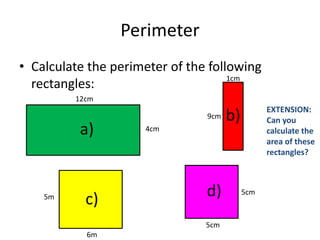
• Calculate the perimeter of the following
                                     1cm
  rectangles:
         12cm
                                                 EXTENSION:
                                9cm   b)         Can you
          a)         4cm                         calculate the
                                                 area of these
                                                 rectangles?


    5m
           c)                   d)         5cm


                                5cm
           6m
Perimeter
• Compound shape: a 2D shape made up of
  many shapes
Perimeter
       10m                                    Can I calculate the
                                              perimeter of this
                                              shape?
                 15m
                                              I need to find the
                          21m                 length of the
25m
                                              missing sides first.
      P = 10 + 15 + 21 + 10 + 31 + 25
                                        10m   Now I can calculate
      P = 112m                                the perimeter by
                                              adding up the all the
                  31m                         sides.
Perimeter
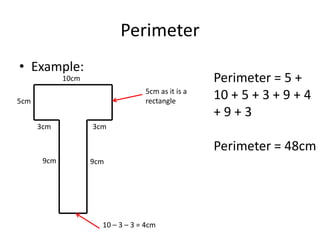
• Example:
             10cm                                  Perimeter = 5 +
                                  5cm as it is a
5cm                               rectangle
                                                   10 + 5 + 3 + 9 + 4
                                                   +9+3
      3cm           3cm

                                                   Perimeter = 48cm
       9cm          9cm


                      10 – 3 – 3 = 4cm
Starter
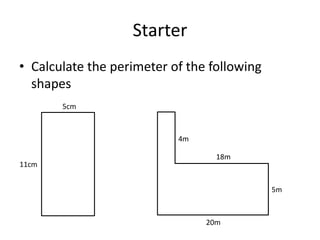
• Calculate the perimeter of the following
  shapes
       5cm


                           4m

                                  18m
11cm


                                             5m


                                20m
Perimeter              25/02/2013


Learning Objectives:

   Able to calculate the perimeter of a
   rectangle
   Able to calculate the perimeter of a
   compound shape
   Able to calculate the area of a
   rectangle
Your turn…
• Exercise 5A, page 97
Area
• How can I calculate the area of this rectangle?

                           • Count the squares
                             inside the shape

                           • Multiply the width
                             by the length
Area of a rectangle
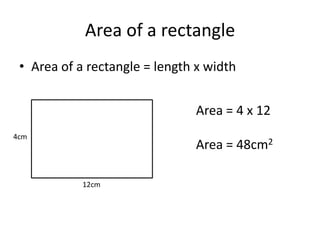
 • Area of a rectangle = length x width


                               Area = 4 x 12
4cm
                               Area = 48cm2

            12cm
Starter
• How many rectangles can you design that
  have an area of 24cm2?

• Do the sides have to be whole numbers?
Area of Triangles           25/02/2013


Learning Objectives:

• Able to calculate the area of a rectangle

• Able to calculate the area of a triangle

• Able to calculate the area of a compound
  shape
Area of Triangles

         Height


                      Base


• Area of a triangle = ½ x base x height
                     = ½bh
Area of a Triangle
• Calculate the area of this triangle.


          4cm


                         12cm


    Area = ½ x 4 x 12
         = 24cm2
Area of Triangles
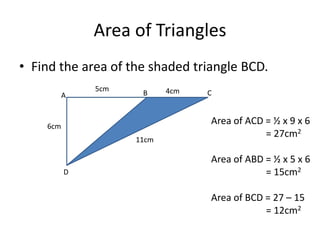
• Find the area of the shaded triangle BCD.
              5cm          4cm
          A          B           C


    6cm
                                 Area of ACD = ½ x 9 x 6
                                             = 27cm2
                    11cm

                                 Area of ABD = ½ x 5 x 6
          D                                  = 15cm2

                                 Area of BCD = 27 – 15
                                             = 12cm2
Your turn…
• Page 104, Exercise 5E, Qs 1 to 4.
Starter
• Complete the worksheet in your workbook
  – Show all your working out
  – Remember to use the correct units!
Grade D
              Area of Triangles                25/02/2013


Learning Objectives:

• Able to calculate the area of a right angled
  triangle

• Able to identify the perpendicular height of a
  triangle

• Able to calculate the area of any triangle
Area of Triangles
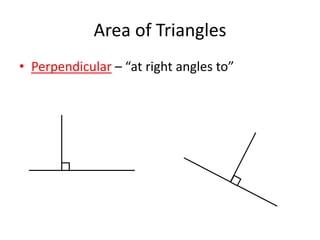
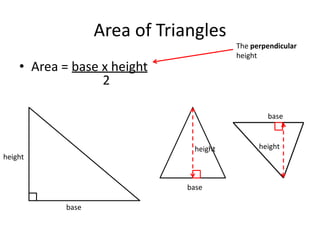
• Perpendicular – “at right angles to”
Area of Triangles
                                        The perpendicular
                                        height
    • Area = base x height
                  2

                                                base


                               height         height
height


                              base

            base
Area of Triangles
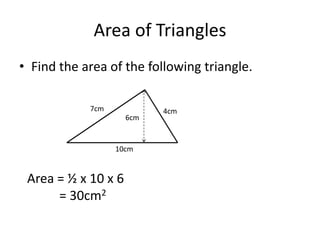
• Find the area of the following triangle.

            7cm            4cm
                     6cm


                  10cm


 Area = ½ x 10 x 6
      = 30cm2
Area of Triangles
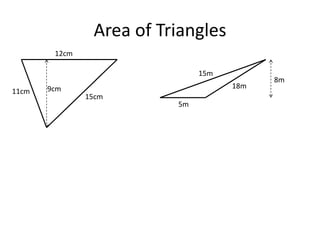
        12cm

                               15m
                                           8m
       9cm                           18m
11cm
               15cm
                          5m
Grade D
              Area of Triangles             25/02/2013


Learning Objectives:

• Able to calculate the area of a right-angled
  triangle

• Able to calculate the area of other
  triangles

• Able to calculate the area of a parallelogram
Area of Triangles
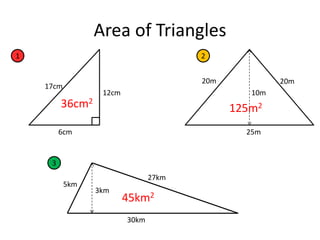
1                                      2


                                       20m            20m
    17cm
                  12cm                          10m
         36cm2                               125m2
         6cm                                   25m


     3
                                27km
           5km
                 3km
                         45km2
                         30km
Some work…
• In your workbooks, work through pages 65
  and 66.
Home Learning
• Complete the worksheet in your books

• Show all working out

• DUE: Monday 19th September
Starter
• Match the shape to the correct area and
  perimeter.

• There is one perimeter and one area that
  don’t have a shape. Draw the shape to match
  the perimeter and area on the blank card.
Parallelograms and Trapezia
Grade D                                     25/02/2013

Learning Objectives

• Able to calculate the area of triangles

• Able to calculate the area of parallelograms
  and trapezia
Area of a Parallelogram
                         Area of Parallelogram = base x perpendicular
                                                        height
               height


      Base


                                            Area = 6 x 12
9cm
                           6cm
                                                 = 72cm2


                  12cm
Area of a Trapezium
              a

                             h


              b


Area of Trapezium = ½ (a + b) x h

 a and b are the parallel sides
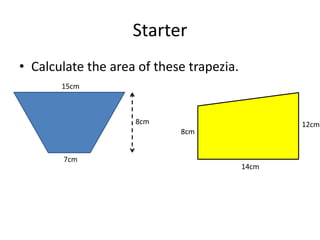
Starter
• Calculate the area of these trapezia.
       15cm


                    8cm                          12cm
                            8cm


       7cm
                                          14cm
Area of Compound Shapes
Grade D                                 25/02/2013

Learning Objectives:

• Able to calculate areas of trapezia

• Able to split up a compound shape

• Able to find the area of a compound
  shape
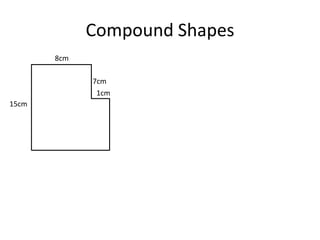
Compound Shapes
• To find the area of compound shapes, split
  them up into their composite shapes.

• Find the area of each shape, then add them
  together
Compound Shapes
      8cm
                    Area A = 8 x 5
      A       5cm
                           = 40cm2
                    Area B = 11 x 2
                           = 22cm2
B     11cm

                    Total Area = 40 + 22
                               = 62cm2
2cm
Compound Shapes
       8cm

             7cm
              1cm
15cm
Your turn…
• Complete the worksheet in your work books.
Starter
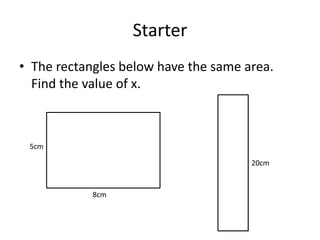
• The rectangles below have the same area.
  Find the value of x.


 5cm

                                      20cm


            8cm
Grade D/C
                   Circles             25/02/2013


Learning Objectives:

• Able to calculate the radius and diameter
  of a circle
• Able to use a calculator to find the
  circumference of a circle
• Able to calculate the area of a circle
Circles
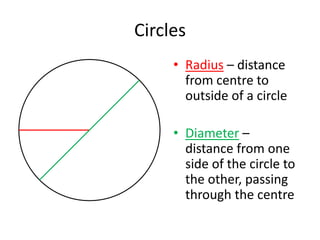
     • Radius – distance
       from centre to
       outside of a circle

     • Diameter –
       distance from one
       side of the circle to
       the other, passing
       through the centre
Circles
                     Diameter = 2 x radius

                     Radius = diameter ÷ 2

6cm   12cm   6cm
Circles
• Circumference – the distance around the
  outside of a circle.

• You are going to investigate the relationship
  between the circumference and the diameter.
Circles
1) Measure the circumference and diameter of
   the objects and record them in the table.

2) Divide the circumference by the diameter.
   Write your results in the table

3) Can you spot the common link?
Object   Circumference   Diameter   C÷d
Starter
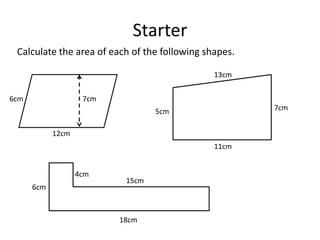
 Calculate the area of each of the following shapes.

                                               13cm


6cm                 7cm
                                  5cm                  7cm


            12cm
                                               11cm


                   4cm
                           15cm
      6cm


                          18cm
Grade D/C
                   Circles             25/02/2013


Learning Objectives:

• Able to calculate the radius and diameter
  of a circle
• Able to use a calculator to find the
  circumference of a circle
• Able to calculate the area of a circle
Circles
• This relationship between the circumference and
  diameter is called ‘pi’

• The symbol for pi is ∏

• ∏ = 3.1415926….

• We often use 3.14 as an approximation

• It is found on calculators
Circles
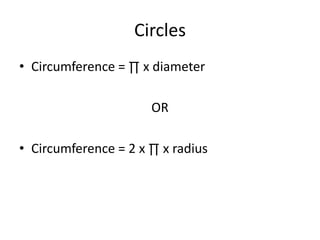
• Circumference = ∏ x diameter

                      OR

• Circumference = 2 x ∏ x radius
Circles
                Circumference = 2∏r

                C=2x∏x4
4cm
                C=8x∏

                C = 25.13cm (2dp)
Circles
           Find the circumference of the
           circle.
7cm
           C=2x∏x7

           C = 14 x ∏

           C = 43.98cm (2dp)
Starter
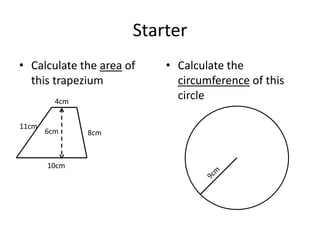
• Calculate the area of   • Calculate the
  this trapezium            circumference of this
         4cm
                            circle

11cm
       6cm     8cm


       10cm
Grade D/C
              Circumference            25/02/2013


Learning Objectives:

• Able to calculate the radius and diameter
  of a circle
• Able to use a calculator to find the
  circumference of a circle
• Able to calculate the area of a circle
Circles
If I want to find the circumference of these circles, which formula
should I use?


          6cm


        C=2x∏xr                                 C=∏xd
        C=2x∏x6                                C = ∏ x 14
         C = 12 x ∏                          C = 43.98 (2dp)
      C = 37.7cm (1dp)
Circles
• Page
  – Exercise
  – Questions
Starter
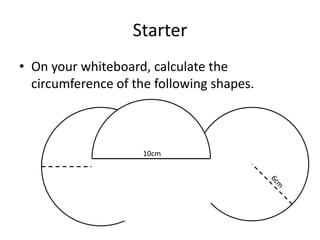
• On your whiteboard, calculate the
  circumference of the following shapes.


                     10cm
            9cm
Grade C
                Area of Circles             25/02/2013


Learning Objectives:

• Able to calculate the circumference of a circle

• Able to calculate the area of a circle given
  the radius

• Able to calculate the area of a circle given
  the diameter
Area of Circles
• Area = ∏ x radius2

• Area = ∏r2
                       radius
Area of Circles
• Area = ∏r2

• Area = ∏ x 42

• Area = ∏ x 4 x 4         4cm


• Area = 16 x ∏

• Area = 50.27cm2
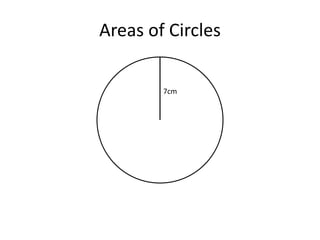
Areas of Circles

        7cm
Area of Circles
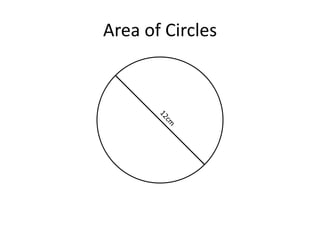
• Radius = 18 ÷ 2
         = 9cm

• Area = ∏ x 92             18cm


• Area = 81 x ∏

• Area = 254.47cm2
Area of Circles
Your turn…
• Page 364 – 366
  – Exercise 16C
  – Questions 1, 3, 5, 6, 7*, 9*

Area and perimeter_10_r5

  • 1.
    Starter • On whiteboards,write down as many units of LENGTH as you can • Write down as many units for AREA as you can EXTENSION: What is the perimeter of this rectangle?
  • 2.
    Perimeter 25/02/2013 Learning Objectives: Know the key words for perimeter and the units used Able to calculate the perimeter of a rectangle Able to calculate the perimeter of a compound shape
  • 3.
    Perimeter • Perimeter: Thedistance around the outside of a shape • To calculate the perimeter, you add together all the sides of a shape
  • 4.
    Perimeter 10cm • Example: 3cm P = 10 + 3 + 10 + 3 P = 26cm
  • 5.
    Perimeter • Calculate theperimeter of the following 1cm rectangles: 12cm EXTENSION: 9cm b) Can you a) 4cm calculate the area of these rectangles? 5m c) d) 5cm 5cm 6m
  • 6.
    Perimeter • Compound shape:a 2D shape made up of many shapes
  • 7.
    Perimeter 10m Can I calculate the perimeter of this shape? 15m I need to find the 21m length of the 25m missing sides first. P = 10 + 15 + 21 + 10 + 31 + 25 10m Now I can calculate P = 112m the perimeter by adding up the all the 31m sides.
  • 8.
    Perimeter • Example: 10cm Perimeter = 5 + 5cm as it is a 5cm rectangle 10 + 5 + 3 + 9 + 4 +9+3 3cm 3cm Perimeter = 48cm 9cm 9cm 10 – 3 – 3 = 4cm
  • 9.
    Starter • Calculate theperimeter of the following shapes 5cm 4m 18m 11cm 5m 20m
  • 10.
    Perimeter 25/02/2013 Learning Objectives: Able to calculate the perimeter of a rectangle Able to calculate the perimeter of a compound shape Able to calculate the area of a rectangle
  • 11.
  • 12.
    Area • How canI calculate the area of this rectangle? • Count the squares inside the shape • Multiply the width by the length
  • 13.
    Area of arectangle • Area of a rectangle = length x width Area = 4 x 12 4cm Area = 48cm2 12cm
  • 14.
    Starter • How manyrectangles can you design that have an area of 24cm2? • Do the sides have to be whole numbers?
  • 15.
    Area of Triangles 25/02/2013 Learning Objectives: • Able to calculate the area of a rectangle • Able to calculate the area of a triangle • Able to calculate the area of a compound shape
  • 16.
    Area of Triangles Height Base • Area of a triangle = ½ x base x height = ½bh
  • 17.
    Area of aTriangle • Calculate the area of this triangle. 4cm 12cm Area = ½ x 4 x 12 = 24cm2
  • 18.
    Area of Triangles •Find the area of the shaded triangle BCD. 5cm 4cm A B C 6cm Area of ACD = ½ x 9 x 6 = 27cm2 11cm Area of ABD = ½ x 5 x 6 D = 15cm2 Area of BCD = 27 – 15 = 12cm2
  • 19.
    Your turn… • Page104, Exercise 5E, Qs 1 to 4.
  • 20.
    Starter • Complete theworksheet in your workbook – Show all your working out – Remember to use the correct units!
  • 21.
    Grade D Area of Triangles 25/02/2013 Learning Objectives: • Able to calculate the area of a right angled triangle • Able to identify the perpendicular height of a triangle • Able to calculate the area of any triangle
  • 22.
    Area of Triangles •Perpendicular – “at right angles to”
  • 23.
    Area of Triangles The perpendicular height • Area = base x height 2 base height height height base base
  • 24.
    Area of Triangles •Find the area of the following triangle. 7cm 4cm 6cm 10cm Area = ½ x 10 x 6 = 30cm2
  • 25.
    Area of Triangles 12cm 15m 8m 9cm 18m 11cm 15cm 5m
  • 26.
    Grade D Area of Triangles 25/02/2013 Learning Objectives: • Able to calculate the area of a right-angled triangle • Able to calculate the area of other triangles • Able to calculate the area of a parallelogram
  • 27.
    Area of Triangles 1 2 20m 20m 17cm 12cm 10m 36cm2 125m2 6cm 25m 3 27km 5km 3km 45km2 30km
  • 28.
    Some work… • Inyour workbooks, work through pages 65 and 66.
  • 29.
    Home Learning • Completethe worksheet in your books • Show all working out • DUE: Monday 19th September
  • 30.
    Starter • Match theshape to the correct area and perimeter. • There is one perimeter and one area that don’t have a shape. Draw the shape to match the perimeter and area on the blank card.
  • 31.
    Parallelograms and Trapezia GradeD 25/02/2013 Learning Objectives • Able to calculate the area of triangles • Able to calculate the area of parallelograms and trapezia
  • 32.
    Area of aParallelogram Area of Parallelogram = base x perpendicular height height Base Area = 6 x 12 9cm 6cm = 72cm2 12cm
  • 33.
    Area of aTrapezium a h b Area of Trapezium = ½ (a + b) x h a and b are the parallel sides
  • 34.
    Starter • Calculate thearea of these trapezia. 15cm 8cm 12cm 8cm 7cm 14cm
  • 35.
    Area of CompoundShapes Grade D 25/02/2013 Learning Objectives: • Able to calculate areas of trapezia • Able to split up a compound shape • Able to find the area of a compound shape
  • 36.
    Compound Shapes • Tofind the area of compound shapes, split them up into their composite shapes. • Find the area of each shape, then add them together
  • 37.
    Compound Shapes 8cm Area A = 8 x 5 A 5cm = 40cm2 Area B = 11 x 2 = 22cm2 B 11cm Total Area = 40 + 22 = 62cm2 2cm
  • 38.
    Compound Shapes 8cm 7cm 1cm 15cm
  • 39.
    Your turn… • Completethe worksheet in your work books.
  • 40.
    Starter • The rectanglesbelow have the same area. Find the value of x. 5cm 20cm 8cm
  • 41.
    Grade D/C Circles 25/02/2013 Learning Objectives: • Able to calculate the radius and diameter of a circle • Able to use a calculator to find the circumference of a circle • Able to calculate the area of a circle
  • 42.
    Circles • Radius – distance from centre to outside of a circle • Diameter – distance from one side of the circle to the other, passing through the centre
  • 43.
    Circles Diameter = 2 x radius Radius = diameter ÷ 2 6cm 12cm 6cm
  • 44.
    Circles • Circumference –the distance around the outside of a circle. • You are going to investigate the relationship between the circumference and the diameter.
  • 45.
    Circles 1) Measure thecircumference and diameter of the objects and record them in the table. 2) Divide the circumference by the diameter. Write your results in the table 3) Can you spot the common link?
  • 46.
    Object Circumference Diameter C÷d
  • 47.
    Starter Calculate thearea of each of the following shapes. 13cm 6cm 7cm 5cm 7cm 12cm 11cm 4cm 15cm 6cm 18cm
  • 48.
    Grade D/C Circles 25/02/2013 Learning Objectives: • Able to calculate the radius and diameter of a circle • Able to use a calculator to find the circumference of a circle • Able to calculate the area of a circle
  • 49.
    Circles • This relationshipbetween the circumference and diameter is called ‘pi’ • The symbol for pi is ∏ • ∏ = 3.1415926…. • We often use 3.14 as an approximation • It is found on calculators
  • 50.
    Circles • Circumference =∏ x diameter OR • Circumference = 2 x ∏ x radius
  • 51.
    Circles Circumference = 2∏r C=2x∏x4 4cm C=8x∏ C = 25.13cm (2dp)
  • 52.
    Circles Find the circumference of the circle. 7cm C=2x∏x7 C = 14 x ∏ C = 43.98cm (2dp)
  • 53.
    Starter • Calculate thearea of • Calculate the this trapezium circumference of this 4cm circle 11cm 6cm 8cm 10cm
  • 54.
    Grade D/C Circumference 25/02/2013 Learning Objectives: • Able to calculate the radius and diameter of a circle • Able to use a calculator to find the circumference of a circle • Able to calculate the area of a circle
  • 55.
    Circles If I wantto find the circumference of these circles, which formula should I use? 6cm C=2x∏xr C=∏xd C=2x∏x6 C = ∏ x 14 C = 12 x ∏ C = 43.98 (2dp) C = 37.7cm (1dp)
  • 56.
    Circles • Page – Exercise – Questions
  • 57.
    Starter • On yourwhiteboard, calculate the circumference of the following shapes. 10cm 9cm
  • 58.
    Grade C Area of Circles 25/02/2013 Learning Objectives: • Able to calculate the circumference of a circle • Able to calculate the area of a circle given the radius • Able to calculate the area of a circle given the diameter
  • 59.
    Area of Circles •Area = ∏ x radius2 • Area = ∏r2 radius
  • 60.
    Area of Circles •Area = ∏r2 • Area = ∏ x 42 • Area = ∏ x 4 x 4 4cm • Area = 16 x ∏ • Area = 50.27cm2
  • 61.
  • 62.
    Area of Circles •Radius = 18 ÷ 2 = 9cm • Area = ∏ x 92 18cm • Area = 81 x ∏ • Area = 254.47cm2
  • 63.
  • 64.
    Your turn… • Page364 – 366 – Exercise 16C – Questions 1, 3, 5, 6, 7*, 9*