MATHEMATICS 5
QUARTER 4 WEEK 3
D
A
Y
1
Finding the Volume of a
given Cube and
Rectangular Prism
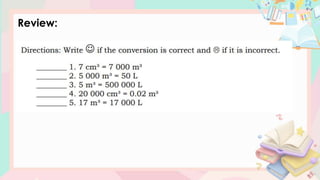
Review:
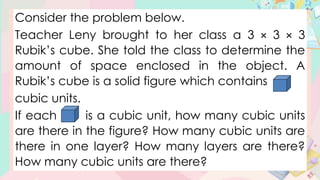
Consider the problem below.
Teacher Leny brought to her class a 3 × 3 × 3
Rubik’s cube. She told the class to determine the
amount of space enclosed in the object. A
Rubik’s cube is a solid figure which contains
cubic units.
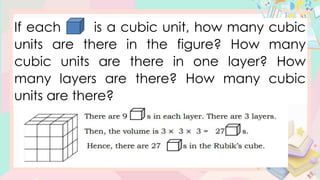
If each is a cubic unit, how many cubic units
are there in the figure? How many cubic units are
there in one layer? How many layers are there?
How many cubic units are there?
In this lesson, you are going to deal
about finding the volume of a given
cube and a rectangular prism using
cubic centimeters (cu. cm or cm³)
and cubic meters (cu. m or m³).
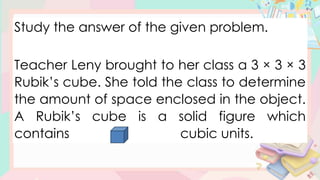
Study the answer of the given problem.
Teacher Leny brought to her class a 3 × 3 × 3
Rubik’s cube. She told the class to determine
the amount of space enclosed in the object.
A Rubik’s cube is a solid figure which
contains cubic units.
If each is a cubic unit, how many cubic
units are there in the figure? How many
cubic units are there in one layer? How
many layers are there? How many cubic
units are there?
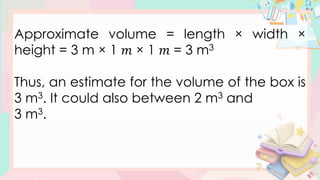
In a rectangular prism, the base is
always a rectangle. The area of the
base is the product of its length (l)
and width (w). Thus, to get the volume
of the prism, we may multiply the area
of the base with the height (h).
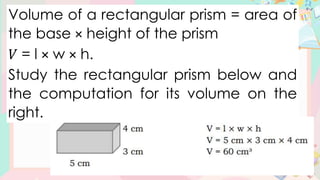
Volume of a rectangular prism = area of
the base × height of the prism
𝑉 = l × w × h.
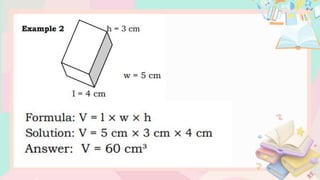
Study the rectangular prism below and
the computation for its volume on the
right.
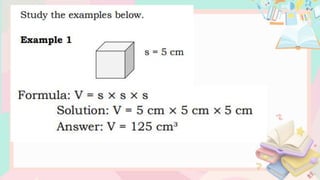
Note that 125 cm³ is read either as 125
cubic centimeters or 125 centimeters
cube.
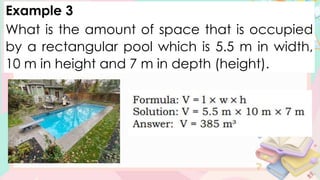
Example 3
What is the amount of space that is occupied
by a rectangular pool which is 5.5 m in width,
10 m in height and 7 m in depth (height).
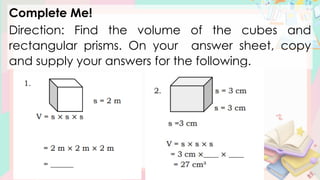
Complete Me!
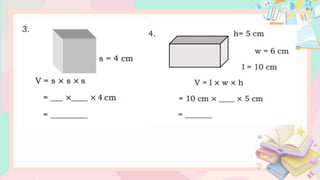
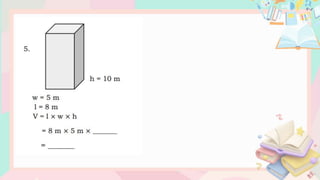
Direction: Find the volume of the cubes and
rectangular prisms. On your answer sheet, copy
and supply your answers for the following.
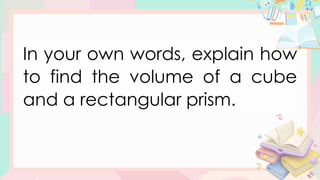
In your own words, explain how
to find the volume of a cube
and a rectangular prism.
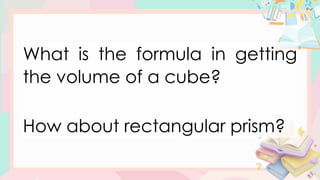
What is the formula in getting
the volume of a cube?
How about rectangular prism?
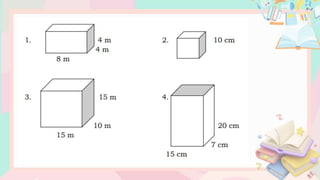
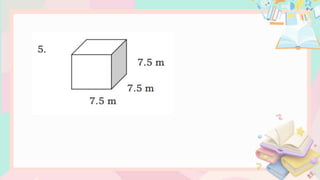
Find Me!
Directions: Find the volume of
the solid figures below. Write
your answers in your Math
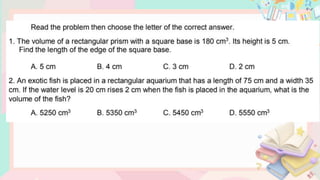
Activity notebook.
MATHEMATICS 5
QUARTER 4 WEEK 3
D
A
Y
2
Estimating and using
appropriate units of
measure for volume
Review;
Let us recall some of the different cubic units
of measure in the metric system arranged
from smallest to largest unit.
mm3 cm3 dm3 m3 dam3 hm3 km3
Answer:
mm3 cm3 dm3 m3 dam3 hm3 km3
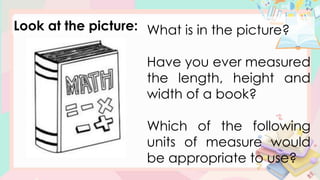
Look at the picture: What is in the picture?
Have you ever measured
the length, height and
width of a book?
Which of the following
units of measure would
be appropriate to use?
You already have an idea how big
or small everyday objects are. You
should have an idea of how big or
small the different units of volume
are so you can match these with
the objects.
The common units of measure for lengths,
width, and height are meter, centimeter,
millimeter, foot, yard and inch. In our
country, we are usually using the units in
metric system like meters, kilometers,
centimeters and millimeters. Other countries
use the units in imperial system like feet,
yards and inches. You may have seen
people using feet, yards and inches for
measuring lengths.
If we need to measure the dimensions of a
small object, we can use centimeter,
millimeter, decimeter, or inches. However,
for bigger, longer or wider objects, the units
that can be used are foot, yard, meter or
kilometer.
You already know that volume is the
amount of space that is enclosed in a 3-
dimensional or solid figure. Since it is an
amount of space, it has to be measured in
cubes. For instance, if the dimensions of a
solid figure are in meters, the volume would
be measured in cubic meters or m3. If the 3-
dimensional figure is measured in inches,
the volume would be in cubic inches or in3.
Let’s consider the example in the previous
part of the lesson.
What do you think is an
appropriate unit of
measure to be used for
finding the volume of
the book?
A book may represent a solid figure. Its
dimensions are small.
Hence, the volume is also small.
Therefore, you may use inches or
centimeters as units of measure for the
length, width and height of the book. The
volume of the book can be in cubic inches
or cubic centimeters.
Read and study the
examples below.
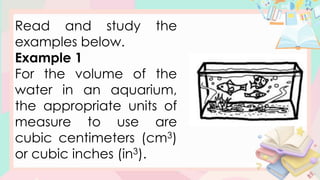
Example 1
For the volume of the
water in an aquarium,
the appropriate units of
measure to use are
cubic centimeters (cm3)
or cubic inches (in3).
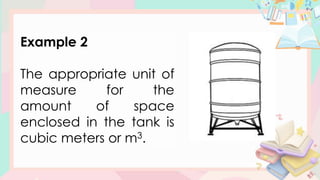
Example 2
The appropriate unit of
measure for the
amount of space
enclosed in the tank is
cubic meters or m3.
Another Examples
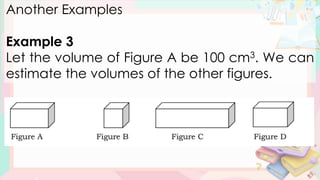
Example 3
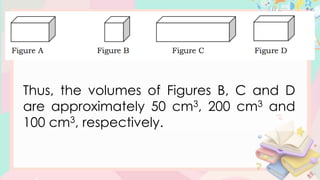
Let the volume of Figure A be 100 cm3. We can
estimate the volumes of the other figures.
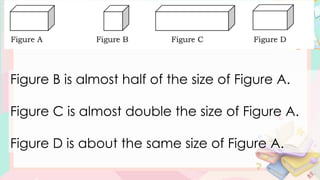
Figure B is almost half of the size of Figure A.
Figure C is almost double the size of Figure A.
Figure D is about the same size of Figure A.
Thus, the volumes of Figures B, C and D
are approximately 50 cm3, 200 cm3 and
100 cm3, respectively.
Example 4
A box is in the shape of rectangular prism. Its
length, width and height are 2.8 m, 1.1 m
and 0.95 m. Multiplying the dimensions,
rounded off to the nearest whole numbers,
gives a good estimate of the volume of the
prism.
Length: 2.8 m is rounded up to 3 m.
Width: 1.1 m is rounded down to 1 m.
Height: 0.95 m is rounded up to 1 m.
Approximate volume = length × width ×
height = 3 m × 1 𝑚 × 1 𝑚 = 3 m3
Thus, an estimate for the volume of the box is
3 m3. It could also between 2 m3 and
3 m3.
Example 5
A piece of wood is in the shape of a cube.
If its edge is 0.21 m, estimate the volume of
the piece of wood.
Solution: If we are going to estimate the volume
of the piece of wood, it is not logical to round it
off to the nearest whole number, as that would
be zero. This would give us a zero cubic meter
for volume.
Since rounding off to the nearest whole number
is not a good strategy, we may do it another
way. You already know that 1 m = 100 cm..
It follows that
0.21 m = 21 cm ≈ 21 cm.
Let us use 20 cm as our estimate.
Approximate volume = 20 𝑐𝑚 × 20 𝑐𝑚 × 20 𝑐
𝑚 = 8 000 cm3
Thus, an estimate for the volume of the
wood is 8 000 cm3. It must be less than a
cubic meter.
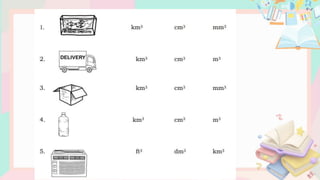
Choose Me In!
Directions: Select the appropriate unit of
measure for the volumes of the following
objects. Write your answers on a separate
sheet of paper.
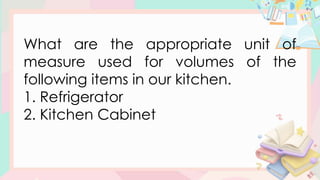
What are the appropriate unit of
measure used for volumes of the
following items in our kitchen.
1. Refrigerator
2. Kitchen Cabinet
What have you learned?
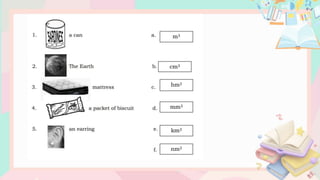
Pair Me Up!
Directions: Match the items in
column A with the units of
measure in column B in
finding the volume of the
given objects. Write the letter
of your answer on your
answer sheet.
MATHEMATICS 5
QUARTER 4 WEEK 3
D
A
Y
3
Solving routine problems
involving volume of a cube
and rectangular prism.
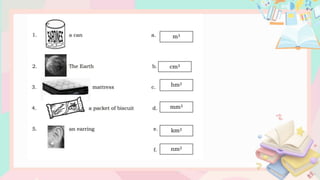
Review! Pair Me Up!
Directions: Match the items in
column A with the units of
measure in column B in
finding the volume of the
given objects. Write the letter
of your answer on your
answer sheet.
Ask:
What do you mean by the word
“Routine”?
Routine problems are real life problems.
- It involves at least one of the four
operations to solve practical problems.
- It requires basic skills and organized
and sequenced steps.
- Planned strategies and methods are
needed to come up with the answer.
This Four-Step Method is used to solve the
problem.
1. Understand: Know what is asked.
Identify the given facts.
2. Plan: Choose the operation or the
formula to be used.
3. Solve: Perform the strategy.
Suggested Strategies
a. Drawing a model/diagram
b. Using a formula and changing them
to mathematical symbol.
c. Working Backward
4. Check: Verify if the answer is correct.
Remember:
Volume (V) is the number of cubic
units needed to fill the shape. It is the
amount of space that is occupied by a
solid figure.
Cube and rectangular prism are
examples of a solid figure.
The formula in finding the
volume of a cube:
V= s x s x s or s3
The formula in finding the
volume of rectangular prism is
V = l x w x h
Problem 1
Miguel made a rectangular prism picture
frame with the family’s picture on its
faces as his birthday gift to his father and
mother who happens to have the same
birthdate. Find the volume of Miguel’s
picture frame with 4 inches long, 3 inches
wide and 6 inches tall.
To solve the problem, we can use the 4-
Step Method.
Understand:
Know what is asked. The volume of
Miguel’s picture frame
Know the given facts.
4 inches – length
3 inches width
6 inches height
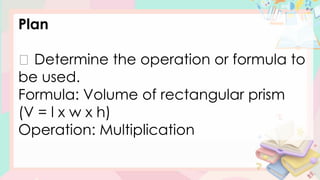
Plan
Determine the operation or formula to
be used.
Formula: Volume of rectangular prism
(V = l x w x h)
Operation: Multiplication
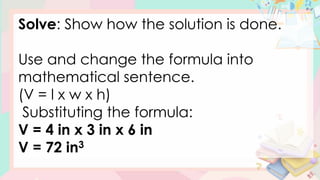
Solve: Show how the solution is done.
Use and change the formula into
mathematical sentence.
(V = l x w x h)
Substituting the formula:
V = 4 in x 3 in x 6 in
V = 72 in3
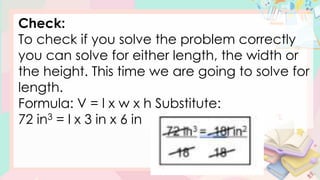
Check:
To check if you solve the problem correctly
you can solve for either length, the width or
the height. This time we are going to solve for
length.
Formula: V = l x w x h Substitute:
72 in3 = l x 3 in x 6 in
Problem 2
Jules gift to his father’s birthday is a
rubik’s cube because it was his favorite
pastime. What is the volume of the
Rubik’s cube if the edge is 5
centimeters?
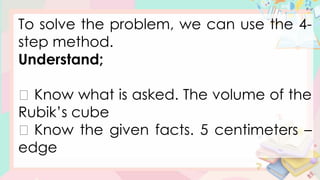
To solve the problem, we can use the 4-
step method.
Understand;
Know what is asked. The volume of the
Rubik’s cube
Know the given facts. 5 centimeters –
edge
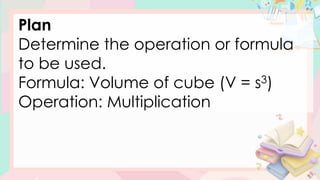
Plan
Determine the operation or formula
to be used.
Formula: Volume of cube (V = s3)
Operation: Multiplication
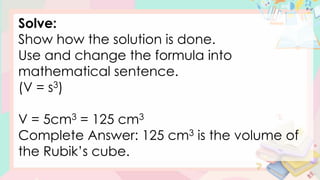
Solve:
Show how the solution is done.
Use and change the formula into
mathematical sentence.
(V = s3)
V = 5cm3 = 125 cm3
Complete Answer: 125 cm3 is the volume of
the Rubik’s cube.
Check:
To check if we solve the problem correctly
just go back to your solution and check your
computation.
PRACTICE EXERCISE
1. A rectangular tank measures 6 dm long, 5
dm wide and 20 dm tall. What is the volume
of the tank?
____________________________________________
_________________
2. What is the volume of the cube with an
edge of 7 cm? __________________________
3. The Town Engineer made a model of the
building to house the patients of Covid 19.
The model building has the length of 8 dm,5
dm as the width and 14 dm as the height.
Find the volume of the building.
____________________________
What is the meaning of routine problem?
Routine problems are real life problems.
- It involves at least one of the four operations
to solve practical problems.
- It requires basic skills and organized and
sequenced steps.
- Planned strategies and methods are
needed to come up with the answer.
Remember:
Routine problems are practical problems and
can be solved using the 4-step method.
These methods are:
1. understanding the problem- know what is
asked and identify the given facts;
2. planning-determine the formula or
operation.
3. solving-show how the solution is done;
4. checking;
Directions: Read each problem carefully and
encircle the letter of the correct answer.
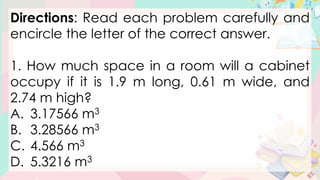
1. How much space in a room will a cabinet
occupy if it is 1.9 m long, 0.61 m wide, and
2.74 m high?
A. 3.17566 m3
B. 3.28566 m3
C. 4.566 m3
D. 5.3216 m3
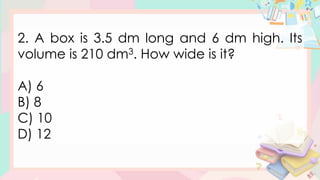
2. A box is 3.5 dm long and 6 dm high. Its
volume is 210 dm3. How wide is it?
A) 6
B) 8
C) 10
D) 12
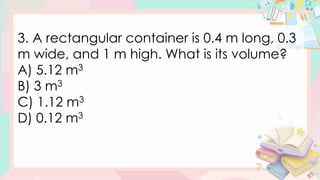
3. A rectangular container is 0.4 m long, 0.3
m wide, and 1 m high. What is its volume?
A) 5.12 m3
B) 3 m3
C) 1.12 m3
D) 0.12 m3
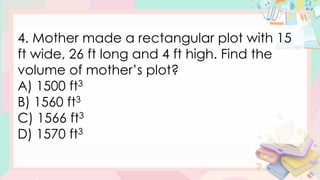
4. Mother made a rectangular plot with 15
ft wide, 26 ft long and 4 ft high. Find the
volume of mother’s plot?
A) 1500 ft3
B) 1560 ft3
C) 1566 ft3
D) 1570 ft3
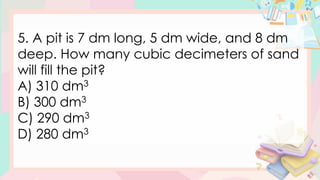
5. A pit is 7 dm long, 5 dm wide, and 8 dm
deep. How many cubic decimeters of sand
will fill the pit?
A) 310 dm3
B) 300 dm3
C) 290 dm3
D) 280 dm3
MATHEMATICS 5
QUARTER 4 WEEK 3
D
A
Y
4
Solving non-routine
problems involving volume
of a cube and rectangular
prism.
Review:
What is the meaning of Routine
Problems?
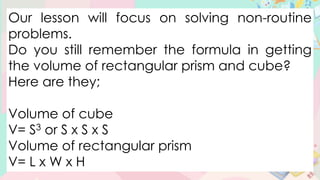
Our lesson will focus on solving non-routine
problems.
Do you still remember the formula in getting
the volume of rectangular prism and cube?
Here are they;
Volume of cube
V= S3 or S x S x S
Volume of rectangular prism
V= L x W x H
A non-routine problem is any complex
problem that requires some degree of
creativity or originality to solve. Non-
routine problems typically do not have an
immediately apparent strategy for solving
them. Oftentimes, these problems can be
solved in multiple ways.
TRY TO DISCOVER!
An aquarium is 100 cm long, 50 cm wide
and 80 cm high. If it is filled halfway through
its height, how much volume of water is in
it?
We can apply the following steps in solving
the given problem.
Step 1. Understand:
Read and understand. No pencil or
paper necessary for this step.
Remember, you cannot solve a
problem until you know what the
problem is!
What is asked in the problem?
The volume of water in the aquarium.
What are the needed information?
Length= 100 cm
width = 50 cm
height = 80 cm
Step 2. Plan:
Now it’s time to decide on a plan of
action! Choose a reasonable
problem-solving strategy.
Several are listed below. You may only
need to use one strategy or a combination
of strategies.
• draw a picture or diagram
• make an organized list
• make a table
• solve a simpler related problem
• find a pattern
• guess and check
• act out a problem
• work backward
• write an equation
• use manipulatives
• break it into parts
• use logical reasoning
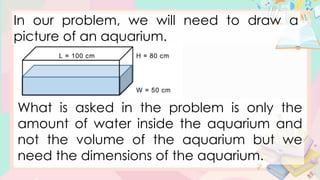
In our problem, we will need to draw a
picture of an aquarium.
What is asked in the problem is only the
amount of water inside the aquarium and
not the volume of the aquarium but we
need the dimensions of the aquarium.
Step 3. Solve or Execute:
Now it’s time to dig in and get to work!
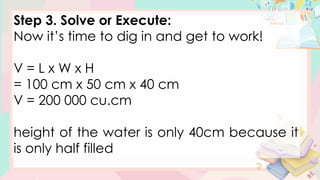
V = L x W x H
= 100 cm x 50 cm x 40 cm
V = 200 000 cu.cm
height of the water is only 40cm because it
is only half filled
Step 4. Check or Review:
Reviewing your work is just as important as
the first 3 steps! Reread the problem and
review all your work.
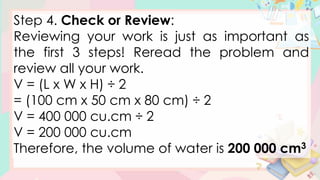
V = (L x W x H) ÷ 2
= (100 cm x 50 cm x 80 cm) ÷ 2
V = 400 000 cu.cm ÷ 2
V = 200 000 cu.cm
Therefore, the volume of water is 200 000 cm3
Let’s try another one.
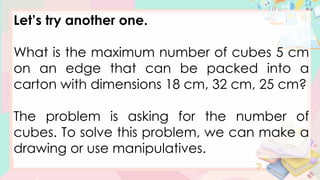
What is the maximum number of cubes 5 cm
on an edge that can be packed into a
carton with dimensions 18 cm, 32 cm, 25 cm?
The problem is asking for the number of
cubes. To solve this problem, we can make a
drawing or use manipulatives.
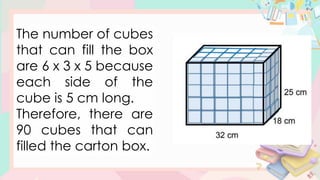
The number of cubes
that can fill the box
are 6 x 3 x 5 because
each side of the
cube is 5 cm long.
Therefore, there are
90 cubes that can
filled the carton box.
PRACTICE EXERCISE 1
Read the problem and do the needed
steps.
The width of a rectangular prism is
doubled, its length is tripled, and its height
is cut in half. If the volume of the original
prism was V, what is its new volume?.
1.What is asked?
__________________________________________
2. What are the given?
__________________________________________
3. What strategy will you do?
__________________________________________
4. What is the operation?
________________________________________
5. What is the answer?
__________________________________________
What is the meaning of non-routine
problem?
A non-routine problem is any complex
problem that requires some degree of
creativity or originality to solve. Non-routine
problems typically do not have an
immediately apparent strategy for solving
them. Oftentimes, these problems can be
solved in multiple ways.
REMEMBER
In solving non routine problems we can
used different strategies to be able to it .
You may only need to use one strategy
or a combination of strategies.
• draw a picture or diagram
• make an organized list
• make a table
• solve a simpler related problem
• find a pattern
• guess and check
• act out a problem
• work backward
• write an equation
• use manipulatives
• break it into parts
• use logical reasoning
MATHEMATICS 5
QUARTER 4 WEEK 3
D
A
Y
5
Catch-Up Friday

Quarter 4 Wee 3 MATHEMATICS POWERPOINT 5

  • 1.
    MATHEMATICS 5 QUARTER 4WEEK 3 D A Y 1 Finding the Volume of a given Cube and Rectangular Prism
  • 2.
  • 3.
    Consider the problembelow. Teacher Leny brought to her class a 3 × 3 × 3 Rubik’s cube. She told the class to determine the amount of space enclosed in the object. A Rubik’s cube is a solid figure which contains cubic units. If each is a cubic unit, how many cubic units are there in the figure? How many cubic units are there in one layer? How many layers are there? How many cubic units are there?
  • 4.
    In this lesson,you are going to deal about finding the volume of a given cube and a rectangular prism using cubic centimeters (cu. cm or cm³) and cubic meters (cu. m or m³).
  • 5.
    Study the answerof the given problem. Teacher Leny brought to her class a 3 × 3 × 3 Rubik’s cube. She told the class to determine the amount of space enclosed in the object. A Rubik’s cube is a solid figure which contains cubic units.
  • 6.
    If each isa cubic unit, how many cubic units are there in the figure? How many cubic units are there in one layer? How many layers are there? How many cubic units are there?
  • 7.
    In a rectangularprism, the base is always a rectangle. The area of the base is the product of its length (l) and width (w). Thus, to get the volume of the prism, we may multiply the area of the base with the height (h).
  • 8.
    Volume of arectangular prism = area of the base × height of the prism 𝑉 = l × w × h. Study the rectangular prism below and the computation for its volume on the right.
  • 10.
    Note that 125cm³ is read either as 125 cubic centimeters or 125 centimeters cube.
  • 12.
    Example 3 What isthe amount of space that is occupied by a rectangular pool which is 5.5 m in width, 10 m in height and 7 m in depth (height).
  • 13.
    Complete Me! Direction: Findthe volume of the cubes and rectangular prisms. On your answer sheet, copy and supply your answers for the following.
  • 16.
    In your ownwords, explain how to find the volume of a cube and a rectangular prism.
  • 17.
    What is theformula in getting the volume of a cube? How about rectangular prism?
  • 18.
    Find Me! Directions: Findthe volume of the solid figures below. Write your answers in your Math Activity notebook.
  • 21.
    MATHEMATICS 5 QUARTER 4WEEK 3 D A Y 2 Estimating and using appropriate units of measure for volume
  • 22.
    Review; Let us recallsome of the different cubic units of measure in the metric system arranged from smallest to largest unit. mm3 cm3 dm3 m3 dam3 hm3 km3 Answer: mm3 cm3 dm3 m3 dam3 hm3 km3
  • 23.
    Look at thepicture: What is in the picture? Have you ever measured the length, height and width of a book? Which of the following units of measure would be appropriate to use?
  • 24.
    You already havean idea how big or small everyday objects are. You should have an idea of how big or small the different units of volume are so you can match these with the objects.
  • 25.
    The common unitsof measure for lengths, width, and height are meter, centimeter, millimeter, foot, yard and inch. In our country, we are usually using the units in metric system like meters, kilometers, centimeters and millimeters. Other countries use the units in imperial system like feet, yards and inches. You may have seen people using feet, yards and inches for measuring lengths.
  • 26.
    If we needto measure the dimensions of a small object, we can use centimeter, millimeter, decimeter, or inches. However, for bigger, longer or wider objects, the units that can be used are foot, yard, meter or kilometer.
  • 27.
    You already knowthat volume is the amount of space that is enclosed in a 3- dimensional or solid figure. Since it is an amount of space, it has to be measured in cubes. For instance, if the dimensions of a solid figure are in meters, the volume would be measured in cubic meters or m3. If the 3- dimensional figure is measured in inches, the volume would be in cubic inches or in3.
  • 28.
    Let’s consider theexample in the previous part of the lesson. What do you think is an appropriate unit of measure to be used for finding the volume of the book?
  • 29.
    A book mayrepresent a solid figure. Its dimensions are small. Hence, the volume is also small. Therefore, you may use inches or centimeters as units of measure for the length, width and height of the book. The volume of the book can be in cubic inches or cubic centimeters.
  • 30.
    Read and studythe examples below. Example 1 For the volume of the water in an aquarium, the appropriate units of measure to use are cubic centimeters (cm3) or cubic inches (in3).
  • 31.
    Example 2 The appropriateunit of measure for the amount of space enclosed in the tank is cubic meters or m3.
  • 32.
    Another Examples Example 3 Letthe volume of Figure A be 100 cm3. We can estimate the volumes of the other figures.
  • 33.
    Figure B isalmost half of the size of Figure A. Figure C is almost double the size of Figure A. Figure D is about the same size of Figure A.
  • 34.
    Thus, the volumesof Figures B, C and D are approximately 50 cm3, 200 cm3 and 100 cm3, respectively.
  • 35.
    Example 4 A boxis in the shape of rectangular prism. Its length, width and height are 2.8 m, 1.1 m and 0.95 m. Multiplying the dimensions, rounded off to the nearest whole numbers, gives a good estimate of the volume of the prism. Length: 2.8 m is rounded up to 3 m. Width: 1.1 m is rounded down to 1 m. Height: 0.95 m is rounded up to 1 m.
  • 36.
    Approximate volume =length × width × height = 3 m × 1 𝑚 × 1 𝑚 = 3 m3 Thus, an estimate for the volume of the box is 3 m3. It could also between 2 m3 and 3 m3.
  • 37.
    Example 5 A pieceof wood is in the shape of a cube. If its edge is 0.21 m, estimate the volume of the piece of wood.
  • 38.
    Solution: If weare going to estimate the volume of the piece of wood, it is not logical to round it off to the nearest whole number, as that would be zero. This would give us a zero cubic meter for volume. Since rounding off to the nearest whole number is not a good strategy, we may do it another way. You already know that 1 m = 100 cm..
  • 39.
    It follows that 0.21m = 21 cm ≈ 21 cm. Let us use 20 cm as our estimate. Approximate volume = 20 𝑐𝑚 × 20 𝑐𝑚 × 20 𝑐 𝑚 = 8 000 cm3 Thus, an estimate for the volume of the wood is 8 000 cm3. It must be less than a cubic meter.
  • 40.
    Choose Me In! Directions:Select the appropriate unit of measure for the volumes of the following objects. Write your answers on a separate sheet of paper.
  • 42.
    What are theappropriate unit of measure used for volumes of the following items in our kitchen. 1. Refrigerator 2. Kitchen Cabinet
  • 43.
    What have youlearned?
  • 44.
    Pair Me Up! Directions:Match the items in column A with the units of measure in column B in finding the volume of the given objects. Write the letter of your answer on your answer sheet.
  • 46.
    MATHEMATICS 5 QUARTER 4WEEK 3 D A Y 3 Solving routine problems involving volume of a cube and rectangular prism.
  • 47.
    Review! Pair MeUp! Directions: Match the items in column A with the units of measure in column B in finding the volume of the given objects. Write the letter of your answer on your answer sheet.
  • 49.
    Ask: What do youmean by the word “Routine”?
  • 50.
    Routine problems arereal life problems. - It involves at least one of the four operations to solve practical problems. - It requires basic skills and organized and sequenced steps. - Planned strategies and methods are needed to come up with the answer.
  • 51.
    This Four-Step Methodis used to solve the problem. 1. Understand: Know what is asked. Identify the given facts. 2. Plan: Choose the operation or the formula to be used. 3. Solve: Perform the strategy.
  • 52.
    Suggested Strategies a. Drawinga model/diagram b. Using a formula and changing them to mathematical symbol. c. Working Backward 4. Check: Verify if the answer is correct.
  • 53.
    Remember: Volume (V) isthe number of cubic units needed to fill the shape. It is the amount of space that is occupied by a solid figure. Cube and rectangular prism are examples of a solid figure.
  • 54.
    The formula infinding the volume of a cube: V= s x s x s or s3 The formula in finding the volume of rectangular prism is V = l x w x h
  • 55.
    Problem 1 Miguel madea rectangular prism picture frame with the family’s picture on its faces as his birthday gift to his father and mother who happens to have the same birthdate. Find the volume of Miguel’s picture frame with 4 inches long, 3 inches wide and 6 inches tall.
  • 56.
    To solve theproblem, we can use the 4- Step Method. Understand: Know what is asked. The volume of Miguel’s picture frame Know the given facts. 4 inches – length 3 inches width 6 inches height
  • 57.
    Plan Determine the operationor formula to be used. Formula: Volume of rectangular prism (V = l x w x h) Operation: Multiplication
  • 58.
    Solve: Show howthe solution is done. Use and change the formula into mathematical sentence. (V = l x w x h) Substituting the formula: V = 4 in x 3 in x 6 in V = 72 in3
  • 59.
    Check: To check ifyou solve the problem correctly you can solve for either length, the width or the height. This time we are going to solve for length. Formula: V = l x w x h Substitute: 72 in3 = l x 3 in x 6 in
  • 60.
    Problem 2 Jules giftto his father’s birthday is a rubik’s cube because it was his favorite pastime. What is the volume of the Rubik’s cube if the edge is 5 centimeters?
  • 61.
    To solve theproblem, we can use the 4- step method. Understand; Know what is asked. The volume of the Rubik’s cube Know the given facts. 5 centimeters – edge
  • 62.
    Plan Determine the operationor formula to be used. Formula: Volume of cube (V = s3) Operation: Multiplication
  • 63.
    Solve: Show how thesolution is done. Use and change the formula into mathematical sentence. (V = s3) V = 5cm3 = 125 cm3 Complete Answer: 125 cm3 is the volume of the Rubik’s cube.
  • 64.
    Check: To check ifwe solve the problem correctly just go back to your solution and check your computation.
  • 65.
    PRACTICE EXERCISE 1. Arectangular tank measures 6 dm long, 5 dm wide and 20 dm tall. What is the volume of the tank? ____________________________________________ _________________ 2. What is the volume of the cube with an edge of 7 cm? __________________________
  • 66.
    3. The TownEngineer made a model of the building to house the patients of Covid 19. The model building has the length of 8 dm,5 dm as the width and 14 dm as the height. Find the volume of the building. ____________________________
  • 67.
    What is themeaning of routine problem? Routine problems are real life problems. - It involves at least one of the four operations to solve practical problems. - It requires basic skills and organized and sequenced steps. - Planned strategies and methods are needed to come up with the answer.
  • 68.
    Remember: Routine problems arepractical problems and can be solved using the 4-step method. These methods are: 1. understanding the problem- know what is asked and identify the given facts; 2. planning-determine the formula or operation. 3. solving-show how the solution is done; 4. checking;
  • 69.
    Directions: Read eachproblem carefully and encircle the letter of the correct answer. 1. How much space in a room will a cabinet occupy if it is 1.9 m long, 0.61 m wide, and 2.74 m high? A. 3.17566 m3 B. 3.28566 m3 C. 4.566 m3 D. 5.3216 m3
  • 70.
    2. A boxis 3.5 dm long and 6 dm high. Its volume is 210 dm3. How wide is it? A) 6 B) 8 C) 10 D) 12
  • 71.
    3. A rectangularcontainer is 0.4 m long, 0.3 m wide, and 1 m high. What is its volume? A) 5.12 m3 B) 3 m3 C) 1.12 m3 D) 0.12 m3
  • 72.
    4. Mother madea rectangular plot with 15 ft wide, 26 ft long and 4 ft high. Find the volume of mother’s plot? A) 1500 ft3 B) 1560 ft3 C) 1566 ft3 D) 1570 ft3
  • 73.
    5. A pitis 7 dm long, 5 dm wide, and 8 dm deep. How many cubic decimeters of sand will fill the pit? A) 310 dm3 B) 300 dm3 C) 290 dm3 D) 280 dm3
  • 74.
    MATHEMATICS 5 QUARTER 4WEEK 3 D A Y 4 Solving non-routine problems involving volume of a cube and rectangular prism.
  • 75.
    Review: What is themeaning of Routine Problems?
  • 76.
    Our lesson willfocus on solving non-routine problems. Do you still remember the formula in getting the volume of rectangular prism and cube? Here are they; Volume of cube V= S3 or S x S x S Volume of rectangular prism V= L x W x H
  • 77.
    A non-routine problemis any complex problem that requires some degree of creativity or originality to solve. Non- routine problems typically do not have an immediately apparent strategy for solving them. Oftentimes, these problems can be solved in multiple ways.
  • 78.
    TRY TO DISCOVER! Anaquarium is 100 cm long, 50 cm wide and 80 cm high. If it is filled halfway through its height, how much volume of water is in it? We can apply the following steps in solving the given problem.
  • 79.
    Step 1. Understand: Readand understand. No pencil or paper necessary for this step. Remember, you cannot solve a problem until you know what the problem is!
  • 80.
    What is askedin the problem? The volume of water in the aquarium. What are the needed information? Length= 100 cm width = 50 cm height = 80 cm
  • 81.
    Step 2. Plan: Nowit’s time to decide on a plan of action! Choose a reasonable problem-solving strategy.
  • 82.
    Several are listedbelow. You may only need to use one strategy or a combination of strategies. • draw a picture or diagram • make an organized list • make a table • solve a simpler related problem • find a pattern • guess and check
  • 83.
    • act outa problem • work backward • write an equation • use manipulatives • break it into parts • use logical reasoning
  • 84.
    In our problem,we will need to draw a picture of an aquarium. What is asked in the problem is only the amount of water inside the aquarium and not the volume of the aquarium but we need the dimensions of the aquarium.
  • 85.
    Step 3. Solveor Execute: Now it’s time to dig in and get to work! V = L x W x H = 100 cm x 50 cm x 40 cm V = 200 000 cu.cm height of the water is only 40cm because it is only half filled
  • 86.
    Step 4. Checkor Review: Reviewing your work is just as important as the first 3 steps! Reread the problem and review all your work. V = (L x W x H) ÷ 2 = (100 cm x 50 cm x 80 cm) ÷ 2 V = 400 000 cu.cm ÷ 2 V = 200 000 cu.cm Therefore, the volume of water is 200 000 cm3
  • 87.
    Let’s try anotherone. What is the maximum number of cubes 5 cm on an edge that can be packed into a carton with dimensions 18 cm, 32 cm, 25 cm? The problem is asking for the number of cubes. To solve this problem, we can make a drawing or use manipulatives.
  • 88.
    The number ofcubes that can fill the box are 6 x 3 x 5 because each side of the cube is 5 cm long. Therefore, there are 90 cubes that can filled the carton box.
  • 89.
    PRACTICE EXERCISE 1 Readthe problem and do the needed steps. The width of a rectangular prism is doubled, its length is tripled, and its height is cut in half. If the volume of the original prism was V, what is its new volume?.
  • 90.
    1.What is asked? __________________________________________ 2.What are the given? __________________________________________ 3. What strategy will you do? __________________________________________ 4. What is the operation? ________________________________________ 5. What is the answer? __________________________________________
  • 91.
    What is themeaning of non-routine problem? A non-routine problem is any complex problem that requires some degree of creativity or originality to solve. Non-routine problems typically do not have an immediately apparent strategy for solving them. Oftentimes, these problems can be solved in multiple ways.
  • 92.
    REMEMBER In solving nonroutine problems we can used different strategies to be able to it . You may only need to use one strategy or a combination of strategies. • draw a picture or diagram • make an organized list • make a table
  • 93.
    • solve asimpler related problem • find a pattern • guess and check • act out a problem • work backward • write an equation • use manipulatives • break it into parts • use logical reasoning
  • 96.
    MATHEMATICS 5 QUARTER 4WEEK 3 D A Y 5 Catch-Up Friday