Polygons The word
‘polygon’ is a
Greek word.
PolyPoly means
many and
gongon means
angles.

Polygons
Polygons
• The word polygon
means “many angles”
• A two dimensional
object
• A closed figure
More about Polygons
• Made up of three or more
straight line segments
• There are exactly two sides
that meet at a vertex
• The sides do not cross each
other
Polygons
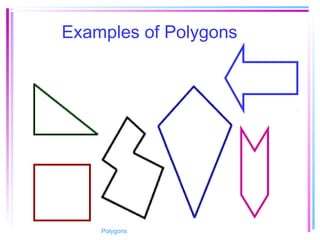
Examples of Polygons
Polygons
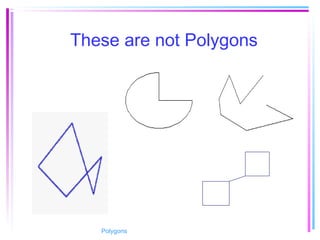
These are not Polygons
Polygons
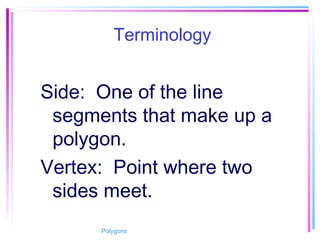
Terminology
Side: One of the line
segments that make up a
polygon.
Vertex: Point where two
sides meet.
Polygons
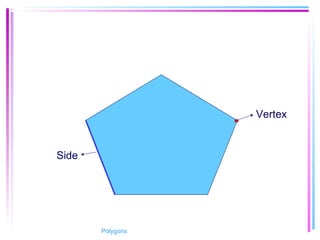
Vertex
Side
Polygons
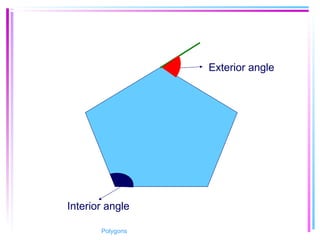
• Interior angle: An angle
formed by two adjacent
sides inside the polygon.
• Exterior angle: An angle
formed by two adjacent
sides outside the polygon.
Polygons
Interior angle
Exterior angle
Polygons
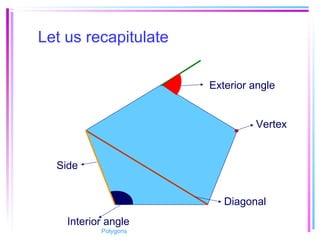
Let us recapitulate
Interior angle
Diagonal
Vertex
Side
Exterior angle
Polygons
Types of Polygons
• Equiangular Polygon: a
polygon in which all of the
angles are equal
• Equilateral Polygon: a
polygon in which all of the
sides are the same length
Polygons
• Regular Polygon: a
polygon where all the
angles are equal and all
of the sides are the same
length. They are both
equilateral and
equiangular
Polygons
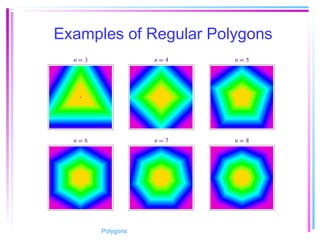
Examples of Regular Polygons
Polygons
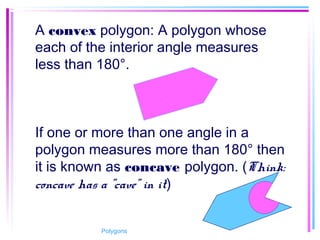
A convex polygon: A polygon whose
each of the interior angle measures
less than 180°.
If one or more than one angle in a
polygon measures more than 180° then
it is known as concave polygon. (Think:
concave has a "cave" in it)
Polygons
INTERIOR ANGLES
OF A POLYGON
Polygons
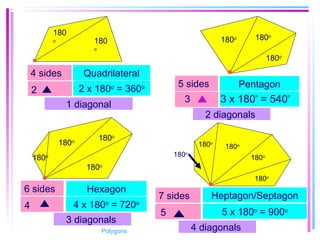
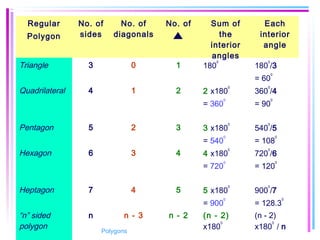
Let us find the connection
between the number of sides,
number of diagonals and the
number of triangles of a
polygon.
Polygons
Quadrilateral
Pentagon
180
o 180
o
180o 180o
180o
2 x 180o
= 360o
3
4 sides
5 sides
3 x 180
o
= 540
o
Hexagon6 sides
180o 180o
180o
180o
4 x 180o
= 720o
4
Heptagon/Septagon7 sides
180o
180o
180o
180o
180o
5 x 180o
= 900o
5
2
1 diagonal
2 diagonals
3 diagonals
4 diagonalsPolygons
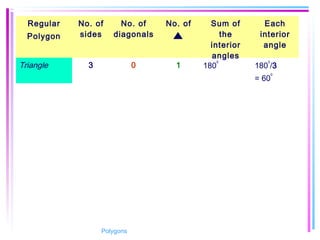
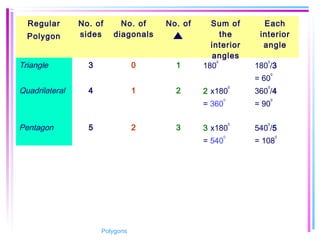
Regular
Polygon
No. of
sides
No. of
diagonals
No. of Sum of
the
interior
angles
Each
interior
angle
Triangle 3 0 1 180
0
180
0
/3
= 60
0
Polygons
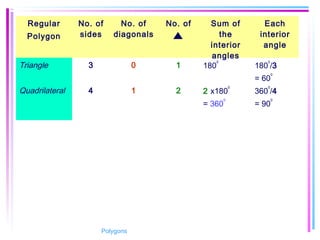
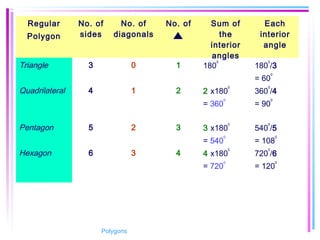
Regular
Polygon
No. of
sides
No. of
diagonals
No. of Sum of
the
interior
angles
Each
interior
angle
Triangle 3 0 1 180
0
180
0
/3
= 60
0
Quadrilateral 4 1 2 2 x180
0
= 360
0
360
0
/4
= 90
0
Polygons
Regular
Polygon
No. of
sides
No. of
diagonals
No. of Sum of
the
interior
angles
Each
interior
angle
Triangle 3 0 1 180
0
180
0
/3
= 60
0
Quadrilateral 4 1 2 2 x180
0
= 360
0
360
0
/4
= 90
0
Pentagon 5 2 3 3 x180
0
= 540
0
540
0
/5
= 108
0
Polygons
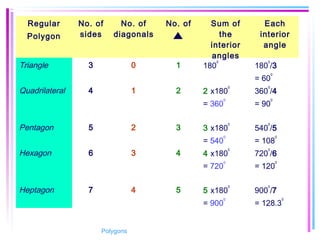
Regular
Polygon
No. of
sides
No. of
diagonals
No. of Sum of
the
interior
angles
Each
interior
angle
Triangle 3 0 1 180
0
180
0
/3
= 60
0
Quadrilateral 4 1 2 2 x180
0
= 360
0
360
0
/4
= 90
0
Pentagon 5 2 3 3 x180
0
= 540
0
540
0
/5
= 108
0
Hexagon 6 3 4 4 x180
0
= 720
0
720
0
/6
= 120
0
Polygons
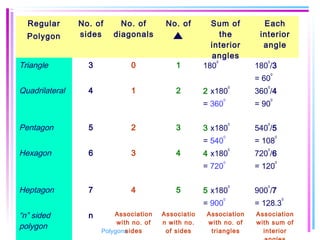
Regular
Polygon
No. of
sides
No. of
diagonals
No. of Sum of
the
interior
angles
Each
interior
angle
Triangle 3 0 1 180
0
180
0
/3
= 60
0
Quadrilateral 4 1 2 2 x180
0
= 360
0
360
0
/4
= 90
0
Pentagon 5 2 3 3 x180
0
= 540
0
540
0
/5
= 108
0
Hexagon 6 3 4 4 x180
0
= 720
0
720
0
/6
= 120
0
Heptagon 7 4 5 5 x180
0
= 900
0
900
0
/7
= 128.3
0
Polygons
Regular
Polygon
No. of
sides
No. of
diagonals
No. of Sum of
the
interior
angles
Each
interior
angle
Triangle 3 0 1 180
0
180
0
/3
= 60
0
Quadrilateral 4 1 2 2 x180
0
= 360
0
360
0
/4
= 90
0
Pentagon 5 2 3 3 x180
0
= 540
0
540
0
/5
= 108
0
Hexagon 6 3 4 4 x180
0
= 720
0
720
0
/6
= 120
0
Heptagon 7 4 5 5 x180
0
= 900
0
900
0
/7
= 128.3
0
“n” sided
polygon
n Association
with no. of
sides
Associatio
n with no.
of sides
Association
with no. of
triangles
Association
with sum of
interiorPolygons
Regular
Polygon
No. of
sides
No. of
diagonals
No. of Sum of
the
interior
angles
Each
interior
angle
Triangle 3 0 1 180
0
180
0
/3
= 60
0
Quadrilateral 4 1 2 2 x180
0
= 360
0
360
0
/4
= 90
0
Pentagon 5 2 3 3 x180
0
= 540
0
540
0
/5
= 108
0
Hexagon 6 3 4 4 x180
0
= 720
0
720
0
/6
= 120
0
Heptagon 7 4 5 5 x180
0
= 900
0
900
0
/7
= 128.3
0
“n” sided
polygon
n n - 3 n - 2 (n - 2)
x180
0
(n - 2)
x180
0
/ nPolygons
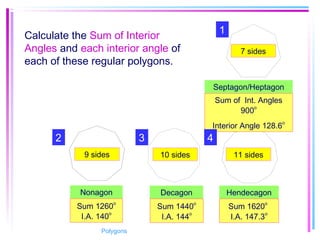
Septagon/Heptagon
Decagon Hendecagon
7 sides
10 sides 11 sides9 sides
Nonagon
Sum of Int. Angles
900
o
Interior Angle 128.6
o
Sum 1260
o
I.A. 140
o
Sum 1440o
I.A. 144
o
Sum 1620o
I.A. 147.3
o
Calculate the Sum of Interior
Angles and each interior angle of
each of these regular polygons.
1
2 43
Polygons
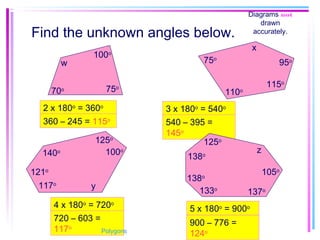
2 x 180o
= 360o
360 – 245 = 115o
3 x 180o
= 540o
540 – 395 =
145o
y117o
121o
100o
125o
140o z
133o
137o
138o
138o
125o
105o
Find the unknown angles below.
Diagrams not
drawn
accurately.
75o
100o
70o
w
x
115o
110o
75o
95o
4 x 180o
= 720o
720 – 603 =
117o
5 x 180o
= 900o
900 – 776 =
124oPolygons
EXTERIOR
ANGLES OF A
POLYGON
Polygons
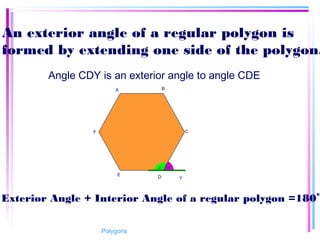
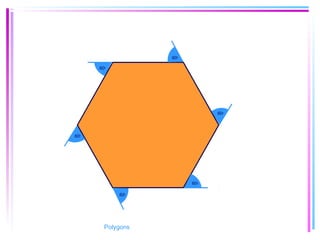
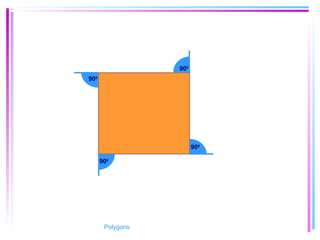
An exterior angle of a regular polygon is
formed by extending one side of the polygon.
Angle CDY is an exterior angle to angle CDE
Exterior Angle + Interior Angle of a regular polygon =180
0
DE
Y
B
C
A
F
12
Polygons
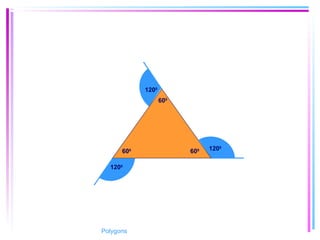
1200
1200
1200
600
600
600
Polygons
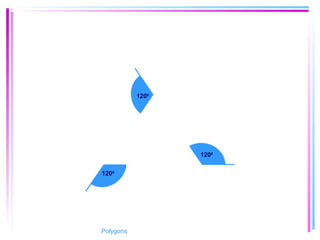
1200
1200
1200
Polygons
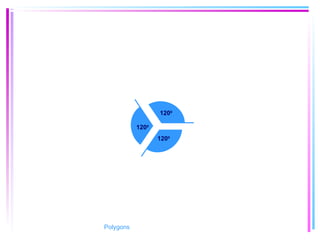
1200
1200
1200
Polygons
3600
Polygons
600
600
600
600
600
600
Polygons
600
600
600
600
600
600
Polygons
1
2
3
4
5
6
600
600
600
600
600
600
Polygons
1
2
3
4
5
6
600
600
600
600
600
600
Polygons
1
2
3
4
5
6
3600
Polygons
900
900
900
900
Polygons
900
900
900
900
Polygons
900
900
900
900
Polygons
1
23
4
3600
Polygons
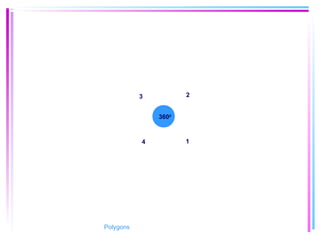
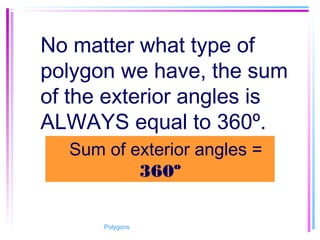
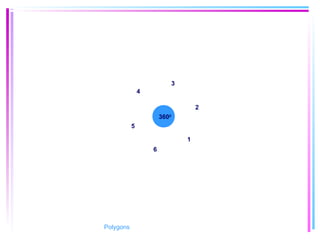
No matter what type of
polygon we have, the sum
of the exterior angles is
ALWAYS equal to 360º.
  Sum of exterior angles =
360º
Polygons
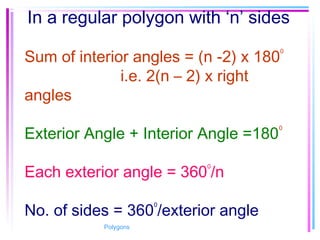
In a regular polygon with ‘n’ sides
Sum of interior angles = (n -2) x 180
0
i.e. 2(n – 2) x right
angles
Exterior Angle + Interior Angle =180
0
Each exterior angle = 360
0
/n
No. of sides = 360
0
/exterior angle
Polygons
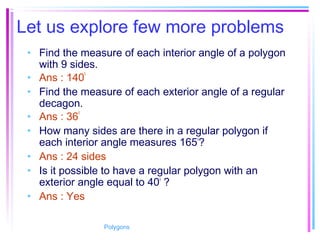
Let us explore few more problems
• Find the measure of each interior angle of a polygon
with 9 sides.
• Ans : 140
0
• Find the measure of each exterior angle of a regular
decagon.
• Ans : 36
0
• How many sides are there in a regular polygon if
each interior angle measures 1650
?
• Ans : 24 sides
• Is it possible to have a regular polygon with an
exterior angle equal to 400
?
• Ans : Yes
Polygons
Polygons DG
This powerpoint was kindly donated to
www.worldofteaching.com
Home to well over a thousand free
powerpoint presentations submitted by
teachers. This a free site. Please visit and I
hope it will help in your teaching

Polygons