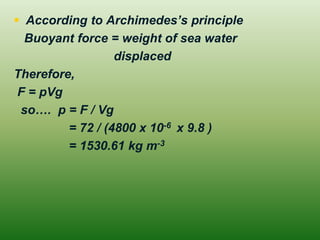
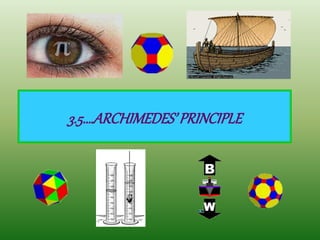
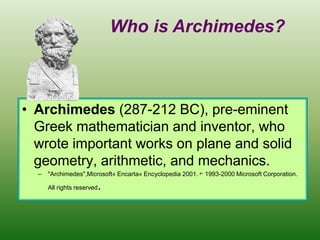
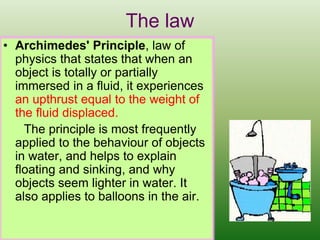
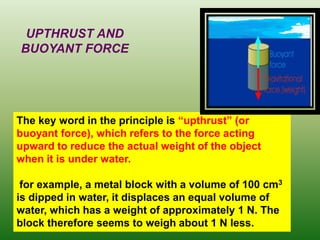
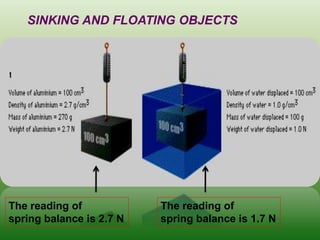
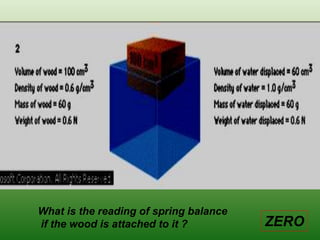
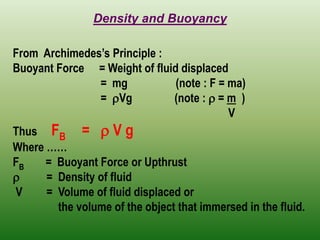
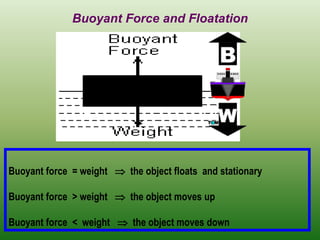
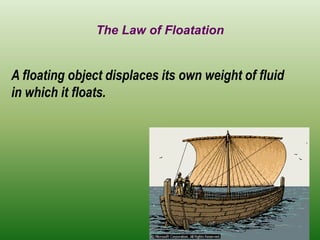
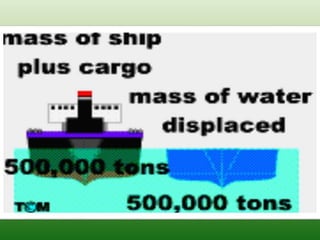
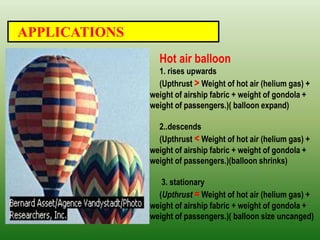
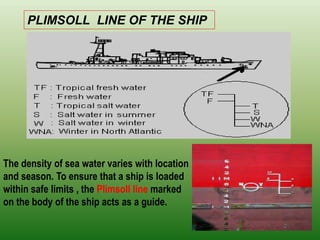
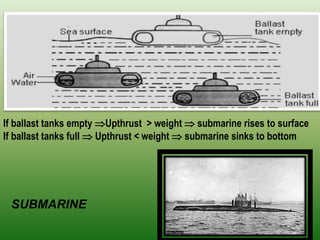
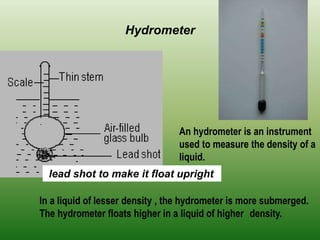
Archimedes' principle states that when an object is fully or partially submerged in a fluid, it experiences an upthrust equal to the weight of the fluid displaced. This principle explains why objects float or sink based on their density. If an object's density is greater than the fluid, it will sink, and if its density is less than the fluid, it will float. The upthrust force reduces the apparent weight felt by submerged objects. Archimedes' principle applies to ships, submarines, hot air balloons, and other objects interacting with fluids. It allows calculation of fluid density based on measurements of weight changes when objects are submerged.
![2. A concrete slab weight 180N. When it is fully
submerged under the sea its apparent weight
is 105N.
Calculate the density of the sea water if the
volume of the sea water displaced by the
concrete slab is 4800 cm3. [ g = 9.8 Nkg-1 ]
Solution :
Buoyant force = actual weight – apparent weight
= 180 – 102
= 72N](https://image.slidesharecdn.com/archimedes-principle-240119063008-359e80d3/85/archimedes-principle-ppt-20-320.jpg)