Poornima inSTiTUTE oF EnGinEErinG & TECHnoLoGY,JaiPUr
ARCHIMEDES
PRINCIPLE
Presented BY;
MD ZAHID SIDDIQUI
Submitted to;
mr.ViKaSH SHarma
CONTENTS
inTroDUCTion aBoUT arCHimEDES PrinCiPLE
rESErCH PaPEr inFormaTion
inTrESTinG FaCTS
3.5….ARCHIMEDES’ PRINCIPLE
The law
 Archimedes' Principle, law of
physics that states that when an
object is totally or partially
immersed in a fluid, it
experiences an upthrust equal to
the weight of the fluid displaced.
The principle is most frequently
applied to the behaviour of objects
in water, and helps to explain
floating and sinking, and why
objects seem lighter in water. It also
applies to balloons in the air.
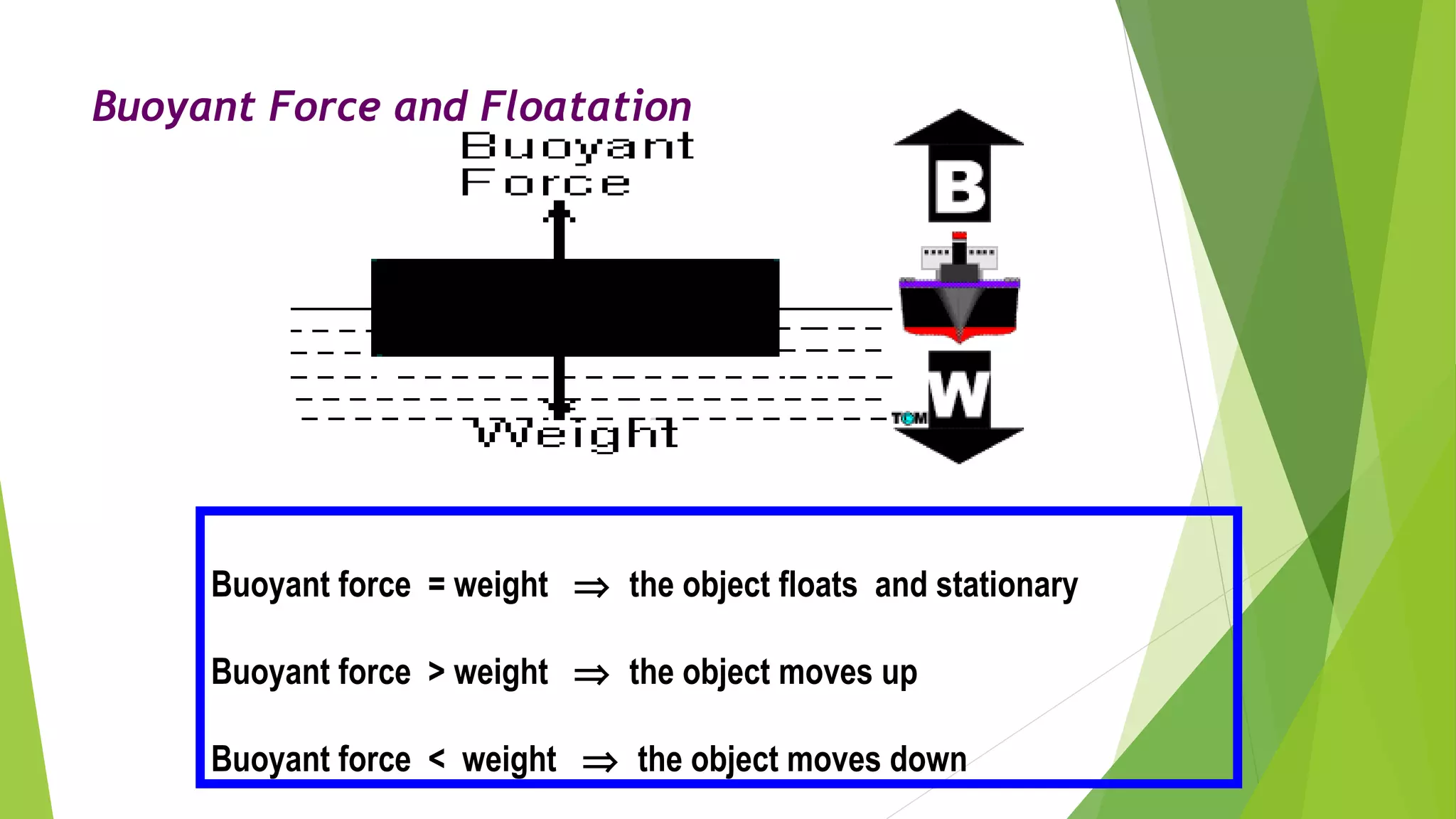
Buoyant Force and Floatation
Buoyant force = weight ⇒ the object floats and stationary
Buoyant force > weight ⇒ the object moves up
Buoyant force < weight ⇒ the object moves down
warm fresh
water
cold fresh
water
warm sea
water
cold sea
water
THINK!!!!!
1. Why the depth of ship immersed in the water different?
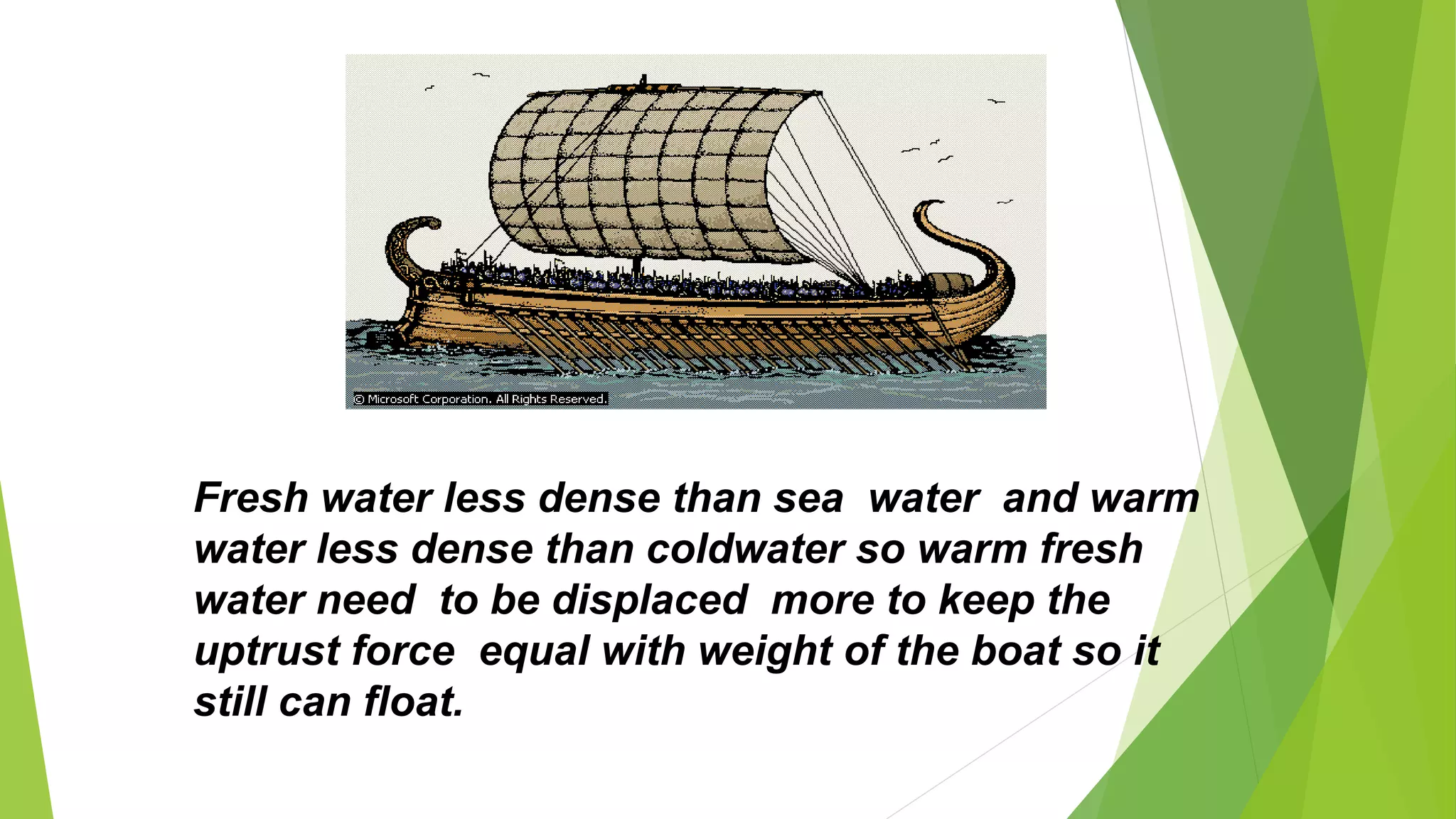
Fresh water less dense than sea water and warm
water less dense than coldwater so warm fresh
water need to be displaced more to keep the
uptrust force equal with weight of the boat so it
still can float.
APPLICATIONS
Hot air balloon
1. rises upwards
(Upthrust > Weight of hot air (helium gas) +
weight of airship fabric + weight of gondola +
weight of passengers.)( balloon expand)
2..descends
(Upthrust < Weight of hot air (helium gas) +
weight of airship fabric + weight of gondola +
weight of passengers.)(balloon shrinks)
3. stationary
(Upthrust = Weight of hot air (helium gas) +
weight of airship fabric + weight of gondola +
weight of passengers.)( balloon size uncanged)
RESERCH PAPER INFORMATION
MATERIAL ISSUES RELATING TO CONSTRUCTION OF SHIP:-
1 STRENGHT
2 WELDABILITY
3 TOUGHNESS
4 MARINE CORROSION
5 THE COST
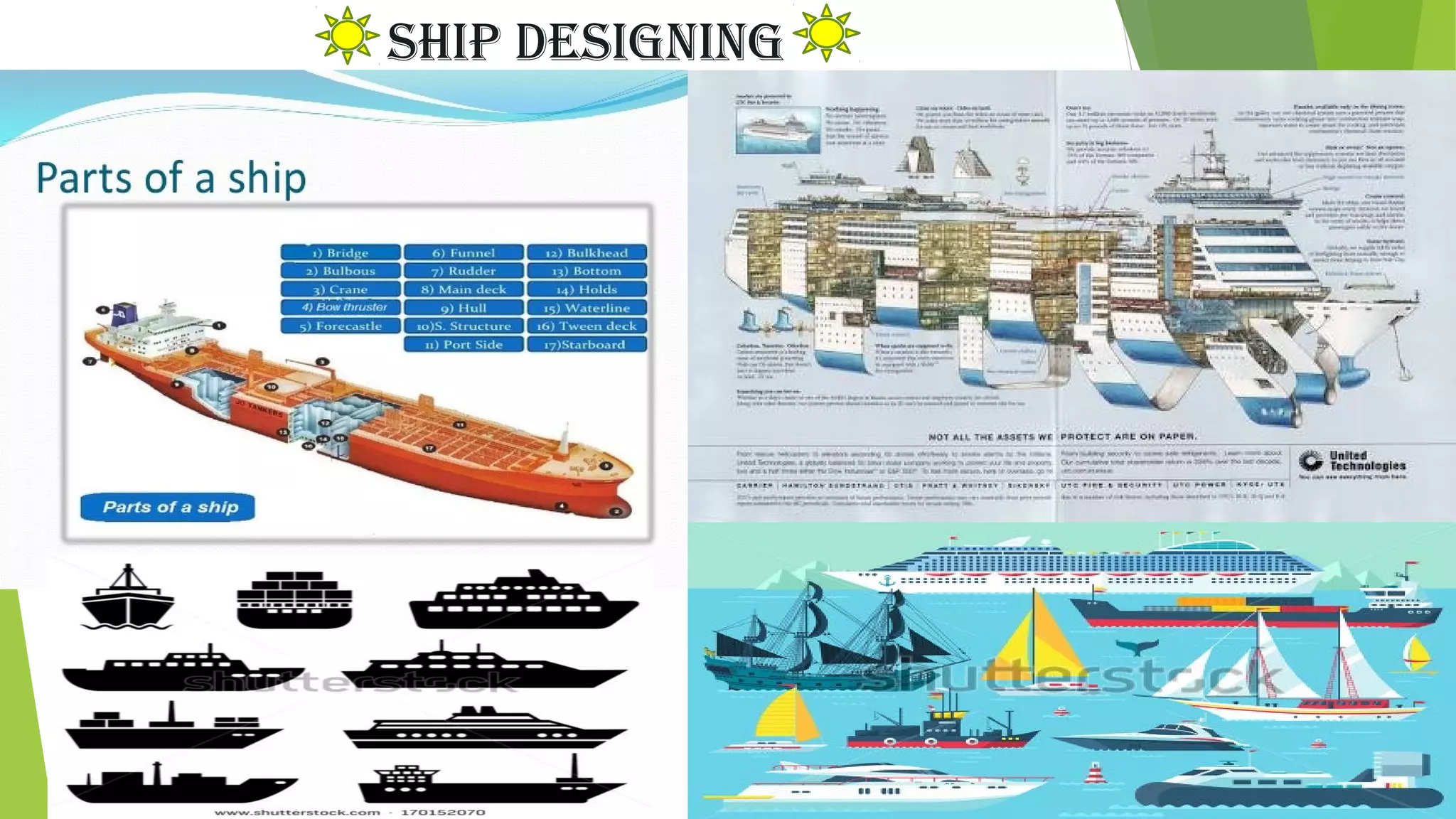
SHIP DESIGNING
[1]. M. Gow, Archimedes: Mathematical Genius of the Ancient World. Enslow Publishers,
Inc. Berkeley Heights , USA, 2005 pp.126. [2]. C.R. Green, Technical Physics. Englewood Cliffs:
Prentice Hall, 1984, pp.217-31. [3]. S. Borowitz and A. Beiser, Essential of Physics. California:
Addison Wesley Publishing Company, 1967, pp. 203-210. [4].
A. Sharma, Speculations in Science and Technology, 20, 1997, 297-300.
10
[5]. A. Sharma, Einstein and Archimedes: Generalized, LAP Lambert Academic Publishers,
Saarbrucken , Germany, 2011, pp.140-144 . [6]. I. Newton, The Principia: Mathematical Principles
of Natural Philosophy (Trans. I. B. Cohen and A. Whitman). Berkeley, CA: 1999, University of
California Press. [7]. G.K. Batchelor, An Introduction to Fluid Dynamics, Cambridge University
Press, 2000, pp.17- 22. [8] Gamow, G., My World Line (Viking, New York). p 44, 1970 [9]. P.G.
Bizzeti, et al. Phys. Rev. Lett., 62, 1989, 2901-2904. [10].H. Lamb, Hydrodynamics, Cambridge,
At University Press 1895, pp. 512-518. [11]. R.A. Millikan, The Electrons (University of Chicago
Press, Chicago), 1980, pp. 80-100 and various references therein.
REFERENCES
DO YOU KNOW??
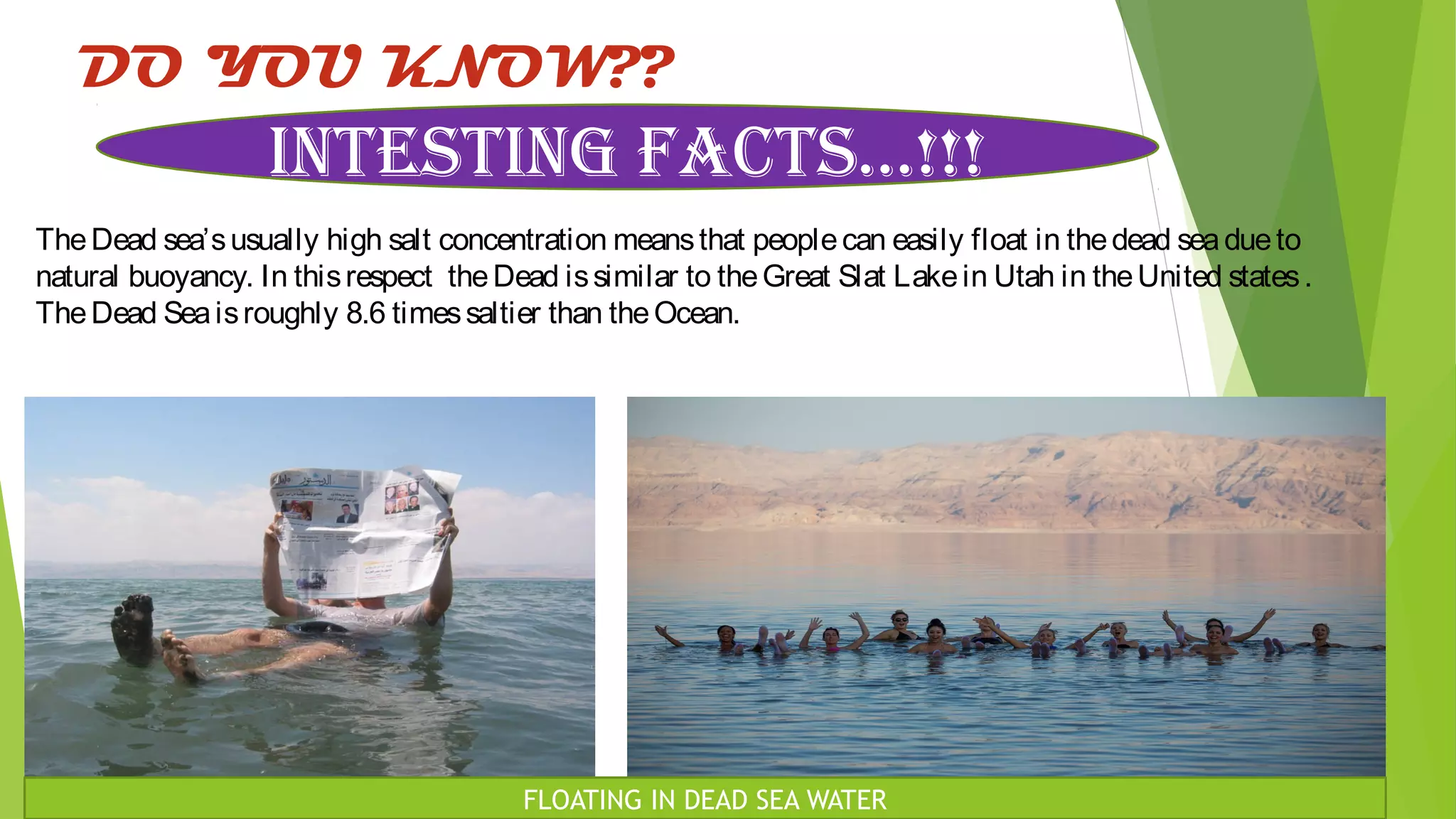
TheDead sea’susually high salt concentration meansthat peoplecan easily float in thedead seadueto
natural buoyancy. In thisrespect theDead issimilar to theGreat Slat Lakein Utah in theUnited states.
TheDead Seaisroughly 8.6 timessaltier than theOcean.
INTESTING FACTS…!!!
FLOATING IN DEAD SEA WATER
INTESTING FACTS…!!!
Archimedes Principle!!!!Best Ppt

Archimedes Principle!!!!Best Ppt

  • 1.
    Poornima inSTiTUTE oFEnGinEErinG & TECHnoLoGY,JaiPUr ARCHIMEDES PRINCIPLE Presented BY; MD ZAHID SIDDIQUI Submitted to; mr.ViKaSH SHarma
  • 2.
    CONTENTS inTroDUCTion aBoUT arCHimEDESPrinCiPLE rESErCH PaPEr inFormaTion inTrESTinG FaCTS
  • 3.
  • 4.
    The law  Archimedes'Principle, law of physics that states that when an object is totally or partially immersed in a fluid, it experiences an upthrust equal to the weight of the fluid displaced. The principle is most frequently applied to the behaviour of objects in water, and helps to explain floating and sinking, and why objects seem lighter in water. It also applies to balloons in the air.
  • 5.
    Buoyant Force andFloatation Buoyant force = weight ⇒ the object floats and stationary Buoyant force > weight ⇒ the object moves up Buoyant force < weight ⇒ the object moves down
  • 6.
    warm fresh water cold fresh water warmsea water cold sea water THINK!!!!! 1. Why the depth of ship immersed in the water different?
  • 7.
    Fresh water lessdense than sea water and warm water less dense than coldwater so warm fresh water need to be displaced more to keep the uptrust force equal with weight of the boat so it still can float.
  • 8.
    APPLICATIONS Hot air balloon 1.rises upwards (Upthrust > Weight of hot air (helium gas) + weight of airship fabric + weight of gondola + weight of passengers.)( balloon expand) 2..descends (Upthrust < Weight of hot air (helium gas) + weight of airship fabric + weight of gondola + weight of passengers.)(balloon shrinks) 3. stationary (Upthrust = Weight of hot air (helium gas) + weight of airship fabric + weight of gondola + weight of passengers.)( balloon size uncanged)
  • 9.
    RESERCH PAPER INFORMATION MATERIALISSUES RELATING TO CONSTRUCTION OF SHIP:- 1 STRENGHT 2 WELDABILITY 3 TOUGHNESS 4 MARINE CORROSION 5 THE COST
  • 10.
  • 12.
    [1]. M. Gow,Archimedes: Mathematical Genius of the Ancient World. Enslow Publishers, Inc. Berkeley Heights , USA, 2005 pp.126. [2]. C.R. Green, Technical Physics. Englewood Cliffs: Prentice Hall, 1984, pp.217-31. [3]. S. Borowitz and A. Beiser, Essential of Physics. California: Addison Wesley Publishing Company, 1967, pp. 203-210. [4]. A. Sharma, Speculations in Science and Technology, 20, 1997, 297-300. 10 [5]. A. Sharma, Einstein and Archimedes: Generalized, LAP Lambert Academic Publishers, Saarbrucken , Germany, 2011, pp.140-144 . [6]. I. Newton, The Principia: Mathematical Principles of Natural Philosophy (Trans. I. B. Cohen and A. Whitman). Berkeley, CA: 1999, University of California Press. [7]. G.K. Batchelor, An Introduction to Fluid Dynamics, Cambridge University Press, 2000, pp.17- 22. [8] Gamow, G., My World Line (Viking, New York). p 44, 1970 [9]. P.G. Bizzeti, et al. Phys. Rev. Lett., 62, 1989, 2901-2904. [10].H. Lamb, Hydrodynamics, Cambridge, At University Press 1895, pp. 512-518. [11]. R.A. Millikan, The Electrons (University of Chicago Press, Chicago), 1980, pp. 80-100 and various references therein. REFERENCES
  • 13.
    DO YOU KNOW?? TheDeadsea’susually high salt concentration meansthat peoplecan easily float in thedead seadueto natural buoyancy. In thisrespect theDead issimilar to theGreat Slat Lakein Utah in theUnited states. TheDead Seaisroughly 8.6 timessaltier than theOcean. INTESTING FACTS…!!! FLOATING IN DEAD SEA WATER
  • 14.

Editor's Notes

  • #4 &amp;lt;number&amp;gt;
  • #5 &amp;lt;number&amp;gt;
  • #6 &amp;lt;number&amp;gt;
  • #7 &amp;lt;number&amp;gt;
  • #8 &amp;lt;number&amp;gt;
  • #9 &amp;lt;number&amp;gt;