Presentation on about
Archimedes' principle
Presented by:-
Biimmaann
biman09876543210@gmail.com
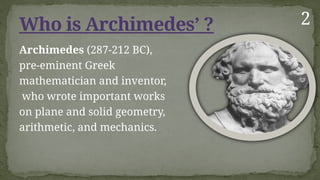
Archimedes (287-212 BC),
pre-eminent Greek
mathematician and inventor,
who wrote important works
on plane and solid geometry,
arithmetic, and mechanics.
Who is Archimedes’ ? 2
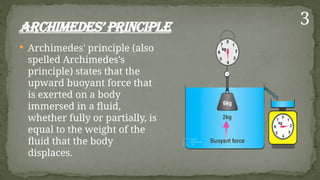
 Archimedes' principle (also
spelled Archimedes's
principle) states that the
upward buoyant force that
is exerted on a body
immersed in a fluid,
whether fully or partially, is
equal to the weight of the
fluid that the body
displaces.
Archimedes’ Principle 3
The principle is most frequently applied to the
behaviour of objects in water, and helps to explain
floating and sinking, and why objects seem lighter in
water. It also applies to balloons in the air.
4
UPTHRUST AND BUOYANT FORCE
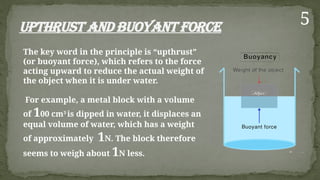
The key word in the principle is “upthrust”
(or buoyant force), which refers to the force
acting upward to reduce the actual weight of
the object when it is under water.
For example, a metal block with a volume
of 100 cm3
is dipped in water, it displaces an
equal volume of water, which has a weight
of approximately 1N. The block therefore
seems to weigh about 1N less.
5
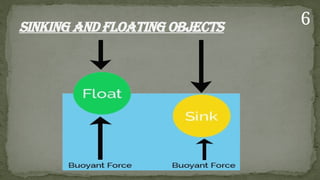
SINKING AND FLOATING OBJECTS 6
Density and Buoyancy
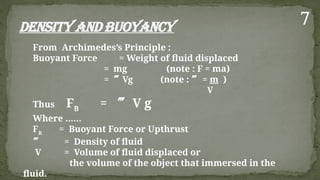
From Archimedes’s Principle :
Buoyant Force = Weight of fluid displaced
= mg (note : F = ma)
= Vg (note :  = m )
V
Thus FB
=  V g
Where ……
FB
= Buoyant Force or Upthrust
 = Density of fluid
V = Volume of fluid displaced or
the volume of the object that immersed in the
fluid.
7
Applications
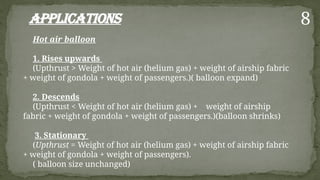
Hot air balloon
1. Rises upwards
(Upthrust > Weight of hot air (helium gas) + weight of airship fabric
+ weight of gondola + weight of passengers.)( balloon expand)
2. Descends
(Upthrust < Weight of hot air (helium gas) + weight of airship
fabric + weight of gondola + weight of passengers.)(balloon shrinks)
3. Stationary
(Upthrust = Weight of hot air (helium gas) + weight of airship fabric
+ weight of gondola + weight of passengers).
( balloon size unchanged)
8
9
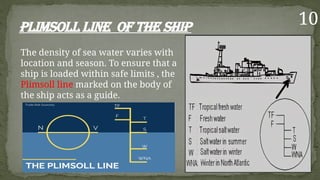
Plimsoll Line of the ship
The density of sea water varies with
location and season. To ensure that a
ship is loaded within safe limits , the
Plimsoll line marked on the body of
the ship acts as a guide.
10
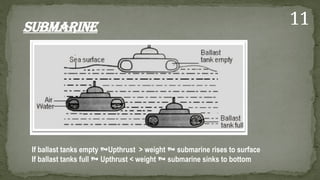
Submarine
If ballast tanks empty Upthrust > weight  submarine rises to surface
If ballast tanks full  Upthrust < weight  submarine sinks to bottom
11
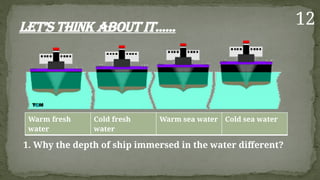
Let’s think about it......
Warm fresh
water
Cold fresh
water
Warm sea water Cold sea water
1. Why the depth of ship immersed in the water different?
12
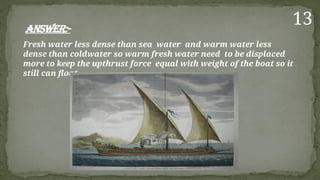
Answer:-
Fresh water less dense than sea water and warm water less
dense than coldwater so warm fresh water need to be displaced
more to keep the upthrust force equal with weight of the boat so it
still can float.
13
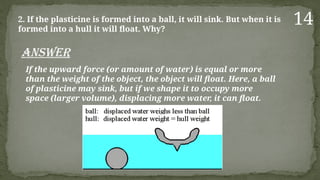
2. If the plasticine is formed into a ball, it will sink. But when it is
formed into a hull it will float. Why?
Answer
If the upward force (or amount of water) is equal or more
than the weight of the object, the object will float. Here, a ball
of plasticine may sink, but if we shape it to occupy more
space (larger volume), displacing more water
, it can float.
14
Thank you
15

Presentation on about Archimedes' principle.pptx

  • 1.
    Presentation on about Archimedes'principle Presented by:- Biimmaann biman09876543210@gmail.com
  • 2.
    Archimedes (287-212 BC), pre-eminentGreek mathematician and inventor, who wrote important works on plane and solid geometry, arithmetic, and mechanics. Who is Archimedes’ ? 2
  • 3.
     Archimedes' principle(also spelled Archimedes's principle) states that the upward buoyant force that is exerted on a body immersed in a fluid, whether fully or partially, is equal to the weight of the fluid that the body displaces. Archimedes’ Principle 3
  • 4.
    The principle ismost frequently applied to the behaviour of objects in water, and helps to explain floating and sinking, and why objects seem lighter in water. It also applies to balloons in the air. 4
  • 5.
    UPTHRUST AND BUOYANTFORCE The key word in the principle is “upthrust” (or buoyant force), which refers to the force acting upward to reduce the actual weight of the object when it is under water. For example, a metal block with a volume of 100 cm3 is dipped in water, it displaces an equal volume of water, which has a weight of approximately 1N. The block therefore seems to weigh about 1N less. 5
  • 6.
  • 7.
    Density and Buoyancy FromArchimedes’s Principle : Buoyant Force = Weight of fluid displaced = mg (note : F = ma) = Vg (note :  = m ) V Thus FB =  V g Where …… FB = Buoyant Force or Upthrust  = Density of fluid V = Volume of fluid displaced or the volume of the object that immersed in the fluid. 7
  • 8.
    Applications Hot air balloon 1.Rises upwards (Upthrust > Weight of hot air (helium gas) + weight of airship fabric + weight of gondola + weight of passengers.)( balloon expand) 2. Descends (Upthrust < Weight of hot air (helium gas) + weight of airship fabric + weight of gondola + weight of passengers.)(balloon shrinks) 3. Stationary (Upthrust = Weight of hot air (helium gas) + weight of airship fabric + weight of gondola + weight of passengers). ( balloon size unchanged) 8
  • 9.
  • 10.
    Plimsoll Line ofthe ship The density of sea water varies with location and season. To ensure that a ship is loaded within safe limits , the Plimsoll line marked on the body of the ship acts as a guide. 10
  • 11.
    Submarine If ballast tanksempty Upthrust > weight  submarine rises to surface If ballast tanks full  Upthrust < weight  submarine sinks to bottom 11
  • 12.
    Let’s think aboutit...... Warm fresh water Cold fresh water Warm sea water Cold sea water 1. Why the depth of ship immersed in the water different? 12
  • 13.
    Answer:- Fresh water lessdense than sea water and warm water less dense than coldwater so warm fresh water need to be displaced more to keep the upthrust force equal with weight of the boat so it still can float. 13
  • 14.
    2. If theplasticine is formed into a ball, it will sink. But when it is formed into a hull it will float. Why? Answer If the upward force (or amount of water) is equal or more than the weight of the object, the object will float. Here, a ball of plasticine may sink, but if we shape it to occupy more space (larger volume), displacing more water , it can float. 14
  • 15.