Archimedes principle
and Buoyancy
By:- Aafreen Mairaj
9E
Archimedes principle – The Law
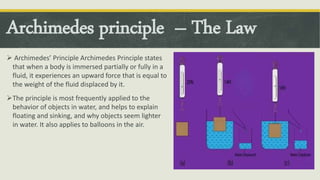
 Archimedes’ Principle Archimedes Principle states
that when a body is immersed partially or fully in a
fluid, it experiences an upward force that is equal to
the weight of the fluid displaced by it.
The principle is most frequently applied to the
behavior of objects in water, and helps to explain
floating and sinking, and why objects seem lighter
in water. It also applies to balloons in the air.
Buoyant force or up thrust
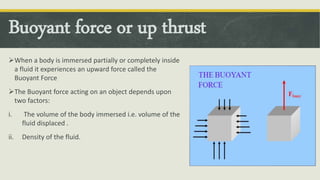
When a body is immersed partially or completely inside
a fluid it experiences an upward force called the
Buoyant Force
The Buoyant force acting on an object depends upon
two factors:
i. The volume of the body immersed i.e. volume of the
fluid displaced .
ii. Density of the fluid.
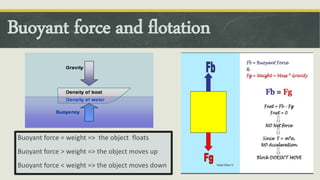
Buoyant force = weight => the object floats
Buoyant force > weight => the object moves up
Buoyant force < weight => the object moves down
Buoyant force and flotation
Application on Archimedes Principle
Used in designing ships and submarines.
Used in making Lactometers, which are used to determine the purity of a sample of milk .
Used in making Hydrometers , which are used for determining density of liquids.
Thank You