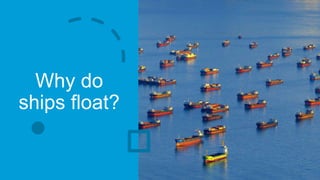
Why do
ships float?
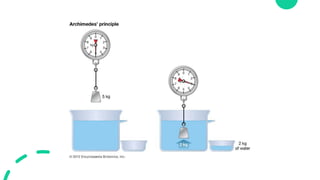
Archimedes
Principle
States that the upward buoyant
force that is exerted on an object
immersed in a fluid, whether fully
or partially submerged, is equal to
the weight of the fluid that the
object displaces
Buoyant Force (N) =
Weight of Liquid Displaced =
(Mass Liquid x 9.8m/s^2)
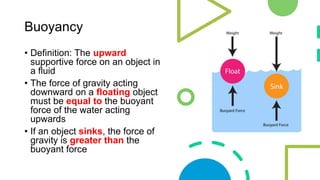
Buoyancy
• Definition: The upward
supportive force on an object in
a fluid
• The force of gravity acting
downward on a floating object
must be equal to the buoyant
force of the water acting
upwards
• If an object sinks, the force of
gravity is greater than the
buoyant force
Sinking vs Floating
Floating object:
Mass of Object (kg) = Mass of Liquid
Displaced (kg)
Weight of Object (N) = Weight of
displaced liquid (N)/Buoyant force (N)
Sinking object:
Mass of Object (kg) > Mass of Liquid
Displaced (kg)
Weight of Object (N) > Weight of
displaced liquid (N)/Buoyant force (N)
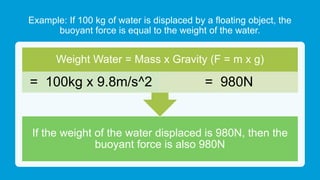
Example: If 100 kg of water is displaced by a floating object, the
buoyant force is equal to the weight of the water.
If the weight of the water displaced is 980N, then the
buoyant force is also 980N
Weight Water = Mass x Gravity (F = m x g)
= 100kg x 9.8m/s^2 = 980N
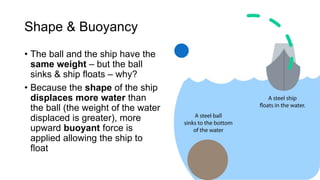
Shape & Buoyancy
• The ball and the ship have the
same weight – but the ball
sinks & ship floats – why?
• Because the shape of the ship
displaces more water than
the ball (the weight of the water
displaced is greater), more
upward buoyant force is
applied allowing the ship to
float
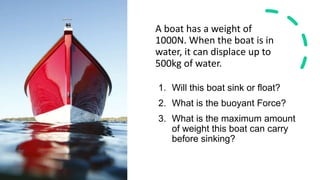
A boat has a weight of
1000N. When the boat is in
water, it can displace up to
500kg of water.
1. Will this boat sink or float?
2. What is the buoyant Force?
3. What is the maximum amount
of weight this boat can carry
before sinking?
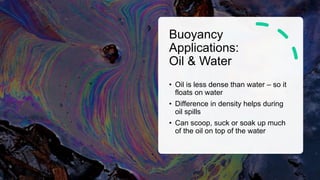
Buoyancy
Applications:
Oil & Water
• Oil is less dense than water – so it
floats on water
• Difference in density helps during
oil spills
• Can scoop, suck or soak up much
of the oil on top of the water
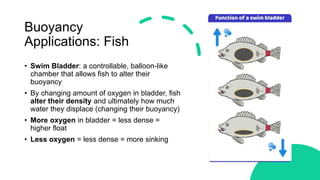
Buoyancy
Applications: Fish
• Swim Bladder: a controllable, balloon-like
chamber that allows fish to alter their
buoyancy
• By changing amount of oxygen in bladder, fish
alter their density and ultimately how much
water they displace (changing their buoyancy)
• More oxygen in bladder = less dense =
higher float
• Less oxygen = less dense = more sinking
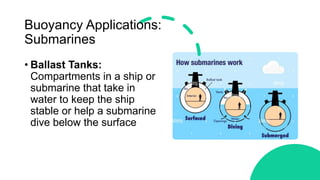
Buoyancy Applications:
Submarines
• Ballast Tanks:
Compartments in a ship or
submarine that take in
water to keep the ship
stable or help a submarine
dive below the surface
Boat
Challenge
Objective: Students will design and build
a boat using aluminum foil that can carry
the most weight while floating in water.
Materials: Aluminum foil
Best Design: Awarded to the boat with
the most innovative, aesthetically
pleasing, and well-executed design.
Carry the Most Weight: Awarded to the
boat that successfully carries the greatest
amount of weight while remaining afloat.
Density and Buoyancy for Grade 8 Science Class

Density and Buoyancy for Grade 8 Science Class

  • 2.
  • 3.
    Archimedes Principle States that theupward buoyant force that is exerted on an object immersed in a fluid, whether fully or partially submerged, is equal to the weight of the fluid that the object displaces Buoyant Force (N) = Weight of Liquid Displaced = (Mass Liquid x 9.8m/s^2)
  • 4.
    Buoyancy • Definition: Theupward supportive force on an object in a fluid • The force of gravity acting downward on a floating object must be equal to the buoyant force of the water acting upwards • If an object sinks, the force of gravity is greater than the buoyant force
  • 5.
    Sinking vs Floating Floatingobject: Mass of Object (kg) = Mass of Liquid Displaced (kg) Weight of Object (N) = Weight of displaced liquid (N)/Buoyant force (N) Sinking object: Mass of Object (kg) > Mass of Liquid Displaced (kg) Weight of Object (N) > Weight of displaced liquid (N)/Buoyant force (N)
  • 7.
    Example: If 100kg of water is displaced by a floating object, the buoyant force is equal to the weight of the water. If the weight of the water displaced is 980N, then the buoyant force is also 980N Weight Water = Mass x Gravity (F = m x g) = 100kg x 9.8m/s^2 = 980N
  • 8.
    Shape & Buoyancy •The ball and the ship have the same weight – but the ball sinks & ship floats – why? • Because the shape of the ship displaces more water than the ball (the weight of the water displaced is greater), more upward buoyant force is applied allowing the ship to float
  • 9.
    A boat hasa weight of 1000N. When the boat is in water, it can displace up to 500kg of water. 1. Will this boat sink or float? 2. What is the buoyant Force? 3. What is the maximum amount of weight this boat can carry before sinking?
  • 10.
    Buoyancy Applications: Oil & Water •Oil is less dense than water – so it floats on water • Difference in density helps during oil spills • Can scoop, suck or soak up much of the oil on top of the water
  • 11.
    Buoyancy Applications: Fish • SwimBladder: a controllable, balloon-like chamber that allows fish to alter their buoyancy • By changing amount of oxygen in bladder, fish alter their density and ultimately how much water they displace (changing their buoyancy) • More oxygen in bladder = less dense = higher float • Less oxygen = less dense = more sinking
  • 12.
    Buoyancy Applications: Submarines • BallastTanks: Compartments in a ship or submarine that take in water to keep the ship stable or help a submarine dive below the surface
  • 13.
    Boat Challenge Objective: Students willdesign and build a boat using aluminum foil that can carry the most weight while floating in water. Materials: Aluminum foil Best Design: Awarded to the boat with the most innovative, aesthetically pleasing, and well-executed design. Carry the Most Weight: Awarded to the boat that successfully carries the greatest amount of weight while remaining afloat.