Photo: NASA
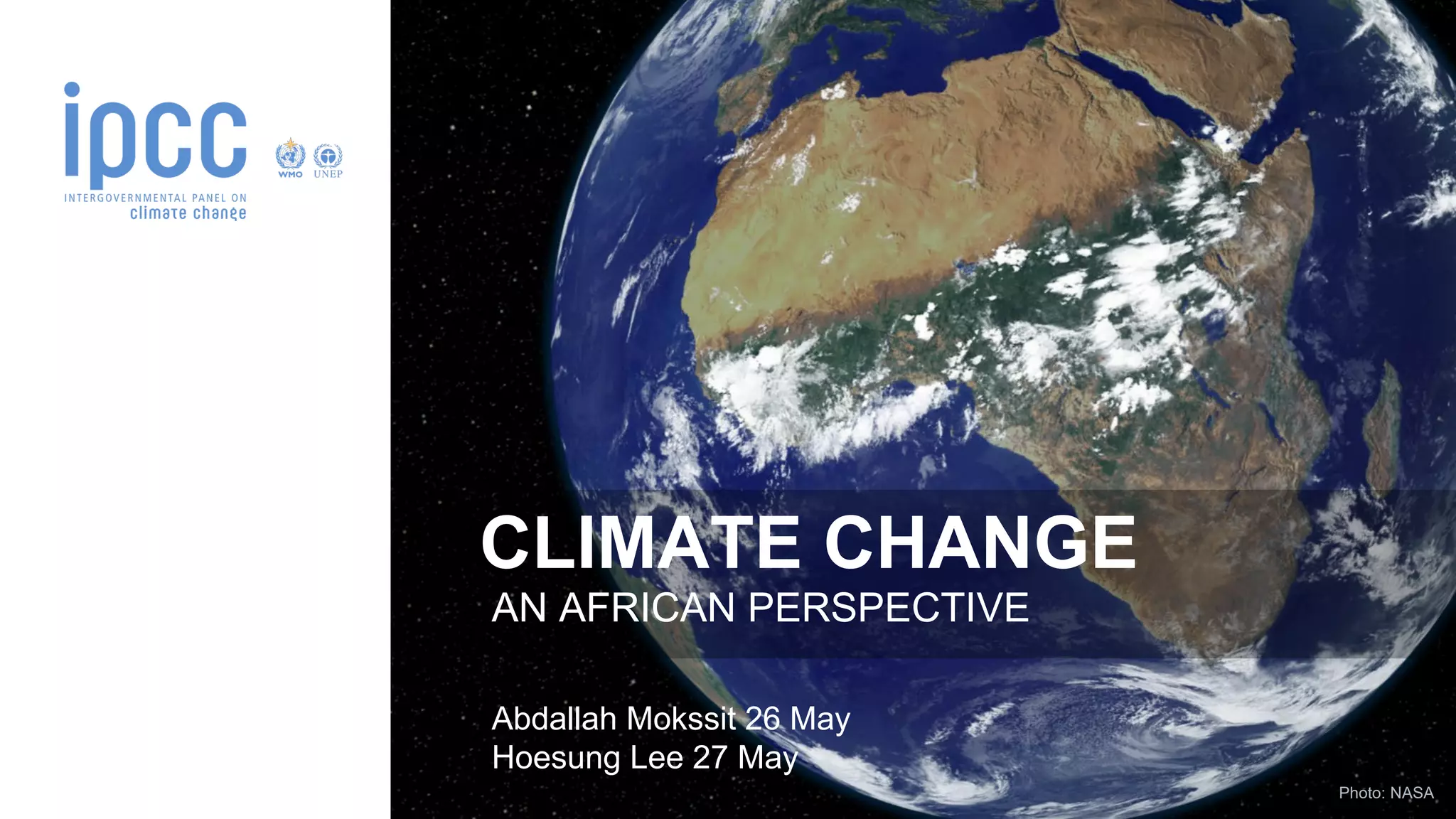
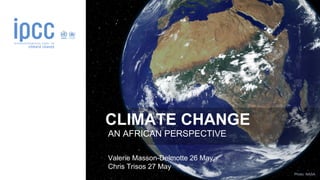
CLIMATE CHANGE
AN AFRICAN PERSPECTIVE
Abdallah Mokssit 26 May
Hoesung Lee 27 May
INTRODUCTION
CLIMATE & RELATED
CHANGES
ECOSYSTEM CHANGES
SOCIETAL CHANGES
LOW CARBON CLIMATE-
RESILIENT DEVELOPMENT
CONCLUSION
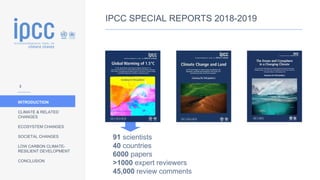
IPCC SPECIAL REPORTS 2018-2019
91 scientists
40 countries
6000 papers
>1000 expert reviewers
45,000 review comments
2
INTRODUCTION
CLIMATE & RELATED
CHANGES
ECOSYSTEM CHANGES
SOCIETAL CHANGES
LOW CARBON CLIMATE-
RESILIENT DEVELOPMENT
CONCLUSION
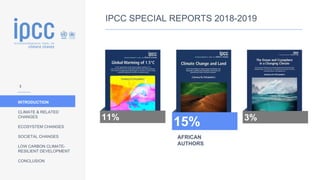
IPCC SPECIAL REPORTS 2018-2019
AFRICAN
AUTHORS
15%
11% 3%
3
INTRODUCTION
CLIMATE & RELATED
CHANGES
ECOSYSTEM CHANGES
SOCIETAL CHANGES
LOW CARBON CLIMATE-
RESILIENT DEVELOPMENT
CONCLUSION
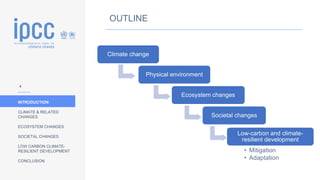
OUTLINE
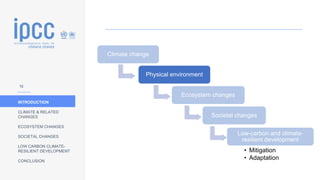
• OUTLINE
Climate change
Physical environment
Ecosystem changes
Societal changes
Low-carbon and climate-
resilient development
• Mitigation
• Adaptation
4
INTRODUCTION
CLIMATE & RELATED
CHANGES
ECOSYSTEM CHANGES
SOCIETAL CHANGES
LOW CARBON CLIMATE-
RESILIENT DEVELOPMENT
CONCLUSION
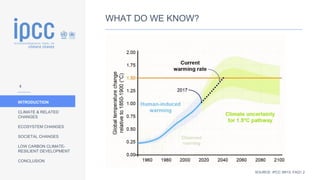
WHAT DO WE KNOW?
SOURCE: IPCC SR15, FAQ1.2
5
NIGER
Photo:
NigerTZai
INTRODUCTION
CLIMATE & RELATED
CHANGES
ECOSYSTEM CHANGES
SOCIETAL CHANGES
LOW CARBON CLIMATE-
RESILIENT DEVELOPMENT
CONCLUSION
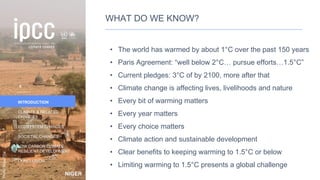
WHAT DO WE KNOW?
• The world has warmed by about 1°C over the past 150 years
• Paris Agreement: “well below 2°C… pursue efforts…1.5°C”
• Current pledges: 3°C of by 2100, more after that
• Climate change is affecting lives, livelihoods and nature
• Every bit of warming matters
• Every year matters
• Every choice matters
• Climate action and sustainable development
• Clear benefits to keeping warming to 1.5°C or below
• Limiting warming to 1.5°C presents a global challenge
6
DEM. REPUBLIC OF CONGO
INTRODUCTION
CLIMATE & RELATED
CHANGES
ECOSYSTEM CHANGES
SOCIETAL CHANGES
LOW CARBON CLIMATE-
RESILIENT DEVELOPMENT
CONCLUSION
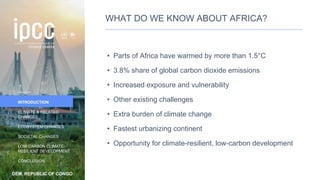
WHAT DO WE KNOW ABOUT AFRICA?
• Parts of Africa have warmed by more than 1.5°C
• 3.8% share of global carbon dioxide emissions
• Increased exposure and vulnerability
• Other existing challenges
• Extra burden of climate change
• Fastest urbanizing continent
• Opportunity for climate-resilient, low-carbon development
7
DJIBOUTI
INTRODUCTION
CLIMATE & RELATED
CHANGES
ECOSYSTEM CHANGES
SOCIETAL CHANGES
LOW CARBON CLIMATE-
RESILIENT DEVELOPMENT
CONCLUSION
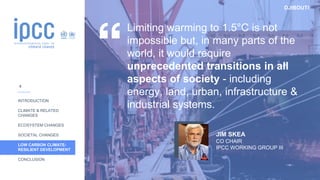
Limiting warming to 1.5°C is not
impossible but, in many parts of the
world, it would require
unprecedented transitions in all
aspects of society - including
energy, land, urban, infrastructure &
industrial systems.
JIM SKEA
CO CHAIR
IPCC WORKING GROUP III
8
INTRODUCTION
CLIMATE & RELATED
CHANGES
ECOSYSTEM CHANGES
SOCIETAL CHANGES
LOW CARBON CLIMATE-
RESILIENT DEVELOPMENT
CONCLUSION
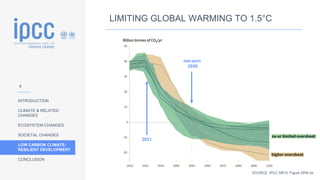
LIMITING GLOBAL WARMING TO 1.5°C
2021
net-zero
2050
9
SOURCE: IPCC SR15, Figure SPM.3a
INTRODUCTION
CLIMATE & RELATED
CHANGES
ECOSYSTEM CHANGES
SOCIETAL CHANGES
LOW CARBON CLIMATE-
RESILIENT DEVELOPMENT
CONCLUSION
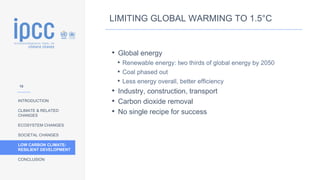
LIMITING GLOBAL WARMING TO 1.5°C
• Global energy
• Renewable energy: two thirds of global energy by 2050
• Coal phased out
• Less energy overall, better efficiency
• Industry, construction, transport
• Carbon dioxide removal
• No single recipe for success
10
Photo: NASA
CLIMATE CHANGE
AN AFRICAN PERSPECTIVE
Valerie Masson-Delmotte 26 May
Chris Trisos 27 May
INTRODUCTION
CLIMATE & RELATED
CHANGES
ECOSYSTEM CHANGES
SOCIETAL CHANGES
LOW CARBON CLIMATE-
RESILIENT DEVELOPMENT
CONCLUSION
• OUTLINE
Climate change
Physical environment
Ecosystem changes
Societal changes
Low-carbon and climate-
resilient development
• Mitigation
• Adaptation
12
SOMALIA
INTRODUCTION
CLIMATE & RELATED
CHANGES
ECOSYSTEM CHANGES
SOCIETAL CHANGES
LOW CARBON CLIMATE-
RESILIENT DEVELOPMENT
CONCLUSION
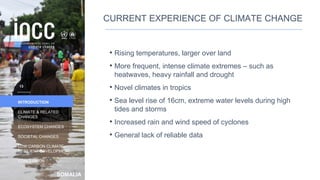
CURRENT EXPERIENCE OF CLIMATE CHANGE
• Rising temperatures, larger over land
• More frequent, intense climate extremes – such as
heatwaves, heavy rainfall and drought
• Novel climates in tropics
• Sea level rise of 16cm, extreme water levels during high
tides and storms
• Increased rain and wind speed of cyclones
• General lack of reliable data
13
BOTSWANA
INTRODUCTION
CLIMATE & RELATED
CHANGES
ECOSYSTEM CHANGES
SOCIETAL CHANGES
LOW CARBON CLIMATE-
RESILIENT DEVELOPMENT
CONCLUSION
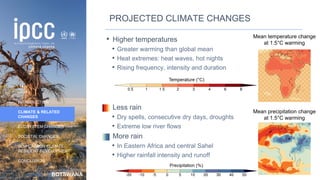
PROJECTED CLIMATE CHANGES
• Higher temperatures
• Greater warming than global mean
• Heat extremes: heat waves, hot nights
• Rising frequency, intensity and duration
• Less rain
• Dry spells, consecutive dry days, droughts
• Extreme low river flows
• More rain
• In Eastern Africa and central Sahel
• Higher rainfall intensity and runoff
Mean temperature change
at 1.5°C warming
Mean precipitation change
at 1.5°C warming
14
INTRODUCTION
CLIMATE & RELATED
CHANGES
ECOSYSTEM CHANGES
SOCIETAL CHANGES
LOW CARBON CLIMATE-
RESILIENT DEVELOPMENT
CONCLUSION
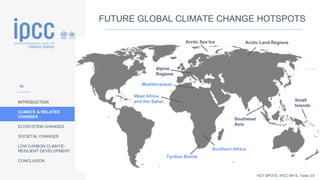
FUTURE GLOBAL CLIMATE CHANGE HOTSPOTS
Arctic Sea Ice Arctic Land Regions
Mediterranean
West Africa
and the Sahel
Southern Africa
Alpine
Regions
Southeast
Asia
Fynbos Biome
Small
Islands
HOT SPOTS: IPCC SR15, Table 3.6
15
EGYPT
INTRODUCTION
CLIMATE & RELATED
CHANGES
ECOSYSTEM CHANGES
SOCIETAL CHANGES
LOW CARBON CLIMATE-
RESILIENT DEVELOPMENT
CONCLUSION
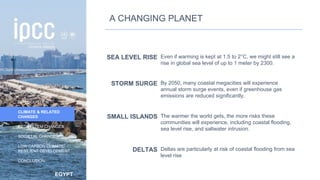
SEA LEVEL RISE Even if warming is kept at 1.5 to 2°C, we might still see a
rise in global sea level of up to 1 meter by 2300.
STORM SURGE By 2050, many coastal megacities will experience
annual storm surge events, even if greenhouse gas
emissions are reduced significantly.
SMALL ISLANDS The warmer the world gets, the more risks these
communities will experience, including coastal flooding,
sea level rise, and saltwater intrusion.
DELTAS Deltas are particularly at risk of coastal flooding from sea
level rise
A CHANGING PLANET
16
INTRODUCTION
CLIMATE & RELATED
CHANGES
ECOSYSTEM CHANGES
SOCIETAL CHANGES
LOW CARBON CLIMATE-
RESILIENT DEVELOPMENT
CONCLUSION
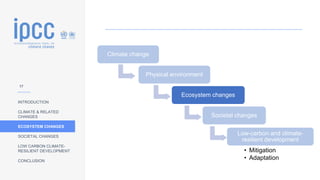
Climate change
Physical environment
Ecosystem changes
Societal changes
Low-carbon and climate-
resilient development
• Mitigation
• Adaptation
17
INTRODUCTION
CLIMATE & RELATED
CHANGES
ECOSYSTEM CHANGES
SOCIETAL CHANGES
LOW CARBON CLIMATE-
RESILIENT DEVELOPMENT
CONCLUSION
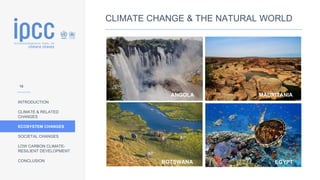
CLIMATE CHANGE & THE NATURAL WORLD
ANGOLA
BOTSWANA
MAURITANIA
EGYPT
18
NAMIBIA
INTRODUCTION
CLIMATE & RELATED
CHANGES
ECOSYSTEM CHANGES
SOCIETAL CHANGES
LOW CARBON CLIMATE-
RESILIENT DEVELOPMENT
CONCLUSION
Photo:
MarliesCraig
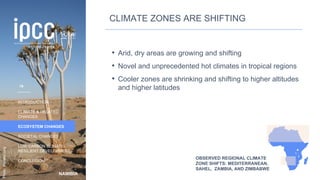
CLIMATE ZONES ARE SHIFTING
• Arid, dry areas are growing and shifting
• Novel and unprecedented hot climates in tropical regions
• Cooler zones are shrinking and shifting to higher altitudes
and higher latitudes
OBSERVED REGIONAL CLIMATE
ZONE SHIFTS: MEDITERRANEAN,
SAHEL, ZAMBIA, AND ZIMBABWE
19
SUDAN
INTRODUCTION
CLIMATE & RELATED
CHANGES
ECOSYSTEM CHANGES
SOCIETAL CHANGES
LOW CARBON CLIMATE-
RESILIENT DEVELOPMENT
CONCLUSION
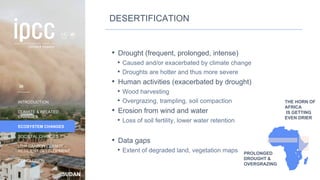
DESERTIFICATION
• Drought (frequent, prolonged, intense)
• Caused and/or exacerbated by climate change
• Droughts are hotter and thus more severe
• Human activities (exacerbated by drought)
• Wood harvesting
• Overgrazing, trampling, soil compaction
• Erosion from wind and water
• Loss of soil fertility, lower water retention
• Data gaps
• Extent of degraded land, vegetation maps
THE HORN OF
AFRICA
IS GETTING
EVEN DRIER
PROLONGED
DROUGHT &
OVERGRAZING
20
ALGERIA
INTRODUCTION
CLIMATE & RELATED
CHANGES
ECOSYSTEM CHANGES
SOCIETAL CHANGES
LOW CARBON CLIMATE-
RESILIENT DEVELOPMENT
CONCLUSION
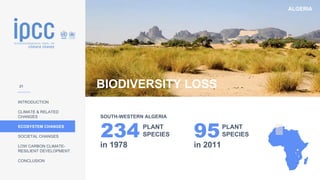
BIODIVERSITY LOSS
234
in 1978
95
in 2011
PLANT
SPECIES
PLANT
SPECIES
SOUTH-WESTERN ALGERIA
21
CHAD
INTRODUCTION
CLIMATE & RELATED
CHANGES
ECOSYSTEM CHANGES
SOCIETAL CHANGES
LOW CARBON CLIMATE-
RESILIENT DEVELOPMENT
CONCLUSION
Photo:
Stuart
Rankin
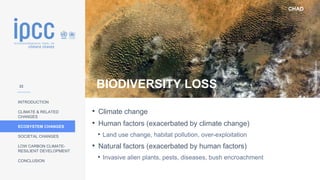
BIODIVERSITY LOSS
• Climate change
• Human factors (exacerbated by climate change)
• Land use change, habitat pollution, over-exploitation
• Natural factors (exacerbated by human factors)
• Invasive alien plants, pests, diseases, bush encroachment
22
SOUTH AFRICA
INTRODUCTION
CLIMATE & RELATED
CHANGES
ECOSYSTEM CHANGES
SOCIETAL CHANGES
LOW CARBON CLIMATE-
RESILIENT DEVELOPMENT
CONCLUSION
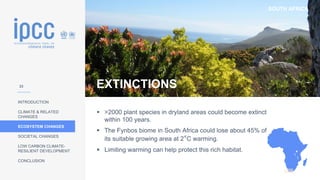
EXTINCTIONS
▪ >2000 plant species in dryland areas could become extinct
within 100 years.
▪ The Fynbos biome in South Africa could lose about 45% of
its suitable growing area at 2°C warming.
▪ Limiting warming can help protect this rich habitat.
23
LIBYA
INTRODUCTION
CLIMATE & RELATED
CHANGES
ECOSYSTEM CHANGES
SOCIETAL CHANGES
LOW CARBON CLIMATE-
RESILIENT DEVELOPMENT
CONCLUSION
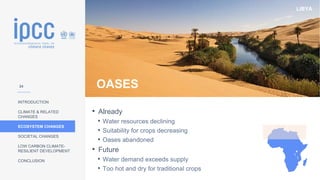
OASES
• Already
• Water resources declining
• Suitability for crops decreasing
• Oases abandoned
• Future
• Water demand exceeds supply
• Too hot and dry for traditional crops
24
KENYA
INTRODUCTION
CLIMATE & RELATED
CHANGES
ECOSYSTEM CHANGES
SOCIETAL CHANGES
LOW CARBON CLIMATE-
RESILIENT DEVELOPMENT
CONCLUSION
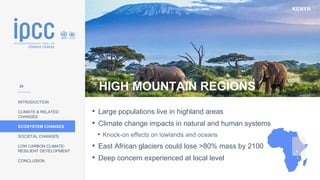
HIGH MOUNTAIN REGIONS
• Large populations live in highland areas
• Climate change impacts in natural and human systems
• Knock-on effects on lowlands and oceans
• East African glaciers could lose >80% mass by 2100
• Deep concern experienced at local level
25
SEYCHELLES
INTRODUCTION
CLIMATE & RELATED
CHANGES
ECOSYSTEM CHANGES
SOCIETAL CHANGES
LOW CARBON CLIMATE-
RESILIENT DEVELOPMENT
CONCLUSION
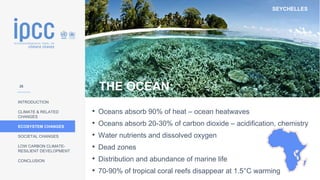
THE OCEAN
• Oceans absorb 90% of heat – ocean heatwaves
• Oceans absorb 20-30% of carbon dioxide – acidification, chemistry
• Water nutrients and dissolved oxygen
• Dead zones
• Distribution and abundance of marine life
• 70-90% of tropical coral reefs disappear at 1.5°C warming
26
Photo: NASA
CLIMATE CHANGE
AN AFRICAN PERSPECTIVE
Fatima Denton 26 & 27 May
INTRODUCTION
CLIMATE & RELATED
CHANGES
ECOSYSTEM CHANGES
SOCIETAL CHANGES
LOW CARBON CLIMATE-
RESILIENT DEVELOPMENT
CONCLUSION
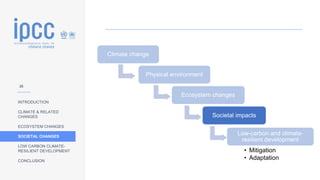
Climate change
Physical environment
Ecosystem changes
Societal impacts
Low-carbon and climate-
resilient development
• Mitigation
• Adaptation
28
GHANA
INTRODUCTION
CLIMATE & RELATED
CHANGES
ECOSYSTEM CHANGES
SOCIETAL CHANGES
LOW CARBON CLIMATE-
RESILIENT DEVELOPMENT
CONCLUSION
Photo:
Flickr
user
Jenny
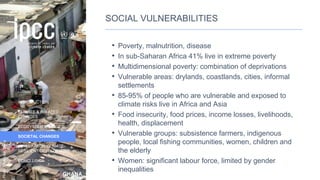
SOCIAL VULNERABILITIES
• Poverty, malnutrition, disease
• In sub-Saharan Africa 41% live in extreme poverty
• Multidimensional poverty: combination of deprivations
• Vulnerable areas: drylands, coastlands, cities, informal
settlements
• 85-95% of people who are vulnerable and exposed to
climate risks live in Africa and Asia
• Food insecurity, food prices, income losses, livelihoods,
health, displacement
• Vulnerable groups: subsistence farmers, indigenous
people, local fishing communities, women, children and
the elderly
• Women: significant labour force, limited by gender
inequalities
29
CAMEROON
INTRODUCTION
CLIMATE & RELATED
CHANGES
ECOSYSTEM CHANGES
SOCIETAL CHANGES
LOW CARBON CLIMATE-
RESILIENT DEVELOPMENT
CONCLUSION
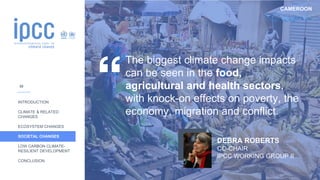
The biggest climate change impacts
can be seen in the food,
agricultural and health sectors,
with knock-on effects on poverty, the
economy, migration and conflict.
DEBRA ROBERTS
CO-CHAIR
IPCC WORKING GROUP II
30
INTRODUCTION
CLIMATE & RELATED
CHANGES
ECOSYSTEM CHANGES
SOCIETAL CHANGES
LOW CARBON CLIMATE-
RESILIENT DEVELOPMENT
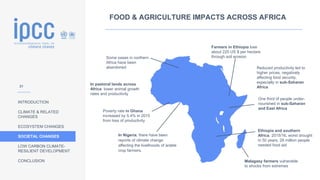
CONCLUSION Malagasy farmers vulnerable
to shocks from extremes
Farmers in Ethiopia lose
about 220 US $ per hectare
through soil erosion
In pastoral lands across
Africa lower animal growth
rates and productivity
Poverty rate in Ghana
increased by 5.4% in 2015
from loss of productivity
In Nigeria, there have been
reports of climate change
affecting the livelihoods of arable
crop farmers.
Ethiopia and southern
Africa, 2015/16, worst drought
in 50 years, 28 million people
needed food aid
One third of people under-
nourished in sub-Saharan
and East Africa
Reduced productivity led to
higher prices, negatively
affecting food security,
especially in sub-Saharan
Africa
Some oases in northern
Africa have been
abandoned
FOOD & AGRICULTURE IMPACTS ACROSS AFRICA
31
BENIN
INTRODUCTION
CLIMATE & RELATED
CHANGES
ECOSYSTEM CHANGES
SOCIETAL CHANGES
LOW CARBON CLIMATE-
RESILIENT DEVELOPMENT
CONCLUSION
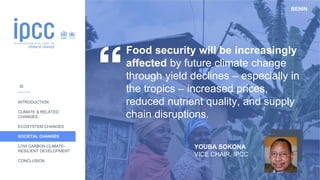
Food security will be increasingly
affected by future climate change
through yield declines – especially in
the tropics – increased prices,
reduced nutrient quality, and supply
chain disruptions.
YOUBA SOKONA
VICE CHAIR, IPCC
32
ZAMBIA
INTRODUCTION
CLIMATE & RELATED
CHANGES
ECOSYSTEM CHANGES
SOCIETAL CHANGES
LOW CARBON CLIMATE-
RESILIENT DEVELOPMENT
CONCLUSION
Photo:
Marlies
Craig
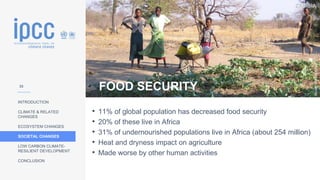
• 11% of global population has decreased food security
• 20% of these live in Africa
• 31% of undernourished populations live in Africa (about 254 million)
• Heat and dryness impact on agriculture
• Made worse by other human activities
FOOD SECURITY
33
TANZANIA
INTRODUCTION
CLIMATE & RELATED
CHANGES
ECOSYSTEM CHANGES
SOCIETAL CHANGES
LOW CARBON CLIMATE-
RESILIENT DEVELOPMENT
CONCLUSION
Photo:
MarliesCraig
FOOD SECURITY
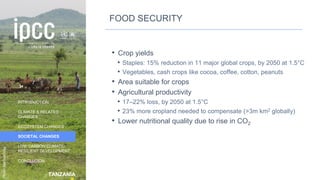
• Crop yields
• Staples: 15% reduction in 11 major global crops, by 2050 at 1.5°C
• Vegetables, cash crops like cocoa, coffee, cotton, peanuts
• Area suitable for crops
• Agricultural productivity
• 17–22% loss, by 2050 at 1.5°C
• 23% more cropland needed to compensate (>3m km2 globally)
• Lower nutritional quality due to rise in CO2
34
MADAGASCAR
INTRODUCTION
CLIMATE & RELATED
CHANGES
ECOSYSTEM CHANGES
SOCIETAL CHANGES
LOW CARBON CLIMATE-
RESILIENT DEVELOPMENT
CONCLUSION
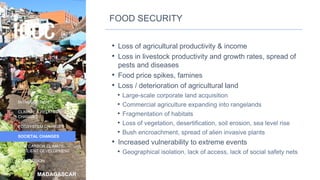
FOOD SECURITY
• Loss of agricultural productivity & income
• Loss in livestock productivity and growth rates, spread of
pests and diseases
• Food price spikes, famines
• Loss / deterioration of agricultural land
• Large-scale corporate land acquisition
• Commercial agriculture expanding into rangelands
• Fragmentation of habitats
• Loss of vegetation, desertification, soil erosion, sea level rise
• Bush encroachment, spread of alien invasive plants
• Increased vulnerability to extreme events
• Geographical isolation, lack of access, lack of social safety nets
35
BENIN
INTRODUCTION
CLIMATE & RELATED
CHANGES
ECOSYSTEM CHANGES
SOCIETAL CHANGES
LOW CARBON CLIMATE-
RESILIENT DEVELOPMENT
CONCLUSION
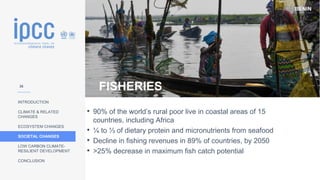
FISHERIES
• 90% of the world’s rural poor live in coastal areas of 15
countries, including Africa
• ¼ to ⅓ of dietary protein and micronutrients from seafood
• Decline in fishing revenues in 89% of countries, by 2050
• >25% decrease in maximum fish catch potential
36
SOUTH AFRICA
INTRODUCTION
CLIMATE & RELATED
CHANGES
ECOSYSTEM CHANGES
SOCIETAL CHANGES
LOW CARBON CLIMATE-
RESILIENT DEVELOPMENT
CONCLUSION
Photo:
Marlies
Craig
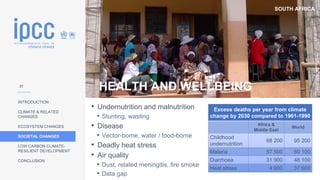
HEALTH AND WELLBEING
• Undernutrition and malnutrition
• Stunting, wasting
• Disease
• Vector-borne, water / food-borne
• Deadly heat stress
• Air quality
• Dust, related meningitis, fire smoke
• Data gap
37
Excess deaths per year from climate
change by 2030 compared to 1961-1990
Africa &
Middle East
World
Childhood
undernutrition
68 200 95 200
Malaria 57 500 60 100
Diarrhoea 31 900 48 100
Heat stress 4 900 37 600
NAMIBIA
INTRODUCTION
CLIMATE & RELATED
CHANGES
ECOSYSTEM CHANGES
SOCIETAL CHANGES
LOW CARBON CLIMATE-
RESILIENT DEVELOPMENT
CONCLUSION
Photo:
MarliesCraig
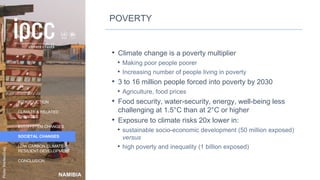
POVERTY
• Climate change is a poverty multiplier
• Making poor people poorer
• Increasing number of people living in poverty
• 3 to 16 million people forced into poverty by 2030
• Agriculture, food prices
• Food security, water-security, energy, well-being less
challenging at 1.5°C than at 2°C or higher
• Exposure to climate risks 20x lower in:
• sustainable socio-economic development (50 million exposed)
versus
• high poverty and inequality (1 billion exposed)
38
DEM. REPUBLIC OF CONGO
INTRODUCTION
CLIMATE & RELATED
CHANGES
ECOSYSTEM CHANGES
SOCIETAL CHANGES
LOW CARBON CLIMATE-
RESILIENT DEVELOPMENT
CONCLUSION
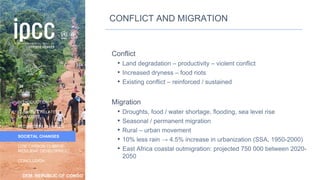
CONFLICT AND MIGRATION
Conflict
• Land degradation – productivity – violent conflict
• Increased dryness – food riots
• Existing conflict – reinforced / sustained
Migration
• Droughts, food / water shortage, flooding, sea level rise
• Seasonal / permanent migration
• Rural – urban movement
• 10% less rain → 4.5% increase in urbanization (SSA, 1950-2000)
• East Africa coastal outmigration: projected 750 000 between 2020-
2050
39
BURKINA FASO
INTRODUCTION
CLIMATE & RELATED
CHANGES
ECOSYSTEM CHANGES
SOCIETAL CHANGES
LOW CARBON CLIMATE-
RESILIENT DEVELOPMENT
CONCLUSION
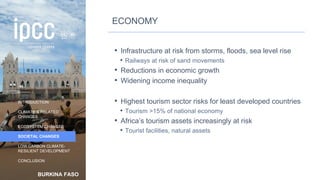
ECONOMY
• Infrastructure at risk from storms, floods, sea level rise
• Railways at risk of sand movements
• Reductions in economic growth
• Widening income inequality
• Highest tourism sector risks for least developed countries
• Tourism >15% of national economy
• Africa’s tourism assets increasingly at risk
• Tourist facilities, natural assets
40
MOZAMBIQUE
INTRODUCTION
CLIMATE & RELATED
CHANGES
ECOSYSTEM CHANGES
SOCIETAL CHANGES
LOW CARBON CLIMATE-
RESILIENT DEVELOPMENT
CONCLUSION
Photo:
Denis
Onyodi:
IFRC/DRK/Climate
Centre
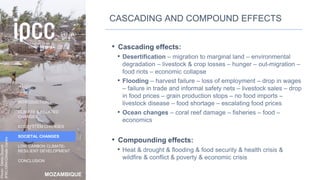
CASCADING AND COMPOUND EFFECTS
• Cascading effects:
• Desertification – migration to marginal land – environmental
degradation – livestock & crop losses – hunger – out-migration –
food riots – economic collapse
• Flooding – harvest failure – loss of employment – drop in wages
– failure in trade and informal safety nets – livestock sales – drop
in food prices – grain production stops – no food imports –
livestock disease – food shortage – escalating food prices
• Ocean changes – coral reef damage – fisheries – food –
economics
• Compounding effects:
• Heat & drought & flooding & food security & health crisis &
wildfire & conflict & poverty & economic crisis
41
COTE D’IVOIRE
INTRODUCTION
CLIMATE & RELATED
CHANGES
ECOSYSTEM CHANGES
SOCIETAL CHANGES
LOW CARBON CLIMATE-
RESILIENT DEVELOPMENT
CONCLUSION
Photo:
UN
Photo/Basile
Zoma
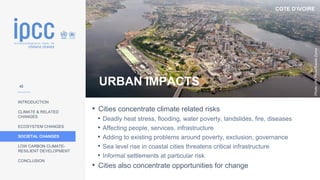
URBAN IMPACTS
• Cities concentrate climate related risks
• Deadly heat stress, flooding, water poverty, landslides, fire, diseases
• Affecting people, services, infrastructure
• Adding to existing problems around poverty, exclusion, governance
• Sea level rise in coastal cities threatens critical infrastructure
• Informal settlements at particular risk
• Cities also concentrate opportunities for change
42
Photo: NASA
CLIMATE CHANGE
AN AFRICAN PERSPECTIVE
Youba Sokona, 26&27 May 2021
INTRODUCTION
CLIMATE & RELATED
CHANGES
ECOSYSTEM CHANGES
SOCIETAL CHANGES
LOW CARBON CLIMATE-
RESILIENT DEVELOPMENT
CONCLUSION
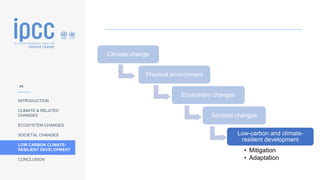
Climate change
Physical environment
Ecosystem changes
Societal changes
Low-carbon and climate-
resilient development
• Mitigation
• Adaptation
44
NIGERIA
INTRODUCTION
CLIMATE & RELATED
CHANGES
ECOSYSTEM CHANGES
SOCIETAL CHANGES
LOW CARBON CLIMATE-
RESILIENT DEVELOPMENT
CONCLUSION
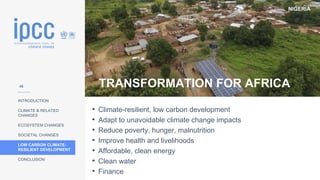
TRANSFORMATION FOR AFRICA
• Climate-resilient, low carbon development
• Adapt to unavoidable climate change impacts
• Reduce poverty, hunger, malnutrition
• Improve health and livelihoods
• Affordable, clean energy
• Clean water
• Finance
45
TANZANIA
INTRODUCTION
CLIMATE & RELATED
CHANGES
ECOSYSTEM CHANGES
SOCIETAL CHANGES
LOW CARBON CLIMATE-
RESILIENT DEVELOPMENT
CONCLUSION
Photo:
Clean
Cooking
Alliance
TRANSFORMATION: ENERGY
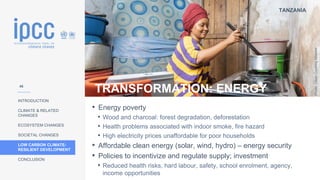
• Energy poverty
• Wood and charcoal: forest degradation, deforestation
• Health problems associated with indoor smoke, fire hazard
• High electricity prices unaffordable for poor households
• Affordable clean energy (solar, wind, hydro) – energy security
• Policies to incentivize and regulate supply; investment
• Reduced health risks, hard labour, safety, school enrolment, agency,
income opportunities
46
MOROCCO
INTRODUCTION
CLIMATE & RELATED
CHANGES
ECOSYSTEM CHANGES
SOCIETAL CHANGES
LOW CARBON CLIMATE-
RESILIENT DEVELOPMENT
CONCLUSION
Photo:
Richard
Allaway
TRANSFORMATION: ENERGY
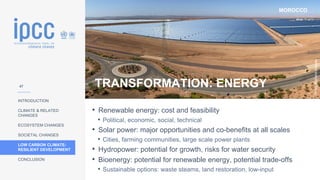
• Renewable energy: cost and feasibility
• Political, economic, social, technical
• Solar power: major opportunities and co-benefits at all scales
• Cities, farming communities, large scale power plants
• Hydropower: potential for growth, risks for water security
• Bioenergy: potential for renewable energy, potential trade-offs
• Sustainable options: waste steams, land restoration, low-input
47
BURUNDI
INTRODUCTION
CLIMATE & RELATED
CHANGES
ECOSYSTEM CHANGES
SOCIETAL CHANGES
LOW CARBON CLIMATE-
RESILIENT DEVELOPMENT
CONCLUSION
Photo:
(cropped):
CTB/Josiane
Droeghag
TRANSFORMATION: LAND
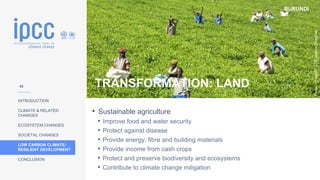
• Sustainable agriculture
• Improve food and water security
• Protect against disease
• Provide energy, fibre and building materials
• Provide income from cash crops
• Protect and preserve biodiversity and ecosystems
• Contribute to climate change mitigation
48
SOUTH AFRICA
INTRODUCTION
CLIMATE & RELATED
CHANGES
ECOSYSTEM CHANGES
SOCIETAL CHANGES
LOW CARBON CLIMATE-
RESILIENT DEVELOPMENT
CONCLUSION
Photo:
Herding
academy
CLIMATE RESILIENT AGRICULTURE
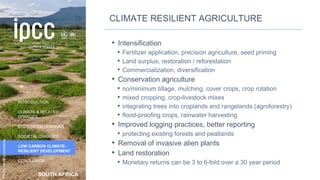
• Intensification
• Fertilizer application, precision agriculture, seed priming
• Land surplus, restoration / reforestation
• Commercialization, diversification
• Conservation agriculture
• no/minimum tillage, mulching, cover crops, crop rotation
• mixed cropping, crop-livestock mixes
• integrating trees into croplands and rangelands (agroforestry)
• flood-proofing crops, rainwater harvesting
• Improved logging practices, better reporting
• protecting existing forests and peatlands
• Removal of invasive alien plants
• Land restoration
• Monetary returns can be 3 to 6-fold over a 30 year period
49
TANZANIA
INTRODUCTION
CLIMATE & RELATED
CHANGES
ECOSYSTEM CHANGES
SOCIETAL CHANGES
LOW CARBON CLIMATE-
RESILIENT DEVELOPMENT
CONCLUSION
Photo:
Marlies
Craig
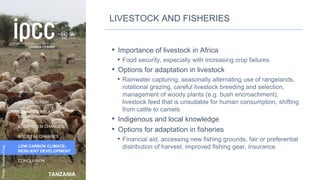
LIVESTOCK AND FISHERIES
• Importance of livestock in Africa
• Food security, especially with increasing crop failures
• Options for adaptation in livestock
• Rainwater capturing, seasonally alternating use of rangelands,
rotational grazing, careful livestock breeding and selection,
management of woody plants (e.g. bush encroachment),
livestock feed that is unsuitable for human consumption, shifting
from cattle to camels
• Indigenous and local knowledge
• Options for adaptation in fisheries
• Financial aid, accessing new fishing grounds, fair or preferential
distribution of harvest, improved fishing gear, insurance
50
INTRODUCTION
CLIMATE & RELATED
CHANGES
ECOSYSTEM CHANGES
SOCIETAL CHANGES
LOW CARBON CLIMATE-
RESILIENT DEVELOPMENT
CONCLUSION
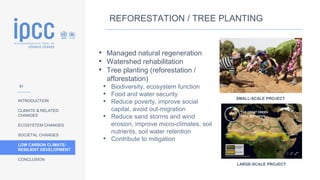
REFORESTATION / TREE PLANTING
• Managed natural regeneration
• Watershed rehabilitation
• Tree planting (reforestation /
afforestation)
• Biodiversity, ecosystem function
• Food and water security
• Reduce poverty, improve social
capital, avoid out-migration
• Reduce sand storms and wind
erosion, improve micro-climates, soil
nutrients, soil water retention
• Contribute to mitigation
LARGE-SCALE PROJECT
SMALL-SCALE PROJECT
51
Photo: NASA
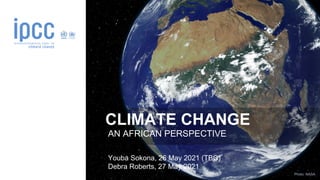
CLIMATE CHANGE
AN AFRICAN PERSPECTIVE
Youba Sokona, 26 May 2021 (TBC)
Debra Roberts, 27 May 2021
RWANDA
INTRODUCTION
CLIMATE & RELATED
CHANGES
ECOSYSTEM CHANGES
SOCIETAL CHANGES
LOW CARBON CLIMATE-
RESILIENT DEVELOPMENT
CONCLUSION
Photo:
GATETE
Pacifique
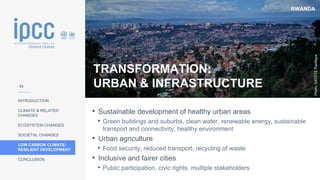
TRANSFORMATION:
URBAN & INFRASTRUCTURE
• Sustainable development of healthy urban areas
• Green buildings and suburbs, clean water, renewable energy, sustainable
transport and connectivity, healthy environment
• Urban agriculture
• Food security, reduced transport, recycling of waste
• Inclusive and fairer cities
• Public participation, civic rights, multiple stakeholders
53
SOUTH AFRICA
INTRODUCTION
CLIMATE & RELATED
CHANGES
ECOSYSTEM CHANGES
SOCIETAL CHANGES
LOW CARBON CLIMATE-
RESILIENT DEVELOPMENT
CONCLUSION
Photo:
Marlies
Craig
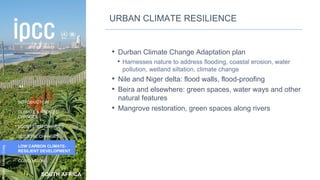
URBAN CLIMATE RESILIENCE
• Durban Climate Change Adaptation plan
• Harnesses nature to address flooding, coastal erosion, water
pollution, wetland siltation, climate change
• Nile and Niger delta: flood walls, flood-proofing
• Beira and elsewhere: green spaces, water ways and other
natural features
• Mangrove restoration, green spaces along rivers
54
ZAMBIA
INTRODUCTION
CLIMATE & RELATED
CHANGES
ECOSYSTEM CHANGES
SOCIETAL CHANGES
LOW CARBON CLIMATE-
RESILIENT DEVELOPMENT
CONCLUSION
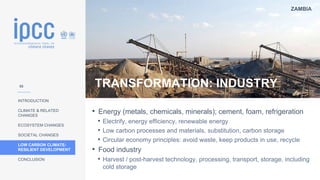
TRANSFORMATION: INDUSTRY
• Energy (metals, chemicals, minerals); cement, foam, refrigeration
• Electrify, energy efficiency, renewable energy
• Low carbon processes and materials, substitution, carbon storage
• Circular economy principles: avoid waste, keep products in use, recycle
• Food industry
• Harvest / post-harvest technology, processing, transport, storage, including
cold storage
55
NIGERIA
INTRODUCTION
CLIMATE & RELATED
CHANGES
ECOSYSTEM CHANGES
SOCIETAL CHANGES
LOW CARBON CLIMATE-
RESILIENT DEVELOPMENT
CONCLUSION
Photo:
Commonwealth
Secretariat
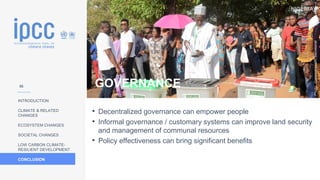
• Decentralized governance can empower people
• Informal governance / customary systems can improve land security
and management of communal resources
• Policy effectiveness can bring significant benefits
GOVERNANCE
56
ZIMBABWE
INTRODUCTION
CLIMATE & RELATED
CHANGES
ECOSYSTEM CHANGES
SOCIETAL CHANGES
LOW CARBON CLIMATE-
RESILIENT DEVELOPMENT
CONCLUSION
Photo:
Michaelphillipr
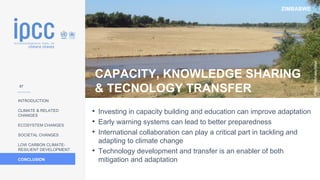
• Investing in capacity building and education can improve adaptation
• Early warning systems can lead to better preparedness
• International collaboration can play a critical part in tackling and
adapting to climate change
• Technology development and transfer is an enabler of both
mitigation and adaptation
CAPACITY, KNOWLEDGE SHARING
& TECNOLOGY TRANSFER
57
ETHIOPIA
INTRODUCTION
CLIMATE & RELATED
CHANGES
ECOSYSTEM CHANGES
SOCIETAL CHANGES
LOW CARBON CLIMATE-
RESILIENT DEVELOPMENT
CONCLUSION
Photo:
EU/ECHO/Martin
Karimi
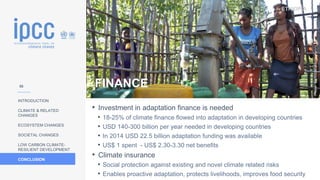
• Investment in adaptation finance is needed
• 18-25% of climate finance flowed into adaptation in developing countries
• USD 140-300 billion per year needed in developing countries
• In 2014 USD 22.5 billion adaptation funding was available
• US$ 1 spent - US$ 2.30-3.30 net benefits
• Climate insurance
• Social protection against existing and novel climate related risks
• Enables proactive adaptation, protects livelihoods, improves food security
FINANCE
58
UNITED NATIONS
INTRODUCTION
CLIMATE & RELATED
CHANGES
ECOSYSTEM CHANGES
SOCIETAL CHANGES
LOW CARBON CLIMATE-
RESILIENT DEVELOPMENT
CONCLUSION
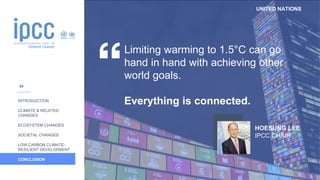
Limiting warming to 1.5°C can go
hand in hand with achieving other
world goals.
Everything is connected.
HOESUNG LEE
IPCC CHAIR
59
THANK YOU!
[CONTACT INFORMATION]
[EMAIL]

Climate Change - An African Perspective

  • 1.
    Photo: NASA CLIMATE CHANGE ANAFRICAN PERSPECTIVE Abdallah Mokssit 26 May Hoesung Lee 27 May
  • 2.
    INTRODUCTION CLIMATE & RELATED CHANGES ECOSYSTEMCHANGES SOCIETAL CHANGES LOW CARBON CLIMATE- RESILIENT DEVELOPMENT CONCLUSION IPCC SPECIAL REPORTS 2018-2019 91 scientists 40 countries 6000 papers >1000 expert reviewers 45,000 review comments 2
  • 3.
    INTRODUCTION CLIMATE & RELATED CHANGES ECOSYSTEMCHANGES SOCIETAL CHANGES LOW CARBON CLIMATE- RESILIENT DEVELOPMENT CONCLUSION IPCC SPECIAL REPORTS 2018-2019 AFRICAN AUTHORS 15% 11% 3% 3
  • 4.
    INTRODUCTION CLIMATE & RELATED CHANGES ECOSYSTEMCHANGES SOCIETAL CHANGES LOW CARBON CLIMATE- RESILIENT DEVELOPMENT CONCLUSION OUTLINE • OUTLINE Climate change Physical environment Ecosystem changes Societal changes Low-carbon and climate- resilient development • Mitigation • Adaptation 4
  • 5.
    INTRODUCTION CLIMATE & RELATED CHANGES ECOSYSTEMCHANGES SOCIETAL CHANGES LOW CARBON CLIMATE- RESILIENT DEVELOPMENT CONCLUSION WHAT DO WE KNOW? SOURCE: IPCC SR15, FAQ1.2 5
  • 6.
    NIGER Photo: NigerTZai INTRODUCTION CLIMATE & RELATED CHANGES ECOSYSTEMCHANGES SOCIETAL CHANGES LOW CARBON CLIMATE- RESILIENT DEVELOPMENT CONCLUSION WHAT DO WE KNOW? • The world has warmed by about 1°C over the past 150 years • Paris Agreement: “well below 2°C… pursue efforts…1.5°C” • Current pledges: 3°C of by 2100, more after that • Climate change is affecting lives, livelihoods and nature • Every bit of warming matters • Every year matters • Every choice matters • Climate action and sustainable development • Clear benefits to keeping warming to 1.5°C or below • Limiting warming to 1.5°C presents a global challenge 6
  • 7.
    DEM. REPUBLIC OFCONGO INTRODUCTION CLIMATE & RELATED CHANGES ECOSYSTEM CHANGES SOCIETAL CHANGES LOW CARBON CLIMATE- RESILIENT DEVELOPMENT CONCLUSION WHAT DO WE KNOW ABOUT AFRICA? • Parts of Africa have warmed by more than 1.5°C • 3.8% share of global carbon dioxide emissions • Increased exposure and vulnerability • Other existing challenges • Extra burden of climate change • Fastest urbanizing continent • Opportunity for climate-resilient, low-carbon development 7
  • 8.
    DJIBOUTI INTRODUCTION CLIMATE & RELATED CHANGES ECOSYSTEMCHANGES SOCIETAL CHANGES LOW CARBON CLIMATE- RESILIENT DEVELOPMENT CONCLUSION Limiting warming to 1.5°C is not impossible but, in many parts of the world, it would require unprecedented transitions in all aspects of society - including energy, land, urban, infrastructure & industrial systems. JIM SKEA CO CHAIR IPCC WORKING GROUP III 8
  • 9.
    INTRODUCTION CLIMATE & RELATED CHANGES ECOSYSTEMCHANGES SOCIETAL CHANGES LOW CARBON CLIMATE- RESILIENT DEVELOPMENT CONCLUSION LIMITING GLOBAL WARMING TO 1.5°C 2021 net-zero 2050 9 SOURCE: IPCC SR15, Figure SPM.3a
  • 10.
    INTRODUCTION CLIMATE & RELATED CHANGES ECOSYSTEMCHANGES SOCIETAL CHANGES LOW CARBON CLIMATE- RESILIENT DEVELOPMENT CONCLUSION LIMITING GLOBAL WARMING TO 1.5°C • Global energy • Renewable energy: two thirds of global energy by 2050 • Coal phased out • Less energy overall, better efficiency • Industry, construction, transport • Carbon dioxide removal • No single recipe for success 10
  • 11.
    Photo: NASA CLIMATE CHANGE ANAFRICAN PERSPECTIVE Valerie Masson-Delmotte 26 May Chris Trisos 27 May
  • 12.
    INTRODUCTION CLIMATE & RELATED CHANGES ECOSYSTEMCHANGES SOCIETAL CHANGES LOW CARBON CLIMATE- RESILIENT DEVELOPMENT CONCLUSION • OUTLINE Climate change Physical environment Ecosystem changes Societal changes Low-carbon and climate- resilient development • Mitigation • Adaptation 12
  • 13.
    SOMALIA INTRODUCTION CLIMATE & RELATED CHANGES ECOSYSTEMCHANGES SOCIETAL CHANGES LOW CARBON CLIMATE- RESILIENT DEVELOPMENT CONCLUSION CURRENT EXPERIENCE OF CLIMATE CHANGE • Rising temperatures, larger over land • More frequent, intense climate extremes – such as heatwaves, heavy rainfall and drought • Novel climates in tropics • Sea level rise of 16cm, extreme water levels during high tides and storms • Increased rain and wind speed of cyclones • General lack of reliable data 13
  • 14.
    BOTSWANA INTRODUCTION CLIMATE & RELATED CHANGES ECOSYSTEMCHANGES SOCIETAL CHANGES LOW CARBON CLIMATE- RESILIENT DEVELOPMENT CONCLUSION PROJECTED CLIMATE CHANGES • Higher temperatures • Greater warming than global mean • Heat extremes: heat waves, hot nights • Rising frequency, intensity and duration • Less rain • Dry spells, consecutive dry days, droughts • Extreme low river flows • More rain • In Eastern Africa and central Sahel • Higher rainfall intensity and runoff Mean temperature change at 1.5°C warming Mean precipitation change at 1.5°C warming 14
  • 15.
    INTRODUCTION CLIMATE & RELATED CHANGES ECOSYSTEMCHANGES SOCIETAL CHANGES LOW CARBON CLIMATE- RESILIENT DEVELOPMENT CONCLUSION FUTURE GLOBAL CLIMATE CHANGE HOTSPOTS Arctic Sea Ice Arctic Land Regions Mediterranean West Africa and the Sahel Southern Africa Alpine Regions Southeast Asia Fynbos Biome Small Islands HOT SPOTS: IPCC SR15, Table 3.6 15
  • 16.
    EGYPT INTRODUCTION CLIMATE & RELATED CHANGES ECOSYSTEMCHANGES SOCIETAL CHANGES LOW CARBON CLIMATE- RESILIENT DEVELOPMENT CONCLUSION SEA LEVEL RISE Even if warming is kept at 1.5 to 2°C, we might still see a rise in global sea level of up to 1 meter by 2300. STORM SURGE By 2050, many coastal megacities will experience annual storm surge events, even if greenhouse gas emissions are reduced significantly. SMALL ISLANDS The warmer the world gets, the more risks these communities will experience, including coastal flooding, sea level rise, and saltwater intrusion. DELTAS Deltas are particularly at risk of coastal flooding from sea level rise A CHANGING PLANET 16
  • 17.
    INTRODUCTION CLIMATE & RELATED CHANGES ECOSYSTEMCHANGES SOCIETAL CHANGES LOW CARBON CLIMATE- RESILIENT DEVELOPMENT CONCLUSION Climate change Physical environment Ecosystem changes Societal changes Low-carbon and climate- resilient development • Mitigation • Adaptation 17
  • 18.
    INTRODUCTION CLIMATE & RELATED CHANGES ECOSYSTEMCHANGES SOCIETAL CHANGES LOW CARBON CLIMATE- RESILIENT DEVELOPMENT CONCLUSION CLIMATE CHANGE & THE NATURAL WORLD ANGOLA BOTSWANA MAURITANIA EGYPT 18
  • 19.
    NAMIBIA INTRODUCTION CLIMATE & RELATED CHANGES ECOSYSTEMCHANGES SOCIETAL CHANGES LOW CARBON CLIMATE- RESILIENT DEVELOPMENT CONCLUSION Photo: MarliesCraig CLIMATE ZONES ARE SHIFTING • Arid, dry areas are growing and shifting • Novel and unprecedented hot climates in tropical regions • Cooler zones are shrinking and shifting to higher altitudes and higher latitudes OBSERVED REGIONAL CLIMATE ZONE SHIFTS: MEDITERRANEAN, SAHEL, ZAMBIA, AND ZIMBABWE 19
  • 20.
    SUDAN INTRODUCTION CLIMATE & RELATED CHANGES ECOSYSTEMCHANGES SOCIETAL CHANGES LOW CARBON CLIMATE- RESILIENT DEVELOPMENT CONCLUSION DESERTIFICATION • Drought (frequent, prolonged, intense) • Caused and/or exacerbated by climate change • Droughts are hotter and thus more severe • Human activities (exacerbated by drought) • Wood harvesting • Overgrazing, trampling, soil compaction • Erosion from wind and water • Loss of soil fertility, lower water retention • Data gaps • Extent of degraded land, vegetation maps THE HORN OF AFRICA IS GETTING EVEN DRIER PROLONGED DROUGHT & OVERGRAZING 20
  • 21.
    ALGERIA INTRODUCTION CLIMATE & RELATED CHANGES ECOSYSTEMCHANGES SOCIETAL CHANGES LOW CARBON CLIMATE- RESILIENT DEVELOPMENT CONCLUSION BIODIVERSITY LOSS 234 in 1978 95 in 2011 PLANT SPECIES PLANT SPECIES SOUTH-WESTERN ALGERIA 21
  • 22.
    CHAD INTRODUCTION CLIMATE & RELATED CHANGES ECOSYSTEMCHANGES SOCIETAL CHANGES LOW CARBON CLIMATE- RESILIENT DEVELOPMENT CONCLUSION Photo: Stuart Rankin BIODIVERSITY LOSS • Climate change • Human factors (exacerbated by climate change) • Land use change, habitat pollution, over-exploitation • Natural factors (exacerbated by human factors) • Invasive alien plants, pests, diseases, bush encroachment 22
  • 23.
    SOUTH AFRICA INTRODUCTION CLIMATE &RELATED CHANGES ECOSYSTEM CHANGES SOCIETAL CHANGES LOW CARBON CLIMATE- RESILIENT DEVELOPMENT CONCLUSION EXTINCTIONS ▪ >2000 plant species in dryland areas could become extinct within 100 years. ▪ The Fynbos biome in South Africa could lose about 45% of its suitable growing area at 2°C warming. ▪ Limiting warming can help protect this rich habitat. 23
  • 24.
    LIBYA INTRODUCTION CLIMATE & RELATED CHANGES ECOSYSTEMCHANGES SOCIETAL CHANGES LOW CARBON CLIMATE- RESILIENT DEVELOPMENT CONCLUSION OASES • Already • Water resources declining • Suitability for crops decreasing • Oases abandoned • Future • Water demand exceeds supply • Too hot and dry for traditional crops 24
  • 25.
    KENYA INTRODUCTION CLIMATE & RELATED CHANGES ECOSYSTEMCHANGES SOCIETAL CHANGES LOW CARBON CLIMATE- RESILIENT DEVELOPMENT CONCLUSION HIGH MOUNTAIN REGIONS • Large populations live in highland areas • Climate change impacts in natural and human systems • Knock-on effects on lowlands and oceans • East African glaciers could lose >80% mass by 2100 • Deep concern experienced at local level 25
  • 26.
    SEYCHELLES INTRODUCTION CLIMATE & RELATED CHANGES ECOSYSTEMCHANGES SOCIETAL CHANGES LOW CARBON CLIMATE- RESILIENT DEVELOPMENT CONCLUSION THE OCEAN • Oceans absorb 90% of heat – ocean heatwaves • Oceans absorb 20-30% of carbon dioxide – acidification, chemistry • Water nutrients and dissolved oxygen • Dead zones • Distribution and abundance of marine life • 70-90% of tropical coral reefs disappear at 1.5°C warming 26
  • 27.
    Photo: NASA CLIMATE CHANGE ANAFRICAN PERSPECTIVE Fatima Denton 26 & 27 May
  • 28.
    INTRODUCTION CLIMATE & RELATED CHANGES ECOSYSTEMCHANGES SOCIETAL CHANGES LOW CARBON CLIMATE- RESILIENT DEVELOPMENT CONCLUSION Climate change Physical environment Ecosystem changes Societal impacts Low-carbon and climate- resilient development • Mitigation • Adaptation 28
  • 29.
    GHANA INTRODUCTION CLIMATE & RELATED CHANGES ECOSYSTEMCHANGES SOCIETAL CHANGES LOW CARBON CLIMATE- RESILIENT DEVELOPMENT CONCLUSION Photo: Flickr user Jenny SOCIAL VULNERABILITIES • Poverty, malnutrition, disease • In sub-Saharan Africa 41% live in extreme poverty • Multidimensional poverty: combination of deprivations • Vulnerable areas: drylands, coastlands, cities, informal settlements • 85-95% of people who are vulnerable and exposed to climate risks live in Africa and Asia • Food insecurity, food prices, income losses, livelihoods, health, displacement • Vulnerable groups: subsistence farmers, indigenous people, local fishing communities, women, children and the elderly • Women: significant labour force, limited by gender inequalities 29
  • 30.
    CAMEROON INTRODUCTION CLIMATE & RELATED CHANGES ECOSYSTEMCHANGES SOCIETAL CHANGES LOW CARBON CLIMATE- RESILIENT DEVELOPMENT CONCLUSION The biggest climate change impacts can be seen in the food, agricultural and health sectors, with knock-on effects on poverty, the economy, migration and conflict. DEBRA ROBERTS CO-CHAIR IPCC WORKING GROUP II 30
  • 31.
    INTRODUCTION CLIMATE & RELATED CHANGES ECOSYSTEMCHANGES SOCIETAL CHANGES LOW CARBON CLIMATE- RESILIENT DEVELOPMENT CONCLUSION Malagasy farmers vulnerable to shocks from extremes Farmers in Ethiopia lose about 220 US $ per hectare through soil erosion In pastoral lands across Africa lower animal growth rates and productivity Poverty rate in Ghana increased by 5.4% in 2015 from loss of productivity In Nigeria, there have been reports of climate change affecting the livelihoods of arable crop farmers. Ethiopia and southern Africa, 2015/16, worst drought in 50 years, 28 million people needed food aid One third of people under- nourished in sub-Saharan and East Africa Reduced productivity led to higher prices, negatively affecting food security, especially in sub-Saharan Africa Some oases in northern Africa have been abandoned FOOD & AGRICULTURE IMPACTS ACROSS AFRICA 31
  • 32.
    BENIN INTRODUCTION CLIMATE & RELATED CHANGES ECOSYSTEMCHANGES SOCIETAL CHANGES LOW CARBON CLIMATE- RESILIENT DEVELOPMENT CONCLUSION Food security will be increasingly affected by future climate change through yield declines – especially in the tropics – increased prices, reduced nutrient quality, and supply chain disruptions. YOUBA SOKONA VICE CHAIR, IPCC 32
  • 33.
    ZAMBIA INTRODUCTION CLIMATE & RELATED CHANGES ECOSYSTEMCHANGES SOCIETAL CHANGES LOW CARBON CLIMATE- RESILIENT DEVELOPMENT CONCLUSION Photo: Marlies Craig • 11% of global population has decreased food security • 20% of these live in Africa • 31% of undernourished populations live in Africa (about 254 million) • Heat and dryness impact on agriculture • Made worse by other human activities FOOD SECURITY 33
  • 34.
    TANZANIA INTRODUCTION CLIMATE & RELATED CHANGES ECOSYSTEMCHANGES SOCIETAL CHANGES LOW CARBON CLIMATE- RESILIENT DEVELOPMENT CONCLUSION Photo: MarliesCraig FOOD SECURITY • Crop yields • Staples: 15% reduction in 11 major global crops, by 2050 at 1.5°C • Vegetables, cash crops like cocoa, coffee, cotton, peanuts • Area suitable for crops • Agricultural productivity • 17–22% loss, by 2050 at 1.5°C • 23% more cropland needed to compensate (>3m km2 globally) • Lower nutritional quality due to rise in CO2 34
  • 35.
    MADAGASCAR INTRODUCTION CLIMATE & RELATED CHANGES ECOSYSTEMCHANGES SOCIETAL CHANGES LOW CARBON CLIMATE- RESILIENT DEVELOPMENT CONCLUSION FOOD SECURITY • Loss of agricultural productivity & income • Loss in livestock productivity and growth rates, spread of pests and diseases • Food price spikes, famines • Loss / deterioration of agricultural land • Large-scale corporate land acquisition • Commercial agriculture expanding into rangelands • Fragmentation of habitats • Loss of vegetation, desertification, soil erosion, sea level rise • Bush encroachment, spread of alien invasive plants • Increased vulnerability to extreme events • Geographical isolation, lack of access, lack of social safety nets 35
  • 36.
    BENIN INTRODUCTION CLIMATE & RELATED CHANGES ECOSYSTEMCHANGES SOCIETAL CHANGES LOW CARBON CLIMATE- RESILIENT DEVELOPMENT CONCLUSION FISHERIES • 90% of the world’s rural poor live in coastal areas of 15 countries, including Africa • ¼ to ⅓ of dietary protein and micronutrients from seafood • Decline in fishing revenues in 89% of countries, by 2050 • >25% decrease in maximum fish catch potential 36
  • 37.
    SOUTH AFRICA INTRODUCTION CLIMATE &RELATED CHANGES ECOSYSTEM CHANGES SOCIETAL CHANGES LOW CARBON CLIMATE- RESILIENT DEVELOPMENT CONCLUSION Photo: Marlies Craig HEALTH AND WELLBEING • Undernutrition and malnutrition • Stunting, wasting • Disease • Vector-borne, water / food-borne • Deadly heat stress • Air quality • Dust, related meningitis, fire smoke • Data gap 37 Excess deaths per year from climate change by 2030 compared to 1961-1990 Africa & Middle East World Childhood undernutrition 68 200 95 200 Malaria 57 500 60 100 Diarrhoea 31 900 48 100 Heat stress 4 900 37 600
  • 38.
    NAMIBIA INTRODUCTION CLIMATE & RELATED CHANGES ECOSYSTEMCHANGES SOCIETAL CHANGES LOW CARBON CLIMATE- RESILIENT DEVELOPMENT CONCLUSION Photo: MarliesCraig POVERTY • Climate change is a poverty multiplier • Making poor people poorer • Increasing number of people living in poverty • 3 to 16 million people forced into poverty by 2030 • Agriculture, food prices • Food security, water-security, energy, well-being less challenging at 1.5°C than at 2°C or higher • Exposure to climate risks 20x lower in: • sustainable socio-economic development (50 million exposed) versus • high poverty and inequality (1 billion exposed) 38
  • 39.
    DEM. REPUBLIC OFCONGO INTRODUCTION CLIMATE & RELATED CHANGES ECOSYSTEM CHANGES SOCIETAL CHANGES LOW CARBON CLIMATE- RESILIENT DEVELOPMENT CONCLUSION CONFLICT AND MIGRATION Conflict • Land degradation – productivity – violent conflict • Increased dryness – food riots • Existing conflict – reinforced / sustained Migration • Droughts, food / water shortage, flooding, sea level rise • Seasonal / permanent migration • Rural – urban movement • 10% less rain → 4.5% increase in urbanization (SSA, 1950-2000) • East Africa coastal outmigration: projected 750 000 between 2020- 2050 39
  • 40.
    BURKINA FASO INTRODUCTION CLIMATE &RELATED CHANGES ECOSYSTEM CHANGES SOCIETAL CHANGES LOW CARBON CLIMATE- RESILIENT DEVELOPMENT CONCLUSION ECONOMY • Infrastructure at risk from storms, floods, sea level rise • Railways at risk of sand movements • Reductions in economic growth • Widening income inequality • Highest tourism sector risks for least developed countries • Tourism >15% of national economy • Africa’s tourism assets increasingly at risk • Tourist facilities, natural assets 40
  • 41.
    MOZAMBIQUE INTRODUCTION CLIMATE & RELATED CHANGES ECOSYSTEMCHANGES SOCIETAL CHANGES LOW CARBON CLIMATE- RESILIENT DEVELOPMENT CONCLUSION Photo: Denis Onyodi: IFRC/DRK/Climate Centre CASCADING AND COMPOUND EFFECTS • Cascading effects: • Desertification – migration to marginal land – environmental degradation – livestock & crop losses – hunger – out-migration – food riots – economic collapse • Flooding – harvest failure – loss of employment – drop in wages – failure in trade and informal safety nets – livestock sales – drop in food prices – grain production stops – no food imports – livestock disease – food shortage – escalating food prices • Ocean changes – coral reef damage – fisheries – food – economics • Compounding effects: • Heat & drought & flooding & food security & health crisis & wildfire & conflict & poverty & economic crisis 41
  • 42.
    COTE D’IVOIRE INTRODUCTION CLIMATE &RELATED CHANGES ECOSYSTEM CHANGES SOCIETAL CHANGES LOW CARBON CLIMATE- RESILIENT DEVELOPMENT CONCLUSION Photo: UN Photo/Basile Zoma URBAN IMPACTS • Cities concentrate climate related risks • Deadly heat stress, flooding, water poverty, landslides, fire, diseases • Affecting people, services, infrastructure • Adding to existing problems around poverty, exclusion, governance • Sea level rise in coastal cities threatens critical infrastructure • Informal settlements at particular risk • Cities also concentrate opportunities for change 42
  • 43.
    Photo: NASA CLIMATE CHANGE ANAFRICAN PERSPECTIVE Youba Sokona, 26&27 May 2021
  • 44.
    INTRODUCTION CLIMATE & RELATED CHANGES ECOSYSTEMCHANGES SOCIETAL CHANGES LOW CARBON CLIMATE- RESILIENT DEVELOPMENT CONCLUSION Climate change Physical environment Ecosystem changes Societal changes Low-carbon and climate- resilient development • Mitigation • Adaptation 44
  • 45.
    NIGERIA INTRODUCTION CLIMATE & RELATED CHANGES ECOSYSTEMCHANGES SOCIETAL CHANGES LOW CARBON CLIMATE- RESILIENT DEVELOPMENT CONCLUSION TRANSFORMATION FOR AFRICA • Climate-resilient, low carbon development • Adapt to unavoidable climate change impacts • Reduce poverty, hunger, malnutrition • Improve health and livelihoods • Affordable, clean energy • Clean water • Finance 45
  • 46.
    TANZANIA INTRODUCTION CLIMATE & RELATED CHANGES ECOSYSTEMCHANGES SOCIETAL CHANGES LOW CARBON CLIMATE- RESILIENT DEVELOPMENT CONCLUSION Photo: Clean Cooking Alliance TRANSFORMATION: ENERGY • Energy poverty • Wood and charcoal: forest degradation, deforestation • Health problems associated with indoor smoke, fire hazard • High electricity prices unaffordable for poor households • Affordable clean energy (solar, wind, hydro) – energy security • Policies to incentivize and regulate supply; investment • Reduced health risks, hard labour, safety, school enrolment, agency, income opportunities 46
  • 47.
    MOROCCO INTRODUCTION CLIMATE & RELATED CHANGES ECOSYSTEMCHANGES SOCIETAL CHANGES LOW CARBON CLIMATE- RESILIENT DEVELOPMENT CONCLUSION Photo: Richard Allaway TRANSFORMATION: ENERGY • Renewable energy: cost and feasibility • Political, economic, social, technical • Solar power: major opportunities and co-benefits at all scales • Cities, farming communities, large scale power plants • Hydropower: potential for growth, risks for water security • Bioenergy: potential for renewable energy, potential trade-offs • Sustainable options: waste steams, land restoration, low-input 47
  • 48.
    BURUNDI INTRODUCTION CLIMATE & RELATED CHANGES ECOSYSTEMCHANGES SOCIETAL CHANGES LOW CARBON CLIMATE- RESILIENT DEVELOPMENT CONCLUSION Photo: (cropped): CTB/Josiane Droeghag TRANSFORMATION: LAND • Sustainable agriculture • Improve food and water security • Protect against disease • Provide energy, fibre and building materials • Provide income from cash crops • Protect and preserve biodiversity and ecosystems • Contribute to climate change mitigation 48
  • 49.
    SOUTH AFRICA INTRODUCTION CLIMATE &RELATED CHANGES ECOSYSTEM CHANGES SOCIETAL CHANGES LOW CARBON CLIMATE- RESILIENT DEVELOPMENT CONCLUSION Photo: Herding academy CLIMATE RESILIENT AGRICULTURE • Intensification • Fertilizer application, precision agriculture, seed priming • Land surplus, restoration / reforestation • Commercialization, diversification • Conservation agriculture • no/minimum tillage, mulching, cover crops, crop rotation • mixed cropping, crop-livestock mixes • integrating trees into croplands and rangelands (agroforestry) • flood-proofing crops, rainwater harvesting • Improved logging practices, better reporting • protecting existing forests and peatlands • Removal of invasive alien plants • Land restoration • Monetary returns can be 3 to 6-fold over a 30 year period 49
  • 50.
    TANZANIA INTRODUCTION CLIMATE & RELATED CHANGES ECOSYSTEMCHANGES SOCIETAL CHANGES LOW CARBON CLIMATE- RESILIENT DEVELOPMENT CONCLUSION Photo: Marlies Craig LIVESTOCK AND FISHERIES • Importance of livestock in Africa • Food security, especially with increasing crop failures • Options for adaptation in livestock • Rainwater capturing, seasonally alternating use of rangelands, rotational grazing, careful livestock breeding and selection, management of woody plants (e.g. bush encroachment), livestock feed that is unsuitable for human consumption, shifting from cattle to camels • Indigenous and local knowledge • Options for adaptation in fisheries • Financial aid, accessing new fishing grounds, fair or preferential distribution of harvest, improved fishing gear, insurance 50
  • 51.
    INTRODUCTION CLIMATE & RELATED CHANGES ECOSYSTEMCHANGES SOCIETAL CHANGES LOW CARBON CLIMATE- RESILIENT DEVELOPMENT CONCLUSION REFORESTATION / TREE PLANTING • Managed natural regeneration • Watershed rehabilitation • Tree planting (reforestation / afforestation) • Biodiversity, ecosystem function • Food and water security • Reduce poverty, improve social capital, avoid out-migration • Reduce sand storms and wind erosion, improve micro-climates, soil nutrients, soil water retention • Contribute to mitigation LARGE-SCALE PROJECT SMALL-SCALE PROJECT 51
  • 52.
    Photo: NASA CLIMATE CHANGE ANAFRICAN PERSPECTIVE Youba Sokona, 26 May 2021 (TBC) Debra Roberts, 27 May 2021
  • 53.
    RWANDA INTRODUCTION CLIMATE & RELATED CHANGES ECOSYSTEMCHANGES SOCIETAL CHANGES LOW CARBON CLIMATE- RESILIENT DEVELOPMENT CONCLUSION Photo: GATETE Pacifique TRANSFORMATION: URBAN & INFRASTRUCTURE • Sustainable development of healthy urban areas • Green buildings and suburbs, clean water, renewable energy, sustainable transport and connectivity, healthy environment • Urban agriculture • Food security, reduced transport, recycling of waste • Inclusive and fairer cities • Public participation, civic rights, multiple stakeholders 53
  • 54.
    SOUTH AFRICA INTRODUCTION CLIMATE &RELATED CHANGES ECOSYSTEM CHANGES SOCIETAL CHANGES LOW CARBON CLIMATE- RESILIENT DEVELOPMENT CONCLUSION Photo: Marlies Craig URBAN CLIMATE RESILIENCE • Durban Climate Change Adaptation plan • Harnesses nature to address flooding, coastal erosion, water pollution, wetland siltation, climate change • Nile and Niger delta: flood walls, flood-proofing • Beira and elsewhere: green spaces, water ways and other natural features • Mangrove restoration, green spaces along rivers 54
  • 55.
    ZAMBIA INTRODUCTION CLIMATE & RELATED CHANGES ECOSYSTEMCHANGES SOCIETAL CHANGES LOW CARBON CLIMATE- RESILIENT DEVELOPMENT CONCLUSION TRANSFORMATION: INDUSTRY • Energy (metals, chemicals, minerals); cement, foam, refrigeration • Electrify, energy efficiency, renewable energy • Low carbon processes and materials, substitution, carbon storage • Circular economy principles: avoid waste, keep products in use, recycle • Food industry • Harvest / post-harvest technology, processing, transport, storage, including cold storage 55
  • 56.
    NIGERIA INTRODUCTION CLIMATE & RELATED CHANGES ECOSYSTEMCHANGES SOCIETAL CHANGES LOW CARBON CLIMATE- RESILIENT DEVELOPMENT CONCLUSION Photo: Commonwealth Secretariat • Decentralized governance can empower people • Informal governance / customary systems can improve land security and management of communal resources • Policy effectiveness can bring significant benefits GOVERNANCE 56
  • 57.
    ZIMBABWE INTRODUCTION CLIMATE & RELATED CHANGES ECOSYSTEMCHANGES SOCIETAL CHANGES LOW CARBON CLIMATE- RESILIENT DEVELOPMENT CONCLUSION Photo: Michaelphillipr • Investing in capacity building and education can improve adaptation • Early warning systems can lead to better preparedness • International collaboration can play a critical part in tackling and adapting to climate change • Technology development and transfer is an enabler of both mitigation and adaptation CAPACITY, KNOWLEDGE SHARING & TECNOLOGY TRANSFER 57
  • 58.
    ETHIOPIA INTRODUCTION CLIMATE & RELATED CHANGES ECOSYSTEMCHANGES SOCIETAL CHANGES LOW CARBON CLIMATE- RESILIENT DEVELOPMENT CONCLUSION Photo: EU/ECHO/Martin Karimi • Investment in adaptation finance is needed • 18-25% of climate finance flowed into adaptation in developing countries • USD 140-300 billion per year needed in developing countries • In 2014 USD 22.5 billion adaptation funding was available • US$ 1 spent - US$ 2.30-3.30 net benefits • Climate insurance • Social protection against existing and novel climate related risks • Enables proactive adaptation, protects livelihoods, improves food security FINANCE 58
  • 59.
    UNITED NATIONS INTRODUCTION CLIMATE &RELATED CHANGES ECOSYSTEM CHANGES SOCIETAL CHANGES LOW CARBON CLIMATE- RESILIENT DEVELOPMENT CONCLUSION Limiting warming to 1.5°C can go hand in hand with achieving other world goals. Everything is connected. HOESUNG LEE IPCC CHAIR 59
  • 60.