SIXTH ASSESSMENT REPORT
WorkingGroup I – The Physical Science Basis
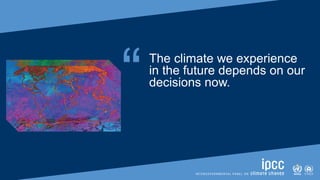
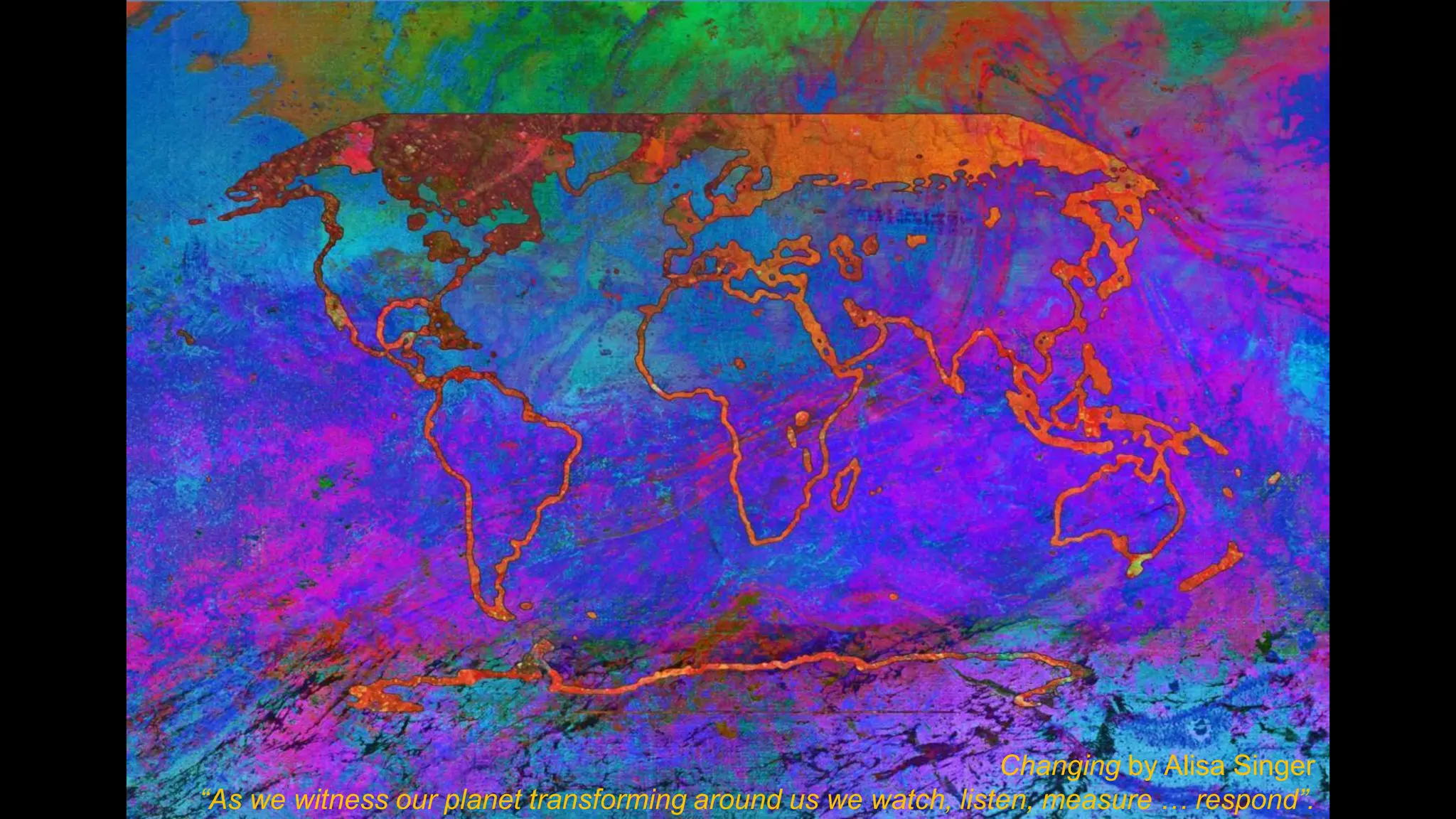
Changing by Alisa Singer
“As we witness our planet transforming around us we watch, listen, measure … respond”.
2.
SIXTH ASSESSMENT REPORT
WorkingGroup I – The Physical Science Basis
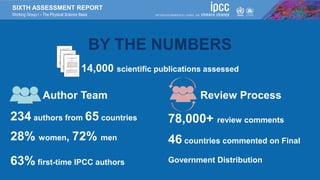
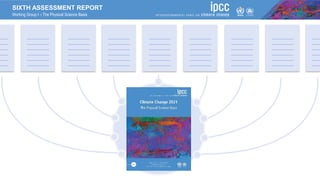
BY THE NUMBERS
Author Team
234 authors from 65 countries
28% women, 72% men
63% first-time IPCC authors
Review Process
78,000+ review comments
46 countries commented on Final
Government Distribution
14,000 scientific publications assessed
SIXTH ASSESSMENT REPORT
WorkingGroup I – The Physical Science Basis
“Recent changes in the climate
are widespread, rapid, and
intensifying, and
unprecedented in thousands
of years.
[Credit: NASA]
6.
SIXTH ASSESSMENT REPORT
WorkingGroup I – The Physical Science Basis
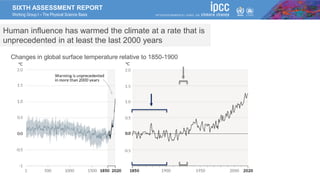
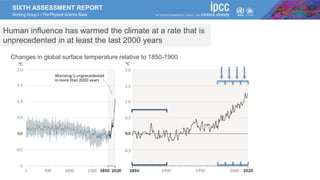
Changes in global surface temperature relative to 1850-1900
Human influence has warmed the climate at a rate that is
unprecedented in at least the last 2000 years
7.
SIXTH ASSESSMENT REPORT
WorkingGroup I – The Physical Science Basis
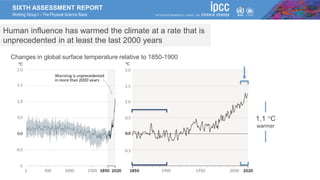
Changes in global surface temperature relative to 1850-1900
Human influence has warmed the climate at a rate that is
unprecedented in at least the last 2000 years
1.1 C
warmer
8.
SIXTH ASSESSMENT REPORT
WorkingGroup I – The Physical Science Basis
Changes in global surface temperature relative to 1850-1900
Human influence has warmed the climate at a rate that is
unprecedented in at least the last 2000 years
9.
SIXTH ASSESSMENT REPORT
WorkingGroup I – The Physical Science Basis
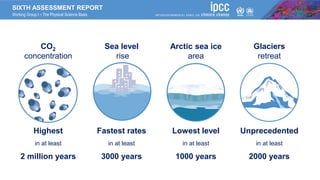
Highest
in at least
2 million years
CO2
concentration
Sea level
rise
Glaciers
retreat
Arctic sea ice
area
Fastest rates
in at least
3000 years
Lowest level
in at least
1000 years
Unprecedented
in at least
2000 years
10.
SIXTH ASSESSMENT REPORT
WorkingGroup I – The Physical Science Basis
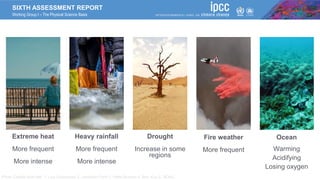
Extreme heat
More frequent
More intense
Heavy rainfall
More frequent
More intense
Drought
Increase in some
regions
Fire weather
More frequent
Photo Credits from left: 1. Luiz Guimaraes 2. Jonathan Ford 3. Peter Burdon 4. Ben Kuo 5. NOAA
Ocean
Warming
Acidifying
Losing oxygen
11.
SIXTH ASSESSMENT REPORT
WorkingGroup I – The Physical Science Basis
“Unless there are immediate,
rapid, and large-scale
reductions in greenhouse gas
emissions, limiting warming to
1.5°C will be beyond reach.
[Credit: Peter John Maridable]
12.
SIXTH ASSESSMENT REPORT
WorkingGroup I – The Physical Science Basis
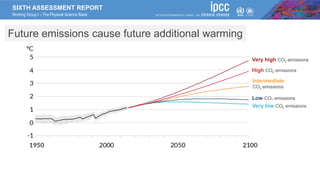
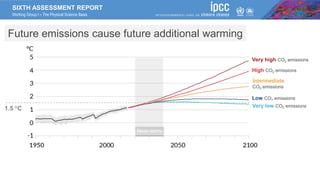
Future emissions cause future additional warming
Very high CO2 emissions
High CO2 emissions
Intermediate
CO2 emissions
Low CO2 emissions
Very low CO2 emissions
13.
SIXTH ASSESSMENT REPORT
WorkingGroup I – The Physical Science Basis
Future emissions cause future additional warming
Very high CO2 emissions
High CO2 emissions
Intermediate
CO2 emissions
Low CO2 emissions
Very low CO2 emissions
Near-term
1.5 C
14.
SIXTH ASSESSMENT REPORT
WorkingGroup I – The Physical Science Basis
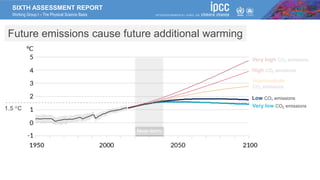
Future emissions cause future additional warming
Very high CO2 emissions
High CO2 emissions
Intermediate
CO2 emissions
Low CO2 emissions
Very low CO2 emissions
1.5 C
Near-term
15.
SIXTH ASSESSMENT REPORT
WorkingGroup I – The Physical Science Basis
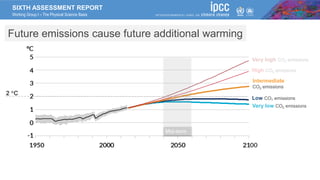
Future emissions cause future additional warming
Very high CO2 emissions
High CO2 emissions
Intermediate
CO2 emissions
Low CO2 emissions
Very low CO2 emissions
Mid-term
2 C
16.
SIXTH ASSESSMENT REPORT
WorkingGroup I – The Physical Science Basis
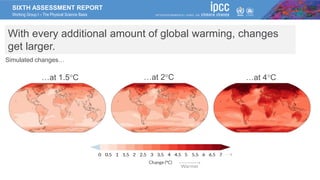
…at 2C …at 4C
…at 1.5C
With every additional amount of global warming, changes
get larger.
Simulated changes…
17.
SIXTH ASSESSMENT REPORT
WorkingGroup I – The Physical Science Basis
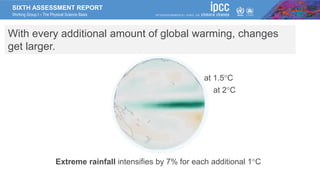
Extreme rainfall intensifies by 7% for each additional 1C
at 1.5C
at 2C
With every additional amount of global warming, changes
get larger.
18.
SIXTH ASSESSMENT REPORT
WorkingGroup I – The Physical Science Basis
“
It is indisputable that human
activities are causing climate
change, making extreme climate
events, including heat waves,
heavy rainfall, and droughts,
more frequent and severe.
[Credit: Yoda Adaman | Unsplash]
19.
SIXTH ASSESSMENT REPORT
WorkingGroup I – The Physical Science Basis
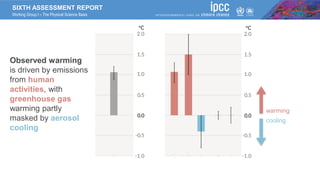
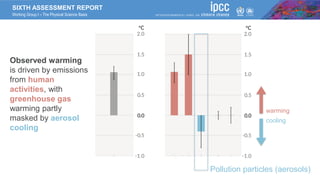
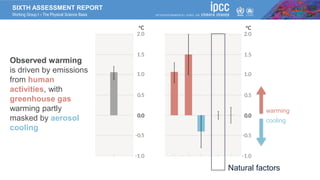
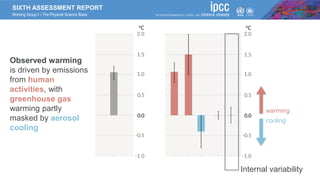
Observed warming
is driven by emissions
from human
activities, with
greenhouse gas
warming partly
masked by aerosol
cooling
warming
cooling
20.
SIXTH ASSESSMENT REPORT
WorkingGroup I – The Physical Science Basis
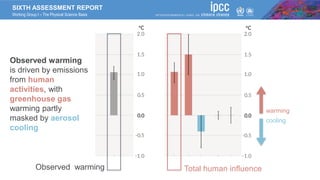
Observed warming
is driven by emissions
from human
activities, with
greenhouse gas
warming partly
masked by aerosol
cooling
warming
cooling
Observed warming Total human influence
21.
SIXTH ASSESSMENT REPORT
WorkingGroup I – The Physical Science Basis
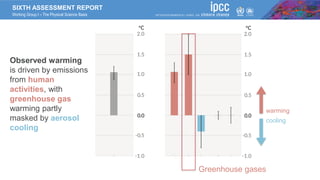
Greenhouse gases
warming
cooling
Observed warming
is driven by emissions
from human
activities, with
greenhouse gas
warming partly
masked by aerosol
cooling
22.
SIXTH ASSESSMENT REPORT
WorkingGroup I – The Physical Science Basis
Pollution particles (aerosols)
warming
cooling
Observed warming
is driven by emissions
from human
activities, with
greenhouse gas
warming partly
masked by aerosol
cooling
23.
SIXTH ASSESSMENT REPORT
WorkingGroup I – The Physical Science Basis
Natural factors
warming
cooling
Observed warming
is driven by emissions
from human
activities, with
greenhouse gas
warming partly
masked by aerosol
cooling
24.
SIXTH ASSESSMENT REPORT
WorkingGroup I – The Physical Science Basis
Internal variability
warming
cooling
Observed warming
is driven by emissions
from human
activities, with
greenhouse gas
warming partly
masked by aerosol
cooling
25.
SIXTH ASSESSMENT REPORT
WorkingGroup I – The Physical Science Basis
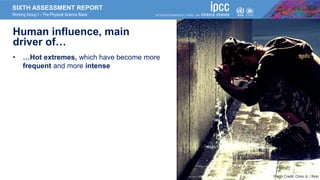
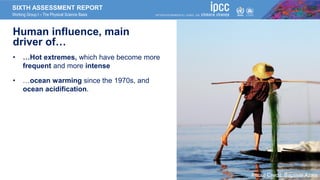
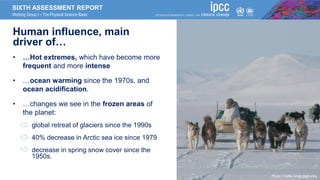
Human influence, main
driver of…
• …Hot extremes, which have become more
frequent and more intense
Photo Credit: Chris JL
Photo Credit: Chris JL / flickr
26.
SIXTH ASSESSMENT REPORT
WorkingGroup I – The Physical Science Basis
Human influence, main
driver of…
• …Hot extremes, which have become more
frequent and more intense
• …ocean warming since the 1970s, and
ocean acidification.
Photo Credit: Baptiste Azais
27.
SIXTH ASSESSMENT REPORT
WorkingGroup I – The Physical Science Basis
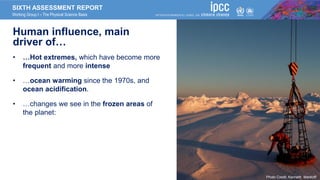
Human influence, main
driver of…
• …Hot extremes, which have become more
frequent and more intense
• …ocean warming since the 1970s, and
ocean acidification.
• …changes we see in the frozen areas of
the planet:
Photo Credit: Kenneth Mankoff
28.
SIXTH ASSESSMENT REPORT
WorkingGroup I – The Physical Science Basis
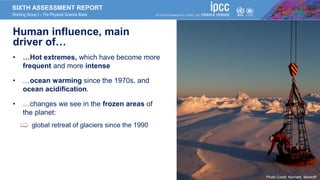
Human influence, main
driver of…
• …Hot extremes, which have become more
frequent and more intense
• …ocean warming since the 1970s, and
ocean acidification.
• …changes we see in the frozen areas of
the planet:
• global retreat of glaciers since the 1990
Photo Credit: Kenneth Mankoff
29.
SIXTH ASSESSMENT REPORT
WorkingGroup I – The Physical Science Basis
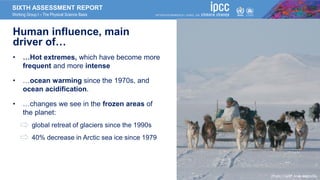
Human influence, main
driver of…
• …Hot extremes, which have become more
frequent and more intense
• …ocean warming since the 1970s, and
ocean acidification.
• …changes we see in the frozen areas of
the planet:
• global retreat of glaciers since the 1990s
• 40% decrease in Arctic sea ice since 1979
Photo Credit: Andy Mahoney
30.
SIXTH ASSESSMENT REPORT
WorkingGroup I – The Physical Science Basis
Human influence, main
driver of…
• …Hot extremes, which have become more
frequent and more intense
• …ocean warming since the 1970s, and
ocean acidification.
• …changes we see in the frozen areas of
the planet:
• global retreat of glaciers since the 1990s
• 40% decrease in Arctic sea ice since 1979
• decrease in spring snow cover since the
1950s.
Photo Credit: Andy Mahoney
31.
SIXTH ASSESSMENT REPORT
WorkingGroup I – The Physical Science Basis
“
Climate change is already
affecting every region on Earth,
in multiple ways.
The changes we experience will
increase with further warming.
[Credit: Hong Nguyen | Unsplash]
32.
SIXTH ASSESSMENT REPORT
WorkingGroup I – The Physical Science Basis
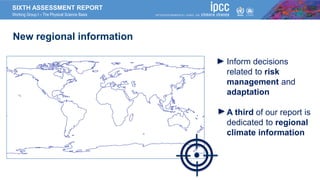
New regional information
Inform decisions
related to risk
management and
adaptation
A third of our report is
dedicated to regional
climate information
33.
SIXTH ASSESSMENT REPORT
WorkingGroup I – The Physical Science Basis
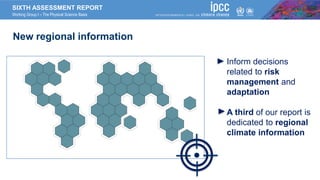
New regional information
Inform decisions
related to risk
management and
adaptation
A third of our report is
dedicated to regional
climate information
34.
SIXTH ASSESSMENT REPORT
WorkingGroup I – The Physical Science Basis
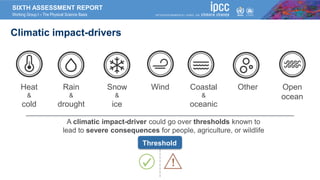
Climatic impact-drivers
Heat
&
cold
Rain
&
drought
Snow
&
ice
Coastal
&
oceanic
Wind Other Open
ocean
A climatic impact-driver could go over thresholds known to
lead to severe consequences for people, agriculture, or wildlife
Threshold
35.
SIXTH ASSESSMENT REPORT
WorkingGroup I – The Physical Science Basis
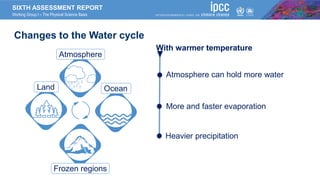
Changes to the Water cycle
With warmer temperature
Atmosphere can hold more water
More and faster evaporation
Heavier precipitation
Atmosphere
Frozen regions
Land Ocean
36.
SIXTH ASSESSMENT REPORT
WorkingGroup I – The Physical Science Basis
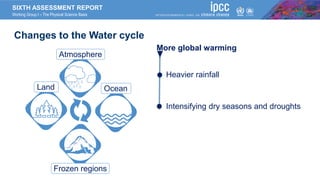
Changes to the Water cycle
Heavier rainfall
Intensifying dry seasons and droughts
Atmosphere
Frozen regions
Land Ocean
More global warming
37.
SIXTH ASSESSMENT REPORT
WorkingGroup I – The Physical Science Basis
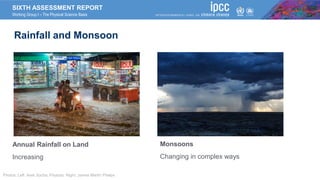
Rainfall and Monsoon
Annual Rainfall on Land
Increasing
Monsoons
Changing in complex ways
Photos: Left: Arek Socha, Pixabay: Right: James Martin Phelps
38.
SIXTH ASSESSMENT REPORT
WorkingGroup I – The Physical Science Basis
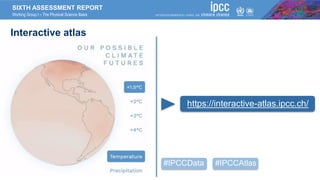
Interactive atlas
https://interactive-atlas.ipcc.ch/
#IPCCData #IPCCAtlas
39.
SIXTH ASSESSMENT REPORT
WorkingGroup I – The Physical Science Basis
“There’s no going back from some
changes in the climate system…
[Credit: Jenn Caselle | UCSB]
40.
SIXTH ASSESSMENT REPORT
WorkingGroup I – The Physical Science Basis
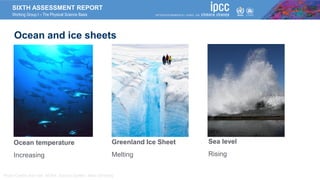
Ocean and ice sheets
Ocean temperature
Increasing
Greenland Ice Sheet
Melting
Sea level
Rising
Photo Credits from left: NOAA; Konrad Steffen; Allan Grinberg
41.
SIXTH ASSESSMENT REPORT
WorkingGroup I – The Physical Science Basis
“…However, some changes could
be slowed and others could be
stopped by limiting warming.
[Credit: Andy Mahoney | NSIDC]
42.
SIXTH ASSESSMENT REPORT
WorkingGroup I – The Physical Science Basis
“
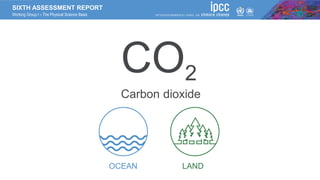
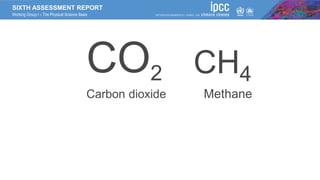
To limit global warming, strong,
rapid, and sustained reductions in
CO2, methane, and other
greenhouse gases are necessary.
This would not only reduce the
consequences of climate change
but also improve air quality.
[Credit: evgeny-nelmin.]
43.
SIXTH ASSESSMENT REPORT
WorkingGroup I – The Physical Science Basis
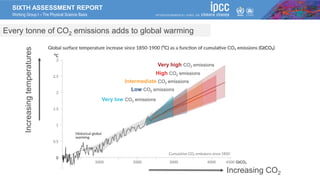
Every tonne of CO2 emissions adds to global warming
Very high CO2 emissions
High CO2 emissions
Intermediate CO2 emissions
Low CO2 emissions
Very low CO2 emissions
Increasing CO2
Increasing
temperatures
44.
SIXTH ASSESSMENT REPORT
WorkingGroup I – The Physical Science Basis
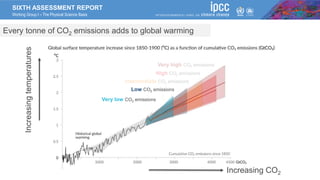
Every tonne of CO2 emissions adds to global warming
Very high CO2 emissions
High CO2 emissions
Intermediate CO2 emissions
Low CO2 emissions
Very low CO2 emissions
Increasing CO2
Increasing
temperatures
SIXTH ASSESSMENT REPORT
WorkingGroup I – The Physical Science Basis
“The climate we experience
in the future depends on our
decisions now.
48.
SIXTH ASSESSMENT REPORT
WorkingGroup I – The Physical Science Basis
9 August 2021
#ClimateReport #IPCC
SIXTH ASSESSMENT REPORT
Working Group I – The Physical Science Basis
Thank you.
@IPCC
@IPCC_CH
linkedin.com/company/ipcc
IPCC: www.ipcc.ch
Interactive Atlas: interactive-atlas.ipcc.ch
IPCC Working Group I TSU:
IPCC Press Office: ipcc-media@wmo.int
More Information: Follow Us:

![SIXTH ASSESSMENT REPORT
Working Group I – The Physical Science Basis
“Recent changes in the climate
are widespread, rapid, and
intensifying, and
unprecedented in thousands
of years.
[Credit: NASA]](https://image.slidesharecdn.com/ipccar6wgipressconferenceslides-250522120844-ea6345f2/85/IPCC_AR6_WGI_Press_Conference_Slides-pdf-5-320.jpg)
![SIXTH ASSESSMENT REPORT
Working Group I – The Physical Science Basis
“Unless there are immediate,
rapid, and large-scale
reductions in greenhouse gas
emissions, limiting warming to
1.5°C will be beyond reach.
[Credit: Peter John Maridable]](https://image.slidesharecdn.com/ipccar6wgipressconferenceslides-250522120844-ea6345f2/85/IPCC_AR6_WGI_Press_Conference_Slides-pdf-11-320.jpg)
![SIXTH ASSESSMENT REPORT
Working Group I – The Physical Science Basis
“
It is indisputable that human
activities are causing climate
change, making extreme climate
events, including heat waves,
heavy rainfall, and droughts,
more frequent and severe.
[Credit: Yoda Adaman | Unsplash]](https://image.slidesharecdn.com/ipccar6wgipressconferenceslides-250522120844-ea6345f2/85/IPCC_AR6_WGI_Press_Conference_Slides-pdf-18-320.jpg)
![SIXTH ASSESSMENT REPORT
Working Group I – The Physical Science Basis
“
Climate change is already
affecting every region on Earth,
in multiple ways.
The changes we experience will
increase with further warming.
[Credit: Hong Nguyen | Unsplash]](https://image.slidesharecdn.com/ipccar6wgipressconferenceslides-250522120844-ea6345f2/85/IPCC_AR6_WGI_Press_Conference_Slides-pdf-31-320.jpg)
![SIXTH ASSESSMENT REPORT
Working Group I – The Physical Science Basis
“There’s no going back from some
changes in the climate system…
[Credit: Jenn Caselle | UCSB]](https://image.slidesharecdn.com/ipccar6wgipressconferenceslides-250522120844-ea6345f2/85/IPCC_AR6_WGI_Press_Conference_Slides-pdf-39-320.jpg)
![SIXTH ASSESSMENT REPORT
Working Group I – The Physical Science Basis
“…However, some changes could
be slowed and others could be
stopped by limiting warming.
[Credit: Andy Mahoney | NSIDC]](https://image.slidesharecdn.com/ipccar6wgipressconferenceslides-250522120844-ea6345f2/85/IPCC_AR6_WGI_Press_Conference_Slides-pdf-41-320.jpg)
![SIXTH ASSESSMENT REPORT
Working Group I – The Physical Science Basis
“
To limit global warming, strong,
rapid, and sustained reductions in
CO2, methane, and other
greenhouse gases are necessary.
This would not only reduce the
consequences of climate change
but also improve air quality.
[Credit: evgeny-nelmin.]](https://image.slidesharecdn.com/ipccar6wgipressconferenceslides-250522120844-ea6345f2/85/IPCC_AR6_WGI_Press_Conference_Slides-pdf-42-320.jpg)