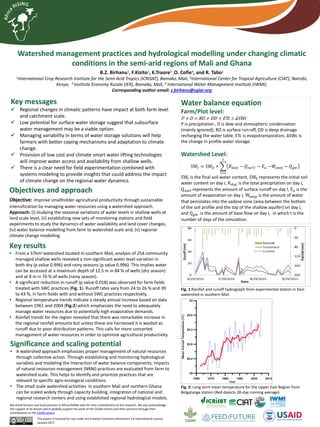
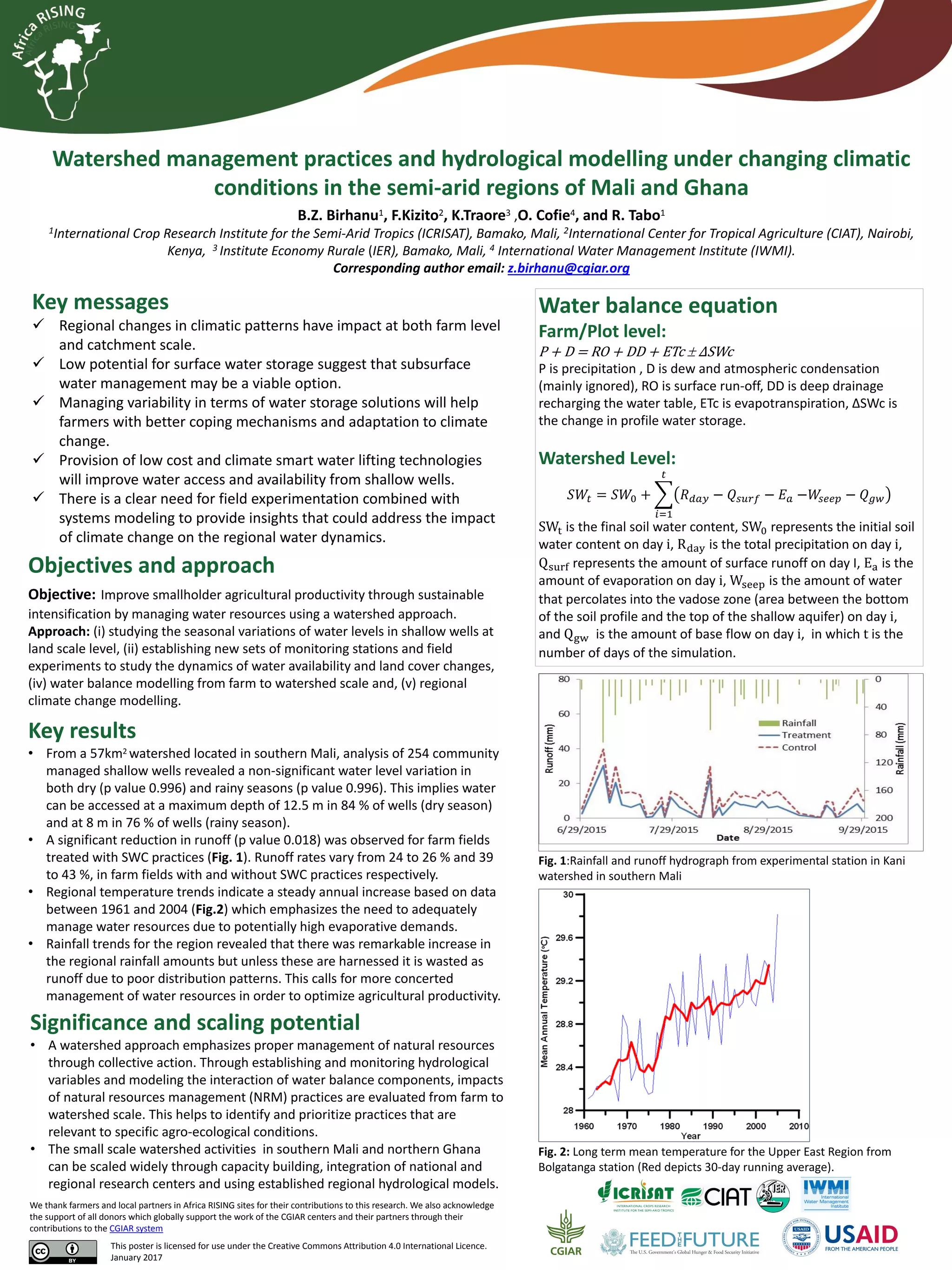
Watershed management practices and hydrological modelling under changing climatic
conditions in the semi-arid regions of Mali and Ghana
B.Z. Birhanu1, F.Kizito2, K.Traore3 ,O. Cofie4, and R. Tabo1
1International Crop Research Institute for the Semi-Arid Tropics (ICRISAT), Bamako, Mali, 2International Center for Tropical Agriculture (CIAT), Nairobi,
Kenya, 3 Institute Economy Rurale (IER), Bamako, Mali, 4 International Water Management Institute (IWMI).
Corresponding author email: z.birhanu@cgiar.org
Key messages
 Regional changes in climatic patterns have impact at both farm level
and catchment scale.
 Low potential for surface water storage suggest that subsurface
water management may be a viable option.
 Managing variability in terms of water storage solutions will help
farmers with better coping mechanisms and adaptation to climate
change.
 Provision of low cost and climate smart water lifting technologies
will improve water access and availability from shallow wells.
 There is a clear need for field experimentation combined with
systems modeling to provide insights that could address the impact
of climate change on the regional water dynamics.
This poster is licensed for use under the Creative Commons Attribution 4.0 International Licence.
January 2017
We thank farmers and local partners in Africa RISING sites for their contributions to this research. We also acknowledge
the support of all donors which globally support the work of the CGIAR centers and their partners through their
contributions to the CGIAR system
Objectives and approach
Objective: Improve smallholder agricultural productivity through sustainable
intensification by managing water resources using a watershed approach.
Approach: (i) studying the seasonal variations of water levels in shallow wells at
land scale level, (ii) establishing new sets of monitoring stations and field
experiments to study the dynamics of water availability and land cover changes,
(iv) water balance modelling from farm to watershed scale and, (v) regional
climate change modelling.
Key results
• From a 57km2 watershed located in southern Mali, analysis of 254 community
managed shallow wells revealed a non-significant water level variation in
both dry (p value 0.996) and rainy seasons (p value 0.996). This implies water
can be accessed at a maximum depth of 12.5 m in 84 % of wells (dry season)
and at 8 m in 76 % of wells (rainy season).
• A significant reduction in runoff (p value 0.018) was observed for farm fields
treated with SWC practices (Fig. 1). Runoff rates vary from 24 to 26 % and 39
to 43 %, in farm fields with and without SWC practices respectively.
• Regional temperature trends indicate a steady annual increase based on data
between 1961 and 2004 (Fig.2) which emphasizes the need to adequately
manage water resources due to potentially high evaporative demands.
• Rainfall trends for the region revealed that there was remarkable increase in
the regional rainfall amounts but unless these are harnessed it is wasted as
runoff due to poor distribution patterns. This calls for more concerted
management of water resources in order to optimize agricultural productivity.
Water balance equation
Farm/Plot level:
P + D = RO + DD + ETc  ΔSWc
P is precipitation , D is dew and atmospheric condensation
(mainly ignored), RO is surface run-off, DD is deep drainage
recharging the water table, ETc is evapotranspiration, ΔSWc is
the change in profile water storage.
Watershed Level:
𝑆𝑊𝑡 = 𝑆𝑊0 +
𝑖=1
𝑡
𝑅 𝑑𝑎𝑦 − 𝑄𝑠𝑢𝑟𝑓 − 𝐸 𝑎 −𝑊𝑠𝑒𝑒𝑝 − 𝑄 𝑔𝑤
SWt is the final soil water content, SW0 represents the initial soil
water content on day i, Rday is the total precipitation on day i,
Qsurf represents the amount of surface runoff on day I, Ea is the
amount of evaporation on day i, Wseep is the amount of water
that percolates into the vadose zone (area between the bottom
of the soil profile and the top of the shallow aquifer) on day i,
and Qgw is the amount of base flow on day i, in which t is the
number of days of the simulation.
Significance and scaling potential
• A watershed approach emphasizes proper management of natural resources
through collective action. Through establishing and monitoring hydrological
variables and modeling the interaction of water balance components, impacts
of natural resources management (NRM) practices are evaluated from farm to
watershed scale. This helps to identify and prioritize practices that are
relevant to specific agro-ecological conditions.
• The small scale watershed activities in southern Mali and northern Ghana
can be scaled widely through capacity building, integration of national and
regional research centers and using established regional hydrological models.
Fig. 2: Long term mean temperature for the Upper East Region from
Bolgatanga station (Red depicts 30-day running average).
Fig. 1:Rainfall and runoff hydrograph from experimental station in Kani
watershed in southern Mali

Watershed management practices and hydrological modelling under changing climatic conditions in the semi-arid regions of Mali and Ghana

  • 1.
    Watershed management practicesand hydrological modelling under changing climatic conditions in the semi-arid regions of Mali and Ghana B.Z. Birhanu1, F.Kizito2, K.Traore3 ,O. Cofie4, and R. Tabo1 1International Crop Research Institute for the Semi-Arid Tropics (ICRISAT), Bamako, Mali, 2International Center for Tropical Agriculture (CIAT), Nairobi, Kenya, 3 Institute Economy Rurale (IER), Bamako, Mali, 4 International Water Management Institute (IWMI). Corresponding author email: z.birhanu@cgiar.org Key messages  Regional changes in climatic patterns have impact at both farm level and catchment scale.  Low potential for surface water storage suggest that subsurface water management may be a viable option.  Managing variability in terms of water storage solutions will help farmers with better coping mechanisms and adaptation to climate change.  Provision of low cost and climate smart water lifting technologies will improve water access and availability from shallow wells.  There is a clear need for field experimentation combined with systems modeling to provide insights that could address the impact of climate change on the regional water dynamics. This poster is licensed for use under the Creative Commons Attribution 4.0 International Licence. January 2017 We thank farmers and local partners in Africa RISING sites for their contributions to this research. We also acknowledge the support of all donors which globally support the work of the CGIAR centers and their partners through their contributions to the CGIAR system Objectives and approach Objective: Improve smallholder agricultural productivity through sustainable intensification by managing water resources using a watershed approach. Approach: (i) studying the seasonal variations of water levels in shallow wells at land scale level, (ii) establishing new sets of monitoring stations and field experiments to study the dynamics of water availability and land cover changes, (iv) water balance modelling from farm to watershed scale and, (v) regional climate change modelling. Key results • From a 57km2 watershed located in southern Mali, analysis of 254 community managed shallow wells revealed a non-significant water level variation in both dry (p value 0.996) and rainy seasons (p value 0.996). This implies water can be accessed at a maximum depth of 12.5 m in 84 % of wells (dry season) and at 8 m in 76 % of wells (rainy season). • A significant reduction in runoff (p value 0.018) was observed for farm fields treated with SWC practices (Fig. 1). Runoff rates vary from 24 to 26 % and 39 to 43 %, in farm fields with and without SWC practices respectively. • Regional temperature trends indicate a steady annual increase based on data between 1961 and 2004 (Fig.2) which emphasizes the need to adequately manage water resources due to potentially high evaporative demands. • Rainfall trends for the region revealed that there was remarkable increase in the regional rainfall amounts but unless these are harnessed it is wasted as runoff due to poor distribution patterns. This calls for more concerted management of water resources in order to optimize agricultural productivity. Water balance equation Farm/Plot level: P + D = RO + DD + ETc  ΔSWc P is precipitation , D is dew and atmospheric condensation (mainly ignored), RO is surface run-off, DD is deep drainage recharging the water table, ETc is evapotranspiration, ΔSWc is the change in profile water storage. Watershed Level: 𝑆𝑊𝑡 = 𝑆𝑊0 + 𝑖=1 𝑡 𝑅 𝑑𝑎𝑦 − 𝑄𝑠𝑢𝑟𝑓 − 𝐸 𝑎 −𝑊𝑠𝑒𝑒𝑝 − 𝑄 𝑔𝑤 SWt is the final soil water content, SW0 represents the initial soil water content on day i, Rday is the total precipitation on day i, Qsurf represents the amount of surface runoff on day I, Ea is the amount of evaporation on day i, Wseep is the amount of water that percolates into the vadose zone (area between the bottom of the soil profile and the top of the shallow aquifer) on day i, and Qgw is the amount of base flow on day i, in which t is the number of days of the simulation. Significance and scaling potential • A watershed approach emphasizes proper management of natural resources through collective action. Through establishing and monitoring hydrological variables and modeling the interaction of water balance components, impacts of natural resources management (NRM) practices are evaluated from farm to watershed scale. This helps to identify and prioritize practices that are relevant to specific agro-ecological conditions. • The small scale watershed activities in southern Mali and northern Ghana can be scaled widely through capacity building, integration of national and regional research centers and using established regional hydrological models. Fig. 2: Long term mean temperature for the Upper East Region from Bolgatanga station (Red depicts 30-day running average). Fig. 1:Rainfall and runoff hydrograph from experimental station in Kani watershed in southern Mali