Taking agricultural technologies to scale: Experience of
the Africa RISING-NAFAKA partnership in Tanzania
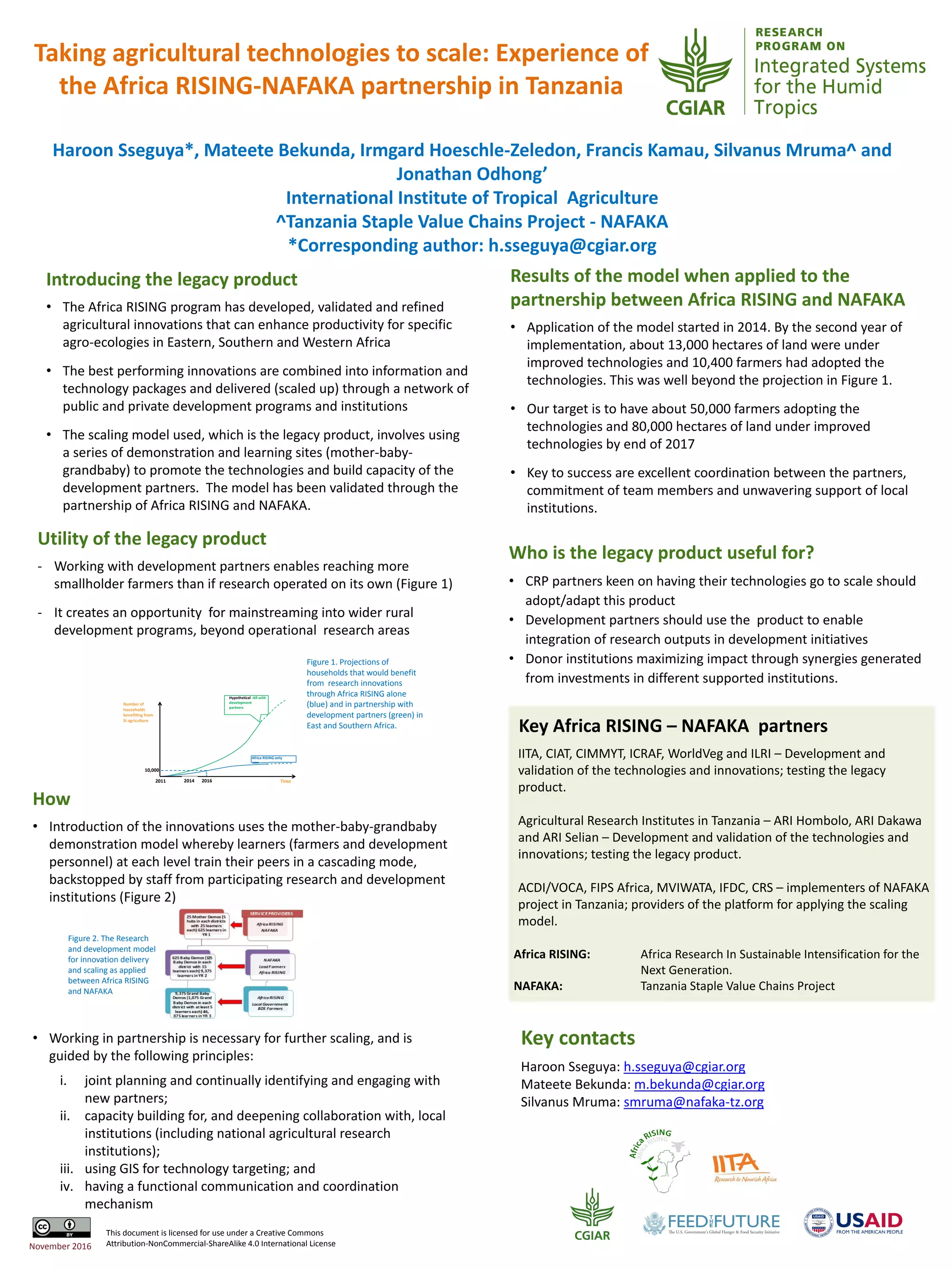
Utility of the legacy product
- Working with development partners enables reaching more
smallholder farmers than if research operated on its own (Figure 1)
- It creates an opportunity for mainstreaming into wider rural
development programs, beyond operational research areas
Introducing the legacy product
• The Africa RISING program has developed, validated and refined
agricultural innovations that can enhance productivity for specific
agro-ecologies in Eastern, Southern and Western Africa
• The best performing innovations are combined into information and
technology packages and delivered (scaled up) through a network of
public and private development programs and institutions
• The scaling model used, which is the legacy product, involves using
a series of demonstration and learning sites (mother-baby-
grandbaby) to promote the technologies and build capacity of the
development partners. The model has been validated through the
partnership of Africa RISING and NAFAKA.
Pictures
Key Africa RISING – NAFAKA partners
IITA, CIAT, CIMMYT, ICRAF, WorldVeg and ILRI – Development and
validation of the technologies and innovations; testing the legacy
product.
Agricultural Research Institutes in Tanzania – ARI Hombolo, ARI Dakawa
and ARI Selian – Development and validation of the technologies and
innovations; testing the legacy product.
ACDI/VOCA, FIPS Africa, MVIWATA, IFDC, CRS – implementers of NAFAKA
project in Tanzania; providers of the platform for applying the scaling
model.
Africa RISING: Africa Research In Sustainable Intensification for the
Next Generation.
NAFAKA: Tanzania Staple Value Chains Project
This document is licensed for use under a Creative Commons
Attribution-NonCommercial-ShareAlike 4.0 International LicenseNovember 2016
Who is the legacy product useful for?
• CRP partners keen on having their technologies go to scale should
adopt/adapt this product
• Development partners should use the product to enable
integration of research outputs in development initiatives
• Donor institutions maximizing impact through synergies generated
from investments in different supported institutions.
Results of the model when applied to the
partnership between Africa RISING and NAFAKA
• Application of the model started in 2014. By the second year of
implementation, about 13,000 hectares of land were under
improved technologies and 10,400 farmers had adopted the
technologies. This was well beyond the projection in Figure 1.
• Our target is to have about 50,000 farmers adopting the
technologies and 80,000 hectares of land under improved
technologies by end of 2017
• Key to success are excellent coordination between the partners,
commitment of team members and unwavering support of local
institutions.
Key contacts
Haroon Sseguya: h.sseguya@cgiar.org
Mateete Bekunda: m.bekunda@cgiar.org
Silvanus Mruma: smruma@nafaka-tz.org
How does it work?
• Introduction of the innovations uses the mother-baby-grandbaby
demonstration model whereby learners (farmers and development
personnel) at each level train their peers in a cascading mode,
backstopped by staff from participating research and development
institutions (Figure 2)
• Working in partnership is necessary for further scaling, and is
guided by the following principles:
Haroon Sseguya*, Mateete Bekunda, Irmgard Hoeschle-Zeledon, Francis Kamau, Silvanus Mruma^ and
Jonathan Odhong’
International Institute of Tropical Agriculture
^Tanzania Staple Value Chains Project - NAFAKA
*Corresponding author: h.sseguya@cgiar.org
Time
Number of
households
benefiting from
SI agriculture
2011
Africa RISING only
Hypothetical -AR with
development
partners
2016
10,000
2014
Figure 1. Projections of
households that would benefit
from research innovations
through Africa RISING alone
(blue) and in partnership with
development partners (green) in
East and Southern Africa.
Figure 2. The Research
and development model
for innovation delivery
and scaling as applied
between Africa RISING
and NAFAKA
i. joint planning and continually identifying and engaging with
new partners;
ii. capacity building for, and deepening collaboration with, local
institutions (including national agricultural research
institutions);
iii. using GIS for technology targeting; and
iv. having a functional communication and coordination
mechanism

Taking agricultural technologies to scale: Experience of the Africa RISING-NAFAKA partnership in Tanzania

  • 1.
    Taking agricultural technologiesto scale: Experience of the Africa RISING-NAFAKA partnership in Tanzania Utility of the legacy product - Working with development partners enables reaching more smallholder farmers than if research operated on its own (Figure 1) - It creates an opportunity for mainstreaming into wider rural development programs, beyond operational research areas Introducing the legacy product • The Africa RISING program has developed, validated and refined agricultural innovations that can enhance productivity for specific agro-ecologies in Eastern, Southern and Western Africa • The best performing innovations are combined into information and technology packages and delivered (scaled up) through a network of public and private development programs and institutions • The scaling model used, which is the legacy product, involves using a series of demonstration and learning sites (mother-baby- grandbaby) to promote the technologies and build capacity of the development partners. The model has been validated through the partnership of Africa RISING and NAFAKA. Pictures Key Africa RISING – NAFAKA partners IITA, CIAT, CIMMYT, ICRAF, WorldVeg and ILRI – Development and validation of the technologies and innovations; testing the legacy product. Agricultural Research Institutes in Tanzania – ARI Hombolo, ARI Dakawa and ARI Selian – Development and validation of the technologies and innovations; testing the legacy product. ACDI/VOCA, FIPS Africa, MVIWATA, IFDC, CRS – implementers of NAFAKA project in Tanzania; providers of the platform for applying the scaling model. Africa RISING: Africa Research In Sustainable Intensification for the Next Generation. NAFAKA: Tanzania Staple Value Chains Project This document is licensed for use under a Creative Commons Attribution-NonCommercial-ShareAlike 4.0 International LicenseNovember 2016 Who is the legacy product useful for? • CRP partners keen on having their technologies go to scale should adopt/adapt this product • Development partners should use the product to enable integration of research outputs in development initiatives • Donor institutions maximizing impact through synergies generated from investments in different supported institutions. Results of the model when applied to the partnership between Africa RISING and NAFAKA • Application of the model started in 2014. By the second year of implementation, about 13,000 hectares of land were under improved technologies and 10,400 farmers had adopted the technologies. This was well beyond the projection in Figure 1. • Our target is to have about 50,000 farmers adopting the technologies and 80,000 hectares of land under improved technologies by end of 2017 • Key to success are excellent coordination between the partners, commitment of team members and unwavering support of local institutions. Key contacts Haroon Sseguya: h.sseguya@cgiar.org Mateete Bekunda: m.bekunda@cgiar.org Silvanus Mruma: smruma@nafaka-tz.org How does it work? • Introduction of the innovations uses the mother-baby-grandbaby demonstration model whereby learners (farmers and development personnel) at each level train their peers in a cascading mode, backstopped by staff from participating research and development institutions (Figure 2) • Working in partnership is necessary for further scaling, and is guided by the following principles: Haroon Sseguya*, Mateete Bekunda, Irmgard Hoeschle-Zeledon, Francis Kamau, Silvanus Mruma^ and Jonathan Odhong’ International Institute of Tropical Agriculture ^Tanzania Staple Value Chains Project - NAFAKA *Corresponding author: h.sseguya@cgiar.org Time Number of households benefiting from SI agriculture 2011 Africa RISING only Hypothetical -AR with development partners 2016 10,000 2014 Figure 1. Projections of households that would benefit from research innovations through Africa RISING alone (blue) and in partnership with development partners (green) in East and Southern Africa. Figure 2. The Research and development model for innovation delivery and scaling as applied between Africa RISING and NAFAKA i. joint planning and continually identifying and engaging with new partners; ii. capacity building for, and deepening collaboration with, local institutions (including national agricultural research institutions); iii. using GIS for technology targeting; and iv. having a functional communication and coordination mechanism