Options for intensifying vegetable production
Asamoah Larbi1 Jean-Baptiste Tignegre2 , Abdul Rahman Nurudeen1 , Issa Sugri3 and Bekele Kotu1
1International Institute of Tropical Agriculture, Tamale-Ghana;
2World Vegetable Center, Bamako-Mali; 3Savanna Agricultural Research Institute, Tamale-Ghana
Partners
This poster is licensed for use under the Creative Commons Attribution 4.0 International Licence.
January 2017
We thank farmers and local partners in Africa RISING sites for their contributions to this research. We also acknowledge
the support of all donors which globally support the work of the CGIAR centers and their partners through their
contributions to the CGIAR system
Objectives
To identify and disseminate farmer-preferred varieties of okra, roselle,
pepper and egg plant and GAPs (spatial arrangements and planting density)
to intensify sole and cereal-legume production in Africa RISING intervention
communities in Ghana and Mali.
Key results
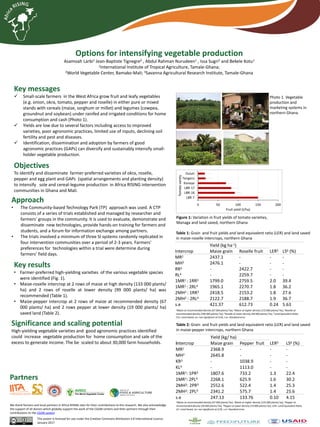
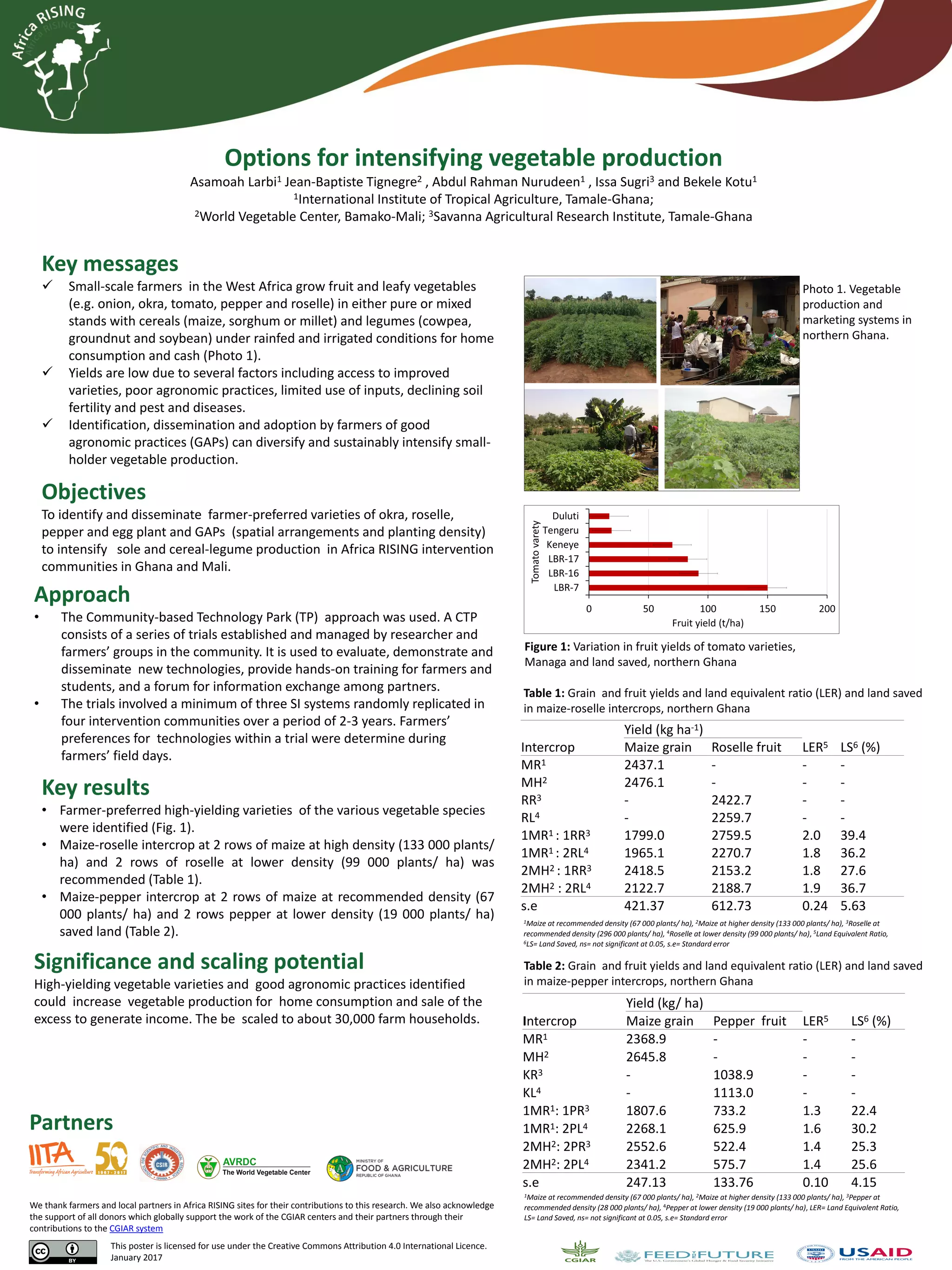
• Farmer-preferred high-yielding varieties of the various vegetable species
were identified (Fig. 1).
• Maize-roselle intercrop at 2 rows of maize at high density (133 000 plants/
ha) and 2 rows of roselle at lower density (99 000 plants/ ha) was
recommended (Table 1).
• Maize-pepper intercrop at 2 rows of maize at recommended density (67
000 plants/ ha) and 2 rows pepper at lower density (19 000 plants/ ha)
saved land (Table 2).
Significance and scaling potential
High-yielding vegetable varieties and good agronomic practices identified
could increase vegetable production for home consumption and sale of the
excess to generate income. The be scaled to about 30,000 farm households.
Key messages
 Small-scale farmers in the West Africa grow fruit and leafy vegetables
(e.g. onion, okra, tomato, pepper and roselle) in either pure or mixed
stands with cereals (maize, sorghum or millet) and legumes (cowpea,
groundnut and soybean) under rainfed and irrigated conditions for home
consumption and cash (Photo 1).
 Yields are low due to several factors including access to improved
varieties, poor agronomic practices, limited use of inputs, declining soil
fertility and pest and diseases.
 Identification, dissemination and adoption by farmers of good
agronomic practices (GAPs) can diversify and sustainably intensify small-
holder vegetable production.
Approach
• The Community-based Technology Park (TP) approach was used. A CTP
consists of a series of trials established and managed by researcher and
farmers’ groups in the community. It is used to evaluate, demonstrate and
disseminate new technologies, provide hands-on training for farmers and
students, and a forum for information exchange among partners.
• The trials involved a minimum of three SI systems randomly replicated in
four intervention communities over a period of 2-3 years. Farmers’
preferences for technologies within a trial were determine during
farmers’ field days.
Photo 1. Vegetable
production and
marketing systems in
northern Ghana.
Yield (kg ha-1)
Intercrop Maize grain Roselle fruit LER5 LS6 (%)
MR1 2437.1 - - -
MH2 2476.1 - - -
RR3 - 2422.7 - -
RL4 - 2259.7 - -
1MR1 : 1RR3 1799.0 2759.5 2.0 39.4
1MR1 : 2RL4 1965.1 2270.7 1.8 36.2
2MH2 : 1RR3 2418.5 2153.2 1.8 27.6
2MH2 : 2RL4 2122.7 2188.7 1.9 36.7
s.e 421.37 612.73 0.24 5.63
Table 1: Grain and fruit yields and land equivalent ratio (LER) and land saved
in maize-roselle intercrops, northern Ghana
1Maize at recommended density (67 000 plants/ ha), 2Maize at higher density (133 000 plants/ ha), 3Roselle at
recommended density (296 000 plants/ ha), 4Roselle at lower density (99 000 plants/ ha), 5Land Equivalent Ratio,
6LS= Land Saved, ns= not significant at 0.05, s.e= Standard error
Figure 1: Variation in fruit yields of tomato varieties,
Managa and land saved, northern Ghana
Yield (kg/ ha)
Intercrop Maize grain Pepper fruit LER5 LS6 (%)
MR1 2368.9 - - -
MH2 2645.8 - - -
KR3 - 1038.9 - -
KL4 - 1113.0 - -
1MR1: 1PR3 1807.6 733.2 1.3 22.4
1MR1: 2PL4 2268.1 625.9 1.6 30.2
2MH2: 2PR3 2552.6 522.4 1.4 25.3
2MH2: 2PL4 2341.2 575.7 1.4 25.6
s.e 247.13 133.76 0.10 4.15
Table 2: Grain and fruit yields and land equivalent ratio (LER) and land saved
in maize-pepper intercrops, northern Ghana
1Maize at recommended density (67 000 plants/ ha), 2Maize at higher density (133 000 plants/ ha), 3Pepper at
recommended density (28 000 plants/ ha), 4Pepper at lower density (19 000 plants/ ha), LER= Land Equivalent Ratio,
LS= Land Saved, ns= not significant at 0.05, s.e= Standard error

Options for intensifying vegetable production

  • 1.
    Options for intensifyingvegetable production Asamoah Larbi1 Jean-Baptiste Tignegre2 , Abdul Rahman Nurudeen1 , Issa Sugri3 and Bekele Kotu1 1International Institute of Tropical Agriculture, Tamale-Ghana; 2World Vegetable Center, Bamako-Mali; 3Savanna Agricultural Research Institute, Tamale-Ghana Partners This poster is licensed for use under the Creative Commons Attribution 4.0 International Licence. January 2017 We thank farmers and local partners in Africa RISING sites for their contributions to this research. We also acknowledge the support of all donors which globally support the work of the CGIAR centers and their partners through their contributions to the CGIAR system Objectives To identify and disseminate farmer-preferred varieties of okra, roselle, pepper and egg plant and GAPs (spatial arrangements and planting density) to intensify sole and cereal-legume production in Africa RISING intervention communities in Ghana and Mali. Key results • Farmer-preferred high-yielding varieties of the various vegetable species were identified (Fig. 1). • Maize-roselle intercrop at 2 rows of maize at high density (133 000 plants/ ha) and 2 rows of roselle at lower density (99 000 plants/ ha) was recommended (Table 1). • Maize-pepper intercrop at 2 rows of maize at recommended density (67 000 plants/ ha) and 2 rows pepper at lower density (19 000 plants/ ha) saved land (Table 2). Significance and scaling potential High-yielding vegetable varieties and good agronomic practices identified could increase vegetable production for home consumption and sale of the excess to generate income. The be scaled to about 30,000 farm households. Key messages  Small-scale farmers in the West Africa grow fruit and leafy vegetables (e.g. onion, okra, tomato, pepper and roselle) in either pure or mixed stands with cereals (maize, sorghum or millet) and legumes (cowpea, groundnut and soybean) under rainfed and irrigated conditions for home consumption and cash (Photo 1).  Yields are low due to several factors including access to improved varieties, poor agronomic practices, limited use of inputs, declining soil fertility and pest and diseases.  Identification, dissemination and adoption by farmers of good agronomic practices (GAPs) can diversify and sustainably intensify small- holder vegetable production. Approach • The Community-based Technology Park (TP) approach was used. A CTP consists of a series of trials established and managed by researcher and farmers’ groups in the community. It is used to evaluate, demonstrate and disseminate new technologies, provide hands-on training for farmers and students, and a forum for information exchange among partners. • The trials involved a minimum of three SI systems randomly replicated in four intervention communities over a period of 2-3 years. Farmers’ preferences for technologies within a trial were determine during farmers’ field days. Photo 1. Vegetable production and marketing systems in northern Ghana. Yield (kg ha-1) Intercrop Maize grain Roselle fruit LER5 LS6 (%) MR1 2437.1 - - - MH2 2476.1 - - - RR3 - 2422.7 - - RL4 - 2259.7 - - 1MR1 : 1RR3 1799.0 2759.5 2.0 39.4 1MR1 : 2RL4 1965.1 2270.7 1.8 36.2 2MH2 : 1RR3 2418.5 2153.2 1.8 27.6 2MH2 : 2RL4 2122.7 2188.7 1.9 36.7 s.e 421.37 612.73 0.24 5.63 Table 1: Grain and fruit yields and land equivalent ratio (LER) and land saved in maize-roselle intercrops, northern Ghana 1Maize at recommended density (67 000 plants/ ha), 2Maize at higher density (133 000 plants/ ha), 3Roselle at recommended density (296 000 plants/ ha), 4Roselle at lower density (99 000 plants/ ha), 5Land Equivalent Ratio, 6LS= Land Saved, ns= not significant at 0.05, s.e= Standard error Figure 1: Variation in fruit yields of tomato varieties, Managa and land saved, northern Ghana Yield (kg/ ha) Intercrop Maize grain Pepper fruit LER5 LS6 (%) MR1 2368.9 - - - MH2 2645.8 - - - KR3 - 1038.9 - - KL4 - 1113.0 - - 1MR1: 1PR3 1807.6 733.2 1.3 22.4 1MR1: 2PL4 2268.1 625.9 1.6 30.2 2MH2: 2PR3 2552.6 522.4 1.4 25.3 2MH2: 2PL4 2341.2 575.7 1.4 25.6 s.e 247.13 133.76 0.10 4.15 Table 2: Grain and fruit yields and land equivalent ratio (LER) and land saved in maize-pepper intercrops, northern Ghana 1Maize at recommended density (67 000 plants/ ha), 2Maize at higher density (133 000 plants/ ha), 3Pepper at recommended density (28 000 plants/ ha), 4Pepper at lower density (19 000 plants/ ha), LER= Land Equivalent Ratio, LS= Land Saved, ns= not significant at 0.05, s.e= Standard error