A Gliricidia-pigeonpea doubled-up legume system for improved productivity of crop
and livestock farming systems of semi-arid agro-ecologies of Central Tanzania
1A. A. Kimaro, 2E. Jonas, 3Ganga Rao, 4C. Rubanza, 1M. Swamila and 3P. Okori
1World Agroforestry Centre, 2Sokoine University of Agriculture, 3International Crops Research Institute for the Semi-Arid Tropics , 4University of Dodoma.
Key messages
• Overgrazing and the use of crop residue and wood harvests for cooking are
major drivers of land degradation in semi-arid ecologies.
• Agroforestry technologies based on dual purpose shrubs and trees such as
Gliricidia sepium and Pigeonpea when grown as a doubled up legume
provide an opportunity to meet fodder, energy supply and build resilience.
• These slow growing leguminous tree/shrub are beneficial for multiple
cropping, allowing cultivation of annual cereals and legumes.
• A network of champion farmers have been engaged in technology testing,
validation and benefit mapping of tree-based doubled up legume
technology to inform scaling out.
Partners
This poster is licensed for use under the Creative Commons Attribution 4.0 International
Licence. January 2017
We thank farmers and local partners in Africa RISING sites for their contributions to this research. We also
acknowledge the support of all donors which globally support the work of the CGIAR centers and their partners
through their contributions to the CGIAR system
Key results
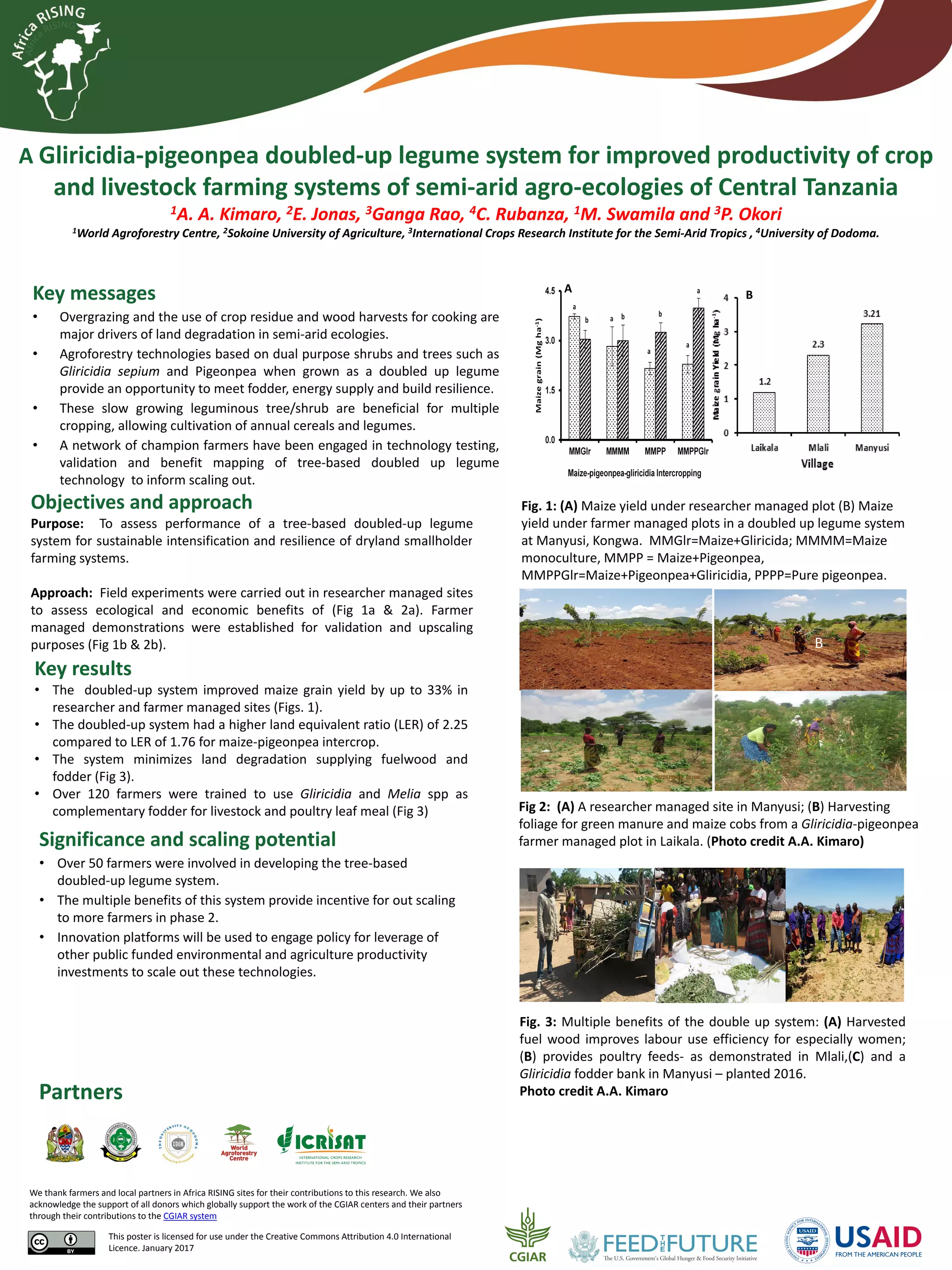
• The doubled-up system improved maize grain yield by up to 33% in
researcher and farmer managed sites (Figs. 1).
• The doubled-up system had a higher land equivalent ratio (LER) of 2.25
compared to LER of 1.76 for maize-pigeonpea intercrop.
• The system minimizes land degradation supplying fuelwood and
fodder (Fig 3).
• Over 120 farmers were trained to use Gliricidia and Melia spp as
complementary fodder for livestock and poultry leaf meal (Fig 3)
Significance and scaling potential
• Over 50 farmers were involved in developing the tree-based
doubled-up legume system.
• The multiple benefits of this system provide incentive for out scaling
to more farmers in phase 2.
• Innovation platforms will be used to engage policy for leverage of
other public funded environmental and agriculture productivity
investments to scale out these technologies.
Fig. 1: (A) Maize yield under researcher managed plot (B) Maize
yield under farmer managed plots in a doubled up legume system
at Manyusi, Kongwa. MMGlr=Maize+Gliricida; MMMM=Maize
monoculture, MMPP = Maize+Pigeonpea,
MMPPGlr=Maize+Pigeonpea+Gliricidia, PPPP=Pure pigeonpea.
Fig. 3: Multiple benefits of the double up system: (A) Harvested
fuel wood improves labour use efficiency for especially women;
(B) provides poultry feeds- as demonstrated in Mlali,(C) and a
Gliricidia fodder bank in Manyusi – planted 2016.
Photo credit A.A. Kimaro
Objectives and approach
Purpose: To assess performance of a tree-based doubled-up legume
system for sustainable intensification and resilience of dryland smallholder
farming systems.
Approach: Field experiments were carried out in researcher managed sites
to assess ecological and economic benefits of (Fig 1a & 2a). Farmer
managed demonstrations were established for validation and upscaling
purposes (Fig 1b & 2b).
Fig 2: (A) A researcher managed site in Manyusi; (B) Harvesting
foliage for green manure and maize cobs from a Gliricidia-pigeonpea
farmer managed plot in Laikala. (Photo credit A.A. Kimaro)
(A)
A
B
A
B

A Gliricidia-pigeonpea doubled-up legume system for improved productivity of crop and livestock farming systems of semi-arid agro-ecologies of Central Tanzania

  • 1.
    A Gliricidia-pigeonpea doubled-uplegume system for improved productivity of crop and livestock farming systems of semi-arid agro-ecologies of Central Tanzania 1A. A. Kimaro, 2E. Jonas, 3Ganga Rao, 4C. Rubanza, 1M. Swamila and 3P. Okori 1World Agroforestry Centre, 2Sokoine University of Agriculture, 3International Crops Research Institute for the Semi-Arid Tropics , 4University of Dodoma. Key messages • Overgrazing and the use of crop residue and wood harvests for cooking are major drivers of land degradation in semi-arid ecologies. • Agroforestry technologies based on dual purpose shrubs and trees such as Gliricidia sepium and Pigeonpea when grown as a doubled up legume provide an opportunity to meet fodder, energy supply and build resilience. • These slow growing leguminous tree/shrub are beneficial for multiple cropping, allowing cultivation of annual cereals and legumes. • A network of champion farmers have been engaged in technology testing, validation and benefit mapping of tree-based doubled up legume technology to inform scaling out. Partners This poster is licensed for use under the Creative Commons Attribution 4.0 International Licence. January 2017 We thank farmers and local partners in Africa RISING sites for their contributions to this research. We also acknowledge the support of all donors which globally support the work of the CGIAR centers and their partners through their contributions to the CGIAR system Key results • The doubled-up system improved maize grain yield by up to 33% in researcher and farmer managed sites (Figs. 1). • The doubled-up system had a higher land equivalent ratio (LER) of 2.25 compared to LER of 1.76 for maize-pigeonpea intercrop. • The system minimizes land degradation supplying fuelwood and fodder (Fig 3). • Over 120 farmers were trained to use Gliricidia and Melia spp as complementary fodder for livestock and poultry leaf meal (Fig 3) Significance and scaling potential • Over 50 farmers were involved in developing the tree-based doubled-up legume system. • The multiple benefits of this system provide incentive for out scaling to more farmers in phase 2. • Innovation platforms will be used to engage policy for leverage of other public funded environmental and agriculture productivity investments to scale out these technologies. Fig. 1: (A) Maize yield under researcher managed plot (B) Maize yield under farmer managed plots in a doubled up legume system at Manyusi, Kongwa. MMGlr=Maize+Gliricida; MMMM=Maize monoculture, MMPP = Maize+Pigeonpea, MMPPGlr=Maize+Pigeonpea+Gliricidia, PPPP=Pure pigeonpea. Fig. 3: Multiple benefits of the double up system: (A) Harvested fuel wood improves labour use efficiency for especially women; (B) provides poultry feeds- as demonstrated in Mlali,(C) and a Gliricidia fodder bank in Manyusi – planted 2016. Photo credit A.A. Kimaro Objectives and approach Purpose: To assess performance of a tree-based doubled-up legume system for sustainable intensification and resilience of dryland smallholder farming systems. Approach: Field experiments were carried out in researcher managed sites to assess ecological and economic benefits of (Fig 1a & 2a). Farmer managed demonstrations were established for validation and upscaling purposes (Fig 1b & 2b). Fig 2: (A) A researcher managed site in Manyusi; (B) Harvesting foliage for green manure and maize cobs from a Gliricidia-pigeonpea farmer managed plot in Laikala. (Photo credit A.A. Kimaro) (A) A B A B