The Fertilizer Forecaster:
guiding short-term decisions in nutrient management
Project Director’s Meeting
October 12, 2016
United States
Department of
Agriculture
National Institute
of Food
and Agriculture
This project was supported by Agriculture and Food Research Initiative Competitive Grant
number 2012-67019-1929 from the USDA National Institute of Food and Agriculture.
Anthony Buda, Peter Kleinman,
Ray Bryant, and Gordon Folmar
USDA Agricultural Research Service
Patrick Drohan, Lauren Vitko,
Doug Miller, and Stephen Crawford
Penn State University
Seann Reed and Peter Ahnert
NOAA NWS Middle Atlantic River Forecast Center
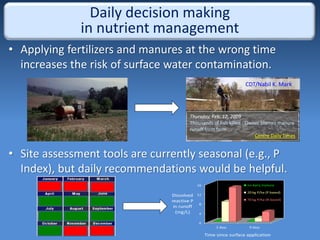
• Applying fertilizers and manures at the wrong time
increases the risk of surface water contamination.
CDT/Nabil K. Mark
Thursday, Feb. 12, 2009
Thousands of fish killed - Owner blames manure
runoff from farm
Centre Daily Times
• Site assessment tools are currently seasonal (e.g., P
Index), but daily recommendations would be helpful.
0
4
8
12
16
2 days 9 days
Dissolved
reactive P
in runoff
(mg/L)
Time since surface application
no dairy manure
20 kg P/ha (P based)
70 kg P/ha (N based)
Daily decision making
in nutrient management
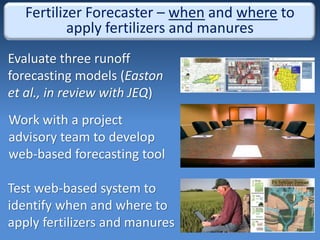
Work with a project
advisory team to develop
web-based forecasting tool
Fertilizer Forecaster – when and where to
apply fertilizers and manures
Evaluate three runoff
forecasting models (Easton
et al., in review with JEQ)
Test web-based system to
identify when and where to
apply fertilizers and manures
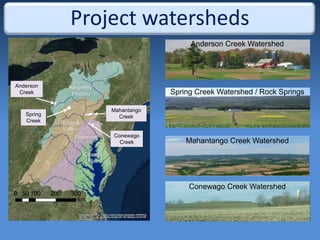
Allegheny
Plateau
Piedmont
Coastal
Plain
Ridge &
Valley
Project watersheds
Anderson Creek Watershed
Anderson
Creek Spring Creek Watershed / Rock Springs
Spring
Creek
Mahantango Creek Watershed
Mahantango
Creek
Conewago Creek Watershed
Conewago
Creek
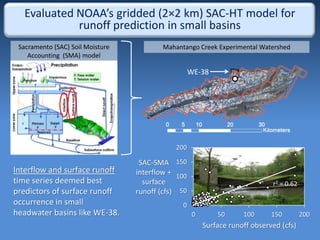
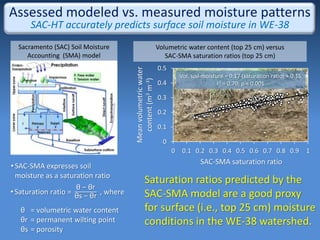
Sacramento (SAC) Soil Moisture
Accounting (SMA) model
Mahantango Creek Experimental Watershed
WE-38
Surface runoff observed (cfs)
SAC-SMA
interflow +
surface
runoff (cfs)
Interflow and surface runoff
time series deemed best
predictors of surface runoff
occurrence in small
headwater basins like WE-38.
0
50
100
150
200
0 50 100 150 200
r2 = 0.62
Evaluated NOAA’s gridded (2×2 km) SAC-HT model for
runoff prediction in small basins
Sacramento (SAC) Soil Moisture
Accounting (SMA) model
•Saturation ratio =
θ − θr
θs − θr
, where
•SAC-SMA expresses soil
moisture as a saturation ratio
θ = volumetric water content
θr = permanent wilting point
θs = porosity
Saturation ratios predicted by the
SAC-SMA model are a good proxy
for surface (i.e., top 25 cm) moisture
conditions in the WE-38 watershed.
0
0.1
0.2
0.3
0.4
0.5
0 0.1 0.2 0.3 0.4 0.5 0.6 0.7 0.8 0.9 1
Meanvolumetricwater
content(m3m-3)
SAC-SMA saturation ratio
Vol. soil moisture = 0.17 (saturation ratio) + 0.15
r2 = 0.70; p < 0.001
Volumetric water content (top 25 cm) versus
SAC-SMA saturation ratios (top 25 cm)
Assessed modeled vs. measured moisture patterns
SAC-HT accurately predicts surface soil moisture in WE-38
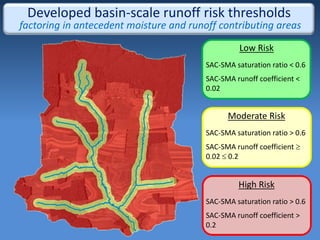
Developed basin-scale runoff risk thresholds
factoring in antecedent moisture and runoff contributing areas
Low Risk
SAC-SMA saturation ratio < 0.6
SAC-SMA runoff coefficient <
0.02
Moderate Risk
SAC-SMA saturation ratio > 0.6
SAC-SMA runoff coefficient 
0.02  0.2
High Risk
SAC-SMA saturation ratio > 0.6
SAC-SMA runoff coefficient >
0.2
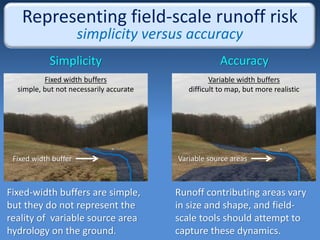
Representing field-scale runoff risk
simplicity versus accuracy
Simplicity
Fixed-width buffers are simple,
but they do not represent the
reality of variable source area
hydrology on the ground.
Fixed width buffer
Fixed width buffers
simple, but not necessarily accurate
Accuracy
Variable source areas
Runoff contributing areas vary
in size and shape, and field-
scale tools should attempt to
capture these dynamics.
Variable width buffers
difficult to map, but more realistic
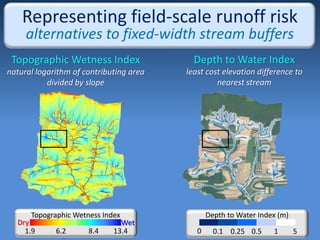
Representing field-scale runoff risk
alternatives to fixed-width stream buffers
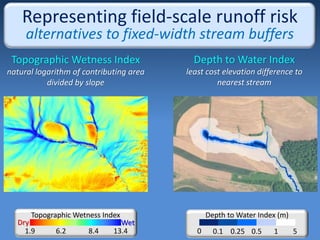
Depth to Water Index
least cost elevation difference to
nearest stream
0 0.1 0.25 0.5 1 5
Depth to Water Index (m)
Topographic Wetness Index
natural logarithm of contributing area
divided by slope
Dry Wet
Topographic Wetness Index
1.9 13.46.2 8.4
Representing field-scale runoff risk
alternatives to fixed-width stream buffers
Topographic Wetness Index
natural logarithm of contributing area
divided by slope
Depth to Water Index
least cost elevation difference to
nearest stream
0 0.1 0.25 0.5 1 5
Depth to Water Index (m)
Dry Wet
Topographic Wetness Index
1.9 13.46.2 8.4
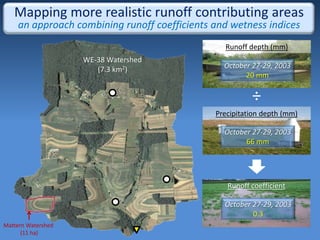
Runoff depth (mm)
WE-38 Watershed
(7.3 km2)
Precipitation depth (mm)
÷
Runoff coefficient
Mapping more realistic runoff contributing areas
an approach combining runoff coefficients and wetness indices
October 27-29, 2003
20 mm
October 27-29, 2003
66 mm
October 27-29, 2003
0.3
Mattern Watershed
(11 ha)
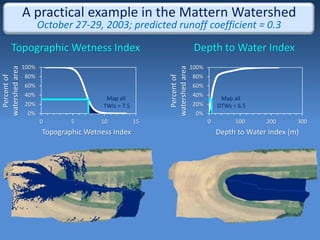
A practical example in the Mattern Watershed
October 27-29, 2003; predicted runoff coefficient = 0.3
Topographic Wetness Index
0%
20%
40%
60%
80%
100%
0 5 10 15
Topographic Wetness Index
Percentof
watershedarea
Depth to Water Index
0%
20%
40%
60%
80%
100%
0 100 200 300
Depth to Water Index (m)
Percentof
watershedarea
Map all
TWIs > 7.5
Map all
DTWs < 6.5
Saturated area observed
Saturated area
predicted
(runoff contributing area)
YES NO
YES
NO
True positive (TP) False positive (FP)
False negative (FN) True negative (TN)
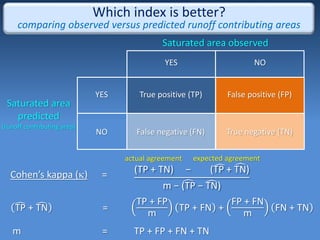
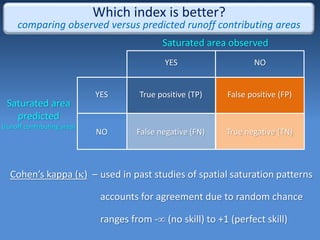
Which index is better?
comparing observed versus predicted runoff contributing areas
Cohen’s kappa () = (TP + TN) − (TP + TN)
m − (TP − TN)
TP + TN =
TP + FP
m
TP + FN +
FP + FN
m
FN + TN
actual agreement expected agreement
TP + FP + FN + TNm =
Saturated area observed
YES NO
YES
NO
True positive (TP) False positive (FP)
False negative (FN) True negative (TN)
Which index is better?
comparing observed versus predicted runoff contributing areas
Cohen’s kappa () – used in past studies of spatial saturation patterns
accounts for agreement due to random chance
ranges from - (no skill) to +1 (perfect skill)
Saturated area
predicted
(runoff contributing area)
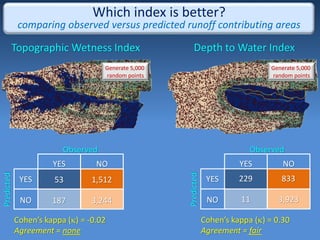
Which index is better?
comparing observed versus predicted runoff contributing areas
Predicted
YES NO
YES
NO
53 1,512
187 3,244
Observed
Cohen’s kappa () = -0.02
Agreement = none
Predicted
YES NO
YES
NO
229 833
11 3,923
Observed
Cohen’s kappa () = 0.30
Agreement = fair
Depth to Water IndexTopographic Wetness Index
Wet boot Wet bootMapped saturated area Mapped saturated area
Generate 5,000
random points
Generate 5,000
random points
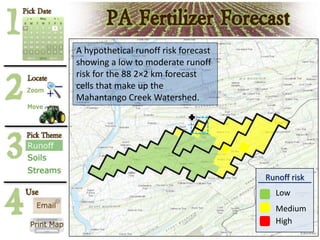
Low
Medium
High
Runoff risk
A hypothetical runoff risk forecast
showing a low to moderate runoff
risk for the 88 2×2 km forecast
cells that make up the
Mahantango Creek Watershed.
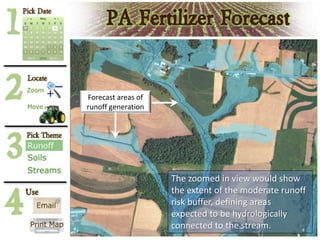
Forecast areas of
runoff generation
The zoomed in view would show
the extent of the moderate runoff
risk buffer, defining areas
expected to be hydrologically
connected to the stream.
Summary and next steps
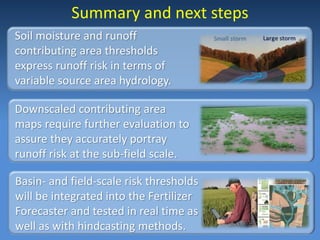
Soil moisture and runoff
contributing area thresholds
express runoff risk in terms of
variable source area hydrology.
Downscaled contributing area
maps require further evaluation to
assure they accurately portray
runoff risk at the sub-field scale.
Basin- and field-scale risk thresholds
will be integrated into the Fertilizer
Forecaster and tested in real time as
well as with hindcasting methods.
Thank you
Partners
STATE CONSERVATION COMMISSION
Middle Atlantic
River Forecast
Center

Developing a Web-based Forecasting Tool for Nutrient Management

  • 1.
    The Fertilizer Forecaster: guidingshort-term decisions in nutrient management Project Director’s Meeting October 12, 2016 United States Department of Agriculture National Institute of Food and Agriculture This project was supported by Agriculture and Food Research Initiative Competitive Grant number 2012-67019-1929 from the USDA National Institute of Food and Agriculture. Anthony Buda, Peter Kleinman, Ray Bryant, and Gordon Folmar USDA Agricultural Research Service Patrick Drohan, Lauren Vitko, Doug Miller, and Stephen Crawford Penn State University Seann Reed and Peter Ahnert NOAA NWS Middle Atlantic River Forecast Center
  • 2.
    • Applying fertilizersand manures at the wrong time increases the risk of surface water contamination. CDT/Nabil K. Mark Thursday, Feb. 12, 2009 Thousands of fish killed - Owner blames manure runoff from farm Centre Daily Times • Site assessment tools are currently seasonal (e.g., P Index), but daily recommendations would be helpful. 0 4 8 12 16 2 days 9 days Dissolved reactive P in runoff (mg/L) Time since surface application no dairy manure 20 kg P/ha (P based) 70 kg P/ha (N based) Daily decision making in nutrient management
  • 3.
    Work with aproject advisory team to develop web-based forecasting tool Fertilizer Forecaster – when and where to apply fertilizers and manures Evaluate three runoff forecasting models (Easton et al., in review with JEQ) Test web-based system to identify when and where to apply fertilizers and manures
  • 4.
    Allegheny Plateau Piedmont Coastal Plain Ridge & Valley Project watersheds AndersonCreek Watershed Anderson Creek Spring Creek Watershed / Rock Springs Spring Creek Mahantango Creek Watershed Mahantango Creek Conewago Creek Watershed Conewago Creek
  • 5.
    Sacramento (SAC) SoilMoisture Accounting (SMA) model Mahantango Creek Experimental Watershed WE-38 Surface runoff observed (cfs) SAC-SMA interflow + surface runoff (cfs) Interflow and surface runoff time series deemed best predictors of surface runoff occurrence in small headwater basins like WE-38. 0 50 100 150 200 0 50 100 150 200 r2 = 0.62 Evaluated NOAA’s gridded (2×2 km) SAC-HT model for runoff prediction in small basins
  • 6.
    Sacramento (SAC) SoilMoisture Accounting (SMA) model •Saturation ratio = θ − θr θs − θr , where •SAC-SMA expresses soil moisture as a saturation ratio θ = volumetric water content θr = permanent wilting point θs = porosity Saturation ratios predicted by the SAC-SMA model are a good proxy for surface (i.e., top 25 cm) moisture conditions in the WE-38 watershed. 0 0.1 0.2 0.3 0.4 0.5 0 0.1 0.2 0.3 0.4 0.5 0.6 0.7 0.8 0.9 1 Meanvolumetricwater content(m3m-3) SAC-SMA saturation ratio Vol. soil moisture = 0.17 (saturation ratio) + 0.15 r2 = 0.70; p < 0.001 Volumetric water content (top 25 cm) versus SAC-SMA saturation ratios (top 25 cm) Assessed modeled vs. measured moisture patterns SAC-HT accurately predicts surface soil moisture in WE-38
  • 7.
    Developed basin-scale runoffrisk thresholds factoring in antecedent moisture and runoff contributing areas Low Risk SAC-SMA saturation ratio < 0.6 SAC-SMA runoff coefficient < 0.02 Moderate Risk SAC-SMA saturation ratio > 0.6 SAC-SMA runoff coefficient  0.02  0.2 High Risk SAC-SMA saturation ratio > 0.6 SAC-SMA runoff coefficient > 0.2
  • 8.
    Representing field-scale runoffrisk simplicity versus accuracy Simplicity Fixed-width buffers are simple, but they do not represent the reality of variable source area hydrology on the ground. Fixed width buffer Fixed width buffers simple, but not necessarily accurate Accuracy Variable source areas Runoff contributing areas vary in size and shape, and field- scale tools should attempt to capture these dynamics. Variable width buffers difficult to map, but more realistic
  • 9.
    Representing field-scale runoffrisk alternatives to fixed-width stream buffers Depth to Water Index least cost elevation difference to nearest stream 0 0.1 0.25 0.5 1 5 Depth to Water Index (m) Topographic Wetness Index natural logarithm of contributing area divided by slope Dry Wet Topographic Wetness Index 1.9 13.46.2 8.4
  • 10.
    Representing field-scale runoffrisk alternatives to fixed-width stream buffers Topographic Wetness Index natural logarithm of contributing area divided by slope Depth to Water Index least cost elevation difference to nearest stream 0 0.1 0.25 0.5 1 5 Depth to Water Index (m) Dry Wet Topographic Wetness Index 1.9 13.46.2 8.4
  • 11.
    Runoff depth (mm) WE-38Watershed (7.3 km2) Precipitation depth (mm) ÷ Runoff coefficient Mapping more realistic runoff contributing areas an approach combining runoff coefficients and wetness indices October 27-29, 2003 20 mm October 27-29, 2003 66 mm October 27-29, 2003 0.3 Mattern Watershed (11 ha)
  • 12.
    A practical examplein the Mattern Watershed October 27-29, 2003; predicted runoff coefficient = 0.3 Topographic Wetness Index 0% 20% 40% 60% 80% 100% 0 5 10 15 Topographic Wetness Index Percentof watershedarea Depth to Water Index 0% 20% 40% 60% 80% 100% 0 100 200 300 Depth to Water Index (m) Percentof watershedarea Map all TWIs > 7.5 Map all DTWs < 6.5
  • 13.
    Saturated area observed Saturatedarea predicted (runoff contributing area) YES NO YES NO True positive (TP) False positive (FP) False negative (FN) True negative (TN) Which index is better? comparing observed versus predicted runoff contributing areas Cohen’s kappa () = (TP + TN) − (TP + TN) m − (TP − TN) TP + TN = TP + FP m TP + FN + FP + FN m FN + TN actual agreement expected agreement TP + FP + FN + TNm =
  • 14.
    Saturated area observed YESNO YES NO True positive (TP) False positive (FP) False negative (FN) True negative (TN) Which index is better? comparing observed versus predicted runoff contributing areas Cohen’s kappa () – used in past studies of spatial saturation patterns accounts for agreement due to random chance ranges from - (no skill) to +1 (perfect skill) Saturated area predicted (runoff contributing area)
  • 15.
    Which index isbetter? comparing observed versus predicted runoff contributing areas Predicted YES NO YES NO 53 1,512 187 3,244 Observed Cohen’s kappa () = -0.02 Agreement = none Predicted YES NO YES NO 229 833 11 3,923 Observed Cohen’s kappa () = 0.30 Agreement = fair Depth to Water IndexTopographic Wetness Index Wet boot Wet bootMapped saturated area Mapped saturated area Generate 5,000 random points Generate 5,000 random points
  • 16.
    Low Medium High Runoff risk A hypotheticalrunoff risk forecast showing a low to moderate runoff risk for the 88 2×2 km forecast cells that make up the Mahantango Creek Watershed.
  • 17.
    Forecast areas of runoffgeneration The zoomed in view would show the extent of the moderate runoff risk buffer, defining areas expected to be hydrologically connected to the stream.
  • 18.
    Summary and nextsteps Soil moisture and runoff contributing area thresholds express runoff risk in terms of variable source area hydrology. Downscaled contributing area maps require further evaluation to assure they accurately portray runoff risk at the sub-field scale. Basin- and field-scale risk thresholds will be integrated into the Fertilizer Forecaster and tested in real time as well as with hindcasting methods.
  • 19.
    Thank you Partners STATE CONSERVATIONCOMMISSION Middle Atlantic River Forecast Center