Landscape natural resources management using forage grasses and legume
intercrops
F.Kizito1, J. Kihara1, B. Lukuyu2; G. Sikumba2; S. Lyimo3, L. Yangole3 , and I. Ibrahim1
1International Center for Tropical Agriculture (CIAT), Nairobi, Kenya; 2International Livestock Research Institute (ILRI) Nairobi, Kenya; 3Selian Agricultural
Research Institute (SARI) Arusha, Tanzania.
Corresponding author email: f.kizito@cgiar.org
Key messages
 Quantitative approaches in estimating fluxes of soil, water and nutrients
(Figure 1) provide vital management insights that help increase
smallholder farm productivity.
 Increase in farm productivity is partly as a result of soil and water
conservation that includes incorporation of forage grasses and legumes
into conventional farming systems
This poster is licensed for use under the Creative Commons Attribution 4.0 International Licence.
January 2017
We thank farmers and local partners in Africa RISING sites for their contributions to this research. We also acknowledge
the support of all donors which globally support the work of the CGIAR centers and their partners through their
contributions to the CGIAR system
Objectives and approach
Objective:
Improve smallholder agricultural productivity through sustainable
intensification by improved management of soil, water and nutrient resources
Approach: (i) Studying the seasonal variations of annual runoff and soil
moisture storage levels within smallholder farming systems integrated with
forage grasses and forage legumes (ii) water balance modelling from farm to
watershed scale.
Key results
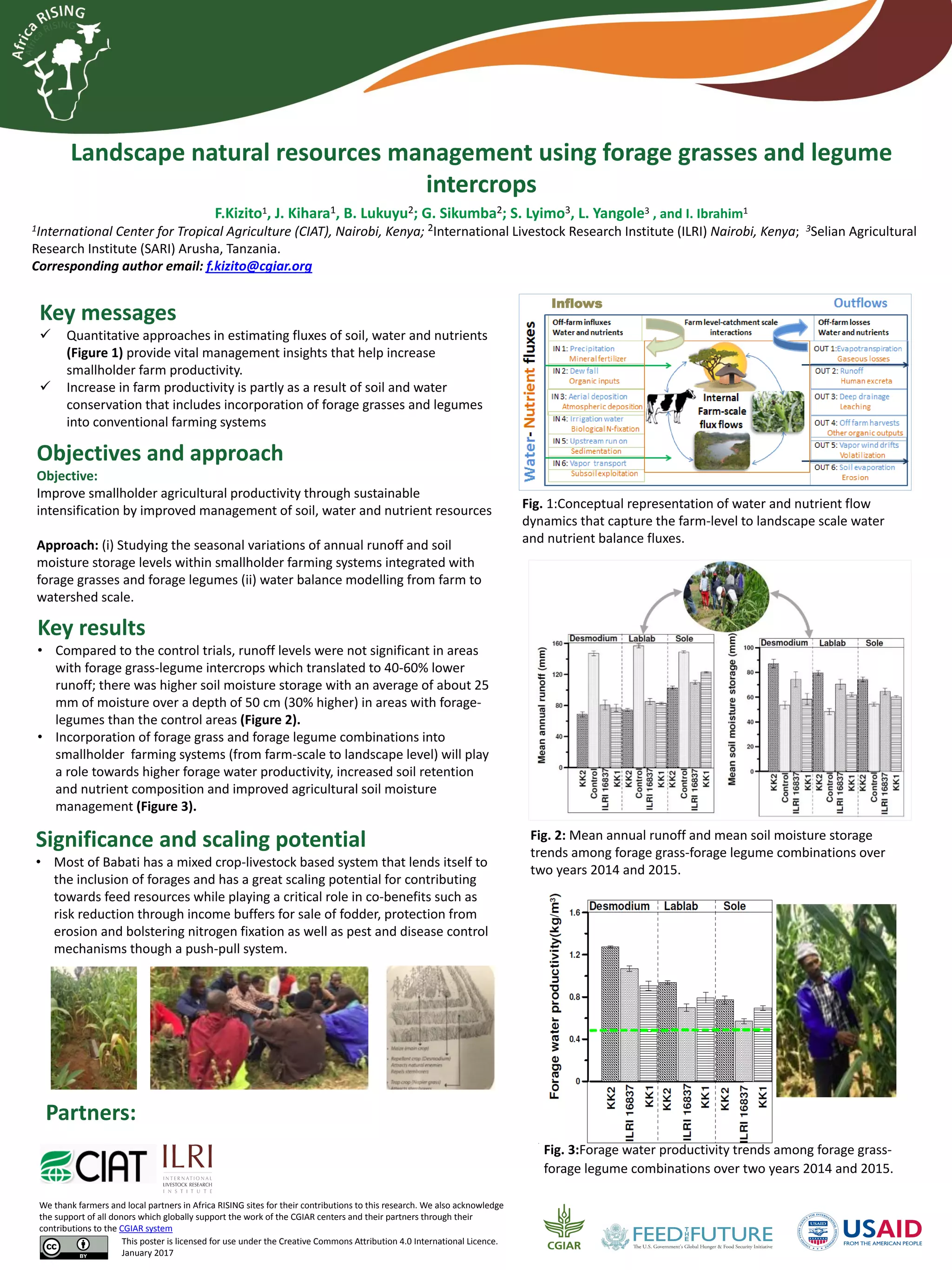
• Compared to the control trials, runoff levels were not significant in areas
with forage grass-legume intercrops which translated to 40-60% lower
runoff; there was higher soil moisture storage with an average of about 25
mm of moisture over a depth of 50 cm (30% higher) in areas with forage-
legumes than the control areas (Figure 2).
• Incorporation of forage grass and forage legume combinations into
smallholder farming systems (from farm-scale to landscape level) will play
a role towards higher forage water productivity, increased soil retention
and nutrient composition and improved agricultural soil moisture
management (Figure 3).
Significance and scaling potential
• Most of Babati has a mixed crop-livestock based system that lends itself to
the inclusion of forages and has a great scaling potential for contributing
towards feed resources while playing a critical role in co-benefits such as
risk reduction through income buffers for sale of fodder, protection from
erosion and bolstering nitrogen fixation as well as pest and disease control
mechanisms though a push-pull system.
Fig. 1:Conceptual representation of water and nutrient flow
dynamics that capture the farm-level to landscape scale water
and nutrient balance fluxes.
Partners:
Fig. 2: Mean annual runoff and mean soil moisture storage
trends among forage grass-forage legume combinations over
two years 2014 and 2015.
Fig. 3:Forage water productivity trends among forage grass-
forage legume combinations over two years 2014 and 2015.
Inflows

Landscape natural resources management using forage grasses and legume intercrops

  • 1.
    Landscape natural resourcesmanagement using forage grasses and legume intercrops F.Kizito1, J. Kihara1, B. Lukuyu2; G. Sikumba2; S. Lyimo3, L. Yangole3 , and I. Ibrahim1 1International Center for Tropical Agriculture (CIAT), Nairobi, Kenya; 2International Livestock Research Institute (ILRI) Nairobi, Kenya; 3Selian Agricultural Research Institute (SARI) Arusha, Tanzania. Corresponding author email: f.kizito@cgiar.org Key messages  Quantitative approaches in estimating fluxes of soil, water and nutrients (Figure 1) provide vital management insights that help increase smallholder farm productivity.  Increase in farm productivity is partly as a result of soil and water conservation that includes incorporation of forage grasses and legumes into conventional farming systems This poster is licensed for use under the Creative Commons Attribution 4.0 International Licence. January 2017 We thank farmers and local partners in Africa RISING sites for their contributions to this research. We also acknowledge the support of all donors which globally support the work of the CGIAR centers and their partners through their contributions to the CGIAR system Objectives and approach Objective: Improve smallholder agricultural productivity through sustainable intensification by improved management of soil, water and nutrient resources Approach: (i) Studying the seasonal variations of annual runoff and soil moisture storage levels within smallholder farming systems integrated with forage grasses and forage legumes (ii) water balance modelling from farm to watershed scale. Key results • Compared to the control trials, runoff levels were not significant in areas with forage grass-legume intercrops which translated to 40-60% lower runoff; there was higher soil moisture storage with an average of about 25 mm of moisture over a depth of 50 cm (30% higher) in areas with forage- legumes than the control areas (Figure 2). • Incorporation of forage grass and forage legume combinations into smallholder farming systems (from farm-scale to landscape level) will play a role towards higher forage water productivity, increased soil retention and nutrient composition and improved agricultural soil moisture management (Figure 3). Significance and scaling potential • Most of Babati has a mixed crop-livestock based system that lends itself to the inclusion of forages and has a great scaling potential for contributing towards feed resources while playing a critical role in co-benefits such as risk reduction through income buffers for sale of fodder, protection from erosion and bolstering nitrogen fixation as well as pest and disease control mechanisms though a push-pull system. Fig. 1:Conceptual representation of water and nutrient flow dynamics that capture the farm-level to landscape scale water and nutrient balance fluxes. Partners: Fig. 2: Mean annual runoff and mean soil moisture storage trends among forage grass-forage legume combinations over two years 2014 and 2015. Fig. 3:Forage water productivity trends among forage grass- forage legume combinations over two years 2014 and 2015. Inflows