JOURNAL
PRESENTATION
Dr. Maliha Nawar
Resident, Phase-B(Year-1)
Department of Community Ophthalmology
Bangabandhu Sheikh Mujib Medical University
TITLE
Comparative visual outcomes of EDOF
intraocular lens with FLACS vs conventional
phacoemulsification
PUBLISHED IN
 Journal of Cataract & Refractive Surgery
 January 2023
 Volume:49(1)
 Page:55-61
3
AUTHORS
 Jia Xu,
 Wenbo Li,
 Zhe Xu,
 Binsong Zhao,
 Yueyang Zhong,
 Kai Wang,
 Xin Liu,
 Xiaohui Song,
 Yinhui Yu,
 Yanan Zhu,
 Qiaomei Tang,
 Ke Yao,
4
PLACE OF STUDY
 Eye Center, the Second Affiliated
Hospital of Zhejiang University,
Zhejiang, China.
5
PURPOSE OF STUDY
To investigate the visual quality after femtosecond
laser–assisted cataract surgery (FLACS) and
conventional phacoemulsification surgery (CPS) with
the implantation of an extended depth-of-focus
(EDOF) intraocular lens (IOL) TECNIS Symfony.
INTRODUCTION
At present in cataract surgery, where only monofocal intraocular
lenses (IOLs) was used to restore vision at 1 specific distance, has
evolved into refractive cataract surgery. The extended depth-of-
focus (EDOF) IOL TECNIS Symfony (Johnson & Johnson Vision), a
new concept IOL, based on a proprietary achromatic diffraction
echelette design, is proven to be capable of restoring the
patient’s far, intermediate, and part of near vision, producing
EDOF and minimal interference light phenomenon.
7
INTRODUCTION
The decentration and tilt of the IOL is a crucial factor
influencing the visual quality of patients
postoperatively. The architecture of the capsulorhexis
has a great influence on the position of the lens, which
in turn affects the refractive effect. The aim of this
study was to compare the visual outcomes and photic
phenomena between FLACS
and CPS in cases implanted with the TECNIS Symfony
IOL.
8
DESIGN OF STUDY
Prospective cohort study.
STUDY DURATION
July 2017 and March 2021
STUDY
POPULATION
261 patients(261 eyes)
10
INCLUSION CRITERIA
 Aged from 45 to 85 years,
 No active ocular disease
except cataracts,
 Received FLACS or CPS in 1
eye,
 Non severe dry eye
 Angle k within 0.5 mm,
 No pupillary abnormality
 No surgery within 3 months.
EXCLUSION CRITERIA
 Complications during
surgery
 Reduced zonular/capsular
stability
 Corneal astigmatism higher
than 1.5 diopters (D)
 Previous refractive surgery
 Poor mobility
 IOL dislocation
 Posterior capsule
opacification, or any ocular
comorbidity (amblyopia,
retina, or optic nerve
pathology) that may hamper
postoperative acuity.
11
MATERIAL AND METHODS
Surgical Technique:
 IOL power was chosen to target emmetropia ±0.5 D.
 Every patient accepted the standard surgical procedure.
 In the Femto group, disposable interface contact lenses
with suction rings (SoftFit Patient Interface, Alcon LenSx,
Inc.) were used for the corneal applanation. LenSx
software (v. 2.23, Alcon LenSx, Inc.) was used to create a
5.0 mm capsulotomy, and nuclear prefragmentation was
performed to obtain 6 pieces in a cross pattern.
12
MATERIAL AND METHODS
 In the Phaco group, anterior capsules were treated
conventionally (Amvisc Plus, Bausch & Lomb, Inc.).
Capsule forceps were used to complete a 5.0 mm
continuous curvilinear capsulorhexis.
 In both groups, a 2.0 mm single-plane main incision
and a 0.8 mm side-port corneal incision were made
with a keratome.
 Phacoemulsification was performed using a standard
stop-and chop technique with the longitudinal
phacoemulsification system.
13
MATERIAL AND METHODS
 After the IOL implantation, the ophthalmic viscosurgical
device material was removed from the anterior chamber
and the capsular bag by irrigation/aspiration.
 All incisions were left sutureless.
 All patients received standard regimen consisting of
topical dexamethasone tobramycin 4 times a day for 2
weeks and pranoprofen for 1 month postoperatively.
14
MATERIAL AND METHODS
IOLS:
 The TECNIS Symfony IOL,an extended-range-of-
vision IOL based on the diffractive achromatic
technology which is a single-piece, UV-filtering,
open-loop haptic, hydrophobic acrylic folding IOL
with an overall diameter of 13.0 mm and an optic
diameter of 6.0 mm.
 According to the manufacturer, this IOL provides an
elongated focal area, rather than 1 or more
individual focal points.
15
MATERIAL AND METHODS
Outcome and Assessment:
 The routine examinations for all patients were performed
within 1 month preoperatively and postoperatively at 1
week, 1 month, and 3 months. Each measurement was
performed by the same technicians who performed certain
functional tests but were ignorant of the surgical approach
to all operated eyes.
 UDVA, slit lamp anterior segment examination, direct
fundoscopy and tonometry were examined at the
postoperative routine visit.
16
MATERIAL AND METHODS
 As for the additional follow-up assessment, the following
parameters were evaluated: visual acuity, defocus curve,
contrast sensitivity (CS), an optic path difference
aberrometry scan (OPD), and anterior segment
photography with a dilated pupil.
 Monocular uncorrected and corrected distance visual
acuities were measured at far (5m), intermediate (80 cm),
and near (40 cm) distances.
17
MATERIAL AND METHODS
 Distance-corrected visual acuity was measured at
intermediate (80 cm) and near (40 cm) distances.
 A monocular defocus curve was tested from-4.00 to
+2.00D in 0.5 D increments.
 CS with or without glare (45 cd/m2)under mesopic
conditions was measured by CSV-1000 contrast test
(Vectorvision, Inc.)
 An optic path difference aberrometry scan (OPD Scan III,
Nidek Co., Ltd.) was completed at a 5.0 mm pupil diameter
using tropicamide eyedrops 0.5%.
18
MATERIAL AND METHODS
 The root mean square of tilt, coma, trefoil, spherical
aberration, HOAs, and total aberration was calculated.
 AutoCAD 2020 image processing for Windows software was
used to measure the area and perimeter of the capsulorhexis
and the IOL centration depending on the anterior segment
photography
 All patients were asked to complete the Questionnaire for
Visual Disturbances (QUVID) to assess and evaluate the visual
symptoms postoperatively.
19
STATISTICAL ANALYSIS
 Data are presented as mean ± SD.
 Statistics were analyzed using SPSS for Mac software
and SPSS Statistics for Windows software (v. 26.0, IBM
Corp.). The normality of data distribution was
assessed using the Shapiro-Wilks test.
 Comparisons between 2 groups were made using t
tests or Wilcoxon-Mann-Whitney U tests, depending
on data normality and homogeneity of variance.
20
STATISTICAL ANALYSIS
 For categorical data, chi-square tests were
applied.
 The correlations between parameters were
assessed using the Spearman rank correlation
coefficient (r).
 P values less than 0.05 were considered
statistically significant.
 All tests were analyzed in a 2-tailed style.
21
RESULT
 A total of 261 eyes of 261 patients attended to the follow-up visit.
A total of 131 eyes were treated by FLACS (the Femto group),
whereas 130 eyes were treated by CPS (the Phaco group). Missing
data were due to personal inconvenience, refusal to mydriasis for
OPD scan, or temporary device failure. No significant difference
was found between the 2 groups regarding preoperative
characteristics. No intraoperative complication occurred.
22
RESULT
IOL Decentration Postoperatively, the decentration of
the IOL and the area and perimeter of the
capsulorhexis were also calculated and compared
between groups. IOL decentration was significantly
smaller in the Femto group than that in the Phaco
group (P = .011)
23
RESULT
24
25
RESULT
Wavefront Aberrations tilt(P= .009), total aberration
(P< .001), coma (P = .001), spherical aberration (P <
.001), and HOAs (P < .001) were significantly lower in
the Femto group than those in the Phaco group. No
significant difference was observed in terms of trefoil
aberration.
26
27
RESULT
 Visual Acuities and Refractive Outcomes postoperatively,
there were no significant differences between uncorrected
and corrected visual acuity at far, intermediate, and near
distances, along with spherical equivalents.
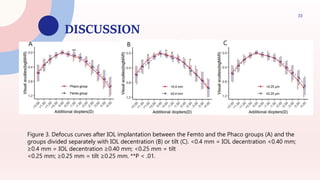
 Defocus Curve of the 2 groups was equality smooth, and
the values revealed no significant differences, except that
the Femto group performed better at -1.00 D (P < .01)
28
RESULT
 Contrast Sensitivity compared with the Femto group was
significantly reduced at 6 to 18 cpd spatial frequency in the
presence of glare and at 6 to 12 cpd spatial frequency without
glare in the Phaco group.
 Questionnaire Evaluation for visual disturbances, eyes in the
Phaco group were more likely to suffer from starburst and
suffer more in the frequency, severity, or level of bother with
halo and hazy, blurred, double vision.
29
DISCUSSION
30
The use of EDOF IOLs has been plagued with reduced CS, halos, and a
variety of visual complaints. It was reported that many of these
intolerances were actually attributable to uncorrected astigmatism and
optical imperfections that might be overcome with the use of FLACS. In
this study, clinical outcomes at 3 months after operation, including IOL
decentration, wavefront
aberrations, visual acuities, refractive outcomes, defocus curve, CS, and
questionnaire, were evaluated and compared between the Femto and
Phaco groups. Study showed that FLACS could make the capsular bag
well encapsulate the IOL, inducing a better-centered IOL position.
DISCUSSION
31
To analyze the visual quality, wavefront aberration analysis isolates
the effects of lower-order aberrations (defocus and astigmatism) and
HOAs, which is overwhelmingly affected by the anterior corneal
surface and crystalline lens. Study observed significantly smaller tilt,
total aberration, coma, and HOAs in the femtosecond group at a 5.0
mm pupil. No significant differences were found in visual acuity or
refractive outcome between the Femto and Phaco groups. As for
defocus curve, on the other
hand, FLACS performed better at -1.00 D. In this study, the Femto
group achieved higher CS at intermediate to high spatial frequencies
(6 to 18 cpd)
DISCUSSION
32
especially at 6 to 12 cpd spatial frequency under glare condition, which
indicated that patients who accepted traditional phacoemulsification were
more likely to suffer from starburst, glare, halo, light spots, streaks, or color
blocks in the field of vision, and the visual contrast would be worse with the
appearance of strong light (such as sunlight and street lights). In summary,
by investigating the visual and optical quality after FLACS and CPS with the
implantation of EDOF IOL TECNIS Symfony, study provides evidence that
FLACS could precisely control the shape and size of the capsulotomy and
induce a significantly better-centered IOL, leading to higher visual
performance and less photic phenomena.
DISCUSSION
33
igure 3. Defocus curves after IOL implantation between the Femto and the Phaco groups (A) and the groups divided separately with
IOL decentration (B) or tilt (C). <0.4 mm = IOL decentration <0.40 mm; ≥0.4 mm = IOL decentration ≥0.40 mm; <0.25 mm = tilt
<0.25 mm; ≥0.25 mm = tilt ≥0.25 mm. **P < .01.
Figure 3. Defocus curves after IOL implantation between the Femto and the Phaco groups (A) and the
groups divided separately with IOL decentration (B) or tilt (C). <0.4 mm = IOL decentration <0.40 mm;
≥0.4 mm = IOL decentration ≥0.40 mm; <0.25 mm = tilt
<0.25 mm; ≥0.25 mm = tilt ≥0.25 mm. **P < .01.
DISCUSSION
34
Figure 4. Contrast sensitivities with and without glare under mesopic
condition after IOL implantation. *P < .05; **P < .01.
CONCLUSION
With the implantation of an EDOF IOL, FLACS
could precisely control the shape and size of the
capsulotomy and induce a significantly better-
centered IOL, leading to higher visual
performance compared with CPS.
35
LIMITATION OF STUDY
 It was not a randomized clinical trial, because of patient
compliance and the relatively high cost of femtosecond
surgery.
 we only included TECNIS Symfony IOL, and therefore, the
clinical outcomes after FLACS and CPS with the
implantation of other types of extended-range-of-vision
IOLs could not be investigated.
36
TAKE HOME MESSAGE
When an EDOF IOL is implanted, a better IOL position, which
largely depends on the better-sized capsulorhexis done using
a femtosecond laser, may eventually result in improved visual
performance. It may also reduce IOL decentration and tilt,
lower higher-order aberrations, and improve functional vision
and contrast sensitivity. With the use of EDOF IOLs and
femtosecond technology, refractive cataract surgery may
advance dramatically while better meeting patient demands
for a higher quality of life.
37
REFERENCES
1. Xu J, Li C, Wang L, Li C, Li X, Lu P. Influence of measurement differences of anterior
chamber depth and axial length on lens thickness evaluation in cataract patients: a
comparison of two tests. BMC Ophthalmol 2020;20: 481
2. Akella SS, Juthani VV. Extended depth of focus intraocular lenses for presbyopia. Curr
Opin Ophthalmol 2018;29:318–322
3. Calladine D, Evans JR, Shah S, Leyland M. Multifocal versus monofocal intraocular
lenses after cataract extraction. Sao Paulo Med J 2015;133:68
4. Miret JJ, Camps VJ, Garc´ıa C, Caballero MT, de Fez D, Piñero DP. New method to
improve the quality of vision in cataractous keratoconus eyes. Sci Rep 2020;10:20049
5. Hahn U, Krummenauer F, Schmickler S, Koch J. Rotation of a toric intraocular lens with
and without capsular tension ring: data from a multicenter non-inferiority randomized
clinical trial (RCT). BMC Ophthalmol 2019;19:143
6. Chen X, Gu X, Wang W, Xiao W, Jin G, Wang L, Dai Y, Zhang E, Ruan X, Liu Z, Luo L,
Liu Y. Characteristics and factors associated with intraocular lens tilt and decentration
after cataract surgery. J Cataract Refract Surg 2020; 46:1126–1131
7. Nikitovic M, Brener S. Health technologies for the improvement of chronic disease
management: a review of the Medical Advisory Secretariat evidence-based analyses
between 2006 and 2011. Ont Health Technol Assess Ser 2013;13:1–87
38
8.Khan S, Rocha G. Cataract surgery and optimal spherical aberration: as simple as
you think? Can J Ophthalmol 2008;43:693–701
9. Xu CC, Xue T, Wang QM, Zhou YN, Huang JH, Yu AY. Repeatability and
reproducibility of a double-pass optical quality analysis device. PLoS One
2015;10:e0117587
10. Xu J, Zheng JT, Lu Y. Effect of decentration on the optical quality of monofocal,
extended depth of focus, and bifocal intraocular lenses. J Refract Surg
2019;35:484–492
11. Ruiz-Alcocer J, Mart´ınez-Alberquilla I, Rementer´ıa-Capelo LA, De Gracia P,
Lorente-Vel ´azquez A. Changes in optical quality induced by tilt and decentration of
a trifocal IOL and a novel extended depth of focus IOL in eyes with corneal myopic
ablations. J Refract Surg 2021;37:532–537
12. Agarwal K, Hatch K. Femtosecond laser assisted cataract surgery: a review.
Semin Ophthalmol 2021;36:618–627
13. Cochener B; Concerto Study Group. Clinical outcomes of a new extended range
of vision intraocular lens: International Multicenter Concerto Study. J Cataract
Refract Surg 2016;42:1268–1275
14. Pomerance GN, Evans DW. Test-retest reliability of the CSV-1000 contrast test
and its relationship to glaucoma therapy. Invest Ophthalmol Vis Sci 1994;35:3357–
3361
15. Schweitzer C, Brezin A, Cochener B, Monnet D, Germain C, Roseng S, Sitta R,
Maillard A, Hayes N, Denis P, Pisella PJ, Benard A; FEMCAT study group.
Femtosecond laser-assisted versus phacoemulsification cataract surgery
(FEMCAT): a multicentre participant-masked randomised superiority and cost-
39
16.Day AC, Gore DM, Bunce C, Evans JR. Laser-assisted cataract surgery versus
standard ultrasound phacoemulsification cataract surgery. Cochrane Database Syst
Rev 2016;7:CD010735
17. Popovic M, Campos-Moller X, Schlenker MB, Ahmed IIK. Efficacy and safety of
femtosecond laser-assisted cataract surgery compared with manual cataract
surgery: a meta-analysis of 14 567 eyes. Ophthalmology 2016;123:2113–2126
18. Ferrer-Blasco T, Montes-Mico R, Peixoto-de-Matos SC, Gonzalez-Meijome JM,
Cervino A. Prevalence of corneal astigmatism before cataract surgery. J Cataract
Refract Surg 2009;35:70–75
19. Byun YS, Kim S, Lazo MZ, Choi MH, Kang MJ, Lee JH, Yoo YS, Whang WJ, Joo
CK. Astigmatic correction by intrastromal astigmatic keratotomy during femtosecond
laser-assisted cataract surgery: factors in outcomes. J Cataract Refract Surg
2018;44:202–208
20. Kessel L, Andresen J, Tendal B, Erngaard D, Flesner P, Hjortdal J. Toric
intraocular lenses in the correction of astigmatism during cataract surgery: a
systematic review and meta-analysis. Ophthalmology 2016;123:275–286
21. Barnett BP. FOCUSED (femtosecond optimized continuous uncorrected sight
with EDOF and diffractive multifocal IOLs)—a review. Curr Opin Ophthalmol
2021;32:3–12
22. Chen X, Gu X, Wang W, Jin G, Wang L, Zhang E, Xu J, Liu Z, Luo L, Liu Y.
Distributions of crystalline lens tilt and decentration and associated factors in age-
related cataract. J Cataract Refract Surg 2021;47:1296–1301
23. Dubbelman M, Sicam VA, van der Heijde RG. The contribution of the posterior
surface to the coma aberration of the human cornea. J Vis
2007;7:10.1–10.8
40
24.Ernest PH, Popovic M, Schlenker MB, Klumpp L, Ahmed IIK. Higher order
aberrations in femtosecond laser-assisted versus manual cataract surgery: a
retrospective cohort study. J Refract Surg 2019;35:102–108
25. Mihaltz K, Knorz MC, Alio JL, Takacs AI, Kranitz K, Kovacs I, Nagy ZZ.
Internal aberrations and optical quality after femtosecond laser anterior
capsulotomy in cataract surgery. J Refract Surg 2011;27:711–716
26. Kranitz K, Mihaltz K, Sandor GL, Takacs A, Knorz MC, Nagy ZZ.
Intraocular lens tilt and decentration measured by Scheimpflug camera
following manual or femtosecond laser-created continuous circular
capsulotomy. J Refract Surg 2012;28:259–263
27. Lee JA, Song WK, Kim JY, Kim MJ, Tchah H. Femtosecond laser-assisted
cataract surgery versus conventional phacoemulsification: refractive and
aberrometric outcomes with a diffractive multifocal intraocular lens. J Cataract
Refract Surg 2019;45:21–27
28. Zhong Y, Zhu Y, Wang W, Wang K, Liu X, Yao K. Femtosecond
laserassisted cataract surgery versus conventional phacoemulsification:
comparison of internal aberrations and visual quality. Graefes Arch Clin Exp
Ophthalmol 2022;260:901–911
29. Bellucci R, Morselli S, Piers P. Comparison of wavefront aberrations and
optical quality of eyes implanted with five different intraocular lenses. J
Refract Surg 2004;20:297–306
41
30.Day AC, Donachie PHJ, Sparrow JM, Johnston RL; Royal College of
Ophthalmologists’ National Ophthalmology Database. The Royal College of
Ophthalmologists’ National Ophthalmology Database Study of cataract surgery:
report 2, relationships of axial length with ocular copathology, preoperative visual
acuity, and posterior capsule rupture. Eye (Lond) 2015; 29:1528–1537
31. Lundstrom M, Dickman M, Henry Y, Manning S, Rosen P, Tassignon MJ, Young
D, Stenevi U. Risk factors for refractive error after cataract surgery: analysis of 282
811 cataract extractions reported to the European Registry of Quality Outcomes for
cataract and refractive surgery. J Cataract Refract
Surg 2018;44:447–45
Day AO, Burr JM, Bennett K, Hunter R, Bunce C, Dor ´e CJ, Nanavaty MA,
Balaggan KS, Wilkins MR. Femtosecond laser-assisted cataract surgery compared
with phacoemulsification: the FACT non-inferiority RCT. Health Technol Assess
2021;25:1–68
33. Fujikado T, Kuroda T, Maeda N, Ninomiya S, Goto H, Tano Y, Oshika T, Hirohara
Y, Mihashi T. Light scattering and optical aberrations as objective parameters to
predict visual deterioration in eyes with cataracts. J Cataract Refract Surg
2004;30:1198–1208
34. Franssen L, Coppens JE, van den Berg TJTP. Compensation comparison
method for assessment of retinal straylight. Invest Ophthalmol Vis Sci 2006;
47:768–776
35. Shandiz JH, Derakhshan A, Daneshyar A, Azimi A, Moghaddam HO, Yekta AA,
Yazdi SHH, Esmaily H. Effect of cataract type and severity on visual
acuity and contrast sensitivity. J Ophthalmic Vis Res 2011;6:26–31
42
Disclosures: None of the authors has any
financial or proprietary interest in any
material or method mentioned.
43
THANK YOU

Journal Presentation.pptx

  • 1.
    JOURNAL PRESENTATION Dr. Maliha Nawar Resident,Phase-B(Year-1) Department of Community Ophthalmology Bangabandhu Sheikh Mujib Medical University
  • 2.
    TITLE Comparative visual outcomesof EDOF intraocular lens with FLACS vs conventional phacoemulsification
  • 3.
    PUBLISHED IN  Journalof Cataract & Refractive Surgery  January 2023  Volume:49(1)  Page:55-61 3
  • 4.
    AUTHORS  Jia Xu, Wenbo Li,  Zhe Xu,  Binsong Zhao,  Yueyang Zhong,  Kai Wang,  Xin Liu,  Xiaohui Song,  Yinhui Yu,  Yanan Zhu,  Qiaomei Tang,  Ke Yao, 4
  • 5.
    PLACE OF STUDY Eye Center, the Second Affiliated Hospital of Zhejiang University, Zhejiang, China. 5
  • 6.
    PURPOSE OF STUDY Toinvestigate the visual quality after femtosecond laser–assisted cataract surgery (FLACS) and conventional phacoemulsification surgery (CPS) with the implantation of an extended depth-of-focus (EDOF) intraocular lens (IOL) TECNIS Symfony.
  • 7.
    INTRODUCTION At present incataract surgery, where only monofocal intraocular lenses (IOLs) was used to restore vision at 1 specific distance, has evolved into refractive cataract surgery. The extended depth-of- focus (EDOF) IOL TECNIS Symfony (Johnson & Johnson Vision), a new concept IOL, based on a proprietary achromatic diffraction echelette design, is proven to be capable of restoring the patient’s far, intermediate, and part of near vision, producing EDOF and minimal interference light phenomenon. 7
  • 8.
    INTRODUCTION The decentration andtilt of the IOL is a crucial factor influencing the visual quality of patients postoperatively. The architecture of the capsulorhexis has a great influence on the position of the lens, which in turn affects the refractive effect. The aim of this study was to compare the visual outcomes and photic phenomena between FLACS and CPS in cases implanted with the TECNIS Symfony IOL. 8
  • 9.
  • 10.
    STUDY DURATION July 2017and March 2021 STUDY POPULATION 261 patients(261 eyes) 10
  • 11.
    INCLUSION CRITERIA  Agedfrom 45 to 85 years,  No active ocular disease except cataracts,  Received FLACS or CPS in 1 eye,  Non severe dry eye  Angle k within 0.5 mm,  No pupillary abnormality  No surgery within 3 months. EXCLUSION CRITERIA  Complications during surgery  Reduced zonular/capsular stability  Corneal astigmatism higher than 1.5 diopters (D)  Previous refractive surgery  Poor mobility  IOL dislocation  Posterior capsule opacification, or any ocular comorbidity (amblyopia, retina, or optic nerve pathology) that may hamper postoperative acuity. 11
  • 12.
    MATERIAL AND METHODS SurgicalTechnique:  IOL power was chosen to target emmetropia ±0.5 D.  Every patient accepted the standard surgical procedure.  In the Femto group, disposable interface contact lenses with suction rings (SoftFit Patient Interface, Alcon LenSx, Inc.) were used for the corneal applanation. LenSx software (v. 2.23, Alcon LenSx, Inc.) was used to create a 5.0 mm capsulotomy, and nuclear prefragmentation was performed to obtain 6 pieces in a cross pattern. 12
  • 13.
    MATERIAL AND METHODS In the Phaco group, anterior capsules were treated conventionally (Amvisc Plus, Bausch & Lomb, Inc.). Capsule forceps were used to complete a 5.0 mm continuous curvilinear capsulorhexis.  In both groups, a 2.0 mm single-plane main incision and a 0.8 mm side-port corneal incision were made with a keratome.  Phacoemulsification was performed using a standard stop-and chop technique with the longitudinal phacoemulsification system. 13
  • 14.
    MATERIAL AND METHODS After the IOL implantation, the ophthalmic viscosurgical device material was removed from the anterior chamber and the capsular bag by irrigation/aspiration.  All incisions were left sutureless.  All patients received standard regimen consisting of topical dexamethasone tobramycin 4 times a day for 2 weeks and pranoprofen for 1 month postoperatively. 14
  • 15.
    MATERIAL AND METHODS IOLS: The TECNIS Symfony IOL,an extended-range-of- vision IOL based on the diffractive achromatic technology which is a single-piece, UV-filtering, open-loop haptic, hydrophobic acrylic folding IOL with an overall diameter of 13.0 mm and an optic diameter of 6.0 mm.  According to the manufacturer, this IOL provides an elongated focal area, rather than 1 or more individual focal points. 15
  • 16.
    MATERIAL AND METHODS Outcomeand Assessment:  The routine examinations for all patients were performed within 1 month preoperatively and postoperatively at 1 week, 1 month, and 3 months. Each measurement was performed by the same technicians who performed certain functional tests but were ignorant of the surgical approach to all operated eyes.  UDVA, slit lamp anterior segment examination, direct fundoscopy and tonometry were examined at the postoperative routine visit. 16
  • 17.
    MATERIAL AND METHODS As for the additional follow-up assessment, the following parameters were evaluated: visual acuity, defocus curve, contrast sensitivity (CS), an optic path difference aberrometry scan (OPD), and anterior segment photography with a dilated pupil.  Monocular uncorrected and corrected distance visual acuities were measured at far (5m), intermediate (80 cm), and near (40 cm) distances. 17
  • 18.
    MATERIAL AND METHODS Distance-corrected visual acuity was measured at intermediate (80 cm) and near (40 cm) distances.  A monocular defocus curve was tested from-4.00 to +2.00D in 0.5 D increments.  CS with or without glare (45 cd/m2)under mesopic conditions was measured by CSV-1000 contrast test (Vectorvision, Inc.)  An optic path difference aberrometry scan (OPD Scan III, Nidek Co., Ltd.) was completed at a 5.0 mm pupil diameter using tropicamide eyedrops 0.5%. 18
  • 19.
    MATERIAL AND METHODS The root mean square of tilt, coma, trefoil, spherical aberration, HOAs, and total aberration was calculated.  AutoCAD 2020 image processing for Windows software was used to measure the area and perimeter of the capsulorhexis and the IOL centration depending on the anterior segment photography  All patients were asked to complete the Questionnaire for Visual Disturbances (QUVID) to assess and evaluate the visual symptoms postoperatively. 19
  • 20.
    STATISTICAL ANALYSIS  Dataare presented as mean ± SD.  Statistics were analyzed using SPSS for Mac software and SPSS Statistics for Windows software (v. 26.0, IBM Corp.). The normality of data distribution was assessed using the Shapiro-Wilks test.  Comparisons between 2 groups were made using t tests or Wilcoxon-Mann-Whitney U tests, depending on data normality and homogeneity of variance. 20
  • 21.
    STATISTICAL ANALYSIS  Forcategorical data, chi-square tests were applied.  The correlations between parameters were assessed using the Spearman rank correlation coefficient (r).  P values less than 0.05 were considered statistically significant.  All tests were analyzed in a 2-tailed style. 21
  • 22.
    RESULT  A totalof 261 eyes of 261 patients attended to the follow-up visit. A total of 131 eyes were treated by FLACS (the Femto group), whereas 130 eyes were treated by CPS (the Phaco group). Missing data were due to personal inconvenience, refusal to mydriasis for OPD scan, or temporary device failure. No significant difference was found between the 2 groups regarding preoperative characteristics. No intraoperative complication occurred. 22
  • 23.
    RESULT IOL Decentration Postoperatively,the decentration of the IOL and the area and perimeter of the capsulorhexis were also calculated and compared between groups. IOL decentration was significantly smaller in the Femto group than that in the Phaco group (P = .011) 23
  • 24.
  • 25.
  • 26.
    RESULT Wavefront Aberrations tilt(P=.009), total aberration (P< .001), coma (P = .001), spherical aberration (P < .001), and HOAs (P < .001) were significantly lower in the Femto group than those in the Phaco group. No significant difference was observed in terms of trefoil aberration. 26
  • 27.
  • 28.
    RESULT  Visual Acuitiesand Refractive Outcomes postoperatively, there were no significant differences between uncorrected and corrected visual acuity at far, intermediate, and near distances, along with spherical equivalents.  Defocus Curve of the 2 groups was equality smooth, and the values revealed no significant differences, except that the Femto group performed better at -1.00 D (P < .01) 28
  • 29.
    RESULT  Contrast Sensitivitycompared with the Femto group was significantly reduced at 6 to 18 cpd spatial frequency in the presence of glare and at 6 to 12 cpd spatial frequency without glare in the Phaco group.  Questionnaire Evaluation for visual disturbances, eyes in the Phaco group were more likely to suffer from starburst and suffer more in the frequency, severity, or level of bother with halo and hazy, blurred, double vision. 29
  • 30.
    DISCUSSION 30 The use ofEDOF IOLs has been plagued with reduced CS, halos, and a variety of visual complaints. It was reported that many of these intolerances were actually attributable to uncorrected astigmatism and optical imperfections that might be overcome with the use of FLACS. In this study, clinical outcomes at 3 months after operation, including IOL decentration, wavefront aberrations, visual acuities, refractive outcomes, defocus curve, CS, and questionnaire, were evaluated and compared between the Femto and Phaco groups. Study showed that FLACS could make the capsular bag well encapsulate the IOL, inducing a better-centered IOL position.
  • 31.
    DISCUSSION 31 To analyze thevisual quality, wavefront aberration analysis isolates the effects of lower-order aberrations (defocus and astigmatism) and HOAs, which is overwhelmingly affected by the anterior corneal surface and crystalline lens. Study observed significantly smaller tilt, total aberration, coma, and HOAs in the femtosecond group at a 5.0 mm pupil. No significant differences were found in visual acuity or refractive outcome between the Femto and Phaco groups. As for defocus curve, on the other hand, FLACS performed better at -1.00 D. In this study, the Femto group achieved higher CS at intermediate to high spatial frequencies (6 to 18 cpd)
  • 32.
    DISCUSSION 32 especially at 6to 12 cpd spatial frequency under glare condition, which indicated that patients who accepted traditional phacoemulsification were more likely to suffer from starburst, glare, halo, light spots, streaks, or color blocks in the field of vision, and the visual contrast would be worse with the appearance of strong light (such as sunlight and street lights). In summary, by investigating the visual and optical quality after FLACS and CPS with the implantation of EDOF IOL TECNIS Symfony, study provides evidence that FLACS could precisely control the shape and size of the capsulotomy and induce a significantly better-centered IOL, leading to higher visual performance and less photic phenomena.
  • 33.
    DISCUSSION 33 igure 3. Defocuscurves after IOL implantation between the Femto and the Phaco groups (A) and the groups divided separately with IOL decentration (B) or tilt (C). <0.4 mm = IOL decentration <0.40 mm; ≥0.4 mm = IOL decentration ≥0.40 mm; <0.25 mm = tilt <0.25 mm; ≥0.25 mm = tilt ≥0.25 mm. **P < .01. Figure 3. Defocus curves after IOL implantation between the Femto and the Phaco groups (A) and the groups divided separately with IOL decentration (B) or tilt (C). <0.4 mm = IOL decentration <0.40 mm; ≥0.4 mm = IOL decentration ≥0.40 mm; <0.25 mm = tilt <0.25 mm; ≥0.25 mm = tilt ≥0.25 mm. **P < .01.
  • 34.
    DISCUSSION 34 Figure 4. Contrastsensitivities with and without glare under mesopic condition after IOL implantation. *P < .05; **P < .01.
  • 35.
    CONCLUSION With the implantationof an EDOF IOL, FLACS could precisely control the shape and size of the capsulotomy and induce a significantly better- centered IOL, leading to higher visual performance compared with CPS. 35
  • 36.
    LIMITATION OF STUDY It was not a randomized clinical trial, because of patient compliance and the relatively high cost of femtosecond surgery.  we only included TECNIS Symfony IOL, and therefore, the clinical outcomes after FLACS and CPS with the implantation of other types of extended-range-of-vision IOLs could not be investigated. 36
  • 37.
    TAKE HOME MESSAGE Whenan EDOF IOL is implanted, a better IOL position, which largely depends on the better-sized capsulorhexis done using a femtosecond laser, may eventually result in improved visual performance. It may also reduce IOL decentration and tilt, lower higher-order aberrations, and improve functional vision and contrast sensitivity. With the use of EDOF IOLs and femtosecond technology, refractive cataract surgery may advance dramatically while better meeting patient demands for a higher quality of life. 37
  • 38.
    REFERENCES 1. Xu J,Li C, Wang L, Li C, Li X, Lu P. Influence of measurement differences of anterior chamber depth and axial length on lens thickness evaluation in cataract patients: a comparison of two tests. BMC Ophthalmol 2020;20: 481 2. Akella SS, Juthani VV. Extended depth of focus intraocular lenses for presbyopia. Curr Opin Ophthalmol 2018;29:318–322 3. Calladine D, Evans JR, Shah S, Leyland M. Multifocal versus monofocal intraocular lenses after cataract extraction. Sao Paulo Med J 2015;133:68 4. Miret JJ, Camps VJ, Garc´ıa C, Caballero MT, de Fez D, Piñero DP. New method to improve the quality of vision in cataractous keratoconus eyes. Sci Rep 2020;10:20049 5. Hahn U, Krummenauer F, Schmickler S, Koch J. Rotation of a toric intraocular lens with and without capsular tension ring: data from a multicenter non-inferiority randomized clinical trial (RCT). BMC Ophthalmol 2019;19:143 6. Chen X, Gu X, Wang W, Xiao W, Jin G, Wang L, Dai Y, Zhang E, Ruan X, Liu Z, Luo L, Liu Y. Characteristics and factors associated with intraocular lens tilt and decentration after cataract surgery. J Cataract Refract Surg 2020; 46:1126–1131 7. Nikitovic M, Brener S. Health technologies for the improvement of chronic disease management: a review of the Medical Advisory Secretariat evidence-based analyses between 2006 and 2011. Ont Health Technol Assess Ser 2013;13:1–87 38
  • 39.
    8.Khan S, RochaG. Cataract surgery and optimal spherical aberration: as simple as you think? Can J Ophthalmol 2008;43:693–701 9. Xu CC, Xue T, Wang QM, Zhou YN, Huang JH, Yu AY. Repeatability and reproducibility of a double-pass optical quality analysis device. PLoS One 2015;10:e0117587 10. Xu J, Zheng JT, Lu Y. Effect of decentration on the optical quality of monofocal, extended depth of focus, and bifocal intraocular lenses. J Refract Surg 2019;35:484–492 11. Ruiz-Alcocer J, Mart´ınez-Alberquilla I, Rementer´ıa-Capelo LA, De Gracia P, Lorente-Vel ´azquez A. Changes in optical quality induced by tilt and decentration of a trifocal IOL and a novel extended depth of focus IOL in eyes with corneal myopic ablations. J Refract Surg 2021;37:532–537 12. Agarwal K, Hatch K. Femtosecond laser assisted cataract surgery: a review. Semin Ophthalmol 2021;36:618–627 13. Cochener B; Concerto Study Group. Clinical outcomes of a new extended range of vision intraocular lens: International Multicenter Concerto Study. J Cataract Refract Surg 2016;42:1268–1275 14. Pomerance GN, Evans DW. Test-retest reliability of the CSV-1000 contrast test and its relationship to glaucoma therapy. Invest Ophthalmol Vis Sci 1994;35:3357– 3361 15. Schweitzer C, Brezin A, Cochener B, Monnet D, Germain C, Roseng S, Sitta R, Maillard A, Hayes N, Denis P, Pisella PJ, Benard A; FEMCAT study group. Femtosecond laser-assisted versus phacoemulsification cataract surgery (FEMCAT): a multicentre participant-masked randomised superiority and cost- 39
  • 40.
    16.Day AC, GoreDM, Bunce C, Evans JR. Laser-assisted cataract surgery versus standard ultrasound phacoemulsification cataract surgery. Cochrane Database Syst Rev 2016;7:CD010735 17. Popovic M, Campos-Moller X, Schlenker MB, Ahmed IIK. Efficacy and safety of femtosecond laser-assisted cataract surgery compared with manual cataract surgery: a meta-analysis of 14 567 eyes. Ophthalmology 2016;123:2113–2126 18. Ferrer-Blasco T, Montes-Mico R, Peixoto-de-Matos SC, Gonzalez-Meijome JM, Cervino A. Prevalence of corneal astigmatism before cataract surgery. J Cataract Refract Surg 2009;35:70–75 19. Byun YS, Kim S, Lazo MZ, Choi MH, Kang MJ, Lee JH, Yoo YS, Whang WJ, Joo CK. Astigmatic correction by intrastromal astigmatic keratotomy during femtosecond laser-assisted cataract surgery: factors in outcomes. J Cataract Refract Surg 2018;44:202–208 20. Kessel L, Andresen J, Tendal B, Erngaard D, Flesner P, Hjortdal J. Toric intraocular lenses in the correction of astigmatism during cataract surgery: a systematic review and meta-analysis. Ophthalmology 2016;123:275–286 21. Barnett BP. FOCUSED (femtosecond optimized continuous uncorrected sight with EDOF and diffractive multifocal IOLs)—a review. Curr Opin Ophthalmol 2021;32:3–12 22. Chen X, Gu X, Wang W, Jin G, Wang L, Zhang E, Xu J, Liu Z, Luo L, Liu Y. Distributions of crystalline lens tilt and decentration and associated factors in age- related cataract. J Cataract Refract Surg 2021;47:1296–1301 23. Dubbelman M, Sicam VA, van der Heijde RG. The contribution of the posterior surface to the coma aberration of the human cornea. J Vis 2007;7:10.1–10.8 40
  • 41.
    24.Ernest PH, PopovicM, Schlenker MB, Klumpp L, Ahmed IIK. Higher order aberrations in femtosecond laser-assisted versus manual cataract surgery: a retrospective cohort study. J Refract Surg 2019;35:102–108 25. Mihaltz K, Knorz MC, Alio JL, Takacs AI, Kranitz K, Kovacs I, Nagy ZZ. Internal aberrations and optical quality after femtosecond laser anterior capsulotomy in cataract surgery. J Refract Surg 2011;27:711–716 26. Kranitz K, Mihaltz K, Sandor GL, Takacs A, Knorz MC, Nagy ZZ. Intraocular lens tilt and decentration measured by Scheimpflug camera following manual or femtosecond laser-created continuous circular capsulotomy. J Refract Surg 2012;28:259–263 27. Lee JA, Song WK, Kim JY, Kim MJ, Tchah H. Femtosecond laser-assisted cataract surgery versus conventional phacoemulsification: refractive and aberrometric outcomes with a diffractive multifocal intraocular lens. J Cataract Refract Surg 2019;45:21–27 28. Zhong Y, Zhu Y, Wang W, Wang K, Liu X, Yao K. Femtosecond laserassisted cataract surgery versus conventional phacoemulsification: comparison of internal aberrations and visual quality. Graefes Arch Clin Exp Ophthalmol 2022;260:901–911 29. Bellucci R, Morselli S, Piers P. Comparison of wavefront aberrations and optical quality of eyes implanted with five different intraocular lenses. J Refract Surg 2004;20:297–306 41
  • 42.
    30.Day AC, DonachiePHJ, Sparrow JM, Johnston RL; Royal College of Ophthalmologists’ National Ophthalmology Database. The Royal College of Ophthalmologists’ National Ophthalmology Database Study of cataract surgery: report 2, relationships of axial length with ocular copathology, preoperative visual acuity, and posterior capsule rupture. Eye (Lond) 2015; 29:1528–1537 31. Lundstrom M, Dickman M, Henry Y, Manning S, Rosen P, Tassignon MJ, Young D, Stenevi U. Risk factors for refractive error after cataract surgery: analysis of 282 811 cataract extractions reported to the European Registry of Quality Outcomes for cataract and refractive surgery. J Cataract Refract Surg 2018;44:447–45 Day AO, Burr JM, Bennett K, Hunter R, Bunce C, Dor ´e CJ, Nanavaty MA, Balaggan KS, Wilkins MR. Femtosecond laser-assisted cataract surgery compared with phacoemulsification: the FACT non-inferiority RCT. Health Technol Assess 2021;25:1–68 33. Fujikado T, Kuroda T, Maeda N, Ninomiya S, Goto H, Tano Y, Oshika T, Hirohara Y, Mihashi T. Light scattering and optical aberrations as objective parameters to predict visual deterioration in eyes with cataracts. J Cataract Refract Surg 2004;30:1198–1208 34. Franssen L, Coppens JE, van den Berg TJTP. Compensation comparison method for assessment of retinal straylight. Invest Ophthalmol Vis Sci 2006; 47:768–776 35. Shandiz JH, Derakhshan A, Daneshyar A, Azimi A, Moghaddam HO, Yekta AA, Yazdi SHH, Esmaily H. Effect of cataract type and severity on visual acuity and contrast sensitivity. J Ophthalmic Vis Res 2011;6:26–31 42
  • 43.
    Disclosures: None ofthe authors has any financial or proprietary interest in any material or method mentioned. 43
  • 44.