Plate Movement
The theory of plate tectonics
   1912, Alfred Wegener published theory of single continent (Pangaea) that existed 300 million
   years ago
       o Later split into 2 continents
                Laurasia in north
                Gondwanaland in south
   Different evidences to prove single continent
       o Geological evidence
                Bulge of south America fitting into indent below west Africa
                Evidence of glaciation of late Carboniferous period – deposits found in south
                   America, Antarctica and India
                Rock sequences in northern Scotland and Eastern Canada
       o Biological evidence
                Fossil brachiopods found in Indian limestones – comparable with fossils in
                   Australia
                Fossil remains in South America and southern Africa
                Fossil remains in coal in India and Antarctica

Earth’s layers
      o   Core – made up of dense rocks containing iron and nickel alloys
                Divided into solid inner core / molten outer core
      o   Mantle – made up of molten / semi-molten rocks containing lighter elements such as
          silicon and oxygen
      o   Crust – even lighter because of elements
                Most abundant = silicon, oxygen, aluminium, potassium, sodium
                Varies in thickness
                           Oceanic crust – 6-10 km thick
                           Continental crust – 30-40km thick
                           Under highest mountain ranges – 70km thick
      o   Lithosphere – consists of crust and the rigid upper section of the mantle
                Approximately 80-90 km thick
      o   Asthenosphere – below lithosphere

                 Semi-molten

                                Continental Crust                Oceanic Crust
Thickness                       30-70 km                         6-10 km
Age                             Over 1,500 million years         Less than 200 million years
Density                         2.6 (lighter)                    3.0 (heavier)
Composition                     Mainly granite; silicon,         Mainly basalt; silicon,
                                aluminium, oxygen (SIAL)         magnesium, oxygen (SIMA)
      o   Hot spots – generate thermal convection currents within asthenosphere


                                            Page 1
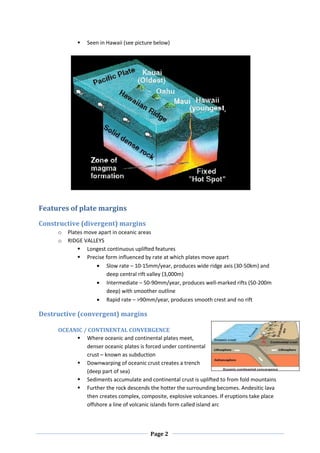
   Seen in Hawaii (see picture below)


Features of plate margins

Constructive (divergent) margins
     o   Plates move apart in oceanic areas
     o   RIDGE VALLEYS
              Longest continuous uplifted features
              Precise form influenced by rate at which plates move apart
                        Slow rate – 10-15mm/year, produces wide ridge axis (30-50km) and
                        deep central rift valley (3,000m)
                        Intermediate – 50-90mm/year, produces well-marked rifts (50-200m
                        deep) with smoother outline
                        Rapid rate – >90mm/year, produces smooth crest and no rift

Destructive (convergent) margins

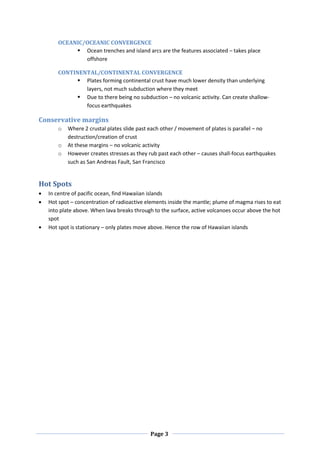
     OCEANIC / CONTINENTAL CONVERGENCE
           Where oceanic and continental plates meet,
              denser oceanic plates is forced under continental
              crust – known as subduction
           Downwarping of oceanic crust creates a trench
              (deep part of sea)
           Sediments accumulate and continental crust is uplifted to from fold mountains
           Further the rock descends the hotter the surrounding becomes. Andesitic lava
              then creates complex, composite, explosive volcanoes. If eruptions take place
              offshore a line of volcanic islands form called island arc


                                          Page 2
OCEANIC/OCEANIC CONVERGENCE
           Ocean trenches and island arcs are the features associated – takes place
             offshore

     CONTINENTAL/CONTINENTAL CONVERGENCE
           Plates forming continental crust have much lower density than underlying
             layers, not much subduction where they meet
           Due to there being no subduction – no volcanic activity. Can create shallow-
             focus earthquakes

Conservative margins
     o   Where 2 crustal plates slide past each other / movement of plates is parallel – no
         destruction/creation of crust
     o   At these margins – no volcanic activity
     o   However creates stresses as they rub past each other – causes shall-focus earthquakes
         such as San Andreas Fault, San Francisco


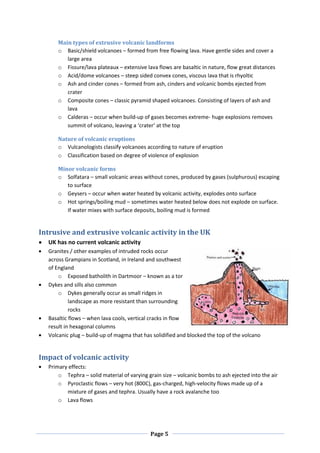
Hot Spots
  In centre of pacific ocean, find Hawaiian islands
  Hot spot – concentration of radioactive elements inside the mantle; plume of magma rises to eat
  into plate above. When lava breaks through to the surface, active volcanoes occur above the hot
  spot
  Hot spot is stationary – only plates move above. Hence the row of Hawaiian islands


                                           Page 3
Vulcanicity
Distribution
  Most volcanic activity associated with plate tectonic processes, mainly located along plate
  margins
  Such activity therefore found:
     o Along ocean ridges
     o Associated with rift valleys
     o On or near a subduction zones
     o Over hot spots


Volcanic Eruptions
  Vary in form, frequency and type of volcanic eruption

Intrusive volcanic landforms
      o    When magma forced the surface, only small amount of lava reaches that level
      o    Most magma is intruded into crust where it solidifies
      o    Often exposed after erosion
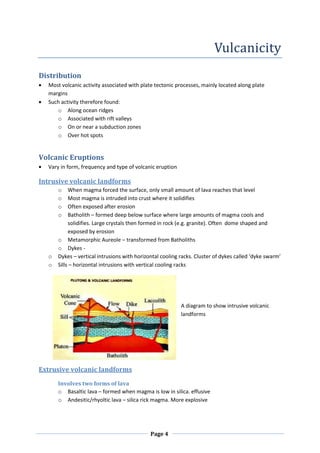
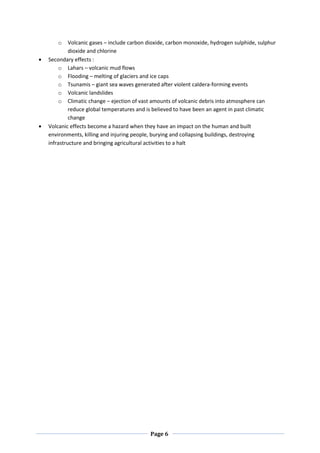
      o    Batholith – formed deep below surface where large amounts of magma cools and
           solidifies. Large crystals then formed in rock (e.g. granite). Often dome shaped and
           exposed by erosion
      o Metamorphic Aureole – transformed from Batholiths
      o Dykes -
  o   Dykes – vertical intrusions with horizontal cooling racks. Cluster of dykes called ‘dyke swarm’
  o   Sills – horizontal intrusions with vertical cooling racks


                                                          A diagram to show intrusive volcanic
                                                          landforms


Extrusive volcanic landforms
      Involves two forms of lava
      o Basaltic lava – formed when magma is low in silica. effusive
      o Andesitic/rhyoltic lava – silica rick magma. More explosive


                                             Page 4
Main types of extrusive volcanic landforms
      o Basic/shield volcanoes – formed from free flowing lava. Have gentle sides and cover a
         large area
      o Fissure/lava plateaux – extensive lava flows are basaltic in nature, flow great distances
      o Acid/dome volcanoes – steep sided convex cones, viscous lava that is rhyoltic
      o Ash and cinder cones – formed from ash, cinders and volcanic bombs ejected from
         crater
      o Composite cones – classic pyramid shaped volcanoes. Consisting of layers of ash and
         lava
      o Calderas – occur when build-up of gases becomes extreme- huge explosions removes
         summit of volcano, leaving a ‘crater’ at the top

      Nature of volcanic eruptions
      o Vulcanologists classify volcanoes according to nature of eruption
      o Classification based on degree of violence of explosion

      Minor volcanic forms
      o Solfatara – small volcanic areas without cones, produced by gases (sulphurous) escaping
         to surface
      o Geysers – occur when water heated by volcanic activity, explodes onto surface
      o Hot springs/boiling mud – sometimes water heated below does not explode on surface.
         If water mixes with surface deposits, boiling mud is formed


Intrusive and extrusive volcanic activity in the UK
  UK has no current volcanic activity
  Granites / other examples of intruded rocks occur
  across Grampians in Scotland, in Ireland and southwest
  of England
      o Exposed batholith in Dartmoor – known as a tor
  Dykes and sills also common
      o Dykes generally occur as small ridges in
           landscape as more resistant than surrounding
           rocks
  Basaltic flows – when lava cools, vertical cracks in flow
  result in hexagonal columns
  Volcanic plug – build-up of magma that has solidified and blocked the top of the volcano


Impact of volcanic activity
  Primary effects:
      o Tephra – solid material of varying grain size – volcanic bombs to ash ejected into the air
      o Pyroclastic flows – very hot (800C), gas-charged, high-velocity flows made up of a
         mixture of gases and tephra. Usually have a rock avalanche too
      o Lava flows


                                            Page 5
o     Volcanic gases – include carbon dioxide, carbon monoxide, hydrogen sulphide, sulphur
         dioxide and chlorine
Secondary effects :
    o Lahars – volcanic mud flows
    o Flooding – melting of glaciers and ice caps
    o Tsunamis – giant sea waves generated after violent caldera-forming events
    o Volcanic landslides
    o Climatic change – ejection of vast amounts of volcanic debris into atmosphere can
         reduce global temperatures and is believed to have been an agent in past climatic
         change
Volcanic effects become a hazard when they have an impact on the human and built
environments, killing and injuring people, burying and collapsing buildings, destroying
infrastructure and bringing agricultural activities to a halt


                                         Page 6
Seismicity
Causes of earthquakes
  As crust of Earth is mobile, tends to be a build up of stress within the rocks
  When pressure is suddenly released part of the surface experience an intense shaking motion
  Point of pressure release is known as focus – point immediately above on earth’s surface is
  called epicentre
  Depth of focus is significant and 3 broad categories of earthquake are recognised:
       o Shallow focus (0-70km deep) – tend to cause the greatest damage / account for 75% of
          all earthquake energy released
       o Intermediate focus (70-300km deep)
       o Deep focus (300-700km deep)
  Seismic waves radiate from focus rather like ripples in water
  Three main types of seismic wave, each travelling at different speeds:
       o Primary (P) waves travel fastest and are compressional, vibrating in direction in which
          they are travelling
       o Secondary (S) waves travel at half speed of P waves and shear rock by vibrating at right
          angles to direction of travel
       o Surface (L) waves travel slowest and near ground surface. Some surface waves shake
          ground at right angles to direction of wave movement / some have a rolling motion that
          produces a vertical ground movement
  P and S waves travel through interior of Earth and recorded on seismograph


Distribution
  Vast majority of earthquakes occur along plate boundaries – most powerful at destructive
  margins
  Conservative margins, boundary marked by a fault – movement along which produces the
  earthquake
  Some earthquakes occur away from plate boundaries and are associated with reactivation of old
  fault lines
  Human activity could be cause of some minor earthquakes


Magnitude and frequency
  Magnitude measured on 2 scales
     o Richter scale – logarithmic scale
             Event measured on a 7 point scale
             Has an amplitude of seismic waves 10 times greater than once measured at 6 on
               a scale
             Energy release is proportional to magnitude – for each unit increase in scale,
               energy released increases by approximately 30 times
             Mercalli scale - Measures intensity of event and its impact (12 point scale)


                                            Page 7
Seismic records enable earthquake frequency to be observed – records only date back to 1848
  when instrument to record seismic waves was first developed


Effects of earthquakes
  Initial effect is ground shaking
  Severity depends on magnitude of earthquake, distance from epicentre, local geological
  conditions
  Secondary effects:
       o Soil liquefaction when violently shaken, soils with high water content lose mechanical
            strength / start to behave like fluid
       o Landslides/avalanches slope failure as a result of ground shaking
       o Effects of people and built environment
                 Collapsing buildings
                 Destruction of road systems / other forms of communication
                 Destruction of service provision (gas, electricity)
                 Fires from gas pipes and collapsed electricity lines
                 Flooding
                 Disease
                 Food shortages
                 Disruption to local economy
       o Tsunamis giant sea waves generated by shallow-focus underwater earthquakes, volcanic
            eruptions, underwater debris slides and large landslides into the sea

Tsunamis
  Have a very long wavelength (sometimes more than 100km) and low wave height (under 1m),
  travel quickly at speeds greater than 700km/h-1
  On reaching shallow water bordering land they increase rapidly in height
  When a tsunami reaches land, its effect will depend upon:
      o Height of the waves / distance they have travelled
      o Length of event that caused tsunami
      o Extent to which warnings can be given
      o Coastal physical geography, both offshore and in coastal area
      o Coastal land use / population density
  Effects of most tsunamis are felt at least 500-600m inland depending upon coastal geography
  Buildings, roads, bridges, harbour structures, trees and soil washed away
  Around 90% if all tsunamis are generated within Pacific basin / are associated with tectonic
  activity taking place around its edges


                                           Page 8

AQA A2 Geography

  • 1.
    Plate Movement The theoryof plate tectonics 1912, Alfred Wegener published theory of single continent (Pangaea) that existed 300 million years ago o Later split into 2 continents  Laurasia in north  Gondwanaland in south Different evidences to prove single continent o Geological evidence  Bulge of south America fitting into indent below west Africa  Evidence of glaciation of late Carboniferous period – deposits found in south America, Antarctica and India  Rock sequences in northern Scotland and Eastern Canada o Biological evidence  Fossil brachiopods found in Indian limestones – comparable with fossils in Australia  Fossil remains in South America and southern Africa  Fossil remains in coal in India and Antarctica Earth’s layers o Core – made up of dense rocks containing iron and nickel alloys  Divided into solid inner core / molten outer core o Mantle – made up of molten / semi-molten rocks containing lighter elements such as silicon and oxygen o Crust – even lighter because of elements  Most abundant = silicon, oxygen, aluminium, potassium, sodium  Varies in thickness Oceanic crust – 6-10 km thick Continental crust – 30-40km thick Under highest mountain ranges – 70km thick o Lithosphere – consists of crust and the rigid upper section of the mantle  Approximately 80-90 km thick o Asthenosphere – below lithosphere  Semi-molten Continental Crust Oceanic Crust Thickness 30-70 km 6-10 km Age Over 1,500 million years Less than 200 million years Density 2.6 (lighter) 3.0 (heavier) Composition Mainly granite; silicon, Mainly basalt; silicon, aluminium, oxygen (SIAL) magnesium, oxygen (SIMA) o Hot spots – generate thermal convection currents within asthenosphere Page 1
  • 2.
    Seen in Hawaii (see picture below) Features of plate margins Constructive (divergent) margins o Plates move apart in oceanic areas o RIDGE VALLEYS  Longest continuous uplifted features  Precise form influenced by rate at which plates move apart Slow rate – 10-15mm/year, produces wide ridge axis (30-50km) and deep central rift valley (3,000m) Intermediate – 50-90mm/year, produces well-marked rifts (50-200m deep) with smoother outline Rapid rate – >90mm/year, produces smooth crest and no rift Destructive (convergent) margins OCEANIC / CONTINENTAL CONVERGENCE  Where oceanic and continental plates meet, denser oceanic plates is forced under continental crust – known as subduction  Downwarping of oceanic crust creates a trench (deep part of sea)  Sediments accumulate and continental crust is uplifted to from fold mountains  Further the rock descends the hotter the surrounding becomes. Andesitic lava then creates complex, composite, explosive volcanoes. If eruptions take place offshore a line of volcanic islands form called island arc Page 2
  • 3.
    OCEANIC/OCEANIC CONVERGENCE  Ocean trenches and island arcs are the features associated – takes place offshore CONTINENTAL/CONTINENTAL CONVERGENCE  Plates forming continental crust have much lower density than underlying layers, not much subduction where they meet  Due to there being no subduction – no volcanic activity. Can create shallow- focus earthquakes Conservative margins o Where 2 crustal plates slide past each other / movement of plates is parallel – no destruction/creation of crust o At these margins – no volcanic activity o However creates stresses as they rub past each other – causes shall-focus earthquakes such as San Andreas Fault, San Francisco Hot Spots In centre of pacific ocean, find Hawaiian islands Hot spot – concentration of radioactive elements inside the mantle; plume of magma rises to eat into plate above. When lava breaks through to the surface, active volcanoes occur above the hot spot Hot spot is stationary – only plates move above. Hence the row of Hawaiian islands Page 3
  • 4.
    Vulcanicity Distribution Mostvolcanic activity associated with plate tectonic processes, mainly located along plate margins Such activity therefore found: o Along ocean ridges o Associated with rift valleys o On or near a subduction zones o Over hot spots Volcanic Eruptions Vary in form, frequency and type of volcanic eruption Intrusive volcanic landforms o When magma forced the surface, only small amount of lava reaches that level o Most magma is intruded into crust where it solidifies o Often exposed after erosion o Batholith – formed deep below surface where large amounts of magma cools and solidifies. Large crystals then formed in rock (e.g. granite). Often dome shaped and exposed by erosion o Metamorphic Aureole – transformed from Batholiths o Dykes - o Dykes – vertical intrusions with horizontal cooling racks. Cluster of dykes called ‘dyke swarm’ o Sills – horizontal intrusions with vertical cooling racks A diagram to show intrusive volcanic landforms Extrusive volcanic landforms Involves two forms of lava o Basaltic lava – formed when magma is low in silica. effusive o Andesitic/rhyoltic lava – silica rick magma. More explosive Page 4
  • 5.
    Main types ofextrusive volcanic landforms o Basic/shield volcanoes – formed from free flowing lava. Have gentle sides and cover a large area o Fissure/lava plateaux – extensive lava flows are basaltic in nature, flow great distances o Acid/dome volcanoes – steep sided convex cones, viscous lava that is rhyoltic o Ash and cinder cones – formed from ash, cinders and volcanic bombs ejected from crater o Composite cones – classic pyramid shaped volcanoes. Consisting of layers of ash and lava o Calderas – occur when build-up of gases becomes extreme- huge explosions removes summit of volcano, leaving a ‘crater’ at the top Nature of volcanic eruptions o Vulcanologists classify volcanoes according to nature of eruption o Classification based on degree of violence of explosion Minor volcanic forms o Solfatara – small volcanic areas without cones, produced by gases (sulphurous) escaping to surface o Geysers – occur when water heated by volcanic activity, explodes onto surface o Hot springs/boiling mud – sometimes water heated below does not explode on surface. If water mixes with surface deposits, boiling mud is formed Intrusive and extrusive volcanic activity in the UK UK has no current volcanic activity Granites / other examples of intruded rocks occur across Grampians in Scotland, in Ireland and southwest of England o Exposed batholith in Dartmoor – known as a tor Dykes and sills also common o Dykes generally occur as small ridges in landscape as more resistant than surrounding rocks Basaltic flows – when lava cools, vertical cracks in flow result in hexagonal columns Volcanic plug – build-up of magma that has solidified and blocked the top of the volcano Impact of volcanic activity Primary effects: o Tephra – solid material of varying grain size – volcanic bombs to ash ejected into the air o Pyroclastic flows – very hot (800C), gas-charged, high-velocity flows made up of a mixture of gases and tephra. Usually have a rock avalanche too o Lava flows Page 5
  • 6.
    o Volcanic gases – include carbon dioxide, carbon monoxide, hydrogen sulphide, sulphur dioxide and chlorine Secondary effects : o Lahars – volcanic mud flows o Flooding – melting of glaciers and ice caps o Tsunamis – giant sea waves generated after violent caldera-forming events o Volcanic landslides o Climatic change – ejection of vast amounts of volcanic debris into atmosphere can reduce global temperatures and is believed to have been an agent in past climatic change Volcanic effects become a hazard when they have an impact on the human and built environments, killing and injuring people, burying and collapsing buildings, destroying infrastructure and bringing agricultural activities to a halt Page 6
  • 7.
    Seismicity Causes of earthquakes As crust of Earth is mobile, tends to be a build up of stress within the rocks When pressure is suddenly released part of the surface experience an intense shaking motion Point of pressure release is known as focus – point immediately above on earth’s surface is called epicentre Depth of focus is significant and 3 broad categories of earthquake are recognised: o Shallow focus (0-70km deep) – tend to cause the greatest damage / account for 75% of all earthquake energy released o Intermediate focus (70-300km deep) o Deep focus (300-700km deep) Seismic waves radiate from focus rather like ripples in water Three main types of seismic wave, each travelling at different speeds: o Primary (P) waves travel fastest and are compressional, vibrating in direction in which they are travelling o Secondary (S) waves travel at half speed of P waves and shear rock by vibrating at right angles to direction of travel o Surface (L) waves travel slowest and near ground surface. Some surface waves shake ground at right angles to direction of wave movement / some have a rolling motion that produces a vertical ground movement P and S waves travel through interior of Earth and recorded on seismograph Distribution Vast majority of earthquakes occur along plate boundaries – most powerful at destructive margins Conservative margins, boundary marked by a fault – movement along which produces the earthquake Some earthquakes occur away from plate boundaries and are associated with reactivation of old fault lines Human activity could be cause of some minor earthquakes Magnitude and frequency Magnitude measured on 2 scales o Richter scale – logarithmic scale  Event measured on a 7 point scale  Has an amplitude of seismic waves 10 times greater than once measured at 6 on a scale  Energy release is proportional to magnitude – for each unit increase in scale, energy released increases by approximately 30 times  Mercalli scale - Measures intensity of event and its impact (12 point scale) Page 7
  • 8.
    Seismic records enableearthquake frequency to be observed – records only date back to 1848 when instrument to record seismic waves was first developed Effects of earthquakes Initial effect is ground shaking Severity depends on magnitude of earthquake, distance from epicentre, local geological conditions Secondary effects: o Soil liquefaction when violently shaken, soils with high water content lose mechanical strength / start to behave like fluid o Landslides/avalanches slope failure as a result of ground shaking o Effects of people and built environment  Collapsing buildings  Destruction of road systems / other forms of communication  Destruction of service provision (gas, electricity)  Fires from gas pipes and collapsed electricity lines  Flooding  Disease  Food shortages  Disruption to local economy o Tsunamis giant sea waves generated by shallow-focus underwater earthquakes, volcanic eruptions, underwater debris slides and large landslides into the sea Tsunamis Have a very long wavelength (sometimes more than 100km) and low wave height (under 1m), travel quickly at speeds greater than 700km/h-1 On reaching shallow water bordering land they increase rapidly in height When a tsunami reaches land, its effect will depend upon: o Height of the waves / distance they have travelled o Length of event that caused tsunami o Extent to which warnings can be given o Coastal physical geography, both offshore and in coastal area o Coastal land use / population density Effects of most tsunamis are felt at least 500-600m inland depending upon coastal geography Buildings, roads, bridges, harbour structures, trees and soil washed away Around 90% if all tsunamis are generated within Pacific basin / are associated with tectonic activity taking place around its edges Page 8