 Describe and Draw the Earth’s Structure
 Explain the Earth’s structure – the different layers
 Explain the Theory of Plate Tectonics
 Understand how plate tectonics creates landforms
around the world.
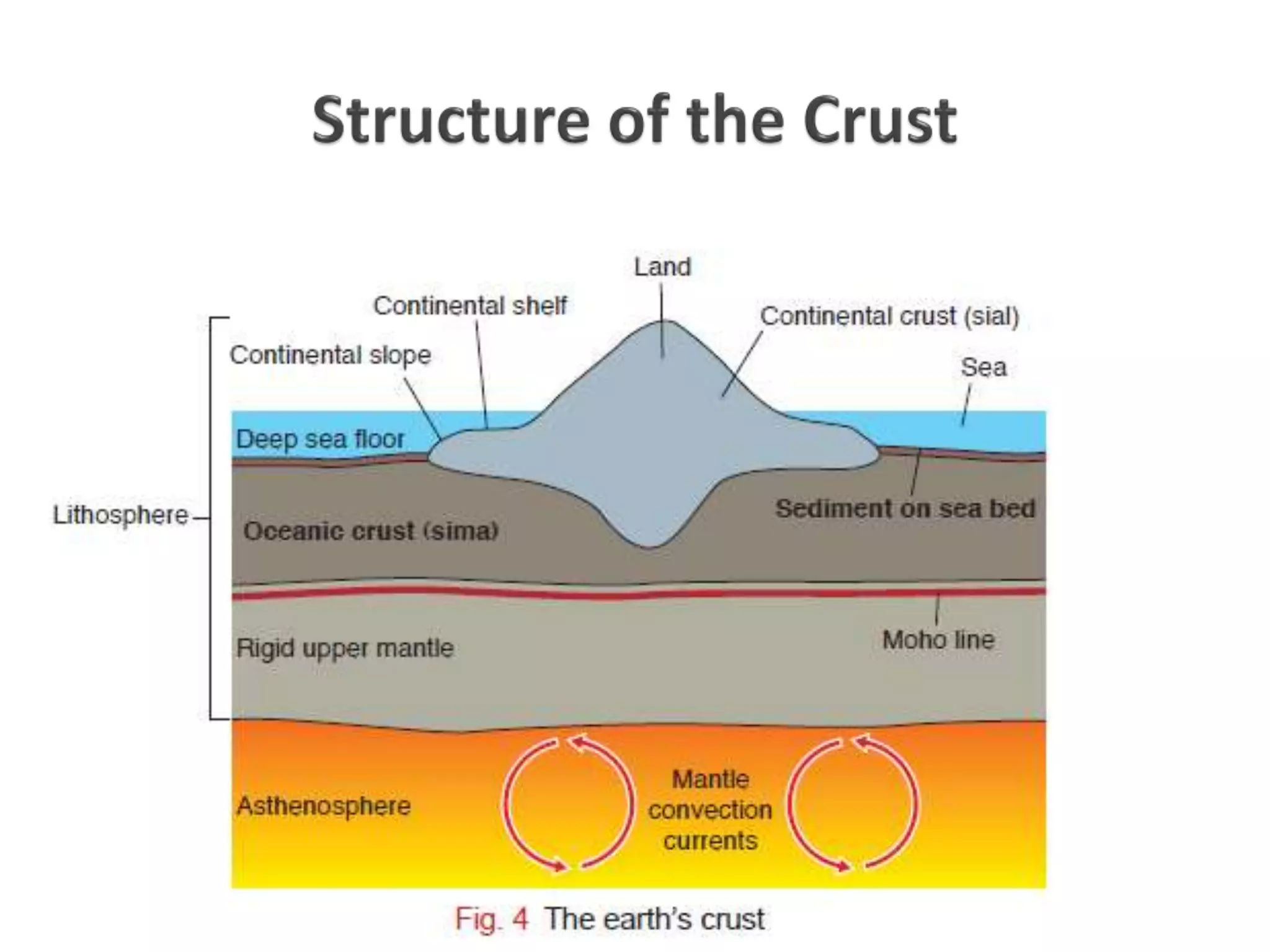
 The crust is the thin, outer part of the Earth.
 The crust is divided into a number of sections called
plates that float on the molten mantle below
 The movement of the plates causes Earthquakes, fold
mountains and volcanoes.
 The plates move because of convection currents in the
mantle underneath
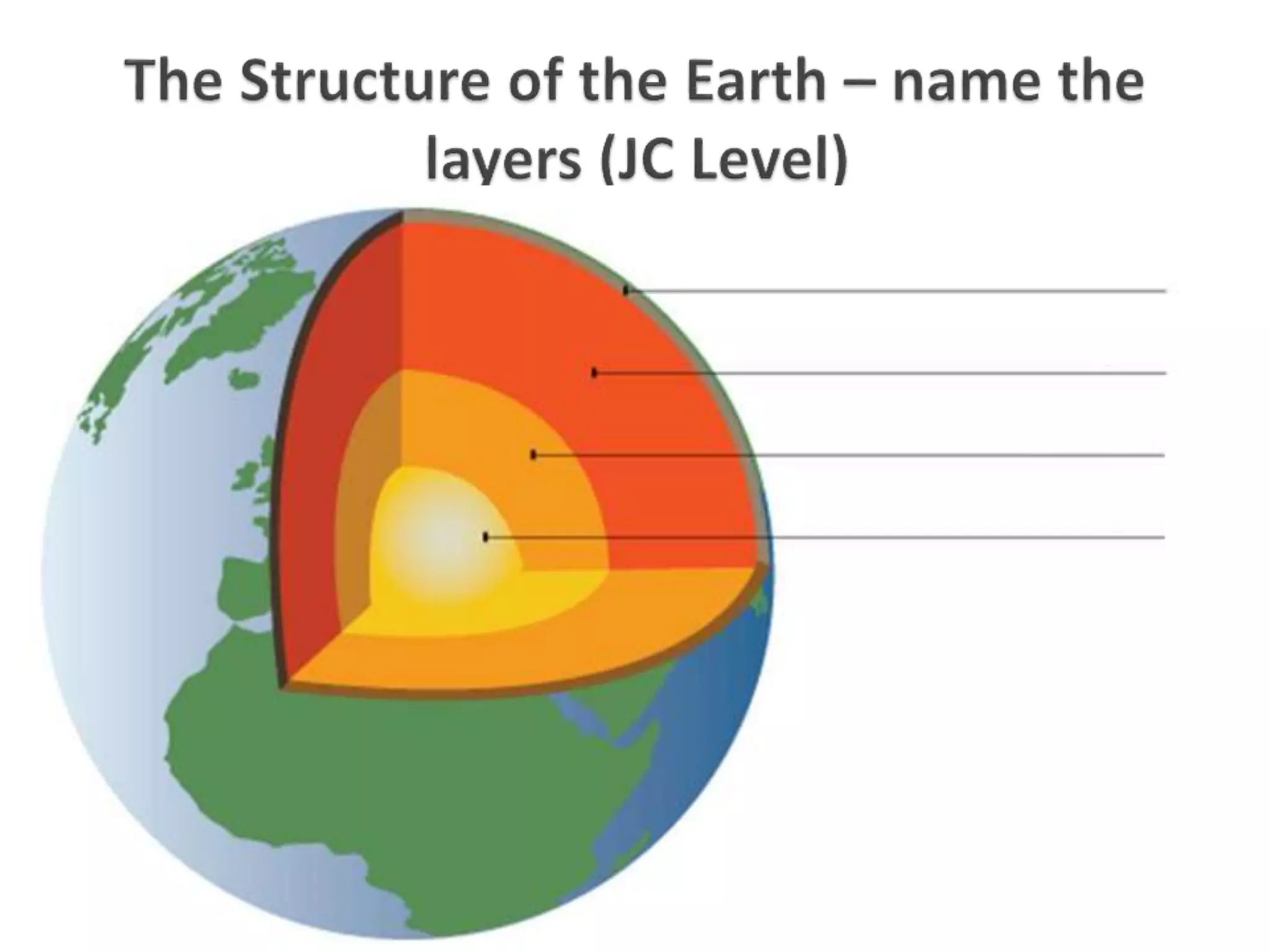
 Oceanic (young)
◦ 6 – 12K thick
◦ Dense heavy rocks (usually basalt)
◦ Silicon and Magnesium rich rocks (SIMA)
 Continental (older)
◦ 40 – 60 K thick
◦ Lighter rocks (granite, limestone etc)
◦ Silicon and Aluminium rich rocks (SIAL)
 This is the study of the processes that cause the
movement of the Earth’s plates and the landforms that
result.
 Plate Tectonics is a mixing of two theories
◦ Continental Drift by Alfred Wegener
◦ Sea Floor Spreading by Harry Hess
•Fossils of same animal
species on different
continents
•Matching rock types and
mountain trends on
different continents
•Matching coastline shape
(Africa and S. America)
As new magma is pushed up from the mantle, it
pushes the crust to either side to make space. This
causes the sea floor to spread apart.
North American Plate
Eurasian Plate
Newly
formed crust
 Different magnetic patterns on rocks either side of the
mid ocean ridges match up
 Youngest rocks are nearest the mid ocean ridge
 Youngest islands are nearest the ridge (e.g. Iceland) –
older Islands (e.g. Ireland) are further away
 The Earth’s North and South magnetic poles have
reversed several times in Earth’s history
 Grains of iron in lava point toward the magnetic pole
as it cools – keeping a record of the magnetic field at
the time
 The ideas of Continental Drift and Sea Floor Spreading
were merged in the 1960s to form the Theory of Plate
Tectonics by Vine and Matthews
 Oceanic – Continental plate collisions form...
◦ trenches
◦ Earthquakes
◦ Fold mountains and volcanoes
◦ Terranes (piles of sedimentary material at plate boundaries)
 Key Term: Subduction (one plate pushed under
another)
 Volcanic eruptions at these boundaries are often very
violent
Trench
Fold Mountains (Andes)
 Oceanic – Oceanic plate collisions form...
◦ Trenches
◦ Island Arcs – lines of volcanic islands (e.g. Japan and its
islands)
◦ Earthquakes
SIAL How plates move
Basalt Mantle-Crust boundary
Harry Hess Fold Mountains
Convection Constructive plate boundary
Fossils Silicon-Aluminium
Pangaea Proof of continental drift
Granite Oceanic Plate Rock
Moho Sea Floor Spreading
Mid Atlantic Ridge Continental Plate Rock
Himalayas One big “Super Continent”
Example of where this is
found: Mid Atlantic Ridge &
Iceland
Proof of Sea Floor
Spreading – the
youngest crust is
closest to the Mid
Atlantic Ridge
Two plates scrape
past each other.
What will happen
here?
Example of a
Transverse Plate
Boundary?
Hotspots – formed when
a plume of rising magma
in the middle of a plate
forces its way through to
the surface.
Produces gentle volcanic
eruptions as the magma
is not under pressure.
Plate Tectonics

Plate Tectonics

  • 2.
     Describe andDraw the Earth’s Structure  Explain the Earth’s structure – the different layers  Explain the Theory of Plate Tectonics  Understand how plate tectonics creates landforms around the world.
  • 5.
     The crustis the thin, outer part of the Earth.  The crust is divided into a number of sections called plates that float on the molten mantle below  The movement of the plates causes Earthquakes, fold mountains and volcanoes.  The plates move because of convection currents in the mantle underneath
  • 7.
     Oceanic (young) ◦6 – 12K thick ◦ Dense heavy rocks (usually basalt) ◦ Silicon and Magnesium rich rocks (SIMA)  Continental (older) ◦ 40 – 60 K thick ◦ Lighter rocks (granite, limestone etc) ◦ Silicon and Aluminium rich rocks (SIAL)
  • 9.
     This isthe study of the processes that cause the movement of the Earth’s plates and the landforms that result.  Plate Tectonics is a mixing of two theories ◦ Continental Drift by Alfred Wegener ◦ Sea Floor Spreading by Harry Hess
  • 11.
    •Fossils of sameanimal species on different continents •Matching rock types and mountain trends on different continents •Matching coastline shape (Africa and S. America)
  • 12.
    As new magmais pushed up from the mantle, it pushes the crust to either side to make space. This causes the sea floor to spread apart.
  • 13.
    North American Plate EurasianPlate Newly formed crust
  • 14.
     Different magneticpatterns on rocks either side of the mid ocean ridges match up  Youngest rocks are nearest the mid ocean ridge  Youngest islands are nearest the ridge (e.g. Iceland) – older Islands (e.g. Ireland) are further away
  • 16.
     The Earth’sNorth and South magnetic poles have reversed several times in Earth’s history  Grains of iron in lava point toward the magnetic pole as it cools – keeping a record of the magnetic field at the time  The ideas of Continental Drift and Sea Floor Spreading were merged in the 1960s to form the Theory of Plate Tectonics by Vine and Matthews
  • 19.
     Oceanic –Continental plate collisions form... ◦ trenches ◦ Earthquakes ◦ Fold mountains and volcanoes ◦ Terranes (piles of sedimentary material at plate boundaries)  Key Term: Subduction (one plate pushed under another)  Volcanic eruptions at these boundaries are often very violent
  • 20.
  • 21.
     Oceanic –Oceanic plate collisions form... ◦ Trenches ◦ Island Arcs – lines of volcanic islands (e.g. Japan and its islands) ◦ Earthquakes
  • 23.
    SIAL How platesmove Basalt Mantle-Crust boundary Harry Hess Fold Mountains Convection Constructive plate boundary Fossils Silicon-Aluminium Pangaea Proof of continental drift Granite Oceanic Plate Rock Moho Sea Floor Spreading Mid Atlantic Ridge Continental Plate Rock Himalayas One big “Super Continent”
  • 24.
    Example of wherethis is found: Mid Atlantic Ridge & Iceland
  • 25.
    Proof of SeaFloor Spreading – the youngest crust is closest to the Mid Atlantic Ridge
  • 26.
    Two plates scrape pasteach other. What will happen here? Example of a Transverse Plate Boundary?
  • 31.
    Hotspots – formedwhen a plume of rising magma in the middle of a plate forces its way through to the surface. Produces gentle volcanic eruptions as the magma is not under pressure.