Volcanoes and Plutons
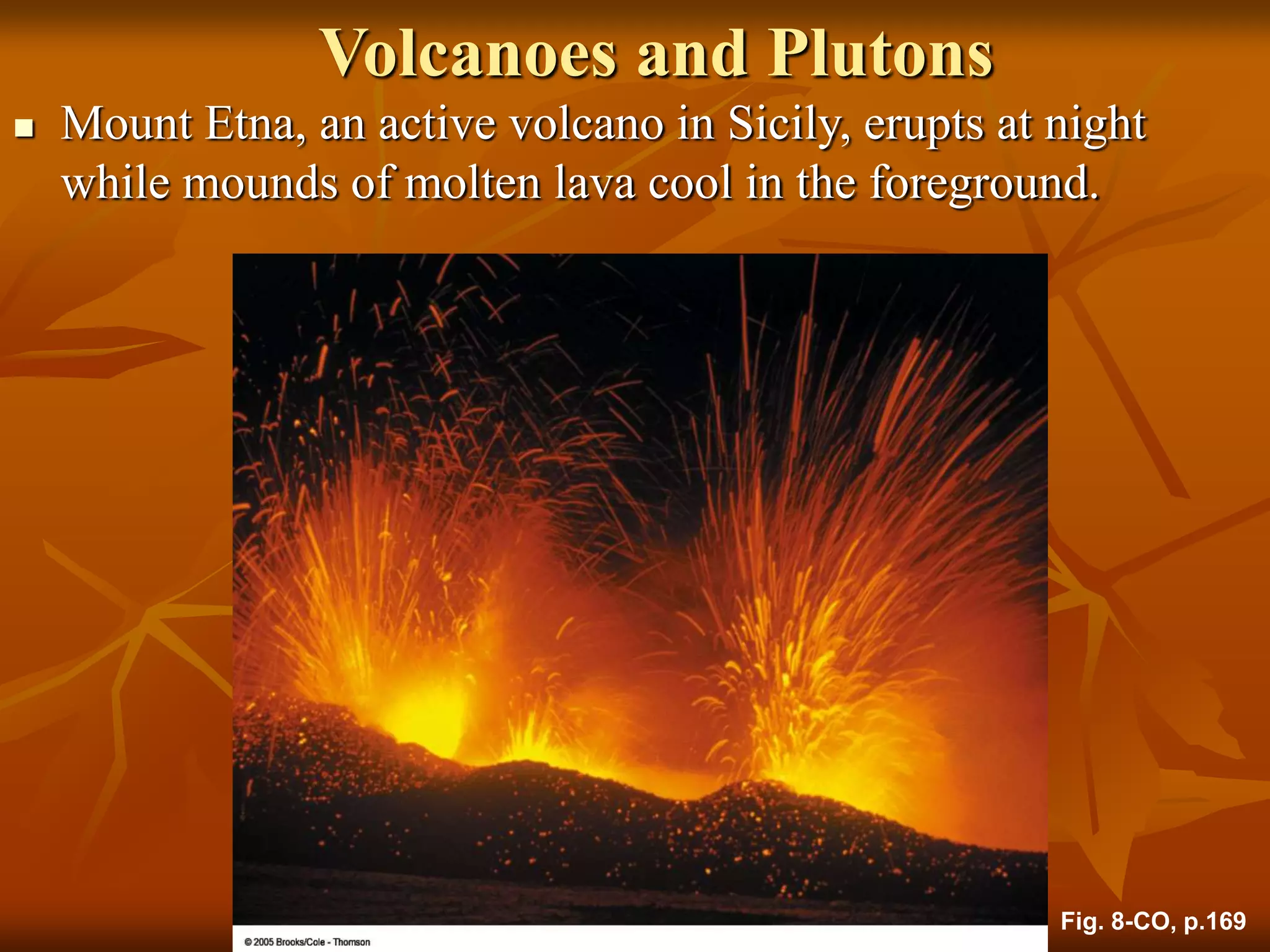
 Mount Etna, an active volcano in Sicily, erupts at night
while mounds of molten lava cool in the foreground.
Fig. 8-CO, p.169
 Geologists retreat from a slowly advancing lava flow on the
island of Hawaii.
Fig. 8-1, p.170
 How does magma form?
 The asthenosphere (from 100-300 km deep in upper mantle) is a layer
where temperature is high enough and pressure is low enough that 1-
2% is molten.
 Three processes melt the asthenosphere to form magma:
-Increasing temperature (least important cause in asthenosphere)
-Decreasing pressure
-Addition of water
Fig. 8-2, p.171
 Pressure-release melting occurs from decreased pressure. Magma
occupies about 10% more volume than the solid rock it melted from.
High pressure results in the dense, orderly arrangement of solid
mineral while low pressure favors the random, less dense arrangement
of molecules in a liquid magma. Therefore, rock can melt easier near
the Earth’s surface (given the right temp) than when it is under great
pressure. Fig. 8-3, p.171
 Pressure-
release melting
produces
magma beneath
a spreading
center, where
hot
asthenosphere
rises to fill the
gap left by the
two separating
tectonic plates.
Fig. 8-4, p.172
also,
 A wet rock generally melts at a lower
temperature than an identical dry rock. Certain
tectonic processes add water to the hot rock of
the asthenosphere to form magma.
 NOW, on to Environments of Magma
Formation…
 Spreading Centers: hot, plastic asthenosphere oozes upward
when plates separate; pressure drops as it rises, and melting
forms basaltic magma. The magma is of lower density than
surrounding rock, so it rises. Nearly all of Earth’s oceanic
crust is formed at the Mid-Oceanic Ridge system.
 Iceland is one
of the few
places on Earth
where
volcanoes of
the Mid-
Oceanic Ridge
system rise
above the sea.
Shown is an
eruption of
Mount Surtsey
of Iceland.
Fig. 8-5, p.173
 Mantle Plume: a rising column of hot, plastic rock from the
mantle. The plume rises because it is hotter than the
surrounding mantle, so it is less dense and more buoyant.
As it rises, pressure decreases and just beneath the
lithosphere is melts to form magma, and continues to rise.
Can occur, for example, within a tectonic plate
(Yellowstone) or beneath the sea (Hawaiian Islands).
Fig. 8-6, p.173
 Subduction Zone (SZ): huge quantities of magma form here
from decreasing pressure, addition of water and heating.
The asthenosphere is stirred up and rises. Volcanoes and
plutonic rocks are common features at SZ. Fig. 8-7, p.173
 75% of Earth’s active volcanoes lie in the “ring of fire” (a
chain of subduction zones at convergent plate boundaries
that encircles tha Pacific Ocean.
Fig. 8-8, p.174
Basalt and Granite
 Are the most common igneous rocks. Basalt is the main
rock of oceanic crust; granite is the main rock of continental
crust.
 Because rock is a mixture of several minerals with different
melting temperatures it does not melt to form magma at the
same time (unlike a pure substance such as ice). This is
called partial melting. Minerals with the highest silica
content melt at the lowest temperatures (so magma is
always richer in silica than the rock that produced it).
 Granite contains more silica than basalt and melts at a lower
temp. So, basaltic magma can melt granitic continental
crust. In this way, magmas with varying compositions are
produced.
Origin of the Continents
 The Earth is thought to have melted shortly after its
formation 4.6 billion years ago. Geologists surmise
the first crust was lava with a composition similar to
today’s mantle (peridotite). When and how did the
granitic continents form?
 The oldest rocks known have been dated to 3.96
billion years old (metamorphosed granite), and the
oldest mineral known has been dated to 4.2 billion
years old (the mineral zircon that commonly forms
in granite).
 Possibly from partial melting during horizontal and
vertical tectonics of the Precambrian crust.
Fig. 8-9, p.176
Fig. 8-9a, p.176
Fig. 8-9b, p.176
Fig. 8-10, p.177
Magma Behavior
 When magma rises cooling tends to solidify magma while
decreasing pressure tends to keep it liquid. What really
happens depends on the type of magma (its composition).
 Granitic magma contains about 70% silica and 10% water;
basaltic magma contains about 50% silica and 1-2% water.
 Higher silica makes the magma viscous (stiff). So granitic
magma solidifies in the crust easily, while basaltic magma
can reach the surface.
 Water escapes from granitic magma when pressure
decreases as it rises. Its solidification temperature rises,
causing it to crystallize within the crust. Basaltic magma’s
water content is relatively unimportant.
 Plutons: granitic magma solidifies in the Earth’s crust to
form a large mass of granite called a pluton. Tectonic forces
may push it upward, and erosion may expose parts of it at
the Earth’s surface.
Fig. 8-11, p.178
Fig. 8-11a, p.178
 A batholith is a
pluton exposed over
more than 100 sq.
km of Earth’s
surface; a stock is
similar, but exposed
over less than 100
sq. km.
Fig. 8-11b, p.178
 Many mountain ranges,
such as California’s Sierra
Nevada range, contain
large batholiths.
Fig. 8-12, p.178
 Granite plutons make up most of California’s Sierra Nevada
in Yosemite National Park.
Fig. 8-13, p.179
 Smaller magma intrusions may flow into a fracture or
between layers in country rock.
 Dike: tabular intrusive rock that cuts across country rock.
 Sill: magma oozes between layers of country rock and
forms parallel to layering. Fig. 8-14, p.179
 Dikes intruding older country rock.
Fig. 8-15, p.179
 A large dike near Shiprock,
New Mexico, has been left
standing after softer
sediment (country rock)
eroded away.
Fig. 8-16, p.180
 A black basalt sill has been injected between layers of
sandstone. Grand Canyon, Arizona.
Fig. 8-17, p.180
 Volcanoes:
 Lava is fluid
magma that flows
onto the Earth’s
surface and
solidifies. To right
is pahoehoe lava,
low viscosity lava
that flows while it
cools, forming
smooth, glassy-
surfaced, wrinkled,
or “ropy” ridges.
Fig. 8-18, p.181
 If viscosity is higher, its
surface may partially
solidigy as it flows. The
solid crust breaks up as the
deeper, molten lava flows,
forming aa lava, with a
jagged, rubbled, broken
surface.
 If a volcano erupts
explosively, however, it may
eject liquid magma and solid
rock fragments. A rock
from this material is called a
pyroclastic rock; the
smallest particles are ash,
while cinders are 2-64 mm.
Fig. 8-19, p.181
 Hot lava shrinks as
it cools and
solidifies, pulling
the rock apart and
forming cracks that
can be 5 or 6 sided
and grow
downward through
the solidifying
lava. This is called
columnar jointing.
Fig. 8-20a, p.181
 Columnar joints
viewed from the
top.
Fig. 8-20b, p.181
 Fissure eruptions and lava plateaus: gentle type of volcanic
eruption occurs when magma oozes from cracks (fissures)
in the land surface (or flanks of a volcano) and flows over
the land like water. Common in Hawaii and Icelandic
volcanoes.
 Some create flood basalts and lava plateaus. Fig. 8-21, p.182
Fig. 8-21a, p.182
Fig. 8-21b, p.182
Table 8-1, p.183
 Types of volcanoes
 Lava and rocks commonly erupt from a vent located in the
crater (bowl-shaped depression at the summit).
 This photo shows steam rising from vents in the crater of
Marum volcano, Vanuatu. Fig. 8-22, p.183
 Mount Skjoldbreidier in Iceland shows the typical low-
angle slopes of a shield volcano.
Fig. 8-23, p.183
 Cinder cones in southern Bolivia
Fig. 8-24a, p.184
 Pyroclastic fragment
of cinder cones.
Fig. 8-24b, p.184
 A composite cone
consists of
alternating layers
of lava and
pyroclastic
material; Mount
Rainier (below) is
a composite
volcano rising
behind Seattle’s
skyline.
Fig. 8-25, p.185
Fig. 8-25a, p.185
Fig. 8-25b, p.185
 Caldera eruption
Fig. 8-26, p.186
 Rising granitic
magma stretches
and fractures
overlying crust.
Gas separates from
the magma and
rises to the upper
part of the magma
body.
Fig. 8-26a, p.186
 The gas-rich magma
explodes through
fractures, rising as a
vertical column of hot
ash, rock fragments
and gas.
Fig. 8-26b, p.186
 When the gas is used
up, the column
collapses and
spreads outward as a
high speed ash flow.
Fig. 8-26c, p.186
 Because so much
material has
erupted from the
top of the magma
chamber, the roof
collapses to form a
caldera.
Fig. 8-26d, p.186
 Ash-flow tuff forms
when an ash flow
comes to a stop.
Fragments of rock
are carried along
with volcanic ash
and gas. Ash-flows
can travel more than
100 km in distance at
200 km/hr.
Fig. 8-27, p.186
 View of the caldera that
forms Crater Lake, Oregon.
Fig. 8-28, p.187
 Calderas (red dots) and ash-
flow tuffs (orange areas) are
abundant in wester North
America.
Fig. 8-29, p.187
 Archaeologists uncover
molds of people killed in
the A.D. 79 eruption of
Mount Vesuvius near the
Roman city of Pompeii.
During the eruption an
ash flow streamed down
the volcano and buried
cities and towns under 5-
8 meters of hot ash.
Mount Vesuvius is a
stratovolcano. Recent
seismic studies show that
seismic waves suddenly
slow from 6 to 2.7 km/sec
at a depth of 10 km.
What does this mean?
Fig. 8-30, p.188
Table 8-2, p.188
 Approximately 1300 active volcanoes are recognized
globally, and 5564 eruptions have occurred in the past
10,000 years. Volcanic eruptions are one of the greatest
geologic hazards.
 May 18, 1980
eruption of
Mount St.
Helens.
Fig. 8-31, p.190
Fig. 8-32a, p.190
Fig. 8-32b, p.190
 Plot of temperatures in the Northern Hemisphere shows that
atmospheric cooling follows major volcanic eruptions.
 Mount Pinatubo in 1991 produced the greatest ash and sulfur clouds
toward the end of the 20th century, decreasing solar radiation that
reached the Earth’s surface by 2-4% and cooling the globe by a few
tenths of a degree during 1992-93. Fig. 8-33, p.191
 Do volcanic eruptions always
create global cooling?
 End of Permian (248 million
years ago); greatest extinction
known, linked to flood basalts
in Siberia
 120 million years ago, vast
submarine lava plateau formed
beneath the Pacific Ocean off
the west coast of SA. Large
quantities of C02 released.
Dinosaurs flourished in
swamps, coal deposits
formed…global climate may
have warmed by 12-15 degrees
C.
p.193

Volcanoes and Plutons (Compre).ppt

  • 1.
    Volcanoes and Plutons Mount Etna, an active volcano in Sicily, erupts at night while mounds of molten lava cool in the foreground. Fig. 8-CO, p.169
  • 2.
     Geologists retreatfrom a slowly advancing lava flow on the island of Hawaii. Fig. 8-1, p.170
  • 3.
     How doesmagma form?  The asthenosphere (from 100-300 km deep in upper mantle) is a layer where temperature is high enough and pressure is low enough that 1- 2% is molten.  Three processes melt the asthenosphere to form magma: -Increasing temperature (least important cause in asthenosphere) -Decreasing pressure -Addition of water Fig. 8-2, p.171
  • 4.
     Pressure-release meltingoccurs from decreased pressure. Magma occupies about 10% more volume than the solid rock it melted from. High pressure results in the dense, orderly arrangement of solid mineral while low pressure favors the random, less dense arrangement of molecules in a liquid magma. Therefore, rock can melt easier near the Earth’s surface (given the right temp) than when it is under great pressure. Fig. 8-3, p.171
  • 5.
     Pressure- release melting produces magmabeneath a spreading center, where hot asthenosphere rises to fill the gap left by the two separating tectonic plates. Fig. 8-4, p.172
  • 6.
    also,  A wetrock generally melts at a lower temperature than an identical dry rock. Certain tectonic processes add water to the hot rock of the asthenosphere to form magma.  NOW, on to Environments of Magma Formation…
  • 7.
     Spreading Centers:hot, plastic asthenosphere oozes upward when plates separate; pressure drops as it rises, and melting forms basaltic magma. The magma is of lower density than surrounding rock, so it rises. Nearly all of Earth’s oceanic crust is formed at the Mid-Oceanic Ridge system.
  • 8.
     Iceland isone of the few places on Earth where volcanoes of the Mid- Oceanic Ridge system rise above the sea. Shown is an eruption of Mount Surtsey of Iceland. Fig. 8-5, p.173
  • 9.
     Mantle Plume:a rising column of hot, plastic rock from the mantle. The plume rises because it is hotter than the surrounding mantle, so it is less dense and more buoyant. As it rises, pressure decreases and just beneath the lithosphere is melts to form magma, and continues to rise. Can occur, for example, within a tectonic plate (Yellowstone) or beneath the sea (Hawaiian Islands). Fig. 8-6, p.173
  • 10.
     Subduction Zone(SZ): huge quantities of magma form here from decreasing pressure, addition of water and heating. The asthenosphere is stirred up and rises. Volcanoes and plutonic rocks are common features at SZ. Fig. 8-7, p.173
  • 11.
     75% ofEarth’s active volcanoes lie in the “ring of fire” (a chain of subduction zones at convergent plate boundaries that encircles tha Pacific Ocean. Fig. 8-8, p.174
  • 12.
    Basalt and Granite Are the most common igneous rocks. Basalt is the main rock of oceanic crust; granite is the main rock of continental crust.  Because rock is a mixture of several minerals with different melting temperatures it does not melt to form magma at the same time (unlike a pure substance such as ice). This is called partial melting. Minerals with the highest silica content melt at the lowest temperatures (so magma is always richer in silica than the rock that produced it).  Granite contains more silica than basalt and melts at a lower temp. So, basaltic magma can melt granitic continental crust. In this way, magmas with varying compositions are produced.
  • 13.
    Origin of theContinents  The Earth is thought to have melted shortly after its formation 4.6 billion years ago. Geologists surmise the first crust was lava with a composition similar to today’s mantle (peridotite). When and how did the granitic continents form?  The oldest rocks known have been dated to 3.96 billion years old (metamorphosed granite), and the oldest mineral known has been dated to 4.2 billion years old (the mineral zircon that commonly forms in granite).  Possibly from partial melting during horizontal and vertical tectonics of the Precambrian crust.
  • 14.
  • 15.
  • 16.
  • 17.
  • 18.
    Magma Behavior  Whenmagma rises cooling tends to solidify magma while decreasing pressure tends to keep it liquid. What really happens depends on the type of magma (its composition).  Granitic magma contains about 70% silica and 10% water; basaltic magma contains about 50% silica and 1-2% water.  Higher silica makes the magma viscous (stiff). So granitic magma solidifies in the crust easily, while basaltic magma can reach the surface.  Water escapes from granitic magma when pressure decreases as it rises. Its solidification temperature rises, causing it to crystallize within the crust. Basaltic magma’s water content is relatively unimportant.
  • 19.
     Plutons: graniticmagma solidifies in the Earth’s crust to form a large mass of granite called a pluton. Tectonic forces may push it upward, and erosion may expose parts of it at the Earth’s surface. Fig. 8-11, p.178
  • 20.
  • 21.
     A batholithis a pluton exposed over more than 100 sq. km of Earth’s surface; a stock is similar, but exposed over less than 100 sq. km. Fig. 8-11b, p.178
  • 22.
     Many mountainranges, such as California’s Sierra Nevada range, contain large batholiths. Fig. 8-12, p.178
  • 23.
     Granite plutonsmake up most of California’s Sierra Nevada in Yosemite National Park. Fig. 8-13, p.179
  • 24.
     Smaller magmaintrusions may flow into a fracture or between layers in country rock.  Dike: tabular intrusive rock that cuts across country rock.  Sill: magma oozes between layers of country rock and forms parallel to layering. Fig. 8-14, p.179
  • 25.
     Dikes intrudingolder country rock. Fig. 8-15, p.179
  • 26.
     A largedike near Shiprock, New Mexico, has been left standing after softer sediment (country rock) eroded away. Fig. 8-16, p.180
  • 27.
     A blackbasalt sill has been injected between layers of sandstone. Grand Canyon, Arizona. Fig. 8-17, p.180
  • 28.
     Volcanoes:  Lavais fluid magma that flows onto the Earth’s surface and solidifies. To right is pahoehoe lava, low viscosity lava that flows while it cools, forming smooth, glassy- surfaced, wrinkled, or “ropy” ridges. Fig. 8-18, p.181
  • 29.
     If viscosityis higher, its surface may partially solidigy as it flows. The solid crust breaks up as the deeper, molten lava flows, forming aa lava, with a jagged, rubbled, broken surface.  If a volcano erupts explosively, however, it may eject liquid magma and solid rock fragments. A rock from this material is called a pyroclastic rock; the smallest particles are ash, while cinders are 2-64 mm. Fig. 8-19, p.181
  • 30.
     Hot lavashrinks as it cools and solidifies, pulling the rock apart and forming cracks that can be 5 or 6 sided and grow downward through the solidifying lava. This is called columnar jointing. Fig. 8-20a, p.181
  • 31.
     Columnar joints viewedfrom the top. Fig. 8-20b, p.181
  • 32.
     Fissure eruptionsand lava plateaus: gentle type of volcanic eruption occurs when magma oozes from cracks (fissures) in the land surface (or flanks of a volcano) and flows over the land like water. Common in Hawaii and Icelandic volcanoes.  Some create flood basalts and lava plateaus. Fig. 8-21, p.182
  • 33.
  • 34.
  • 35.
    Table 8-1, p.183 Types of volcanoes
  • 36.
     Lava androcks commonly erupt from a vent located in the crater (bowl-shaped depression at the summit).  This photo shows steam rising from vents in the crater of Marum volcano, Vanuatu. Fig. 8-22, p.183
  • 37.
     Mount Skjoldbreidierin Iceland shows the typical low- angle slopes of a shield volcano. Fig. 8-23, p.183
  • 38.
     Cinder conesin southern Bolivia Fig. 8-24a, p.184
  • 39.
     Pyroclastic fragment ofcinder cones. Fig. 8-24b, p.184
  • 40.
     A compositecone consists of alternating layers of lava and pyroclastic material; Mount Rainier (below) is a composite volcano rising behind Seattle’s skyline. Fig. 8-25, p.185
  • 41.
  • 42.
  • 43.
  • 44.
     Rising granitic magmastretches and fractures overlying crust. Gas separates from the magma and rises to the upper part of the magma body. Fig. 8-26a, p.186
  • 45.
     The gas-richmagma explodes through fractures, rising as a vertical column of hot ash, rock fragments and gas. Fig. 8-26b, p.186
  • 46.
     When thegas is used up, the column collapses and spreads outward as a high speed ash flow. Fig. 8-26c, p.186
  • 47.
     Because somuch material has erupted from the top of the magma chamber, the roof collapses to form a caldera. Fig. 8-26d, p.186
  • 48.
     Ash-flow tuffforms when an ash flow comes to a stop. Fragments of rock are carried along with volcanic ash and gas. Ash-flows can travel more than 100 km in distance at 200 km/hr. Fig. 8-27, p.186
  • 49.
     View ofthe caldera that forms Crater Lake, Oregon. Fig. 8-28, p.187
  • 50.
     Calderas (reddots) and ash- flow tuffs (orange areas) are abundant in wester North America. Fig. 8-29, p.187
  • 51.
     Archaeologists uncover moldsof people killed in the A.D. 79 eruption of Mount Vesuvius near the Roman city of Pompeii. During the eruption an ash flow streamed down the volcano and buried cities and towns under 5- 8 meters of hot ash. Mount Vesuvius is a stratovolcano. Recent seismic studies show that seismic waves suddenly slow from 6 to 2.7 km/sec at a depth of 10 km. What does this mean? Fig. 8-30, p.188
  • 52.
    Table 8-2, p.188 Approximately 1300 active volcanoes are recognized globally, and 5564 eruptions have occurred in the past 10,000 years. Volcanic eruptions are one of the greatest geologic hazards.
  • 53.
     May 18,1980 eruption of Mount St. Helens. Fig. 8-31, p.190
  • 54.
  • 55.
  • 56.
     Plot oftemperatures in the Northern Hemisphere shows that atmospheric cooling follows major volcanic eruptions.  Mount Pinatubo in 1991 produced the greatest ash and sulfur clouds toward the end of the 20th century, decreasing solar radiation that reached the Earth’s surface by 2-4% and cooling the globe by a few tenths of a degree during 1992-93. Fig. 8-33, p.191
  • 57.
     Do volcaniceruptions always create global cooling?  End of Permian (248 million years ago); greatest extinction known, linked to flood basalts in Siberia  120 million years ago, vast submarine lava plateau formed beneath the Pacific Ocean off the west coast of SA. Large quantities of C02 released. Dinosaurs flourished in swamps, coal deposits formed…global climate may have warmed by 12-15 degrees C. p.193