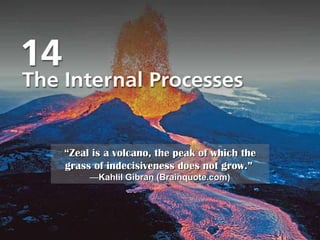
Title Page Photo “ Zeal is a volcano, the peak of which the grass of indecisiveness does not grow.”   — Kahlil Gibran (Brainquote.com)
Vocabulary pyroclastic flow  (p. 440) pyroclastics  (p. 429) reverse fault  (p. 449 sag pond  (p. 450) seafloor spreading  (p. 416) shield volcano  (p. 433) strike-slip fault  (p. 449) subduction  (p. 416) syncline  (p. 446) thrust fault  (p. 449) tilted fault block mountain  (p. 449) transform boundary  (p. 422) volcanic island arc  (p. 422) volcanic mudflow (lahar)  (p. 442) vulcanism  (p. 428) graben  (p. 449) horst  (p. 449) igneous intrusion  (p. 442) lava  (p. 429) liquefaction  (p. 452) magma  (p. 429) magnitude (of earthquake)  (p. 451) mantle plume (hot spot)  (p. 426) midocean ridge  (p. 420) normal fault  (p. 449) oceanic trench  (p. 421) overturned fold  (p. 446) Pacific ring of fire  (p. 424) paleomagnetism  (p. 416) Pangaea  (p. 413) plate tectonics  (p. 419) anticline  (p. 446) batholith  (p. 443) caldera  (p. 437) cinder cone  (p. 437) composite volcano  (p. 434) continental drift  (p. 413) continental rift valley  (p. 420) convergent boundary  (p. 420) divergent boundary  (p. 420) earthquake  (p. 450) epicenter (of earthquake)  (p. 451) faulting  (p. 447) fault scarp  (p. 448) flood basalt  (p. 433) folding  (p. 445)
The Impact of Internal Processes on the Landscape Internal processes are fundamentally responsible for the gross shape of lithospheric landscape. Do not always act independently and separately.
From Rigid Earth to Plate Tectonics Variety of recent discoveries and hypotheses called into question rigid-Earth theory. The idea that all of the continents had at one time been united has been around for a considerable period of time, but not until recently was a plausible theory formulated.
Wegener’s Continental Drift When looked at in geological time scale, continents very mobile. Theory of continental drift proposes that continents were originally all connected, but broke up and are still drifting apart, so will continue to change position. Pangaea —the massive supercontinent that Alfred Wegener postulated to have existed about 250 million years ago. Evidence includes remarkable number of close affinities of geologic features on both sides of Atlantic Ocean. Continental margins of subequatorial portions of Africa and South America fit together.  Petrologic and paleontologic records on both sides of Atlantic show many distributions would be continuous if no ocean.
Fossils, e.g., the mesosaurus fossils Fig. 14-3 Wegener’s flaw – no plausible propelling mechanism
Plate Tectonics The Evidence Oceans have a continuous system of large ridges located some distance from continents, often midocean.  Also, deep trenches occur at many places in the ocean floors, often around margins of ocean basins. Seafloor Spreading —theory proposing that oceanic ridges are formed by currents of deep-seated magma rising up from the mantle (often during volcanic eruptions), creating new crust on the ridges (the newest crust formed on the planet). Subduction  — process proposed to explain trenches, making them the site where older crust descends into the interior of Earth, where it is presumably melted and recycled into the convective cycle that operates in Earth.
Plate Tectonics Convection: The missing propelling mechanism Movement of mass due to changes in its density caused by gain or loss of heat heat H - H + heat Core Mantle Lithosphere
Plate Tectonics Verification of Seafloor Spreading  -- Theory of seafloor spreading supported by two sets of evidence: Paleomagnetism  Seafloor has a relative symmetrical pattern of magnetic orientation on both sides of ridges, indicating that it has spread laterally by addition of new crust (displaying how the magnetic field has reversed itself [more than 170 times]). Ocean floor core sampling Sediment age and thickness increase with increasing distance from the ridges, indicating that sediments farthest from ridges are oldest
Age of the ocean floors based on paleomagnetism Fig. 14-9
Plate Tectonics By 1968, the great body of evidence convinced many scientists that the theory of plate tectonics was viable.  Number of plates and their boundaries are not completely clear. About a dozen major plates and smaller ones are postulated; thought to be about 100 kilometers (60 miles) thick, and consist of both oceanic and continental crust. Driving mechanism for plate tectonics is convection within Earth’s mantle. Plates move at varying rates from 1 centimeter to 10 centimeters per year.
Plate Boundaries Divergent boundary —type of plate association in which two plates are moving away from each other because of magma welling up from asthenosphere.  Most common is  midocean ridge , but also occurs within a continent ( continental rift valley ), as in East African Rift Valley.
Divergent Plate Boundaries: Origin of Ocean Basins Fig. 14-12
Rift Valley Formation Begins on a continent East African Rift Valley Grows to become linear sea (“proto-ocean”) Red Sea Constructive boundary (rock is created) Fig. 14-13
Plate Boundaries Convergent boundary —type of plate association in which two plates are colliding. Normal result is one plate being subducted, but showing crumpling at the edges where they meet (often resulting in massive and spectacular landforms). Three types:  Oceanic–continental convergence Oceanic–oceanic convergence Continental–continental convergence
Convergent Plate Boundary: Continent-to-Continent No subduction Conservative boundary: Rock is neither created nor destroyed Folded Mountains: e.g., Himalayas Fig. 14-14c
Plate Boundaries Convergent boundary (con’t) Oceanic–continental convergence—denser oceanic plate is subducted, and oceanic trench and coastal mountains are usually created (e.g., Andes). Accompanied by earthquakes, and volcanoes develop.  Oceanic–oceanic convergence—creates oceanic trench and volcanoes on ocean floor, which initiate volcanic island arc (e.g., Aleutians and Japan). Continental–continental convergence—no subduction occurs, so huge mountain ranges are built up (e.g., Alps and Himalayas).  Volcanoes rare, but shallow-focus earthquakes common.
Plate Boundaries Transform boundary —plate association in which two plates slip past one another laterally in a typical fault structure. Associated with a great deal of seismic activity (e.g., San Andreas in California).
California and San Andreas Fault system Fig. 14-16
The Rearrangement Evidence points to five continents existing 450 million years ago. These converged into single continent of Pangaea, which then began to break up about 250 million years ago into two pieces: Laurasia (Northern Hemisphere) and Gondwanaland (Southern Hemisphere). Look at rocks, fossils, and magnetic patterns to determine relative positions. Numbers of plates appear to have changed through time, with some eras having more than today, others having less.  Sizes and shapes also have changed through time.
The Rearrangement Animation  (Assembly and Breakup of Pangaea) Fig. 14-17
The Pacific Ring of Fire Plate boundaries are found all around the Pacific basin—primarily subduction zones. Along these plate boundaries many volcanoes have formed giving this region the name the  Pacific Ring of Fire
Additions to the Basic Plate Tectonic Theory Mantle plumes (hot spots) —a location where molten mantle magma rises to, or almost to, Earth’s surface. Cause is unknown; creates volcanoes and/or hydrothermal (hot water) features.  Recent research indicates that explanation of hot spots may be more complex than previous assumed. Seismic tomography suggests that some mantle plumes may be shallow and that some may be mobile.
Hawaiian Islands Fig. 14-20
Accreted Terranes Terrane —a small-to-medium mass of lithosphere that is too buoyant to be subducted so instead is fused to a plate. It is often very different from the plate.  For example, most of Alaska, western Canada, and western U.S. are a mosaic of several dozen accreted terranes.
Accreted Terranes Fig. 14-21, with Fig. 14-22 overlay
The Questions Several unanswered questions regarding plate tectonics include the following: Is the contemporary pattern of plates adequate even though it does not explain all mountain belts?  Why does the number and the size and shape of plates seem to vary through geologic time? Why does plate size vary so much? What determines zones of weakness where plate boundaries first develop? What explains tectonic activity in the middle of plates? What is ultimate cause of plate movement?
Vulcanism Other internal processes are directly associated with tectonic movement; one is vulcanism. Vulcanism —general term that refers to all phenomena connected with origin and movement of magma from the interior of Earth to or near the surface
Volcano Distribution Fig. 14-24
Magma Chemistry, Styles of Eruption, Etc. Table comparing two eruptive styles and their characteristics Basalt Andesite Common type of Lava Shield volcano Composite volcano Type of Volcano Subduction areas High silica content (felsic magma) More polymerization Thick magma More gas pressure build up High explosivity index Explosive Low silica content (mafic magma) Less polymerization Thin magma Less gas pressure build up Low explosivity index Magma chemistry Mid-ocean ridge and hot spots General locations Effusive (mild) Characteristics
Vulcanism Three types of vulcanism: volcanism, intrusive vulcanism, and plutonic activity. Volcanism —extrusive vulcanism, in that the magma is expelled onto Earth’s surface while still molten. Intrusive vulcanism—occurs where magma solidifies in shallow crust near surface. Plutonic activity —occurs where magma solidifies very deep inside Earth, far below surface.
Vulcanism Lava —molten magma that is extruded onto the surface of Earth, where it cools and solidifies; affects landscape whether gentle or explosive. Pyroclastic material —solid material such as rock fragments, solidified lava blobs, and dust thrown into the air by volcanic explosions. For example, the Krakatau explosion in 1883 ejected 20 cubic kilometers (6 cubic miles) of material into air.
Vulcanism Active volcanoes—those that have erupted at least once in recorded history. U.S. has 10% of about 550 active volcanoes in world. Pacific Ring of Fire or Andesite Line has some 80% of world’s volcanoes.
Vulcanism Volcanic activity is primarily associated with plate boundaries.  At divergent boundaries, magma wells up by volcanic eruption and flooding from fissures. At convergent boundaries, volcanoes form because of turbulent descent and melting of crust that occurs with subduction.
Vulcanism Magma Chemistry and Styles of Eruption Chemistry of magma largely determines nature of eruption. Critical component appears to be relative amount of silica (Si02).  High silica content can result in explosive eruption. Strength of surface crust and degree of confining pressure can also play role.
Vulcanism Volcanic Activity Benefit of volcanoes: magma provides essential nutrients for plant growth. Volcanoes provide fertile environments.
Vulcanism Lava Flows Flood basalt  —a large-scale outpouring of basaltic lava that may cover an extensive area of Earth’s surface. Can build up, layer upon layer, to depths of many hundreds of feet and cover tens of thousands of square kilometers, like Columbia Plateau in United States.
Volcanic Peaks Volcanic Peaks often starts small, can grow into hill or mountain. Most have crater set at apex of cone.
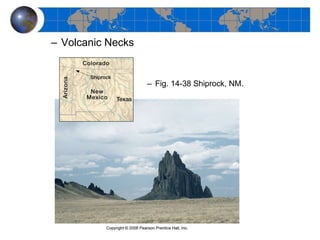
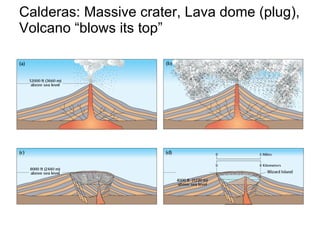
Volcanic Peaks Shield Volcanoes —never steep-sided, though can be very high (e.g., Hawaiian Islands). Composite Volcanoes —steep-sided, large, symmetrical cones (e.g., Mt. Fuji, Japan). Lava Domes —usually small, with irregular shape (e.g., Lassen Peak, California). Cinder Cones —smallest of volcanic mountains (e.g., Sunset Crater in Arizona). Calderas —uncommon, but large, steep-sided, roughly circular depression resulting from the explosion and subsidence of a large volcano (e.g., Oregon’s Crater Lake). Volcanic Necks —rare but prominent sharp spire that rises abruptly above the surrounding land. It represents the pipe or throat of an old volcano, filled with solidified lava after its final eruption. The less resistant material that makes up the cone is eroded, leaving the harder, lava-choked neck as a remnant (e.g., Shiprock in New Mexico).
Volcanic Peaks Animations Shield Volcanoes Hawaiian Islands (Mauna Loa and Kilauea)  Fig. 14-29b Volcanoes Formation of Crater Lake
Dome-shaped (broad base, gentle slopes) Fig. 14-30
Composite Volcanoes (cone-shaped, steep slopes) Mt. Fuji, Mt. Kilimanjaro, Mt. Rainier, Mt. Shasta Fig. 14-29d
Lava domes (plug domes) Solitary volcanoes: Mono Craters, CA Inside craters of composite volcanoes: Mt. St. Helens Fig. 14-29c
Cinder Cones Youthful volcanoes Highly erodible slopes (loose pyroclasts) Found in association with other volcanoes Fig. 14-29a
Fig. 14-32 Volc án Popocatépetl, Mexico Photographs of Volcanic Peaks    Composite volcano
Fig. 14-33. Crater Mountain, Mono Craters, CA    Lava (Plug) Dome
Fig. 14-34 Sunset Crater, AZ    Cinder Cone
Calderas: Massive crater, Lava dome (plug), Volcano “blows its top”
Fig. 14-35a and b Crater Lake, OR
Volcanic Necks Fig. 14-38 Shiprock, NM.
Volcanic Hazards Wide range of hazards can affect people living near volcanoes: Volcanic gases, lava flows, eruption column and clouds, pyroclastic flows, volcanic mudflows (lahars).
Volcanic Hazards Volcanic Gases Volcanic gases include carbon dioxide, sulfur dioxide, hydrogen sulfide, and fluorine. Affects can range from acid rain that destroys local vegetation to droplets affecting solar insolation and lowering global temperatures (e.g., Mount Pinatubo in 1991 lowered temperatures for more than a year). Lava Flows Lava flows cause more property damage than loss of life. Eruption Column and Clouds Violent ejection of pyroclastic material and gases; can reach elevations of 16 kilometers (10 miles) or more.
Volcanic Hazards Pyroclastic Flows Pyroclastic flows  —terrifying high-speed avalanche of searing hot gases, ash, and rock fragments (e.g., one on Martinique in the Caribbean killed nearly 28,000 inhabitants of one town in a matter of moments in 1902). Volcanic Mudflows  ( Lahars )—fast moving, and sometimes hot, slurry of mud and boulders; one of most common volcanic hazards. (e.g., Nevada del Ruiz volcano in Columbia produced a mudflow that killed more than 20,000 people in a town nearly 50 kilometers [30 miles] away). Fig. 14-40 Eruption of Mount St. Augustine,  Alaska. A pyroclastic flow is moving down the slope to the left.
Fig. 14-41 Unzen volcano in Japan showing path of pyroclastic flows.
Igneous Features Intrusions can rise high enough to deform overlying material and affect landscape, or be exposed at surface.  Can take on almost infinite variety of forms, but are classified into scheme of six types (the largest three—batholiths, stocks, and laccoliths—are subgrouped as plutons). Batholiths —the largest and most amorphous of igneous intrusions; subterranean igneous body of indefinite depth and enormous size. Often form the core of major mountain ranges. Stocks —a small body of igneous rock intruded into older rock, amorphous in shape and indefinite in depth. Many are offshoots of batholiths.
Igneous Features Laccoliths —an igneous intrusion produced when slow-moving viscous magma is forced between horizontal layers of preexisting rock. The magma resists flowing and builds up into a mushroom-shaped mass that domes the overlying strata. If near enough to Earth’s surface, a rounded hill will rise above the surrounding area (e.g., South Dakota’s Black Hills). Dikes —a vertical or nearly vertical sheet of magma that is thrust upward into preexisting rock; probably most widespread.  Sills —a long, thin intrusive body that is formed when magma is forced between parallel layers of preexisting rock to solidify eventually in a sheet. Veins —small igneous intrusions, usually with vertical orientation.
Diastrophism Diastrophism —a general term that refers to the deformation of Earth’s crust, and implies that the material is solid and not molten. Two types of diastrophic movements: folding and faulting. Separation of two not always discrete and clear-cut.
Folding Folding —the bending of crustal rocks by compression and/or uplift (with great pressure being applied for long periods). Can vary from centimeters to tens of kilometers, from simple and symmetrical forms to complex, asymmetrical features. Figure 14–33 shows the various main types of folds:
Folding Monocline —a one-sided slope connecting two horizontal or gently inclined strata. Anticline —a simple symmetrical upfold. Syncline —a simple downfold. Overturned fold —an upfold that has been pushed so vigorously from one side that it becomes oversteepened enough to have a reverse orientation on the other side. Overthrust fold —a fold in which the pressure was great enough to break the oversteepened limb and cause a shearing movement, so older rock rides above younger.
Formation of Anticlinal Valleys and Synclinal Ridges Fig. 14-47a and b
Fig. 14-48 Intensely folded Appalachian topography in the eastern United States.
Fig. 14-49 Cross section through the Swiss Alps, showing the enormous complexity of fold structures.
Faulting Faulting —the breaking apart of crustal rocks with accompanying displacement (vertical, horizontal, or both). Can vary in time (slow or sudden) and in size (centimeter to 20 or 30 feet [in sudden slippage] up to hundreds of kilometers horizontally and tens of kilometers vertically [over millions of years]). Earthquakes usually but not exclusively associated with faults. Fault lines often marked by other prominent topographic features. Fault scarp —steep cliff formed by faulting; represent the edge of a vertically displaced block. Linear erosional valleys and sag ponds.
Types of Faults Two dozen types of faults can be generalized into four principal types on basis of direction and angle of movement: Normal fault, reverse fault, strike-slip fault, and overthrust fault.
Types of Faults Normal fault —the result of tension producing a steeply inclined fault plain, with the block of land on one side being pushed up, or upthrown, in relation to the block on the other side, which is downthrown (displacement is mostly vertical). Reverse fault —a fault produced from compression, with the upthrown block rising steeply above the downthrown block, so that the fault scarp would be severely oversteepened if erosion did not act to smooth the slope (displacement is mostly vertical). Thrust fault —a fault created by compression forcing the upthrown block to override the downthrown block at a relatively low angle; complicated in structure. Strike-slip fault —a fault produced by shearing, with adjacent blocks being displaced laterally with respect to one another (displacement is entirely horizontal).
Types of Faults Normal Fig. 14-52
Reverse Fig. 14-52
Strike-slip Fig. 14-52
Fig. 14-53. Calaveras fault, Hollister, CA. Offset wall and sidewalk. Example of a strike-slip fault.
Landforms Associated with Normal Faulting Tilted Fault-block Mountains A mountain formed under certain conditions of crustal stress, whereby a surface block may be severely faulted and upthrown on one side without any faulting or uplift on the other side. The block is tilted asymmetrically, producing a steep slope along the fault scarp and a relatively gentle slope on the other side of the block.
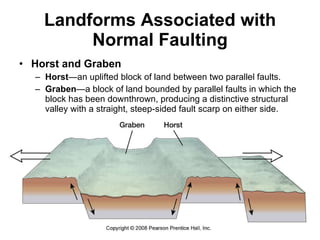
Landforms Associated with Normal Faulting Horst and Graben Horst —an uplifted block of land between two parallel faults. Graben —a block of land bounded by parallel faults in which the block has been downthrown, producing a distinctive structural valley with a straight, steep-sided fault scarp on either side.
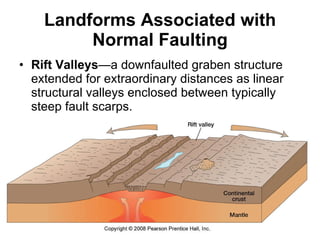
Landforms Associated with Normal Faulting Rift Valleys —a downfaulted graben structure extended for extraordinary distances as linear structural valleys enclosed between typically steep fault scarps.
Landforms Associated with Strike-Slip Faulting Can result in wide variety of landforms, including Linear fault trough—a valley marking a strike-slip fault; occurs by repeated movement and fracturing of rock. Sag pond—a pond caused by the collection of water from springs and/or runoff into sunken ground, resulting from the jostling of Earth in the area of fault movement. Offset stream—offset drainage channel; perhaps most conspicuous landform produced by strike-slip faulting. Shutter ridge—displaces streams flowing across a fault.
Earthquakes When there is a sudden displacement of a fault, shock waves produce vibrations we call earthquakes.  Earthquake Waves The focus, or center, of the fault motion produces several kinds of shock or seismic waves that travel outward in widening circles.  Epicenter —the location on the ground directly above the focus of an earthquake, where the strongest shocks and greatest crustal vibrations are often felt.
Earthquakes Primary or P waves are the fastest moving waves, moving through Earth like sound waves, alternately compressing and relaxing the material they pass through.  Secondary or S waves are slower moving waves, also passing through body of Earth, producing both strong side-to-side and up-and-down “shearing” motion. A third type of waves, surface, do not travel through Earth like P and S waves do, but only travel across surface, immediately after S waves, and produce strong side-to-side and up-and-down “rolling” motion.
Earthquake Magnitude Seismograph —instrument used to record earthquakes. Seismologists can pinpoint earthquake focus with great precision, measuring lag time between arrival of P and S waves. Magnitude —the relative amount of energy released during an earthquake. Calculated on a logarithmic scale, so there’s an energy increase from one magnitude to the next of about 32 times. Richter scale —a scale of earthquake magnitudes, devised by California seismologist Charles F. Richter in 1935, to describe the amount of energy released in a single earthquake. Most commonly quoted magnitude, but is not ideal for comparing very large earthquakes (those of magnitude 7 or higher).
Shaking Intensity Moment magnitude —now most commonly used to describe large earthquakes.  Modified Mercalli intensity scale —a scale that assigns the strength of local shaking, based on observed effects and damage.
Earthquake Hazards Ground shaking—causes most damage. Generally, ground shaking diminishes with distance from epicenter, but local geology also modifies. For example, loose, unstable soils will amplify the shaking.  Liquefaction —occurs when loose, water-saturated sediments turn fluid, resulting in subsidence, fracturing, and horizontal sliding of the ground surface. Landslides Tsunami —very long sea wave generated by submarine earthquake or volcanic eruption.

Chapter fourteen

  • 1.
    Title Page Photo“ Zeal is a volcano, the peak of which the grass of indecisiveness does not grow.” — Kahlil Gibran (Brainquote.com)
  • 2.
    Vocabulary pyroclastic flow (p. 440) pyroclastics (p. 429) reverse fault (p. 449 sag pond (p. 450) seafloor spreading (p. 416) shield volcano (p. 433) strike-slip fault (p. 449) subduction (p. 416) syncline (p. 446) thrust fault (p. 449) tilted fault block mountain (p. 449) transform boundary (p. 422) volcanic island arc (p. 422) volcanic mudflow (lahar) (p. 442) vulcanism (p. 428) graben (p. 449) horst (p. 449) igneous intrusion (p. 442) lava (p. 429) liquefaction (p. 452) magma (p. 429) magnitude (of earthquake) (p. 451) mantle plume (hot spot) (p. 426) midocean ridge (p. 420) normal fault (p. 449) oceanic trench (p. 421) overturned fold (p. 446) Pacific ring of fire (p. 424) paleomagnetism (p. 416) Pangaea (p. 413) plate tectonics (p. 419) anticline (p. 446) batholith (p. 443) caldera (p. 437) cinder cone (p. 437) composite volcano (p. 434) continental drift (p. 413) continental rift valley (p. 420) convergent boundary (p. 420) divergent boundary (p. 420) earthquake (p. 450) epicenter (of earthquake) (p. 451) faulting (p. 447) fault scarp (p. 448) flood basalt (p. 433) folding (p. 445)
  • 3.
    The Impact ofInternal Processes on the Landscape Internal processes are fundamentally responsible for the gross shape of lithospheric landscape. Do not always act independently and separately.
  • 4.
    From Rigid Earthto Plate Tectonics Variety of recent discoveries and hypotheses called into question rigid-Earth theory. The idea that all of the continents had at one time been united has been around for a considerable period of time, but not until recently was a plausible theory formulated.
  • 5.
    Wegener’s Continental DriftWhen looked at in geological time scale, continents very mobile. Theory of continental drift proposes that continents were originally all connected, but broke up and are still drifting apart, so will continue to change position. Pangaea —the massive supercontinent that Alfred Wegener postulated to have existed about 250 million years ago. Evidence includes remarkable number of close affinities of geologic features on both sides of Atlantic Ocean. Continental margins of subequatorial portions of Africa and South America fit together. Petrologic and paleontologic records on both sides of Atlantic show many distributions would be continuous if no ocean.
  • 6.
    Fossils, e.g., themesosaurus fossils Fig. 14-3 Wegener’s flaw – no plausible propelling mechanism
  • 7.
    Plate Tectonics TheEvidence Oceans have a continuous system of large ridges located some distance from continents, often midocean. Also, deep trenches occur at many places in the ocean floors, often around margins of ocean basins. Seafloor Spreading —theory proposing that oceanic ridges are formed by currents of deep-seated magma rising up from the mantle (often during volcanic eruptions), creating new crust on the ridges (the newest crust formed on the planet). Subduction — process proposed to explain trenches, making them the site where older crust descends into the interior of Earth, where it is presumably melted and recycled into the convective cycle that operates in Earth.
  • 8.
    Plate Tectonics Convection:The missing propelling mechanism Movement of mass due to changes in its density caused by gain or loss of heat heat H - H + heat Core Mantle Lithosphere
  • 9.
    Plate Tectonics Verificationof Seafloor Spreading -- Theory of seafloor spreading supported by two sets of evidence: Paleomagnetism Seafloor has a relative symmetrical pattern of magnetic orientation on both sides of ridges, indicating that it has spread laterally by addition of new crust (displaying how the magnetic field has reversed itself [more than 170 times]). Ocean floor core sampling Sediment age and thickness increase with increasing distance from the ridges, indicating that sediments farthest from ridges are oldest
  • 10.
    Age of theocean floors based on paleomagnetism Fig. 14-9
  • 11.
    Plate Tectonics By1968, the great body of evidence convinced many scientists that the theory of plate tectonics was viable. Number of plates and their boundaries are not completely clear. About a dozen major plates and smaller ones are postulated; thought to be about 100 kilometers (60 miles) thick, and consist of both oceanic and continental crust. Driving mechanism for plate tectonics is convection within Earth’s mantle. Plates move at varying rates from 1 centimeter to 10 centimeters per year.
  • 12.
    Plate Boundaries Divergentboundary —type of plate association in which two plates are moving away from each other because of magma welling up from asthenosphere. Most common is midocean ridge , but also occurs within a continent ( continental rift valley ), as in East African Rift Valley.
  • 13.
    Divergent Plate Boundaries:Origin of Ocean Basins Fig. 14-12
  • 14.
    Rift Valley FormationBegins on a continent East African Rift Valley Grows to become linear sea (“proto-ocean”) Red Sea Constructive boundary (rock is created) Fig. 14-13
  • 15.
    Plate Boundaries Convergentboundary —type of plate association in which two plates are colliding. Normal result is one plate being subducted, but showing crumpling at the edges where they meet (often resulting in massive and spectacular landforms). Three types: Oceanic–continental convergence Oceanic–oceanic convergence Continental–continental convergence
  • 16.
    Convergent Plate Boundary:Continent-to-Continent No subduction Conservative boundary: Rock is neither created nor destroyed Folded Mountains: e.g., Himalayas Fig. 14-14c
  • 17.
    Plate Boundaries Convergentboundary (con’t) Oceanic–continental convergence—denser oceanic plate is subducted, and oceanic trench and coastal mountains are usually created (e.g., Andes). Accompanied by earthquakes, and volcanoes develop. Oceanic–oceanic convergence—creates oceanic trench and volcanoes on ocean floor, which initiate volcanic island arc (e.g., Aleutians and Japan). Continental–continental convergence—no subduction occurs, so huge mountain ranges are built up (e.g., Alps and Himalayas). Volcanoes rare, but shallow-focus earthquakes common.
  • 18.
    Plate Boundaries Transformboundary —plate association in which two plates slip past one another laterally in a typical fault structure. Associated with a great deal of seismic activity (e.g., San Andreas in California).
  • 19.
    California and SanAndreas Fault system Fig. 14-16
  • 20.
    The Rearrangement Evidencepoints to five continents existing 450 million years ago. These converged into single continent of Pangaea, which then began to break up about 250 million years ago into two pieces: Laurasia (Northern Hemisphere) and Gondwanaland (Southern Hemisphere). Look at rocks, fossils, and magnetic patterns to determine relative positions. Numbers of plates appear to have changed through time, with some eras having more than today, others having less. Sizes and shapes also have changed through time.
  • 21.
    The Rearrangement Animation (Assembly and Breakup of Pangaea) Fig. 14-17
  • 22.
    The Pacific Ringof Fire Plate boundaries are found all around the Pacific basin—primarily subduction zones. Along these plate boundaries many volcanoes have formed giving this region the name the Pacific Ring of Fire
  • 23.
    Additions to theBasic Plate Tectonic Theory Mantle plumes (hot spots) —a location where molten mantle magma rises to, or almost to, Earth’s surface. Cause is unknown; creates volcanoes and/or hydrothermal (hot water) features. Recent research indicates that explanation of hot spots may be more complex than previous assumed. Seismic tomography suggests that some mantle plumes may be shallow and that some may be mobile.
  • 24.
  • 25.
    Accreted Terranes Terrane—a small-to-medium mass of lithosphere that is too buoyant to be subducted so instead is fused to a plate. It is often very different from the plate. For example, most of Alaska, western Canada, and western U.S. are a mosaic of several dozen accreted terranes.
  • 26.
    Accreted Terranes Fig.14-21, with Fig. 14-22 overlay
  • 27.
    The Questions Severalunanswered questions regarding plate tectonics include the following: Is the contemporary pattern of plates adequate even though it does not explain all mountain belts? Why does the number and the size and shape of plates seem to vary through geologic time? Why does plate size vary so much? What determines zones of weakness where plate boundaries first develop? What explains tectonic activity in the middle of plates? What is ultimate cause of plate movement?
  • 28.
    Vulcanism Other internalprocesses are directly associated with tectonic movement; one is vulcanism. Vulcanism —general term that refers to all phenomena connected with origin and movement of magma from the interior of Earth to or near the surface
  • 29.
  • 30.
    Magma Chemistry, Stylesof Eruption, Etc. Table comparing two eruptive styles and their characteristics Basalt Andesite Common type of Lava Shield volcano Composite volcano Type of Volcano Subduction areas High silica content (felsic magma) More polymerization Thick magma More gas pressure build up High explosivity index Explosive Low silica content (mafic magma) Less polymerization Thin magma Less gas pressure build up Low explosivity index Magma chemistry Mid-ocean ridge and hot spots General locations Effusive (mild) Characteristics
  • 31.
    Vulcanism Three typesof vulcanism: volcanism, intrusive vulcanism, and plutonic activity. Volcanism —extrusive vulcanism, in that the magma is expelled onto Earth’s surface while still molten. Intrusive vulcanism—occurs where magma solidifies in shallow crust near surface. Plutonic activity —occurs where magma solidifies very deep inside Earth, far below surface.
  • 32.
    Vulcanism Lava —moltenmagma that is extruded onto the surface of Earth, where it cools and solidifies; affects landscape whether gentle or explosive. Pyroclastic material —solid material such as rock fragments, solidified lava blobs, and dust thrown into the air by volcanic explosions. For example, the Krakatau explosion in 1883 ejected 20 cubic kilometers (6 cubic miles) of material into air.
  • 33.
    Vulcanism Active volcanoes—thosethat have erupted at least once in recorded history. U.S. has 10% of about 550 active volcanoes in world. Pacific Ring of Fire or Andesite Line has some 80% of world’s volcanoes.
  • 34.
    Vulcanism Volcanic activityis primarily associated with plate boundaries. At divergent boundaries, magma wells up by volcanic eruption and flooding from fissures. At convergent boundaries, volcanoes form because of turbulent descent and melting of crust that occurs with subduction.
  • 35.
    Vulcanism Magma Chemistryand Styles of Eruption Chemistry of magma largely determines nature of eruption. Critical component appears to be relative amount of silica (Si02). High silica content can result in explosive eruption. Strength of surface crust and degree of confining pressure can also play role.
  • 36.
    Vulcanism Volcanic ActivityBenefit of volcanoes: magma provides essential nutrients for plant growth. Volcanoes provide fertile environments.
  • 37.
    Vulcanism Lava FlowsFlood basalt —a large-scale outpouring of basaltic lava that may cover an extensive area of Earth’s surface. Can build up, layer upon layer, to depths of many hundreds of feet and cover tens of thousands of square kilometers, like Columbia Plateau in United States.
  • 38.
    Volcanic Peaks VolcanicPeaks often starts small, can grow into hill or mountain. Most have crater set at apex of cone.
  • 39.
    Volcanic Peaks ShieldVolcanoes —never steep-sided, though can be very high (e.g., Hawaiian Islands). Composite Volcanoes —steep-sided, large, symmetrical cones (e.g., Mt. Fuji, Japan). Lava Domes —usually small, with irregular shape (e.g., Lassen Peak, California). Cinder Cones —smallest of volcanic mountains (e.g., Sunset Crater in Arizona). Calderas —uncommon, but large, steep-sided, roughly circular depression resulting from the explosion and subsidence of a large volcano (e.g., Oregon’s Crater Lake). Volcanic Necks —rare but prominent sharp spire that rises abruptly above the surrounding land. It represents the pipe or throat of an old volcano, filled with solidified lava after its final eruption. The less resistant material that makes up the cone is eroded, leaving the harder, lava-choked neck as a remnant (e.g., Shiprock in New Mexico).
  • 40.
    Volcanic Peaks AnimationsShield Volcanoes Hawaiian Islands (Mauna Loa and Kilauea) Fig. 14-29b Volcanoes Formation of Crater Lake
  • 41.
    Dome-shaped (broad base,gentle slopes) Fig. 14-30
  • 42.
    Composite Volcanoes (cone-shaped,steep slopes) Mt. Fuji, Mt. Kilimanjaro, Mt. Rainier, Mt. Shasta Fig. 14-29d
  • 43.
    Lava domes (plugdomes) Solitary volcanoes: Mono Craters, CA Inside craters of composite volcanoes: Mt. St. Helens Fig. 14-29c
  • 44.
    Cinder Cones Youthfulvolcanoes Highly erodible slopes (loose pyroclasts) Found in association with other volcanoes Fig. 14-29a
  • 45.
    Fig. 14-32 Volcán Popocatépetl, Mexico Photographs of Volcanic Peaks  Composite volcano
  • 46.
    Fig. 14-33. CraterMountain, Mono Craters, CA  Lava (Plug) Dome
  • 47.
    Fig. 14-34 SunsetCrater, AZ  Cinder Cone
  • 48.
    Calderas: Massive crater,Lava dome (plug), Volcano “blows its top”
  • 49.
    Fig. 14-35a andb Crater Lake, OR
  • 50.
    Volcanic Necks Fig.14-38 Shiprock, NM.
  • 51.
    Volcanic Hazards Widerange of hazards can affect people living near volcanoes: Volcanic gases, lava flows, eruption column and clouds, pyroclastic flows, volcanic mudflows (lahars).
  • 52.
    Volcanic Hazards VolcanicGases Volcanic gases include carbon dioxide, sulfur dioxide, hydrogen sulfide, and fluorine. Affects can range from acid rain that destroys local vegetation to droplets affecting solar insolation and lowering global temperatures (e.g., Mount Pinatubo in 1991 lowered temperatures for more than a year). Lava Flows Lava flows cause more property damage than loss of life. Eruption Column and Clouds Violent ejection of pyroclastic material and gases; can reach elevations of 16 kilometers (10 miles) or more.
  • 53.
    Volcanic Hazards PyroclasticFlows Pyroclastic flows —terrifying high-speed avalanche of searing hot gases, ash, and rock fragments (e.g., one on Martinique in the Caribbean killed nearly 28,000 inhabitants of one town in a matter of moments in 1902). Volcanic Mudflows ( Lahars )—fast moving, and sometimes hot, slurry of mud and boulders; one of most common volcanic hazards. (e.g., Nevada del Ruiz volcano in Columbia produced a mudflow that killed more than 20,000 people in a town nearly 50 kilometers [30 miles] away). Fig. 14-40 Eruption of Mount St. Augustine, Alaska. A pyroclastic flow is moving down the slope to the left.
  • 54.
    Fig. 14-41 Unzenvolcano in Japan showing path of pyroclastic flows.
  • 55.
    Igneous Features Intrusionscan rise high enough to deform overlying material and affect landscape, or be exposed at surface. Can take on almost infinite variety of forms, but are classified into scheme of six types (the largest three—batholiths, stocks, and laccoliths—are subgrouped as plutons). Batholiths —the largest and most amorphous of igneous intrusions; subterranean igneous body of indefinite depth and enormous size. Often form the core of major mountain ranges. Stocks —a small body of igneous rock intruded into older rock, amorphous in shape and indefinite in depth. Many are offshoots of batholiths.
  • 56.
    Igneous Features Laccoliths—an igneous intrusion produced when slow-moving viscous magma is forced between horizontal layers of preexisting rock. The magma resists flowing and builds up into a mushroom-shaped mass that domes the overlying strata. If near enough to Earth’s surface, a rounded hill will rise above the surrounding area (e.g., South Dakota’s Black Hills). Dikes —a vertical or nearly vertical sheet of magma that is thrust upward into preexisting rock; probably most widespread. Sills —a long, thin intrusive body that is formed when magma is forced between parallel layers of preexisting rock to solidify eventually in a sheet. Veins —small igneous intrusions, usually with vertical orientation.
  • 57.
    Diastrophism Diastrophism —ageneral term that refers to the deformation of Earth’s crust, and implies that the material is solid and not molten. Two types of diastrophic movements: folding and faulting. Separation of two not always discrete and clear-cut.
  • 58.
    Folding Folding —thebending of crustal rocks by compression and/or uplift (with great pressure being applied for long periods). Can vary from centimeters to tens of kilometers, from simple and symmetrical forms to complex, asymmetrical features. Figure 14–33 shows the various main types of folds:
  • 59.
    Folding Monocline —aone-sided slope connecting two horizontal or gently inclined strata. Anticline —a simple symmetrical upfold. Syncline —a simple downfold. Overturned fold —an upfold that has been pushed so vigorously from one side that it becomes oversteepened enough to have a reverse orientation on the other side. Overthrust fold —a fold in which the pressure was great enough to break the oversteepened limb and cause a shearing movement, so older rock rides above younger.
  • 60.
    Formation of AnticlinalValleys and Synclinal Ridges Fig. 14-47a and b
  • 61.
    Fig. 14-48 Intenselyfolded Appalachian topography in the eastern United States.
  • 62.
    Fig. 14-49 Crosssection through the Swiss Alps, showing the enormous complexity of fold structures.
  • 63.
    Faulting Faulting —thebreaking apart of crustal rocks with accompanying displacement (vertical, horizontal, or both). Can vary in time (slow or sudden) and in size (centimeter to 20 or 30 feet [in sudden slippage] up to hundreds of kilometers horizontally and tens of kilometers vertically [over millions of years]). Earthquakes usually but not exclusively associated with faults. Fault lines often marked by other prominent topographic features. Fault scarp —steep cliff formed by faulting; represent the edge of a vertically displaced block. Linear erosional valleys and sag ponds.
  • 64.
    Types of FaultsTwo dozen types of faults can be generalized into four principal types on basis of direction and angle of movement: Normal fault, reverse fault, strike-slip fault, and overthrust fault.
  • 65.
    Types of FaultsNormal fault —the result of tension producing a steeply inclined fault plain, with the block of land on one side being pushed up, or upthrown, in relation to the block on the other side, which is downthrown (displacement is mostly vertical). Reverse fault —a fault produced from compression, with the upthrown block rising steeply above the downthrown block, so that the fault scarp would be severely oversteepened if erosion did not act to smooth the slope (displacement is mostly vertical). Thrust fault —a fault created by compression forcing the upthrown block to override the downthrown block at a relatively low angle; complicated in structure. Strike-slip fault —a fault produced by shearing, with adjacent blocks being displaced laterally with respect to one another (displacement is entirely horizontal).
  • 66.
    Types of FaultsNormal Fig. 14-52
  • 67.
  • 68.
  • 69.
    Fig. 14-53. Calaverasfault, Hollister, CA. Offset wall and sidewalk. Example of a strike-slip fault.
  • 70.
    Landforms Associated withNormal Faulting Tilted Fault-block Mountains A mountain formed under certain conditions of crustal stress, whereby a surface block may be severely faulted and upthrown on one side without any faulting or uplift on the other side. The block is tilted asymmetrically, producing a steep slope along the fault scarp and a relatively gentle slope on the other side of the block.
  • 71.
    Landforms Associated withNormal Faulting Horst and Graben Horst —an uplifted block of land between two parallel faults. Graben —a block of land bounded by parallel faults in which the block has been downthrown, producing a distinctive structural valley with a straight, steep-sided fault scarp on either side.
  • 72.
    Landforms Associated withNormal Faulting Rift Valleys —a downfaulted graben structure extended for extraordinary distances as linear structural valleys enclosed between typically steep fault scarps.
  • 73.
    Landforms Associated withStrike-Slip Faulting Can result in wide variety of landforms, including Linear fault trough—a valley marking a strike-slip fault; occurs by repeated movement and fracturing of rock. Sag pond—a pond caused by the collection of water from springs and/or runoff into sunken ground, resulting from the jostling of Earth in the area of fault movement. Offset stream—offset drainage channel; perhaps most conspicuous landform produced by strike-slip faulting. Shutter ridge—displaces streams flowing across a fault.
  • 74.
    Earthquakes When thereis a sudden displacement of a fault, shock waves produce vibrations we call earthquakes. Earthquake Waves The focus, or center, of the fault motion produces several kinds of shock or seismic waves that travel outward in widening circles. Epicenter —the location on the ground directly above the focus of an earthquake, where the strongest shocks and greatest crustal vibrations are often felt.
  • 75.
    Earthquakes Primary orP waves are the fastest moving waves, moving through Earth like sound waves, alternately compressing and relaxing the material they pass through. Secondary or S waves are slower moving waves, also passing through body of Earth, producing both strong side-to-side and up-and-down “shearing” motion. A third type of waves, surface, do not travel through Earth like P and S waves do, but only travel across surface, immediately after S waves, and produce strong side-to-side and up-and-down “rolling” motion.
  • 76.
    Earthquake Magnitude Seismograph—instrument used to record earthquakes. Seismologists can pinpoint earthquake focus with great precision, measuring lag time between arrival of P and S waves. Magnitude —the relative amount of energy released during an earthquake. Calculated on a logarithmic scale, so there’s an energy increase from one magnitude to the next of about 32 times. Richter scale —a scale of earthquake magnitudes, devised by California seismologist Charles F. Richter in 1935, to describe the amount of energy released in a single earthquake. Most commonly quoted magnitude, but is not ideal for comparing very large earthquakes (those of magnitude 7 or higher).
  • 77.
    Shaking Intensity Momentmagnitude —now most commonly used to describe large earthquakes. Modified Mercalli intensity scale —a scale that assigns the strength of local shaking, based on observed effects and damage.
  • 78.
    Earthquake Hazards Groundshaking—causes most damage. Generally, ground shaking diminishes with distance from epicenter, but local geology also modifies. For example, loose, unstable soils will amplify the shaking. Liquefaction —occurs when loose, water-saturated sediments turn fluid, resulting in subsidence, fracturing, and horizontal sliding of the ground surface. Landslides Tsunami —very long sea wave generated by submarine earthquake or volcanic eruption.