HAZARDS

  Combination of natural and human
processes. A hazard is an event with the
  potential to damage human activity.
Structure of the Earth
• Inner Core
  solid, iron and nickel
• Outer Core
  molten, 5000 degrees
• Mantle
  semi-solid, asthenosphere is upper mantle- 20km
  thick
• Crust
  divided into plates, combined with asthenosphere is
  lithosphere, 80-90 km thick
Plates
• Plates are 7 large pieces of the lithosphere
• They float on asthenosphere and move through
  convection currents
• Continental
  30-70 km thick, light in colour (mainly
  granite), composed of SIAL (silicon, aluminium), lighter
  than oceanic, over 1500 million years old
• Oceanic
  6-10 km thick, dark (mainly basalt), SIMA (silicon
  magnesium), heavier than continental, younger than
  continental (200 million years old)
Plate Tectonic Theory
• Alfred Wegener, German
• 1915
• Coastlines of South America and Africa- suggested continents were joined
  together
• Originally one continent, Pangaea
• Split into 3 super continents which were later fragmented
• He could not prove why this happened, so theory was dismissed
• Sea floor spreading in Mid Atlantic Ridge brought his theory back to light
• Glacial deposits of similar ages in Brazil and West Africa
• Geologically corresponding mountains in US (Appalachian) and NW Europe
  (incl. Scotland)
• Fossil remains of the Mesosauraus (270 million years extinct) found in South
  Africa and Brazil
• Fossilised plants in India and Antarctica
• Palaeomagnetism shows periodically reversing magnetic fields (shown by sea
  floor spreading)
• Earthquakes and Volcanic activity
Magnetic Striping
• Iron particles in solidified lava align with Earth’s
  magnetic field
• Polarity
• Reversed regularly
• You can tell how old lava is by looking at its
  polarity
• Palaeomagnetism
• Creates striped pattern
• Ocean crust spreading away from plate boundary
Destructive Boundaries
•    Andean-type subduction
Oceanic beneath continental
Deep sea trench
Fold mountains
Deep focus Earthquakes
Steep-sided volcanoes
Nazca under South American plate – Andes Mountains, Peru-Chile trench, Nevado del Ruiz volcano

•    Island Arcs
Oceanic and oceanic crusts
Steep-sided volcanoes formed
Shallow sea trench
Deep-focus earthquakes
South American under Caribbean plate formed Caribbean Islands, Soufriere Hills, Marianas Islands

•     Continental collision boundaries
Two continental crusts colliding
Sediments between plates rise up to form fold mountains
Deep focus earthquakes
e.g. The Himalayas- Indo-Australian and Eurasian plates
Constructive Boundaries
• Ocean ridges
Sea floor spreading zones
Two areas of oceanic crust pulled apart
New ocean floor formed as lava fills gap
Shield volcanoes
Shallow focus earthquakes
e.g. Mid-Atlantic Ridge, Eurasian and North American plates

• Continental rifts
Rift valleys
Two areas of continental crust pulled apart
e.g. East African rift valley
Volcanoes are rare
Shallow focus earthquakes
Conservative Boundaries
•   Plates sliding parallel to each other
•   Friction and tension build
•   Shallow focus earthquakes
•   E.g. San Andreas Fault, California
•   Pacific vs. North American plates
•   Moving in same direction at different speeds
•   Pacific is faster (5-9cm/year)
•   Can cause transform faults
Hot Spots
• E.g. Hawaiian Islands
• Hot Spot within pacific plate
• Radioactive elements within mantle
• Magma rises to surface in plumes, forming small
  shield volcanoes
• Hot spots are rooted, but the movement of the
  pacific plate has caused Island Chains
• Only the volcano above the hot spot is active-
  Mauna Loa
• Pacific plate is moving in a NW direction
Intrusive Volcanicity
• It’s what happens when the magma cools
  before it reaches the surface
• Often exposed years later after erosion
• Batholiths are an example of a bubble of
  solidified magma, often hundreds of
  kilometres in diameter
• E.g. Dartmoor
• Dykes radiate from batholiths
Extrusive Volcanicity
• When magma reaches the surface
• Formation depends on type of lava
• Lava plateaux formed from fissure eruptions-
  flat landscapes due to basic lava
• E.g. Antrim Plateau, NI
• Volcanic forms e.g. Volcanoes, Geysers and
  Mud volcanoes
Volcanic shapes
• Shield- basic lava, short and wide
  e.g. Mauna Loa, Hawaii
• Dome- viscous lava, tall and steep
  e.g. Puy district, France
• Cinder cone
  e.g. Paricutin, Mexico
• Composite cone- pyramid shape, layers of ash and lava
  e.g. Mt Etna, Sicily
• Calderas- gas build up explodes and removes summit
  Krakatoa, Indonesia
Volcanic Eruptions
• Icelandic
  gently flowing basalt lava from a fissure
• Hawaiian
  basalt lava flowing from a central vent
• Vesuvian
  violent explosion after long inactivity
• Kratatoan
  violent eruption destroying entire cone base leaving crater
• Pelean
  violent eruption with pyroclastic flows
• Plinean
   violent eruption where lava and pyroclastic materials ejected e.g. Lava bombs
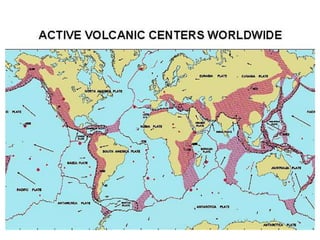
Distribution of Volcanoes
• Mainly found along mid-ocean ridges
e.g. Mid-Atlantic ridge- Iceland
• Near subduction zones
e.g. ‘Ring of Fire’- Nazca plate under South American plate
• Along rift valleys
e.g. African rift valley- Mt Kenya and Mt Kilamanjaro
• Over hot spots
e.g. Pacific ocean- Hawaiian islands
Effects of Volcanic Activity
Primary
• Lava flow – threat to farmland and infrastructure
• Tephra – solid material of varying size ejected into the atmosphere
• Pyroclastic flows – hot, gas-charged, high velocity flows of gas and tephra, respiratory problems
• Volcanic gases – mainly carbon dioxide, killed 1700 people in 1986 at Lake Nyos, Cameroon

Secondary
• Lahars – volcanic mud flows, e.g. Nevado del Ruiz in 1985
• Flooding – melting of ice caps and glaciers e.g. Grimsvotn, Iceland 1996
• Tsunamis – giant sea waves e.g. Krakatoa, 1883 killing 30,000 in Sumatra
• Volcanic landslides
• Climatic change – volcanic debris in the atmosphere reduces global temperatures
Hazard Management- Prediction
•   Swelling ground (rising magma)
•   Seismic activity (splitting rock)
•   Groundwater (gets hotter)
•   Emission of gases (from crater)
•   Magnetic fields (change)
•   Animal behaviour
Hazard Management - Protection
• Monitoring the volcano (leaves time for evacuation)

• Risk assessments (identifying those at greatest risk)

• Land use planning (avoid building in high-risk areas)

• Controlling lava flows             (trenches, walls, dynamite, pouring water on slow moving lava to set)


• Technical and financial aid (for LEDW)
LEDC Eruption -Montserrat
• Soufriere Hills, Montserrat, Caribbean
• Dormant for 400 years
• July 1995, started steaming and small ash explosions
• 1996, pyroclastic flows, southern population in danger,
  most had fled
• 1997, residents move back to south as volcano went
  through a quiet phase
• June 1997- exploded, large pyroclastic flows destroyed
  settlements (Plymouth, capital city) and killed 19
Montserrat Aftermath
• British dependency, UK government had to provide:
• Evacuation of 7000 inhabitants to Antigua/UK
• Resettlement of population from south to north of the
  island
• Constructing temporary shelters in north
• Re-establish air and sea links to Montserrat
• Building permanent housing
• Providing farming areas in north
• Moving the capital from Plymouth to Salem
• It cost the government £100million+ to minimise
  effects and introduce a 3-yeaer development plan
MEDC Eruption- Mt Etna
•   Northern Sicily
•   3310m tall and 460 miles long
•   Lies on destructive Eurasian and African plate boundary
•   Theories to its existence include hot spot over European plate and
    fractures in lithospheric slab
•   Densely populated lower slopes due to banana, fig and pistachio
    farming
•   Skiing, cafe and cable car bring tourism
•   Erupted in may 2008
•   Lava travelled 6km
•   200 earthquakes
•   Flank eruption (lava exposed on eastern side as opposed to crater)
•   Artificial channels dug and water cooling used to divert lava from
    villages
Etna Aftermath
•   Activity continued for 6 months
•    No deaths
•   Sulphur dioxide found 3000 miles away
•   Temporary closure of airport
•   Dip in tourism
•   Dip in economy (farmland ruined)
Benefits of Volcanoes
• Geothermal power - Iceland use this to heat greenhouses and
  this enables it to be self-sufficient in most food stuffs


• Volcanic soils – lava weathers to produce fertile soils rich in
  minerals. Farmers work at the low lopes of volcanoes such as Mt Etna,
  Sicily


• Volcanic rocks – they make good building materials also pumice

• Tourism – tourists are able to climb to the crater of mount Vesuvius
Earthquakes
•   An earthquake is oscillation of the earth’s crust
•   Measured on a Richter scale (logarithmic)
•   May also be measured on the Mercalli scale
•   Triggered mostly by plate boundaries moving but also
    by movement in fault lines, volcanic activity and
    human activity (e.g. Drilling)
•   Epicentre happens underground
•   Focus is where it impacts on the surface
•   Surface waves- Raleigh and Love
•   Body waves- primary and secondary
•   Easier to say ‘where’ than ‘when’
MEDC Earthquake
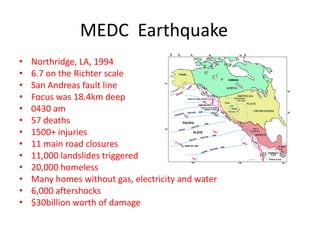
•   Northridge, LA, 1994
•   6.7 on the Richter scale
•   San Andreas fault line
•   Focus was 18.4km deep
•   0430 am
•   57 deaths
•   1500+ injuries
•   11 main road closures
•   11,000 landslides triggered
•   20,000 homeless
•   Many homes without gas, electricity and water
•   6,000 aftershocks
•   $30billion worth of damage
LEDC Earthquake
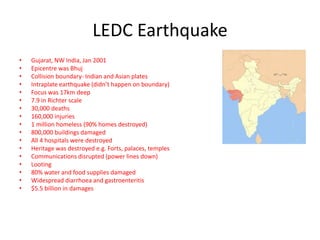
•   Gujarat, NW India, Jan 2001
•   Epicentre was Bhuj
•   Collision boundary- Indian and Asian plates
•   Intraplate earthquake (didn’t happen on boundary)
•   Focus was 17km deep
•   7.9 in Richter scale
•   30,000 deaths
•   160,000 injuries
•   1 million homeless (90% homes destroyed)
•   800,000 buildings damaged
•   All 4 hospitals were destroyed
•   Heritage was destroyed e.g. Forts, palaces, temples
•   Communications disrupted (power lines down)
•   Looting
•   80% water and food supplies damaged
•   Widespread diarrhoea and gastroenteritis
•   $5.5 billion in damages
Tsunami
• A tsunami is a large ocean wave which is
  caused by sudden motion on the ocean floor
• This is usually caused by an earthquake
• Pacific ocean accounts for 80% tsunamis
• Oceanic under continental plate
Boxing Day Tsunami
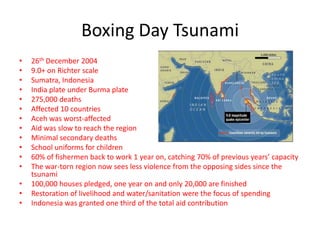
•   26th December 2004
•   9.0+ on Richter scale
•   Sumatra, Indonesia
•   India plate under Burma plate
•   275,000 deaths
•   Affected 10 countries
•   Aceh was worst-affected
•   Aid was slow to reach the region
•   Minimal secondary deaths
•   School uniforms for children
•   60% of fishermen back to work 1 year on, catching 70% of previous years’ capacity
•   The war-torn region now sees less violence from the opposing sides since the
    tsunami
•   100,000 houses pledged, one year on and only 20,000 are finished
•   Restoration of livelihood and water/sanitation were the focus of spending
•   Indonesia was granted one third of the total aid contribution
Multi hazard urban environment
                                  MANY HAZARDS HAVE INTERRELATIONSHIPS

•   Los Angeles
Earthquakes- lies on fault line
River flooding- increased interception as well as heavy winter storms
Coastal flooding- heavy winter storms cause waves to pound coast
Drought- high evapotranspiration and little rainfall
Wildfires- hot summers dry vegetation, and wind spreads fires more easily
Landslides/mudslides- fires remove vegetation, loosening ground
Smog- due to intense car use
Crime- highest in USA

•   Mexico City
Earthquakes- Cocos plate subducted under North American plate (last earthquake in 1985, 8.1 on Richter)
Smog- worst air quality in the world, old cars running in a small area
Sinking ground- sediments in old lake bed on which the city lies are contracting
Crime- increased by 80% in the 90’s, few crimes are solved

    Reasons for Mexico City linked to unconstrained growth, meaning many poorly-built structures are erected,
    only to easily fall down in an earthquake/landslide. 40% of people live in informal settlements there.
Additional Clarification
•   31: Oceanic Ridges
•   32: Sea floor spreading
•   33: Destructive boundaries (OC)
•   34: Destructive boundaries (OO)
•   35: Destructive boundaries (CC)
•   36: Fold mountains
Oceanic Ridges
• E.g. Mid Atlantic Ridge
• 1000km wide
• Result of sea-floor spreading
• 10-15mm/year
• Shallow-focus earthquakes due to transform
  faults which cause sideways slipping
• Volcanic activity occurs
• Forms submarine volcanoes (sometimes rise
  above sea-level, shield shape)
Sea Floor Spreading
•   Constructive plate margins
•   Space between diverging plates
•   Filled with basaltic lava
•   New crust continually being formed
•   Youngest part of Earth
•   Form mid oceanic ridges and rift valleys
•   E.g. Jordan- East Africa 5500km
Destructive plate margins
             oceanic-continental
•   Oceanic plate goes under continental (heavier)
•   Subduction
•   Ocean trench
•   Fold mountains
•   Oceanic plate melts in Benioff zone
•   Magma oozes up through plate and forms volcanoes
    (andesitic lava)
•   Island arc may occur here
•   Triggers earthquakes
•   e.g. Nazca vs. South American plates
•   Andes, Peru-Chile trench, Cotopaxi volcano and Ecuador
    earthquake of 1906 were formed this way
Destructive plate margins
             oceanic-oceanic
•   Ocean trenches
•   Subduction
•   Submarine volcanoes
•   Island arc
•   Earthquakes
•   E.g. Pacific vs. Philippine plate
•   Marianas trench, Island of Guam formed
Destructive plate margins
         continental-continental
• Little subduction due to low density
• Fold mountains as two masses push upwards
• Shallow focus earthquakes may be triggered
• E.g. Indo-Australian vs. Eurasian plate
• Sediments from the Sea of Tethys rose to form
  Himalayas
• India at risk of earthquakes, e.g. Gujarat, 2001
Fold Mountains
• Formed by Destructive plate margins (but not
  ocean-ocean)
• Have anticline and synclines (folded rocks)
• Volcanic areas (e.g. Andes)
• Huge areas of overfolds
• Uplifted central areas e.g. Altiplano, Andes
• Earthquakes
• Highly weathered and eroded features e.g.
  valleys, gorges, glaciers

Geography notes volcanoes, Earthquakes, AQA

  • 1.
    HAZARDS Combinationof natural and human processes. A hazard is an event with the potential to damage human activity.
  • 2.
    Structure of theEarth • Inner Core solid, iron and nickel • Outer Core molten, 5000 degrees • Mantle semi-solid, asthenosphere is upper mantle- 20km thick • Crust divided into plates, combined with asthenosphere is lithosphere, 80-90 km thick
  • 3.
    Plates • Plates are7 large pieces of the lithosphere • They float on asthenosphere and move through convection currents • Continental 30-70 km thick, light in colour (mainly granite), composed of SIAL (silicon, aluminium), lighter than oceanic, over 1500 million years old • Oceanic 6-10 km thick, dark (mainly basalt), SIMA (silicon magnesium), heavier than continental, younger than continental (200 million years old)
  • 4.
    Plate Tectonic Theory •Alfred Wegener, German • 1915 • Coastlines of South America and Africa- suggested continents were joined together • Originally one continent, Pangaea • Split into 3 super continents which were later fragmented • He could not prove why this happened, so theory was dismissed • Sea floor spreading in Mid Atlantic Ridge brought his theory back to light • Glacial deposits of similar ages in Brazil and West Africa • Geologically corresponding mountains in US (Appalachian) and NW Europe (incl. Scotland) • Fossil remains of the Mesosauraus (270 million years extinct) found in South Africa and Brazil • Fossilised plants in India and Antarctica • Palaeomagnetism shows periodically reversing magnetic fields (shown by sea floor spreading) • Earthquakes and Volcanic activity
  • 5.
    Magnetic Striping • Ironparticles in solidified lava align with Earth’s magnetic field • Polarity • Reversed regularly • You can tell how old lava is by looking at its polarity • Palaeomagnetism • Creates striped pattern • Ocean crust spreading away from plate boundary
  • 6.
    Destructive Boundaries • Andean-type subduction Oceanic beneath continental Deep sea trench Fold mountains Deep focus Earthquakes Steep-sided volcanoes Nazca under South American plate – Andes Mountains, Peru-Chile trench, Nevado del Ruiz volcano • Island Arcs Oceanic and oceanic crusts Steep-sided volcanoes formed Shallow sea trench Deep-focus earthquakes South American under Caribbean plate formed Caribbean Islands, Soufriere Hills, Marianas Islands • Continental collision boundaries Two continental crusts colliding Sediments between plates rise up to form fold mountains Deep focus earthquakes e.g. The Himalayas- Indo-Australian and Eurasian plates
  • 7.
    Constructive Boundaries • Oceanridges Sea floor spreading zones Two areas of oceanic crust pulled apart New ocean floor formed as lava fills gap Shield volcanoes Shallow focus earthquakes e.g. Mid-Atlantic Ridge, Eurasian and North American plates • Continental rifts Rift valleys Two areas of continental crust pulled apart e.g. East African rift valley Volcanoes are rare Shallow focus earthquakes
  • 8.
    Conservative Boundaries • Plates sliding parallel to each other • Friction and tension build • Shallow focus earthquakes • E.g. San Andreas Fault, California • Pacific vs. North American plates • Moving in same direction at different speeds • Pacific is faster (5-9cm/year) • Can cause transform faults
  • 9.
    Hot Spots • E.g.Hawaiian Islands • Hot Spot within pacific plate • Radioactive elements within mantle • Magma rises to surface in plumes, forming small shield volcanoes • Hot spots are rooted, but the movement of the pacific plate has caused Island Chains • Only the volcano above the hot spot is active- Mauna Loa • Pacific plate is moving in a NW direction
  • 10.
    Intrusive Volcanicity • It’swhat happens when the magma cools before it reaches the surface • Often exposed years later after erosion • Batholiths are an example of a bubble of solidified magma, often hundreds of kilometres in diameter • E.g. Dartmoor • Dykes radiate from batholiths
  • 11.
    Extrusive Volcanicity • Whenmagma reaches the surface • Formation depends on type of lava • Lava plateaux formed from fissure eruptions- flat landscapes due to basic lava • E.g. Antrim Plateau, NI • Volcanic forms e.g. Volcanoes, Geysers and Mud volcanoes
  • 12.
    Volcanic shapes • Shield-basic lava, short and wide e.g. Mauna Loa, Hawaii • Dome- viscous lava, tall and steep e.g. Puy district, France • Cinder cone e.g. Paricutin, Mexico • Composite cone- pyramid shape, layers of ash and lava e.g. Mt Etna, Sicily • Calderas- gas build up explodes and removes summit Krakatoa, Indonesia
  • 13.
    Volcanic Eruptions • Icelandic gently flowing basalt lava from a fissure • Hawaiian basalt lava flowing from a central vent • Vesuvian violent explosion after long inactivity • Kratatoan violent eruption destroying entire cone base leaving crater • Pelean violent eruption with pyroclastic flows • Plinean violent eruption where lava and pyroclastic materials ejected e.g. Lava bombs
  • 14.
    Distribution of Volcanoes •Mainly found along mid-ocean ridges e.g. Mid-Atlantic ridge- Iceland • Near subduction zones e.g. ‘Ring of Fire’- Nazca plate under South American plate • Along rift valleys e.g. African rift valley- Mt Kenya and Mt Kilamanjaro • Over hot spots e.g. Pacific ocean- Hawaiian islands
  • 16.
    Effects of VolcanicActivity Primary • Lava flow – threat to farmland and infrastructure • Tephra – solid material of varying size ejected into the atmosphere • Pyroclastic flows – hot, gas-charged, high velocity flows of gas and tephra, respiratory problems • Volcanic gases – mainly carbon dioxide, killed 1700 people in 1986 at Lake Nyos, Cameroon Secondary • Lahars – volcanic mud flows, e.g. Nevado del Ruiz in 1985 • Flooding – melting of ice caps and glaciers e.g. Grimsvotn, Iceland 1996 • Tsunamis – giant sea waves e.g. Krakatoa, 1883 killing 30,000 in Sumatra • Volcanic landslides • Climatic change – volcanic debris in the atmosphere reduces global temperatures
  • 17.
    Hazard Management- Prediction • Swelling ground (rising magma) • Seismic activity (splitting rock) • Groundwater (gets hotter) • Emission of gases (from crater) • Magnetic fields (change) • Animal behaviour
  • 18.
    Hazard Management -Protection • Monitoring the volcano (leaves time for evacuation) • Risk assessments (identifying those at greatest risk) • Land use planning (avoid building in high-risk areas) • Controlling lava flows (trenches, walls, dynamite, pouring water on slow moving lava to set) • Technical and financial aid (for LEDW)
  • 19.
    LEDC Eruption -Montserrat •Soufriere Hills, Montserrat, Caribbean • Dormant for 400 years • July 1995, started steaming and small ash explosions • 1996, pyroclastic flows, southern population in danger, most had fled • 1997, residents move back to south as volcano went through a quiet phase • June 1997- exploded, large pyroclastic flows destroyed settlements (Plymouth, capital city) and killed 19
  • 20.
    Montserrat Aftermath • Britishdependency, UK government had to provide: • Evacuation of 7000 inhabitants to Antigua/UK • Resettlement of population from south to north of the island • Constructing temporary shelters in north • Re-establish air and sea links to Montserrat • Building permanent housing • Providing farming areas in north • Moving the capital from Plymouth to Salem • It cost the government £100million+ to minimise effects and introduce a 3-yeaer development plan
  • 21.
    MEDC Eruption- MtEtna • Northern Sicily • 3310m tall and 460 miles long • Lies on destructive Eurasian and African plate boundary • Theories to its existence include hot spot over European plate and fractures in lithospheric slab • Densely populated lower slopes due to banana, fig and pistachio farming • Skiing, cafe and cable car bring tourism • Erupted in may 2008 • Lava travelled 6km • 200 earthquakes • Flank eruption (lava exposed on eastern side as opposed to crater) • Artificial channels dug and water cooling used to divert lava from villages
  • 22.
    Etna Aftermath • Activity continued for 6 months • No deaths • Sulphur dioxide found 3000 miles away • Temporary closure of airport • Dip in tourism • Dip in economy (farmland ruined)
  • 23.
    Benefits of Volcanoes •Geothermal power - Iceland use this to heat greenhouses and this enables it to be self-sufficient in most food stuffs • Volcanic soils – lava weathers to produce fertile soils rich in minerals. Farmers work at the low lopes of volcanoes such as Mt Etna, Sicily • Volcanic rocks – they make good building materials also pumice • Tourism – tourists are able to climb to the crater of mount Vesuvius
  • 24.
    Earthquakes • An earthquake is oscillation of the earth’s crust • Measured on a Richter scale (logarithmic) • May also be measured on the Mercalli scale • Triggered mostly by plate boundaries moving but also by movement in fault lines, volcanic activity and human activity (e.g. Drilling) • Epicentre happens underground • Focus is where it impacts on the surface • Surface waves- Raleigh and Love • Body waves- primary and secondary • Easier to say ‘where’ than ‘when’
  • 25.
    MEDC Earthquake • Northridge, LA, 1994 • 6.7 on the Richter scale • San Andreas fault line • Focus was 18.4km deep • 0430 am • 57 deaths • 1500+ injuries • 11 main road closures • 11,000 landslides triggered • 20,000 homeless • Many homes without gas, electricity and water • 6,000 aftershocks • $30billion worth of damage
  • 26.
    LEDC Earthquake • Gujarat, NW India, Jan 2001 • Epicentre was Bhuj • Collision boundary- Indian and Asian plates • Intraplate earthquake (didn’t happen on boundary) • Focus was 17km deep • 7.9 in Richter scale • 30,000 deaths • 160,000 injuries • 1 million homeless (90% homes destroyed) • 800,000 buildings damaged • All 4 hospitals were destroyed • Heritage was destroyed e.g. Forts, palaces, temples • Communications disrupted (power lines down) • Looting • 80% water and food supplies damaged • Widespread diarrhoea and gastroenteritis • $5.5 billion in damages
  • 27.
    Tsunami • A tsunamiis a large ocean wave which is caused by sudden motion on the ocean floor • This is usually caused by an earthquake • Pacific ocean accounts for 80% tsunamis • Oceanic under continental plate
  • 28.
    Boxing Day Tsunami • 26th December 2004 • 9.0+ on Richter scale • Sumatra, Indonesia • India plate under Burma plate • 275,000 deaths • Affected 10 countries • Aceh was worst-affected • Aid was slow to reach the region • Minimal secondary deaths • School uniforms for children • 60% of fishermen back to work 1 year on, catching 70% of previous years’ capacity • The war-torn region now sees less violence from the opposing sides since the tsunami • 100,000 houses pledged, one year on and only 20,000 are finished • Restoration of livelihood and water/sanitation were the focus of spending • Indonesia was granted one third of the total aid contribution
  • 29.
    Multi hazard urbanenvironment MANY HAZARDS HAVE INTERRELATIONSHIPS • Los Angeles Earthquakes- lies on fault line River flooding- increased interception as well as heavy winter storms Coastal flooding- heavy winter storms cause waves to pound coast Drought- high evapotranspiration and little rainfall Wildfires- hot summers dry vegetation, and wind spreads fires more easily Landslides/mudslides- fires remove vegetation, loosening ground Smog- due to intense car use Crime- highest in USA • Mexico City Earthquakes- Cocos plate subducted under North American plate (last earthquake in 1985, 8.1 on Richter) Smog- worst air quality in the world, old cars running in a small area Sinking ground- sediments in old lake bed on which the city lies are contracting Crime- increased by 80% in the 90’s, few crimes are solved Reasons for Mexico City linked to unconstrained growth, meaning many poorly-built structures are erected, only to easily fall down in an earthquake/landslide. 40% of people live in informal settlements there.
  • 30.
    Additional Clarification • 31: Oceanic Ridges • 32: Sea floor spreading • 33: Destructive boundaries (OC) • 34: Destructive boundaries (OO) • 35: Destructive boundaries (CC) • 36: Fold mountains
  • 31.
    Oceanic Ridges • E.g.Mid Atlantic Ridge • 1000km wide • Result of sea-floor spreading • 10-15mm/year • Shallow-focus earthquakes due to transform faults which cause sideways slipping • Volcanic activity occurs • Forms submarine volcanoes (sometimes rise above sea-level, shield shape)
  • 32.
    Sea Floor Spreading • Constructive plate margins • Space between diverging plates • Filled with basaltic lava • New crust continually being formed • Youngest part of Earth • Form mid oceanic ridges and rift valleys • E.g. Jordan- East Africa 5500km
  • 33.
    Destructive plate margins oceanic-continental • Oceanic plate goes under continental (heavier) • Subduction • Ocean trench • Fold mountains • Oceanic plate melts in Benioff zone • Magma oozes up through plate and forms volcanoes (andesitic lava) • Island arc may occur here • Triggers earthquakes • e.g. Nazca vs. South American plates • Andes, Peru-Chile trench, Cotopaxi volcano and Ecuador earthquake of 1906 were formed this way
  • 34.
    Destructive plate margins oceanic-oceanic • Ocean trenches • Subduction • Submarine volcanoes • Island arc • Earthquakes • E.g. Pacific vs. Philippine plate • Marianas trench, Island of Guam formed
  • 35.
    Destructive plate margins continental-continental • Little subduction due to low density • Fold mountains as two masses push upwards • Shallow focus earthquakes may be triggered • E.g. Indo-Australian vs. Eurasian plate • Sediments from the Sea of Tethys rose to form Himalayas • India at risk of earthquakes, e.g. Gujarat, 2001
  • 36.
    Fold Mountains • Formedby Destructive plate margins (but not ocean-ocean) • Have anticline and synclines (folded rocks) • Volcanic areas (e.g. Andes) • Huge areas of overfolds • Uplifted central areas e.g. Altiplano, Andes • Earthquakes • Highly weathered and eroded features e.g. valleys, gorges, glaciers