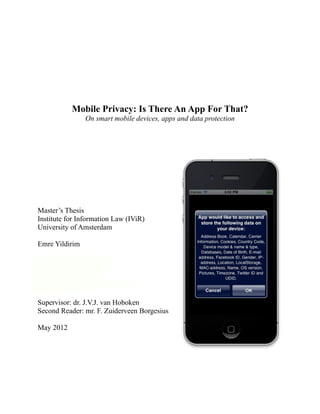
Mobile Privacy: Is There An App For That?
                On smart mobile devices, apps and data protection


Master’s Thesis
Institute for Information Law (IViR)
University of Amsterdam

Emre Yildirim

2e van Swindenstraat 58
1093 VV Amsterdam
T 06 15 699 519
E v.e.yildirim@gmail.com

Supervisor: dr. J.V.J. van Hoboken
Second Reader: mr. F. Zuiderveen Borgesius

May 2012
Master’s Thesis, Institute for Information Law, University of Amsterdam, Emre Yildirim


Table of Contents


  List of Abbreviations!                                                                       4

  Introduction!                                                                                5

  1. Smart Mobile Devices !                                                                    7
    1.1 Manufacturers!                                                                          7

    1.2 Application Catalogs!                                                                   9

    1.3 Software Development Kits!                                                             10

    1.4 Payment Models!                                                                        11

    1.5 Analytics & Advertisement!                                                             12

    1.6 EULAs & Privacy Policies!                                                              13

    1.7 Conclusion!                                                                            16

  2. Data!                                                                                     17
    2.1 Access!                                                                                17

    2.2 Available Data!                                                                        20

    2.3 Methodology!                                                                           30

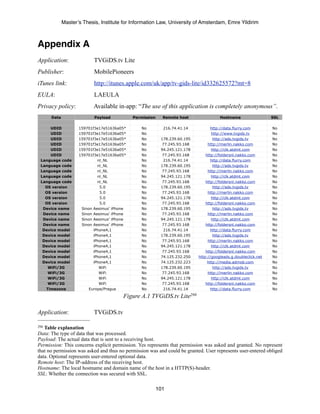
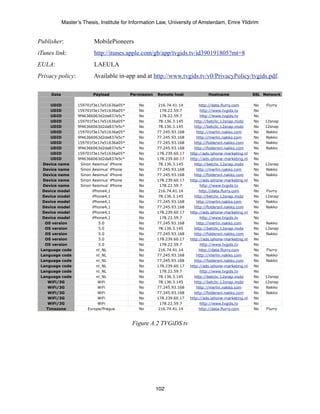
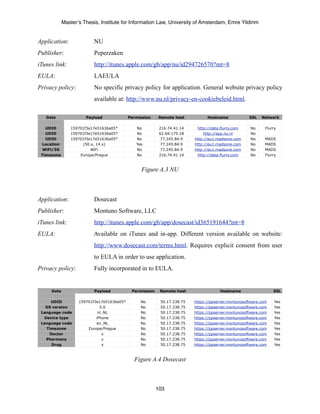
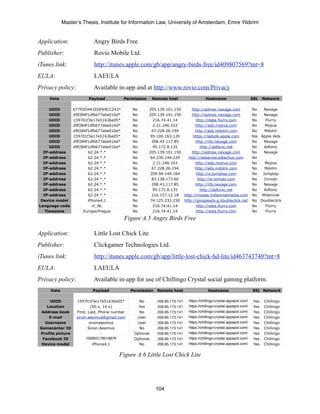
    2.4 Results!                                                                               32

    2.5 Summary!                                                                               35

    2.6 Conclusion!                                                                            38

  3. Applicable Laws and Jurisdiction!                                                         39
    3.1 Applicability of the Data Protection Directive!                                        40

    3.2 Jurisdiction and the Data Protection Directive!                                        49

    3.3 Applicability of the e-Privacy Directive!                                              54

    3.4 Conclusion!                                                                            59


                                                2
Master’s Thesis, Institute for Information Law, University of Amsterdam, Emre Yildirim


4. Analysis!                                                                                  61
   4.1 Data Protection Directive!                                                             61

          4.1.1 Legitimate grounds!                                                           62

                  4.1.1.1 Consent!                                                            63

                  4.1.1.2 Contract!                                                           71

                  4.1.1.3 Legitimate Interest!                                                73

          4.1.2 Proportionality!                                                              75

          4.1.3 Legitimacy and purpose limitation!                                            79

          4.1.4 Transparency!                                                                 81

   4.2 e-Privacy Directive!                                                                   87

          4.2.1 Prior Informed Consent!                                                       87

5. Conclusion!                                                                                92

Literature list!                                                                              98

Appendix A!                                                                                  101


                                              3
Master’s Thesis, Institute for Information Law, University of Amsterdam, Emre Yildirim


List of Abbreviations

ADID                           Application Device Identifier
API                            Application Programming Interface
CDMA                           Code Division Multiple Access
EULA                           End User License Agreement
HTTP                           HyperText Transfer Protocol
HTTPS                          HyperText Transfer Protocol Secure
LAEULA                         Licensed Application End User License Agreement
IP(-address)                   Internet Protocol (address)
MAC(-address)                  Media Access Control (address)
(M)OS                          (Mobile) Operating System
SDK                            Software Development Kit
SMD                            Smart Mobile Device
SSL                            Secure Sockets Layer
UDID                           Unique Device Identifier
UMTS                           Universal Mobile Telecommunications System


                                                   4
Master’s Thesis, Institute for Information Law, University of Amsterdam, Emre Yildirim


Introduction
Snap a photo with your camera. Geotag its location using GPS. Apply a funky retro filter using
your favorite photo editing application. Simultaneously share it with your friends by e-mail,
Twitter and Facebook. The capabilities of smartphones and tablets are endless. Smart mobile
devices are more popular than ever now, and are part of everyday life of their users; we bring
them everywhere we go.1 Their communication and connectivity capabilities ensure that we are
always connected to the outside world.
        An important shared feature of smart mobile devices (‘SMDs’) is the ability to purchase,
download and install applications (‘apps’) that are available in application catalogs. Application
catalogs are immensely popular as they give users the ability to enhance and enrich their device
according to their personal needs, by downloading apps of their interest. The majority of these
apps are developed by third parties. 2
        The fact that smart mobile devices are personal and intensively used, ensures that they
hold a lot of data; this results in a goldmine of (personal) data that can be of interest to third
parties. As smart mobile devices have become more popular and widespread, various privacy
concerns have been raised. Several studies regarding apps showed that personal data was widely
processed.3 Diverse (class action) lawsuits have already been filed around the world for
unauthorized processing of personal data by apps. Users are concerned: according to a research
published by the GSM Association, 92% of the respondents expressed their concern about apps
collecting ‘personal information’ without their consent.4 During the course of writing this thesis,
mobile privacy was frequently in the spotlights on several occasions: new privacy issues were
reported, while at the same time various initiatives to enhance mobile user privacy were
launched. It is expected that mobile privacy will receive a greater focus in the future. Several


1 The term smart mobile devices in this thesis refers to smartphones and tablets.
2 Apps that are developed by third parties, as opposed to apps that are developed by the manufacturer of the mobile
operating system or the operator of the application catalog, are referred to as ‘third-party apps’.
3 For example, The Wall Street Journal, ‘Your Apps Are Watching You’, 17 December 2010, available at <http://

online.wsj.com/article/SB10001424052748704694004576020083703574602.html?mod=WSJ_hps_sections_tech>.
4 Future Sight, ‘User perspectives on mobile privacy’, prepared for the GSMA, September 2011, available at <http://

www.gsma.com/publicpolicy/user-perspectives-on-mobile-privacy-september-2011/>. An infographic of the
research is available at: <http://serving.webgen.gsm.org/5926DA9A-2DD6-48E7-BAD4-50D4CD3AF30A/assets/
privacyinfographicsposterfinal.pdf>.

                                                        5
Master’s Thesis, Institute for Information Law, University of Amsterdam, Emre Yildirim


bodies involved in data protection in Europe have already made mobile privacy a focus of their
work program for 2012.5
        Mobile privacy has been described as terra incognita.6 The source of the privacy
concerns is twofold; firstly because apps can access a lot of personal data available on smart
mobile devices, secondly because the processing of personal data by apps is not always
transparent to users.
        The goal of this thesis is to research to what extent third-party apps for smart mobile
devices have to comply with relevant EU legislation concerning the processing of personal data.
        To be able to answer this question, first the world of smart mobile devices, catalogs and
apps is explored in chapter one, to get a overview of the involved stakeholders. Second, a
technical sidestep will be taken in chapter two. This will demonstrate what kind of data are
available on smart mobile devices, to what extent developers of apps can access them with or
without permission of users, and how these are processed by apps. Chapter three will deal with
applicable laws and discusses their substantive scope and jurisdiction. Chapter four will finally
form a legal analysis of the applicable laws with respect to apps. The focus in these last two
chapters is set on Directives 95/46/EC and 2002/58/EC of the European Union.7 Where relevant,
the results from chapter two will be evaluated from a legal point of view, in chapters three and
four.
        Due to the scope of the thesis, two topics will only be discussed briefly. These topics are
behavioral advertising in general and the specific roles of analytics and advertising companies as
data processors and/or data controllers, and the discussion about whether article 5 section 3 of
Directive 2002/58/EC enforces an opt-in or opt-out regime.


5 See CNIL, ‘Quel programme des contrôles pour 2012?’, 19 April 2012, available at <http://www.cnil.fr/la-cnil/
actualite/article/article/quel-programme-des-controles-pour-2012/> and The Article 29 Working Party, ‘Work
Programme 2012 - 2013’, 1 February 2012, p. 2.
6 PC World, ‘Mobile Data Privacy Is Terra Incognita to Users and Developers’, 24 February 2012, available at

<https://www.pcworld.com/article/250619/mobile_data_privacy_is_terra_incognita_to_users_and_developers.html>
7 Directive 95/46/EC of the European Parliament and of the Council of 24 October 1995 on the protection of

individuals with regard to the processing of personal data and on the free movement of such data.
Directive 2002/58/EC of the European Parliament and of the Council of 12 July 2002 concerning the processing of
personal data and the protection of privacy in the electronic communications sector.

                                                      6
Master’s Thesis, Institute for Information Law, University of Amsterdam, Emre Yildirim


1. Smart Mobile Devices

Smartphones and tablet computers are like Swiss Army knives. They combine various functions
into a single device: they are digital cameras, portable media players, GPS navigation units,
gaming consoles and are connected to the internet via Wi-Fi or Wireless Wide Area Network
(e.g. UMTS, CDMA). Smart mobile devices are popular. The adaptation of smart mobile devices
is rising. Research by Nielsen shows that by January 2012, the penetration of smartphones was
50.4% in the United States.8 In the Netherlands the penetration has reached 51% according to
research by Telecompaper, and it is expected that this figure will continue to grow.9
            In this chapter a brief overview will be given of smart mobile devices to get a better
understanding of their operation and the involved stakeholders. This will include devices and
mobile operating systems, along with the functioning of application catalogs and their
relationship with Software Development Kits. Furthermore payment models and their connection
with analytics and advertising companies will be discussed. Finally a closer look will be taken at
the triangular relationship between users, publishers of apps and operators of application
catalogs, by examining how End User License Agreements and privacy policies are implemented
in catalogs and apps.10


1.1 Manufacturers
Although the smart mobile devices market consists of multiple players, it is currently being
dominated by Apple and Google.11 Other players on the market are, inter alia, Research in
Motion with its Blackberry devices and Microsoft with its Windows Phone 7 mobile operating
system.


8 Nielsen, ‘State of the Appnation – A Year of Change and Growth in U.S. Smartphones’, 16 May 2012, available at:
<http://blog.nielsen.com/nielsenwire/?p=31891>
9    Telecompaper, ‘Smartphone growth tapers off in NL’, 18 November 2011, available at: <http://
www.telecompaper.com/news/smartphone-growth-tapers-off-in-nl-telecompaper>.
10 The phrase ‘user’ in this thesis can - depending on the context in which it is used - refer to either a user of a smart

mobile device and/or application, a data subject in the sense of the Data Protection Directive, or user in the sense of
the e-Privacy Directive.
11 According to research by comScore, the mobile operating systems of Apple and Google have a 80% market share

in the United States, see comScore, ‘comScore Reports February 2012 U.S. Mobile Subscriber Market Share’, 3
A p r i l 2 0 1 2 , a v a i l a b l e a t : < h t t p : / / w w w. c o m s c o r e . c o m / P r e s s _ E v e n t s / P r e s s _ R e l e a s e s / 2 0 1 2 / 4 /
comScore_Reports_February_2012_U.S._Mobile_Subscriber_Market_Share>.

                                                                                7
Master’s Thesis, Institute for Information Law, University of Amsterdam, Emre Yildirim


        The current line-up of Apple’s SMDs consists of the iPhone smartphone, the iPad tablet
and its iPod touch portable media player.12 All of these SMDs run on the same mobile operating
system (‘iOS’) developed by Apple, and share similar features.13 The fifth and latest version of
its iOS mobile operating system, dubbed iOS 5, was introduced by Apple on 12 October 2011.
        A unique selling point of Apple’s iOS devices (‘iDevice’) is the system created around it.
iOS is closely integrated with Apple’s iTunes software, that includes the iTunes Store. The
iTunes Store and App Store, also available on iDevices as apps, lets users download music,
movies, television shows, books and apps to their iDevices. The iTunes software can furthermore
be used by users to manage their device (e.g. data syncing), or to update their device to the latest
available iOS version.14 Updates to iOS are pushed to all devices, which makes it a uniform
experience for their users.15 Whether users are on their iPhone or iPad, they have a similar
experience across all devices that is complemented by the fact that they can sync their apps
across multiple iDevices.
        According to the latest figures announced by Apple on 4 October 2011, over 315 million
iDevices (iPhones, iPads and iPod touches) have been sold worldwide. 16
        Although Google did release three smartphones to date in cooperation with other
manufacturers, its core business is not manufacturing SMDs. Instead, Google develops a mobile
operating system for use by other manufacturers: Android OS.17 The open source nature of
Android makes it possible for manufacturers to adapt Android for use on their SMDs.18 Among


12 For specifications and capabilities of the Apple’s devices see the descriptions on the following product pages:
Apple iPhone <https://www.apple.com/iphone/>, Apple iPad <https://www.apple.com/ipad/> and Apple iPod touch
<https://www.apple.com/ipodtouch/>.
13 Although they run on the same mobile operating system, each device gets a specific version due to differences in

connectivity between the devices. The iPod touch and iPad for example lack phone functionality.
14 With the introduction of iOS 5, Apple is also providing over-the-air updates to their iOS devices. Users are

therefore not any longer tied to the iTunes desktop software to update their devices.
15 Older generation devices however are eventually cut off by Apple from any further updates.
16 Apple Press Info ‘Apple’s App Store Downloads Top 25 Billion’, 5 March 2012, available at <https://

www.apple.com/pr/library/2012/03/05Apples-App-Store-Downloads-Top-25-Billion.html>.
17 The Nexus One was Google’s first flagship smartphone build in cooperation with the Taiwanese manufacturer

HTC, while the Nexus S and Galaxy Nexus were build in cooperation with the Korean manufacturer Samsung.
Google typically introduces a new flagship smartphone with major releases of its Android OS.
18 The Android OS source code is available under the GNU General Public License version 2 and the Apache

License version 2. See <http://source.android.com/source/licenses.html>.

                                                        8
Master’s Thesis, Institute for Information Law, University of Amsterdam, Emre Yildirim


the manufacturers who use the Android OS for their SMDs are HTC, LG, Motorola, Samsung
and Sony Ericsson.19
        The Android OS is integrated with Google’s services, and offers similar features as
Apple’s iOS. Users can purchase apps and music in Google Play - formerly known as the
Android Market.20 Unlike Apple’s iOS however, updates to Android devices are generally not
centrally distributed. They are instead made available at the discretion of the manufacturer of an
Android device. This leads to fragmentation of the platform, because users can not always update
to the latest available version of Android OS. 21
        According to the latest official figures announced by Google, more than 300 million
Android devices have been activated. 22


1.2 Application Catalogs
Smart mobile devices utilize an application catalog where users can browse, purchase and
download apps on their devices. The application catalog offered by Apple is called the App
Store, and Google’s the Android Market. 23
        The App Store and Android Market are accessible as an on-device app. On personal
computers they are respectively available within the iTunes software, or the Android Market
website.24 The ability of users to customize their device with apps that are of their interest,
created a huge boost in the popularity of application catalogs and apps. When Apple’s App Store
was initiated in 2008, there were merely 500 third-party apps available. Today the App Store has
more than 585.000 apps available, with over 25 billion downloads to date and a continued one


19    A list of all Android OS SMD manufacturers is available at: <https://en.wikipedia.org/wiki/
List_of_Android_devices>.
20 In March Google rebranded its services for downloading media, including the Android Market, to Google Play. In

the course of this thesis - for the sake of clarity - Google Play, and in particular Google Play’s Android Apps, will
still be referred to as the Android Market. See Google, ‘Introducing Google Play: All your entertainment, anywhere
you go’, 6 March 2012, available at <http://googlemobile.blogspot.com/2012/03/introducing-google-play-all-
your.html>.
21 For a brief overview of Android fragmentation see Techcrunch, ‘Charted: Android fragmentation’, 27 October

2011, available at <http://techcrunch.com/2011/10/27/charted-android-fragmentation/>.
22 Google Mobile Blog, ‘Android@Mobile World Congress: It’s all about the ecosystem’, 27 February 2012,

available at: <http://googlemobile.blogspot.com/2012/02/androidmobile-world-congress-its-all.html>.
23 Other examples of catalogs are Blackberry App World by Research in Motion, Windows Phone Marketplace by

Windows, Ovi Store by Nokia, Palm App Catalog by Palm. Third party catalogs are also available for the Android
OS, an example of this is the Amazon Appstore.
24 Android Market, available at: <https://market.android.com>.


                                                         9
Master’s Thesis, Institute for Information Law, University of Amsterdam, Emre Yildirim


billion downloads per month.25 The Android Market has more than 500.000 apps available, with
over one billion downloads per month.26
          Apple’s 2009 iPhone commercial called “There’s an App For That” comes pretty close to
reality regarding the variety of apps.27 You can find apps that will help you cook the perfect soft
boiled egg or record what you are talking about during your sleep. The possibilities are almost
endless. Apps range from social networking to health, and comprises of 21 different categories.
          The large amount of available apps can be explained by the ability of third-party
publishers and developers to create apps (‘third-party apps’) with a Software Development Kit.28
The popularity of apps and the anticipation of great profits have lured many publishers to create
apps.29


1.3 Software Development Kits
Native apps for iOS and Android are respectively developed with the iOS and Android SDK.30
Both SDKs are freely available, although publishing developed apps in the application catalogs
requires registration.31
          A SDK combined with an Integrated Development Environment (‘IDE’) allows
developers to program and design every aspect of their app: from the design of the graphical user
interface, to the incorporation of available data on the SMD. It also allows them to closely
integrate specific features of a SMD - such as the camera, microphone or GPS - in to their apps.
Finally, they can also request data from the device, such as the address book, technical details or
calendars.

25 Apple Press Info, ‘Apple Launches New iPad’, 7 March 2012, available at <https://www.apple.com/pr/library/
2012/03/07Apple-Launches-New-iPad.html> and ‘Apple’s App Store Downloads Top 25 Billion’, 5 March 2012,
<https://www.apple.com/pr/library/2012/03/05Apples-App-Store-Downloads-Top-25-Billion.html>.
26 Google Mobile Blog, ‘Galaxy Nexus now on sale in Google Play’, 24 April 2012, available at: <http://

googlemobile.blogspot.com/2012/04/galaxy-nexus-now-on-sale-in-google-play.html>.
27 Apple commercial, ‘There’s An App For That’, 2009, available at: <http://youtu.be/szrsfeyLzyg>.
28 The phrases ‘developer’ is interchangeable with ‘publisher’ throughout this thesis. The phrase developer is

preferred over publisher when discussing technical aspects of apps.
29 In this thesis the phrase ‘developers’ is used in the context of technical implementations of an app. Where legal

obligations and rights are concerned, the phrase ‘publisher’ is used.
30 Contrary to web applications that run in the web browser, native applications are installed and run directly in the

mobile operating system. This allows them to integrate and interact with the mobile operating system and they thus
have far greater possibilities in comparison with web applications.
31 The App Store and Android Market require developers to sign up for respectively the ‘iOS Developer Program’

and a ‘Developer profile‘ in order to be able to publish applications. See <https://developer.apple.com/programs/ios/
> and <https://market.android.com/publish/signup>.

                                                         10
Master’s Thesis, Institute for Information Law, University of Amsterdam, Emre Yildirim


           Developers however do not have access to all data on SMDs. Due to the sensitive nature
of some data, access can be denied, restricted or require prior permission from users. Data that is
available on SMDs and retrievable by SDKs, will be discussed in depth in chapter two.


1.4 Payment Models
Four models of payment can be found in application catalogs: the (1) free, (2) free and in-app
purchase, (3) paid and (4) subscription.32
           The free payment model (1) is self-evident. There can be multiple reasons for publishers
to choose this model. A publisher can generate revenue from in-app advertisement, make the app
popular to follow up with a paid version, introduce a light version of the paid app with limited
functions or simply be generous.
           Similar to the free payment model is the free and in-app purchase model (2), that is also
known as the ‘freemium’ model. The difference with the former is that users can purchase
‘upgrades’ from within the app. Upgrades can consist, inter alia, of an upgrade to a full version
of the app, removing in-app advertisement or purchasing downloadable content.
           The paid payment model (3) is self-explanatory. Publishers can choose the pricing of
their apps as they wish.
           The subscription model (4) lets users subscribe to apps for a certain length of time for a
price that is set by the publisher. Like the freemium model, these purchases can be made from
within the app.
           Application catalogs typically share a certain percentage of revenue between the
publisher of an app and the provider of the catalog, or other involved parties. In case of the App
Store and the Android Market, publishers of apps receive 70% of the revenue that their app
generates. The fact that application catalogs are a lucrative business for publishers can be
demonstrated by the amount of money that is in the business: Apple alone has already paid out
US$ three billion to publishers.33
           There is a clear relationship between apps that adopt the free and freemium payment
models and mobile advertising companies, because it is an easy way for publishers to monetize


32   The availability of a certain payment model depends on the application catalog.
33 Apple   Special Event, 4 October 2011, available at: <http://www.apple.com/apple-events/october-2011/>.

                                                         11
Master’s Thesis, Institute for Information Law, University of Amsterdam, Emre Yildirim


their apps. A study of apps in the Android Market (n = 250.000), showed that %73 of the apps
were free.34 A sample of 50 apps from those free apps showed that 77% was supported by
advertising.35 Free apps generally generate more users, which leads to higher profits of
publishers through advertising. The trade-off for users is that they can download apps without
cost, in return for in-app advertisements and possibly the collection of data by advertising
companies. Some apps also offer the option to remove advertisement by an in-app purchase, or to
install the paid version of the app which does not feature advertisement.


1.5 Analytics & Advertisement
Analytics and advertising companies are surging on SMDs. Imagine an advertisement campaign
aimed at adult males that are between the ages of 25 and 30, who have a love for cooking and
reside in Rome. Mobile advertising companies can make that happen with behavioral targeting.
        All the data they need are available on, or can be retrieved with, SMDs. Personal details
can be retrieved from user profiles required by an app (if they are subsequently shared with the
advertisement company, which is a possibility that various advertisement SDKs offer), while the
location of users can be precisely or coarsely retrieved using GPS, or Wi-Fi and GSM
triangulation.36 The interests of users can be inferred by tracking the kinds of apps that they have
installed on their SMDs, with the help of unique identifiers.
        Advertising companies often make their own SDKs available, that developers can easily
integrate in to their apps. One line of code incorporated in an app can be enough to display in-
app advertisements. Publishers typically get paid by traditional web advertisement compensation
methods like cost-per-click and effective-cost-per-mille, alongside new methods like pay-per-
install (of an app).
        No matter what payment model a publisher adopts, analytics are key to understanding
customer behavior. Mobile analytics companies allow publishers to track what their users are
doing, with an easily integrated SDK. The analytics SDK takes care of tracking users, also across


34Leontiadis et. al. 2012, p. 2.
35Idem.
36 Advertisement company Mobclix for example offers developers that use their SDK the option to share

information about a users ethnicity and religion alongside marital status and education. The SDK is available at:
https://developer.mobclix.com/auth/register (sign-up required).

                                                       12
Master’s Thesis, Institute for Information Law, University of Amsterdam, Emre Yildirim


apps, with the use of unique identifiers. The tracking of users could also be used to build profiles
of users. The level of tracking is detailed: the amount of users (total, new, active) by country,
sessions and frequency of app usage, specific events (e.g. user took a photo, user pressed invite
button) and the popularity of device models and carriers.
        Advertising and analytics companies run on (personal) data. Most advertisement and
analytics SDKs have a standard set of data that is collected, which is not alterable by a
developer.37 The SDKs often provide optional methods for developers to send more information
about users. Some analytics and advertising companies oblige publishers to inform users about
their use of analytics and advertisement services. There are several identifiers available that
analytics and advertising companies use to track users. These will be discussed in depth in the
following chapter.


1.6 EULAs & Privacy Policies
With the use of application catalogs, several legal questions come to mind regarding the legal
relationship between users, operators of application catalogs and publishers of third-party apps
(‘publishers’). Are operators of application catalogs responsible for third-party apps? Are
publishers obliged to provide an End User License Agreement (‘EULA’) or a privacy policy if
they process personal data? A clear overview of the legal relationships between them can help
understanding the duties and the responsibilities they carry.


Android Market
The Android Market Terms of Service governs the use of the Android Market, and forms a legal
agreement between Google and a user.38 Regarding liability, Google explicitly exonerates itself
from liability for apps in the Android Market that do not originate from Google.39 As such,
Google deems itself not responsible for third-party apps that are available in the Android Market.


37 The inspection of various SDKs of analytics and advertising companies shows that developers can not change
what data is collected by default. The provided SDKs are pre-set, and sometimes closed sourced in the form of static
libraries. Customization is only available to the developer to supply more information about a user, or to incorporate
the visual aspects of advertisements. See the Getting Started guide to the SDK of Flurry analytics for an example of
this practice: <http://support.flurry.com/index.php?title=Analytics/GettingStarted>.
38 Android Market Terms of Service, available at <http://www.google.com/mobile/android/market-tos.html>.
39 Article 1.2 Android Market Terms of Service.


                                                         13
Master’s Thesis, Institute for Information Law, University of Amsterdam, Emre Yildirim


        The nature of the relationship between publishers and users is not explicitly stipulated in
the Android Market Terms of Service. However, the Android Market Developer Distribution
Agreement does force publishers to give users a standard non-exclusive, worldwide and
perpetual license to use their app. 40 This license to use however does not cover any other topics.
        Although publishers are not obliged by Google to provide their own EULA, they can do
so to substitute the above mentioned standard license. This EULA can be used to stipulate the
publisher’s and user’s obligations and rights. Google does recommend publishers to include an
EULA within their app, but does not provide a designated area in the Android Market to do so.41
The only way publishers can provide their users with an EULA, is by providing a link in their
app description, or by making the EULA available within their app.42 There is no mechanism in
place that allows users to accept or decline EULAs before installing an app on their device.
        Regarding privacy, Google obliges publishers to protect the privacy of their users. 43 If an
app processes personal data, and it is governed by the standard license of use, users have to be
notified of the processing, and a ‘legally adequate’ privacy notice has to be provided by the
publisher. If an app provides an individual EULA that covers the processing of personal data, the
processing is governed by that EULA.


App Store
The App Store Terms and Conditions governs the use of the App Store, and forms a legal
agreement between Apple’s subsidiary iTunes s.a.r.l. and users.44 The App Store, according to its
terms and conditions, sells ‘licenses’ to use apps. The Licensed Application End User License


40  Article 5.4 Android Market Developer Distribution Agreement, available at <http://www.android.com/uk/
developer-distribution-agreement.html>.
41 See Android Market Developers Guide, ‘Preparing for release’, available at <http://developer.android.com/guide/

publishing/preparing.html>.
42   For an example of this use, see games by Electronic Arts <https://play.google.com/store/apps/details?
i d = c o m . e a m o b i l e . t e t r i s _ e u & f e a t u r e = m o r e _ f r o m _ d e v e l o p e r # ?
t=W251bGwsMSwxLDEwMiwiY29tLmVhbW9iaWxlLnRldHJpc19ldSJd>
43 Article 4.3 Android Market Developer Distribution Agreement.
44 App Store Terms and Conditions, available at <https://www.apple.com/legal/itunes/uk/terms.html#APPS>. The

App Store Terms and Conditions for the United Kingdom are used for demonstration purposes. iTunes s.a.r.l.
(Luxembourg) is a subsidiary of Apple and is the data controller for European users of iTunes.

                                                       14
Master’s Thesis, Institute for Information Law, University of Amsterdam, Emre Yildirim


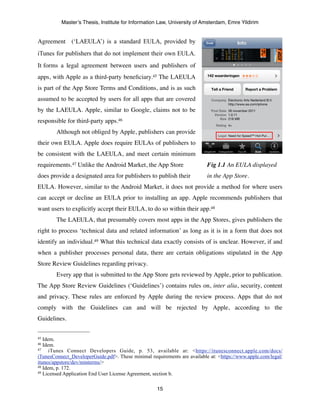
Agreement (‘LAEULA’) is a standard EULA, provided by
iTunes for publishers that do not implement their own EULA.
It forms a legal agreement between users and publishers of
apps, with Apple as a third-party beneficiary.45 The LAEULA
is part of the App Store Terms and Conditions, and is as such
assumed to be accepted by users for all apps that are covered
by the LAEULA. Apple, similar to Google, claims not to be
responsible for third-party apps.46
	

     Although not obliged by Apple, publishers can provide
their own EULA. Apple does require EULAs of publishers to
be consistent with the LAEULA, and meet certain minimum
requirements.47 Unlike the Android Market, the App Store 	


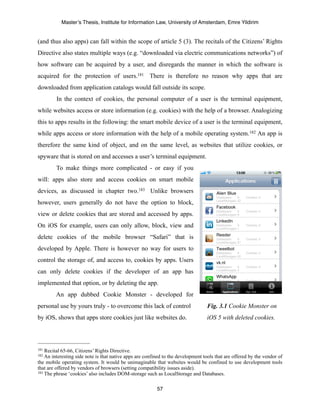
           Fig 1.1 An EULA displayed
does provide a designated area for publishers to publish their 	

         in the App Store.
EULA. However, similar to the Android Market, it does not provide a method for where users
can accept or decline an EULA prior to installing an app. Apple recommends publishers that
want users to explicitly accept their EULA, to do so within their app.48
	

     The LAEULA, that presumably covers most apps in the App Stores, gives publishers the
right to process ‘technical data and related information’ as long as it is in a form that does not
identify an individual.49 What this technical data exactly consists of is unclear. However, if and
when a publisher processes personal data, there are certain obligations stipulated in the App
Store Review Guidelines regarding privacy.
	

     Every app that is submitted to the App Store gets reviewed by Apple, prior to publication.
The App Store Review Guidelines (‘Guidelines’) contains rules on, inter alia, security, content
and privacy. These rules are enforced by Apple during the review process. Apps that do not
comply with the Guidelines can and will be rejected by Apple, according to the
Guidelines.	


45 Idem.
46 Idem.
47    iTunes Connect Developers Guide, p. 53, available at: <https://itunesconnect.apple.com/docs/
iTunesConnect_DeveloperGuide.pdf>. These minimal requirements are available at: <https://www.apple.com/legal/
itunes/appstore/dev/minterms/>
48 Idem, p. 172.
49 Licensed Application End User License Agreement, section b.


                                                     15
Master’s Thesis, Institute for Information Law, University of Amsterdam, Emre Yildirim


      The Guidelines states that apps “cannot transmit data about a user without obtaining the
user's prior permission and providing the user with access to information about how and where
the data will be used”.50 How publishers are supposed to obtain prior permission or provide their
users with information, is not specified in the Guidelines.


1.7 Conclusion
Smart mobile devices are popular. Their vast array of features make them a virtually
indispensable device for users. The possibility for users to enhance their devices to their personal
tastes with application catalogs, caused a surge in third-party apps. On Apple’s App Store and
Google’s Android Market alone, there are more than a million apps available with over two
billion downloads per month. Third-party apps are developed with Software Development Kits
and are integrated in the mobile operating system. They can access internal functions of SMDs
such as GPS and cameras, alongside on-device (personal) data, to the extent that SDKs allow
them. Apps are distributed in application catalogs with different payment models, and frequently
use the services of analytics and advertising companies. A clear relationship can be seen between
apps that use the free or freemium payment models and advertising companies. The legal
relationship between users and publishers of apps is direct, as the application catalog provider
merely acts as a middleman that sells standard licenses to use. Publishers can, but are not obliged
to, adopt an EULA in lieu of the standard license to use. Although catalog providers claim not to
be responsible for third-party apps, they do deem it necessary to oblige publishers to implement
privacy policies if personal data is processed.


50 Article   17.1, App Store Review Guidelines.

                                                       16
Master’s Thesis, Institute for Information Law, University of Amsterdam, Emre Yildirim


2. Data

In December 2010, The Wall Street Journal published an article about apps in its investigative
series on data privacy.51 The study analyzed the data that 101 iOS and Android apps collect and
share. The results demonstrated that apps collect and share location data, unique device
identifiers, personal details and more, often without informing their users.
         This chapter will take a look at what kind of data are accessible, retrievable and actively
or passively processed by apps. An attempt to enumerate the available data will be made by
taking a look at SDKs, and the possibilities or restrictions they offer to developers. Subsequently
concrete examples of collected data, that have been acquired by monitoring the network traffic of
apps, are demonstrated.52 While this chapter will not evaluate the privacy policies of the
researched apps from a legal point of view, some general remarks will be made about their
privacy policies. To limit the scope of the technical research, the focus is solely on Apple’s iOS
mobile operating system. Important features of other mobile operating systems will be discussed
as well.53


2.1 Access
Developers that use a SDK have the possibility to use the ingenuity of SMDs, and gain access to
all kinds of data that is stored on, or can be retrieved by them. Apps for iOS are developed with
the use of the official iOS SDK. If for example a developer wants to use location data that is
retrieved with the GPS function of an iPhone, it would have to do so with the help of the iOS
SDK. The possibilities are not endless though.
         Apple does not provide methods to gain access to all data that is available on an iOS
device, and uses three solutions to achieve this: sandboxing, an ex-ante review of apps and a
restrictive Application Programming Interface (‘API’).

51 Supra note 3.
52   Capturing and inspecting network traffic enables eavesdropping on data processed by applications which
otherwise is hidden from the user. The process includes analyzing the Internet Protocol (‘IP)’ packets that are used
for communication to external servers by an application.
53 First, the goal of this chapter is not to give a complete overview of all available mobile operating systems. Second,

it is likely that the data and conclusions would overall be similar in case other mobile operating systems were
researched. Finally, I do not own any other SMDs besides the iPhone 4S. As a long time user I am familiar with its
environment, capabilities and SDK.

                                                          17
Master’s Thesis, Institute for Information Law, University of Amsterdam, Emre Yildirim


            Sandboxing is a security mechanism that forces apps to run individually in a controlled
environment or container. Apple describes it as “every application is an island”.54 The effect of
sandboxing is that apps can be prohibited to access files that they are not entitled to by default. A
concrete example of the restrictiveness of sandboxing is for example that an app does not have
read and/or write permissions outside of its own container. It can not access call logs or browser
history, unless Apple provides a public API to do so. Apps that attempt to read or write data
outside of their container are subject to rejection for the App Store.55
            The ex-ante review of apps provides a mechanism for Apple to enforce rules on
developers. The App Store Review Guidelines (‘Guidelines’), according to its recitals, is a living
document. This is strongly manifested by the following quote in the introduction of the
Guidelines:


            “We will reject Apps for any content or behavior that we believe is over the line. What
            line, you ask? Well, as a Supreme Court Justice once said, "I'll know it when I see it".
            And we think that you will also know it when you cross it.” 56


While there are concrete rules in the Guidelines regarding the use of for example location data,
more general rules can be found as well. The Guidelines states that apps that attempt to cheat the
system by stealing user data, will be removed from the App Store, while the developers are
expelled from the iOS Developer Program.
            Apps are furthermore limited to the use of public APIs provided by the iOS SDK. Private
APIs are, inter alia, used by Apple in the standard apps that are available on every iOS device.
They are for example used to manage and handle phone calls or e-mails, and thus give access to
the file system on a deep level. If a third-party app attempts to use private APIs, it is subject to
rejection from the App Store.57 With public APIs Apple is able to control how and when

54  See the iOS Developer Guide, ‘The iOS Environment’ and the ‘File System Programming Guide’, respectively
a v a i l a b l e a t : < h t t p s : / / d e v e l o p e r. a p p l e . c o m / l i b r a r y / i o s / d o c u m e n t a t i o n / i P h o n e / C o n c e p t u a l /
iPhoneOSProgrammingGuide/TheiOSEnvironment/TheiOSEnvironment.html#//apple_ref/doc/uid/TP40007072-
CH9-SW2> and <https://developer.apple.com/library/ios/documentation/FileManagement/Conceptual/
FileSystemProgrammingGUide/FileSystemOverview/FileSystemOverview.html#//apple_ref/doc/uid/TP40010672-
CH2-SW13>.
55 Article 2.6 App Store Review Guidelines.
56 Justice Potter Stewart, concurring opinion in Jacobellis v. Ohio, 378 U.S. 184 (1964).
57 Article 2.5 App Store Review Guidelines.


                                                                                 18
Master’s Thesis, Institute for Information Law, University of Amsterdam, Emre Yildirim


developers have access to data, alongside the option whether prior permission is needed from
users. The iOS SDK can be characterized as fairly liberal: at the moment only the access to
location data, and accessing photos without user interaction, requires prior permission from
users. This is achieved via a pop-up that is automatically presented to users by iOS. Access to the
address book or calendars do not require any prior permission, and users are not notified by iOS.
Notifying users about the use of address books and calendars, is therefore at the discretion of
publishers.
         Unlike Apple’s iOS, Google’s Android operating system uses a permission model.58 This
is partly the outcome of the fact that Google relies on ex-post review of apps, as opposed to
Apple. In order for developers to use certain features of SMDs or access data (e.g. read address
book, calendar or SMS messages) in apps, they need to request permission at all times. A list of
permissions is displayed to users upon the installation of an app. This list includes a short
explanation by Google about what the required permissions are (e.g. ‘Network communication -
full internet access’). Developers however do not need to - and can not - specify the purposes of
the requested permissions, which are therefore absent in the permission list. Users have the
option to allow or decline the needed permissions. In the latter case, the app can not be used. A
pitfall of Google’s permission model is that a lot more data can be accessed in Android, in
contrast to iOS.59 This includes SMS messages, browser history, or the ability to read low-level
system logs of the device.


58 Bø & Pederson 2011, p. 2, available at <http://ntnu.diva-portal.org/smash/get/diva2:443205/FULLTEXT01> and
Leontiadis et. al. 2012, p. 1, available at <https://www.cl.cam.ac.uk/~il235/HotMobile12_Leontiadis.pdf>.
59 A list of all available permissions is enumerated at the Android Developer Reference guide, available at: <https://

developer.android.com/reference/android/Manifest.permission.html>.

                                                         19
Master’s Thesis, Institute for Information Law, University of Amsterdam, Emre Yildirim


2.2 Available Data
The available types of data on iOS can roughly be divided in four categories:


     1.      Technical data
     2.      On-device data
     3.      User entered data
     4.      Cookies


          A further distinction can be made in the categories, by whether the data is actively or
passively processed. While actively processed data requires some form of user interaction, such
as giving permission or entering data, passively processed data requires no user interaction at all.
In chapter three an evaluation will be made of whether the available data that is discussed below,
constitute personal data under the Data Protection Directive.


Technical data
Carrier data
Apple provides developers with an API to retrieve the carrier name, carrier country code, mobile
country code, and the mobile network code of the cellular provider of users. 60 The mobile
country code and mobile network codes are defined by the International Telecom Union and can
be used to identify cellular providers.61 An example of the output for a cellular provider is
respectively: vfnl (Vodafone Netherlands - VEY), NL, 204, 04.


Connection type
It is possible to retrieve the current connection type of users. This can either be Wi-Fi or
WWAN.62


60   See CTCarrier Class Reference, available at <https://developer.apple.com/library/ios/#documentation/
NetworkingInternet/Reference/CTCarrier/Reference/Reference.html>.
61 Mobile Network Codes (MNC) for the international identification plan for public networks and subscriptions,

available at <http://www.itu.int/dms_pub/itu-t/opb/sp/T-SP-E.212B-2011-PDF-E.pdf>.
62 See Reachability sample application by Apple, available at <https://developer.apple.com/library/ios/#samplecode/

Reachability/Introduction/Intro.html>.

                                                        20
Master’s Thesis, Institute for Information Law, University of Amsterdam, Emre Yildirim


Device model and type, OS version and type
With the UIDevice API it is possible for developers to retrieve device types, such as ‘iPhone’ or
‘iPad’.63 An extension to the public API has been made by developers that allows the retrieval of
the specific model of a device (e.g. iPhone 4S).64 It is furthermore possible to retrieve the iOS
version (e.g. 5.0) and type (e.g. iOS) of the mobile operating system.


Device name
Every iOS device (‘iDevice’) has a name, which can be set by its user. During the initial setup of
the iDevice without iTunes, the device name is automatically set to the type of the device (e.g.
‘iPad’). During the initial setup of an iDevice with iTunes though, the name of the iDevice - by
default - is set to the first and last name that is associated with the Apple ID that is used for the
iDevice. This results in the following name for the iDevice: [first_name last_name’s [device
type]]. It is up to the user to change the name of its device.


                           Fig. 2.1 Default name of a new device set in iTunes


In its UIDevice API, Apple provides developers to retrieve the name of the device. The
description in the API mentions that the device name is an “arbitrary alphanumeric string that is
associated with the device as an identifier”.


63   See UIDevice Class Reference, available at <https://developer.apple.com/library/ios/#documentation/uikit/
reference/UIDevice_Class/Reference/UIDevice.html>.
64 See UIDevice extension developed by Erica Sadun, available at <https://github.com/erica/uidevice-extension>.


                                                      21
Master’s Thesis, Institute for Information Law, University of Amsterdam, Emre Yildirim


IP-address
Every device that is connected to the internet has an assigned Internet Protocol address.65
Although there is no method provided in the iOS SDK to retrieve the current IP-address of an
iDevice, it is still possible without using the restricted private APIs or deducing it from a HTTP-
request. Apple’s iOS is based on the Darwin operating system, which subsequently is based on
UNIX.66 The fact that the foundation of iOS is built on UNIX, makes it possible to retrieve
networking information without using private APIs. 67


Locale and country code
The locale of an iDevice forms the user’s preferences regarding language, and the region format
that is in use for dates and time. It can be retrieved by developers using the NSLocale API.68 An
example would be ‘nl_NL’ for a user that uses the Dutch language on its device. A country code
can be distilled from the locale as well.


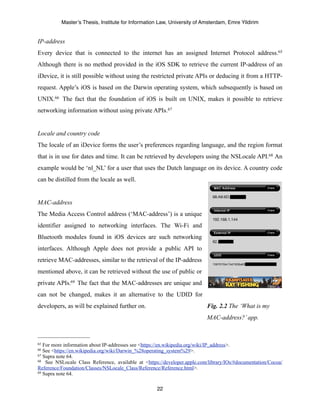
MAC-address
The Media Access Control address (‘MAC-address’) is a unique
identifier assigned to networking interfaces. The Wi-Fi and
Bluetooth modules found in iOS devices are such networking
interfaces. Although Apple does not provide a public API to
retrieve MAC-addresses, similar to the retrieval of the IP-address
mentioned above, it can be retrieved without the use of public or
private APIs.69 The fact that the MAC-addresses are unique and
can not be changed, makes it an alternative to the UDID for
developers, as will be explained further on.                              Fig. 2.2 The ‘What is my
                                                                          MAC-address?’ app.


65 For more information about IP-addresses see <https://en.wikipedia.org/wiki/IP_address>.
66 See <https://en.wikipedia.org/wiki/Darwin_%28operating_system%29>.
67 Supra note 64.
68 See NSLocale Class Reference, available at <https://developer.apple.com/library/IOs/#documentation/Cocoa/

Reference/Foundation/Classes/NSLocale_Class/Reference/Reference.html>.
69 Supra note 64.


                                                    22
Master’s Thesis, Institute for Information Law, University of Amsterdam, Emre Yildirim


Timezone
The time zone of an iDevice can be retrieved by using the NSTimeZone API. 70 This will return
the time zone that is currently in use by the iDevice (e.g. ‘Europe/Amsterdam’).


UDID
A Unique Device Identifier (‘UDID’) is an alphanumeric string that is assigned to every iDevice.
It is calculated using a formula that is based on the serial number, International Mobile
Equipment Identity or Electronic Chip ID, Wi-Fi MAC-address and Bluetooth MAC-address of
an iOS device.71 The UDID is unique to every iDevice and is not alterable by users. The UDID
was initially provided by Apple as an aid for developers to identify their users. The normal use of
the UDID, as intended by Apple, was for example to store high scores of games on external
servers. According to the Wall Street Journal, Apple internally treats UDIDs as ‘personally
identifiable information’. When the UDID is combined with data from the Apple IDs of users, it
can be used to identify an individual.72 Due to the sensitive nature of UDIDs, Apple advises
developers to not publicly associate a UDID with user accounts, due to user security and privacy.
        The very nature of the UDID, and the fact that it is easily accessible, makes it a perfect
tool for developers, analytics and advertising companies to track user behavior. 73 Users generally
are not made aware of, and can not block, its use by apps. The UDID can be - and is - used by
analytics and advertising companies to aggregate data, and create profiles of users based on the
apps they use.74 It is therefore no surprise that most analytics and advertising companies collect
UDIDs. They often provide developers with their own SDKs that can be easily integrated in to
apps. As a result, apps automatically transmit data, with limited options for developers to decide
what data is collected. Developers in return receive free analytics services, or have a new
channel of revenue by advertisements displayed in their app.


70 See NSTimeZone Class Reference, available at <https://developer.apple.com/library/ios/#documentation/Cocoa/
Reference/Foundation/Classes/NSTimeZone_Class/Reference/Reference.html>.
71 See <http://iphonedevwiki.net/index.php/Lockdownd>.
72 Supra note 3.
73 Smith 2010, p. 6, available at <http://www.pskl.us/wp/wp-content/uploads/2010/09/iPhone-Applications-Privacy-

Issues.pdf>.
74 Seriot 2010, p. 25, available at <http://seriot.ch/resources/talks_papers/iPhonePrivacy.pdf>.


                                                      23
Master’s Thesis, Institute for Information Law, University of Amsterdam, Emre Yildirim


        The UDID of an iDevice can be retrieved using the UIDevice API of the iOS SDK.75
With the introduction of iOS 5.0 however, Apple deprecated the UDID. Although the UDID is
still retrievable, the depreciation denotes that it will soon be limited for use by developers, and
that developers will have to find alternatives to the UDID. The UDID is therefore in a
transitional phase until further notice by Apple.76 Apple recommends developers to create an app
specific Universally Unique Identifier (‘UUID’).77
        In 2010 Seriot recommended two solution to tackle the privacy issues of UDIDs: firstly
the introduction of an application device identifier (‘ADID’), and secondly the requirement of
prior permission from users.78 The ADID would still allow developers to use a unique identifier,
be it for their app only. Effectively, this would block the aggregation of data and profiling of
users across apps by analytics and advertising companies, unless they create their own global
UDIDs. The UDID would furthermore only be accessible by apps, and thus also analytics and
advertising companies, if users gave their prior permission. It seems like Apple has chosen for
the ADID.
        Why Apple has chosen to deprecate the UDID remains a mystery. A good guess is that the
depreciation is the result of privacy concerns. Nevertheless, the industry is already catching with
what seems a cat-and-mouse game. Several ideas have been opted and are already in use by
analytics and advertising companies to keep tracking users. These ideas generally use unique
identifiers that are similar to the UDID. W3i, an app monetization network, suggests developers
to use unique identifiers based on the MAC-address.79 As described above, the nature of a MAC-
address is very similar to the UDID, and is thus a good candidate for an alternative to the UDID.
Although the use of the MAC-address as a unique identifier is against the ratio of the deprecation
of the UDID, it is yet to be seen how Apple will react to apps that are using the MAC-address as


75   See UIDevice Class Reference, available at <https://developer.apple.com/library/ios/#documentation/uikit/
reference/UIDevice_Class/Reference/UIDevice.html>.
76 By the end of March 2012, news of Apple starting to reject applications that use the UDID have emerged. See

Techcrunch, ‘Amid Privacy Concerns, Apple Has Started Rejecting Apps That Access UDIDs’, 24 March 2012,
available at <http://techcrunch.com/2012/03/24/apple-udids/>.
77 See CFUUID, available at <https://developer.apple.com/library/ios/#documentation/CoreFoundation/Reference/

CFUUIDRef/Reference/reference.html#//apple_ref/c/func/CFUUIDCreate>.
78 Seriot 2010, p. 25.
79 Techcruch, ‘W3i suggests iOS Developers Use MAC-address As UDID Replacement’, 28 October 2011, available

at <http://techcrunch.com/2011/10/28/w3i-suggests-ios-developers-use-mac-address-as-udid-replacement/>.

                                                     24
Master’s Thesis, Institute for Information Law, University of Amsterdam, Emre Yildirim


a unique identifier. Currently there are apps available in the App Store that retrieve the MAC-
address, albeit not with the specific use of a unique identifier. 80


On-device Data
Address book
The address book of users is accessible by developers with the use of a public API provided by
Apple.81 Developers can access and modify all contact details without limitations, and without
informing or obtaining prior permission from users.82 The address book is for example used by
apps that are an alternative to the standard contacts app of Apple. The address book is
furthermore used by (social) apps for a ‘find my friends’ feature.


Calendar
The calendar of users is accessible by developers with the Event Kit API. 83 Like the address
book, developers can access and modify the calendar of users, without informing or obtaining
prior permission from users.


Game Center ID
Game Center is a social gaming platform that is developed by Apple. It is a framework for
developers that allows the interaction of their apps with Game Center. Developers can store high
scores of users on leader boards, or present challenges to users in order to unlock achievements.
Users have to register for a Game Center account using their Apple ID. While setting up their
account, users have to accept the Game Center Terms and Conditions, that are presented during
registration. Users are furthermore required to choose a Game Center ID, that will be publicly
displayed to other users.


80  What is my MAC-address?, published on 17 August 2010, available at <http://itunes.apple.com/gb/app/mac-
address/id386545612?mt=8>.
81   See Address Book Framework Reference iOS, available at <https://developer.apple.com/library/ios/
#documentation/AddressBook/Reference/AddressBook_iPhoneOS_Framework/_index.html>.
82 Seriot 2010, p. 11.
83 Event Kit Framework Reference, available at <https://developer.apple.com/library/ios/#DOCUMENTATION/

EventKit/Reference/EventKitFrameworkRef/_index.html>.

                                                    25
Master’s Thesis, Institute for Information Law, University of Amsterdam, Emre Yildirim


        It is possible for developers to retrieve the Game Center ID of users by using the
GameKit framework provided by Apple.84 Although the Game Center Terms and Conditions
mention several uses of the nickname by Apple, it does not include the fact that developers are
able to retrieve nicknames of users.85 While there are no requirements for users to use their real
names as their Game Center ID, they can do so.
        It seems that Apple has realized that the Game Center ID could be problematic and has
therefore taken the following measures that are mentioned in the App Store Review Guidelines in
order to prevent abuse. Section 6 of the Guidelines states that developers are not allowed to
display Game Center IDs to users or third parties, and may not use Game Center IDs for any
other purposes than those that are approved by the Game Center Terms and Conditions.
Furthermore, developers that “attempt to reverse lookup, trace, relate, associate, mine, harvest,
or otherwise exploit Player IDs, alias, or other information obtained through the Game Center
will be removed from the iOS Developer Program”.86


Location data
Developers can retrieve the realtime location of users by using the build-in GPS of an iDevice.87
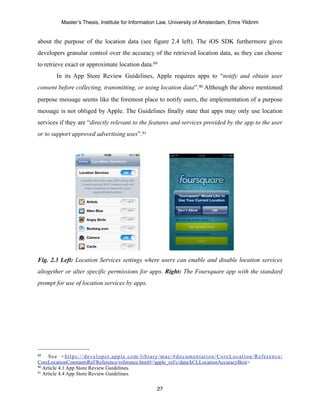
In order for location data to be retrievable though, location services need to be enabled in the
general settings of the iDevice by users (see figure 2.3 left). Only when location services are
enabled, can apps retrieve location data from the device.
        The CLLocationManager class assists developers in retrieving location data.88 On the
first attempt of an app to retrieve location data from an iDevice, iOS prompts the user with a
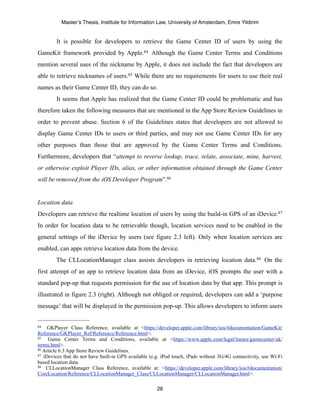
standard pop-up that requests permission for the use of location data by that app. This prompt is
illustrated in figure 2.3 (right). Although not obliged or required, developers can add a ‘purpose
message’ that will be displayed in the permission pop-up. This allows developers to inform users


84   GKPlayer Class Reference, available at <https://developer.apple.com/library/ios/#documentation/GameKit/
Reference/GKPlayer_Ref/Reference/Reference.html>.
85   Game Center Terms and Conditions, available at <https://www.apple.com/legal/itunes/gamecenter/uk/
terms.html>.
86 Article 6.3 App Store Review Guidelines.
87 iDevices that do not have built-in GPS available (e.g. iPod touch, iPads without 3G/4G connectivity, use Wi-Fi

based location data.
88 CLLocationManager Class Reference, available at: <https://developer.apple.com/library/ios/#documentation/

CoreLocation/Reference/CLLocationManager_Class/CLLocationManager/CLLocationManager.html>.

                                                       26
Master’s Thesis, Institute for Information Law, University of Amsterdam, Emre Yildirim


about the purpose of the location data (see figure 2.4 left). The iOS SDK furthermore gives
developers granular control over the accuracy of the retrieved location data, as they can choose
to retrieve exact or approximate location data.89
            In its App Store Review Guidelines, Apple requires apps to “notify and obtain user
consent before collecting, transmitting, or using location data”.90 Although the above mentioned
purpose message seems like the foremost place to notify users, the implementation of a purpose
message is not obliged by Apple. The Guidelines finally state that apps may only use location
services if they are “directly relevant to the features and services provided by the app to the user
or to support approved advertising uses”. 91


Fig. 2.3 Left: Location Services settings where users can enable and disable location services
altogether or alter specific permissions for apps. Right: The Foursquare app with the standard
prompt for use of location services by apps.


89   S e e < h t t p s : / / d e v e l o p e r. a p p l e . c o m / l i b r a r y / m a c / # d o c u m e n t a t i o n / C o r e L o c a t i o n / R e f e r e n c e /
CoreLocationConstantsRef/Reference/reference.html#//apple_ref/c/data/kCLLocationAccuracyBest>
90 Article 4.1 App Store Review Guidelines.
91 Article 4.4 App Store Review Guidelines.


                                                                                 27
Master’s Thesis, Institute for Information Law, University of Amsterdam, Emre Yildirim


Photos
Developers are able to interact with the camera of iDevices, and have access to stored photos of
users. iOS offers developers two ways of accessing photos: using a standard Image Picker
developed by Apple, or alternatively with a framework that allows developers to customize how
images are picked. 92
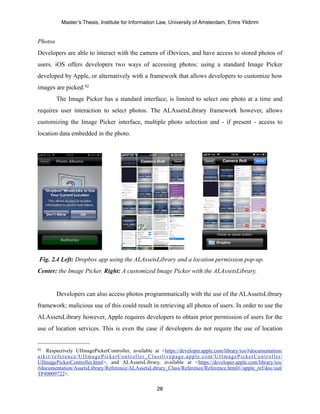
         The Image Picker has a standard interface, is limited to select one photo at a time and
requires user interaction to select photos. The ALAssetsLibrary framework however, allows
customizing the Image Picker interface, multiple photo selection and - if present - access to
location data embedded in the photo.


Fig. 2.4 Left: Dropbox app using the ALAssetsLibrary and a location permission pop-up.
Center: the Image Picker. Right: A customized Image Picker with the ALAssetsLibrary.


         Developers can also access photos programmatically with the use of the ALAssetsLibrary
framework; malicious use of this could result in retrieving all photos of users. In order to use the
ALAssetsLibrary however, Apple requires developers to obtain prior permission of users for the
use of location services. This is even the case if developers do not require the use of location


92 Respectively UIImagePickerController, available at <https://developer.apple.com/library/ios/#documentation/
uikit/reference/UIImagePickerController_Classlivepage.apple.com/UIImagePickerController/
UIImagePickerController.html>, and ALAssetsLibrary, available at <https://developer.apple.com/library/ios/
#documentation/AssetsLibrary/Reference/ALAssetsLibrary_Class/Reference/Reference.html#//apple_ref/doc/uid/
TP40009722>.

                                                     28
Master’s Thesis, Institute for Information Law, University of Amsterdam, Emre Yildirim


services for their app. The ratio behind the required permission seems to be based on the fact that
photos could have - and in case location services for the camera app are enabled by users do have
- location data embedded. The prior permission of users is therefore not required for the use of
the image library per se, but for the embedded location data in photos. This leads to a curious
result: any app that obtains permission from their users to use location services, automatically
has access to all their photos with the ALAssetsLibrary framework.


User-entered Data
The amount of data that developers can collect is endless as long as users are willing to disclose
them. Especially when user profiles are made in apps, a lot of data is processed. A list of
frequently collected data includes the date of birth, e-mail address, first and last name, gender,
profile picture, phone number, social media account (e.g. Twitter user-ID, Facebook user-ID),
username and website.


Cookies
Apps - just as web browsers - have the ability to set cookies and use web storage (together
‘cookies’).93 The NSHTTPCookie(Storage) class allows developers to set cookies for their
apps.94 These cookies are invisible to users, as there is currently no way to view or delete them in
iOS, unless apps provide the option to do so. It is safe to say that the majority of apps do not
have such an option built-in. Cookies of apps can therefore - exceptions aside - only be deleted if
an app is removed.


93   For more information on web storage see the World Wide Web Consortium: <http://dev.w3.org/html5/webstorage/
>.
94  NSHTTPCookie and NSHTTPCookieStorage Class Reference, respectively available at: <https://
developer.apple.com/library/ios/#documentation/Cocoa/Reference/Foundation/Classes/NSHTTPCookie_Class/
Reference/Reference.html> and <https://developer.apple.com/library/ios/#documentation/Cocoa/Reference/
Foundation/Classes/NSHTTPCookieStorage_Class/Reference/Reference.html>.

                                                        29
Master’s Thesis, Institute for Information Law, University of Amsterdam, Emre Yildirim


2.3 Methodology
To monitor the network traffic of apps, an iPhone 4S was purchased and set up as a new phone.
This ensured that the device was not yet known to any third parties. The iPhone came pre-loaded
with iOS 5.0, the latest version available by the time this research was conducted. A dedicated
network environment was set up in order to ensure the accuracy of the collected data, and to
prevent contamination thereof. Several other measures were taken as well:
     • The spy Sinon, son of Aesimus, who told the Trojans that the wooden horse of the Greeks
      was a gift to the gods to ensure their safe return home, was used as a pseudonym during the
      research. The device name of the iPhone was set to ‘Sinon Aesimus’ iPhone’, while an e-
      mail address, a Facebook profile and a Twitter account were set up under the same name.
      These were used to interact with apps. In case apps required or offered a possibility to set
      up a user account, registration was performed using the same pseudonym and associated
      accounts.
     • All apps were freshly installed on the iPhone from the App Store.
     • Only one app was run at a time.
     • The apps were used for a reasonable time, while exploring app specific features just as
      ‘regular’ users would. This included, inter alia, sharing content to social networks and
      tagging photos or messages with location data.
     • Only the Wi-Fi connection of the iPhone was used. Cellular data was switched off.
     • If an app required any form of consent or permission, it was given and noted.
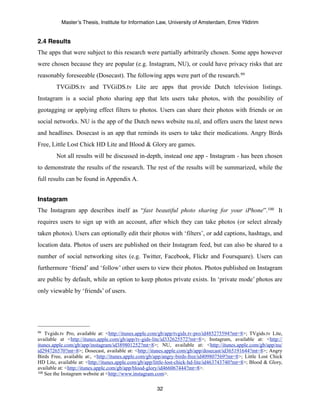
     • In order to capture the network traffic of the iPhone, a dedicated Wi-Fi network was created
      for the iPhone using a notebook and internet sharing. The network setup was as follows:
     • The network traffic of the dedicated Wi-Fi connection was captured and analyzed using
      two tools. Burp Suite (version 1.4.01), which includes an intercepting proxy server, was
      used to capture HTTP/S traffic from the iPhone.95 The iPhone was manually setup to use
      this HTTP proxy.96 Wireshark (version 1.4.6), a free and open source network protocol
      analyzer, was used to capture non-HTTP/S traffic as well.97


95 Burp Suite Free Edition, available at: <http://portswigger.net/burp/>.
96 A proxy in this case acts as an intermediary for data transfer between the iPhone and an external server.
97 Wireshark version 1.6.3, available at: <https://www.wireshark.org>.


                                                          30
Master’s Thesis, Institute for Information Law, University of Amsterdam, Emre Yildirim


       • In order to capture secure communications using the Secure Socket Layer (‘SSL’) with
         Burp Suite, a self-signed Certificate Authority certificate was authorized on the iPhone.
         Each time an HTTPS connection was made with a host, Burp Suite automatically generated
         certificates that were signed by the above mentioned Certificate Authority, for that specific
         host.98 This essentially provides a way to inspect secured communications traveling
         between the iPhone and the external host, before they are forwarded to the external host.
         The proxy acted as if it the data was directly send from the iPhone, and no eavesdropping
         had taken place.
       • The types of data collected during the monitoring of network traffic ranged from merely
         technical data and content, to possibly personal data. While collecting data, no focus was
         set on whether the data constituted personal data under the Data Protection Directive.
         Furthermore, no data was filtered out except content related data. Therefore merely
         technical data such as the device model, or the locale of the device is included as well.


                                  Fig. 2.5 Setup for network traffic monitoring


98   For more information about this process see <http://portswigger.net/burp/help/servercerts.html>.

                                                           31
Master’s Thesis, Institute for Information Law, University of Amsterdam, Emre Yildirim


2.4 Results
The apps that were subject to this research were partially arbitrarily chosen. Some apps however
were chosen because they are popular (e.g. Instagram, NU), or could have privacy risks that are
reasonably foreseeable (Dosecast). The following apps were part of the research. 99
        TVGiDS.tv and TVGiDS.tv Lite are apps that provide Dutch television listings.
Instagram is a social photo sharing app that lets users take photos, with the possibility of
geotagging or applying effect filters to photos. Users can share their photos with friends or on
social networks. NU is the app of the Dutch news website nu.nl, and offers users the latest news
and headlines. Dosecast is an app that reminds its users to take their medications. Angry Birds
Free, Little Lost Chick HD Lite and Blood & Glory are games.
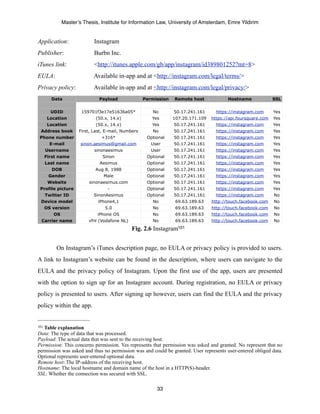
        Not all results will be discussed in-depth, instead one app - Instagram - has been chosen
to demonstrate the results of the research. The rest of the results will be summarized, while the
full results can be found in Appendix A.


Instagram
The Instagram app describes itself as “fast beautiful photo sharing for your iPhone”.100 It
requires users to sign up with an account, after which they can take photos (or select already
taken photos). Users can optionally edit their photos with ‘filters’, or add captions, hashtags, and
location data. Photos of users are published on their Instagram feed, but can also be shared to a
number of social networking sites (e.g. Twitter, Facebook, Flickr and Foursquare). Users can
furthermore ‘friend’ and ‘follow’ other users to view their photos. Photos published on Instagram
are public by default, while an option to keep photos private exists. In ‘private mode’ photos are
only viewable by ‘friends’ of users.


99  Tvgids.tv Pro, available at: <http://itunes.apple.com/gb/app/tvgids.tv-pro/id485275594?mt=8>; TVgids.tv Lite,
available at <http://itunes.apple.com/gb/app/tv-gids-lite/id332625572?mt=8>; Instagram, available at: <http://
itunes.apple.com/gb/app/instagram/id389801252?mt=8>; NU, available at: <http://itunes.apple.com/gb/app/nu/
id294726570?mt=8>; Dosecast, available at: <http://itunes.apple.com/gb/app/dosecast/id365191644?mt=8>; Angry
Birds Free, available at:, <http://itunes.apple.com/gb/app/angry-birds-free/id409807569?mt=8>; Little Lost Chick
HD Lite, available at: <http://itunes.apple.com/gb/app/little-lost-chick-hd-lite/id463743740?mt=8>; Blood & Glory,
available at: <http://itunes.apple.com/gb/app/blood-glory/id466067444?mt=8>.
100 See the Instagram website at <http://www.instagram.com>.


                                                       32
Master’s Thesis, Institute for Information Law, University of Amsterdam, Emre Yildirim


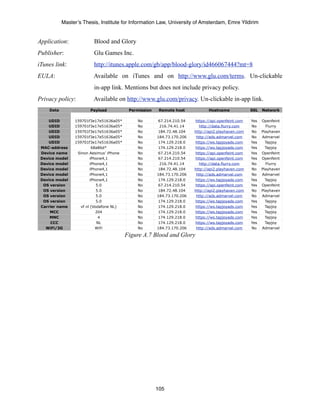
Application:                     Instagram
Publisher:                       Burbn Inc.
iTunes link:                     <http://itunes.apple.com/gb/app/instagram/id389801252?mt=8>
EULA:                            Available in-app and at <http://instagram.com/legal/terms/>
Privacy policy:                  Available in-app and at <http://instagram.com/legal/privacy/>
         Data                        Payload             Permission   Remote host             Hostname              SSL


        UDID               159701f3e17e51636a05*              No      50.17.241.161      https://instagram.com      Yes
       Location                  (50.x, 14.x)                 Yes     107.20.171.109   https://api.foursquare.com   Yes
       Location                  (50.x, 14.x)                 Yes     50.17.241.161      https://instagram.com      Yes
    Address book          First, Last, E-mail, Numbers        No      50.17.241.161      https://instagram.com      Yes
    Phone number                      +316*               Optional    50.17.241.161      https://instagram.com      Yes
        E-mail            sinon.aesimus@gmail.com           User      50.17.241.161      https://instagram.com      Yes
      Username                   sinonaesimus               User      50.17.241.161      https://instagram.com      Yes
      First name                       Sinon              Optional    50.17.241.161      https://instagram.com      Yes
      Last name                      Aesimus              Optional    50.17.241.161      https://instagram.com      Yes
         DOB                     Aug 8, 1988              Optional    50.17.241.161      https://instagram.com      Yes
       Gender                          Male               Optional    50.17.241.161      https://instagram.com      Yes
       Website                sinonaesimus.com            Optional    50.17.241.161      https://instagram.com      Yes
    Profile picture                      -                Optional    50.17.241.161      https://instagram.com      Yes
      Twitter ID                 SinonAesimus             Optional    50.17.241.161      https://instagram.com      No
    Device model                     iPhone4,1                No       69.63.189.63    http://touch.facebook.com    No
      OS version                        5.0                   No       69.63.189.63    http://touch.facebook.com    No
          OS                         iPhone OS                No       69.63.189.63    http://touch.facebook.com    No
    Carrier name              vfnl (Vodafone NL)              No       69.63.189.63    http://touch.facebook.com    No

!          !          !          !            !    Fig. 2.6   Instagram101


           On Instagram’s iTunes description page, no EULA or privacy policy is provided to users.
A link to Instagram’s website can be found in the description, where users can navigate to the
EULA and the privacy policy of Instagram. Upon the first use of the app, users are presented
with the option to sign up for an Instagram account. During registration, no EULA or privacy
policy is presented to users. After signing up however, users can find the EULA and the privacy
policy within the app.


101Table explanation
Data: The type of data that was processed.
Payload: The actual data that was sent to the receiving host.
Permission: This concerns permission. Yes represents that permission was asked and granted. No represent that no
permission was asked and thus no permission was and could be granted. User represents user-entered obliged data.
Optional represents user-entered optional data.
Remote host: The IP-address of the receiving host.
Hostname: The local hostname and domain name of the host in a HTTP(S)-header.
SSL: Whether the connection was secured with SSL.

                                                                33
Master’s Thesis, Institute for Information Law, University of Amsterdam, Emre Yildirim


            When signing up for an account, an e-mail address and username is required. A phone
number and profile picture is optional. The profile of a user can - after signing up - be edited to
include a first and last name, a website, a short biography, a date of birth and gender. User-
entered data is not visibly transmitted to third parties by Instagram.
            Users have the option to encourage friends to use Instagram, by sending them invitations.
They can also opt to find friends that already use Instagram with the help of their address book,
or by linking their Twitter and Facebook accounts. The option to find friends by linking Twitter
and Facebook accounts within Instagram, requires affirmative action from users by logging in to
Twitter and Facebook. The option to find friends with the use of the address book however,
required merely the tap of a button. When the option ‘Find Friends’ and subsequently ‘From my
contact list’ was selected, Instagram uploaded the first and last names, e-mail addresses and
phone numbers of all contacts to their servers. There was no further explanation, nor was there a
pop-up that informed what was about to be happening. Merely tapping the ‘From my contact
list’ option sufficed. No mention of this practice was made in their privacy policy. After the Path
debacle, Instagram issued an update to the app.102 Choosing the ‘From my contact list’ option
now prompts the user for permission with the following explanation: “Search for Your Friends in
Address Book? - In order to find your friends, we need to send address book information to
Instagram’s servers using a secure connection”.
            In case users link their Twitter account to Instagram for automatic publications or finding
friends, the Twitter ID (username) is retained. Upon linking a Facebook account, Facebook
retrieves technical data about the device, as can be seen in figure 2.6.
            For the use of location services by Instagram, the permission of users is required per the
standard location permission pop-up found in iOS. Instagram uses the Foursquare API in order to
retrieve venues in close proximity of the user’s location, and therefore transmits the user’s
location data to Foursquare. No other data concerning users is sent to the Foursquare API besides
location coordinates.
            Finally the UDID of the device is processed, and cookies are set on the device. Several
cookies were placed by Instagram, Facebook and Twitter.


102   Infra §4.1.3.1.

                                                       34
Master’s Thesis, Institute for Information Law, University of Amsterdam, Emre Yildirim


2.5 Summary
The TVGiDS.tv and TVGiDS.tv Lite apps are published by Mobile Pioneers (see figures A.1 &
A.2, Appendix A). Both apps are licensed with the LAEULA and have a privacy policy available
within the app. The apps process device names (‘Sinon Aesimus’ iPhone’) and UDIDs, and
transmit them to an analytics company and several advertising companies. The payload shows
that the ‘original’ UDID that is retrievable with the UIDevice API is used, alongside another
UDID of which the computation is unknown. The privacy policy found inside the TVGiDS.tv
Lite app, which consists of one sentence, mentions that the use of the app is completely
anonymous. The TVGiDS.tv app has a more extensive privacy policy. It mentions the use of the
UDID for statistics, personal preferences inside the app, ‘push notifications’ and technical
support. TVGiDS.tv specifically mentions that the UDID is never connected to individuals, and
that the UDID is not transmitted to third parties. The results show that the latter assertion is false,
as the UDID is transmitted to several third parties. The privacy policy furthermore does not
mention the use of the device name.
       NU, the app of news website nu.nl, is published by Peperzaken (see figure A.3). The app
processes UDIDs and location data. Upon opening the app the first time after installation, it
prompts the user for permission to use location data. The purpose thereof is unknown, as it is not
specified. The UDIDs that are processed by NU are transmitted to one analytics and one
advertisement company. The latter also receives the location data of the user, possibly for
location based advertising. The app has no privacy policy available inside the app. A privacy
policy can be found on nu.nl, but it does not mention the mobile app, and thus the processing of
UDIDs and location data.
       Dosecast, published by Montuno Software LLC, is an app that helps its users to take their
medication on time (see figure A.4). Users have the ability to specify, inter alia, their
medications, the dosage, their doctor and their apothecary. Dosecast has implemented its own
EULA that is available on iTunes. Users furthermore have to explicitly accept the EULA upon
their first use of the app; declination results in not being able to use the app. The EULA, and the
privacy policy found within, of Dosecast mentions that no ‘personally identifiable information’ is
collected during the operation of the app. Dosecast processes UDIDs and any other data that is


                                                   35
Master’s Thesis, Institute for Information Law, University of Amsterdam, Emre Yildirim


entered by users about their medication. Dosecast has not been found to visibly share data with
third parties.103
        Angry Birds Free, published by Rovio Mobile Ltd., is a free version of one of the most
popular games available on iOS (see figure A.5). Angry Birds Free provides links to the EULA
and privacy policy of Rovio in its iTunes description page. The EULA of Rovio is however not
incorporated in the designated area in iTunes: according to the iTunes Connect Developer Guide,
this leads to the app being licensed with the standard LAEULA.104 A link to the privacy policy is
also available within the app. The privacy policy mentions that ‘non-personal data’ such as the
UDID or IP-address is processed, and subsequently shared with ‘partners and contractors’ for
analytics and advertisement purposes. The UDID is transmitted to one analytics company and six
advertising companies, while the IP-address is shared with nine advertising companies. Three
different payloads for the UDID were found; the original UDID provided by Apple, and two
other UDIDs of which the computation is unknown.
        Little Lost Chick HD Lite, published by Clickgamer Technologies Ltd., is licensed with
the LAEULA (see figure A.6). Clickgamer does not provide a privacy policy within the app, nor
can a privacy policy be found on its website. Little Lost Chick implements the social gaming
platform Crystal, which is operated by Chillingo Ltd. Crystal allows players to unlock
achievements, view leader boards and share high scores to social media. The use of Crystal
requires a Crystal account. During the sign up process, the terms and conditions and privacy
policy of the Crystal service can be viewed by users. The privacy policy mentions that Crystal
collects names, photos or avatars, e-mail addresses, geolocations, UDIDs and IP-addresses of
users. That data is indeed processed, in addition to users’ Facebook IDs, GameCenter IDs and
address books, in case they choose to ‘connect’ with friends. The UDIDs of users are furthermore
collected even if users do not have a Crystal account, or a fortiori have not even interacted with
Crystal at all.
        Blood and Glory, published by Glu Games Inc., is a game where one assumes the role of
a Roman gladiator (see figure A.7). The app provides its own EULA in iTunes, and provides a


103Data might be shared with third parties, but this does not happen automatically during the use of the app.
104  iTunes Connect Developers Guide, p. 54, available at: <https://itunesconnect.apple.com/docs/
iTunesConnect_DeveloperGuide.pdf>.

                                                     36
Master’s Thesis, Institute for Information Law, University of Amsterdam, Emre Yildirim


link to its privacy policy within the EULA. Both documents are also available through a link
within the app, and on the website of the publisher. The privacy policy of Glu explains what data
is processed by Glu, and third parties that Glu collaborates with. The third-party services are
mentioned specifically and include, inter alia, Facebook, Flurry Analytics, Playhaven
Advertisement and OpenFeint social gaming. Blood and Glory was observed to transmit the
UDID to one analytics, one social gaming and three advertising companies. One advertisement
company also retrieved the MAC-address of the device, while a social gaming platform also
retrieved the device name.
           Regarding the privacy policies and EULAs of the researched apps, the following
conclusions can be drawn: six out of the eight observed apps had privacy policies available from
within the app, while two apps had no privacy policy. Five out of eight apps were licensed with
the LAEULA. Of the three other apps, one explicitly required acceptance of their EULA from
users.


        Application                       In-app                         Website                         EULA                       LAEULA


         Instagram                          Yes                             Yes                            No                        Yes
         TVGiDS.tv                          Yes                             Yes                            No                        Yes
      TVGiDS.tv Lite                        Yes1                            No                             No                        Yes
             NU                              No                            Yes2                            No                        Yes
         Dosecast                           Yes                             Yes                            Yes                        No
     Angry Birds Free                       Yes                             Yes                            Yes                        No
     Little Lost Chick                      No3                             No                             No                        Yes
     Blood and Honor                        Yes                             Yes                            Yes                        No

                                               Fig. 2.7 Availability of Privacy Policies
1: The privacy policy mentions that the use of the application is completely anonymous.
2: There is a privacy policy available on their website, but it does not mention the use of or data processed by the application.
3: There is however a privacy policy available within the app of the social gaming network Crystal.


Of course merely implementing a privacy policy does not make the processing of personal data
legitimate. A closer look will be taken at some of the privacy policies of these apps in chapter
four.


                                                                            37
Master’s Thesis, Institute for Information Law, University of Amsterdam, Emre Yildirim


2.6 Conclusion
The checks and balances to control the amount of data accessible - and the accessibility itself by
developers - differs per platform. The iOS SDK provides an API where developers can get access
to a dataset that is predefined by Apple. Prior permission from users, in the form of a pop-up, is
only required when an app wants to access location data. Misuse of accessible data is sought to
be prevented by an ex-ante review of apps, in combination with the enforcement of rules that are
set out in the App Store Review Guidelines. Google has a different approach: apps are reviewed
ex-post, while access to data is handled by a permission model. The permission model requires
developers to request permissions from users to use features of SMDs or to access data. In
contrast to iOS, Android allows developers to gain access to a lot more data. A list of permissions
to access data, including a brief description of the sought permissions by Google, is presented to
users prior to the installation of an app, which they can accept or decline.
       The amount of available and accessible data in the iOS SDK is substantial. Developers
have access to a wide array of data: the majority of the time without having to request prior
permission from users. This includes - most notably - address books, calendars, device names,
location data, photos and UDIDs.
       Monitoring the network traffic of apps showed a glimpse of what data is actively and
passively processed by apps. As can be seen in the results, users are not always informed of the
data that is processed or subsequently shared with third parties. The most notable processing in
the results was the address books of users by the Instagram app. Neither in their privacy policy,
nor during the process itself, are users made aware of the fact that their address book is
transmitted to the servers of Instagram.


                                                  38
Master’s Thesis, Institute for Information Law, University of Amsterdam, Emre Yildirim


3. Applicable Laws and Jurisdiction
        “Everyone has the right to the protection of personal data concerning him or her. Such data must be processed
 fairly for specified purposes and on the basis of the consent of the person concerned or some other legitimate basis
                                                                                              laid down by law. [..]”
                                       - Article 8 of the Charter of Fundamental Rights of the European Union


This chapter has the primary goal of discussing the applicability and jurisdiction of the Data
Protection Directive (‘Directive’) and the e-Privacy Directive with regard to apps. The phrase
‘applicability’ is used to indicate whether apps fall within the substantive scope of the directives,
while ‘jurisdiction’ in this chapter denotes the fact whether the directives, and thus subsequently
national data protection laws of Member States, are applicable to apps.
           First, the applicability of the Data Protection Directive is analyzed. The main question in
this paragraph is whether apps process personal data, and will include an evaluation of available
data on SMDs under the concept of personal data. Second, the jurisdiction of the Data Protection
Directive is discussed. This paragraph will elaborate on data controllers of apps. The focus will
furthermore be set on whether the Data Protection Directive has jurisdiction over data controllers
of apps, that have no relevant establishment within the European Union (‘EU’): jurisdictional
issues will foremost play a role with data controllers of apps that are not established within the
EU.105 Finally, the applicability and jurisdiction of the e-Privacy Directive is analyzed. The focus
in this paragraph is set on whether article 5 (3) is applicable to apps.
           Throughout this chapter, the directives are the focal point, and not the specific
implementations of the directives in Member States. This will be similar regarding the
jurisdictional scope of the directives; no focus will be set on which national law specifically
applies. Rather the fact whether any national law applies is analyzed, because of the vast
territorial diffusion of publishers of apps. Furthermore, the opinions of the Article 29 Working


105   Where ‘EU’ is used, it is interchangeable with ‘Community’, and also includes the European Economic Area.


                                                          39
Master’s Thesis, Institute for Information Law, University of Amsterdam, Emre Yildirim


Party (‘Working Party’) are taken into account when discussing the directives.106 Finally, where
suitable, results from the research on apps of chapter two will be evaluated.


3.1 Applicability of the Data Protection Directive
The Data Protection Directive forms the fundament to the lawful processing of personal data
within the EU, and aims to protect individuals.107 The substantive scope of the Directive is
applicable when ‘personal data’ is ‘processed’.108


Personal data
Personal data is defined in the Directive as “any information relating to an identified or
identifiable natural person (‘data subject’); an identifiable person is one who can be identified,
directly or indirectly, in particular by reference to an identification number or to one or more
factors specific to his physical, physiological, mental, economic, cultural or social identity”.109
The definition consists of four components which can be disseminated as follows: (1) “any
information”, (2) “relating to”, (3) “an identified or identifiable” and (4) “natural person”. These
components will be successively discussed.
         In its opinion “on the concept of personal data”, the Working Party has elaborated on the
four components of the definition of personal data.110 The wording of “any information” per se is
very broad, in the sense that it could indeed cover any sort of information.111 The Working Party
states that from the point of view of the nature of the information, both ‘subjective’ and
‘objective’ information is covered. The format of the information can be in any form; even
binary code stored in the memory of a device.112


106 The Article 29 Working Party is an independent EU advisory body set up under article 29 of the Data Protection
Directive. It advises Member States and the European Commission on data protection matters, promotes the uniform
application of the general principles of the directives, and publishes explanatory opinions. The Working Party, inter
alia, consists of representatives of Data Protection Authorities from all Member States. See <http://ec.europa.eu/
justice/data-protection/article-29/index_en.htm>.
107 Directive 95/46/EC of the European Parliament and of the Council of 24 October 1995 on the protection of

individuals with regard to the processing of personal data and on the free movement of such data.
108 Article 3 Data Protection Directive; Schnabel 2009, p. 517.
109 Article 2 (a) Data Protection Directive.
110 WP Opinion 4/2007.
111 Schnabel 2009, p. 517; Nouwt 2008, p. 384.
112 WP Opinion 4/2007, p. 7.


                                                         40
Master’s Thesis, Institute for Information Law, University of Amsterdam, Emre Yildirim


        Whether information “relates to” an individual, can be determined using three non-
cumulative elements: content, purpose and result.113 The content element covers information
about an individual, regardless of the purpose of a data controller or the impact it has on a data
subject.114 In the light of apps, this could for example be the locale or country code of a SMD.
They can denote the country of residence of a user, assuming that it can be linked to an
individual. The purpose element can relate information to an individual if the data is used to
evaluate or influence the status or behavior of an individual. From the point of view of apps, the
unique device identifier (‘UDID’) can be an example of data that could have the purpose to
evaluate an individual, as the UDID can be used by analytics and advertising companies to
profile users across apps. Finally, the result element covers data that is used to impact, however
big or small, an individuals rights or interests. The Working Party states that for the result
element, it is sufficient that an individual is treated differently from others.115 The above
mentioned UDID is a good example of the possible cumulation of the three elements. The UDID
is information about a user as it is tied to the user’s device. It can be used for the purpose of
profiling the user, and it can have the result that a user is shown different advertisements based
on their profile that is generated with the use of the UDID.
        The Directive makes a distinction between an identified or identifiable person. While an
identified person is intrinsically identified, the concept of an identifiable person presumes the
possibility to identify a person. This possibility can present itself through direct or indirect
identifiability. Direct identifiability may be achieved, inter alia, by the name of an individual,
depending on the circumstances of the case and given that one would be able to distinguish the
individual from other individuals. Indirect identifiability can be caused by data that has unique
characteristics (‘CEO of Google Inc.’), or by combining data that per se does not identify an
individual, but when combined with other data, could lead to the identification of an
individual.116 In this regard it is not necessary for the concept of an ‘identifiable person’ to
identify an individual by its name; the ability to single out an individual from others with the use


113 Idem, p. 10.
114 Nouwt 2008, p. 385.
115 WP Opinion 4/2007, p. 11.
116 Kuner 2007, p. 92; Nouwt 2008, p. 385.


                                                    41
Master’s Thesis, Institute for Information Law, University of Amsterdam, Emre Yildirim


of an identifier can be sufficient for indirect identifiability.117 An example of this concept is the
use of cookies with unique identifiers, that are used to single out and target individuals. 118 The
recital of the Directive mentions that all means that are likely reasonably to be used by a data
controller or third party to identify a person should be borne in mind, when determining whether
a person is identifiable.119 A relevant factor worth mentioning in this context is the purpose of the
data processing; when prima facie not identifiable data is processed with the purpose to single
out and target individuals, one can hardly argue that those individuals are not identifiable, albeit
not directly.
        Regarding the last component of the definition of personal data, for the purpose and
scope of this chapter, the assumption that users of smart mobile devices are indeed (living)
individuals is sufficient.


Personal data and apps
The previous chapter gave a good overview of the kinds of data that can be processed by apps on
the iOS mobile operating system of Apple. This list is limited to iOS, as other mobile operating
systems may offer wider access to data. Nevertheless, the available data on iOS will certainly
overlap with other mobile operating systems, and can accurately demonstrate what kind of data
is available on smart mobile devices.
        Naturally, not all apps process personal data. Similarly, not all data that is processed by
apps can be qualified as personal data. Some types of data, like the timezone or the language of a
device, say little about an individual. However, when they are combined with other data, they
can enhance the identifiability of a user. Since there is no common standard of what data apps
process, it will ultimately depend on the circumstances of the case whether personal data is
processed by an app. The following paragraphs will evaluate whether the available data on iOS -
as discussed in chapter two - constitute personal data under the Data Protection Directive. The
available data are discussed individually, largely following the structure of §2.2


117 Kuner 2007, p. 92; WP Opinion 4/2007, p. 14.
118 WP Opinion 1/2008, p. 9; WP Opinion 2/2010, p. 9.
119 Recital 26 Data Protection Directive.


                                                        42
Master’s Thesis, Institute for Information Law, University of Amsterdam, Emre Yildirim


Technical data
         The data that was collected by apps in chapter two shows that a range of technical data is
processed by apps. Most notably, with the concept of personal data in mind, is the processing of
IP-addresses, device names, UDIDs and MAC-addresses. However, information about a user’s
carrier, timezone or locale should not be discarded as irrelevant. While they might not constitute
personal data per se, they are relevant information when combined with other personal data.
They could denote the country of residence of users by utilizing the details of the timezone, the
users’ subscribed carriers and the language they prefer, although that information is not always
necessarily correct. 120
         When apps transmit data, the IP-address of the device is naturally transmitted because of
the Internet Protocol. The IP-address can also be locally detected on the device, or derived from
the HTTP-requests made from the device. There seems to be a consensus within the EU that IP-
addresses constitute personal data, or at least have to be treated as such, as subscribers are
indirectly identifiable by their Internet Access Provider.121
         Device names could constitute personal data, especially in the default state. In case users
do not change their device names, the default name is set to the first and last name of the Apple
ID of users. The same applies to the GameCenter ID of users, which, although it is not set to the
first and last name of users by default, could contain the real name of users. While a common
name alone can not directly identify an individual, names that are unique could certainly do so.
A common name could also identify an individual if it is combined with other available data (e.g.
date of birth and timezone which can denote the user’s country of residence).
         The UDID is intrinsically the ultimate tracking tool present on iDevices. Similar to
tracking cookies, it is a tool that specifically allows the tracking of users on smart mobile
devices. Unlike cookies though, the UDID can not be deleted or altered by users. It is also not
possible for users to control access to the UDID by apps or any subsequent transmission to third
parties by apps. It is therefore no surprise that the use of the UDIDs by apps and the transmission


120 My device for example deliberately has the timezone of another European city than the one I reside in, albeit one
that is in the same timezone. I have been roaming with my carrier for a long time, while the carrier data reflects the
SIM-card that is in use. Finally I prefer to use English on my devices instead of my native tongue.
121 V.E. Yildirim, ‘IP-adressen als persoonsgegevens. Zonder meer het geval?’, 2011; WP Privacy on the Internet, p.

21; WP Opinion 4/2007, p. 16; WP Opinion 1/2008, p. 8; WP Opinion 2/2010, p. 9.

                                                         43
Master’s Thesis, Institute for Information Law, University of Amsterdam, Emre Yildirim


of UDIDs to analytics and advertising companies is widespread. It is the ultimate tool for
publishers, and advertisement or analytics companies, to track users. In the case of analytics and
advertising companies, the UDID even allows them to track users across apps. They can
furthermore use the UDIDs to build profiles of users based on the apps they use and any further
information they can tie to a specific UDID (e.g. location data, age).
        The key to detailed user profiles is data. The more data there is, the more detailed a
profile will be.122 If an analytics or advertisement company receives data from tens of thousands
of apps, which is not unrealistic based on the amount of apps available in application catalogs,
detailed profiles can be made of users that can be used for behavioral advertising. One of the
biggest analytics providers on smart mobile devices, Flurry Inc., currently serves more than
60.000 companies with over 150.000 apps across all mobile platforms.123 According to their
privacy policy, they tie UDIDs to Flurry IDs.124 The fact that the tracking of users is achieved
through the use of the UDID, is positively proven by the fact that Flurry - and other companies -
give users the ability to opt-out of tracking with their UDIDs.125 The tracking and profiling of
users allows Flurry to display information to publishers of apps about, inter alia, their users’
categories of interest, location, language and estimated gender.
        The amount of profiling that can be achieved is immense. Imagine a user that has the
following apps installed on his device: The Democrats, iBaby Monitor, The Torah Bible
Pentateuch, Cancer Signs and Symptoms, Chopin Waltz & Impromptus and 3in1 Mortgage Calc.
Assume that all of these apps send the UDID of the user’s device to an advertisement company.
While these apps individually have no significant meaning regarding profiling, the combination
of them does. One can likely infer - whether correct or not - that the individual behind the profile
based on these apps is a democrat, a father or mother of at least one child or in expectance
thereof, and is of jewish religion or at least interested in the subject. The individual furthermore
may have cancer, is in fear thereof, or is interested in the subject, likes classical music and owns
real estate or is interested in it.

122 Cleff 2007, p. 228.
123 Flurry.com, ‘Deep Audience Insight’, available at <http://www.flurry.com/product/analytics/index.html>.
124 Flurry Privacy Policy, available at <http://www.flurry.com/about-us/legal/privacy.html>.
125 Users can opt-out on Flurry’s website by providing their UDID. JumpTap also provides users with the option to

opt-out. Respectively see <http://www.flurry.com/resources/privacy.html> and <http://opt.jumptap.com/optout/opt?
tlid=noid>.

                                                       44
Master’s Thesis, Institute for Information Law, University of Amsterdam, Emre Yildirim


       In March 2012, seven months after announcing the deprecation of the UDID, Apple has
slowly started to reject apps that use the UDID.126 Developers, analytics and advertising
companies have not been idle in the meanwhile and have been working on new ways to keep
tracking users. Several alternatives for the UDID that is provided by Apple have been
developed.127 Some developers sought their refuge in using the MAC-address of iDevices as a
UDID, while other initiatives in the form of ready-made software that can produce UDIDs have
been developed. 128 This ongoing process can also be seen in the results from chapter two, as
different UDIDs are processed.
       The UDID is used by apps, analytics and advertising companies to single out users for
different purposes. While apps might single out users because it is necessary to distinguish users
for the services provided by the app, they are not prevented from using any unique identifiers at
all. While Apple has deprecated the use of the UDID, it does offer developers to generate app
specific UDIDs. This ‘app UDID’ will tailor to the most needs of developers, while it does not
have the specific privacy risks of the UDID. The UDID can furthermore have the purpose to
evaluate individuals - as used by apps and analytics companies - or to influence the behavior of
individuals - as used by advertising companies that present targeted advertisements.
       The deprecation of the UDID hits the analytics and advertising companies the hardest, as
they have to find alternatives to keep tracking users across apps and to measure the effectiveness
of their advertisements. It furthermore also leads to lower prices paid out to publishers of apps
that rely on advertisement.129 The Working Party is of the opinion that unique identifiers of smart
mobile devices constitute personal data, because users can be singled out.130 UDIDs can also be
tied to other data like e-mail addresses or (user)names provided to an app by its users. Some
analytics and advertising companies even offer developers the ability to send location data,


126 Supra note 76.
127   For a good overview of the involved techniques see the following chart by Odin Mobile: <http://
odinmobile.googlegroups.com/attach/6be1f77366e1e29a/UDID+Working+Group+Matrix+04.17.2012.pdf?
view=1&part=6>.
128   See for example OpenUDID and SecureUDID, respectively available at <https://github.com/ylechelle/
OpenUDID> and <http://www.secureudid.org/>.
129 MoPub, ‘Apps Not Using UDID Data Getting 24% Lower Ad Prices’, 25 April 2012, available at: <http://

www.mopub.com/2012/04/25/apps-not-using-udid-data-getting-24-lower-ad-prices/>.
130 WP Opinion 13/2011, p. 10.


                                                   45
Master’s Thesis, Institute for Information Law, University of Amsterdam, Emre Yildirim


usernames, e-mail addresses or other demographical information. Furthermore, to tie a UDID to
an identified person, it is sufficient that it is combined with identifying personal data.
         While the UDID could constitute personal data by itself due to its ability to single out
individuals, a subject access request to iTunes s.a.r.l. in Luxembourg by yours truly provided
evidence that the UDID of an iDevice is linked to the Apple ID of its user.131 Every time users
download an app from the App Store, their UDID and IP-address are processed alongside their
Apple ID. The Apple ID contains personal data like names, addresses and financial information,
that are required to make purchases in the App Store. The UDID is therefore linked to an directly
identifiable individual, and can be used to indirectly identify an individual by combining it with
personal data controlled by iTunes s.a.r.l. This is a similar situation to the above mentioned IP-
address.
         The UDID can thus be qualified as personal data on two grounds. Firstly, because of the
fact that the UDID can single out users. Secondly because users are indirectly identifiable when
the UDID is combined with personal data that is controlled by iTunes s.a.r.l.


On-device data
The address book, calendar, location services and photos of users can reveal intricate details. The
address book by definition contains personal data in the form of names, e-mail addresses and
phone numbers, and will mostly contain data regarding identified individuals.132 Whether the
calendar of users constitutes personal data per se, depends on the entries made in the calendar
and thus on the circumstances of the case. It is safe to presume though that calendars can contain
personal data when the calendar entries are detailed, and include a description of names and
location of an appointment. The calendar could, and especially when combined with other
identifying personal data should, therefore be regarded as personal data.


131 iTunes s.a.r.l. is a subsidiary of Apple Inc. and the controller of data subjects within the EU. See Apple’s privacy
policy under ‘International Users’, available at <https://www.apple.com/privacy/>. The subject access request was
based on article 26 of the Luxembourg Data Protection Act.
132 An interesting question that will not be discussed is whether apps can receive consent from the user (to which the

address book belongs) to process the personal data of the people that are in the address book, as it is primarily the
personal data of the contacts that are being processed, and not of the user itself.

                                                          46
Master’s Thesis, Institute for Information Law, University of Amsterdam, Emre Yildirim


        Photos with portraits are personal data if it is possible to directly identify an individual.133
In some countries, like the Netherlands, portraits are even considered to be sensitive personal
data under section three of the Directive, because one can deduce the racial or ethnic origin of
the portrayed individual(s).134 Although not all photos on smart mobile devices necessarily have
individuals portrayed in them, the likelihood is significant. Even if not all photos automatically
constitute personal data, and disregarding the fact that it is hard - if not impossible - to
technically guarantee whether a photo library contains portrayed individuals, especially when
photos are combined with other identifying personal data, they should be regarded as such,
because they are information relating to an individual.
        Location services can pinpoint the exact location of an individual. The Working Party
accurately demonstrates the fact that location services can give an intimate overview of the
habits and patterns of a user, especially when a large sample of location data about a user is at
hand.135 The effect of large samples of location data was demonstrated by the German politician
Malte Spitz, when he collaborated with the newspaper Zeit and published his location data
spanning over a period of six months. 136 The fact that location data can give an intimate
overview of the habits of a user, was further demonstrated by the app ‘Girls Around Me’ on
iOS.137 Girls Around Me showed its users a map with women (including available portraits) that
were present around their location. The information was gathered through publicly available
location and personal information on Foursquare and Facebook. After raised privacy concerns,
Foursquare denied the developers of the app access to its API that was used to gather location
data of women. This ultimately lead to the developer pulling the app from the App Store.138


133 Kuner 2007, p. 92; WP Opinion 02/2012, p. 5.
134 Supreme Court of the Netherlands, 23 March 2010, LJN BK6331; Article 8 Data Protection Directive.
135 WP Opinion 13/2011, p. 7. For a study on profiling with location based data see M. Gasson & E. Kosta & D.

Royer & M. Meints & K. Warwick, ‘Normality Mining: Privacy Implications of Behavioral Profiles Drawn from
GPS Enabled Mobile Phones’, IEEE Transactions on Systems, Man, and Cybernetics--Part C: Applications and
Reviews, Vol.41(2) 2011, p. 251-261.
136 Zeit, ‘Verräterisches Handy’, 26 March 2011, available at <http://www.zeit.de/digital/datenschutz/2011-03/data-

protection-malte-spitz>.
137 Cult of Mac, ‘This Creepy App Isn’t Just Stalking Women Without Their Knowledge, It’s A Wake-Up Call About

Facebook Privacy’, 30 March 2012, available at <http://www.cultofmac.com/157641/this-creepy-app-isnt-just-
stalking-women-without-their-knowledge-its-a-wake-up-call-about-facebook-privacy/>.
138 Wall Street Journal, ‘‘Girls Around Me’ Developer Defends App After Foursquare Dismissal’, 31 March 2012,

available at <http://blogs.wsj.com/digits/2012/03/31/girls-around-me-developer-defends-app-after-foursquare-
dismissal/>.

                                                        47
Master’s Thesis, Institute for Information Law, University of Amsterdam, Emre Yildirim


        The fact that the e-Privacy Directive regulates the use of location data in the
telecommunications sector, demonstrates that location data are seen to entail specific risks to
privacy.139 The Working Party is of the opinion that location data of smart mobile devices,
especially with repeated observations, should be considered personal data, because the owner of
the device can be identified, especially when combined with indirect identifiers. While that might
be correct, the assumption that location data per se, and in every circumstance, constitutes
personal data is untenable. Not all processing of location data can be considered as the
processing of personal data.140 If an app merely processes location data without any other
identifiers, it can not always be considered personal data. That being said, in the case of apps, as
the results in chapter two show, the location data is often tied to the UDID of a device and/or
other identifiers, which can indirectly lead to the identification of users. In those cases, when
location data is combined with other identifiers that could lead to the identification of an
individual, it should be considered personal data.


User-entered data
        Naturally any information can be collected by publishers, as long as data subjects are
willing to disclose information. The nature of the collected data can be very diverse, ranging
from social media usernames and phone numbers or date of births, to trivial information like
favorite food or color. Whether user-entered data qualifies as personal data, depends on the
circumstances of the case and the data that is processed. It has to be noted however, that user-
entered data could raise risks due to the sensitive nature of the information. This can be
demonstrated with the Dosecast app.
        The Dosecast app reminds its users to take their medication. The collects information
about the medication of its users, as discussed in §2.5. The Directive considers information about
health to be sensitive data: a stricter regime applies to their processing. 141 The privacy policy of
Dosecast states that no ‘personally identifiable information’ is collected during the operation of
the app. The app however processes the UDID alongside user-entered information about


139 Cuijpers & Koops 2008, p. 886.
140 Cuijpers & Koops 2008, p. 888; Schnabel 2009, p. 530.
141 Article 8 Data Protection Directive.


                                                       48
Master’s Thesis, Institute for Information Law, University of Amsterdam, Emre Yildirim


medications, and transmits them to Dosecast servers. When medical information of users are
combined with their UDID, it is possible to indirectly identify the individuals that are using the
app, and gain insight in to their health.


Processing of personal data
The second factor, “processing of personal data”, is broadly defined and enumerates many - if
not all - operations that can be performed upon personal data. 142 The enumeration consists, inter
alia, of collecting, storing and transmitting personal data. Whether the operations are performed
by automatic means or not, does not matter. As a result, any operation performed upon personal
data will most likely fall within its definition. This is no different for the processing of personal
data by apps on smart mobile devices. Whether apps are collecting, storing, or transmitting
personal data on or from smart mobile devices, their operations fall within the definition of
“processing” in the Directive.
         It can be concluded from the evaluation of the available data in this paragraph, that a
majority of the data constitutes personal data. This also leads to the conclusion that all apps that
have been researched in chapter two, processed personal data. While no hard conclusions can be
drawn regarding all available apps in application catalogs, it is safe to presume that a majority
processes personal data, and thus fall within the substantive scope of the Directive.


3.2 Jurisdiction and the Data Protection Directive
Although apps fall within the substantive scope of the Directive when they process personal data,
the important question is whether the Directive has jurisdiction over publishers of apps. This
question is especially interesting with regard to publishers of apps that are established outside the
EU, and shall thus be the focus of this paragraph. Although no official figures exist, it is safe to
assume that the amount of publishers that are established outside the EU is vastly more
substantive than those that are established within the EU. This paragraph will first discuss the
concept of data controller in the context of apps, followed by an analysis of the jurisdictional
provisions of the Directive.


142 Article   2 (b) Data Protection Directive; Kuner 2007, p. 98.

                                                            49
Master’s Thesis, Institute for Information Law, University of Amsterdam, Emre Yildirim


         In determining the jurisdictional scope of the Directive, the data controller plays a key
role.143 A controller is defined in the Directive as “the natural or legal person, public authority,
agency or any other body which alone or jointly with others determines the purposes and means
of the processing of personal data”.144 The qualification of an actor as controller is important, as
most obligations from the Directive must be met by the controller, and controllers are liable for
data protection violations.145 Closely related to the controller is the processor: anybody who
processes personal data on behalf of the controller.146 Regarding apps, in the majority of cases,
the publisher is likely also the controller.147 There can be exceptions to this rule of thumb though.
Consider the following examples:
    • an app is developed for X by a mobile development company. While X is the data
       controller, the app is published in an application catalog by the mobile development
       company;
    • an app is published by X. X is a subsidiary of Y and they are joint controllers of the
       processed data;
    • an app is published by X. X transmits personal data to analytics company A and
       advertisement company B. Depending on the circumstances, X, A and B can either be
       individual controllers, joint controllers or processors.


The given examples show that analytics and advertising companies can be data controllers.
Although developers have to incorporate the SDKs of analytics and advertising companies, the
latter can - and do - determine the purposes and means of the processing of personal data: they
develop their own SDKs and can decide which personal data is being processed, and for what
purposes.148 Apps can thus have multiple data controllers, especially when analytics and
advertising companies are involved. In light of the above, it is important to establish on a case-
by-case basis, who the controller is - or controllers are - of personal data processed by an app.

143 Article 4 Data Protection Directive.
144 Article 2 (d) Data Protection Directive.
145 Kuner 2007, p. 69.
146 Article 2 (2) Data Protection Directive.
147 From the definition of controller in the Data Protection Directive, it should be clear that even hobbyist developers

that publish applications can be data controllers.
148 The exact relationship between analytics companies, advertising companies and publishers, and moreover

whether they are (joint) data controllers and/or processors, falls outside the scope of this thesis.

                                                          50
Master’s Thesis, Institute for Information Law, University of Amsterdam, Emre Yildirim


For the sake of brevity, the above mentioned rule of thumb will hereinafter be followed. The
phrase ‘publisher’ will therefore be used to denote data controllers of personal data that are
processed by apps. It is however interchangeable with any actor that is a data controller of
personal data that is processed by an app.
        The jurisdictional scope of the Directive is regulated by article 4, and more specifically,
since the Directive is implemented in the data protection laws of the Member States, which
national law applies to a particular processing activity. The rationales behind the jurisdictional
provisions of the Directive are twofold: firstly, to avoid gaps where no data protection laws
would apply, secondly, to avoid multiple applications of national laws.149
        The jurisdiction of the Directive can be triggered in two ways.150 First, when the
processing of personal data is carried out in the context of the activities of an establishment of
the controller on the territory of the Member State.151 Second, when the controller is not
established on Community territory, but for the purposes of processing personal data makes use
of equipment, automated or otherwise, that is situated on the territory of a Member State.152 An
exception is made in the latter case, when the equipment is only used for purposes of transit
through the territory of the Community. The Directives makes a distinction between controllers
that are established within and outside the EU.
        Article 4 (1) (a) is mostly relevant for publishers of apps that are established within the
EU. While much has been said and written about which national law applies to a particular
processing, especially when a controller has several establishments scattered throughout the EU,
it is safe to assume that the Directive will have jurisdiction over publishers that are established
within the EU. The more interesting question is whether the Directive has jurisdiction over
publishers that are established outside the EU, and have no relevant establishment within the EU.
        The rationale behind article 4 (1) (c) is the fact that individuals should not be without
protection when their personal data is processed, even if the controller is not established on
Community territory. The provision has two relevant components that will be discussed
successively: (1) “the controller is not established on Community territory”, (2) “and for

149 Kuner 2007, p. 111; WP International application, p. 6; WP Opinion 1/2008, p. 9; WP Opinion 8/2010, p. 9.
150 Whether the Directive has jurisdiction by virtue of international public law, is not relevant for apps.
151 Article 4 (1) (a) Data Protection Directive.
152 Article 4 (1) (c) Data Protection Directive.


                                                        51
Master’s Thesis, Institute for Information Law, University of Amsterdam, Emre Yildirim


purposes of processing personal data makes use of equipment, automated or otherwise situated
on the territory of the Member State”. 153
         The Working Party has touched on this subject in different opinions throughout the last
decade.154 The first component requires that the controller is not established on Community
territory. The notion of establishment is determined by the location where the controller has
effective and real exercise of the processing activities, conforming to the interpretation by the
Court of Justice of the European Union.155 For this chapter, it is assumed that non-EU based
publishers have no relevant establishment in the EU that could trigger the application of article 4
(1) (a), as article 4 (1) (c) only applies when the first does not.156 When such a relevant
establishment does exist, further analysis is required to determine whether the Directive has
jurisdiction on the basis of article 4 (1) (a) or (c).
         Whether apps, and the smart mobile devices they are used on, are equipment is an
interesting question. As Kuner points out, when the Directive was adopted in 1995 - before the
widespread use of the internet, let alone smart mobile devices - the term equipment was probably
not foreseen to be of as great importance as it is now.157 Perhaps that is why the Working Party
advocated a cautious approach to apply this provision. Only in cases where it is necessary, it
makes sense and where there is a reasonable degree of enforceability - to prevent over-
application that could have negative practical consequences - should the provision be applied.158
In later opinions though, the Working Party favors a wider scope of its application, while still
recognizing possible unsatisfactory consequences.159
         The Working Party has put forward the view that equipment should be at the disposal of
the controller for the processing of personal data. No full control of the equipment is required,
nor property or ownership. Instead, whether the controller can determine what data is processed
and for which purposes, should be considered.160 This implies two elements: action taken by the


153 The third component, exemption for purposes of transit only, is not discussed in this chapter as it is irrelevant to
apps.
154 See WP International application, WP Opinion 1/2008 and WP Opinion 8/2010.
155 Recital 19 Data Protection Directive; Case C-221/89 Factortame, [1991] ECR I-3905 §20; Kuner 2007, p. 83.
156 WP Opinion 8/2010, p. 19.
157 Kuner 2007, p. 120.
158 WP International application, p. 9.
159 WP Opinion 8/2010, p. 21.
160 Idem.


                                                          52
Master’s Thesis, Institute for Information Law, University of Amsterdam, Emre Yildirim


controller and the intention to process personal data. In its earlier opinions the Working Party
qualified the use of cookies and JavaScript as “making use of equipment”, because a user’s PC
qualifies as equipment. 161 In a later opinion the Working Party qualified smart mobile devices
that are used by a controller to provide geo-location services through dedicated software installed
on the device, as equipment. 162
        Apps are software that are inherently linked to smart mobile devices, as without it, they
can not function. The question whether apps per se can be considered as equipment can be
ignored, since the SMDs they are installed on and utilize, should certainly be qualified as
equipment. Publishers do not have full control of the SMDs of users, nor do they own them, but
they do have the SMDs at their disposal to process personal data with their app. They can
determine which personal data is processed and for what purposes, as they have control over how
their app functions and which data it collects.
         There are millions of European users that use apps on their smart mobile device within
Community territory. A majority of these apps are published by publishers of apps that are not
established within the EU. Therefore, not qualifying smart mobile devices as equipment would
create a severe lacuna in the protection of their personal data and the application of the Directive.
As such, the Data Protection Directive should also apply to publishers of apps that are not
established - and have no relevant establishment - within the EU.
         That being said, a consequence of the applicability of article 4 (1) (c) is that publishers
most likely will have to comply with multiple data protection laws.163 Publishers are furthermore
obliged to designate a representative that is established on the territory of each Member State
whom’s national law is applicable, which can be a burden.164 Kuner puts his finger on the
problem of enforceability.165 While he criticizes the assertion of jurisdiction that the EU “can not
hope to enforce” and that would undermine general respect for data protection law, denying the
applicability of the Directive on apps would undermine the goals of data protection law itself: the
protection of individuals with regard to the processing of personal data. The desirability or


161 WP Opinion 1/2008, p. 11; WP Opinion 8/2010, p. 21.
162 Supra note 159.
163 In this regard also see WP Opinion 1/2008, p. 11.
164 Article 4 (2) Data Protection Directive; Kuner 2007, p. 131.
165 Kuner 2007, p. 125.


                                                          53
Master’s Thesis, Institute for Information Law, University of Amsterdam, Emre Yildirim


practicality of these consequences and enforcement issues can be subject to discussion, but fall
outside the scope of this paragraph.166


3.3 Applicability of the e-Privacy Directive
The e-Privacy Directive can be characterized as a lex specialis to the Data Protection Directive,
as it specifically covers data protection in the electric communications sector. The e-Privacy
Directive complements the Data Protection Directive, where as the latter applies to all matters
that are not specifically covered by the e-Privacy Directive. 167
        The scope of the e-Privacy Directive limits its applicability to publicly available
electronic communications services in public communications networks within the
Community. 168 Some provisions of the e-Privacy Directive however are more widely applicable,
and are not limited to electronic communication services.169 The most notable and relevant
provision for apps is article 5 (3) of the e-Privacy Directive. Dubbed the ‘cookie article’, it has
gained much attention, stirred up a lot of debate and generated a lot of confusion amongst
stakeholders. Article 5 (3) of the e-Privacy Directive states that the storage of information, or
gaining access to already stored information, in the terminal equipment of a user, is only allowed
if the user has consented thereto, after being provided with clear and comprehensive information
about the purposes of processing.170 An exception is made insofar technical access or storage is
strictly necessary for the sole purpose of the transfer of communications, or to provide a service
provided by an information society service that is explicitly requested by a user.171 In this
paragraph the applicability of article 5 (3) to apps will be analyzed by successively discussing
the following components of article 5 (3): (1) “terminal equipment”, (2) “information” and (3)


166 See for example C. Kuner, ‘Submission to the ‘Consultation on the Commission's comprehensive approach on
personal data protection in the European Union’, 14 January 2011, available at <http://ec.europa.eu/justice/news/
consulting_public/0006/contributions/citizens/kuner_christopher_en.pdf>.
167 Article 1 (2) e-Privacy Directive; Recital 10 e-Privacy Directive; Schnabel 2009, p. 520; Cuijpers & Koops 2008,

p. 886; Debussere 2005, p. 81; Zuiderveen Borgesius 2011, p. 7.
168 Article 3 e-Privacy Directive; Schnabel 2009, p. 521; Kuner 2007, p. 136;
169 Kuner 2007, p. 136.
170 For the definition of user see article 2 (a) e-Privacy Directive: “any natural person using a publicly available

electronic communications service, for private or business purposes, without necessarily having subscribed to this
service”.
171 When accessed or stored information is strictly necessary to provide the services of an app, requires further

analysis; it is difficult to answer this question in abstracto and falls outside the scope of this thesis.

                                                        54
Master’s Thesis, Institute for Information Law, University of Amsterdam, Emre Yildirim


“storing information or accessing already stored information”. Other components of article 5 (3),
including consent and the obligation to inform users, will be discussed in §4.2.1.
        A few general observations have to be made before discussing the aforementioned
components. First, article 5 (3) is not only a framework for browsers and cookies. The recitals of
the e-Privacy Directive provide examples of other objects that can be stored or accessed on the
terminal equipment of users: spyware, web-bugs and hidden identifiers.172 These are confusingly
referred to as ‘devices’. In the context of article 5 (3), devices are objects that are either meant to
be stored or accessed on the terminal equipment of users. The nature of the object (e.g. spyware,
cookies) denotes its further use. Secondly, the recitals of the e-Privacy Directive state the
rationale behind article 5 (3): information that is stored on terminal equipment of users belongs
to their private sphere which requires protection under the European Convention for the
Protection of Human Rights and Fundamental Freedoms. The recitals furthermore provide three
examples of means that objects can use that can “seriously intrude upon the privacy of [..] users”:
(1) third parties can gain access to information without the knowledge of users, (2) store hidden
information, or (3) track the activities of users. The recitals also state that the above mentioned
objects should only be used for legitimate reasons while users are informed about their presence.
Thirdly, article 5 (3) is applicable to any actor that stores or accesses information on the terminal
equipment of users, irrespective of whether they are data controllers or data processors.173 Most
relevant in this regard are information society services, as apps can be deemed to be such
services.174 Finally, purposes for accessing or storing information on terminal equipment do not
play a role in article 5 (3), save for the exception: the purpose of accessing or storing information
is therefore irrelevant for its applicability.175


172 Recital 24 e-Privacy Directive.
173 WP Opinion 2/2010, p. 9.
174 For a definition of information society services, see article 1 (2) Directive 98/34/EC: “any service

normally provided for remuneration, at a distance, by electronic means and at the individual request of a recipient
of services”. Further clarification can be found in Annex V of Directive 98/34/EC and in recitals 17-18 of Directive
2000/31/EC of the European Parliament and of the Council of 8 June 2000 on certain legal aspects of information
society services, in particular electronic commerce, in the Internal Market. It is evident that apps fall within the
definition and should be qualified as information society services.
175 Debuserre 2005, p. 84.


                                                        55
Master’s Thesis, Institute for Information Law, University of Amsterdam, Emre Yildirim


         The definition of “terminal equipment” is broad, so that smart mobile devices fall within
its definition.176 The e-Privacy Directive does not provide a definition of “information”. The
Working Party has stated that “information” does not necessarily needs to be personal data.177
The recitals of the e-Privacy Directive support that interpretation, by stating that any information
stored on terminal equipment of users are part of their private sphere.178 What follows however is
a grey area regarding what information and technologies are covered by the provision. Debussere
mentions that this vagueness undoubtedly corresponds to the intention of drafting the provision
as technology-neutral as possible.179
        Apps can store, and more importantly, access all sorts of information as has been
extensively discussed in chapter two. Data that are retrieved by apps, are often “already stored
information”. When location data is retrieved realtime through GPS on the device, apps access
information that is already stored on the device, as the location data has to be stored on the
device before apps can retrieve that information. An address book of a user is similarly already
stored information on the device.
        Does an app that tries to access an address book fall within the scope of the provision?
When compared to cookies and hidden identifiers, one is likely to say no, as apps are not similar
objects. A negative answer however would undermine the rationale of the provision, as an
address book is at the core of information stored on terminal equipment of users that should be
regarded as falling in their private spheres.
        By taking a look at the objects that are given as examples in the e-Privacy Directive, one
can wonder whether apps belong in that list. Apps are generally not spyware, web-bugs, hidden
identifiers or cookies. There are apps available however that could qualify as spyware or
malware.180 The fact that spyware is considered as an example, proves however that software


176 Article 2 (b) Directive 1999/5/EC. of the European Parliament and of the Council of 9 March 1999 on radio
equipment and telecommunications terminal equipment and the mutual recognition of their conformity;
Zevenbergen 2004, p. 5.
177 WP Opinion 2/2010, p. 9; Zuiderveen Borgesius 2011, p. 6.
178 Recital 24 e-Privacy Directive; Debuserre 2005, p. 83.
179 Debussere 2005, p. 83.
180   See Damopoulos et al., ‘iSAM An iPhone Stealth Airborne Malware’, 2011, available at <http://
www.icsd.aegean.gr/publication_files/conference/62773319.pdf>; P. Gilbert et al., ‘Automated Security Validation
of Mobile Apps at App Markets’, 2011, available at <http://appanalysis.org/jjung/jaeyeon-pub/appvalidation.pdf>;
W. Enck, ‘Defending Users Against Smartphone Apps Techniques and Future Directions’, 2011, available at <http://
www.enck.org/pubs/enck-iciss11.pdf>.

                                                      56
Master’s Thesis, Institute for Information Law, University of Amsterdam, Emre Yildirim


(and thus also apps) can fall within the scope of article 5 (3). The recitals of the Citizens’ Rights
Directive also states multiple ways (e.g. “downloaded via electric communications networks”) of
how software can be acquired by a user, and disregards the manner in which the software is
acquired for the protection of users.181 There is therefore no reason why apps that are
downloaded from application catalogs would fall outside its scope.
         In the context of cookies, the personal computer of a user is the terminal equipment,
while websites access or store information (e.g. cookies) with the help of a browser. Analogizing
this to apps results in the following: the smart mobile device of a user is the terminal equipment,
while apps access or store information with the help of a mobile operating system.182 An app is
therefore the same kind of object, and on the same level, as websites that utilize cookies, or
spyware that is stored on and accesses a user’s terminal equipment.
         To make things more complicated - or easy if you
will: apps also store and access cookies on smart mobile
devices, as discussed in chapter two.183 Unlike browsers
however, users generally do not have the option to block,
view or delete cookies that are stored and accessed by apps.
On iOS for example, users can only allow, block, view and
delete cookies of the mobile browser “Safari” that is
developed by Apple. There is however no way for users to
control the storage of, and access to, cookies by apps. Users
can only delete cookies if the developer of an app has
implemented that option, or by deleting the app.
         An app dubbed Cookie Monster - developed for
personal use by yours truly - to overcome this lack of control                     Fig. 3.1 Cookie Monster on
by iOS, shows that apps store cookies just like websites do.                       iOS 5 with deleted cookies.


181 Recital 65-66, Citizens’ Rights Directive.
182 An interesting side note is that native apps are confined to the development tools that are offered by the vendor of
the mobile operating system. It would be unimaginable that websites would be confined to use development tools
that are offered by vendors of browsers (setting compatibility issues aside).
183 The phrase ‘cookies’ also includes DOM-storage such as LocalStorage and Databases.


                                                          57
Master’s Thesis, Institute for Information Law, University of Amsterdam, Emre Yildirim


As there is no doubt about whether cookies that are placed by websites fall within the substantive
scope of article 5 (3), it would be a great anomaly to have apps fall within the scope of the
provision for the storage of and access to cookies, while denying its applicability for accessing
other information that is peculiar to smart mobile devices.
         When the e-Privacy Directive entered in to force, and also when it was amended by the
Citizens’ Rights Directive, it is likely that apps were not foreseen to fall within its scope.
Irrespective of whether it was foreseen, the reality is that apps generally do access or store
information on terminal equipment of users. They can also pose a threat to the privacy of users,
when they access information without informing a user. Whether apps are malicious or not does
not matter, the recitals of the Citizens’ Rights Directive explicitly recognize both legitimate and
malicious purposes: the purpose of the access or storage of information is irrelevant.184 Apps can
do exactly what the rationale behind the provision tries to protect users from: they can gain
access to a lot of information without a user’s knowledge, store hidden information and track the
behavior of users. Smart mobile devices are exactly the kind of equipment that have information
that belongs to the private sphere of their users. Apps should - and do - therefore fall within the
scope of article 5 (3).
         The e-Privacy Directive does not contain any provisions regarding jurisdiction.185 The
territorial scope of the e-Privacy Directive is stated in article 3: “This Directive shall apply to the
processing of personal data in connection with the provision of publicly available electronic
communications services in public communications networks in the Community, including public
communications networks supporting data collection and identification devices”. Debuserre
states that this provision, in combination with the intention of the European legislature to
regulate ‘electronic communication services in the Community’, also applies to information
society services that are established outside the EU who offer their services to individuals within
the EU. 186 The jurisdictional scope of the e-Privacy Directive however has to be determined
according to article 4 of the Data Protection Directive, which acts as a lex generalis and has been
discussed in the previous paragraph. Further analysis is required on a case-by-case basis whether


184 Recital 65-66, Citizens’ Rights Directive.
185 Kuner 2007, p. 135; Schnabel 2009, p. 84.
186 See article 1 (1) of the e-Privacy Directive; Debuserre 2005, p. 85; Kuner 2007, p. 138.


                                                          58
Master’s Thesis, Institute for Information Law, University of Amsterdam, Emre Yildirim


jurisdiction can be based on article 4 (1) (a) or 4 (1) (c) of the Data Protection Directive. What
consequences the applicability of article 5 (3) has for publishers, will be discussed in the next
chapter.


3.4 Conclusion
The evaluation of available data on smart mobile devices, demonstrates that a majority can be
qualified as personal data under the Data Protection Directive. This is especially the case when
different kinds of data, e.g. location data and UDIDs, are combined. As there is no standard set of
data that apps utilize, a case by case analysis is required to determine whether personal data is
processed. The results of monitoring the network traffic of several apps demonstrates however
that personal data is widely processed by apps. Apps will therefore generally fall within the
substantive scope of the Data Protection Directive (‘Directive’), with the exception of apps that
do not process any personal data at all.
       In most cases the publisher of an app is also the data controller, but there can be
exceptions to this rule. Any actor that determines the purposes and means of the processing of
personal data by or with apps will be a data controller. This may also include analytics and
advertising companies. Regarding the jurisdiction of the Directive, a distinction can be made
between data controllers of apps that are established within and outside of the EU. The former
will generally be subject to the jurisdiction of the Directive based on article 4 (1) (a), as they are
established within the EU. Further analysis on a case-by-case basis is required to determine
which national law is (or national laws are) applicable in a specific case. As a significant amount
of publishers are not established within the EU, it is paramount to determine whether they too
fall within the jurisdiction of the Directive. When a publisher has no relevant establishment
within the EU, article 4 (1) (c) can form the basis of jurisdiction if the publisher makes use of
equipment that is located on Community territory for the processing of personal data. As smart
mobile devices of users fall within the definition of “terminal equipment”, and publishers have
control over what data is collected and for what purposes by means of their apps, the jurisdiction
of the Directive can be based on article 4 (1) (c). When millions of European smart mobile
device users use apps on Community territory of app publishers that are not established, or have


                                                    59
Master’s Thesis, Institute for Information Law, University of Amsterdam, Emre Yildirim


no relevant establishment, within the EU, the inapplicability of article 4 (1) (c) would create a
severe lacuna in the protection of their personal data and the application of the Directive.
        While article 5 (3) of the e-Privacy Directive is generally known for its applicability on
cookies, apps also fall within its scope for two reasons. Firstly, apps can do exactly what the
rationale behind the provision - information on terminal equipment of users belong to their
private sphere and require protection under the European Convention on Human Rights - tries to
protect users from: apps can gain access to information without a user’s knowledge, store hidden
information and track the behavior of users. Secondly, apps access and store information on
terminal equipment of users. While the recitals of the e-Privacy Directive mention that any
information on the terminal equipment of users falls within their private sphere, a lot of personal
data is available on smart mobile devices and are accessed by apps. As apps also store and access
cookies, it would be a great anomaly to have apps fall within the scope of the provision for the
storage of and access to cookies, while denying its applicability for accessing other information
that is peculiar to smart mobile devices. Smart mobile devices are exactly the kind of terminal
equipment that have information belonging to the private sphere of their users, and which the
provision tries to protect. As a result apps fall within the scope of article 5 (3).


                                                   60
Master’s Thesis, Institute for Information Law, University of Amsterdam, Emre Yildirim


4. Analysis
      “Apps must comply with all legal requirements in any location where they are made available to users. It is the
                                                   developer's obligation to understand and conform to all local laws.”


           - Article 22.1 App Store Review Guidelines


This chapter analyzes the specific application of the Data Protection Directive (‘Directive’) and
the e-Privacy Directive to apps and their publishers.187 The first section will focus on the Data
Protection Directive and discuss five aspects of the Directive in the context of apps. These
aspects consist of: the legitimate grounds, the proportionality principle, the legitimacy and
purpose limitation principles and the transparency principle. For each aspect, following an
introduction, its specific application to apps will be discussed. The researched apps in chapter
two will be used to demonstrate, where possible, how each aspect applies to apps in practice. The
second section will discuss article 5 (3) of the e-Privacy Directive and its interaction with the
Data Protection Directive. The focus will be set on the obligation to inform users and to obtain
their consent, while exceptions that are provided by article 5 (3) are evaluated as well. Where
relevant, best practices for apps proposed by a variety of stakeholders, rules set by application
catalog providers and recent developments on mobile privacy across the Atlantic will be
discussed. Finally, recommendations that could increase transparency and user control on smart
mobile devices will be made sporadically.


4.1 Data Protection Directive
Article 6 of the Directive contains principles relating to data quality. The fair and lawful
processing of personal data, the first of the principles, could be regarded as the predominant
principle.188 The fair processing of personal data implies that data subjects must be informed
about who processes their personal data and for what purposes, while they are not deceived or


187 In this chapter the phrase ‘apps’ is interchangeable with ‘data controllers of apps’. As discussed in the previous
chapter, this is often the publisher, but requires further analysis on a case-by-case basis. Where the phrase
‘publisher’ is used, it also denotes the developer of the application, as the developer is either the same person or
entity as the publisher, or is under control of the publisher. The phrase developer is preferred over publisher when
discussing technical aspects of apps.
188 Article 6 (1) (a) Data Protection Directive.


                                                              61
Master’s Thesis, Institute for Information Law, University of Amsterdam, Emre Yildirim


mislead.189 The lawful processing of personal data implies that the processing should be based on
a legitimate ground, and should be in compliance with all legal requirements.190 In the following
sub-paragraphs five aspects of the Directive will be discussed: the legitimate grounds for lawful
processing, the proportionality principle, the legitimacy and purpose limitation principles and
finally the transparency principle.


4.1.1 Legitimate grounds
The processing of personal data by a controller, can only legitimately take place if it is based on
one or more of the six legitimate grounds that are set out in article 7 of the Directive. Depending
on the circumstances, the processing could be simultaneously based on more than one legitimate
ground.191 There are three relevant grounds on which apps could base the processing of personal
data: the unambiguous consent of the data subject, the necessity for the performance of a contract
to which the data subject is party, and the necessity for the purposes of a legitimate interest
pursued by the controller.192 The remaining legitimate grounds in the Directive are irrelevant and
fall outside the scope of this thesis, as apps generally do not have to process personal data to
comply with legal obligations, do not have to protect the vital interests of data subjects, and do
not carry out tasks in the public interest.193 In the following sub-paragraphs, the relevant
legitimate grounds will be discussed in the order that they are found in the Directive. For each
legitimate ground, following its introduction, an assessment will be made regarding its
reconcilability with apps. The sub-paragraph on unambiguous consent will include
recommendations in light of the challenges that apps present with regard to obtaining
unambiguous consent from data subjects. Before discussing each legitimate ground, it is
important to note that none of the legitimate grounds negate other obligations of controllers
under the Data Protection Directive. 194


189 Schnabel 2009, p. 562.
190 Kuner 2007, p. 90.
191 For an example see WP Opinion 15/2011, p. 8.
192 Articles 7 (a), (b) and (f) Data Protection Directive.
193 Article 7 (c), (d) and (e) Data Protection Directive. The necessity to process personal data to comply with legal

obligations may be relevant for some apps, but falls outside the scope of this chapter.
194 WP Opinion 15/2011, p. 7;


                                                         62
Master’s Thesis, Institute for Information Law, University of Amsterdam, Emre Yildirim


4.1.1.1 Consent
A data controller may process personal data if data subjects have given their unambiguous
consent. The Directive defines consent as “any freely given specific and informed indication of
his wishes by which the data subject signifies his agreement to personal data relating to him
being processed”. 195
         This paragraph will start with a description of the requirements for consent by data
subjects, followed by an overview of recent developments in the United States regarding consent
and apps. Subsequently an analysis will be made of how apps and mobile operating systems
currently obtain consent from users, and whether that practice is reconcilable with the Data
Protection Directive. Finally, a recommendation will be made about how mobile operating
systems can aid users and apps in respectively giving and obtaining consent, that is reconcilable
with the Data Protection Directive.
         Several requirements can be found in the definition of consent. Firstly, consent must be
given freely. This denotes that the data subject must be able to exercise a real choice.196
Secondly, consent has to be specific: the exact purpose of the processing must be explained by
the controller.197 Finally, consent has to be informed. This is necessary to guarantee that
individuals can make informed decisions about the processing of their personal data.198 Therefore
data subjects must always have information about the processing, before there can be consent.199
This is inherently linked with the obligations of the controller under the transparency
principle.200
         The Working Party is of the opinion that there are two additional requirements to ensure
appropriate information. Firstly, the provided information should not be in legalese, but in plain
text that is comprehensible by the average data subject. Controllers may not assume that their
customers are technically skilled persons just because they own a smart mobile device.201


195 Article 2 (h) Data Protection Directive.
196 WP Opinion 15/2011, p. 12.
197 Schnabel 2009, p. 543.
198 Schnabel 2009, p. 543.
199 WP Opinion 15/2011, p. 19.
200 Infra §4.1.4.
201 WP Opinion 13/2011, p. 18.


                                                       63
Master’s Thesis, Institute for Information Law, University of Amsterdam, Emre Yildirim


Secondly, the information should be given directly to data subjects. It is not sufficient if the
information is made available somewhere. 202
          The ‘unambiguous’ component of consent in article 7 (a) of the Directive, requires that
there should be no doubt to the data subject’s intention to give consent. 203 This relates to the
manner in which consent is given or obtained. Consent can be given either expressly or implied.
However, implied consent requires a cautious approach as there should be no doubt that the
individual has given consent.204


Recent developments on mobile privacy in the United States
Before analyzing the implications of the legitimate ground of consent for apps, it is worthy to
look at recent developments on mobile privacy across the Atlantic. Among catalog providers,
Apple requires developers to obtain prior permission from users to process personal data.205 That
there can be consequences for apps that do not inform their users about the processing of
personal data, or do not obtain user consent, came to clear light in the course of writing this
thesis.
          In February 2012, Blogger Arun Thempi discovered and published that the social
networking app Path (iOS) automatically uploaded his address book to the Path servers, without
informing him or obtaining his prior permission.206 When the story got picked up by technology
websites, it was soon discovered that Path was not the only app guilty of this practice: the
Foursquare app operated in a similar way. Other apps (e.g. Twitter, Facebook and LinkedIn)
uploaded address books of users when they tapped a ‘Find my Friends’ button, without making it
clear to users that this would upload their address books.207 Morin, the CEO of Path, apologized
to users in a blog post for the erroneous implementation of their ‘Find my Friends’ feature.
Learning from their mistakes, Morin announced that the collected address book data of users was


202 WP Opinion 15/2011, p. 20.
203 WP Opinion 15/2011, p. 21; Schnabel 2009, p. 542.
204 WP Opinion 15/2011, p. 21.
205 Articles 4.1 and 17.1 App Store Review Guidelines.
206 Arun Thempi, ‘Path uploads your entire iPhone address book to its servers’, 8 February 2012, available at <http://

mclov.in/2012/02/08/path-uploads-your-entire-address-book-to-their-servers.html>.
207 The Verge, ‘iOS apps and the address book: who has your data, and how they’re getting it’, 14 February 2012,

available at <http://www.theverge.com/2012/2/14/2798008/ios-apps-and-the-address-book-what-you-need-to-
know>.

                                                         64
Master’s Thesis, Institute for Information Law, University of Amsterdam, Emre Yildirim


deleted, while also giving full disclosure of the purposes and use of the address book data. Morin
furthermore explained that in a future update, the Path app would prompt users to opt-in for
sharing their address books with Path.208 In an even later update, Path has laudably started to
hash the address book data of users.209 Tom Neumayr, an Apple spokesman, commented on the
issues with the iOS address book by stating that “apps that collect or transmit a user’s contact
data without their prior permission are in violation of our guidelines”. He also explained that
“[..] any app wishing to access contact data will require explicit user approval in a future
software release”. 210 Thus, in a future update of iOS, users will be prompted when an app tries to
access their address book, similar to the standard pop-up of iOS when location data is requested
by an app.
        The Path debacle gave rise to debate on mobile privacy in the United States. Following
the disclosure by Path, congressmen Waxman and Butterfield wrote a letter to Tim Cook, the
CEO of Apple Inc., raising the question “whether Apple’s iOS app developer policies and
practices may fall short when it comes to protecting the information of iPhone users and their
contacts”.211 The congressmen send Apple a list of questions that they requested to be answered.
        Apple’s answers to the questions of the congressmen make clear that Apple performs
periodic random audits of apps for compliance.212 The letter furthermore states that “when Apple
becomes aware of a potential violation, such as an app not obtaining consent prior to accessing
user data in an address book, Apple investigates, contacts the application developer, and if
necessary, works with the developer to remedy the violation. If an application developer refuses
to come in to compliance, the application will be expeditiously removed from the App Store”.213
Although Apple states that it conducts periodic random audits of apps, it seems to implicitly


208  Path, ‘We are sorry.’, 8 February 2012, available at <http://blog.path.com/post/17274932484/we-are-sorry?
c8f39750>.
209 Path, ‘Protecting User Privacy: Path 2.1.1’, 2 April 2012, available at <http://blog.path.com/post/20371369060/

protecting-user-privacy-path-2-1-1>.
210 All Things Digital, ‘Apple: App Access to Contact Data Will Require Explicit User Permission’, 15 February

2012, available at <https://allthingsd.com/20120215/apple-app-access-to-contact-data-will-require-explicit-user-
permission/>.
211 The full letter of the congressmen, dated 15 February 2012, is available at <http://butterfield.house.gov/press-

releases/ranking-members-waxman-and-butterfield-want-answers-from-apple-on-iphone-address-book-privacy-
concerns/>.
212 The response of Apple, dated 2 March 2012, is available at <http://democrats.energycommerce.house.gov/sites/

default/files/documents/Letter_CookResponse_03.02.12.pdf>.
213 Idem.


                                                        65
Master’s Thesis, Institute for Information Law, University of Amsterdam, Emre Yildirim


agree that those audits are not foolproof, because Apple sees fit that users are prompted when
their address books are trying to be accessed by an app. While this is a welcome step by Apple, it
only covers the issue of address books; other data that will still be accessible by developers
without obtaining prior permission from users, are left out. It is only a question of when and not
if there will be similar misconducts by apps with other data that is readily accessible on iOS (e.g.
calendars, and photos if prior permission for the use of location has been obtained).
        In the end of February 2012, the Obama administration unveiled a proposal for a
‘Consumer Privacy Bill of Rights’.214 The Consumer Privacy Bill of Rights includes principles
that are similar to those found in the Data Protection Directive: transparency, purpose limitation
and proportionality. The Consumer Privacy Bill of Rights however is only a proposal at the
moment, although the White House did call on Congress to pass legislation that would enforce
the framework.
        In March 2012, congressmen Waxman and Butterfield sent letters to 34 publishers of
social apps on the App Store.215 The publishers were chosen because their apps were included
within the ‘Social Networking’ category of the ‘iPhone Essentials’ subcategory in the App Store.
Among the apps concerned are for example Facebook, Twitter, Foursquare, Instagram and Path.
The letters included nine questions that would form the basis for the congressmen towards
“building a fact-based understanding of the privacy and security practices in the app
marketplace”. 216 The questions concerned, inter alia, the availability of privacy policies,
obtaining user consent, and the use of address books, UDIDs and MAC-addresses.217 The
responses of the publishers are unfortunately not publicly available, which bars their evaluation.
The letters sent by the congressmen however does show that that application catalogs and apps
are under close scrutiny by officials in the United States.


214 The White House, ‘Fact Sheet: Plan to Protect Privacy in the Internet Age by Adopting a Consumer Privacy Bill
of Rights’, 23 February 2012, available at <http://www.whitehouse.gov/the-press-office/2012/02/23/fact-sheet-plan-
protect-privacy-internet-age-adopting-consumer-privacy-b>.
215 U.S. House of Representatives, Committee of Energy and Commerce, ‘Ranking Members Waxman and

Butterfield Launch Inquiry into Information Collection and Use Practices of Social Apps for Apple Devices’, 22
March 2012, available at <http://democrats.energycommerce.house.gov/index.php?q=news/ranking-members-
waxman-and-butterfield-launch-inquiry-into-information-collection-and-use-pract>.
216 Idem.
217    See for example the letter sent by the Congressmen to Instagram, available at <http://
democrats.energycommerce.house.gov/sites/default/files/documents/Letter.Systrom.Instagram.2012.3.22.pdf>.

                                                       66
Master’s Thesis, Institute for Information Law, University of Amsterdam, Emre Yildirim


         The mobile privacy debate is gaining momentum in the United States. It will be even
more interesting to see what effects the debate in the United States will have on mobile privacy,
as mobile operating systems, application catalogs and publishers of apps are under close scrutiny
by the United States Congress, the Federal Trade Commission and the Attorney General of
California.218 In Europe, mobile privacy is slowly but surely gaining attention. The opinion of
the Article 29 Working Party on geolocation services on smart mobile devices demonstrates that
there is no lack of attention for mobile privacy. Although the intensity of the attention may be
lower in Europe, more scrutiny can be expected in the future as the Article 29 Working Party and
the French Data Protection Authority (‘La Commission nationale de l’informatique et des
libertés’) have stated to include mobile privacy in their working programs for 2012.219 Scrutiny
by regulatory and political bodies on both sides of the Atlantic is laudable, as their goals
presumably coincide and could have a positive effect on the mobile privacy of users.


Unambiguous consent and apps
         An interesting question is how apps could obtain unambiguous consent. Can the mere
installation of apps by users be considered as unambiguous consent? When users are not
presented with specific information before or during the first use of an app, the answer is likely
to be negative. Without information, users can not indicate their specific and informed wishes:
one simply can not consent to something one has no idea of. Apps might however be able to
obtain unambiguous consent if users are provided with a privacy policy before, upon the first use
of an app, or when apps actively require consent from users by pop-ups.
         While there currently is no designated area in application catalogs for providing users
with privacy policies of apps, it will be an option in the near future.220 Publishers can use that
opportunity to include privacy policies on the description page of their app so that users can
decide beforehand whether to install and use an app. This does not guarantee however that users
are informed, or consent to the processing of their personal data. They might simply not be aware


218 Infra §4.1.4.
219 Supra note 5.
220 Infra §4.1.4.


                                                    67
Master’s Thesis, Institute for Information Law, University of Amsterdam, Emre Yildirim


of or read the privacy policy.221 Therefore the privacy policy should also be available within the
app. It is the most logical place where users expect to be able to find a privacy policy. To inform
users, apps should display their privacy policies to them upon the first use of the app.222 It is
important that the privacy policy is clear and comprehendible. The relatively small screen estate
on smartphones (as opposed to tablets generally have a larger screen) can present challenges in
this regard.
        Presenting a privacy policy upon the first use of an app does not disturb the usability of
the app, as the process will only have to take place once: consent will generally be valid unless
for example the purpose of the processing of data changes or when data subjects withdraw their
consent. It is important to note that if the purposes of processing do happen to change - and the
app is for example updated - consent will have to be obtained again from users. But even
displaying a privacy policy may not satisfy the requirements of consent if users just click through
and accept the privacy policy. While one can argue that this is a clear indication that data subjects
have a lack of concern for their privacy, this argument can be countered with the fact that apps
need to do a better job at informing and obtaining consent from data subjects, if they want to
base their processing of personal data on unambiguous consent.
        As was demonstrated in chapter two, there is a practice in mobile operating systems that
gives users control - to some degree - of the information that apps can access. This is achieved by
either presenting pop-ups to users when data is actually trying to be accessed (e.g. location data
on iOS), or by displaying a list of data that an app requests access to upon installation (the
majority of data on Android). Levis notes that “permissions are important because a user-
defined permission is evidence that a user consents to the application accessing that data”.223
There is no doubt that in both options users have to take affirmative action to give apps
permission to access such data. The affirmative action to access data however, can not simply be
qualified as consent to the processing of data, if the purposes of the use of data are unknown.
Consent can not be obtained via pop-ups or permission models of mobile operating systems,

221 For an interesting study on consumer behavior regarding the reading of privacy policies see A.M. McDonald &
L.F. Cranor, ‘The Cost of Reading Privacy Policies’, 2008, I/S: A Journal of Law and Policy for the Information
Society, available at <http://lorrie.cranor.org/pubs/readingPolicyCost-authorDraft.pdf>.
222 This practice is recommended in the Electronic Frontier Foundation’s Mobile User Privacy Bill of Rights, and the

GSM Association’s Mobile Privacy Design Guidelines.
223 Levis 2011, p. 202.


                                                        68
Master’s Thesis, Institute for Information Law, University of Amsterdam, Emre Yildirim


unless those pop-ups and the privacy policies of apps supply users with information about how
and why their data is processed.
         The iOS location data pop-up has an option for developers to present the user with
information about the purpose of the processing of location data, but it is rarely used by apps.
While Apple requires apps to obtain prior permission of users and provide them with information
on how and where the data will be used, the purpose specification in the location services API is
not obliged.224 Similarly Android allows developers to request access to data, but does not
provide a way to specify how the data will be used and for what purposes, when the permission
list is presented to users.225 Users therefore have no way of knowing how an app will use the
requested permission to access their call logs for example. While the practice by mobile
operating systems of giving users more control as to what data apps can access is laudable, it is
inherently flawed if apps do not have to specify how and why the data is processed.
         Only when the use of data is covered in a separate privacy policy, or when such pop-ups
or permission lists include information as to what the purpose of the processing is, and how the
information is going to be used, could it be deemed as unambiguous consent. This leads to the
conclusion that the current model of pop-ups or permission lists are not adequate to obtain the
unambiguous consent of users.


Recommendations
         A more coherent way of dealing with unambiguous consent of users, from the point of
view of the mobile operating system, would be a hybrid solution between the iOS pop-up dialogs
and the Android permission list. Unlike the current situation though, developers would be
obliged to specify the purposes and use of data. 226 Envisioning this could result in the following
practice.


224 Articles4.1 and 17.1 App Store Review Guidelines.
225 FTC 2012-1, p. 10.
226 For other proposals of strengthening user privacy on mobile devices see Leontiadis et. al. 2011; S. Kristoffersen,

‘Privacy Management in a Mobile Setting’, 2009; R. Beresford et al., ‘MockDroid  : Trading Privacy for Application
Functionality on Smartphones Categories and Subject Descriptors’, 2011; S. Adappa et al., ‘User Controllable
Security and Privacy for Mobile Mashups’, 2011; W. Enck, ‘Defending Users Against Smartphone Apps   :
Techniques and Future Directions’, 2011; M. Egele et al., ‘PiOS   : Detecting Privacy Leaks in iOS Applications’,
2011.

                                                         69
Master’s Thesis, Institute for Information Law, University of Amsterdam, Emre Yildirim


        Publishers can implement a privacy policy that can be viewed by users before installing
an app. Before or during the installation process of the app, or ultimately upon the first use of the
app, users are presented with a permission list of data that an app tries to access to. This list
includes data that is unconditionally required by an app to work properly. Optional data on the
other hand is handled via pop-ups. If there is a need for data that are not essential to the app, but
are rather needed for optional services that a user might want to use (e.g. a find my friends
feature or location data), consent could be obtained by displaying a pop-up when the data is
actually needed by the app. This pop-up would once again be required to inform users about the
purposes and use of the data. Users should furthermore at all times be able to withdraw their
consent, and be able to view the permissions they have given to an app. A congregate permission
list for essential data provides advantages for the usability factor of apps, as otherwise users
would be presented with an overload of pop-ups.
        The permissions list should be easy to comprehend and include the purposes of the
processing, and how the requested data is used for each distinct item (e.g. location data, photos,
messages). It should also include the privacy policy of an app, that can have additional
information about the processing of data. If a user chooses not to consent to the permission list,
the app will fail to install or function.
        A hybrid solution to permission lists and pop-up dialogs gives users more control over
their data, and forces developers to think about data minimization. While there are no technical
limitations to already implement portions of the above mentioned system by developers of apps,
it is ultimately up to the developers of the mobile operating systems to design and implement
such a system. If the above mentioned model of pop-ups and permission lists is implemented on
the level of the mobile operating system, developers have to adhere to the system.


                                                   70
Master’s Thesis, Institute for Information Law, University of Amsterdam, Emre Yildirim


4.1.1.2 Contract
          Article 7 (b) of the Data Protection Directive states that where a contract exists between a
data subject and a controller, the latter may process personal data if it is necessary for the
performance of that contract. This legitimate ground first of all begs the question whether a
contract exists between the publisher of an app and the user.
          The End User License Agreement (‘EULA’) of apps could form a contract between a
publisher and a user. As was discussed in §1.6, publishers are not obliged to implement an
EULA. If the publisher does not implement an EULA, the app is either covered by a standard
EULA drafted by the operator of the application catalog, or is contractually obliged by the
operator of an application catalog to give users a standard non-exclusive, worldwide and
perpetual license to use their app.227 If the publisher does implement an EULA however, it
overrides the standard license of use. Four scenario’s can be distinguished from §1.6 regarding
EULAs and their implementations in apps and application catalogs.


(1) There is no EULA provided by an app, it is governed by a standard license.
(2) There is an EULA provided by an app. The EULA is embedded, or linked to in the product
      description page but it is not available within the app. Users have an option to view the
      EULA before installing the app.
(3) There is an EULA provided by an app. It is only available within the app. A user has to install
      the app before it can view the EULA. The EULA is either presented to users upon
      installation, or users can view the EULA on their initiative.
(4) There is an EULA provided by an app. The EULA is embedded or linked to in the product
      description and it is available within the app. Users have an option to view the EULA before
      and after installing the app. The EULA might be presented to users upon installation.


The basic assumption of article 7 (b), is that a valid contract must exist between the data subject
and the controller. Only if the contract is valid, can it form the basis for the processing of
personal data that is necessary for the performance of that contract. It is safe to presume that - no

227For Apple’s App Store the standard license is the Licensed Application End User License Agreement, available at
<https://www.apple.com/legal/itunes/uk/terms.html#APPS>.

                                                       71
Master’s Thesis, Institute for Information Law, University of Amsterdam, Emre Yildirim


matter what the applicable law is - a certain form of consent or assent will be required to
constitute a valid contract. This ‘consent’ however, does not necessarily have the same meaning
as consent in the sense of article 7 (a) of the Directive. The latter is the expression of the
agreement of a data subject to the processing of his personal data, and has a different purpose
than ‘consent’ regarding the constitution of contracts. The Directive does not assess the validity
of a contract; it is a presumed fact, for which the data controller bears responsibility.
       To limit the scope of the thesis, it is assumed that the EULAs in the above mentioned
scenarios are valid contracts between publishers of apps and users. While the validity of the
contracts is henceforth assumed, it is by no definition a given that the EULAs are indeed valid
contracts.228 Especially since users - as the differences between scenarios two, three and four
demonstrate - can not easily view and consent to EULAs. Although developers have the
technical ability to present EULAs to users within apps in order to obtain their consent, only a
small fraction does so.229
       The standard licenses in the first scenario are inherently generic, do not contain any
information about the specific services provided by an app and do not cover the processing of
personal data.230 They can therefore not form the basis for the legitimate ground of contract, as
the processing of personal data is not necessary for the performance of the EULA. The Working
Party notes that the assumption that users would enter in to a de facto contractual relationship
when using the services of a website, does not meet the strict limitation of necessity as required
by the legal ground of contract.231 There is no reason why this would be any different for
services provided by apps. Additionally, even if a standard licensed app has a privacy policy, that
does not change the fact that any processing of personal data can not be based on the legitimate
ground of contract.
       In the other scenarios, the app has provided its own EULA. It will depend on the services
provided by an app and the contents of a specific EULA, whether the processing of personal data
is necessary for its performance. EULAs generally establish the rights and obligations of the


228 Good et al. 2006, p. 289.
229 Of the tested apps in chapter two, only Dosecast presented an EULA.
230   See for example Apple’s Licensed Application End User License Agreement, available at <https://
www.apple.com/legal/itunes/appstore/dev/stdeula/>.
231 WP Opinion 1/2008, p. 17.


                                                   72
Master’s Thesis, Institute for Information Law, University of Amsterdam, Emre Yildirim


licensor and the licensee. They are often long documents in legalese that are not easily
comprehensible by users, and are presented to users as ‘click-through agreements’.232 Despite
these hurdles, if one is to assume that EULAs are valid contracts, it can be concluded that
EULAs could form the basis for the processing of personal data. It has to be noted however that,
as a majority of apps do not provide their own EULAs, their processing of personal data can not
be based on the legitimate ground of contract.


4.1.1.3 Legitimate Interest
         The final legal ground on which apps could base the processing of personal data, is the
ground of legitimate interest. It can form the basis for the processing of personal data when the
“processing is necessary for the purposes of the legitimate interests pursued by the controller or
by the third party or parties to whom the data are disclosed, except where such interests are
overridden by the interests for fundamental rights and freedoms of the data subject which require
protection under Article 1 (1)”. 233
         The legitimate interest ground balances the legitimate interests of the controller with the
interests for the fundamental rights and freedoms of the data subject. Only when the latter does
not override the legitimate interests of the controller, can the ground of legitimate interest form
the basis for the processing. Because of the balancing nature of the provision, cautiousness is
necessary on a case-by-case basis.
         Whether the legitimate interest pursued by an app can legitimate its processing of
personal data, will naturally depend on the interests that are pursued by it. Factors that can play a
role in the balancing process are the sensitivity of the data and the safeguards that are
implemented by the controller.234 As smart mobile devices are highly personal devices that have
a lot of personal data stored on them, and users generally do not have a lot of control over their
data, it is difficult to imagine that the interests of data subjects do not override the pursued
interests of controllers. The fact that information that is stored on smart mobile devices of users
are considered to be part of their private sphere, and which requires protection under the


232 Good et. al. 2006, p. 289.
233 Article
          7 (f) Data Protection Directive.
234 Hooghiemstra & Nouwt 2007, p. 68.


                                                       73
Master’s Thesis, Institute for Information Law, University of Amsterdam, Emre Yildirim


European Convention for the Protection of Human Rights and Fundamental Freedoms,
furthermore denotes that the interests of users weigh heavily.235
         The nature of the legitimate interests pursued by apps can differ greatly, and are hard to
discuss in abstracto. They will therefore not be discussed in this paragraph. However, whatever
the pursued interest of an app may be, the processing of personal data is dependent on whether
the data is necessary for those interests. A controller will therefore, even if there is a legitimate
interest that outweighs the interest of data subjects, only process data that is necessary for the
purposes of the pursued interests.
         When the processing of personal data is based on the legitimate interests of the controller,
data subjects have the right to object to the processing.236 For a justified objection, data subjects
have to provide compelling legitimate grounds relating to their particular situation. When there is
a justified objection, the controller may no longer process the data of the data subject.
         While in some cases the legitimate interest of an app may justify the processing of
personal data, controllers should wonder whether it is the appropriate legitimate ground
depending on what data is processed. In the interest of transparency and certainty, and to fortify
the trust of users in an app, unambiguous consent could be a more appropriate legitimate ground.
It is interesting in this regard to note that the Working Party is of the opinion that for the
processing of location data in the context of information society services, the main applicable
legitimate ground is prior informed consent due to the sensitivity of the data.237 It is however not
clear what this position of the Working Party is based on, as there is no extensive motivation
behind it. Given that the argument is grounded on the sensitivity of the data, it is possible that the
position of the Working Party is not based on article 5 (3) of the e-Privacy Directive - although
that can not be ruled out - as the sensitivity of the data does not play a role in that provision.
Given that the Working Party requires prior informed consent, it seems furthermore that the
argument is not based on the Data Protection Directive either, as prior informed consent is not a
legitimate ground in the Directive. The lack of motivation behind the reasoning makes it hard to
judge the opinion of the Working party. Despite that, it is clear that the the Working Party is of


235 Supra note 174.
236 Article14 (a) Data Protection Directive; Schnabel 2009, p. 563.
237 WP Opinion 13/2011, p. 14.


                                                         74
Master’s Thesis, Institute for Information Law, University of Amsterdam, Emre Yildirim


the opinion that the processing of location data can not be based on other ‘legitimate grounds’
than prior informed consent.
        Apps and advertising companies, presumably, often base their processing of personal data
on the ground of legitimate interest, when they do not - or choose not to - obtain unambiguous
consent from data subjects.238 It is however questionable whether their interests are not
overridden by the interests of data subjects. Sloot and Borgesius argue that the interests of data
subjects should probably prevail in the context of behavioral advertising, because “the tracking
of online behaviour can paint a highly detailed picture of an Internet user, which is often
regarded as an invasion of privacy”.239 This argument is even stronger in the context of apps, as
apps and mobile advertising companies can not only track the behavior of users, but can possibly
gain additional information, such as location data, because of the capabilities of smart mobile
devices. It can however not be ruled out that in a specific situation, depending on what data is
processed and for what purposes, the interests of a controller could be more important than the
interests of data subjects.


4.1.2 Proportionality
The proportionality principle requires that personal data needs to be adequate, relevant and not
excessive in relation to the purposes for which they are collected and/or further processed.240
This principle is often referred to as ‘data minimization’, although it is not explicitly mentioned
in the Directive.241 Schnabel states that data minimization should be understood as an appeal for
using technical possibilities to minimize the need for the processing of personal data.242 It
follows from the the proportionality principle, that apps must only process data that is relevant
and not excessive for the purposes for which they are collected. But as the results discussed in
chapter two can demonstrate, excessive or irrelevant collection of information is easily achieved
by apps. The following paragraphs discuss the irrelevant and excessive collection of data by


238 Other legitimate grounds are presumed to be irrelevant as it is unlikely that mobile advertising companies can
base their processing of personal data on other legitimate grounds besides unambiguous consent and legitimate
interest.
239 Sloot & Borgesius 2012, p. 99.
240 Article 6 (1) (c) Data Protection Directive.
241 Kuner 2007, p. 73; Schnabel 2009, p. 561.
242 Schnabel 2009, p. 561.


                                                       75
Master’s Thesis, Institute for Information Law, University of Amsterdam, Emre Yildirim


apps, and demonstrate how data minimization can play a role in preventing the irrelevant and
excessive collection of data. A look will also be taken at what rules operators of application
catalogs have set regarding the proportionality of collected data by apps.
         The NU app collects location data of users and the UDIDs of their devices. Although its
privacy policy does not mention the purpose or use of UDIDs and location data, it can be
inferred from using the app that location data is used to display local weather information, while
the UDID is processed to track users. The location data and UDIDs of users are transmitted to an
advertisement company, presumably for the purposes of targeted advertising. Based on their
exact location, users are placed in one of the six available regions in the Netherlands for weather
information. Users can however also manually select the region for which they wish to display
weather information. One could argue that the use of location data is excessive for the NU app,
as users could and can also manually select one of the six available regions. But even assuming
that the use of location data is necessary and not excessive, for arguments sake, retrieving the
exact location of the user is excessive. The location data API in the iOS SDK offers developers
granular control over the accuracy of the location data. They are able to choose between five
levels of accuracy: ‘best’ accuracy, accurate to within the nearest ten or hundred meters, and
accurate to the nearest one or three kilometers.243 In the case of the NU app, the least accurate
level of location data would be sufficient to place a user in one of the six regions. Using location
services may not always be relevant or a necessity for the provided services. Even if it is deemed
necessary, one should question whether obtaining the exact location of a user is really necessary,
or whether a less accurate location is sufficient.
         The game Little Lost Chick implements and uses the social gaming platform Crystal.
Crystal collects UDIDs, location data, address books (first and last names, e-mail addresses) in
case a user tries to find friends, e-mail addresses, GameCenter IDs, and if users chooses to
connect to Facebook, the Facebook IDs of users. One could wonder why a game would need to
collect all this information. Crystal’s privacy policy (only available in-app) enumerates a list of
information they collect. This list includes all the above mentioned data, save for the address

243 It has to be noted that when developers do not specify a level of accuracy, the default accuracy is automatically
set to ‘best accuracy’ by the iOS SDK. It would be a welcome change if Apple requires developers to specify the
level of accuracy, instead of settings the default accuracy to ‘best’, or to set the default accuracy to the least accurate
possibility.

                                                            76
Master’s Thesis, Institute for Information Law, University of Amsterdam, Emre Yildirim


books and Facebook IDs. The purpose for collecting the information is stated as ‘to improve
products and services’ and for ‘market research’. The purposes are not very illuminating, let
alone specified or explicit. The exact purpose of the use of location information is unknown as it
is not specified by the app, nor is there any clear geolocation service provided by the app. When
users choose to use the ‘find my friends’ feature of the app, the address book information, or
Facebook profile of the user, is used to find friends. The app features a button labeled ‘Find
friends via contacts’, that has the following subtitle: “Automatically match friends from email
addresses in your local [sic]”. When the button is pressed, a pop-up is shown where the user is
explained that his address book is temporarily shared with Crystal to match existing Crystal
users, and that the information is not retained. The user is then asked for permission to transmit
the address book to Crystal’s servers. Why the use of the address book is not covered in Crystal’s
privacy policy, is unknown. Looking at the find my friends feature of Crystal, or any other app
that uses a similar feature and uses multiple identifiers, one can argue that the collection of data
is be excessive for two reasons: first, to match users one could suffice with the use only one
identifier, for example an e-mail address, depending on how the app chooses to match users. Any
additional identifiers like the first and last names or phone numbers do not need to be collected,
unless there is an additional justifiable need for comparing more than one identifier to achieve
greater accuracy. One identifier, chosen by the publisher, can be sufficient. Second, even when
one or multiple identifiers are used, one does not actually have to process the address book in an
identifiable form. Developers have proposed a more privacy friendly implementation of the find
my friends feature, by using hashing. 244 Hashing is explained as “the result of a one-way
function that takes some input [..] and spits out something that looks like this: 2fd4e1c6
7a2d28fc ed849ee1 bb76e739 1b93eb12”.245 The e-mail address used in chapter two would
result in the following hash (if calculated with the MD5 algorithm): bbe8697c 4d9d2924
17f9178f 8161e184. By hashing the address book locally on a SMD, only the hashed identifiers


244  Martin May, ‘PathGate and Best Practices for Implementing “Find Friends”’, 8 February 2012, available at
<http://blog.forkly.com/2012/02/pathgate-and-best-practices-for-implementing-find-friends/>.
245 Idem.


                                                     77
Master’s Thesis, Institute for Information Law, University of Amsterdam, Emre Yildirim


are uploaded to the servers of the app, in a form that does not directly identify individuals.246 The
hashed identifiers are then used to match the hashed identifiers of users that already have an
account on the service. When the hashes match, the friend can still be connected, as if the
identifier was transmitted without hashing. Afterwards the hashed identifiers that did not lead to
any results, can be deleted as they can be deemed obsolete. A find my friends feature can
therefore be implemented without actually transmitting address book data of users.
        The proportionality principle is also found in the iOS Developer Program License
Agreement, which forms an agreement between Apple and publishers of apps on the App Store.
The agreement states that “You and Your Applications may not collect user or device data
without prior user consent, and then only to provide a service or function that is directly relevant
to the use of the Application, or to serve advertising”.247 The same article in the agreement also
contains the following prohibition: “You may not use analytics software in Your Application to
collect and send device data to a third party”. Seeing that most apps in the App Store use
analytics software, the enforcement of the rule by Apple is questionable. The proportionality
principle of the Developer Program License Agreement is further elaborated on in the App Store
Review Guidelines. Developers are only allowed to use location data when it is directly relevant
to the features and services provided by the app, or to support ‘approved’ advertising uses.248 In
short, publishers are not allowed to collect location data if their app does not necessarily need
them. The phrase ‘or to support approved advertising uses’ seems to indicate the use of Apple’s
iAd advertisement platform, which is known to use location data. Whether the mere collecting of
location data by apps for third-party advertisers is allowed, is unknown. There are however many
ways to implement location data in a trivial way within apps, to make them seem relevant and
legitimate.
        Apple furthermore prohibits apps “that require users to share personal information, such
as e-mail address and date of birth, in order to function”.249 While to the letter the rule seems

246 Other developers have argued that only hashing is not enough for anonymity, instead a technique called salting,
where an additional string only known to the controller is appended to the input information before the hashing
process takes place, should be used. See M. Pearce et al., ‘Pass the iOS Privacy Salt – Hashing Does NOT
Guarantee Privacy’, 15 February 2012, available at <https://securitydreamer.wordpress.com/2012/02/15/pass-the-
ios-privacy-salt-hashing-does-not-guarantee-privacy/>.
247 Article 3.3.9 iOS Developer Program License Agreement.
248 Article 4.4 App Store Review Guidelines.
249 Article 17.2 App Store Review Guidelines.


                                                        78
Master’s Thesis, Institute for Information Law, University of Amsterdam, Emre Yildirim


strict, there are lots of apps in the App Store that actually require users to sign up for an account,
notably social media apps, in order to function correctly. The rationale behind the rule could be
to prohibit rogue and malicious apps from collecting personal data in order to function, while the
personal data is actually not needed for the functioning of the app. The thresholds put by Apple
are welcome, but they stand or fall with their enforcement by Apple.
         As a lot of data can easily be obtained from smart mobile devices, app publishers and
developers need to ask themselves the question whether they actually need the data they collect,
and for what purposes. With the vast amount of data available, excessive collecting of data is
easy, although it may not always be necessary for the purposes for which they are collected.


4.1.3 Legitimacy and purpose limitation
A prominent principle of data quality is the legitimacy and purpose limitation principle: data
must be collected for specified, explicit and legitimate purposes, and not further processed in a
way that is incompatible with those purposes.250 The principle has two components. First, apps
must only collect data for specific, explicit and legitimate purposes. Second, apps can not
process collected data for further purposes that are incompatible with the original purpose.251
Universal or vague purposes do not meet the demands of the purpose limitation principle.252
         Illustrating this principle with practical uses by apps can shed more light on its
implications for apps: consider an app that collects the address book of users, to notify them of
their contacts that use that app too. This process is commonly referred to as the ‘find my friends’
feature. The app is able to find friends of a user by collecting and matching address book data
(e.g. either a combination of identifiers like names, phone numbers and e-mail addresses or a
single identifier). This can be a legitimate purpose to collect the data, when it is properly
specified and explicit. When the address book is solely collected for the purpose of finding a
user’s friends however, the address book can not be further processed for other purposes that are
incompatible with the purposes that the data was originally collected for. Further processing of
data is only allowed when it is compatible with the original purpose. A publisher therefore may


250 Article
          6 (1) (b) Data Protection Directive.
251 Kuner 2007, p. 100.
252 Schnabel 2009, p. 560.


                                                       79
Master’s Thesis, Institute for Information Law, University of Amsterdam, Emre Yildirim


not use the collected data from the address book with the original purpose of a find my friends
feature, to send invitations to contacts of the user that do not use the app, or transmit it to third
parties like analytics or advertising companies, as those purposes can hardly be deemed to be
compatible with the original purpose of finding a user’s friends. This is also true for any other
information, like location data. When location data is solely collected for the purpose of
providing a geolocation service, it can not subsequently also be used for targeted advertising as
that is incompatible with the original purpose. That apps do not always adhere to the purpose
limitation principle can be demonstrated with the NU app, as discussed in §4.1.2. The NU App
collects location data of users to present them with local weather forecasts. NU however also
transmits the collected location data to an advertisement company. Although NU does specify the
purposes for which the location data is collected, it is clear that the above mentioned purposes
are incompatible. It can be concluded that apps need to clearly stipulate the purposes for which
they collect data, and may not further process data for purposes that are incompatible with the
original purpose that the data was collected for.
        As developers and publishers - for various reasons - do not always have the privacy of
their users in mind, various parties have drafted best practices or guidelines for mobile apps to
respect the privacy of users.253 The Electronic Frontier Foundation’s ‘Mobile User Privacy Bill
of Rights’ informs publishers about ‘focused data collection’ and ‘respect for context’.254 These
principles match with the rationales of the proportionality and purpose limitation principles of
the Directive. Furthermore, the GSM Association (‘GSMA’) released its ‘Privacy Design
Guidelines for Mobile Application Development’ in february 2012.255 The GSMA announced
that mobile operators in Europe will implement the guidelines in their branded apps, while they
invite other parties to follow their example. The purpose of the guidelines is to create a
harmonized approach to user privacy across mobile platforms, with a consistent functional


253 For a good overview of initiatives on this subject see Application Privacy, ‘App Privacy Guidelines’ and
‘Location Privacy’, respectively available at <http://www.applicationprivacy.org/?page_id=65> and <http://
www.applicationprivacy.org/?page_id=489>.
254 Electronic Frontier Foundation, ‘Mobile User Privacy Bill of Rights’, 3 March 2012, available at <https://

www.eff.org/deeplinks/2012/03/best-practices-respect-mobile-user-bill-rights>.
255 GSM Association, ‘GSMA Announces New Initiative Addressing Mobile App Privacy’, 27 February 2012,

available at <http://www.gsma.com/articles/gsma-announces-new-initiative-addressing-mobile-app-privacy/22540>.

                                                     80
Master’s Thesis, Institute for Information Law, University of Amsterdam, Emre Yildirim


treatment of their privacy and innovation in the development of privacy controls.256 The
guidelines contain best practices that are clearly stipulated in plain language and include
practical examples. Therefore it does not bar publishers or developers from comprehending the
guidelines. Privacy by design is a keyword in the GSMA’s guidelines. The purpose limitation and
proportionality principles can be found in the guidelines under “minimise information you collect
and limit its use” and “do not surreptitiously access or collect personal information”.257 These
initiatives are a good source of information for publishers and developers to design apps that
respect user privacy.


4.1.4 Transparency
        Another fundamental principle of the Data Protection Directive, is the obligation to
inform data subjects about the processing of their data.258 When controllers process information
of data subjects, they are obliged to provide them with information about the processing. This
information has to include, at a minimum, the identity of the controller and the purposes of the
processing for which the data are intended.259 Where necessary to guarantee fair processing, and
depending on the specific circumstances in which the data are collected, additional information
has to be provided as well. Additional information can for example be the recipients or categories
of recipients of the data, and the existence of the right of access and/or the right to
rectification.260 Users are often informed about the processing of their data by the privacy policy
of a controller.
        Although application catalog providers require apps to implement privacy policies (or
other statements) regarding the processing of personal data, apps do not always adhere to that
requirement.261 A study by the Wall Street Journal concluded that 45 of the 101 tested apps on


256 GSM Association, ‘Purposes of the Guidelines’, and Annexes respectively available at <http://www.gsma.com/
mobile-privacy-design-guidelines-feedback/> and <http://www.gsma.com/documents/annex-of-illustrative-
examples/20009>.
257 GSM Association, ‘Privacy Design Guidelines for Mobile Application Development’, pp. 4 - 6, available at

<http://www.gsma.com/documents/privacy-design-guidelines-for-mobile-application-development/20008>.
258 WP Opinion 1/2008, p. 22.
259 Article 10 (a) and (b) Data Protection Directive; Schnabel 2009, p. 562.
260 Article 10 (c) Data Protection Directive; Schnabel 2009, p. 562.
261 For an overview of requirements set by catalog providers, see Privacy Choice, ‘Do app stores require privacy

policies?’, 25 September 2011, available at <http://blog.privacychoice.org/2011/09/25/do-app-stores-require-
privacy-policies/>.

                                                      81
Master’s Thesis, Institute for Information Law, University of Amsterdam, Emre Yildirim


the Android Market and the App Store did not provide privacy policies on their websites, or
inside the app.262 A similar study performed by the Future of Privacy Forum showed that 22 out
of the 30 ‘top 10’ downloaded apps across the Android Market, App Store and Blackberry World,
lacked a privacy policy. 263 The Federal Trade Commission drew similar conclusions in a specific
study on apps related to children.264
        The processing of personal data by apps is often not transparent to users for three (non-
cumulative) reasons: (1) apps are not informing users about the processing of their personal data,
(2) apps either inform users incorrectly or incompletely, and (3) there is no ‘designated area’ in
application catalogs and within apps to inform users. In this paragraph, the first two reasons will
be discussed together in light of the transparency principle, followed by the third reason. Where
possible, the lack of transparency is demonstrated with the apps that have been researched in
chapter two. Finally, the focus will shift towards current developments in the United States that
are related to the transparency of apps.
        Some apps simply do not inform users about the data they collect and do not implement a
privacy policy. This practice can for example be seen in the NU and Little Lost Chick apps, as
discussed in §2.5, which lack a privacy policy within their apps. Where there is a privacy policy
available, it may be incorrect, or not clearly inform users about what data is exactly collected, for
what purposes the data is used, or with whom it is shared. 265 This is for example the case in the
Dosecast, TVGiDS.TV (Lite) and Instagram apps. The Dosecast app asserts that it does not
process personal data, while it does in fact process the UDID of users alongside their medical
information. Similarly, the privacy policy of the TVGiDS.TV Lite app mentions that no personal
data is processed, although the app processes UDIDs of users. The TVGiDS.TV (not to be
confused with the ‘Lite’ version) mentions several specific uses of the UDID. It however does
not mention that the UDID is shared with third parties, as can be seen in the results displayed in
figure A.2. The privacy policy of Instagram is - curiously - targeted as if Instagram was a website


262 Supra note 3.
263 Applicationprivacy.org, ‘FPF Find Nearly Three-Quarters of Most Downloaded Mobile Apps Lack A Privacy
Policy’, 26 May 2011, available at: <http://www.applicationprivacy.org/?p=723>. NB: Four apps did have privacy
policies, but they were not accessible within the application.
264 FTC 2012-1, p. 2, available at <http://www.ftc.gov/os/2012/02/120216mobile_apps_kids.pdf>.
265 See for example the apps Dosecast and TVGiDS.TV Lite that claim in their privacy policy to not process

personal data, while they are processing the UDID.

                                                     82
Master’s Thesis, Institute for Information Law, University of Amsterdam, Emre Yildirim


instead of an app. The privacy policy mentions that Instagram collects ‘non-personally-
identifying’ information for website statistics, and ‘potentially personally-identifying
information’ like IP-addresses and user comments. It furthermore states that Instagram collects
‘personally-identifying information’ in the form of usernames and e-mail addresses from users
that sign up for an Instagram account, including optional user-entered data such as first and last
names. No mention is made however of what data the Instagram app processes besides the
username and e-mail address. Users are for example not informed about the processing of
UDIDs, location data, Twitter IDs or address books. This lack of transparency can be
troublesome for users, and was recently demonstrated by raised user concerns on the acquisition
of Instagram by Facebook. 266
        The third reason that can explain the lack of transparency of apps, is the lack of a
designated area to inform users. Even if there is a privacy policy in place that adequately informs
users, there is no designated place within apps or the application catalogs where users can easily
retrieve a privacy policy. Apps do not have a standard manner of implementing privacy policies.
While on websites a privacy policy is usually retrievable with a link in the footer of a page or
elsewhere, there is no designated or logical way of presenting privacy policies to users of apps.
        Privacy policies of apps can be implemented on two levels: within apps, and in
application catalogs. On the first level, the privacy policy is implemented inside apps. This can
either be in full text or by providing a link to the privacy policy on a website. It is either
displayed to users before the first use of the app in the form of a pop-up or splash screen, or can
be found elsewhere within the app. Depending on the design of the app, it is generally found in
the ‘settings’ page, or beneath several levels of options. The consequence of this practice is that
users often have no information about what data an app processes before they actually use the
app. Users can only find out what data is being processed after using an app, and often after their
data has already been processed. 267 On the second level, the privacy policy is implemented in
application catalogs. As was discussed in §1.6, application catalogs do not provide a designated


266 CNET, ‘Facebook-Instagram deal raises new privacy worries’, 9 April 2012, available at <http://news.cnet.com/
8301-31921_3-57411530-281/facebook-instagram-deal-raises-new-privacy-worries/>.
267 During the research of apps in chapter two, it was frequently seen that apps already process personal data upon

the first launch of the application.

                                                        83
Master’s Thesis, Institute for Information Law, University of Amsterdam, Emre Yildirim


area for publishers to provide users with their privacy policies.268 The only way publishers can
provide users with their privacy policy before installing an app, is by providing a link to their
privacy policy in the description of the app.269
         The lack of transparency of apps has been addressed by senator Franken of the U.S.
Congress in May 2011.270 In a letter to Steve Jobs and Larry Page, respectively former CEO of
Apple Inc. and current CEO of Google Inc., senator Franken petitioned them to require apps to
have privacy policies. The efforts of the senator did not yield any visible results. In February
2012, the attorney general of the state of California, Kamala Harris, reached an agreement with
six leading operators of application catalogs to improve the privacy of users.271 This agreement is
the outcome of the goal of the attorney general to enforce California’s “Online Privacy
Protection Act” on mobile platforms.272 The agreement concerns the following application
catalogs: Amazon’s App Store for Android, Apple’s App Store, Google’s Android Market,
Hewlett-Packard’s App Catalog, Microsoft’s Windows Phone Marketplace and Research In
Motions’ BlackBerry App World. The agreement contains provisions that oblige apps that
process personal data to post a privacy policy (or other statement) that provides clear and
complete information about how personal data is collected, used and shared by the app. It was
furthermore agreed upon that the application catalog providers will implement designated areas
in their application catalogs to provide users either with the full text of privacy policies, or a link
thereto. This process shall be made available to publishers during the app submission process,
and is optional.273 Additionally, the catalog providers will implement means for users to report
apps that do not comply with applicable terms of service and/or laws. Finally, the participants to


268 The App Store does have a designated area for EULAs of apps, which could include a privacy policy.
269 For iTunes see Privacy Choice, ‘How Do I Include a Privacy Policy in my App Store and iTunes Listings’, 25
October 2011, available at <http://blog.privacychoice.org/2011/10/25/how-do-i-include-a-privacy-policy-in-my-app-
store-and-itunes-listings/>.
270 Senator Al Franken is chairman of the Senates Subcommittee on Privacy, Technology and Law. The letter of 25

M a y 2 0 11 i s a v a i l a b l e a t <h t t p : / / w w w. f r a n k e n . s e n a t e . g o v / f i l e s / l e t t e r /
110525_Apple_Google_Privacy_Policy_Letter.pdf>.
271 State of California Department of Justice, ‘Attorney General Kamala D. Harris Secures Global Agreement to

Strengthen Privacy Protections for Users of Mobile Applications’, 22 February 2012, available at <http://oag.ca.gov/
news/press_release?id=2630>.
272   California Online Privacy Protection Act, available at <http://leginfo.ca.gov/cgi-bin/displaycode?
section=bpc&group=22001-23000&file=22575-22579>.
273 One could argue that if apps that process personal data are required to implement a privacy policy, this option

should not be tentative, as apps that do not implement privacy policies can be regarded as not processing personal
data.

                                                            84
Master’s Thesis, Institute for Information Law, University of Amsterdam, Emre Yildirim


the agreement have agreed that an evaluation of privacy in the mobile space will take place
within six months.
        This is a laudable step of the attorney general, and catalog providers alike. While most
catalog providers already require developers to provide privacy policies, publishers do not
always adhere to those rules, nor do catalog providers actively enforce them.274 Catalog
providers do not have an obligation to enforce, inter alia, the transparency principle of the
Directive on publishers, as the transparency principle is only applicable to data controllers or
their representatives.275 The transparency obligations of data controllers of apps that process
personal data, stem directly from the Data Protection Directive and are applicable irrespective of
any rules set by catalog providers. Catalog providers however have deliberately chosen to set
rules regarding the transparency of apps, in spite of the direct obligations of publishers under the
Data Protection Directive. These rules are part of the contractual relationship between catalog
providers and publishers. The enforcement of the rules are therefore at the discretion of the
catalog providers. The existence of these rules are commendable as catalog providers are
gatekeepers of application catalogs. The lack of enforcement of these rules by catalog providers
however is worrying: they have autonomously decided to set their own rules regarding the
requirement of privacy policies and are the principle party that has the power to directly
influence publisher behavior, at the high cost of prohibiting the publication of apps. The fact that
enforcement is lacking can have several causes. A root cause might be the fact that auditing
whether apps need to implement, or correctly implement, privacy policies is practically
impossible for catalog operators, especially with the great amount of apps available. This would
also mean that there would have to be an ex-ante review process like Apple currently operates.
Even so, a designated area in the application catalogs for privacy policies can better inform users
- if of course, there is a privacy policy. Google has been the first party to implement a designated
area for privacy policies in its catalog per the agreement.276 To what extent the option of users to
report apps that do not comply with applicable laws will make catalog providers take action, is


274 Whether the transparency rules set by catalog providers are reconcilable with the transparency principle of the
Data Protection Directive, falls outside the scope of this paragraph.
275 Article 10 Data Protection Directive.
276 Google Play, ‘Developer privacy policy’, available at <https://support.google.com/googleplay/android-developer/

support/bin/answer.py?hl=en&answer=2519872>.

                                                        85
Master’s Thesis, Institute for Information Law, University of Amsterdam, Emre Yildirim


yet to be seen. Transparency alone is no guarantee for fair processing, as Wetherall et. al. discuss:
“A privacy policy may be reassuring when read, but there is no guarantee that it is an accurate
reflection of what happens in practice due to oversights, changes over time, and deception.
Similarly, a mobile app may be configured to use encryption or expected to protect privacy, but

there is no independent check for correctness”.277 It is however an essential step towards fair
processing.
        It can be concluded from the transparency principle, that apps have to inform users about
what data they collect and for what purposes the data are used. Considering that apps can access
intricate information on smart mobile devices, sometimes even without knowledge of their users,
they should comprehensively inform users about all data they process, in order to guarantee fair
processing.278 No data that is processed should be omitted, nor with whom the collected data is
shared. This is especially significant for apps that use analytics and advertisement provided by
third parties. Although it may not be clear what data these third parties collect, as the developer
of the app often merely incorporates a SDK, it is the publishers responsibility to inform users
about what data is collected by analytics and advertising companies.279 In this regard, it does not
matter whether the publisher of the app acts as a data controller or not.280 It is notable that in the
United States several law suits are pending over the surreptitious transmission of UDIDs by apps
to third parties.281
        Furthermore, users should be provided with a clear description of the purposes for which
their data are intended to be processed. When an app collects a significant amount of information
and merely mentions that the purpose of the collection is for ‘market research’, users are not
adequately informed; users will not know what the market research entails or how their data is
relevant for that purpose. Attention therefore needs to be given to the clear stipulation of
purposes for which the data is processed, so users can be adequately informed. In this regard, the


277 Wetherall et. al. 2011, p. 2.
278 In this regard see the disclosure of the use of cookies by websites. See WP Opinion 1/2008, p. 22.
279 Generally, information collected by analytics and advertising companies can be found in their privacy policies.

Developers should however independently find out what data is actually collected, as the privacy policies may be
out of date, or omit collected information.
280 WP Opinion 2/2010, p. 11.
281 California Northern District Court: Jonathan Lalo v. Apple, Inc., et al., C.A. No. 5:10–05878; Anthony Chiu v.

Apple, Inc., C.A. No. 5:11–00407; Natasha Acosta, et al. v. Apple, Inc., et al., C.A. No. 3:11–01326.

                                                        86
Master’s Thesis, Institute for Information Law, University of Amsterdam, Emre Yildirim


implementation of a privacy policy in clear and comprehensible non-legalese can help users
understand what data is processed by an app and for what purposes. The Working Party is in
favor of implementing privacy policies that use language and layouts that are easy to
understand.282 There are initiatives specifically tailored for mobile apps, that provide publishers
with comprehensible privacy policies which are tailorable to their needs, and that they can easily
integrate in their apps.283 The Federal Trade Commission of the United States has also initiated a
project to present mobile privacy disclosures in a short, effective and accessible way. 284


4.2 e-Privacy Directive

4.2.1 Prior Informed Consent
Article 5 (3) of the e-Privacy Directive states that storage or access to information on terminal
equipment of users is only allowed “on [the] condition that the subscriber or user concerned has
given his or her consent, having been provided with clear and comprehensive information, in
accordance with Directive 95/46/EC, inter alia, about the purposes of the processing”. An
exception is made for “any technical storage or access for the sole purpose of carrying out the
transmission of a communication over an electronic communications network, or as strictly
necessary in order for the provider of an information society service explicitly requested by the
subscriber or user to provide the service”. In §3.3 it was concluded that apps fall within the
substantive scope of article 5 (3). In this paragraph, the obligations and exceptions of article 5 (3)
will be discussed, followed by a closer look at the interaction of article 5 (3) with the Data
Protection Directive.
        Two obligations and two exceptions can be found in the provision: (1) obtaining consent
from users and (2) providing users with clear and comprehensive information about the purposes
of the processing. Article 2 and recital 17 of the e-Privacy Directive state that consent in the e-
Privacy Directive, has the same meaning as consent in the Data Protection Directive. 285 The

282 WP Opinion 10/2004, p. 7.
283  Privacy Choice, ‘Policy Maker’, available at <http://www.privacychoice.org/resources/policymaker>. Mobile
Marketing Association, ‘Mobile Application Privacy Policy Framework’, October 2011, available at <http://
w w w . m m a g l o b a l . c o m / w h i t e p a p e r - r e q u e s t ?
filename=MMA_Mobile_Application_Privacy_Policy_15Dec2011PC_Update_FINAL.pdf>.
284 FTC 2012-1, p. 3; FTC 2012-2, p. 5, available at <http://www.ftc.gov/os/2012/03/120326privacyreport.pdf>.
285 WP Opinion 15/2011, p. 29; Article 2 (h) Data Protection Directive.


                                                     87
Master’s Thesis, Institute for Information Law, University of Amsterdam, Emre Yildirim


wording of the provision indicates that consent has to be obtained prior to the access or storage
of information.286 This can be inferred from the phrase “has given [consent]”. The fact that
information has to be provided in accordance with the Data Protection Directive, implies that the
publisher of an app must conform to the transparency principle of article 10 of the Directive.287
The phrase “having been provided with clear and comprehensive information” furthermore
indicates that information has to be given to users prior to obtaining consent.288 A merge of the
these obligations results in prior informed consent.
        Prior informed consent is the only ‘legitimate ground’ on which the processing of data
that is (to be) stored or accessed on terminal equipment of users can be based. The Working Party
notes that when the information - that is processed by means that fall within the scope of article 5
(3) - is also personal data, the Data Protection Directive additionally applies.289 This is the result
of the Data Protection Directive being a lex generalis in regard to the e-Privacy Directive, as
discussed in §3.3. In this regard the Working Party for example acknowledges that the legitimate
grounds of the Data Protection Directive are not applicable to article 5 (3), as the provision
already specifically covers a legitimate ground: prior informed consent.290 As most data that is
processed by apps can be deemed personal data, and are accessed on the terminal equipment of
users, prior informed consent is the main legitimate ground for apps to process personal data.
Zuiderveen Borgesius notes that this could have peculiar consequences when article 5 (3) is
applied to cookies.291 When prior informed consent is obtained for the storage of and access to
cookies on terminal equipment, no additional legitimate grounds of the Data Protection Directive
are needed to process personal data that are related to the cookie.292 When this interpretation is
applied to apps, it would mean that when prior informed consent is obtained to - for example -
access the UDID of a user, the subsequent processing of data based on the UDID will not need to
be based on additional legitimate grounds of the Data Protection Directive. A different
interpretation is discussed by Zuiderveen Borgesius where article 5 (3) would only be a lex


286 WP Opinion 15/2011, p. 31; WP Opinion 2/2010, p. 13.
287 Debuserre 2005, p. 86; WP Opinion 2/2010, p. 17.
288 WP Opinion 15/2011, p. 31.
289 WP Opinion 2/2010, p. 9.
290 WP Opinion 2/2010, p. 10; Debuserre 2005, p. 95.
291 Zuiderveen Borgesius 2011, p. 7.
292 Idem.


                                                      88
Master’s Thesis, Institute for Information Law, University of Amsterdam, Emre Yildirim


specialis regarding the accessed or stored information. The prior informed consent of article 5 (3)
would be adequate to access for example the UDID, but any subsequent processing of personal
data, save for the UDID itself, would then need to be based on one of the legitimate grounds of
the Data Protection Directive.
         The fact that the legitimate grounds of the Data Protection Directive do not apply to
article 5 (3), furthermore fortifies the argument that consent has to be obtained prior to the data
processing. If consent is not obtained prior to the processing of data there will be a lack of
legitimate ground, and the processing would thus be unlawful.293 Other obligations found in the
Data Protection Directive that are not covered in the e-Privacy Directive, such as the principles
relating to data quality, do apply.
         While (unambiguous) consent has been discussed in the paragraph on legitimate grounds,
some additions with regard to prior informed consent need to be made, more specifically on how
consent can be obtained. In the discussion of cookies there have been arguments, especially
supported by recital 66 of the Citizens’ Rights Directive, that consent could be obtained by
browser settings or through opt-out mechanisms.294 The Working Party has mostly rejected these
views.295 Although these two options were (until now) mostly specifically related to cookies,
they can be analogized to apps.
         The Working Party has stated that prior informed consent can not be obtained through
mandatory acceptance of general terms and conditions, or through opt-out possibilities.296 If opt-
out mechanisms would be deemed sufficient to obtain consent, for arguments sake, it is hard to
imagine how opt-out mechanisms would be implemented in a mobile environment. Apps differ
from websites that store and access cookies for several reasons: first, apps do not merely store or
access cookies, but have possibilities to access quite a larger and different set of data. The fact
that not all apps access or store the same kind of information (e.g. location data, address book,
photos) would result in the need for immensely granular opt-out choices for users. Second, while
opting-out with regard to cookies is performed by storing ‘opt-out cookies’, there is no such

293 WP Opinion 15/2011, p. 31.
294 See van Eijk et. al. 2011, p. 3; Recital 66 of the Citizens’ Rights Directive states: “Where it is technically possible
and effective, in accordance with the relevant provisions of Directive 95/46/EC, the user’s consent to processing may
be expressed by using the appropriate settings of a browser or other application”.
295 See WP Opinion 2/2010 §4.1.1 and §4.1.3 and WP Opinion 16/2011.
296 WP Opinion 13/2011, p. 14.


                                                            89
Master’s Thesis, Institute for Information Law, University of Amsterdam, Emre Yildirim


common practice in the mobile environment of apps. While there are no technical difficulties to
implement such a system, the uniform implementation of such a system could be troublesome.
Regarding browser settings the same difficulties play a role. If browser settings would be deemed
sufficient to obtain consent, it is hard to see how that would work in a mobile environment.
While all major browsers generally have options regarding the storage of cookies, similar options
regarding what data apps can access generally do not exist on mobile operating systems. As
described in §4.1.3.1, on Apple’s iOS mobile operating system, no general settings can be found
to control what data an app can access, save for location data. As such it is hard to see how
‘mobile operating system settings’ could play a role in obtaining implied consent, even if such
settings were deemed appropriate to obtain consent. For a description of how consent can be
obtained and what information apps have to provide see §4.1.1.1 and §4.1.4.
           Article 5 (3) furthermore stipulates two exceptions that - if applicable - do not require
apps to obtain prior informed consent: any technical storage or access for (1) the sole purpose of
carrying out the transmission of a communication over an electronic communications network,
or (2) as strictly necessary in order for the provider of an information society service explicitly
requested by the subscriber or user to provide the service. These exceptions are in place to
prevent the application of article 5 (3) to any technical storage or access that is required for the
above mentioned purposes. There can be discussion about when the exceptions exactly apply, as
is demonstrated by the debate on what cookies fall within the exceptions of article 5 (3).297 The
first exception can only be invoked in limited circumstances because of its purpose: apps will not
easily be able to justify access to data with this exception, especially not where it concerns
personal data. The second exception however can lead to discussion about what is strictly
necessary for the provided services of an app. If an app provides its users a service that requires
the processing of the address book of users, is the processing of the address book strictly
necessary for the services provided by the app? Publishers should be cautious in applying the
second exception. Even if information such as the address book of users, is strictly necessary for
the services provided by an app, by applying the exception - and thus not obtaining the prior
informed consent of users - there is no legitimate ground for the processing of the personal data.


297   See for example WP Opinion 16/2011, p. 8.

                                                      90
Master’s Thesis, Institute for Information Law, University of Amsterdam, Emre Yildirim


They will therefore have to base their processing on the legitimate grounds of the Data
Protection Directive, when the accessed or stored information is personal data.
         The applicability of article 5 (3) to apps has its implications. Apps generally access data
that is already stored on the smart mobile devices of users. As article 5 (3) is a lex specialis of the
Data Protection Directive, the main ‘legitimate ground’ to process the above mentioned data is
prior informed consent. Therefore, apps can not base their processing on the legitimate grounds
of the Data Protection Directive, as long as they process data that fall within the scope of article
5 (3).


                                                    91
Master’s Thesis, Institute for Information Law, University of Amsterdam, Emre Yildirim


5. Conclusion

The first chapter served as an introduction to the world of smart mobile devices, application
catalogs and involved stakeholders. The stakeholders consist of vendors of smart mobile devices
and application catalogs, third-party app publishers, analytics and advertising companies, and
users. First, the chapter gave a description of smart mobile devices and the operation of
application catalogs. Second, it showed how third-party apps are developed, the payment models
that are available in application catalogs, and what the roles of advertising and analytics
companies are. It was established that there is a clear relationship between apps that are based on
the free and freemium payment models, and advertising companies. Finally, it also became clear
that the legal relationship between users and third-party app publishers are direct. Although the
application catalog operators merely sell licenses to use apps, and thus are not directly involved
in the legal relationship between users and publishers, they do deem it necessary for publishers
of apps that process personal data to notify - and in some cases obtain consent from - users of the
processing of their data.
       The second chapter consisted of a technical overview of smart mobile devices on several
levels. This included what data is available on smart mobile devices, to what extent they are
accessible by apps, and what restrictions or requirements there are set in place by operators of
application catalogs and mobile operating systems. It revealed that apps on Apple’s iOS mobile
operating system can gain access to a wide array of data, often without having to notify users.
Depending on the mobile operating system at hand, there are permission models implemented to
improve user control in the form of pop-ups or permission lists. In the case of Apple’s iOS, users
are only required to give explicit permission for location services via a pop-up, and in the near
future also for access to the address book.
       The chapter included a technical research to reveal what data is actively or passively
processed by apps. The research included seven apps, and was conducted by monitoring the
network traffic of apps with the help of the Burp Suite and Wireshark network protocol
analyzers. A pseudonym was used to interact with apps by setting up, inter alia, an e-mail
account and Facebook profile. The results of the research revealed in a concrete way what data is


                                                  92
Master’s Thesis, Institute for Information Law, University of Amsterdam, Emre Yildirim


processed by apps: they ranged from UDIDs to address books and from location data to social
media IDs.
       The third chapter was dedicated to the applicability and jurisdiction of the Data
Protection Directive and the e-Privacy Directive. An evaluation of the data that was processed by
the apps that were researched in chapter two, revealed that a majority of the processed data
constituted personal data, and that all researched apps processed personal data. It was concluded
that when apps process personal data, they fall within the substantive scope of the Data
Protection Directive. Regarding jurisdiction, it was concluded that the Data Protection Directive
will generally have jurisdiction over publishers of apps that are established within the European
Union. The more interesting question was whether the Data Protection Directive can exert
jurisdiction over publishers that have no relevant establishment within the European Union. As
publishers that have no relevant establishment within the European Union utilize their apps on
smart mobile devices, and thus equipment location on Community territory to process personal
data, the Data Protection Directive can exert its jurisdiction. Denying the jurisdiction of the Data
Protection Directive would create a severe lacunae in the protection of the personal data of
millions of European smart mobile device users.
       Regarding article 5 (3) of the e-Privacy Directive, it was concluded that apps fall within
its substantive scope for two reasons. Firstly, apps can operate exactly as what the rationales
behind the provision tries to protect users from: apps can gain access to information without the
knowledge of users, store hidden information and track the behavior of users. Secondly, apps
access and store information - in most cases personal data - on smart mobile devices of users. As
apps also store and access cookies, and thus to the current fame of the provision fall within its
substantive scope, it would be a great anomaly to deny the applicability of the provision where it
regards other information on smart mobile devices.
       The fourth chapter was dedicated to the analysis of the obligations and rights of
publishers under the Data Protection Directive and the e-Privacy Directive. First the relevant
legitimate grounds on which apps could base their processing of personal data were discussed
successively. These legitimate grounds consisted of: unambiguous consent, the necessity for the
performance of a contract and the legitimate interest pursued by the app. Regarding the


                                                  93
Master’s Thesis, Institute for Information Law, University of Amsterdam, Emre Yildirim


legitimate ground of unambiguous consent, it was concluded that the current practice of apps to
obtain unambiguous consent from users by pop-ups (iOS) or permission lists (Android) can not
be deemed sufficient. In order to obtain unambiguous consent, those pop-ups, permission lists
and the privacy policies of the apps must provide users with information about how and why
their data is processed: a generic permission alone that allows apps to access data can not
constitute unambiguous consent from users to the processing of that data.
       While apps could possibly base the processing of personal data on the necessity for the
performance of a contract, most apps are licensed by a standard license of use which can not
form the basis for the processing of personal data as they are generic, and do not contain any
information about the services provided by an app or the personal data that is required to be
processed by the app. When apps do provide their own EULA, it could possibly form the basis
for the processing of personal data, depending on the specific circumstances of the case. The
previous statement assumes however that the EULA is a valid contact between the publisher of
an app and a user, which remains questionable.
       Regarding the ground of legitimate interests, it was concluded that the interests of data
subjects weigh heavily, and that therefore controllers will not easily be able to justify their
processing on this ground. This is denoted by the fact that information that is stored on smart
mobile devices of users are considered to be part of their private sphere, that requires protection
under the European Convention for the Protection of Human Rights and Fundamental Freedoms.
Users furthermore do not have a lot of control over their data, which in the case of smart mobile
devices often consist of a lot of personal data due to the highly personal nature of the devices. It
is therefore difficult to imagine that the interests of data subjects do not override the pursued
interests of controllers. As smart mobile devices hold a whole range of personal data, it will
depend on the circumstances of the case whether an app could justify its processing on the
ground of legitimate interest.
       The legitimacy and purpose limitation principle of the Data Protection Directive requires
apps to clearly stipulate the purposes for which they collect data, and to not further process data
in ways that are incompatible with the original purpose that the data was collected for. The
proportionality principle furthermore obliges apps to collect data that is adequate, relevant, and


                                                  94
Master’s Thesis, Institute for Information Law, University of Amsterdam, Emre Yildirim


not excessive in relation to the purposes for which they are collected. An evaluation of the
researched apps demonstrated that publishers do not always adhere to these principles.
Publishers of apps therefore need to question themselves whether they actually need all the data
they process, as excessive processing of data is easily achieved on smart mobile devices as the
researched apps of chapter two show.
       Although apps have an obligation to inform users about what data is processed and for
what purposes, the processing is often not transparent to users for three reasons: a lack of a
privacy policy, an incorrect or incomplete privacy policy, and the lack of a designated area for
users to retrieve privacy policies. This was again demonstrated by the results of the researched
apps. An agreement in the United States between the attorney general of California and six
leading operators of application catalogs to improve user privacy on smart mobile devices, might
improve the transparency issues that are faced. The agreement requires apps to implement
privacy policies in case they process personal data, and the operators of application catalogs will
provide a designated area within their catalogs for privacy policies. Although most operators of
application catalogs already require privacy policies, it can be expected that they will start to
enforce these requirements. The effectiveness of the agreement is however yet to be seen. The
recent initiatives and guidelines by several parties on mobile privacy could prove to be a helpful
and accessible source of information for publishers and developers, although they are not
necessarily reconcilable with the obligations of publishers under the Data Protection Directive
and the e-Privacy Directive.
       As apps fall within the substantive scope of article 5 (3) of the e-Privacy Directive, they
are required to obtain prior informed consent from users when they access or store data on smart
mobile devices. When the accessed or stored data is also personal data, the Data Protection
Directive additionally applies, but only insofar as article 5 (3) does not already specifically cover
the matters. A consequence of this is that the main ‘legitimate ground’ for accessing or storing
(personal) data on smart mobile devices is prior informed consent. The prior informed consent
should however only apply to the processing of the accessed or stored information, and not to
any additional processing of personal data based on that information: additional processing
should require a legitimate ground based on article 7 of the Data Protection Directive. Where


                                                  95
Master’s Thesis, Institute for Information Law, University of Amsterdam, Emre Yildirim


publishers would like to omit obtaining prior informed consent because the accessed or stored
information is necessary for the services provided by the app, they will need to base their
processing on the legitimate grounds of the Data Protection Directive, as if there is no prior
informed consent or any other legitimate ground, the processing will be illegitimate.
       This thesis gave an insight in to the problems that surround apps and data protection. The
answer to the central research question of this thesis is that publishers of apps need to comply
with the Data Protection Directive if they process personal data, and article 5 (3) of the e-Privacy
Directive whenever they access or store information on smart mobile devices. Although the
technical research in this thesis consisted of a handful of apps, it adequately demonstrated that
publishers of apps do not always fulfill their obligations under the Data Protection Directive and
the e-Privacy Directive. The research showed that apps are not always transparent about their
processing, do not always adhere to the purpose limitation principle and have a tendency to
collect data excessively. As prior informed consent is the main applicable ground for a wide
range of data that is collected by apps on smart mobile devices, it can also be concluded that
apps do not always obtain prior informed consent from users.
       There are however several underlying problems of mobile data privacy. First of all, there
is a great variety of stakeholders that all have their own interests. Data protection is not always
reconcilable with those interests, and seems to fall victim to them. Second, there are a lot of
publishers, and an even greater amount of apps. As it is relatively easy for anyone to publish
apps, there is a great variety of publishers: apps can be made by a mobile development company
with an in-house counsel, or by a teenager. The latter may not have a clue about data protection
laws. The former may know all the perks of data protection, but will still not be in full
compliance due to the low probability of regulation by data protection authorities. The only
question that seems to be relevant is whether an app will be rejected or pulled from an
application catalog. Regulating apps, just because of their high volume already, is as hard as
regulating websites and poses difficulties. A difference with websites is that application catalogs
have gatekeepers: the operators of application catalogs. Whether operators of application
catalogs should be forced to play a more active role as gatekeeper is an interesting question.
However, operators of application catalogs already took this role on them, by requiring apps that


                                                  96
Master’s Thesis, Institute for Information Law, University of Amsterdam, Emre Yildirim


process personal data to inform their users and obtain their consent. The enforcement of their
rules is however lacking. It is therefore interesting to see what the efforts of the attorney general
of California will result to, as without the help of application catalogs that can exercise direct and
effective power over publishers, regulating apps will be challenging for data protection
authorities.
        Tackling the problem of mobile data privacy will require involved stakeholders to work
together, as applicable data protection laws alone will not overcome the problems at hand. The
mobile data privacy conundrum will continue to receive greater attention across the globe -
which given the popularity of smart mobile devices and apps is welcome - and hopes that this
research can contribute to the debate. Perhaps one day there will be an app for mobile privacy.


                                                   97
Master’s Thesis, Institute for Information Law, University of Amsterdam, Emre Yildirim


Literature list
Directives

Data Protection Directive
        Directive 95/46/EC of the European Parliament and of the Council of 24 October 1995 on
the protection of individuals with regard to the processing of personal data and on the free
movement of such data.
Directive 98/34/EC
        Directive 98/34/EC of the European Parliament and of the Council of 22 June 1998,
laying down a procedure for the provision of information in the field of technical standards and
regulations and of rules on Information Society services.
Directive 1999/5/EC
        Directive 1999/5/EC of the European Parliament and of the Council of 9 March 1999 on
radio equipment and telecommunications terminal equipment and the mutual recognition of their
conformity.
e-Privacy Directive
        Directive 2002/58/EC of the European Parliament and of the Council of 12 July 2002
concerning the processing of personal data and the protection of privacy in the electronic
communications sector.
Citizens‘ Rights Directive
        Directive 2009/136/EC of the European Parliament and of the Council of 25 November
2009 amending Directive 2002/22/EC on universal service and users’ rights relating to electronic
communications networks and services, Directive 2002/58/EC concerning the processing of
personal data and the protection of privacy in the electronic communications sector and
Regulation (EC)No 2006/2004 on cooperation between national authorities responsible for the
enforcement of consumer protection laws.

Article 29 Working Party

WP Privacy on the Internet
       Article 29 Working Party, ‘Privacy on the Internet - An integrated EU Approach to On-
Line Data Protection’, 21 November 2000.
WP International application
       Article 29 Working Party, ‘Working document on determining the international
application of EU data protection law to personal data processing on the Internet by non-EU
based web sites’, 30 May 2002.
WP Opinion 4/2007
       Article 29 Working Party, ‘Opinion 4/2007 on the concept of personal data’, 20 June
2007.
WP Opinion 1/2008
       Article 29 Working Party, ‘Opinion 1/2008 on data protection issues related to search
engines’, 4 April 2008.

                                                  98
Master’s Thesis, Institute for Information Law, University of Amsterdam, Emre Yildirim


WP Opinion 2/2010
       Article 29 Working Party, ‘Opinion 2/2010 on online behavioral advertising’, 22 June
2010.
WP Opinion 8/2010
       Article 29 Working Party, ‘Opinion 8/2010 on applicable law’, 16 December 2010.
WP Opinion 13/2011
       Article 29 Working Party, ‘Opinion 13/2011 on Geolocation services on smart mobile
devices’, 16 May 2011.
WP Opinion 16/2011
       Article 29 Working Party, ‘Opinion 16/2011 on EASA/IAB Best Practice
Recommendation on Online Behavioral Advertising’, 8 December 2011.
WP Opinion 02/2012
       Article 29 Working Party, ‘Opinion 02/2012 on facial recognition in online and mobile
services’, 22 March 2012.

Literature

Bø & Pederson 2011
        S. Bø & S.R. Pederson, ‘Privacy Service for Mobile Devices’, June 2011.
Cleff 2007
        E.B. Cleff, ‘Privacy Issues in Mobile Advertising’, International Review of Law,
Computers & Technology, 21:3, p. 225-236.
Cuijpers & Koops 2008
        C. Cuijpers & B. Koops, ‘How fragmentation in European law undermines consumer
protection: the case of location-based services’, (2008) 33 E.L. REV.
Debussere 2005
        F. Debussere, ‘The EU E-Privacy Directive: A Monstrous Attempt to Starve the Cookie
Monster?’ International Journal of Law and Information Technology 13 (1), p. 70–9C.
van Eijk et. al. 2011
        N. van Eijk & N. Helberger & L. Kool & A. Plas & B. van der Sloot, ‘Online tracking:
Questioning the power of informed consent’, Paper prepared for ITS, 22nd European Regional
ITS Conference, 18-21 September 2011.
Good et. al. 2006
        N. Good & J. Grossklags & D. Thaw & A. Perzanowski & D. Mulligan & J. Konstan,
‘User Choices and Regret: Understanding Users’ Decision Process about Consensually Acquired
Spyware’, I/S: A Journal of Law and Policy for the Information Society, Vol. 2:2 2006, p. 284 -
344.
Hooghiemstra & Nouwt 2007
        T. Hooghiemstra & S. Nouwt, Tekst en toelichting Wet Bescherming Persoonsgegevens,
Den Haag: SDU 2007
Kuner 2007
        C. Kuner, European data protection law: corporate compliance and regulation, New
York: Oxford 2007.

                                                  99
Master’s Thesis, Institute for Information Law, University of Amsterdam, Emre Yildirim


Leontiadis et. al. 2012
        I. Leontiadis, & C. Efstratiou & M. Picone & C. Mascolo,’Don't kill my ads!: Balancing
Privacy in an Ad-Supported Mobile Application Market’, 2012, In Workshop on Mobile
Computing Systems & Applications (HotMobile).
Levis 2011,
        C. Levis, ‘Smartphone, Dumb Regulations: Mixed Signals in Mobile Privacy’, Fordham
Intellectual Property, Media & Entertainment Law Journal, Vol. 22, No. 1, 2011, p. 191 - 243.
Nouwt 2008
        S. Nouwt, ‘Reasonable Expectations of Geo-Privacy?’, (2008) 5:2 SCRIPTed, p. 275 -
403.
Schnabel 2009
        C. Schnabel, ‘Privacy and Data Protection in EC Telecommunications Law’, in: C.
Koenig, A. Bartosch, J. Braun & M. Romes (eds), EC Competition and Telecommunications
Law, Alphen aan den Rijn: Kluwer Law International 2009, p 509 - 568.
Seriot 2010
        N. Seriot, ‘iPhone Privacy’, 2010.
Sloot & Borgesius 2012
        B. van der Sloot & F. Zuiderveen Borgesius, ‘Google and Personal Data Protection’, in:
A. Lopez-Tarruella (ed.), Google and the Law, The Hague: T.M.C. Asser Press 2012, p. 75 - 111.
Smith 2010
        E. Smith, ‘iPhone Applications & Privacy Issues: An Analysis of Application
Transmission of iPhone Unique Device Identifiers (UDIDs)’, 1 October 2010.
Wetherall et. al. 2011
        D. Wetherall & D. Choffnes & B. Greenstein & S. Han & P. Hornyack & J. Jung & S.
Schechter & X. Wang, ‘Privacy revelations for web and mobile apps’, 2011.
Zevenbergen 2004
        J. Zevenbergen, ‘European Privacy Law and its Effect on Location Information’, August
2004.
Zuiderveen Borgesius 2011
        F.J. Zuiderveen Borgesius, ‘De nieuwe cookieregels: alwetende bedrijven en onwetende
internetgebruikers?’, P&I 2011-1, p. 2-11.

Reports

FTC 2012-1
      FTC, ‘Mobile Apps for Kids: Current Privacy Disclosures are Disappointing’, February
2012.
FTC 2012-2
      FTC, ‘Protecting Consumer Privacy In An Era of Rapid Change’, March 2012.


                                                   100
Master’s Thesis, Institute for Information Law, University of Amsterdam, Emre Yildirim


Appendix A
Application:               TVGiDS.tv Lite
Publisher:                 MobilePioneers
iTunes link:               http://itunes.apple.com/uk/app/tv-gids-lite/id332625572?mt=8
EULA:                      LAEULA
Privacy policy:            Available in-app: “The use of this application is completely anonymous”.
      Data                 Payload           Permission     Remote host                Hostname                  SSL

     UDID           159701f3e17e51636a05*       No          216.74.41.14           http://data.flurry.com        No
     UDID           159701f3e17e51636a05*       No                                 http://www.tvgids.tv          No
     UDID           159701f3e17e51636a05*       No         178.239.60.195           http://ads.tvgids.tv         No
     UDID           159701f3e17e51636a05*       No          77.245.93.168        http://merlin.nakko.com         No
     UDID           159701f3e17e51636a05*       No         94.245.121.178          http://clk.atdmt.com          No
     UDID           159701f3e17e51636a05*       No          77.245.93.168       http://foldersnl.nakko.com       No
 Language code               nl_NL              No           216.74.41.14          http://data.flurry.com        No
 Language code               nl_NL              No         178.239.60.195           http://ads.tvgids.tv         No
 Language code               nl_NL              No          77.245.93.168        http://merlin.nakko.com         No
 Language code               nl_NL              No         94.245.121.178          http://clk.atdmt.com          No
 Language code               nl_NL              No          77.245.93.168       http://foldersnl.nakko.com       No
   OS version                 5.0               No         178.239.60.195           http://ads.tvgids.tv         No
   OS version                 5.0               No          77.245.93.168        http://merlin.nakko.com         No
   OS version                 5.0               No         94.245.121.178          http://clk.atdmt.com          No
   OS version                 5.0               No          77.245.93.168       http://foldersnl.nakko.com       No
  Device name        Sinon Aesimus’ iPhone      No         178.239.60.195           http://ads.tvgids.tv         No
  Device name        Sinon Aesimus’ iPhone      No          77.245.93.168        http://merlin.nakko.com         No
  Device name        Sinon Aesimus’ iPhone      No         94.245.121.178          http://clk.atdmt.com          No
  Device name        Sinon Aesimus’ iPhone      No          77.245.93.168       http://foldersnl.nakko.com       No
  Device model             iPhone4,1            No           216.74.41.14          http://data.flurry.com        No
  Device model             iPhone4,1            No         178.239.60.195           http://ads.tvgids.tv         No
  Device model             iPhone4,1            No          77.245.93.168        http://merlin.nakko.com         No
  Device model             iPhone4,1            No         94.245.121.178          http://clk.atdmt.com          No
  Device model             iPhone4,1            No          77.245.93.168       http://foldersnl.nakko.com       No
  Device model             iPhone4,1            No         74.125.232.250   http://googleads.g.doubleclick.net   No
  Device model             iPhone4,1            No         74.125.232.223        http://media.admob.com          No
    WiFi/3G                   WiFi              No         178.239.60.195           http://ads.tvgids.tv         No
    WiFi/3G                   WiFi              No          77.245.93.168        http://merlin.nakko.com         No
    WiFi/3G                   WiFi              No         94.245.121.178          http://clk.atdmt.com          No
    WiFi/3G                   WiFi              No          77.245.93.168       http://foldersnl.nakko.com       No
   Timezone              Europe/Prague          No           216.74.41.14          http://data.flurry.com        No

                                        Figure A.1 TVGiDS.tv Lite298

Application:               TVGiDS.tv

298Table explanation
Data: The type of data that was processed.
Payload: The actual data that is sent to a receiving host.
Permission: This concerns explicit permission. Yes represents that permission was asked and granted. No represent
that no permission was asked and thus no permission was and could be granted. User represents user-entered obliged
data. Optional represents user-entered optional data.
Remote host: The IP-address of the receiving host.
Hostname: The local hostname and domain name of the host in a HTTP(S)-header.
SSL: Whether the connection was secured with SSL.

                                                          101
Master’s Thesis, Institute for Information Law, University of Amsterdam, Emre Yildirim


Publisher:                      MobilePioneers
iTunes link:                    http://itunes.apple.com/gb/app/tvgids.tv/id390191805?mt=8
EULA:                           LAEULA
Privacy policy:                 Available in-app and at http://www.tvgids.tv/v0/PrivacyPolicy/tvgids.pdf.

        Data                    Payload           Permission   Remote host              Hostname                SSL Network

        UDID             159701f3e17e51636a05*       No         216.74.41.14        http://data.flurry.com      No   Flurry
        UDID             159701f3e17e51636a05*       No          178.22.59.7        http://www.tvgids.tv        No
        UDID             9f46366063d2da837e5c*       No          178.22.59.7        http://www.tvgids.tv        No
        UDID             159701f3e17e51636a05*       No         78.136.3.145     http://betclic.12snap.mobi     No   12snap
        UDID             9f46366063d2da837e5c*       No         78.136.3.145     http://betclic.12snap.mobi     No   12snap
        UDID             159701f3e17e51636a05*       No        77.245.93.168      http://merlin.nakko.com       No   Nakko
        UDID             9f46366063d2da837e5c*       No        77.245.93.168      http://merlin.nakko.com       No   Nakko
        UDID             159701f3e17e51636a05*       No        77.245.93.168     http://foldersnl.nakko.com     No   Nakko
        UDID             9f46366063d2da837e5c*       No        77.245.93.168     http://foldersnl.nakko.com     No   Nakko
        UDID             159701f3e17e51636a05*       No        178.239.60.17   http://ads.iphone-marketing.nl   No
        UDID             9f46366063d2da837e5c*       No        178.239.60.17   http://ads.iphone-marketing.nl   No
     Device name          Sinon Aesimus’ iPhone      No         78.136.3.145     http://betclic.12snap.mobi     No   12snap
     Device name          Sinon Aesimus’ iPhone      No        77.245.93.168      http://merlin.nakko.com       No   Nakko
     Device name          Sinon Aesimus’ iPhone      No        77.245.93.168     http://foldersnl.nakko.com     No   Nakko
     Device name          Sinon Aesimus’ iPhone      No        178.239.60.17   http://ads.iphone-marketing.nl   No
     Device name          Sinon Aesimus’ iPhone      No          178.22.59.7        http://www.tvgids.tv        No
     Device model               iPhone4,1            No         216.74.41.14        http://data.flurry.com      No    Flurry
     Device model               iPhone4,1            No         78.136.3.145     http://betclic.12snap.mobi     No   12snap
     Device model               iPhone4,1            No        77.245.93.168      http://merlin.nakko.com       No   Nakko
     Device model               iPhone4,1            No        77.245.93.168     http://foldersnl.nakko.com     No   Nakko
     Device model               iPhone4,1            No        178.239.60.17   http://ads.iphone-marketing.nl   No
     Device model               iPhone4,1            No          178.22.59.7        http://www.tvgids.tv        No
      OS version                   5.0               No        77.245.93.168      http://merlin.nakko.com       No   Nakko
      OS version                   5.0               No         78.136.3.145     http://betclic.12snap.mobi     No   12snap
      OS version                   5.0               No        77.245.93.168     http://foldersnl.nakko.com     No   Nakko
      OS version                   5.0               No        178.239.60.17   http://ads.iphone-marketing.nl   No
      OS version                   5.0               No          178.22.59.7        http://www.tvgids.tv        No
    Language code                 nl_NL              No         216.74.41.14        http://data.flurry.com      No   Flurry
    Language code                 nl_NL              No        77.245.93.168      http://merlin.nakko.com       No   Nakko
    Language code                 nl_NL              No        77.245.93.168     http://foldersnl.nakko.com     No   Nakko
    Language code                 nl_NL              No        178.239.60.17   http://ads.iphone-marketing.nl   No
    Language code                 nl_NL              No          178.22.59.7        http://www.tvgids.tv        No
    Language code                 nl_NL              No         78.136.3.145     http://betclic.12snap.mobi     No   12snap
       WiFi/3G                     WiFi              No         78.136.3.145     http://betclic.12snap.mobi     No   12snap
       WiFi/3G                     WiFi              No        77.245.93.168      http://merlin.nakko.com       No   Nakko
       WiFi/3G                     WiFi              No        77.245.93.168     http://foldersnl.nakko.com     No   Nakko
       WiFi/3G                     WiFi              No        178.239.60.17   http://ads.iphone-marketing.nl   No
       WiFi/3G                     WiFi              No          178.22.59.7        http://www.tvgids.tv        No
      Timezone                Europe/Prague          No         216.74.41.14        http://data.flurry.com      No   Flurry

!         !          !          !         !
                                                  Figure A.2 TVGiDS.tv


                                                               102
Master’s Thesis, Institute for Information Law, University of Amsterdam, Emre Yildirim


Application:              NU
Publisher:                Peperzaken
iTunes link:              http://itunes.apple.com/gb/app/nu/id294726570?mt=8
EULA:                     LAEULA
Privacy policy:           No specific privacy policy for application. General website privacy policy
                          available at: http://www.nu.nl/privacy-en-cookiebeleid.html.

   Data               Payload              Permission    Remote host           Hostname             SSL   Network

   UDID        159701f3e17e51636a05*          No          216.74.41.14    http://data.flurry.com    No      Flurry
   UDID        159701f3e17e51636a05*          No          62.69.175.18       http://app.nu.nl       No
   UDID        159701f3e17e51636a05*          No           77.245.84.9   http://eu1.madsone.com     No      MADS
 Location           (50.x, 14.x)              Yes          77.245.84.9   http://eu1.madsone.com     No      MADS
  WiFi/3G               WiFi                  No           77.245.84.9   http://eu1.madsone.com     No      MADS
 Timezone          Europe/Prague              No          216.74.41.14    http://data.flurry.com    No      Flurry


                                                Figure A.3 NU


Application:              Dosecast
Publisher:                Montuno Software, LLC
iTunes link:              http://itunes.apple.com/gb/app/dosecast/id365191644?mt=8
EULA:                     Available on iTunes and in-app. Different version available on website:
                          http://www.dosecast.com/terms.html. Requires explicit consent from user
                          to EULA in order to use application.
Privacy policy:           Fully incorporated in to EULA.


     Data                 Payload           Permission    Remote host                Hostname                   SSL

     UDID          159701f3e17e51636a05*        No        50.17.238.75   https://ppserver.montunosoftware.com    Yes
   OS version                5.0                No        50.17.238.75   https://ppserver.montunosoftware.com    Yes
 Language code              nl_NL               No        50.17.238.75   https://ppserver.montunosoftware.com    Yes
  Device type              iPhone               No        50.17.238.75   https://ppserver.montunosoftware.com    Yes
 Language code             en_NL                No        50.17.238.75   https://ppserver.montunosoftware.com    Yes
   Timezone            Europe/Prague            No        50.17.238.75   https://ppserver.montunosoftware.com    Yes
    Doctor                    x                 No        50.17.238.75   https://ppserver.montunosoftware.com    Yes
   Pharmacy                   x                 No        50.17.238.75   https://ppserver.montunosoftware.com    Yes
     Drug                     x                 No        50.17.238.75   https://ppserver.montunosoftware.com    Yes


                                             Figure A.4 Dosecast


                                                         103
Master’s Thesis, Institute for Information Law, University of Amsterdam, Emre Yildirim


Application:               Angry Birds Free
Publisher:                 Rovio Mobile Ltd.
iTunes link:               http://itunes.apple.com/gb/app/angry-birds-free/id409807569?mt=8
EULA:                      LAEULA
Privacy policy:            Available in-app and at http://www.rovio.com/Privacy
    Data                 Payload           Permission      Remote host                  Hostname                       SSL    Network

     UDID         677FDD441EDE69CC243*         No       205.139.101.150     http://admax.nexage.com       No    Nexage
     UDID         d9f284f1dfb677abe016d*       No       205.139.101.150     http://admax.nexage.com       No    Nexage
     UDID         159701f3e17e51636a05*        No         216.74.41.14        http://data.flurry.com      No     Flurry
     UDID         d9f284f1dfb677abe016d*       No         2.21.246.103        http://ads.mojiva.com       No    Mojiva
     UDID         d9f284f1dfb677abe016d*       No        67.228.26.194        http://ads.mdotm.com        No    Mdotm
     UDID         159701f3e17e51636a05*        No       95.100.163.120       https://iadsdk.apple.com     Yes Apple iAds
     UDID         d9f284f1dfb677abe016d*       No        208.43.117.85        http://rtb.nexage.com       No    Nexage
     UDID         d9f284f1dfb677abe016d*       No         95.172.8.135           http://adfonic.net       No    Adfonic
  IP-address             62.24.*.*             No       205.139.101.150     http://admax.nexage.com       No    Nexage
  IP-address             62.24.*.*             No       64.236.144.229    http://adserver.adtechus.com    No
  IP-address             62.24.*.*             No         2.21.246.103        http://ads.mojiva.com       No    Mojiva
  IP-address             62.24.*.*             No        67.228.26.194        http://ads.mdotm.com        No    Mdotm
  IP-address             62.24.*.*             No       209.94.144.164         http://a.jumptap.com       No   Jumptap
  IP-address             62.24.*.*             No        83.138.173.60         http://w.inmobi.com        No    Inmobi
  IP-address             62.24.*.*             No        208.43.117.85        http://rtb.nexage.com       No    Nexage
  IP-address             62.24.*.*             No         95.172.8.135           http://adfonic.net       No    Adfonic
  IP-address             62.24.*.*             No        216.157.12.18  http://mydas.millennialmedia.com No Millennial
 Device model            iPhone4,1             No       74.125.232.250 http://googleads.g.doubleclick.net No Doubleclick
Language code              nl_NL               No         216.74.41.14        http://data.flurry.com      No     Flurry
   Timezone            Europe/Prague           No         216.74.41.14        http://data.flurry.com      No     Flurry

                                           Figure A.5 Angry Birds Free

Application:               Little Lost Chick Lite
Publisher:                 Clickgamer Technologies Ltd.
iTunes link:               http://itunes.apple.com/gb/app/little-lost-chick-hd-lite/id463743740?mt=8
EULA:                      LAEULA
Privacy policy:            Available in-app for use of Chillingo Crystal social gaming platform.
     Data                  Payload             Permission    Remote host                  Hostname                     SSL Network

    UDID           159701f3e17e51636a05*          No         209.85.173.141   https://chillingo-crystal.appspot.com/    Yes   Chillingo
   Location                (50.x, 14.x)           Yes        209.85.173.141   https://chillingo-crystal.appspot.com/    Yes   Chillingo
 Address book      First, Last, Phone number      No         209.85.173.141   https://chillingo-crystal.appspot.com/    Yes   Chillingo
    E-mail         sinon.aesimus@gmail.com       User        209.85.173.141   https://chillingo-crystal.appspot.com/    Yes   Chillingo
  Username                sinonaesimus           User        209.85.173.141   https://chillingo-crystal.appspot.com/    Yes   Chillingo
Gamecenter ID             Sinon Aesimus           No         209.85.173.141   https://chillingo-crystal.appspot.com/    Yes   Chillingo
Profile picture                  -              Optional     209.85.173.141   https://chillingo-crystal.appspot.com/    Yes   Chillingo
 Facebook ID            100003176019976         Optional     209.85.173.141   https://chillingo-crystal.appspot.com/    Yes   Chillingo
 Device model             iPhone4,1               No         209.85.173.141   https://chillingo-crystal.appspot.com/    Yes   Chillingo


                                        Figure A.6 Little Lost Chick Lite


                                                            104
Master’s Thesis, Institute for Information Law, University of Amsterdam, Emre Yildirim


Application:             Blood and Glory
Publisher:               Glu Games Inc.
iTunes link:             http://itunes.apple.com/gb/app/blood-glory/id466067444?mt=8
EULA:                    Available on iTunes and on http://www.glu.com/terms. Un-clickable
                         in-app link. Mentions but does not include privacy policy.
Privacy policy:          Available on http://www.glu.com/privacy. Un-clickable in-app link.
    Data               Payload            Permission    Remote host            Hostname             SSL   Network

     UDID       159701f3e17e51636a05*        No         67.214.210.54   https://api.openfeint.com   Yes   Openfeint
     UDID       159701f3e17e51636a05*        No          216.74.41.14     http://data.flurry.com    No      Flurry
     UDID       159701f3e17e51636a05*        No         184.72.48.104   http://api2.playhaven.com   No    Playhaven
     UDID       159701f3e17e51636a05*        No        184.73.170.206    http://ads.admarvel.com    No    Admarvel
     UDID       159701f3e17e51636a05*        No         174.129.218.0   https://ws.tapjoyads.com    Yes     Tapjoy
 MAC-address              68a86d*            No         174.129.218.0   https://ws.tapjoyads.com    Yes     Tapjoy
 Device name     Sinon Aesimus’ iPhone       No         67.214.210.54   https://api.openfeint.com   Yes   Openfeint
 Device model            iPhone4,1           No         67.214.210.54   https://api.openfeint.com   Yes   Openfeint
 Device model            iPhone4,1           No          216.74.41.14     http://data.flurry.com    No      Flurry
 Device model            iPhone4,1           No         184.72.48.104   http://api2.playhaven.com   No    Playhaven
 Device model            iPhone4,1           No        184.73.170.206    http://ads.admarvel.com    No    Admarvel
 Device model            iPhone4,1           No         174.129.218.0   https://ws.tapjoyads.com    Yes     Tapjoy
  OS version                5.0              No         67.214.210.54   https://api.openfeint.com   Yes   Openfeint
  OS version                5.0              No         184.72.48.104   http://api2.playhaven.com   No    Playhaven
  OS version                5.0              No        184.73.170.206    http://ads.admarvel.com    No    Admarvel
  OS version                5.0              No         174.129.218.0   https://ws.tapjoyads.com    Yes     Tapjoy
 Carrier name      vf nl (Vodafone NL)       No         174.129.218.0   https://ws.tapjoyads.com    Yes     Tapjoy
     MCC                    204              No         174.129.218.0   https://ws.tapjoyads.com    Yes     Tapjoy
     MNC                     4               No         174.129.218.0   https://ws.tapjoyads.com    Yes     Tapjoy
      CCC                    NL              No         174.129.218.0   https://ws.tapjoyads.com    Yes     Tapjoy
   WiFi/3G                  WiFi             No        184.73.170.206    http://ads.admarvel.com    No    Admarvel

                                         Figure A.7 Blood and Glory


                                                       105

Apps and Privacy

  • 1.
    Mobile Privacy: IsThere An App For That? On smart mobile devices, apps and data protection Master’s Thesis Institute for Information Law (IViR) University of Amsterdam Emre Yildirim 2e van Swindenstraat 58 1093 VV Amsterdam T 06 15 699 519 E v.e.yildirim@gmail.com Supervisor: dr. J.V.J. van Hoboken Second Reader: mr. F. Zuiderveen Borgesius May 2012
  • 2.
    Master’s Thesis, Institutefor Information Law, University of Amsterdam, Emre Yildirim Table of Contents List of Abbreviations! 4 Introduction! 5 1. Smart Mobile Devices ! 7 1.1 Manufacturers! 7 1.2 Application Catalogs! 9 1.3 Software Development Kits! 10 1.4 Payment Models! 11 1.5 Analytics & Advertisement! 12 1.6 EULAs & Privacy Policies! 13 1.7 Conclusion! 16 2. Data! 17 2.1 Access! 17 2.2 Available Data! 20 2.3 Methodology! 30 2.4 Results! 32 2.5 Summary! 35 2.6 Conclusion! 38 3. Applicable Laws and Jurisdiction! 39 3.1 Applicability of the Data Protection Directive! 40 3.2 Jurisdiction and the Data Protection Directive! 49 3.3 Applicability of the e-Privacy Directive! 54 3.4 Conclusion! 59 2
  • 3.
    Master’s Thesis, Institutefor Information Law, University of Amsterdam, Emre Yildirim 4. Analysis! 61 4.1 Data Protection Directive! 61 4.1.1 Legitimate grounds! 62 4.1.1.1 Consent! 63 4.1.1.2 Contract! 71 4.1.1.3 Legitimate Interest! 73 4.1.2 Proportionality! 75 4.1.3 Legitimacy and purpose limitation! 79 4.1.4 Transparency! 81 4.2 e-Privacy Directive! 87 4.2.1 Prior Informed Consent! 87 5. Conclusion! 92 Literature list! 98 Appendix A! 101 3
  • 4.
    Master’s Thesis, Institutefor Information Law, University of Amsterdam, Emre Yildirim List of Abbreviations ADID Application Device Identifier API Application Programming Interface CDMA Code Division Multiple Access EULA End User License Agreement HTTP HyperText Transfer Protocol HTTPS HyperText Transfer Protocol Secure LAEULA Licensed Application End User License Agreement IP(-address) Internet Protocol (address) MAC(-address) Media Access Control (address) (M)OS (Mobile) Operating System SDK Software Development Kit SMD Smart Mobile Device SSL Secure Sockets Layer UDID Unique Device Identifier UMTS Universal Mobile Telecommunications System 4
  • 5.
    Master’s Thesis, Institutefor Information Law, University of Amsterdam, Emre Yildirim Introduction Snap a photo with your camera. Geotag its location using GPS. Apply a funky retro filter using your favorite photo editing application. Simultaneously share it with your friends by e-mail, Twitter and Facebook. The capabilities of smartphones and tablets are endless. Smart mobile devices are more popular than ever now, and are part of everyday life of their users; we bring them everywhere we go.1 Their communication and connectivity capabilities ensure that we are always connected to the outside world. An important shared feature of smart mobile devices (‘SMDs’) is the ability to purchase, download and install applications (‘apps’) that are available in application catalogs. Application catalogs are immensely popular as they give users the ability to enhance and enrich their device according to their personal needs, by downloading apps of their interest. The majority of these apps are developed by third parties. 2 The fact that smart mobile devices are personal and intensively used, ensures that they hold a lot of data; this results in a goldmine of (personal) data that can be of interest to third parties. As smart mobile devices have become more popular and widespread, various privacy concerns have been raised. Several studies regarding apps showed that personal data was widely processed.3 Diverse (class action) lawsuits have already been filed around the world for unauthorized processing of personal data by apps. Users are concerned: according to a research published by the GSM Association, 92% of the respondents expressed their concern about apps collecting ‘personal information’ without their consent.4 During the course of writing this thesis, mobile privacy was frequently in the spotlights on several occasions: new privacy issues were reported, while at the same time various initiatives to enhance mobile user privacy were launched. It is expected that mobile privacy will receive a greater focus in the future. Several 1 The term smart mobile devices in this thesis refers to smartphones and tablets. 2 Apps that are developed by third parties, as opposed to apps that are developed by the manufacturer of the mobile operating system or the operator of the application catalog, are referred to as ‘third-party apps’. 3 For example, The Wall Street Journal, ‘Your Apps Are Watching You’, 17 December 2010, available at <http:// online.wsj.com/article/SB10001424052748704694004576020083703574602.html?mod=WSJ_hps_sections_tech>. 4 Future Sight, ‘User perspectives on mobile privacy’, prepared for the GSMA, September 2011, available at <http:// www.gsma.com/publicpolicy/user-perspectives-on-mobile-privacy-september-2011/>. An infographic of the research is available at: <http://serving.webgen.gsm.org/5926DA9A-2DD6-48E7-BAD4-50D4CD3AF30A/assets/ privacyinfographicsposterfinal.pdf>. 5
  • 6.
    Master’s Thesis, Institutefor Information Law, University of Amsterdam, Emre Yildirim bodies involved in data protection in Europe have already made mobile privacy a focus of their work program for 2012.5 Mobile privacy has been described as terra incognita.6 The source of the privacy concerns is twofold; firstly because apps can access a lot of personal data available on smart mobile devices, secondly because the processing of personal data by apps is not always transparent to users. The goal of this thesis is to research to what extent third-party apps for smart mobile devices have to comply with relevant EU legislation concerning the processing of personal data. To be able to answer this question, first the world of smart mobile devices, catalogs and apps is explored in chapter one, to get a overview of the involved stakeholders. Second, a technical sidestep will be taken in chapter two. This will demonstrate what kind of data are available on smart mobile devices, to what extent developers of apps can access them with or without permission of users, and how these are processed by apps. Chapter three will deal with applicable laws and discusses their substantive scope and jurisdiction. Chapter four will finally form a legal analysis of the applicable laws with respect to apps. The focus in these last two chapters is set on Directives 95/46/EC and 2002/58/EC of the European Union.7 Where relevant, the results from chapter two will be evaluated from a legal point of view, in chapters three and four. Due to the scope of the thesis, two topics will only be discussed briefly. These topics are behavioral advertising in general and the specific roles of analytics and advertising companies as data processors and/or data controllers, and the discussion about whether article 5 section 3 of Directive 2002/58/EC enforces an opt-in or opt-out regime. 5 See CNIL, ‘Quel programme des contrôles pour 2012?’, 19 April 2012, available at <http://www.cnil.fr/la-cnil/ actualite/article/article/quel-programme-des-controles-pour-2012/> and The Article 29 Working Party, ‘Work Programme 2012 - 2013’, 1 February 2012, p. 2. 6 PC World, ‘Mobile Data Privacy Is Terra Incognita to Users and Developers’, 24 February 2012, available at <https://www.pcworld.com/article/250619/mobile_data_privacy_is_terra_incognita_to_users_and_developers.html> 7 Directive 95/46/EC of the European Parliament and of the Council of 24 October 1995 on the protection of individuals with regard to the processing of personal data and on the free movement of such data. Directive 2002/58/EC of the European Parliament and of the Council of 12 July 2002 concerning the processing of personal data and the protection of privacy in the electronic communications sector. 6
  • 7.
    Master’s Thesis, Institutefor Information Law, University of Amsterdam, Emre Yildirim 1. Smart Mobile Devices Smartphones and tablet computers are like Swiss Army knives. They combine various functions into a single device: they are digital cameras, portable media players, GPS navigation units, gaming consoles and are connected to the internet via Wi-Fi or Wireless Wide Area Network (e.g. UMTS, CDMA). Smart mobile devices are popular. The adaptation of smart mobile devices is rising. Research by Nielsen shows that by January 2012, the penetration of smartphones was 50.4% in the United States.8 In the Netherlands the penetration has reached 51% according to research by Telecompaper, and it is expected that this figure will continue to grow.9 In this chapter a brief overview will be given of smart mobile devices to get a better understanding of their operation and the involved stakeholders. This will include devices and mobile operating systems, along with the functioning of application catalogs and their relationship with Software Development Kits. Furthermore payment models and their connection with analytics and advertising companies will be discussed. Finally a closer look will be taken at the triangular relationship between users, publishers of apps and operators of application catalogs, by examining how End User License Agreements and privacy policies are implemented in catalogs and apps.10 1.1 Manufacturers Although the smart mobile devices market consists of multiple players, it is currently being dominated by Apple and Google.11 Other players on the market are, inter alia, Research in Motion with its Blackberry devices and Microsoft with its Windows Phone 7 mobile operating system. 8 Nielsen, ‘State of the Appnation – A Year of Change and Growth in U.S. Smartphones’, 16 May 2012, available at: <http://blog.nielsen.com/nielsenwire/?p=31891> 9 Telecompaper, ‘Smartphone growth tapers off in NL’, 18 November 2011, available at: <http:// www.telecompaper.com/news/smartphone-growth-tapers-off-in-nl-telecompaper>. 10 The phrase ‘user’ in this thesis can - depending on the context in which it is used - refer to either a user of a smart mobile device and/or application, a data subject in the sense of the Data Protection Directive, or user in the sense of the e-Privacy Directive. 11 According to research by comScore, the mobile operating systems of Apple and Google have a 80% market share in the United States, see comScore, ‘comScore Reports February 2012 U.S. Mobile Subscriber Market Share’, 3 A p r i l 2 0 1 2 , a v a i l a b l e a t : < h t t p : / / w w w. c o m s c o r e . c o m / P r e s s _ E v e n t s / P r e s s _ R e l e a s e s / 2 0 1 2 / 4 / comScore_Reports_February_2012_U.S._Mobile_Subscriber_Market_Share>. 7
  • 8.
    Master’s Thesis, Institutefor Information Law, University of Amsterdam, Emre Yildirim The current line-up of Apple’s SMDs consists of the iPhone smartphone, the iPad tablet and its iPod touch portable media player.12 All of these SMDs run on the same mobile operating system (‘iOS’) developed by Apple, and share similar features.13 The fifth and latest version of its iOS mobile operating system, dubbed iOS 5, was introduced by Apple on 12 October 2011. A unique selling point of Apple’s iOS devices (‘iDevice’) is the system created around it. iOS is closely integrated with Apple’s iTunes software, that includes the iTunes Store. The iTunes Store and App Store, also available on iDevices as apps, lets users download music, movies, television shows, books and apps to their iDevices. The iTunes software can furthermore be used by users to manage their device (e.g. data syncing), or to update their device to the latest available iOS version.14 Updates to iOS are pushed to all devices, which makes it a uniform experience for their users.15 Whether users are on their iPhone or iPad, they have a similar experience across all devices that is complemented by the fact that they can sync their apps across multiple iDevices. According to the latest figures announced by Apple on 4 October 2011, over 315 million iDevices (iPhones, iPads and iPod touches) have been sold worldwide. 16 Although Google did release three smartphones to date in cooperation with other manufacturers, its core business is not manufacturing SMDs. Instead, Google develops a mobile operating system for use by other manufacturers: Android OS.17 The open source nature of Android makes it possible for manufacturers to adapt Android for use on their SMDs.18 Among 12 For specifications and capabilities of the Apple’s devices see the descriptions on the following product pages: Apple iPhone <https://www.apple.com/iphone/>, Apple iPad <https://www.apple.com/ipad/> and Apple iPod touch <https://www.apple.com/ipodtouch/>. 13 Although they run on the same mobile operating system, each device gets a specific version due to differences in connectivity between the devices. The iPod touch and iPad for example lack phone functionality. 14 With the introduction of iOS 5, Apple is also providing over-the-air updates to their iOS devices. Users are therefore not any longer tied to the iTunes desktop software to update their devices. 15 Older generation devices however are eventually cut off by Apple from any further updates. 16 Apple Press Info ‘Apple’s App Store Downloads Top 25 Billion’, 5 March 2012, available at <https:// www.apple.com/pr/library/2012/03/05Apples-App-Store-Downloads-Top-25-Billion.html>. 17 The Nexus One was Google’s first flagship smartphone build in cooperation with the Taiwanese manufacturer HTC, while the Nexus S and Galaxy Nexus were build in cooperation with the Korean manufacturer Samsung. Google typically introduces a new flagship smartphone with major releases of its Android OS. 18 The Android OS source code is available under the GNU General Public License version 2 and the Apache License version 2. See <http://source.android.com/source/licenses.html>. 8
  • 9.
    Master’s Thesis, Institutefor Information Law, University of Amsterdam, Emre Yildirim the manufacturers who use the Android OS for their SMDs are HTC, LG, Motorola, Samsung and Sony Ericsson.19 The Android OS is integrated with Google’s services, and offers similar features as Apple’s iOS. Users can purchase apps and music in Google Play - formerly known as the Android Market.20 Unlike Apple’s iOS however, updates to Android devices are generally not centrally distributed. They are instead made available at the discretion of the manufacturer of an Android device. This leads to fragmentation of the platform, because users can not always update to the latest available version of Android OS. 21 According to the latest official figures announced by Google, more than 300 million Android devices have been activated. 22 1.2 Application Catalogs Smart mobile devices utilize an application catalog where users can browse, purchase and download apps on their devices. The application catalog offered by Apple is called the App Store, and Google’s the Android Market. 23 The App Store and Android Market are accessible as an on-device app. On personal computers they are respectively available within the iTunes software, or the Android Market website.24 The ability of users to customize their device with apps that are of their interest, created a huge boost in the popularity of application catalogs and apps. When Apple’s App Store was initiated in 2008, there were merely 500 third-party apps available. Today the App Store has more than 585.000 apps available, with over 25 billion downloads to date and a continued one 19 A list of all Android OS SMD manufacturers is available at: <https://en.wikipedia.org/wiki/ List_of_Android_devices>. 20 In March Google rebranded its services for downloading media, including the Android Market, to Google Play. In the course of this thesis - for the sake of clarity - Google Play, and in particular Google Play’s Android Apps, will still be referred to as the Android Market. See Google, ‘Introducing Google Play: All your entertainment, anywhere you go’, 6 March 2012, available at <http://googlemobile.blogspot.com/2012/03/introducing-google-play-all- your.html>. 21 For a brief overview of Android fragmentation see Techcrunch, ‘Charted: Android fragmentation’, 27 October 2011, available at <http://techcrunch.com/2011/10/27/charted-android-fragmentation/>. 22 Google Mobile Blog, ‘Android@Mobile World Congress: It’s all about the ecosystem’, 27 February 2012, available at: <http://googlemobile.blogspot.com/2012/02/androidmobile-world-congress-its-all.html>. 23 Other examples of catalogs are Blackberry App World by Research in Motion, Windows Phone Marketplace by Windows, Ovi Store by Nokia, Palm App Catalog by Palm. Third party catalogs are also available for the Android OS, an example of this is the Amazon Appstore. 24 Android Market, available at: <https://market.android.com>. 9
  • 10.
    Master’s Thesis, Institutefor Information Law, University of Amsterdam, Emre Yildirim billion downloads per month.25 The Android Market has more than 500.000 apps available, with over one billion downloads per month.26 Apple’s 2009 iPhone commercial called “There’s an App For That” comes pretty close to reality regarding the variety of apps.27 You can find apps that will help you cook the perfect soft boiled egg or record what you are talking about during your sleep. The possibilities are almost endless. Apps range from social networking to health, and comprises of 21 different categories. The large amount of available apps can be explained by the ability of third-party publishers and developers to create apps (‘third-party apps’) with a Software Development Kit.28 The popularity of apps and the anticipation of great profits have lured many publishers to create apps.29 1.3 Software Development Kits Native apps for iOS and Android are respectively developed with the iOS and Android SDK.30 Both SDKs are freely available, although publishing developed apps in the application catalogs requires registration.31 A SDK combined with an Integrated Development Environment (‘IDE’) allows developers to program and design every aspect of their app: from the design of the graphical user interface, to the incorporation of available data on the SMD. It also allows them to closely integrate specific features of a SMD - such as the camera, microphone or GPS - in to their apps. Finally, they can also request data from the device, such as the address book, technical details or calendars. 25 Apple Press Info, ‘Apple Launches New iPad’, 7 March 2012, available at <https://www.apple.com/pr/library/ 2012/03/07Apple-Launches-New-iPad.html> and ‘Apple’s App Store Downloads Top 25 Billion’, 5 March 2012, <https://www.apple.com/pr/library/2012/03/05Apples-App-Store-Downloads-Top-25-Billion.html>. 26 Google Mobile Blog, ‘Galaxy Nexus now on sale in Google Play’, 24 April 2012, available at: <http:// googlemobile.blogspot.com/2012/04/galaxy-nexus-now-on-sale-in-google-play.html>. 27 Apple commercial, ‘There’s An App For That’, 2009, available at: <http://youtu.be/szrsfeyLzyg>. 28 The phrases ‘developer’ is interchangeable with ‘publisher’ throughout this thesis. The phrase developer is preferred over publisher when discussing technical aspects of apps. 29 In this thesis the phrase ‘developers’ is used in the context of technical implementations of an app. Where legal obligations and rights are concerned, the phrase ‘publisher’ is used. 30 Contrary to web applications that run in the web browser, native applications are installed and run directly in the mobile operating system. This allows them to integrate and interact with the mobile operating system and they thus have far greater possibilities in comparison with web applications. 31 The App Store and Android Market require developers to sign up for respectively the ‘iOS Developer Program’ and a ‘Developer profile‘ in order to be able to publish applications. See <https://developer.apple.com/programs/ios/ > and <https://market.android.com/publish/signup>. 10
  • 11.
    Master’s Thesis, Institutefor Information Law, University of Amsterdam, Emre Yildirim Developers however do not have access to all data on SMDs. Due to the sensitive nature of some data, access can be denied, restricted or require prior permission from users. Data that is available on SMDs and retrievable by SDKs, will be discussed in depth in chapter two. 1.4 Payment Models Four models of payment can be found in application catalogs: the (1) free, (2) free and in-app purchase, (3) paid and (4) subscription.32 The free payment model (1) is self-evident. There can be multiple reasons for publishers to choose this model. A publisher can generate revenue from in-app advertisement, make the app popular to follow up with a paid version, introduce a light version of the paid app with limited functions or simply be generous. Similar to the free payment model is the free and in-app purchase model (2), that is also known as the ‘freemium’ model. The difference with the former is that users can purchase ‘upgrades’ from within the app. Upgrades can consist, inter alia, of an upgrade to a full version of the app, removing in-app advertisement or purchasing downloadable content. The paid payment model (3) is self-explanatory. Publishers can choose the pricing of their apps as they wish. The subscription model (4) lets users subscribe to apps for a certain length of time for a price that is set by the publisher. Like the freemium model, these purchases can be made from within the app. Application catalogs typically share a certain percentage of revenue between the publisher of an app and the provider of the catalog, or other involved parties. In case of the App Store and the Android Market, publishers of apps receive 70% of the revenue that their app generates. The fact that application catalogs are a lucrative business for publishers can be demonstrated by the amount of money that is in the business: Apple alone has already paid out US$ three billion to publishers.33 There is a clear relationship between apps that adopt the free and freemium payment models and mobile advertising companies, because it is an easy way for publishers to monetize 32 The availability of a certain payment model depends on the application catalog. 33 Apple Special Event, 4 October 2011, available at: <http://www.apple.com/apple-events/october-2011/>. 11
  • 12.
    Master’s Thesis, Institutefor Information Law, University of Amsterdam, Emre Yildirim their apps. A study of apps in the Android Market (n = 250.000), showed that %73 of the apps were free.34 A sample of 50 apps from those free apps showed that 77% was supported by advertising.35 Free apps generally generate more users, which leads to higher profits of publishers through advertising. The trade-off for users is that they can download apps without cost, in return for in-app advertisements and possibly the collection of data by advertising companies. Some apps also offer the option to remove advertisement by an in-app purchase, or to install the paid version of the app which does not feature advertisement. 1.5 Analytics & Advertisement Analytics and advertising companies are surging on SMDs. Imagine an advertisement campaign aimed at adult males that are between the ages of 25 and 30, who have a love for cooking and reside in Rome. Mobile advertising companies can make that happen with behavioral targeting. All the data they need are available on, or can be retrieved with, SMDs. Personal details can be retrieved from user profiles required by an app (if they are subsequently shared with the advertisement company, which is a possibility that various advertisement SDKs offer), while the location of users can be precisely or coarsely retrieved using GPS, or Wi-Fi and GSM triangulation.36 The interests of users can be inferred by tracking the kinds of apps that they have installed on their SMDs, with the help of unique identifiers. Advertising companies often make their own SDKs available, that developers can easily integrate in to their apps. One line of code incorporated in an app can be enough to display in- app advertisements. Publishers typically get paid by traditional web advertisement compensation methods like cost-per-click and effective-cost-per-mille, alongside new methods like pay-per- install (of an app). No matter what payment model a publisher adopts, analytics are key to understanding customer behavior. Mobile analytics companies allow publishers to track what their users are doing, with an easily integrated SDK. The analytics SDK takes care of tracking users, also across 34Leontiadis et. al. 2012, p. 2. 35Idem. 36 Advertisement company Mobclix for example offers developers that use their SDK the option to share information about a users ethnicity and religion alongside marital status and education. The SDK is available at: https://developer.mobclix.com/auth/register (sign-up required). 12
  • 13.
    Master’s Thesis, Institutefor Information Law, University of Amsterdam, Emre Yildirim apps, with the use of unique identifiers. The tracking of users could also be used to build profiles of users. The level of tracking is detailed: the amount of users (total, new, active) by country, sessions and frequency of app usage, specific events (e.g. user took a photo, user pressed invite button) and the popularity of device models and carriers. Advertising and analytics companies run on (personal) data. Most advertisement and analytics SDKs have a standard set of data that is collected, which is not alterable by a developer.37 The SDKs often provide optional methods for developers to send more information about users. Some analytics and advertising companies oblige publishers to inform users about their use of analytics and advertisement services. There are several identifiers available that analytics and advertising companies use to track users. These will be discussed in depth in the following chapter. 1.6 EULAs & Privacy Policies With the use of application catalogs, several legal questions come to mind regarding the legal relationship between users, operators of application catalogs and publishers of third-party apps (‘publishers’). Are operators of application catalogs responsible for third-party apps? Are publishers obliged to provide an End User License Agreement (‘EULA’) or a privacy policy if they process personal data? A clear overview of the legal relationships between them can help understanding the duties and the responsibilities they carry. Android Market The Android Market Terms of Service governs the use of the Android Market, and forms a legal agreement between Google and a user.38 Regarding liability, Google explicitly exonerates itself from liability for apps in the Android Market that do not originate from Google.39 As such, Google deems itself not responsible for third-party apps that are available in the Android Market. 37 The inspection of various SDKs of analytics and advertising companies shows that developers can not change what data is collected by default. The provided SDKs are pre-set, and sometimes closed sourced in the form of static libraries. Customization is only available to the developer to supply more information about a user, or to incorporate the visual aspects of advertisements. See the Getting Started guide to the SDK of Flurry analytics for an example of this practice: <http://support.flurry.com/index.php?title=Analytics/GettingStarted>. 38 Android Market Terms of Service, available at <http://www.google.com/mobile/android/market-tos.html>. 39 Article 1.2 Android Market Terms of Service. 13
  • 14.
    Master’s Thesis, Institutefor Information Law, University of Amsterdam, Emre Yildirim The nature of the relationship between publishers and users is not explicitly stipulated in the Android Market Terms of Service. However, the Android Market Developer Distribution Agreement does force publishers to give users a standard non-exclusive, worldwide and perpetual license to use their app. 40 This license to use however does not cover any other topics. Although publishers are not obliged by Google to provide their own EULA, they can do so to substitute the above mentioned standard license. This EULA can be used to stipulate the publisher’s and user’s obligations and rights. Google does recommend publishers to include an EULA within their app, but does not provide a designated area in the Android Market to do so.41 The only way publishers can provide their users with an EULA, is by providing a link in their app description, or by making the EULA available within their app.42 There is no mechanism in place that allows users to accept or decline EULAs before installing an app on their device. Regarding privacy, Google obliges publishers to protect the privacy of their users. 43 If an app processes personal data, and it is governed by the standard license of use, users have to be notified of the processing, and a ‘legally adequate’ privacy notice has to be provided by the publisher. If an app provides an individual EULA that covers the processing of personal data, the processing is governed by that EULA. App Store The App Store Terms and Conditions governs the use of the App Store, and forms a legal agreement between Apple’s subsidiary iTunes s.a.r.l. and users.44 The App Store, according to its terms and conditions, sells ‘licenses’ to use apps. The Licensed Application End User License 40 Article 5.4 Android Market Developer Distribution Agreement, available at <http://www.android.com/uk/ developer-distribution-agreement.html>. 41 See Android Market Developers Guide, ‘Preparing for release’, available at <http://developer.android.com/guide/ publishing/preparing.html>. 42 For an example of this use, see games by Electronic Arts <https://play.google.com/store/apps/details? i d = c o m . e a m o b i l e . t e t r i s _ e u & f e a t u r e = m o r e _ f r o m _ d e v e l o p e r # ? t=W251bGwsMSwxLDEwMiwiY29tLmVhbW9iaWxlLnRldHJpc19ldSJd> 43 Article 4.3 Android Market Developer Distribution Agreement. 44 App Store Terms and Conditions, available at <https://www.apple.com/legal/itunes/uk/terms.html#APPS>. The App Store Terms and Conditions for the United Kingdom are used for demonstration purposes. iTunes s.a.r.l. (Luxembourg) is a subsidiary of Apple and is the data controller for European users of iTunes. 14
  • 15.
    Master’s Thesis, Institutefor Information Law, University of Amsterdam, Emre Yildirim Agreement (‘LAEULA’) is a standard EULA, provided by iTunes for publishers that do not implement their own EULA. It forms a legal agreement between users and publishers of apps, with Apple as a third-party beneficiary.45 The LAEULA is part of the App Store Terms and Conditions, and is as such assumed to be accepted by users for all apps that are covered by the LAEULA. Apple, similar to Google, claims not to be responsible for third-party apps.46 Although not obliged by Apple, publishers can provide their own EULA. Apple does require EULAs of publishers to be consistent with the LAEULA, and meet certain minimum requirements.47 Unlike the Android Market, the App Store Fig 1.1 An EULA displayed does provide a designated area for publishers to publish their in the App Store. EULA. However, similar to the Android Market, it does not provide a method for where users can accept or decline an EULA prior to installing an app. Apple recommends publishers that want users to explicitly accept their EULA, to do so within their app.48 The LAEULA, that presumably covers most apps in the App Stores, gives publishers the right to process ‘technical data and related information’ as long as it is in a form that does not identify an individual.49 What this technical data exactly consists of is unclear. However, if and when a publisher processes personal data, there are certain obligations stipulated in the App Store Review Guidelines regarding privacy. Every app that is submitted to the App Store gets reviewed by Apple, prior to publication. The App Store Review Guidelines (‘Guidelines’) contains rules on, inter alia, security, content and privacy. These rules are enforced by Apple during the review process. Apps that do not comply with the Guidelines can and will be rejected by Apple, according to the Guidelines. 45 Idem. 46 Idem. 47 iTunes Connect Developers Guide, p. 53, available at: <https://itunesconnect.apple.com/docs/ iTunesConnect_DeveloperGuide.pdf>. These minimal requirements are available at: <https://www.apple.com/legal/ itunes/appstore/dev/minterms/> 48 Idem, p. 172. 49 Licensed Application End User License Agreement, section b. 15
  • 16.
    Master’s Thesis, Institutefor Information Law, University of Amsterdam, Emre Yildirim The Guidelines states that apps “cannot transmit data about a user without obtaining the user's prior permission and providing the user with access to information about how and where the data will be used”.50 How publishers are supposed to obtain prior permission or provide their users with information, is not specified in the Guidelines. 1.7 Conclusion Smart mobile devices are popular. Their vast array of features make them a virtually indispensable device for users. The possibility for users to enhance their devices to their personal tastes with application catalogs, caused a surge in third-party apps. On Apple’s App Store and Google’s Android Market alone, there are more than a million apps available with over two billion downloads per month. Third-party apps are developed with Software Development Kits and are integrated in the mobile operating system. They can access internal functions of SMDs such as GPS and cameras, alongside on-device (personal) data, to the extent that SDKs allow them. Apps are distributed in application catalogs with different payment models, and frequently use the services of analytics and advertising companies. A clear relationship can be seen between apps that use the free or freemium payment models and advertising companies. The legal relationship between users and publishers of apps is direct, as the application catalog provider merely acts as a middleman that sells standard licenses to use. Publishers can, but are not obliged to, adopt an EULA in lieu of the standard license to use. Although catalog providers claim not to be responsible for third-party apps, they do deem it necessary to oblige publishers to implement privacy policies if personal data is processed. 50 Article 17.1, App Store Review Guidelines. 16
  • 17.
    Master’s Thesis, Institutefor Information Law, University of Amsterdam, Emre Yildirim 2. Data In December 2010, The Wall Street Journal published an article about apps in its investigative series on data privacy.51 The study analyzed the data that 101 iOS and Android apps collect and share. The results demonstrated that apps collect and share location data, unique device identifiers, personal details and more, often without informing their users. This chapter will take a look at what kind of data are accessible, retrievable and actively or passively processed by apps. An attempt to enumerate the available data will be made by taking a look at SDKs, and the possibilities or restrictions they offer to developers. Subsequently concrete examples of collected data, that have been acquired by monitoring the network traffic of apps, are demonstrated.52 While this chapter will not evaluate the privacy policies of the researched apps from a legal point of view, some general remarks will be made about their privacy policies. To limit the scope of the technical research, the focus is solely on Apple’s iOS mobile operating system. Important features of other mobile operating systems will be discussed as well.53 2.1 Access Developers that use a SDK have the possibility to use the ingenuity of SMDs, and gain access to all kinds of data that is stored on, or can be retrieved by them. Apps for iOS are developed with the use of the official iOS SDK. If for example a developer wants to use location data that is retrieved with the GPS function of an iPhone, it would have to do so with the help of the iOS SDK. The possibilities are not endless though. Apple does not provide methods to gain access to all data that is available on an iOS device, and uses three solutions to achieve this: sandboxing, an ex-ante review of apps and a restrictive Application Programming Interface (‘API’). 51 Supra note 3. 52 Capturing and inspecting network traffic enables eavesdropping on data processed by applications which otherwise is hidden from the user. The process includes analyzing the Internet Protocol (‘IP)’ packets that are used for communication to external servers by an application. 53 First, the goal of this chapter is not to give a complete overview of all available mobile operating systems. Second, it is likely that the data and conclusions would overall be similar in case other mobile operating systems were researched. Finally, I do not own any other SMDs besides the iPhone 4S. As a long time user I am familiar with its environment, capabilities and SDK. 17
  • 18.
    Master’s Thesis, Institutefor Information Law, University of Amsterdam, Emre Yildirim Sandboxing is a security mechanism that forces apps to run individually in a controlled environment or container. Apple describes it as “every application is an island”.54 The effect of sandboxing is that apps can be prohibited to access files that they are not entitled to by default. A concrete example of the restrictiveness of sandboxing is for example that an app does not have read and/or write permissions outside of its own container. It can not access call logs or browser history, unless Apple provides a public API to do so. Apps that attempt to read or write data outside of their container are subject to rejection for the App Store.55 The ex-ante review of apps provides a mechanism for Apple to enforce rules on developers. The App Store Review Guidelines (‘Guidelines’), according to its recitals, is a living document. This is strongly manifested by the following quote in the introduction of the Guidelines: “We will reject Apps for any content or behavior that we believe is over the line. What line, you ask? Well, as a Supreme Court Justice once said, "I'll know it when I see it". And we think that you will also know it when you cross it.” 56 While there are concrete rules in the Guidelines regarding the use of for example location data, more general rules can be found as well. The Guidelines states that apps that attempt to cheat the system by stealing user data, will be removed from the App Store, while the developers are expelled from the iOS Developer Program. Apps are furthermore limited to the use of public APIs provided by the iOS SDK. Private APIs are, inter alia, used by Apple in the standard apps that are available on every iOS device. They are for example used to manage and handle phone calls or e-mails, and thus give access to the file system on a deep level. If a third-party app attempts to use private APIs, it is subject to rejection from the App Store.57 With public APIs Apple is able to control how and when 54 See the iOS Developer Guide, ‘The iOS Environment’ and the ‘File System Programming Guide’, respectively a v a i l a b l e a t : < h t t p s : / / d e v e l o p e r. a p p l e . c o m / l i b r a r y / i o s / d o c u m e n t a t i o n / i P h o n e / C o n c e p t u a l / iPhoneOSProgrammingGuide/TheiOSEnvironment/TheiOSEnvironment.html#//apple_ref/doc/uid/TP40007072- CH9-SW2> and <https://developer.apple.com/library/ios/documentation/FileManagement/Conceptual/ FileSystemProgrammingGUide/FileSystemOverview/FileSystemOverview.html#//apple_ref/doc/uid/TP40010672- CH2-SW13>. 55 Article 2.6 App Store Review Guidelines. 56 Justice Potter Stewart, concurring opinion in Jacobellis v. Ohio, 378 U.S. 184 (1964). 57 Article 2.5 App Store Review Guidelines. 18
  • 19.
    Master’s Thesis, Institutefor Information Law, University of Amsterdam, Emre Yildirim developers have access to data, alongside the option whether prior permission is needed from users. The iOS SDK can be characterized as fairly liberal: at the moment only the access to location data, and accessing photos without user interaction, requires prior permission from users. This is achieved via a pop-up that is automatically presented to users by iOS. Access to the address book or calendars do not require any prior permission, and users are not notified by iOS. Notifying users about the use of address books and calendars, is therefore at the discretion of publishers. Unlike Apple’s iOS, Google’s Android operating system uses a permission model.58 This is partly the outcome of the fact that Google relies on ex-post review of apps, as opposed to Apple. In order for developers to use certain features of SMDs or access data (e.g. read address book, calendar or SMS messages) in apps, they need to request permission at all times. A list of permissions is displayed to users upon the installation of an app. This list includes a short explanation by Google about what the required permissions are (e.g. ‘Network communication - full internet access’). Developers however do not need to - and can not - specify the purposes of the requested permissions, which are therefore absent in the permission list. Users have the option to allow or decline the needed permissions. In the latter case, the app can not be used. A pitfall of Google’s permission model is that a lot more data can be accessed in Android, in contrast to iOS.59 This includes SMS messages, browser history, or the ability to read low-level system logs of the device. 58 Bø & Pederson 2011, p. 2, available at <http://ntnu.diva-portal.org/smash/get/diva2:443205/FULLTEXT01> and Leontiadis et. al. 2012, p. 1, available at <https://www.cl.cam.ac.uk/~il235/HotMobile12_Leontiadis.pdf>. 59 A list of all available permissions is enumerated at the Android Developer Reference guide, available at: <https:// developer.android.com/reference/android/Manifest.permission.html>. 19
  • 20.
    Master’s Thesis, Institutefor Information Law, University of Amsterdam, Emre Yildirim 2.2 Available Data The available types of data on iOS can roughly be divided in four categories: 1. Technical data 2. On-device data 3. User entered data 4. Cookies A further distinction can be made in the categories, by whether the data is actively or passively processed. While actively processed data requires some form of user interaction, such as giving permission or entering data, passively processed data requires no user interaction at all. In chapter three an evaluation will be made of whether the available data that is discussed below, constitute personal data under the Data Protection Directive. Technical data Carrier data Apple provides developers with an API to retrieve the carrier name, carrier country code, mobile country code, and the mobile network code of the cellular provider of users. 60 The mobile country code and mobile network codes are defined by the International Telecom Union and can be used to identify cellular providers.61 An example of the output for a cellular provider is respectively: vfnl (Vodafone Netherlands - VEY), NL, 204, 04. Connection type It is possible to retrieve the current connection type of users. This can either be Wi-Fi or WWAN.62 60 See CTCarrier Class Reference, available at <https://developer.apple.com/library/ios/#documentation/ NetworkingInternet/Reference/CTCarrier/Reference/Reference.html>. 61 Mobile Network Codes (MNC) for the international identification plan for public networks and subscriptions, available at <http://www.itu.int/dms_pub/itu-t/opb/sp/T-SP-E.212B-2011-PDF-E.pdf>. 62 See Reachability sample application by Apple, available at <https://developer.apple.com/library/ios/#samplecode/ Reachability/Introduction/Intro.html>. 20
  • 21.
    Master’s Thesis, Institutefor Information Law, University of Amsterdam, Emre Yildirim Device model and type, OS version and type With the UIDevice API it is possible for developers to retrieve device types, such as ‘iPhone’ or ‘iPad’.63 An extension to the public API has been made by developers that allows the retrieval of the specific model of a device (e.g. iPhone 4S).64 It is furthermore possible to retrieve the iOS version (e.g. 5.0) and type (e.g. iOS) of the mobile operating system. Device name Every iOS device (‘iDevice’) has a name, which can be set by its user. During the initial setup of the iDevice without iTunes, the device name is automatically set to the type of the device (e.g. ‘iPad’). During the initial setup of an iDevice with iTunes though, the name of the iDevice - by default - is set to the first and last name that is associated with the Apple ID that is used for the iDevice. This results in the following name for the iDevice: [first_name last_name’s [device type]]. It is up to the user to change the name of its device. Fig. 2.1 Default name of a new device set in iTunes In its UIDevice API, Apple provides developers to retrieve the name of the device. The description in the API mentions that the device name is an “arbitrary alphanumeric string that is associated with the device as an identifier”. 63 See UIDevice Class Reference, available at <https://developer.apple.com/library/ios/#documentation/uikit/ reference/UIDevice_Class/Reference/UIDevice.html>. 64 See UIDevice extension developed by Erica Sadun, available at <https://github.com/erica/uidevice-extension>. 21
  • 22.
    Master’s Thesis, Institutefor Information Law, University of Amsterdam, Emre Yildirim IP-address Every device that is connected to the internet has an assigned Internet Protocol address.65 Although there is no method provided in the iOS SDK to retrieve the current IP-address of an iDevice, it is still possible without using the restricted private APIs or deducing it from a HTTP- request. Apple’s iOS is based on the Darwin operating system, which subsequently is based on UNIX.66 The fact that the foundation of iOS is built on UNIX, makes it possible to retrieve networking information without using private APIs. 67 Locale and country code The locale of an iDevice forms the user’s preferences regarding language, and the region format that is in use for dates and time. It can be retrieved by developers using the NSLocale API.68 An example would be ‘nl_NL’ for a user that uses the Dutch language on its device. A country code can be distilled from the locale as well. MAC-address The Media Access Control address (‘MAC-address’) is a unique identifier assigned to networking interfaces. The Wi-Fi and Bluetooth modules found in iOS devices are such networking interfaces. Although Apple does not provide a public API to retrieve MAC-addresses, similar to the retrieval of the IP-address mentioned above, it can be retrieved without the use of public or private APIs.69 The fact that the MAC-addresses are unique and can not be changed, makes it an alternative to the UDID for developers, as will be explained further on. Fig. 2.2 The ‘What is my MAC-address?’ app. 65 For more information about IP-addresses see <https://en.wikipedia.org/wiki/IP_address>. 66 See <https://en.wikipedia.org/wiki/Darwin_%28operating_system%29>. 67 Supra note 64. 68 See NSLocale Class Reference, available at <https://developer.apple.com/library/IOs/#documentation/Cocoa/ Reference/Foundation/Classes/NSLocale_Class/Reference/Reference.html>. 69 Supra note 64. 22
  • 23.
    Master’s Thesis, Institutefor Information Law, University of Amsterdam, Emre Yildirim Timezone The time zone of an iDevice can be retrieved by using the NSTimeZone API. 70 This will return the time zone that is currently in use by the iDevice (e.g. ‘Europe/Amsterdam’). UDID A Unique Device Identifier (‘UDID’) is an alphanumeric string that is assigned to every iDevice. It is calculated using a formula that is based on the serial number, International Mobile Equipment Identity or Electronic Chip ID, Wi-Fi MAC-address and Bluetooth MAC-address of an iOS device.71 The UDID is unique to every iDevice and is not alterable by users. The UDID was initially provided by Apple as an aid for developers to identify their users. The normal use of the UDID, as intended by Apple, was for example to store high scores of games on external servers. According to the Wall Street Journal, Apple internally treats UDIDs as ‘personally identifiable information’. When the UDID is combined with data from the Apple IDs of users, it can be used to identify an individual.72 Due to the sensitive nature of UDIDs, Apple advises developers to not publicly associate a UDID with user accounts, due to user security and privacy. The very nature of the UDID, and the fact that it is easily accessible, makes it a perfect tool for developers, analytics and advertising companies to track user behavior. 73 Users generally are not made aware of, and can not block, its use by apps. The UDID can be - and is - used by analytics and advertising companies to aggregate data, and create profiles of users based on the apps they use.74 It is therefore no surprise that most analytics and advertising companies collect UDIDs. They often provide developers with their own SDKs that can be easily integrated in to apps. As a result, apps automatically transmit data, with limited options for developers to decide what data is collected. Developers in return receive free analytics services, or have a new channel of revenue by advertisements displayed in their app. 70 See NSTimeZone Class Reference, available at <https://developer.apple.com/library/ios/#documentation/Cocoa/ Reference/Foundation/Classes/NSTimeZone_Class/Reference/Reference.html>. 71 See <http://iphonedevwiki.net/index.php/Lockdownd>. 72 Supra note 3. 73 Smith 2010, p. 6, available at <http://www.pskl.us/wp/wp-content/uploads/2010/09/iPhone-Applications-Privacy- Issues.pdf>. 74 Seriot 2010, p. 25, available at <http://seriot.ch/resources/talks_papers/iPhonePrivacy.pdf>. 23
  • 24.
    Master’s Thesis, Institutefor Information Law, University of Amsterdam, Emre Yildirim The UDID of an iDevice can be retrieved using the UIDevice API of the iOS SDK.75 With the introduction of iOS 5.0 however, Apple deprecated the UDID. Although the UDID is still retrievable, the depreciation denotes that it will soon be limited for use by developers, and that developers will have to find alternatives to the UDID. The UDID is therefore in a transitional phase until further notice by Apple.76 Apple recommends developers to create an app specific Universally Unique Identifier (‘UUID’).77 In 2010 Seriot recommended two solution to tackle the privacy issues of UDIDs: firstly the introduction of an application device identifier (‘ADID’), and secondly the requirement of prior permission from users.78 The ADID would still allow developers to use a unique identifier, be it for their app only. Effectively, this would block the aggregation of data and profiling of users across apps by analytics and advertising companies, unless they create their own global UDIDs. The UDID would furthermore only be accessible by apps, and thus also analytics and advertising companies, if users gave their prior permission. It seems like Apple has chosen for the ADID. Why Apple has chosen to deprecate the UDID remains a mystery. A good guess is that the depreciation is the result of privacy concerns. Nevertheless, the industry is already catching with what seems a cat-and-mouse game. Several ideas have been opted and are already in use by analytics and advertising companies to keep tracking users. These ideas generally use unique identifiers that are similar to the UDID. W3i, an app monetization network, suggests developers to use unique identifiers based on the MAC-address.79 As described above, the nature of a MAC- address is very similar to the UDID, and is thus a good candidate for an alternative to the UDID. Although the use of the MAC-address as a unique identifier is against the ratio of the deprecation of the UDID, it is yet to be seen how Apple will react to apps that are using the MAC-address as 75 See UIDevice Class Reference, available at <https://developer.apple.com/library/ios/#documentation/uikit/ reference/UIDevice_Class/Reference/UIDevice.html>. 76 By the end of March 2012, news of Apple starting to reject applications that use the UDID have emerged. See Techcrunch, ‘Amid Privacy Concerns, Apple Has Started Rejecting Apps That Access UDIDs’, 24 March 2012, available at <http://techcrunch.com/2012/03/24/apple-udids/>. 77 See CFUUID, available at <https://developer.apple.com/library/ios/#documentation/CoreFoundation/Reference/ CFUUIDRef/Reference/reference.html#//apple_ref/c/func/CFUUIDCreate>. 78 Seriot 2010, p. 25. 79 Techcruch, ‘W3i suggests iOS Developers Use MAC-address As UDID Replacement’, 28 October 2011, available at <http://techcrunch.com/2011/10/28/w3i-suggests-ios-developers-use-mac-address-as-udid-replacement/>. 24
  • 25.
    Master’s Thesis, Institutefor Information Law, University of Amsterdam, Emre Yildirim a unique identifier. Currently there are apps available in the App Store that retrieve the MAC- address, albeit not with the specific use of a unique identifier. 80 On-device Data Address book The address book of users is accessible by developers with the use of a public API provided by Apple.81 Developers can access and modify all contact details without limitations, and without informing or obtaining prior permission from users.82 The address book is for example used by apps that are an alternative to the standard contacts app of Apple. The address book is furthermore used by (social) apps for a ‘find my friends’ feature. Calendar The calendar of users is accessible by developers with the Event Kit API. 83 Like the address book, developers can access and modify the calendar of users, without informing or obtaining prior permission from users. Game Center ID Game Center is a social gaming platform that is developed by Apple. It is a framework for developers that allows the interaction of their apps with Game Center. Developers can store high scores of users on leader boards, or present challenges to users in order to unlock achievements. Users have to register for a Game Center account using their Apple ID. While setting up their account, users have to accept the Game Center Terms and Conditions, that are presented during registration. Users are furthermore required to choose a Game Center ID, that will be publicly displayed to other users. 80 What is my MAC-address?, published on 17 August 2010, available at <http://itunes.apple.com/gb/app/mac- address/id386545612?mt=8>. 81 See Address Book Framework Reference iOS, available at <https://developer.apple.com/library/ios/ #documentation/AddressBook/Reference/AddressBook_iPhoneOS_Framework/_index.html>. 82 Seriot 2010, p. 11. 83 Event Kit Framework Reference, available at <https://developer.apple.com/library/ios/#DOCUMENTATION/ EventKit/Reference/EventKitFrameworkRef/_index.html>. 25
  • 26.
    Master’s Thesis, Institutefor Information Law, University of Amsterdam, Emre Yildirim It is possible for developers to retrieve the Game Center ID of users by using the GameKit framework provided by Apple.84 Although the Game Center Terms and Conditions mention several uses of the nickname by Apple, it does not include the fact that developers are able to retrieve nicknames of users.85 While there are no requirements for users to use their real names as their Game Center ID, they can do so. It seems that Apple has realized that the Game Center ID could be problematic and has therefore taken the following measures that are mentioned in the App Store Review Guidelines in order to prevent abuse. Section 6 of the Guidelines states that developers are not allowed to display Game Center IDs to users or third parties, and may not use Game Center IDs for any other purposes than those that are approved by the Game Center Terms and Conditions. Furthermore, developers that “attempt to reverse lookup, trace, relate, associate, mine, harvest, or otherwise exploit Player IDs, alias, or other information obtained through the Game Center will be removed from the iOS Developer Program”.86 Location data Developers can retrieve the realtime location of users by using the build-in GPS of an iDevice.87 In order for location data to be retrievable though, location services need to be enabled in the general settings of the iDevice by users (see figure 2.3 left). Only when location services are enabled, can apps retrieve location data from the device. The CLLocationManager class assists developers in retrieving location data.88 On the first attempt of an app to retrieve location data from an iDevice, iOS prompts the user with a standard pop-up that requests permission for the use of location data by that app. This prompt is illustrated in figure 2.3 (right). Although not obliged or required, developers can add a ‘purpose message’ that will be displayed in the permission pop-up. This allows developers to inform users 84 GKPlayer Class Reference, available at <https://developer.apple.com/library/ios/#documentation/GameKit/ Reference/GKPlayer_Ref/Reference/Reference.html>. 85 Game Center Terms and Conditions, available at <https://www.apple.com/legal/itunes/gamecenter/uk/ terms.html>. 86 Article 6.3 App Store Review Guidelines. 87 iDevices that do not have built-in GPS available (e.g. iPod touch, iPads without 3G/4G connectivity, use Wi-Fi based location data. 88 CLLocationManager Class Reference, available at: <https://developer.apple.com/library/ios/#documentation/ CoreLocation/Reference/CLLocationManager_Class/CLLocationManager/CLLocationManager.html>. 26
  • 27.
    Master’s Thesis, Institutefor Information Law, University of Amsterdam, Emre Yildirim about the purpose of the location data (see figure 2.4 left). The iOS SDK furthermore gives developers granular control over the accuracy of the retrieved location data, as they can choose to retrieve exact or approximate location data.89 In its App Store Review Guidelines, Apple requires apps to “notify and obtain user consent before collecting, transmitting, or using location data”.90 Although the above mentioned purpose message seems like the foremost place to notify users, the implementation of a purpose message is not obliged by Apple. The Guidelines finally state that apps may only use location services if they are “directly relevant to the features and services provided by the app to the user or to support approved advertising uses”. 91 Fig. 2.3 Left: Location Services settings where users can enable and disable location services altogether or alter specific permissions for apps. Right: The Foursquare app with the standard prompt for use of location services by apps. 89 S e e < h t t p s : / / d e v e l o p e r. a p p l e . c o m / l i b r a r y / m a c / # d o c u m e n t a t i o n / C o r e L o c a t i o n / R e f e r e n c e / CoreLocationConstantsRef/Reference/reference.html#//apple_ref/c/data/kCLLocationAccuracyBest> 90 Article 4.1 App Store Review Guidelines. 91 Article 4.4 App Store Review Guidelines. 27
  • 28.
    Master’s Thesis, Institutefor Information Law, University of Amsterdam, Emre Yildirim Photos Developers are able to interact with the camera of iDevices, and have access to stored photos of users. iOS offers developers two ways of accessing photos: using a standard Image Picker developed by Apple, or alternatively with a framework that allows developers to customize how images are picked. 92 The Image Picker has a standard interface, is limited to select one photo at a time and requires user interaction to select photos. The ALAssetsLibrary framework however, allows customizing the Image Picker interface, multiple photo selection and - if present - access to location data embedded in the photo. Fig. 2.4 Left: Dropbox app using the ALAssetsLibrary and a location permission pop-up. Center: the Image Picker. Right: A customized Image Picker with the ALAssetsLibrary. Developers can also access photos programmatically with the use of the ALAssetsLibrary framework; malicious use of this could result in retrieving all photos of users. In order to use the ALAssetsLibrary however, Apple requires developers to obtain prior permission of users for the use of location services. This is even the case if developers do not require the use of location 92 Respectively UIImagePickerController, available at <https://developer.apple.com/library/ios/#documentation/ uikit/reference/UIImagePickerController_Classlivepage.apple.com/UIImagePickerController/ UIImagePickerController.html>, and ALAssetsLibrary, available at <https://developer.apple.com/library/ios/ #documentation/AssetsLibrary/Reference/ALAssetsLibrary_Class/Reference/Reference.html#//apple_ref/doc/uid/ TP40009722>. 28
  • 29.
    Master’s Thesis, Institutefor Information Law, University of Amsterdam, Emre Yildirim services for their app. The ratio behind the required permission seems to be based on the fact that photos could have - and in case location services for the camera app are enabled by users do have - location data embedded. The prior permission of users is therefore not required for the use of the image library per se, but for the embedded location data in photos. This leads to a curious result: any app that obtains permission from their users to use location services, automatically has access to all their photos with the ALAssetsLibrary framework. User-entered Data The amount of data that developers can collect is endless as long as users are willing to disclose them. Especially when user profiles are made in apps, a lot of data is processed. A list of frequently collected data includes the date of birth, e-mail address, first and last name, gender, profile picture, phone number, social media account (e.g. Twitter user-ID, Facebook user-ID), username and website. Cookies Apps - just as web browsers - have the ability to set cookies and use web storage (together ‘cookies’).93 The NSHTTPCookie(Storage) class allows developers to set cookies for their apps.94 These cookies are invisible to users, as there is currently no way to view or delete them in iOS, unless apps provide the option to do so. It is safe to say that the majority of apps do not have such an option built-in. Cookies of apps can therefore - exceptions aside - only be deleted if an app is removed. 93 For more information on web storage see the World Wide Web Consortium: <http://dev.w3.org/html5/webstorage/ >. 94 NSHTTPCookie and NSHTTPCookieStorage Class Reference, respectively available at: <https:// developer.apple.com/library/ios/#documentation/Cocoa/Reference/Foundation/Classes/NSHTTPCookie_Class/ Reference/Reference.html> and <https://developer.apple.com/library/ios/#documentation/Cocoa/Reference/ Foundation/Classes/NSHTTPCookieStorage_Class/Reference/Reference.html>. 29
  • 30.
    Master’s Thesis, Institutefor Information Law, University of Amsterdam, Emre Yildirim 2.3 Methodology To monitor the network traffic of apps, an iPhone 4S was purchased and set up as a new phone. This ensured that the device was not yet known to any third parties. The iPhone came pre-loaded with iOS 5.0, the latest version available by the time this research was conducted. A dedicated network environment was set up in order to ensure the accuracy of the collected data, and to prevent contamination thereof. Several other measures were taken as well: • The spy Sinon, son of Aesimus, who told the Trojans that the wooden horse of the Greeks was a gift to the gods to ensure their safe return home, was used as a pseudonym during the research. The device name of the iPhone was set to ‘Sinon Aesimus’ iPhone’, while an e- mail address, a Facebook profile and a Twitter account were set up under the same name. These were used to interact with apps. In case apps required or offered a possibility to set up a user account, registration was performed using the same pseudonym and associated accounts. • All apps were freshly installed on the iPhone from the App Store. • Only one app was run at a time. • The apps were used for a reasonable time, while exploring app specific features just as ‘regular’ users would. This included, inter alia, sharing content to social networks and tagging photos or messages with location data. • Only the Wi-Fi connection of the iPhone was used. Cellular data was switched off. • If an app required any form of consent or permission, it was given and noted. • In order to capture the network traffic of the iPhone, a dedicated Wi-Fi network was created for the iPhone using a notebook and internet sharing. The network setup was as follows: • The network traffic of the dedicated Wi-Fi connection was captured and analyzed using two tools. Burp Suite (version 1.4.01), which includes an intercepting proxy server, was used to capture HTTP/S traffic from the iPhone.95 The iPhone was manually setup to use this HTTP proxy.96 Wireshark (version 1.4.6), a free and open source network protocol analyzer, was used to capture non-HTTP/S traffic as well.97 95 Burp Suite Free Edition, available at: <http://portswigger.net/burp/>. 96 A proxy in this case acts as an intermediary for data transfer between the iPhone and an external server. 97 Wireshark version 1.6.3, available at: <https://www.wireshark.org>. 30
  • 31.
    Master’s Thesis, Institutefor Information Law, University of Amsterdam, Emre Yildirim • In order to capture secure communications using the Secure Socket Layer (‘SSL’) with Burp Suite, a self-signed Certificate Authority certificate was authorized on the iPhone. Each time an HTTPS connection was made with a host, Burp Suite automatically generated certificates that were signed by the above mentioned Certificate Authority, for that specific host.98 This essentially provides a way to inspect secured communications traveling between the iPhone and the external host, before they are forwarded to the external host. The proxy acted as if it the data was directly send from the iPhone, and no eavesdropping had taken place. • The types of data collected during the monitoring of network traffic ranged from merely technical data and content, to possibly personal data. While collecting data, no focus was set on whether the data constituted personal data under the Data Protection Directive. Furthermore, no data was filtered out except content related data. Therefore merely technical data such as the device model, or the locale of the device is included as well. Fig. 2.5 Setup for network traffic monitoring 98 For more information about this process see <http://portswigger.net/burp/help/servercerts.html>. 31
  • 32.
    Master’s Thesis, Institutefor Information Law, University of Amsterdam, Emre Yildirim 2.4 Results The apps that were subject to this research were partially arbitrarily chosen. Some apps however were chosen because they are popular (e.g. Instagram, NU), or could have privacy risks that are reasonably foreseeable (Dosecast). The following apps were part of the research. 99 TVGiDS.tv and TVGiDS.tv Lite are apps that provide Dutch television listings. Instagram is a social photo sharing app that lets users take photos, with the possibility of geotagging or applying effect filters to photos. Users can share their photos with friends or on social networks. NU is the app of the Dutch news website nu.nl, and offers users the latest news and headlines. Dosecast is an app that reminds its users to take their medications. Angry Birds Free, Little Lost Chick HD Lite and Blood & Glory are games. Not all results will be discussed in-depth, instead one app - Instagram - has been chosen to demonstrate the results of the research. The rest of the results will be summarized, while the full results can be found in Appendix A. Instagram The Instagram app describes itself as “fast beautiful photo sharing for your iPhone”.100 It requires users to sign up with an account, after which they can take photos (or select already taken photos). Users can optionally edit their photos with ‘filters’, or add captions, hashtags, and location data. Photos of users are published on their Instagram feed, but can also be shared to a number of social networking sites (e.g. Twitter, Facebook, Flickr and Foursquare). Users can furthermore ‘friend’ and ‘follow’ other users to view their photos. Photos published on Instagram are public by default, while an option to keep photos private exists. In ‘private mode’ photos are only viewable by ‘friends’ of users. 99 Tvgids.tv Pro, available at: <http://itunes.apple.com/gb/app/tvgids.tv-pro/id485275594?mt=8>; TVgids.tv Lite, available at <http://itunes.apple.com/gb/app/tv-gids-lite/id332625572?mt=8>; Instagram, available at: <http:// itunes.apple.com/gb/app/instagram/id389801252?mt=8>; NU, available at: <http://itunes.apple.com/gb/app/nu/ id294726570?mt=8>; Dosecast, available at: <http://itunes.apple.com/gb/app/dosecast/id365191644?mt=8>; Angry Birds Free, available at:, <http://itunes.apple.com/gb/app/angry-birds-free/id409807569?mt=8>; Little Lost Chick HD Lite, available at: <http://itunes.apple.com/gb/app/little-lost-chick-hd-lite/id463743740?mt=8>; Blood & Glory, available at: <http://itunes.apple.com/gb/app/blood-glory/id466067444?mt=8>. 100 See the Instagram website at <http://www.instagram.com>. 32
  • 33.
    Master’s Thesis, Institutefor Information Law, University of Amsterdam, Emre Yildirim Application: Instagram Publisher: Burbn Inc. iTunes link: <http://itunes.apple.com/gb/app/instagram/id389801252?mt=8> EULA: Available in-app and at <http://instagram.com/legal/terms/> Privacy policy: Available in-app and at <http://instagram.com/legal/privacy/> Data Payload Permission Remote host Hostname SSL UDID 159701f3e17e51636a05* No 50.17.241.161 https://instagram.com Yes Location (50.x, 14.x) Yes 107.20.171.109 https://api.foursquare.com Yes Location (50.x, 14.x) Yes 50.17.241.161 https://instagram.com Yes Address book First, Last, E-mail, Numbers No 50.17.241.161 https://instagram.com Yes Phone number +316* Optional 50.17.241.161 https://instagram.com Yes E-mail sinon.aesimus@gmail.com User 50.17.241.161 https://instagram.com Yes Username sinonaesimus User 50.17.241.161 https://instagram.com Yes First name Sinon Optional 50.17.241.161 https://instagram.com Yes Last name Aesimus Optional 50.17.241.161 https://instagram.com Yes DOB Aug 8, 1988 Optional 50.17.241.161 https://instagram.com Yes Gender Male Optional 50.17.241.161 https://instagram.com Yes Website sinonaesimus.com Optional 50.17.241.161 https://instagram.com Yes Profile picture - Optional 50.17.241.161 https://instagram.com Yes Twitter ID SinonAesimus Optional 50.17.241.161 https://instagram.com No Device model iPhone4,1 No 69.63.189.63 http://touch.facebook.com No OS version 5.0 No 69.63.189.63 http://touch.facebook.com No OS iPhone OS No 69.63.189.63 http://touch.facebook.com No Carrier name vfnl (Vodafone NL) No 69.63.189.63 http://touch.facebook.com No ! ! ! ! ! Fig. 2.6 Instagram101 On Instagram’s iTunes description page, no EULA or privacy policy is provided to users. A link to Instagram’s website can be found in the description, where users can navigate to the EULA and the privacy policy of Instagram. Upon the first use of the app, users are presented with the option to sign up for an Instagram account. During registration, no EULA or privacy policy is presented to users. After signing up however, users can find the EULA and the privacy policy within the app. 101Table explanation Data: The type of data that was processed. Payload: The actual data that was sent to the receiving host. Permission: This concerns permission. Yes represents that permission was asked and granted. No represent that no permission was asked and thus no permission was and could be granted. User represents user-entered obliged data. Optional represents user-entered optional data. Remote host: The IP-address of the receiving host. Hostname: The local hostname and domain name of the host in a HTTP(S)-header. SSL: Whether the connection was secured with SSL. 33
  • 34.
    Master’s Thesis, Institutefor Information Law, University of Amsterdam, Emre Yildirim When signing up for an account, an e-mail address and username is required. A phone number and profile picture is optional. The profile of a user can - after signing up - be edited to include a first and last name, a website, a short biography, a date of birth and gender. User- entered data is not visibly transmitted to third parties by Instagram. Users have the option to encourage friends to use Instagram, by sending them invitations. They can also opt to find friends that already use Instagram with the help of their address book, or by linking their Twitter and Facebook accounts. The option to find friends by linking Twitter and Facebook accounts within Instagram, requires affirmative action from users by logging in to Twitter and Facebook. The option to find friends with the use of the address book however, required merely the tap of a button. When the option ‘Find Friends’ and subsequently ‘From my contact list’ was selected, Instagram uploaded the first and last names, e-mail addresses and phone numbers of all contacts to their servers. There was no further explanation, nor was there a pop-up that informed what was about to be happening. Merely tapping the ‘From my contact list’ option sufficed. No mention of this practice was made in their privacy policy. After the Path debacle, Instagram issued an update to the app.102 Choosing the ‘From my contact list’ option now prompts the user for permission with the following explanation: “Search for Your Friends in Address Book? - In order to find your friends, we need to send address book information to Instagram’s servers using a secure connection”. In case users link their Twitter account to Instagram for automatic publications or finding friends, the Twitter ID (username) is retained. Upon linking a Facebook account, Facebook retrieves technical data about the device, as can be seen in figure 2.6. For the use of location services by Instagram, the permission of users is required per the standard location permission pop-up found in iOS. Instagram uses the Foursquare API in order to retrieve venues in close proximity of the user’s location, and therefore transmits the user’s location data to Foursquare. No other data concerning users is sent to the Foursquare API besides location coordinates. Finally the UDID of the device is processed, and cookies are set on the device. Several cookies were placed by Instagram, Facebook and Twitter. 102 Infra §4.1.3.1. 34
  • 35.
    Master’s Thesis, Institutefor Information Law, University of Amsterdam, Emre Yildirim 2.5 Summary The TVGiDS.tv and TVGiDS.tv Lite apps are published by Mobile Pioneers (see figures A.1 & A.2, Appendix A). Both apps are licensed with the LAEULA and have a privacy policy available within the app. The apps process device names (‘Sinon Aesimus’ iPhone’) and UDIDs, and transmit them to an analytics company and several advertising companies. The payload shows that the ‘original’ UDID that is retrievable with the UIDevice API is used, alongside another UDID of which the computation is unknown. The privacy policy found inside the TVGiDS.tv Lite app, which consists of one sentence, mentions that the use of the app is completely anonymous. The TVGiDS.tv app has a more extensive privacy policy. It mentions the use of the UDID for statistics, personal preferences inside the app, ‘push notifications’ and technical support. TVGiDS.tv specifically mentions that the UDID is never connected to individuals, and that the UDID is not transmitted to third parties. The results show that the latter assertion is false, as the UDID is transmitted to several third parties. The privacy policy furthermore does not mention the use of the device name. NU, the app of news website nu.nl, is published by Peperzaken (see figure A.3). The app processes UDIDs and location data. Upon opening the app the first time after installation, it prompts the user for permission to use location data. The purpose thereof is unknown, as it is not specified. The UDIDs that are processed by NU are transmitted to one analytics and one advertisement company. The latter also receives the location data of the user, possibly for location based advertising. The app has no privacy policy available inside the app. A privacy policy can be found on nu.nl, but it does not mention the mobile app, and thus the processing of UDIDs and location data. Dosecast, published by Montuno Software LLC, is an app that helps its users to take their medication on time (see figure A.4). Users have the ability to specify, inter alia, their medications, the dosage, their doctor and their apothecary. Dosecast has implemented its own EULA that is available on iTunes. Users furthermore have to explicitly accept the EULA upon their first use of the app; declination results in not being able to use the app. The EULA, and the privacy policy found within, of Dosecast mentions that no ‘personally identifiable information’ is collected during the operation of the app. Dosecast processes UDIDs and any other data that is 35
  • 36.
    Master’s Thesis, Institutefor Information Law, University of Amsterdam, Emre Yildirim entered by users about their medication. Dosecast has not been found to visibly share data with third parties.103 Angry Birds Free, published by Rovio Mobile Ltd., is a free version of one of the most popular games available on iOS (see figure A.5). Angry Birds Free provides links to the EULA and privacy policy of Rovio in its iTunes description page. The EULA of Rovio is however not incorporated in the designated area in iTunes: according to the iTunes Connect Developer Guide, this leads to the app being licensed with the standard LAEULA.104 A link to the privacy policy is also available within the app. The privacy policy mentions that ‘non-personal data’ such as the UDID or IP-address is processed, and subsequently shared with ‘partners and contractors’ for analytics and advertisement purposes. The UDID is transmitted to one analytics company and six advertising companies, while the IP-address is shared with nine advertising companies. Three different payloads for the UDID were found; the original UDID provided by Apple, and two other UDIDs of which the computation is unknown. Little Lost Chick HD Lite, published by Clickgamer Technologies Ltd., is licensed with the LAEULA (see figure A.6). Clickgamer does not provide a privacy policy within the app, nor can a privacy policy be found on its website. Little Lost Chick implements the social gaming platform Crystal, which is operated by Chillingo Ltd. Crystal allows players to unlock achievements, view leader boards and share high scores to social media. The use of Crystal requires a Crystal account. During the sign up process, the terms and conditions and privacy policy of the Crystal service can be viewed by users. The privacy policy mentions that Crystal collects names, photos or avatars, e-mail addresses, geolocations, UDIDs and IP-addresses of users. That data is indeed processed, in addition to users’ Facebook IDs, GameCenter IDs and address books, in case they choose to ‘connect’ with friends. The UDIDs of users are furthermore collected even if users do not have a Crystal account, or a fortiori have not even interacted with Crystal at all. Blood and Glory, published by Glu Games Inc., is a game where one assumes the role of a Roman gladiator (see figure A.7). The app provides its own EULA in iTunes, and provides a 103Data might be shared with third parties, but this does not happen automatically during the use of the app. 104 iTunes Connect Developers Guide, p. 54, available at: <https://itunesconnect.apple.com/docs/ iTunesConnect_DeveloperGuide.pdf>. 36
  • 37.
    Master’s Thesis, Institutefor Information Law, University of Amsterdam, Emre Yildirim link to its privacy policy within the EULA. Both documents are also available through a link within the app, and on the website of the publisher. The privacy policy of Glu explains what data is processed by Glu, and third parties that Glu collaborates with. The third-party services are mentioned specifically and include, inter alia, Facebook, Flurry Analytics, Playhaven Advertisement and OpenFeint social gaming. Blood and Glory was observed to transmit the UDID to one analytics, one social gaming and three advertising companies. One advertisement company also retrieved the MAC-address of the device, while a social gaming platform also retrieved the device name. Regarding the privacy policies and EULAs of the researched apps, the following conclusions can be drawn: six out of the eight observed apps had privacy policies available from within the app, while two apps had no privacy policy. Five out of eight apps were licensed with the LAEULA. Of the three other apps, one explicitly required acceptance of their EULA from users. Application In-app Website EULA LAEULA Instagram Yes Yes No Yes TVGiDS.tv Yes Yes No Yes TVGiDS.tv Lite Yes1 No No Yes NU No Yes2 No Yes Dosecast Yes Yes Yes No Angry Birds Free Yes Yes Yes No Little Lost Chick No3 No No Yes Blood and Honor Yes Yes Yes No Fig. 2.7 Availability of Privacy Policies 1: The privacy policy mentions that the use of the application is completely anonymous. 2: There is a privacy policy available on their website, but it does not mention the use of or data processed by the application. 3: There is however a privacy policy available within the app of the social gaming network Crystal. Of course merely implementing a privacy policy does not make the processing of personal data legitimate. A closer look will be taken at some of the privacy policies of these apps in chapter four. 37
  • 38.
    Master’s Thesis, Institutefor Information Law, University of Amsterdam, Emre Yildirim 2.6 Conclusion The checks and balances to control the amount of data accessible - and the accessibility itself by developers - differs per platform. The iOS SDK provides an API where developers can get access to a dataset that is predefined by Apple. Prior permission from users, in the form of a pop-up, is only required when an app wants to access location data. Misuse of accessible data is sought to be prevented by an ex-ante review of apps, in combination with the enforcement of rules that are set out in the App Store Review Guidelines. Google has a different approach: apps are reviewed ex-post, while access to data is handled by a permission model. The permission model requires developers to request permissions from users to use features of SMDs or to access data. In contrast to iOS, Android allows developers to gain access to a lot more data. A list of permissions to access data, including a brief description of the sought permissions by Google, is presented to users prior to the installation of an app, which they can accept or decline. The amount of available and accessible data in the iOS SDK is substantial. Developers have access to a wide array of data: the majority of the time without having to request prior permission from users. This includes - most notably - address books, calendars, device names, location data, photos and UDIDs. Monitoring the network traffic of apps showed a glimpse of what data is actively and passively processed by apps. As can be seen in the results, users are not always informed of the data that is processed or subsequently shared with third parties. The most notable processing in the results was the address books of users by the Instagram app. Neither in their privacy policy, nor during the process itself, are users made aware of the fact that their address book is transmitted to the servers of Instagram. 38
  • 39.
    Master’s Thesis, Institutefor Information Law, University of Amsterdam, Emre Yildirim 3. Applicable Laws and Jurisdiction “Everyone has the right to the protection of personal data concerning him or her. Such data must be processed fairly for specified purposes and on the basis of the consent of the person concerned or some other legitimate basis laid down by law. [..]” - Article 8 of the Charter of Fundamental Rights of the European Union This chapter has the primary goal of discussing the applicability and jurisdiction of the Data Protection Directive (‘Directive’) and the e-Privacy Directive with regard to apps. The phrase ‘applicability’ is used to indicate whether apps fall within the substantive scope of the directives, while ‘jurisdiction’ in this chapter denotes the fact whether the directives, and thus subsequently national data protection laws of Member States, are applicable to apps. First, the applicability of the Data Protection Directive is analyzed. The main question in this paragraph is whether apps process personal data, and will include an evaluation of available data on SMDs under the concept of personal data. Second, the jurisdiction of the Data Protection Directive is discussed. This paragraph will elaborate on data controllers of apps. The focus will furthermore be set on whether the Data Protection Directive has jurisdiction over data controllers of apps, that have no relevant establishment within the European Union (‘EU’): jurisdictional issues will foremost play a role with data controllers of apps that are not established within the EU.105 Finally, the applicability and jurisdiction of the e-Privacy Directive is analyzed. The focus in this paragraph is set on whether article 5 (3) is applicable to apps. Throughout this chapter, the directives are the focal point, and not the specific implementations of the directives in Member States. This will be similar regarding the jurisdictional scope of the directives; no focus will be set on which national law specifically applies. Rather the fact whether any national law applies is analyzed, because of the vast territorial diffusion of publishers of apps. Furthermore, the opinions of the Article 29 Working 105 Where ‘EU’ is used, it is interchangeable with ‘Community’, and also includes the European Economic Area. 39
  • 40.
    Master’s Thesis, Institutefor Information Law, University of Amsterdam, Emre Yildirim Party (‘Working Party’) are taken into account when discussing the directives.106 Finally, where suitable, results from the research on apps of chapter two will be evaluated. 3.1 Applicability of the Data Protection Directive The Data Protection Directive forms the fundament to the lawful processing of personal data within the EU, and aims to protect individuals.107 The substantive scope of the Directive is applicable when ‘personal data’ is ‘processed’.108 Personal data Personal data is defined in the Directive as “any information relating to an identified or identifiable natural person (‘data subject’); an identifiable person is one who can be identified, directly or indirectly, in particular by reference to an identification number or to one or more factors specific to his physical, physiological, mental, economic, cultural or social identity”.109 The definition consists of four components which can be disseminated as follows: (1) “any information”, (2) “relating to”, (3) “an identified or identifiable” and (4) “natural person”. These components will be successively discussed. In its opinion “on the concept of personal data”, the Working Party has elaborated on the four components of the definition of personal data.110 The wording of “any information” per se is very broad, in the sense that it could indeed cover any sort of information.111 The Working Party states that from the point of view of the nature of the information, both ‘subjective’ and ‘objective’ information is covered. The format of the information can be in any form; even binary code stored in the memory of a device.112 106 The Article 29 Working Party is an independent EU advisory body set up under article 29 of the Data Protection Directive. It advises Member States and the European Commission on data protection matters, promotes the uniform application of the general principles of the directives, and publishes explanatory opinions. The Working Party, inter alia, consists of representatives of Data Protection Authorities from all Member States. See <http://ec.europa.eu/ justice/data-protection/article-29/index_en.htm>. 107 Directive 95/46/EC of the European Parliament and of the Council of 24 October 1995 on the protection of individuals with regard to the processing of personal data and on the free movement of such data. 108 Article 3 Data Protection Directive; Schnabel 2009, p. 517. 109 Article 2 (a) Data Protection Directive. 110 WP Opinion 4/2007. 111 Schnabel 2009, p. 517; Nouwt 2008, p. 384. 112 WP Opinion 4/2007, p. 7. 40
  • 41.
    Master’s Thesis, Institutefor Information Law, University of Amsterdam, Emre Yildirim Whether information “relates to” an individual, can be determined using three non- cumulative elements: content, purpose and result.113 The content element covers information about an individual, regardless of the purpose of a data controller or the impact it has on a data subject.114 In the light of apps, this could for example be the locale or country code of a SMD. They can denote the country of residence of a user, assuming that it can be linked to an individual. The purpose element can relate information to an individual if the data is used to evaluate or influence the status or behavior of an individual. From the point of view of apps, the unique device identifier (‘UDID’) can be an example of data that could have the purpose to evaluate an individual, as the UDID can be used by analytics and advertising companies to profile users across apps. Finally, the result element covers data that is used to impact, however big or small, an individuals rights or interests. The Working Party states that for the result element, it is sufficient that an individual is treated differently from others.115 The above mentioned UDID is a good example of the possible cumulation of the three elements. The UDID is information about a user as it is tied to the user’s device. It can be used for the purpose of profiling the user, and it can have the result that a user is shown different advertisements based on their profile that is generated with the use of the UDID. The Directive makes a distinction between an identified or identifiable person. While an identified person is intrinsically identified, the concept of an identifiable person presumes the possibility to identify a person. This possibility can present itself through direct or indirect identifiability. Direct identifiability may be achieved, inter alia, by the name of an individual, depending on the circumstances of the case and given that one would be able to distinguish the individual from other individuals. Indirect identifiability can be caused by data that has unique characteristics (‘CEO of Google Inc.’), or by combining data that per se does not identify an individual, but when combined with other data, could lead to the identification of an individual.116 In this regard it is not necessary for the concept of an ‘identifiable person’ to identify an individual by its name; the ability to single out an individual from others with the use 113 Idem, p. 10. 114 Nouwt 2008, p. 385. 115 WP Opinion 4/2007, p. 11. 116 Kuner 2007, p. 92; Nouwt 2008, p. 385. 41
  • 42.
    Master’s Thesis, Institutefor Information Law, University of Amsterdam, Emre Yildirim of an identifier can be sufficient for indirect identifiability.117 An example of this concept is the use of cookies with unique identifiers, that are used to single out and target individuals. 118 The recital of the Directive mentions that all means that are likely reasonably to be used by a data controller or third party to identify a person should be borne in mind, when determining whether a person is identifiable.119 A relevant factor worth mentioning in this context is the purpose of the data processing; when prima facie not identifiable data is processed with the purpose to single out and target individuals, one can hardly argue that those individuals are not identifiable, albeit not directly. Regarding the last component of the definition of personal data, for the purpose and scope of this chapter, the assumption that users of smart mobile devices are indeed (living) individuals is sufficient. Personal data and apps The previous chapter gave a good overview of the kinds of data that can be processed by apps on the iOS mobile operating system of Apple. This list is limited to iOS, as other mobile operating systems may offer wider access to data. Nevertheless, the available data on iOS will certainly overlap with other mobile operating systems, and can accurately demonstrate what kind of data is available on smart mobile devices. Naturally, not all apps process personal data. Similarly, not all data that is processed by apps can be qualified as personal data. Some types of data, like the timezone or the language of a device, say little about an individual. However, when they are combined with other data, they can enhance the identifiability of a user. Since there is no common standard of what data apps process, it will ultimately depend on the circumstances of the case whether personal data is processed by an app. The following paragraphs will evaluate whether the available data on iOS - as discussed in chapter two - constitute personal data under the Data Protection Directive. The available data are discussed individually, largely following the structure of §2.2 117 Kuner 2007, p. 92; WP Opinion 4/2007, p. 14. 118 WP Opinion 1/2008, p. 9; WP Opinion 2/2010, p. 9. 119 Recital 26 Data Protection Directive. 42
  • 43.
    Master’s Thesis, Institutefor Information Law, University of Amsterdam, Emre Yildirim Technical data The data that was collected by apps in chapter two shows that a range of technical data is processed by apps. Most notably, with the concept of personal data in mind, is the processing of IP-addresses, device names, UDIDs and MAC-addresses. However, information about a user’s carrier, timezone or locale should not be discarded as irrelevant. While they might not constitute personal data per se, they are relevant information when combined with other personal data. They could denote the country of residence of users by utilizing the details of the timezone, the users’ subscribed carriers and the language they prefer, although that information is not always necessarily correct. 120 When apps transmit data, the IP-address of the device is naturally transmitted because of the Internet Protocol. The IP-address can also be locally detected on the device, or derived from the HTTP-requests made from the device. There seems to be a consensus within the EU that IP- addresses constitute personal data, or at least have to be treated as such, as subscribers are indirectly identifiable by their Internet Access Provider.121 Device names could constitute personal data, especially in the default state. In case users do not change their device names, the default name is set to the first and last name of the Apple ID of users. The same applies to the GameCenter ID of users, which, although it is not set to the first and last name of users by default, could contain the real name of users. While a common name alone can not directly identify an individual, names that are unique could certainly do so. A common name could also identify an individual if it is combined with other available data (e.g. date of birth and timezone which can denote the user’s country of residence). The UDID is intrinsically the ultimate tracking tool present on iDevices. Similar to tracking cookies, it is a tool that specifically allows the tracking of users on smart mobile devices. Unlike cookies though, the UDID can not be deleted or altered by users. It is also not possible for users to control access to the UDID by apps or any subsequent transmission to third parties by apps. It is therefore no surprise that the use of the UDIDs by apps and the transmission 120 My device for example deliberately has the timezone of another European city than the one I reside in, albeit one that is in the same timezone. I have been roaming with my carrier for a long time, while the carrier data reflects the SIM-card that is in use. Finally I prefer to use English on my devices instead of my native tongue. 121 V.E. Yildirim, ‘IP-adressen als persoonsgegevens. Zonder meer het geval?’, 2011; WP Privacy on the Internet, p. 21; WP Opinion 4/2007, p. 16; WP Opinion 1/2008, p. 8; WP Opinion 2/2010, p. 9. 43
  • 44.
    Master’s Thesis, Institutefor Information Law, University of Amsterdam, Emre Yildirim of UDIDs to analytics and advertising companies is widespread. It is the ultimate tool for publishers, and advertisement or analytics companies, to track users. In the case of analytics and advertising companies, the UDID even allows them to track users across apps. They can furthermore use the UDIDs to build profiles of users based on the apps they use and any further information they can tie to a specific UDID (e.g. location data, age). The key to detailed user profiles is data. The more data there is, the more detailed a profile will be.122 If an analytics or advertisement company receives data from tens of thousands of apps, which is not unrealistic based on the amount of apps available in application catalogs, detailed profiles can be made of users that can be used for behavioral advertising. One of the biggest analytics providers on smart mobile devices, Flurry Inc., currently serves more than 60.000 companies with over 150.000 apps across all mobile platforms.123 According to their privacy policy, they tie UDIDs to Flurry IDs.124 The fact that the tracking of users is achieved through the use of the UDID, is positively proven by the fact that Flurry - and other companies - give users the ability to opt-out of tracking with their UDIDs.125 The tracking and profiling of users allows Flurry to display information to publishers of apps about, inter alia, their users’ categories of interest, location, language and estimated gender. The amount of profiling that can be achieved is immense. Imagine a user that has the following apps installed on his device: The Democrats, iBaby Monitor, The Torah Bible Pentateuch, Cancer Signs and Symptoms, Chopin Waltz & Impromptus and 3in1 Mortgage Calc. Assume that all of these apps send the UDID of the user’s device to an advertisement company. While these apps individually have no significant meaning regarding profiling, the combination of them does. One can likely infer - whether correct or not - that the individual behind the profile based on these apps is a democrat, a father or mother of at least one child or in expectance thereof, and is of jewish religion or at least interested in the subject. The individual furthermore may have cancer, is in fear thereof, or is interested in the subject, likes classical music and owns real estate or is interested in it. 122 Cleff 2007, p. 228. 123 Flurry.com, ‘Deep Audience Insight’, available at <http://www.flurry.com/product/analytics/index.html>. 124 Flurry Privacy Policy, available at <http://www.flurry.com/about-us/legal/privacy.html>. 125 Users can opt-out on Flurry’s website by providing their UDID. JumpTap also provides users with the option to opt-out. Respectively see <http://www.flurry.com/resources/privacy.html> and <http://opt.jumptap.com/optout/opt? tlid=noid>. 44
  • 45.
    Master’s Thesis, Institutefor Information Law, University of Amsterdam, Emre Yildirim In March 2012, seven months after announcing the deprecation of the UDID, Apple has slowly started to reject apps that use the UDID.126 Developers, analytics and advertising companies have not been idle in the meanwhile and have been working on new ways to keep tracking users. Several alternatives for the UDID that is provided by Apple have been developed.127 Some developers sought their refuge in using the MAC-address of iDevices as a UDID, while other initiatives in the form of ready-made software that can produce UDIDs have been developed. 128 This ongoing process can also be seen in the results from chapter two, as different UDIDs are processed. The UDID is used by apps, analytics and advertising companies to single out users for different purposes. While apps might single out users because it is necessary to distinguish users for the services provided by the app, they are not prevented from using any unique identifiers at all. While Apple has deprecated the use of the UDID, it does offer developers to generate app specific UDIDs. This ‘app UDID’ will tailor to the most needs of developers, while it does not have the specific privacy risks of the UDID. The UDID can furthermore have the purpose to evaluate individuals - as used by apps and analytics companies - or to influence the behavior of individuals - as used by advertising companies that present targeted advertisements. The deprecation of the UDID hits the analytics and advertising companies the hardest, as they have to find alternatives to keep tracking users across apps and to measure the effectiveness of their advertisements. It furthermore also leads to lower prices paid out to publishers of apps that rely on advertisement.129 The Working Party is of the opinion that unique identifiers of smart mobile devices constitute personal data, because users can be singled out.130 UDIDs can also be tied to other data like e-mail addresses or (user)names provided to an app by its users. Some analytics and advertising companies even offer developers the ability to send location data, 126 Supra note 76. 127 For a good overview of the involved techniques see the following chart by Odin Mobile: <http:// odinmobile.googlegroups.com/attach/6be1f77366e1e29a/UDID+Working+Group+Matrix+04.17.2012.pdf? view=1&part=6>. 128 See for example OpenUDID and SecureUDID, respectively available at <https://github.com/ylechelle/ OpenUDID> and <http://www.secureudid.org/>. 129 MoPub, ‘Apps Not Using UDID Data Getting 24% Lower Ad Prices’, 25 April 2012, available at: <http:// www.mopub.com/2012/04/25/apps-not-using-udid-data-getting-24-lower-ad-prices/>. 130 WP Opinion 13/2011, p. 10. 45
  • 46.
    Master’s Thesis, Institutefor Information Law, University of Amsterdam, Emre Yildirim usernames, e-mail addresses or other demographical information. Furthermore, to tie a UDID to an identified person, it is sufficient that it is combined with identifying personal data. While the UDID could constitute personal data by itself due to its ability to single out individuals, a subject access request to iTunes s.a.r.l. in Luxembourg by yours truly provided evidence that the UDID of an iDevice is linked to the Apple ID of its user.131 Every time users download an app from the App Store, their UDID and IP-address are processed alongside their Apple ID. The Apple ID contains personal data like names, addresses and financial information, that are required to make purchases in the App Store. The UDID is therefore linked to an directly identifiable individual, and can be used to indirectly identify an individual by combining it with personal data controlled by iTunes s.a.r.l. This is a similar situation to the above mentioned IP- address. The UDID can thus be qualified as personal data on two grounds. Firstly, because of the fact that the UDID can single out users. Secondly because users are indirectly identifiable when the UDID is combined with personal data that is controlled by iTunes s.a.r.l. On-device data The address book, calendar, location services and photos of users can reveal intricate details. The address book by definition contains personal data in the form of names, e-mail addresses and phone numbers, and will mostly contain data regarding identified individuals.132 Whether the calendar of users constitutes personal data per se, depends on the entries made in the calendar and thus on the circumstances of the case. It is safe to presume though that calendars can contain personal data when the calendar entries are detailed, and include a description of names and location of an appointment. The calendar could, and especially when combined with other identifying personal data should, therefore be regarded as personal data. 131 iTunes s.a.r.l. is a subsidiary of Apple Inc. and the controller of data subjects within the EU. See Apple’s privacy policy under ‘International Users’, available at <https://www.apple.com/privacy/>. The subject access request was based on article 26 of the Luxembourg Data Protection Act. 132 An interesting question that will not be discussed is whether apps can receive consent from the user (to which the address book belongs) to process the personal data of the people that are in the address book, as it is primarily the personal data of the contacts that are being processed, and not of the user itself. 46
  • 47.
    Master’s Thesis, Institutefor Information Law, University of Amsterdam, Emre Yildirim Photos with portraits are personal data if it is possible to directly identify an individual.133 In some countries, like the Netherlands, portraits are even considered to be sensitive personal data under section three of the Directive, because one can deduce the racial or ethnic origin of the portrayed individual(s).134 Although not all photos on smart mobile devices necessarily have individuals portrayed in them, the likelihood is significant. Even if not all photos automatically constitute personal data, and disregarding the fact that it is hard - if not impossible - to technically guarantee whether a photo library contains portrayed individuals, especially when photos are combined with other identifying personal data, they should be regarded as such, because they are information relating to an individual. Location services can pinpoint the exact location of an individual. The Working Party accurately demonstrates the fact that location services can give an intimate overview of the habits and patterns of a user, especially when a large sample of location data about a user is at hand.135 The effect of large samples of location data was demonstrated by the German politician Malte Spitz, when he collaborated with the newspaper Zeit and published his location data spanning over a period of six months. 136 The fact that location data can give an intimate overview of the habits of a user, was further demonstrated by the app ‘Girls Around Me’ on iOS.137 Girls Around Me showed its users a map with women (including available portraits) that were present around their location. The information was gathered through publicly available location and personal information on Foursquare and Facebook. After raised privacy concerns, Foursquare denied the developers of the app access to its API that was used to gather location data of women. This ultimately lead to the developer pulling the app from the App Store.138 133 Kuner 2007, p. 92; WP Opinion 02/2012, p. 5. 134 Supreme Court of the Netherlands, 23 March 2010, LJN BK6331; Article 8 Data Protection Directive. 135 WP Opinion 13/2011, p. 7. For a study on profiling with location based data see M. Gasson & E. Kosta & D. Royer & M. Meints & K. Warwick, ‘Normality Mining: Privacy Implications of Behavioral Profiles Drawn from GPS Enabled Mobile Phones’, IEEE Transactions on Systems, Man, and Cybernetics--Part C: Applications and Reviews, Vol.41(2) 2011, p. 251-261. 136 Zeit, ‘Verräterisches Handy’, 26 March 2011, available at <http://www.zeit.de/digital/datenschutz/2011-03/data- protection-malte-spitz>. 137 Cult of Mac, ‘This Creepy App Isn’t Just Stalking Women Without Their Knowledge, It’s A Wake-Up Call About Facebook Privacy’, 30 March 2012, available at <http://www.cultofmac.com/157641/this-creepy-app-isnt-just- stalking-women-without-their-knowledge-its-a-wake-up-call-about-facebook-privacy/>. 138 Wall Street Journal, ‘‘Girls Around Me’ Developer Defends App After Foursquare Dismissal’, 31 March 2012, available at <http://blogs.wsj.com/digits/2012/03/31/girls-around-me-developer-defends-app-after-foursquare- dismissal/>. 47
  • 48.
    Master’s Thesis, Institutefor Information Law, University of Amsterdam, Emre Yildirim The fact that the e-Privacy Directive regulates the use of location data in the telecommunications sector, demonstrates that location data are seen to entail specific risks to privacy.139 The Working Party is of the opinion that location data of smart mobile devices, especially with repeated observations, should be considered personal data, because the owner of the device can be identified, especially when combined with indirect identifiers. While that might be correct, the assumption that location data per se, and in every circumstance, constitutes personal data is untenable. Not all processing of location data can be considered as the processing of personal data.140 If an app merely processes location data without any other identifiers, it can not always be considered personal data. That being said, in the case of apps, as the results in chapter two show, the location data is often tied to the UDID of a device and/or other identifiers, which can indirectly lead to the identification of users. In those cases, when location data is combined with other identifiers that could lead to the identification of an individual, it should be considered personal data. User-entered data Naturally any information can be collected by publishers, as long as data subjects are willing to disclose information. The nature of the collected data can be very diverse, ranging from social media usernames and phone numbers or date of births, to trivial information like favorite food or color. Whether user-entered data qualifies as personal data, depends on the circumstances of the case and the data that is processed. It has to be noted however, that user- entered data could raise risks due to the sensitive nature of the information. This can be demonstrated with the Dosecast app. The Dosecast app reminds its users to take their medication. The collects information about the medication of its users, as discussed in §2.5. The Directive considers information about health to be sensitive data: a stricter regime applies to their processing. 141 The privacy policy of Dosecast states that no ‘personally identifiable information’ is collected during the operation of the app. The app however processes the UDID alongside user-entered information about 139 Cuijpers & Koops 2008, p. 886. 140 Cuijpers & Koops 2008, p. 888; Schnabel 2009, p. 530. 141 Article 8 Data Protection Directive. 48
  • 49.
    Master’s Thesis, Institutefor Information Law, University of Amsterdam, Emre Yildirim medications, and transmits them to Dosecast servers. When medical information of users are combined with their UDID, it is possible to indirectly identify the individuals that are using the app, and gain insight in to their health. Processing of personal data The second factor, “processing of personal data”, is broadly defined and enumerates many - if not all - operations that can be performed upon personal data. 142 The enumeration consists, inter alia, of collecting, storing and transmitting personal data. Whether the operations are performed by automatic means or not, does not matter. As a result, any operation performed upon personal data will most likely fall within its definition. This is no different for the processing of personal data by apps on smart mobile devices. Whether apps are collecting, storing, or transmitting personal data on or from smart mobile devices, their operations fall within the definition of “processing” in the Directive. It can be concluded from the evaluation of the available data in this paragraph, that a majority of the data constitutes personal data. This also leads to the conclusion that all apps that have been researched in chapter two, processed personal data. While no hard conclusions can be drawn regarding all available apps in application catalogs, it is safe to presume that a majority processes personal data, and thus fall within the substantive scope of the Directive. 3.2 Jurisdiction and the Data Protection Directive Although apps fall within the substantive scope of the Directive when they process personal data, the important question is whether the Directive has jurisdiction over publishers of apps. This question is especially interesting with regard to publishers of apps that are established outside the EU, and shall thus be the focus of this paragraph. Although no official figures exist, it is safe to assume that the amount of publishers that are established outside the EU is vastly more substantive than those that are established within the EU. This paragraph will first discuss the concept of data controller in the context of apps, followed by an analysis of the jurisdictional provisions of the Directive. 142 Article 2 (b) Data Protection Directive; Kuner 2007, p. 98. 49
  • 50.
    Master’s Thesis, Institutefor Information Law, University of Amsterdam, Emre Yildirim In determining the jurisdictional scope of the Directive, the data controller plays a key role.143 A controller is defined in the Directive as “the natural or legal person, public authority, agency or any other body which alone or jointly with others determines the purposes and means of the processing of personal data”.144 The qualification of an actor as controller is important, as most obligations from the Directive must be met by the controller, and controllers are liable for data protection violations.145 Closely related to the controller is the processor: anybody who processes personal data on behalf of the controller.146 Regarding apps, in the majority of cases, the publisher is likely also the controller.147 There can be exceptions to this rule of thumb though. Consider the following examples: • an app is developed for X by a mobile development company. While X is the data controller, the app is published in an application catalog by the mobile development company; • an app is published by X. X is a subsidiary of Y and they are joint controllers of the processed data; • an app is published by X. X transmits personal data to analytics company A and advertisement company B. Depending on the circumstances, X, A and B can either be individual controllers, joint controllers or processors. The given examples show that analytics and advertising companies can be data controllers. Although developers have to incorporate the SDKs of analytics and advertising companies, the latter can - and do - determine the purposes and means of the processing of personal data: they develop their own SDKs and can decide which personal data is being processed, and for what purposes.148 Apps can thus have multiple data controllers, especially when analytics and advertising companies are involved. In light of the above, it is important to establish on a case- by-case basis, who the controller is - or controllers are - of personal data processed by an app. 143 Article 4 Data Protection Directive. 144 Article 2 (d) Data Protection Directive. 145 Kuner 2007, p. 69. 146 Article 2 (2) Data Protection Directive. 147 From the definition of controller in the Data Protection Directive, it should be clear that even hobbyist developers that publish applications can be data controllers. 148 The exact relationship between analytics companies, advertising companies and publishers, and moreover whether they are (joint) data controllers and/or processors, falls outside the scope of this thesis. 50
  • 51.
    Master’s Thesis, Institutefor Information Law, University of Amsterdam, Emre Yildirim For the sake of brevity, the above mentioned rule of thumb will hereinafter be followed. The phrase ‘publisher’ will therefore be used to denote data controllers of personal data that are processed by apps. It is however interchangeable with any actor that is a data controller of personal data that is processed by an app. The jurisdictional scope of the Directive is regulated by article 4, and more specifically, since the Directive is implemented in the data protection laws of the Member States, which national law applies to a particular processing activity. The rationales behind the jurisdictional provisions of the Directive are twofold: firstly, to avoid gaps where no data protection laws would apply, secondly, to avoid multiple applications of national laws.149 The jurisdiction of the Directive can be triggered in two ways.150 First, when the processing of personal data is carried out in the context of the activities of an establishment of the controller on the territory of the Member State.151 Second, when the controller is not established on Community territory, but for the purposes of processing personal data makes use of equipment, automated or otherwise, that is situated on the territory of a Member State.152 An exception is made in the latter case, when the equipment is only used for purposes of transit through the territory of the Community. The Directives makes a distinction between controllers that are established within and outside the EU. Article 4 (1) (a) is mostly relevant for publishers of apps that are established within the EU. While much has been said and written about which national law applies to a particular processing, especially when a controller has several establishments scattered throughout the EU, it is safe to assume that the Directive will have jurisdiction over publishers that are established within the EU. The more interesting question is whether the Directive has jurisdiction over publishers that are established outside the EU, and have no relevant establishment within the EU. The rationale behind article 4 (1) (c) is the fact that individuals should not be without protection when their personal data is processed, even if the controller is not established on Community territory. The provision has two relevant components that will be discussed successively: (1) “the controller is not established on Community territory”, (2) “and for 149 Kuner 2007, p. 111; WP International application, p. 6; WP Opinion 1/2008, p. 9; WP Opinion 8/2010, p. 9. 150 Whether the Directive has jurisdiction by virtue of international public law, is not relevant for apps. 151 Article 4 (1) (a) Data Protection Directive. 152 Article 4 (1) (c) Data Protection Directive. 51
  • 52.
    Master’s Thesis, Institutefor Information Law, University of Amsterdam, Emre Yildirim purposes of processing personal data makes use of equipment, automated or otherwise situated on the territory of the Member State”. 153 The Working Party has touched on this subject in different opinions throughout the last decade.154 The first component requires that the controller is not established on Community territory. The notion of establishment is determined by the location where the controller has effective and real exercise of the processing activities, conforming to the interpretation by the Court of Justice of the European Union.155 For this chapter, it is assumed that non-EU based publishers have no relevant establishment in the EU that could trigger the application of article 4 (1) (a), as article 4 (1) (c) only applies when the first does not.156 When such a relevant establishment does exist, further analysis is required to determine whether the Directive has jurisdiction on the basis of article 4 (1) (a) or (c). Whether apps, and the smart mobile devices they are used on, are equipment is an interesting question. As Kuner points out, when the Directive was adopted in 1995 - before the widespread use of the internet, let alone smart mobile devices - the term equipment was probably not foreseen to be of as great importance as it is now.157 Perhaps that is why the Working Party advocated a cautious approach to apply this provision. Only in cases where it is necessary, it makes sense and where there is a reasonable degree of enforceability - to prevent over- application that could have negative practical consequences - should the provision be applied.158 In later opinions though, the Working Party favors a wider scope of its application, while still recognizing possible unsatisfactory consequences.159 The Working Party has put forward the view that equipment should be at the disposal of the controller for the processing of personal data. No full control of the equipment is required, nor property or ownership. Instead, whether the controller can determine what data is processed and for which purposes, should be considered.160 This implies two elements: action taken by the 153 The third component, exemption for purposes of transit only, is not discussed in this chapter as it is irrelevant to apps. 154 See WP International application, WP Opinion 1/2008 and WP Opinion 8/2010. 155 Recital 19 Data Protection Directive; Case C-221/89 Factortame, [1991] ECR I-3905 §20; Kuner 2007, p. 83. 156 WP Opinion 8/2010, p. 19. 157 Kuner 2007, p. 120. 158 WP International application, p. 9. 159 WP Opinion 8/2010, p. 21. 160 Idem. 52
  • 53.
    Master’s Thesis, Institutefor Information Law, University of Amsterdam, Emre Yildirim controller and the intention to process personal data. In its earlier opinions the Working Party qualified the use of cookies and JavaScript as “making use of equipment”, because a user’s PC qualifies as equipment. 161 In a later opinion the Working Party qualified smart mobile devices that are used by a controller to provide geo-location services through dedicated software installed on the device, as equipment. 162 Apps are software that are inherently linked to smart mobile devices, as without it, they can not function. The question whether apps per se can be considered as equipment can be ignored, since the SMDs they are installed on and utilize, should certainly be qualified as equipment. Publishers do not have full control of the SMDs of users, nor do they own them, but they do have the SMDs at their disposal to process personal data with their app. They can determine which personal data is processed and for what purposes, as they have control over how their app functions and which data it collects. There are millions of European users that use apps on their smart mobile device within Community territory. A majority of these apps are published by publishers of apps that are not established within the EU. Therefore, not qualifying smart mobile devices as equipment would create a severe lacuna in the protection of their personal data and the application of the Directive. As such, the Data Protection Directive should also apply to publishers of apps that are not established - and have no relevant establishment - within the EU. That being said, a consequence of the applicability of article 4 (1) (c) is that publishers most likely will have to comply with multiple data protection laws.163 Publishers are furthermore obliged to designate a representative that is established on the territory of each Member State whom’s national law is applicable, which can be a burden.164 Kuner puts his finger on the problem of enforceability.165 While he criticizes the assertion of jurisdiction that the EU “can not hope to enforce” and that would undermine general respect for data protection law, denying the applicability of the Directive on apps would undermine the goals of data protection law itself: the protection of individuals with regard to the processing of personal data. The desirability or 161 WP Opinion 1/2008, p. 11; WP Opinion 8/2010, p. 21. 162 Supra note 159. 163 In this regard also see WP Opinion 1/2008, p. 11. 164 Article 4 (2) Data Protection Directive; Kuner 2007, p. 131. 165 Kuner 2007, p. 125. 53
  • 54.
    Master’s Thesis, Institutefor Information Law, University of Amsterdam, Emre Yildirim practicality of these consequences and enforcement issues can be subject to discussion, but fall outside the scope of this paragraph.166 3.3 Applicability of the e-Privacy Directive The e-Privacy Directive can be characterized as a lex specialis to the Data Protection Directive, as it specifically covers data protection in the electric communications sector. The e-Privacy Directive complements the Data Protection Directive, where as the latter applies to all matters that are not specifically covered by the e-Privacy Directive. 167 The scope of the e-Privacy Directive limits its applicability to publicly available electronic communications services in public communications networks within the Community. 168 Some provisions of the e-Privacy Directive however are more widely applicable, and are not limited to electronic communication services.169 The most notable and relevant provision for apps is article 5 (3) of the e-Privacy Directive. Dubbed the ‘cookie article’, it has gained much attention, stirred up a lot of debate and generated a lot of confusion amongst stakeholders. Article 5 (3) of the e-Privacy Directive states that the storage of information, or gaining access to already stored information, in the terminal equipment of a user, is only allowed if the user has consented thereto, after being provided with clear and comprehensive information about the purposes of processing.170 An exception is made insofar technical access or storage is strictly necessary for the sole purpose of the transfer of communications, or to provide a service provided by an information society service that is explicitly requested by a user.171 In this paragraph the applicability of article 5 (3) to apps will be analyzed by successively discussing the following components of article 5 (3): (1) “terminal equipment”, (2) “information” and (3) 166 See for example C. Kuner, ‘Submission to the ‘Consultation on the Commission's comprehensive approach on personal data protection in the European Union’, 14 January 2011, available at <http://ec.europa.eu/justice/news/ consulting_public/0006/contributions/citizens/kuner_christopher_en.pdf>. 167 Article 1 (2) e-Privacy Directive; Recital 10 e-Privacy Directive; Schnabel 2009, p. 520; Cuijpers & Koops 2008, p. 886; Debussere 2005, p. 81; Zuiderveen Borgesius 2011, p. 7. 168 Article 3 e-Privacy Directive; Schnabel 2009, p. 521; Kuner 2007, p. 136; 169 Kuner 2007, p. 136. 170 For the definition of user see article 2 (a) e-Privacy Directive: “any natural person using a publicly available electronic communications service, for private or business purposes, without necessarily having subscribed to this service”. 171 When accessed or stored information is strictly necessary to provide the services of an app, requires further analysis; it is difficult to answer this question in abstracto and falls outside the scope of this thesis. 54
  • 55.
    Master’s Thesis, Institutefor Information Law, University of Amsterdam, Emre Yildirim “storing information or accessing already stored information”. Other components of article 5 (3), including consent and the obligation to inform users, will be discussed in §4.2.1. A few general observations have to be made before discussing the aforementioned components. First, article 5 (3) is not only a framework for browsers and cookies. The recitals of the e-Privacy Directive provide examples of other objects that can be stored or accessed on the terminal equipment of users: spyware, web-bugs and hidden identifiers.172 These are confusingly referred to as ‘devices’. In the context of article 5 (3), devices are objects that are either meant to be stored or accessed on the terminal equipment of users. The nature of the object (e.g. spyware, cookies) denotes its further use. Secondly, the recitals of the e-Privacy Directive state the rationale behind article 5 (3): information that is stored on terminal equipment of users belongs to their private sphere which requires protection under the European Convention for the Protection of Human Rights and Fundamental Freedoms. The recitals furthermore provide three examples of means that objects can use that can “seriously intrude upon the privacy of [..] users”: (1) third parties can gain access to information without the knowledge of users, (2) store hidden information, or (3) track the activities of users. The recitals also state that the above mentioned objects should only be used for legitimate reasons while users are informed about their presence. Thirdly, article 5 (3) is applicable to any actor that stores or accesses information on the terminal equipment of users, irrespective of whether they are data controllers or data processors.173 Most relevant in this regard are information society services, as apps can be deemed to be such services.174 Finally, purposes for accessing or storing information on terminal equipment do not play a role in article 5 (3), save for the exception: the purpose of accessing or storing information is therefore irrelevant for its applicability.175 172 Recital 24 e-Privacy Directive. 173 WP Opinion 2/2010, p. 9. 174 For a definition of information society services, see article 1 (2) Directive 98/34/EC: “any service normally provided for remuneration, at a distance, by electronic means and at the individual request of a recipient of services”. Further clarification can be found in Annex V of Directive 98/34/EC and in recitals 17-18 of Directive 2000/31/EC of the European Parliament and of the Council of 8 June 2000 on certain legal aspects of information society services, in particular electronic commerce, in the Internal Market. It is evident that apps fall within the definition and should be qualified as information society services. 175 Debuserre 2005, p. 84. 55
  • 56.
    Master’s Thesis, Institutefor Information Law, University of Amsterdam, Emre Yildirim The definition of “terminal equipment” is broad, so that smart mobile devices fall within its definition.176 The e-Privacy Directive does not provide a definition of “information”. The Working Party has stated that “information” does not necessarily needs to be personal data.177 The recitals of the e-Privacy Directive support that interpretation, by stating that any information stored on terminal equipment of users are part of their private sphere.178 What follows however is a grey area regarding what information and technologies are covered by the provision. Debussere mentions that this vagueness undoubtedly corresponds to the intention of drafting the provision as technology-neutral as possible.179 Apps can store, and more importantly, access all sorts of information as has been extensively discussed in chapter two. Data that are retrieved by apps, are often “already stored information”. When location data is retrieved realtime through GPS on the device, apps access information that is already stored on the device, as the location data has to be stored on the device before apps can retrieve that information. An address book of a user is similarly already stored information on the device. Does an app that tries to access an address book fall within the scope of the provision? When compared to cookies and hidden identifiers, one is likely to say no, as apps are not similar objects. A negative answer however would undermine the rationale of the provision, as an address book is at the core of information stored on terminal equipment of users that should be regarded as falling in their private spheres. By taking a look at the objects that are given as examples in the e-Privacy Directive, one can wonder whether apps belong in that list. Apps are generally not spyware, web-bugs, hidden identifiers or cookies. There are apps available however that could qualify as spyware or malware.180 The fact that spyware is considered as an example, proves however that software 176 Article 2 (b) Directive 1999/5/EC. of the European Parliament and of the Council of 9 March 1999 on radio equipment and telecommunications terminal equipment and the mutual recognition of their conformity; Zevenbergen 2004, p. 5. 177 WP Opinion 2/2010, p. 9; Zuiderveen Borgesius 2011, p. 6. 178 Recital 24 e-Privacy Directive; Debuserre 2005, p. 83. 179 Debussere 2005, p. 83. 180 See Damopoulos et al., ‘iSAM An iPhone Stealth Airborne Malware’, 2011, available at <http:// www.icsd.aegean.gr/publication_files/conference/62773319.pdf>; P. Gilbert et al., ‘Automated Security Validation of Mobile Apps at App Markets’, 2011, available at <http://appanalysis.org/jjung/jaeyeon-pub/appvalidation.pdf>; W. Enck, ‘Defending Users Against Smartphone Apps Techniques and Future Directions’, 2011, available at <http:// www.enck.org/pubs/enck-iciss11.pdf>. 56
  • 57.
    Master’s Thesis, Institutefor Information Law, University of Amsterdam, Emre Yildirim (and thus also apps) can fall within the scope of article 5 (3). The recitals of the Citizens’ Rights Directive also states multiple ways (e.g. “downloaded via electric communications networks”) of how software can be acquired by a user, and disregards the manner in which the software is acquired for the protection of users.181 There is therefore no reason why apps that are downloaded from application catalogs would fall outside its scope. In the context of cookies, the personal computer of a user is the terminal equipment, while websites access or store information (e.g. cookies) with the help of a browser. Analogizing this to apps results in the following: the smart mobile device of a user is the terminal equipment, while apps access or store information with the help of a mobile operating system.182 An app is therefore the same kind of object, and on the same level, as websites that utilize cookies, or spyware that is stored on and accesses a user’s terminal equipment. To make things more complicated - or easy if you will: apps also store and access cookies on smart mobile devices, as discussed in chapter two.183 Unlike browsers however, users generally do not have the option to block, view or delete cookies that are stored and accessed by apps. On iOS for example, users can only allow, block, view and delete cookies of the mobile browser “Safari” that is developed by Apple. There is however no way for users to control the storage of, and access to, cookies by apps. Users can only delete cookies if the developer of an app has implemented that option, or by deleting the app. An app dubbed Cookie Monster - developed for personal use by yours truly - to overcome this lack of control Fig. 3.1 Cookie Monster on by iOS, shows that apps store cookies just like websites do. iOS 5 with deleted cookies. 181 Recital 65-66, Citizens’ Rights Directive. 182 An interesting side note is that native apps are confined to the development tools that are offered by the vendor of the mobile operating system. It would be unimaginable that websites would be confined to use development tools that are offered by vendors of browsers (setting compatibility issues aside). 183 The phrase ‘cookies’ also includes DOM-storage such as LocalStorage and Databases. 57
  • 58.
    Master’s Thesis, Institutefor Information Law, University of Amsterdam, Emre Yildirim As there is no doubt about whether cookies that are placed by websites fall within the substantive scope of article 5 (3), it would be a great anomaly to have apps fall within the scope of the provision for the storage of and access to cookies, while denying its applicability for accessing other information that is peculiar to smart mobile devices. When the e-Privacy Directive entered in to force, and also when it was amended by the Citizens’ Rights Directive, it is likely that apps were not foreseen to fall within its scope. Irrespective of whether it was foreseen, the reality is that apps generally do access or store information on terminal equipment of users. They can also pose a threat to the privacy of users, when they access information without informing a user. Whether apps are malicious or not does not matter, the recitals of the Citizens’ Rights Directive explicitly recognize both legitimate and malicious purposes: the purpose of the access or storage of information is irrelevant.184 Apps can do exactly what the rationale behind the provision tries to protect users from: they can gain access to a lot of information without a user’s knowledge, store hidden information and track the behavior of users. Smart mobile devices are exactly the kind of equipment that have information that belongs to the private sphere of their users. Apps should - and do - therefore fall within the scope of article 5 (3). The e-Privacy Directive does not contain any provisions regarding jurisdiction.185 The territorial scope of the e-Privacy Directive is stated in article 3: “This Directive shall apply to the processing of personal data in connection with the provision of publicly available electronic communications services in public communications networks in the Community, including public communications networks supporting data collection and identification devices”. Debuserre states that this provision, in combination with the intention of the European legislature to regulate ‘electronic communication services in the Community’, also applies to information society services that are established outside the EU who offer their services to individuals within the EU. 186 The jurisdictional scope of the e-Privacy Directive however has to be determined according to article 4 of the Data Protection Directive, which acts as a lex generalis and has been discussed in the previous paragraph. Further analysis is required on a case-by-case basis whether 184 Recital 65-66, Citizens’ Rights Directive. 185 Kuner 2007, p. 135; Schnabel 2009, p. 84. 186 See article 1 (1) of the e-Privacy Directive; Debuserre 2005, p. 85; Kuner 2007, p. 138. 58
  • 59.
    Master’s Thesis, Institutefor Information Law, University of Amsterdam, Emre Yildirim jurisdiction can be based on article 4 (1) (a) or 4 (1) (c) of the Data Protection Directive. What consequences the applicability of article 5 (3) has for publishers, will be discussed in the next chapter. 3.4 Conclusion The evaluation of available data on smart mobile devices, demonstrates that a majority can be qualified as personal data under the Data Protection Directive. This is especially the case when different kinds of data, e.g. location data and UDIDs, are combined. As there is no standard set of data that apps utilize, a case by case analysis is required to determine whether personal data is processed. The results of monitoring the network traffic of several apps demonstrates however that personal data is widely processed by apps. Apps will therefore generally fall within the substantive scope of the Data Protection Directive (‘Directive’), with the exception of apps that do not process any personal data at all. In most cases the publisher of an app is also the data controller, but there can be exceptions to this rule. Any actor that determines the purposes and means of the processing of personal data by or with apps will be a data controller. This may also include analytics and advertising companies. Regarding the jurisdiction of the Directive, a distinction can be made between data controllers of apps that are established within and outside of the EU. The former will generally be subject to the jurisdiction of the Directive based on article 4 (1) (a), as they are established within the EU. Further analysis on a case-by-case basis is required to determine which national law is (or national laws are) applicable in a specific case. As a significant amount of publishers are not established within the EU, it is paramount to determine whether they too fall within the jurisdiction of the Directive. When a publisher has no relevant establishment within the EU, article 4 (1) (c) can form the basis of jurisdiction if the publisher makes use of equipment that is located on Community territory for the processing of personal data. As smart mobile devices of users fall within the definition of “terminal equipment”, and publishers have control over what data is collected and for what purposes by means of their apps, the jurisdiction of the Directive can be based on article 4 (1) (c). When millions of European smart mobile device users use apps on Community territory of app publishers that are not established, or have 59
  • 60.
    Master’s Thesis, Institutefor Information Law, University of Amsterdam, Emre Yildirim no relevant establishment, within the EU, the inapplicability of article 4 (1) (c) would create a severe lacuna in the protection of their personal data and the application of the Directive. While article 5 (3) of the e-Privacy Directive is generally known for its applicability on cookies, apps also fall within its scope for two reasons. Firstly, apps can do exactly what the rationale behind the provision - information on terminal equipment of users belong to their private sphere and require protection under the European Convention on Human Rights - tries to protect users from: apps can gain access to information without a user’s knowledge, store hidden information and track the behavior of users. Secondly, apps access and store information on terminal equipment of users. While the recitals of the e-Privacy Directive mention that any information on the terminal equipment of users falls within their private sphere, a lot of personal data is available on smart mobile devices and are accessed by apps. As apps also store and access cookies, it would be a great anomaly to have apps fall within the scope of the provision for the storage of and access to cookies, while denying its applicability for accessing other information that is peculiar to smart mobile devices. Smart mobile devices are exactly the kind of terminal equipment that have information belonging to the private sphere of their users, and which the provision tries to protect. As a result apps fall within the scope of article 5 (3). 60
  • 61.
    Master’s Thesis, Institutefor Information Law, University of Amsterdam, Emre Yildirim 4. Analysis “Apps must comply with all legal requirements in any location where they are made available to users. It is the developer's obligation to understand and conform to all local laws.” - Article 22.1 App Store Review Guidelines This chapter analyzes the specific application of the Data Protection Directive (‘Directive’) and the e-Privacy Directive to apps and their publishers.187 The first section will focus on the Data Protection Directive and discuss five aspects of the Directive in the context of apps. These aspects consist of: the legitimate grounds, the proportionality principle, the legitimacy and purpose limitation principles and the transparency principle. For each aspect, following an introduction, its specific application to apps will be discussed. The researched apps in chapter two will be used to demonstrate, where possible, how each aspect applies to apps in practice. The second section will discuss article 5 (3) of the e-Privacy Directive and its interaction with the Data Protection Directive. The focus will be set on the obligation to inform users and to obtain their consent, while exceptions that are provided by article 5 (3) are evaluated as well. Where relevant, best practices for apps proposed by a variety of stakeholders, rules set by application catalog providers and recent developments on mobile privacy across the Atlantic will be discussed. Finally, recommendations that could increase transparency and user control on smart mobile devices will be made sporadically. 4.1 Data Protection Directive Article 6 of the Directive contains principles relating to data quality. The fair and lawful processing of personal data, the first of the principles, could be regarded as the predominant principle.188 The fair processing of personal data implies that data subjects must be informed about who processes their personal data and for what purposes, while they are not deceived or 187 In this chapter the phrase ‘apps’ is interchangeable with ‘data controllers of apps’. As discussed in the previous chapter, this is often the publisher, but requires further analysis on a case-by-case basis. Where the phrase ‘publisher’ is used, it also denotes the developer of the application, as the developer is either the same person or entity as the publisher, or is under control of the publisher. The phrase developer is preferred over publisher when discussing technical aspects of apps. 188 Article 6 (1) (a) Data Protection Directive. 61
  • 62.
    Master’s Thesis, Institutefor Information Law, University of Amsterdam, Emre Yildirim mislead.189 The lawful processing of personal data implies that the processing should be based on a legitimate ground, and should be in compliance with all legal requirements.190 In the following sub-paragraphs five aspects of the Directive will be discussed: the legitimate grounds for lawful processing, the proportionality principle, the legitimacy and purpose limitation principles and finally the transparency principle. 4.1.1 Legitimate grounds The processing of personal data by a controller, can only legitimately take place if it is based on one or more of the six legitimate grounds that are set out in article 7 of the Directive. Depending on the circumstances, the processing could be simultaneously based on more than one legitimate ground.191 There are three relevant grounds on which apps could base the processing of personal data: the unambiguous consent of the data subject, the necessity for the performance of a contract to which the data subject is party, and the necessity for the purposes of a legitimate interest pursued by the controller.192 The remaining legitimate grounds in the Directive are irrelevant and fall outside the scope of this thesis, as apps generally do not have to process personal data to comply with legal obligations, do not have to protect the vital interests of data subjects, and do not carry out tasks in the public interest.193 In the following sub-paragraphs, the relevant legitimate grounds will be discussed in the order that they are found in the Directive. For each legitimate ground, following its introduction, an assessment will be made regarding its reconcilability with apps. The sub-paragraph on unambiguous consent will include recommendations in light of the challenges that apps present with regard to obtaining unambiguous consent from data subjects. Before discussing each legitimate ground, it is important to note that none of the legitimate grounds negate other obligations of controllers under the Data Protection Directive. 194 189 Schnabel 2009, p. 562. 190 Kuner 2007, p. 90. 191 For an example see WP Opinion 15/2011, p. 8. 192 Articles 7 (a), (b) and (f) Data Protection Directive. 193 Article 7 (c), (d) and (e) Data Protection Directive. The necessity to process personal data to comply with legal obligations may be relevant for some apps, but falls outside the scope of this chapter. 194 WP Opinion 15/2011, p. 7; 62
  • 63.
    Master’s Thesis, Institutefor Information Law, University of Amsterdam, Emre Yildirim 4.1.1.1 Consent A data controller may process personal data if data subjects have given their unambiguous consent. The Directive defines consent as “any freely given specific and informed indication of his wishes by which the data subject signifies his agreement to personal data relating to him being processed”. 195 This paragraph will start with a description of the requirements for consent by data subjects, followed by an overview of recent developments in the United States regarding consent and apps. Subsequently an analysis will be made of how apps and mobile operating systems currently obtain consent from users, and whether that practice is reconcilable with the Data Protection Directive. Finally, a recommendation will be made about how mobile operating systems can aid users and apps in respectively giving and obtaining consent, that is reconcilable with the Data Protection Directive. Several requirements can be found in the definition of consent. Firstly, consent must be given freely. This denotes that the data subject must be able to exercise a real choice.196 Secondly, consent has to be specific: the exact purpose of the processing must be explained by the controller.197 Finally, consent has to be informed. This is necessary to guarantee that individuals can make informed decisions about the processing of their personal data.198 Therefore data subjects must always have information about the processing, before there can be consent.199 This is inherently linked with the obligations of the controller under the transparency principle.200 The Working Party is of the opinion that there are two additional requirements to ensure appropriate information. Firstly, the provided information should not be in legalese, but in plain text that is comprehensible by the average data subject. Controllers may not assume that their customers are technically skilled persons just because they own a smart mobile device.201 195 Article 2 (h) Data Protection Directive. 196 WP Opinion 15/2011, p. 12. 197 Schnabel 2009, p. 543. 198 Schnabel 2009, p. 543. 199 WP Opinion 15/2011, p. 19. 200 Infra §4.1.4. 201 WP Opinion 13/2011, p. 18. 63
  • 64.
    Master’s Thesis, Institutefor Information Law, University of Amsterdam, Emre Yildirim Secondly, the information should be given directly to data subjects. It is not sufficient if the information is made available somewhere. 202 The ‘unambiguous’ component of consent in article 7 (a) of the Directive, requires that there should be no doubt to the data subject’s intention to give consent. 203 This relates to the manner in which consent is given or obtained. Consent can be given either expressly or implied. However, implied consent requires a cautious approach as there should be no doubt that the individual has given consent.204 Recent developments on mobile privacy in the United States Before analyzing the implications of the legitimate ground of consent for apps, it is worthy to look at recent developments on mobile privacy across the Atlantic. Among catalog providers, Apple requires developers to obtain prior permission from users to process personal data.205 That there can be consequences for apps that do not inform their users about the processing of personal data, or do not obtain user consent, came to clear light in the course of writing this thesis. In February 2012, Blogger Arun Thempi discovered and published that the social networking app Path (iOS) automatically uploaded his address book to the Path servers, without informing him or obtaining his prior permission.206 When the story got picked up by technology websites, it was soon discovered that Path was not the only app guilty of this practice: the Foursquare app operated in a similar way. Other apps (e.g. Twitter, Facebook and LinkedIn) uploaded address books of users when they tapped a ‘Find my Friends’ button, without making it clear to users that this would upload their address books.207 Morin, the CEO of Path, apologized to users in a blog post for the erroneous implementation of their ‘Find my Friends’ feature. Learning from their mistakes, Morin announced that the collected address book data of users was 202 WP Opinion 15/2011, p. 20. 203 WP Opinion 15/2011, p. 21; Schnabel 2009, p. 542. 204 WP Opinion 15/2011, p. 21. 205 Articles 4.1 and 17.1 App Store Review Guidelines. 206 Arun Thempi, ‘Path uploads your entire iPhone address book to its servers’, 8 February 2012, available at <http:// mclov.in/2012/02/08/path-uploads-your-entire-address-book-to-their-servers.html>. 207 The Verge, ‘iOS apps and the address book: who has your data, and how they’re getting it’, 14 February 2012, available at <http://www.theverge.com/2012/2/14/2798008/ios-apps-and-the-address-book-what-you-need-to- know>. 64
  • 65.
    Master’s Thesis, Institutefor Information Law, University of Amsterdam, Emre Yildirim deleted, while also giving full disclosure of the purposes and use of the address book data. Morin furthermore explained that in a future update, the Path app would prompt users to opt-in for sharing their address books with Path.208 In an even later update, Path has laudably started to hash the address book data of users.209 Tom Neumayr, an Apple spokesman, commented on the issues with the iOS address book by stating that “apps that collect or transmit a user’s contact data without their prior permission are in violation of our guidelines”. He also explained that “[..] any app wishing to access contact data will require explicit user approval in a future software release”. 210 Thus, in a future update of iOS, users will be prompted when an app tries to access their address book, similar to the standard pop-up of iOS when location data is requested by an app. The Path debacle gave rise to debate on mobile privacy in the United States. Following the disclosure by Path, congressmen Waxman and Butterfield wrote a letter to Tim Cook, the CEO of Apple Inc., raising the question “whether Apple’s iOS app developer policies and practices may fall short when it comes to protecting the information of iPhone users and their contacts”.211 The congressmen send Apple a list of questions that they requested to be answered. Apple’s answers to the questions of the congressmen make clear that Apple performs periodic random audits of apps for compliance.212 The letter furthermore states that “when Apple becomes aware of a potential violation, such as an app not obtaining consent prior to accessing user data in an address book, Apple investigates, contacts the application developer, and if necessary, works with the developer to remedy the violation. If an application developer refuses to come in to compliance, the application will be expeditiously removed from the App Store”.213 Although Apple states that it conducts periodic random audits of apps, it seems to implicitly 208 Path, ‘We are sorry.’, 8 February 2012, available at <http://blog.path.com/post/17274932484/we-are-sorry? c8f39750>. 209 Path, ‘Protecting User Privacy: Path 2.1.1’, 2 April 2012, available at <http://blog.path.com/post/20371369060/ protecting-user-privacy-path-2-1-1>. 210 All Things Digital, ‘Apple: App Access to Contact Data Will Require Explicit User Permission’, 15 February 2012, available at <https://allthingsd.com/20120215/apple-app-access-to-contact-data-will-require-explicit-user- permission/>. 211 The full letter of the congressmen, dated 15 February 2012, is available at <http://butterfield.house.gov/press- releases/ranking-members-waxman-and-butterfield-want-answers-from-apple-on-iphone-address-book-privacy- concerns/>. 212 The response of Apple, dated 2 March 2012, is available at <http://democrats.energycommerce.house.gov/sites/ default/files/documents/Letter_CookResponse_03.02.12.pdf>. 213 Idem. 65
  • 66.
    Master’s Thesis, Institutefor Information Law, University of Amsterdam, Emre Yildirim agree that those audits are not foolproof, because Apple sees fit that users are prompted when their address books are trying to be accessed by an app. While this is a welcome step by Apple, it only covers the issue of address books; other data that will still be accessible by developers without obtaining prior permission from users, are left out. It is only a question of when and not if there will be similar misconducts by apps with other data that is readily accessible on iOS (e.g. calendars, and photos if prior permission for the use of location has been obtained). In the end of February 2012, the Obama administration unveiled a proposal for a ‘Consumer Privacy Bill of Rights’.214 The Consumer Privacy Bill of Rights includes principles that are similar to those found in the Data Protection Directive: transparency, purpose limitation and proportionality. The Consumer Privacy Bill of Rights however is only a proposal at the moment, although the White House did call on Congress to pass legislation that would enforce the framework. In March 2012, congressmen Waxman and Butterfield sent letters to 34 publishers of social apps on the App Store.215 The publishers were chosen because their apps were included within the ‘Social Networking’ category of the ‘iPhone Essentials’ subcategory in the App Store. Among the apps concerned are for example Facebook, Twitter, Foursquare, Instagram and Path. The letters included nine questions that would form the basis for the congressmen towards “building a fact-based understanding of the privacy and security practices in the app marketplace”. 216 The questions concerned, inter alia, the availability of privacy policies, obtaining user consent, and the use of address books, UDIDs and MAC-addresses.217 The responses of the publishers are unfortunately not publicly available, which bars their evaluation. The letters sent by the congressmen however does show that that application catalogs and apps are under close scrutiny by officials in the United States. 214 The White House, ‘Fact Sheet: Plan to Protect Privacy in the Internet Age by Adopting a Consumer Privacy Bill of Rights’, 23 February 2012, available at <http://www.whitehouse.gov/the-press-office/2012/02/23/fact-sheet-plan- protect-privacy-internet-age-adopting-consumer-privacy-b>. 215 U.S. House of Representatives, Committee of Energy and Commerce, ‘Ranking Members Waxman and Butterfield Launch Inquiry into Information Collection and Use Practices of Social Apps for Apple Devices’, 22 March 2012, available at <http://democrats.energycommerce.house.gov/index.php?q=news/ranking-members- waxman-and-butterfield-launch-inquiry-into-information-collection-and-use-pract>. 216 Idem. 217 See for example the letter sent by the Congressmen to Instagram, available at <http:// democrats.energycommerce.house.gov/sites/default/files/documents/Letter.Systrom.Instagram.2012.3.22.pdf>. 66
  • 67.
    Master’s Thesis, Institutefor Information Law, University of Amsterdam, Emre Yildirim The mobile privacy debate is gaining momentum in the United States. It will be even more interesting to see what effects the debate in the United States will have on mobile privacy, as mobile operating systems, application catalogs and publishers of apps are under close scrutiny by the United States Congress, the Federal Trade Commission and the Attorney General of California.218 In Europe, mobile privacy is slowly but surely gaining attention. The opinion of the Article 29 Working Party on geolocation services on smart mobile devices demonstrates that there is no lack of attention for mobile privacy. Although the intensity of the attention may be lower in Europe, more scrutiny can be expected in the future as the Article 29 Working Party and the French Data Protection Authority (‘La Commission nationale de l’informatique et des libertés’) have stated to include mobile privacy in their working programs for 2012.219 Scrutiny by regulatory and political bodies on both sides of the Atlantic is laudable, as their goals presumably coincide and could have a positive effect on the mobile privacy of users. Unambiguous consent and apps An interesting question is how apps could obtain unambiguous consent. Can the mere installation of apps by users be considered as unambiguous consent? When users are not presented with specific information before or during the first use of an app, the answer is likely to be negative. Without information, users can not indicate their specific and informed wishes: one simply can not consent to something one has no idea of. Apps might however be able to obtain unambiguous consent if users are provided with a privacy policy before, upon the first use of an app, or when apps actively require consent from users by pop-ups. While there currently is no designated area in application catalogs for providing users with privacy policies of apps, it will be an option in the near future.220 Publishers can use that opportunity to include privacy policies on the description page of their app so that users can decide beforehand whether to install and use an app. This does not guarantee however that users are informed, or consent to the processing of their personal data. They might simply not be aware 218 Infra §4.1.4. 219 Supra note 5. 220 Infra §4.1.4. 67
  • 68.
    Master’s Thesis, Institutefor Information Law, University of Amsterdam, Emre Yildirim of or read the privacy policy.221 Therefore the privacy policy should also be available within the app. It is the most logical place where users expect to be able to find a privacy policy. To inform users, apps should display their privacy policies to them upon the first use of the app.222 It is important that the privacy policy is clear and comprehendible. The relatively small screen estate on smartphones (as opposed to tablets generally have a larger screen) can present challenges in this regard. Presenting a privacy policy upon the first use of an app does not disturb the usability of the app, as the process will only have to take place once: consent will generally be valid unless for example the purpose of the processing of data changes or when data subjects withdraw their consent. It is important to note that if the purposes of processing do happen to change - and the app is for example updated - consent will have to be obtained again from users. But even displaying a privacy policy may not satisfy the requirements of consent if users just click through and accept the privacy policy. While one can argue that this is a clear indication that data subjects have a lack of concern for their privacy, this argument can be countered with the fact that apps need to do a better job at informing and obtaining consent from data subjects, if they want to base their processing of personal data on unambiguous consent. As was demonstrated in chapter two, there is a practice in mobile operating systems that gives users control - to some degree - of the information that apps can access. This is achieved by either presenting pop-ups to users when data is actually trying to be accessed (e.g. location data on iOS), or by displaying a list of data that an app requests access to upon installation (the majority of data on Android). Levis notes that “permissions are important because a user- defined permission is evidence that a user consents to the application accessing that data”.223 There is no doubt that in both options users have to take affirmative action to give apps permission to access such data. The affirmative action to access data however, can not simply be qualified as consent to the processing of data, if the purposes of the use of data are unknown. Consent can not be obtained via pop-ups or permission models of mobile operating systems, 221 For an interesting study on consumer behavior regarding the reading of privacy policies see A.M. McDonald & L.F. Cranor, ‘The Cost of Reading Privacy Policies’, 2008, I/S: A Journal of Law and Policy for the Information Society, available at <http://lorrie.cranor.org/pubs/readingPolicyCost-authorDraft.pdf>. 222 This practice is recommended in the Electronic Frontier Foundation’s Mobile User Privacy Bill of Rights, and the GSM Association’s Mobile Privacy Design Guidelines. 223 Levis 2011, p. 202. 68
  • 69.
    Master’s Thesis, Institutefor Information Law, University of Amsterdam, Emre Yildirim unless those pop-ups and the privacy policies of apps supply users with information about how and why their data is processed. The iOS location data pop-up has an option for developers to present the user with information about the purpose of the processing of location data, but it is rarely used by apps. While Apple requires apps to obtain prior permission of users and provide them with information on how and where the data will be used, the purpose specification in the location services API is not obliged.224 Similarly Android allows developers to request access to data, but does not provide a way to specify how the data will be used and for what purposes, when the permission list is presented to users.225 Users therefore have no way of knowing how an app will use the requested permission to access their call logs for example. While the practice by mobile operating systems of giving users more control as to what data apps can access is laudable, it is inherently flawed if apps do not have to specify how and why the data is processed. Only when the use of data is covered in a separate privacy policy, or when such pop-ups or permission lists include information as to what the purpose of the processing is, and how the information is going to be used, could it be deemed as unambiguous consent. This leads to the conclusion that the current model of pop-ups or permission lists are not adequate to obtain the unambiguous consent of users. Recommendations A more coherent way of dealing with unambiguous consent of users, from the point of view of the mobile operating system, would be a hybrid solution between the iOS pop-up dialogs and the Android permission list. Unlike the current situation though, developers would be obliged to specify the purposes and use of data. 226 Envisioning this could result in the following practice. 224 Articles4.1 and 17.1 App Store Review Guidelines. 225 FTC 2012-1, p. 10. 226 For other proposals of strengthening user privacy on mobile devices see Leontiadis et. al. 2011; S. Kristoffersen, ‘Privacy Management in a Mobile Setting’, 2009; R. Beresford et al., ‘MockDroid  : Trading Privacy for Application Functionality on Smartphones Categories and Subject Descriptors’, 2011; S. Adappa et al., ‘User Controllable Security and Privacy for Mobile Mashups’, 2011; W. Enck, ‘Defending Users Against Smartphone Apps   : Techniques and Future Directions’, 2011; M. Egele et al., ‘PiOS   : Detecting Privacy Leaks in iOS Applications’, 2011. 69
  • 70.
    Master’s Thesis, Institutefor Information Law, University of Amsterdam, Emre Yildirim Publishers can implement a privacy policy that can be viewed by users before installing an app. Before or during the installation process of the app, or ultimately upon the first use of the app, users are presented with a permission list of data that an app tries to access to. This list includes data that is unconditionally required by an app to work properly. Optional data on the other hand is handled via pop-ups. If there is a need for data that are not essential to the app, but are rather needed for optional services that a user might want to use (e.g. a find my friends feature or location data), consent could be obtained by displaying a pop-up when the data is actually needed by the app. This pop-up would once again be required to inform users about the purposes and use of the data. Users should furthermore at all times be able to withdraw their consent, and be able to view the permissions they have given to an app. A congregate permission list for essential data provides advantages for the usability factor of apps, as otherwise users would be presented with an overload of pop-ups. The permissions list should be easy to comprehend and include the purposes of the processing, and how the requested data is used for each distinct item (e.g. location data, photos, messages). It should also include the privacy policy of an app, that can have additional information about the processing of data. If a user chooses not to consent to the permission list, the app will fail to install or function. A hybrid solution to permission lists and pop-up dialogs gives users more control over their data, and forces developers to think about data minimization. While there are no technical limitations to already implement portions of the above mentioned system by developers of apps, it is ultimately up to the developers of the mobile operating systems to design and implement such a system. If the above mentioned model of pop-ups and permission lists is implemented on the level of the mobile operating system, developers have to adhere to the system. 70
  • 71.
    Master’s Thesis, Institutefor Information Law, University of Amsterdam, Emre Yildirim 4.1.1.2 Contract Article 7 (b) of the Data Protection Directive states that where a contract exists between a data subject and a controller, the latter may process personal data if it is necessary for the performance of that contract. This legitimate ground first of all begs the question whether a contract exists between the publisher of an app and the user. The End User License Agreement (‘EULA’) of apps could form a contract between a publisher and a user. As was discussed in §1.6, publishers are not obliged to implement an EULA. If the publisher does not implement an EULA, the app is either covered by a standard EULA drafted by the operator of the application catalog, or is contractually obliged by the operator of an application catalog to give users a standard non-exclusive, worldwide and perpetual license to use their app.227 If the publisher does implement an EULA however, it overrides the standard license of use. Four scenario’s can be distinguished from §1.6 regarding EULAs and their implementations in apps and application catalogs. (1) There is no EULA provided by an app, it is governed by a standard license. (2) There is an EULA provided by an app. The EULA is embedded, or linked to in the product description page but it is not available within the app. Users have an option to view the EULA before installing the app. (3) There is an EULA provided by an app. It is only available within the app. A user has to install the app before it can view the EULA. The EULA is either presented to users upon installation, or users can view the EULA on their initiative. (4) There is an EULA provided by an app. The EULA is embedded or linked to in the product description and it is available within the app. Users have an option to view the EULA before and after installing the app. The EULA might be presented to users upon installation. The basic assumption of article 7 (b), is that a valid contract must exist between the data subject and the controller. Only if the contract is valid, can it form the basis for the processing of personal data that is necessary for the performance of that contract. It is safe to presume that - no 227For Apple’s App Store the standard license is the Licensed Application End User License Agreement, available at <https://www.apple.com/legal/itunes/uk/terms.html#APPS>. 71
  • 72.
    Master’s Thesis, Institutefor Information Law, University of Amsterdam, Emre Yildirim matter what the applicable law is - a certain form of consent or assent will be required to constitute a valid contract. This ‘consent’ however, does not necessarily have the same meaning as consent in the sense of article 7 (a) of the Directive. The latter is the expression of the agreement of a data subject to the processing of his personal data, and has a different purpose than ‘consent’ regarding the constitution of contracts. The Directive does not assess the validity of a contract; it is a presumed fact, for which the data controller bears responsibility. To limit the scope of the thesis, it is assumed that the EULAs in the above mentioned scenarios are valid contracts between publishers of apps and users. While the validity of the contracts is henceforth assumed, it is by no definition a given that the EULAs are indeed valid contracts.228 Especially since users - as the differences between scenarios two, three and four demonstrate - can not easily view and consent to EULAs. Although developers have the technical ability to present EULAs to users within apps in order to obtain their consent, only a small fraction does so.229 The standard licenses in the first scenario are inherently generic, do not contain any information about the specific services provided by an app and do not cover the processing of personal data.230 They can therefore not form the basis for the legitimate ground of contract, as the processing of personal data is not necessary for the performance of the EULA. The Working Party notes that the assumption that users would enter in to a de facto contractual relationship when using the services of a website, does not meet the strict limitation of necessity as required by the legal ground of contract.231 There is no reason why this would be any different for services provided by apps. Additionally, even if a standard licensed app has a privacy policy, that does not change the fact that any processing of personal data can not be based on the legitimate ground of contract. In the other scenarios, the app has provided its own EULA. It will depend on the services provided by an app and the contents of a specific EULA, whether the processing of personal data is necessary for its performance. EULAs generally establish the rights and obligations of the 228 Good et al. 2006, p. 289. 229 Of the tested apps in chapter two, only Dosecast presented an EULA. 230 See for example Apple’s Licensed Application End User License Agreement, available at <https:// www.apple.com/legal/itunes/appstore/dev/stdeula/>. 231 WP Opinion 1/2008, p. 17. 72
  • 73.
    Master’s Thesis, Institutefor Information Law, University of Amsterdam, Emre Yildirim licensor and the licensee. They are often long documents in legalese that are not easily comprehensible by users, and are presented to users as ‘click-through agreements’.232 Despite these hurdles, if one is to assume that EULAs are valid contracts, it can be concluded that EULAs could form the basis for the processing of personal data. It has to be noted however that, as a majority of apps do not provide their own EULAs, their processing of personal data can not be based on the legitimate ground of contract. 4.1.1.3 Legitimate Interest The final legal ground on which apps could base the processing of personal data, is the ground of legitimate interest. It can form the basis for the processing of personal data when the “processing is necessary for the purposes of the legitimate interests pursued by the controller or by the third party or parties to whom the data are disclosed, except where such interests are overridden by the interests for fundamental rights and freedoms of the data subject which require protection under Article 1 (1)”. 233 The legitimate interest ground balances the legitimate interests of the controller with the interests for the fundamental rights and freedoms of the data subject. Only when the latter does not override the legitimate interests of the controller, can the ground of legitimate interest form the basis for the processing. Because of the balancing nature of the provision, cautiousness is necessary on a case-by-case basis. Whether the legitimate interest pursued by an app can legitimate its processing of personal data, will naturally depend on the interests that are pursued by it. Factors that can play a role in the balancing process are the sensitivity of the data and the safeguards that are implemented by the controller.234 As smart mobile devices are highly personal devices that have a lot of personal data stored on them, and users generally do not have a lot of control over their data, it is difficult to imagine that the interests of data subjects do not override the pursued interests of controllers. The fact that information that is stored on smart mobile devices of users are considered to be part of their private sphere, and which requires protection under the 232 Good et. al. 2006, p. 289. 233 Article 7 (f) Data Protection Directive. 234 Hooghiemstra & Nouwt 2007, p. 68. 73
  • 74.
    Master’s Thesis, Institutefor Information Law, University of Amsterdam, Emre Yildirim European Convention for the Protection of Human Rights and Fundamental Freedoms, furthermore denotes that the interests of users weigh heavily.235 The nature of the legitimate interests pursued by apps can differ greatly, and are hard to discuss in abstracto. They will therefore not be discussed in this paragraph. However, whatever the pursued interest of an app may be, the processing of personal data is dependent on whether the data is necessary for those interests. A controller will therefore, even if there is a legitimate interest that outweighs the interest of data subjects, only process data that is necessary for the purposes of the pursued interests. When the processing of personal data is based on the legitimate interests of the controller, data subjects have the right to object to the processing.236 For a justified objection, data subjects have to provide compelling legitimate grounds relating to their particular situation. When there is a justified objection, the controller may no longer process the data of the data subject. While in some cases the legitimate interest of an app may justify the processing of personal data, controllers should wonder whether it is the appropriate legitimate ground depending on what data is processed. In the interest of transparency and certainty, and to fortify the trust of users in an app, unambiguous consent could be a more appropriate legitimate ground. It is interesting in this regard to note that the Working Party is of the opinion that for the processing of location data in the context of information society services, the main applicable legitimate ground is prior informed consent due to the sensitivity of the data.237 It is however not clear what this position of the Working Party is based on, as there is no extensive motivation behind it. Given that the argument is grounded on the sensitivity of the data, it is possible that the position of the Working Party is not based on article 5 (3) of the e-Privacy Directive - although that can not be ruled out - as the sensitivity of the data does not play a role in that provision. Given that the Working Party requires prior informed consent, it seems furthermore that the argument is not based on the Data Protection Directive either, as prior informed consent is not a legitimate ground in the Directive. The lack of motivation behind the reasoning makes it hard to judge the opinion of the Working party. Despite that, it is clear that the the Working Party is of 235 Supra note 174. 236 Article14 (a) Data Protection Directive; Schnabel 2009, p. 563. 237 WP Opinion 13/2011, p. 14. 74
  • 75.
    Master’s Thesis, Institutefor Information Law, University of Amsterdam, Emre Yildirim the opinion that the processing of location data can not be based on other ‘legitimate grounds’ than prior informed consent. Apps and advertising companies, presumably, often base their processing of personal data on the ground of legitimate interest, when they do not - or choose not to - obtain unambiguous consent from data subjects.238 It is however questionable whether their interests are not overridden by the interests of data subjects. Sloot and Borgesius argue that the interests of data subjects should probably prevail in the context of behavioral advertising, because “the tracking of online behaviour can paint a highly detailed picture of an Internet user, which is often regarded as an invasion of privacy”.239 This argument is even stronger in the context of apps, as apps and mobile advertising companies can not only track the behavior of users, but can possibly gain additional information, such as location data, because of the capabilities of smart mobile devices. It can however not be ruled out that in a specific situation, depending on what data is processed and for what purposes, the interests of a controller could be more important than the interests of data subjects. 4.1.2 Proportionality The proportionality principle requires that personal data needs to be adequate, relevant and not excessive in relation to the purposes for which they are collected and/or further processed.240 This principle is often referred to as ‘data minimization’, although it is not explicitly mentioned in the Directive.241 Schnabel states that data minimization should be understood as an appeal for using technical possibilities to minimize the need for the processing of personal data.242 It follows from the the proportionality principle, that apps must only process data that is relevant and not excessive for the purposes for which they are collected. But as the results discussed in chapter two can demonstrate, excessive or irrelevant collection of information is easily achieved by apps. The following paragraphs discuss the irrelevant and excessive collection of data by 238 Other legitimate grounds are presumed to be irrelevant as it is unlikely that mobile advertising companies can base their processing of personal data on other legitimate grounds besides unambiguous consent and legitimate interest. 239 Sloot & Borgesius 2012, p. 99. 240 Article 6 (1) (c) Data Protection Directive. 241 Kuner 2007, p. 73; Schnabel 2009, p. 561. 242 Schnabel 2009, p. 561. 75
  • 76.
    Master’s Thesis, Institutefor Information Law, University of Amsterdam, Emre Yildirim apps, and demonstrate how data minimization can play a role in preventing the irrelevant and excessive collection of data. A look will also be taken at what rules operators of application catalogs have set regarding the proportionality of collected data by apps. The NU app collects location data of users and the UDIDs of their devices. Although its privacy policy does not mention the purpose or use of UDIDs and location data, it can be inferred from using the app that location data is used to display local weather information, while the UDID is processed to track users. The location data and UDIDs of users are transmitted to an advertisement company, presumably for the purposes of targeted advertising. Based on their exact location, users are placed in one of the six available regions in the Netherlands for weather information. Users can however also manually select the region for which they wish to display weather information. One could argue that the use of location data is excessive for the NU app, as users could and can also manually select one of the six available regions. But even assuming that the use of location data is necessary and not excessive, for arguments sake, retrieving the exact location of the user is excessive. The location data API in the iOS SDK offers developers granular control over the accuracy of the location data. They are able to choose between five levels of accuracy: ‘best’ accuracy, accurate to within the nearest ten or hundred meters, and accurate to the nearest one or three kilometers.243 In the case of the NU app, the least accurate level of location data would be sufficient to place a user in one of the six regions. Using location services may not always be relevant or a necessity for the provided services. Even if it is deemed necessary, one should question whether obtaining the exact location of a user is really necessary, or whether a less accurate location is sufficient. The game Little Lost Chick implements and uses the social gaming platform Crystal. Crystal collects UDIDs, location data, address books (first and last names, e-mail addresses) in case a user tries to find friends, e-mail addresses, GameCenter IDs, and if users chooses to connect to Facebook, the Facebook IDs of users. One could wonder why a game would need to collect all this information. Crystal’s privacy policy (only available in-app) enumerates a list of information they collect. This list includes all the above mentioned data, save for the address 243 It has to be noted that when developers do not specify a level of accuracy, the default accuracy is automatically set to ‘best accuracy’ by the iOS SDK. It would be a welcome change if Apple requires developers to specify the level of accuracy, instead of settings the default accuracy to ‘best’, or to set the default accuracy to the least accurate possibility. 76
  • 77.
    Master’s Thesis, Institutefor Information Law, University of Amsterdam, Emre Yildirim books and Facebook IDs. The purpose for collecting the information is stated as ‘to improve products and services’ and for ‘market research’. The purposes are not very illuminating, let alone specified or explicit. The exact purpose of the use of location information is unknown as it is not specified by the app, nor is there any clear geolocation service provided by the app. When users choose to use the ‘find my friends’ feature of the app, the address book information, or Facebook profile of the user, is used to find friends. The app features a button labeled ‘Find friends via contacts’, that has the following subtitle: “Automatically match friends from email addresses in your local [sic]”. When the button is pressed, a pop-up is shown where the user is explained that his address book is temporarily shared with Crystal to match existing Crystal users, and that the information is not retained. The user is then asked for permission to transmit the address book to Crystal’s servers. Why the use of the address book is not covered in Crystal’s privacy policy, is unknown. Looking at the find my friends feature of Crystal, or any other app that uses a similar feature and uses multiple identifiers, one can argue that the collection of data is be excessive for two reasons: first, to match users one could suffice with the use only one identifier, for example an e-mail address, depending on how the app chooses to match users. Any additional identifiers like the first and last names or phone numbers do not need to be collected, unless there is an additional justifiable need for comparing more than one identifier to achieve greater accuracy. One identifier, chosen by the publisher, can be sufficient. Second, even when one or multiple identifiers are used, one does not actually have to process the address book in an identifiable form. Developers have proposed a more privacy friendly implementation of the find my friends feature, by using hashing. 244 Hashing is explained as “the result of a one-way function that takes some input [..] and spits out something that looks like this: 2fd4e1c6 7a2d28fc ed849ee1 bb76e739 1b93eb12”.245 The e-mail address used in chapter two would result in the following hash (if calculated with the MD5 algorithm): bbe8697c 4d9d2924 17f9178f 8161e184. By hashing the address book locally on a SMD, only the hashed identifiers 244 Martin May, ‘PathGate and Best Practices for Implementing “Find Friends”’, 8 February 2012, available at <http://blog.forkly.com/2012/02/pathgate-and-best-practices-for-implementing-find-friends/>. 245 Idem. 77
  • 78.
    Master’s Thesis, Institutefor Information Law, University of Amsterdam, Emre Yildirim are uploaded to the servers of the app, in a form that does not directly identify individuals.246 The hashed identifiers are then used to match the hashed identifiers of users that already have an account on the service. When the hashes match, the friend can still be connected, as if the identifier was transmitted without hashing. Afterwards the hashed identifiers that did not lead to any results, can be deleted as they can be deemed obsolete. A find my friends feature can therefore be implemented without actually transmitting address book data of users. The proportionality principle is also found in the iOS Developer Program License Agreement, which forms an agreement between Apple and publishers of apps on the App Store. The agreement states that “You and Your Applications may not collect user or device data without prior user consent, and then only to provide a service or function that is directly relevant to the use of the Application, or to serve advertising”.247 The same article in the agreement also contains the following prohibition: “You may not use analytics software in Your Application to collect and send device data to a third party”. Seeing that most apps in the App Store use analytics software, the enforcement of the rule by Apple is questionable. The proportionality principle of the Developer Program License Agreement is further elaborated on in the App Store Review Guidelines. Developers are only allowed to use location data when it is directly relevant to the features and services provided by the app, or to support ‘approved’ advertising uses.248 In short, publishers are not allowed to collect location data if their app does not necessarily need them. The phrase ‘or to support approved advertising uses’ seems to indicate the use of Apple’s iAd advertisement platform, which is known to use location data. Whether the mere collecting of location data by apps for third-party advertisers is allowed, is unknown. There are however many ways to implement location data in a trivial way within apps, to make them seem relevant and legitimate. Apple furthermore prohibits apps “that require users to share personal information, such as e-mail address and date of birth, in order to function”.249 While to the letter the rule seems 246 Other developers have argued that only hashing is not enough for anonymity, instead a technique called salting, where an additional string only known to the controller is appended to the input information before the hashing process takes place, should be used. See M. Pearce et al., ‘Pass the iOS Privacy Salt – Hashing Does NOT Guarantee Privacy’, 15 February 2012, available at <https://securitydreamer.wordpress.com/2012/02/15/pass-the- ios-privacy-salt-hashing-does-not-guarantee-privacy/>. 247 Article 3.3.9 iOS Developer Program License Agreement. 248 Article 4.4 App Store Review Guidelines. 249 Article 17.2 App Store Review Guidelines. 78
  • 79.
    Master’s Thesis, Institutefor Information Law, University of Amsterdam, Emre Yildirim strict, there are lots of apps in the App Store that actually require users to sign up for an account, notably social media apps, in order to function correctly. The rationale behind the rule could be to prohibit rogue and malicious apps from collecting personal data in order to function, while the personal data is actually not needed for the functioning of the app. The thresholds put by Apple are welcome, but they stand or fall with their enforcement by Apple. As a lot of data can easily be obtained from smart mobile devices, app publishers and developers need to ask themselves the question whether they actually need the data they collect, and for what purposes. With the vast amount of data available, excessive collecting of data is easy, although it may not always be necessary for the purposes for which they are collected. 4.1.3 Legitimacy and purpose limitation A prominent principle of data quality is the legitimacy and purpose limitation principle: data must be collected for specified, explicit and legitimate purposes, and not further processed in a way that is incompatible with those purposes.250 The principle has two components. First, apps must only collect data for specific, explicit and legitimate purposes. Second, apps can not process collected data for further purposes that are incompatible with the original purpose.251 Universal or vague purposes do not meet the demands of the purpose limitation principle.252 Illustrating this principle with practical uses by apps can shed more light on its implications for apps: consider an app that collects the address book of users, to notify them of their contacts that use that app too. This process is commonly referred to as the ‘find my friends’ feature. The app is able to find friends of a user by collecting and matching address book data (e.g. either a combination of identifiers like names, phone numbers and e-mail addresses or a single identifier). This can be a legitimate purpose to collect the data, when it is properly specified and explicit. When the address book is solely collected for the purpose of finding a user’s friends however, the address book can not be further processed for other purposes that are incompatible with the purposes that the data was originally collected for. Further processing of data is only allowed when it is compatible with the original purpose. A publisher therefore may 250 Article 6 (1) (b) Data Protection Directive. 251 Kuner 2007, p. 100. 252 Schnabel 2009, p. 560. 79
  • 80.
    Master’s Thesis, Institutefor Information Law, University of Amsterdam, Emre Yildirim not use the collected data from the address book with the original purpose of a find my friends feature, to send invitations to contacts of the user that do not use the app, or transmit it to third parties like analytics or advertising companies, as those purposes can hardly be deemed to be compatible with the original purpose of finding a user’s friends. This is also true for any other information, like location data. When location data is solely collected for the purpose of providing a geolocation service, it can not subsequently also be used for targeted advertising as that is incompatible with the original purpose. That apps do not always adhere to the purpose limitation principle can be demonstrated with the NU app, as discussed in §4.1.2. The NU App collects location data of users to present them with local weather forecasts. NU however also transmits the collected location data to an advertisement company. Although NU does specify the purposes for which the location data is collected, it is clear that the above mentioned purposes are incompatible. It can be concluded that apps need to clearly stipulate the purposes for which they collect data, and may not further process data for purposes that are incompatible with the original purpose that the data was collected for. As developers and publishers - for various reasons - do not always have the privacy of their users in mind, various parties have drafted best practices or guidelines for mobile apps to respect the privacy of users.253 The Electronic Frontier Foundation’s ‘Mobile User Privacy Bill of Rights’ informs publishers about ‘focused data collection’ and ‘respect for context’.254 These principles match with the rationales of the proportionality and purpose limitation principles of the Directive. Furthermore, the GSM Association (‘GSMA’) released its ‘Privacy Design Guidelines for Mobile Application Development’ in february 2012.255 The GSMA announced that mobile operators in Europe will implement the guidelines in their branded apps, while they invite other parties to follow their example. The purpose of the guidelines is to create a harmonized approach to user privacy across mobile platforms, with a consistent functional 253 For a good overview of initiatives on this subject see Application Privacy, ‘App Privacy Guidelines’ and ‘Location Privacy’, respectively available at <http://www.applicationprivacy.org/?page_id=65> and <http:// www.applicationprivacy.org/?page_id=489>. 254 Electronic Frontier Foundation, ‘Mobile User Privacy Bill of Rights’, 3 March 2012, available at <https:// www.eff.org/deeplinks/2012/03/best-practices-respect-mobile-user-bill-rights>. 255 GSM Association, ‘GSMA Announces New Initiative Addressing Mobile App Privacy’, 27 February 2012, available at <http://www.gsma.com/articles/gsma-announces-new-initiative-addressing-mobile-app-privacy/22540>. 80
  • 81.
    Master’s Thesis, Institutefor Information Law, University of Amsterdam, Emre Yildirim treatment of their privacy and innovation in the development of privacy controls.256 The guidelines contain best practices that are clearly stipulated in plain language and include practical examples. Therefore it does not bar publishers or developers from comprehending the guidelines. Privacy by design is a keyword in the GSMA’s guidelines. The purpose limitation and proportionality principles can be found in the guidelines under “minimise information you collect and limit its use” and “do not surreptitiously access or collect personal information”.257 These initiatives are a good source of information for publishers and developers to design apps that respect user privacy. 4.1.4 Transparency Another fundamental principle of the Data Protection Directive, is the obligation to inform data subjects about the processing of their data.258 When controllers process information of data subjects, they are obliged to provide them with information about the processing. This information has to include, at a minimum, the identity of the controller and the purposes of the processing for which the data are intended.259 Where necessary to guarantee fair processing, and depending on the specific circumstances in which the data are collected, additional information has to be provided as well. Additional information can for example be the recipients or categories of recipients of the data, and the existence of the right of access and/or the right to rectification.260 Users are often informed about the processing of their data by the privacy policy of a controller. Although application catalog providers require apps to implement privacy policies (or other statements) regarding the processing of personal data, apps do not always adhere to that requirement.261 A study by the Wall Street Journal concluded that 45 of the 101 tested apps on 256 GSM Association, ‘Purposes of the Guidelines’, and Annexes respectively available at <http://www.gsma.com/ mobile-privacy-design-guidelines-feedback/> and <http://www.gsma.com/documents/annex-of-illustrative- examples/20009>. 257 GSM Association, ‘Privacy Design Guidelines for Mobile Application Development’, pp. 4 - 6, available at <http://www.gsma.com/documents/privacy-design-guidelines-for-mobile-application-development/20008>. 258 WP Opinion 1/2008, p. 22. 259 Article 10 (a) and (b) Data Protection Directive; Schnabel 2009, p. 562. 260 Article 10 (c) Data Protection Directive; Schnabel 2009, p. 562. 261 For an overview of requirements set by catalog providers, see Privacy Choice, ‘Do app stores require privacy policies?’, 25 September 2011, available at <http://blog.privacychoice.org/2011/09/25/do-app-stores-require- privacy-policies/>. 81
  • 82.
    Master’s Thesis, Institutefor Information Law, University of Amsterdam, Emre Yildirim the Android Market and the App Store did not provide privacy policies on their websites, or inside the app.262 A similar study performed by the Future of Privacy Forum showed that 22 out of the 30 ‘top 10’ downloaded apps across the Android Market, App Store and Blackberry World, lacked a privacy policy. 263 The Federal Trade Commission drew similar conclusions in a specific study on apps related to children.264 The processing of personal data by apps is often not transparent to users for three (non- cumulative) reasons: (1) apps are not informing users about the processing of their personal data, (2) apps either inform users incorrectly or incompletely, and (3) there is no ‘designated area’ in application catalogs and within apps to inform users. In this paragraph, the first two reasons will be discussed together in light of the transparency principle, followed by the third reason. Where possible, the lack of transparency is demonstrated with the apps that have been researched in chapter two. Finally, the focus will shift towards current developments in the United States that are related to the transparency of apps. Some apps simply do not inform users about the data they collect and do not implement a privacy policy. This practice can for example be seen in the NU and Little Lost Chick apps, as discussed in §2.5, which lack a privacy policy within their apps. Where there is a privacy policy available, it may be incorrect, or not clearly inform users about what data is exactly collected, for what purposes the data is used, or with whom it is shared. 265 This is for example the case in the Dosecast, TVGiDS.TV (Lite) and Instagram apps. The Dosecast app asserts that it does not process personal data, while it does in fact process the UDID of users alongside their medical information. Similarly, the privacy policy of the TVGiDS.TV Lite app mentions that no personal data is processed, although the app processes UDIDs of users. The TVGiDS.TV (not to be confused with the ‘Lite’ version) mentions several specific uses of the UDID. It however does not mention that the UDID is shared with third parties, as can be seen in the results displayed in figure A.2. The privacy policy of Instagram is - curiously - targeted as if Instagram was a website 262 Supra note 3. 263 Applicationprivacy.org, ‘FPF Find Nearly Three-Quarters of Most Downloaded Mobile Apps Lack A Privacy Policy’, 26 May 2011, available at: <http://www.applicationprivacy.org/?p=723>. NB: Four apps did have privacy policies, but they were not accessible within the application. 264 FTC 2012-1, p. 2, available at <http://www.ftc.gov/os/2012/02/120216mobile_apps_kids.pdf>. 265 See for example the apps Dosecast and TVGiDS.TV Lite that claim in their privacy policy to not process personal data, while they are processing the UDID. 82
  • 83.
    Master’s Thesis, Institutefor Information Law, University of Amsterdam, Emre Yildirim instead of an app. The privacy policy mentions that Instagram collects ‘non-personally- identifying’ information for website statistics, and ‘potentially personally-identifying information’ like IP-addresses and user comments. It furthermore states that Instagram collects ‘personally-identifying information’ in the form of usernames and e-mail addresses from users that sign up for an Instagram account, including optional user-entered data such as first and last names. No mention is made however of what data the Instagram app processes besides the username and e-mail address. Users are for example not informed about the processing of UDIDs, location data, Twitter IDs or address books. This lack of transparency can be troublesome for users, and was recently demonstrated by raised user concerns on the acquisition of Instagram by Facebook. 266 The third reason that can explain the lack of transparency of apps, is the lack of a designated area to inform users. Even if there is a privacy policy in place that adequately informs users, there is no designated place within apps or the application catalogs where users can easily retrieve a privacy policy. Apps do not have a standard manner of implementing privacy policies. While on websites a privacy policy is usually retrievable with a link in the footer of a page or elsewhere, there is no designated or logical way of presenting privacy policies to users of apps. Privacy policies of apps can be implemented on two levels: within apps, and in application catalogs. On the first level, the privacy policy is implemented inside apps. This can either be in full text or by providing a link to the privacy policy on a website. It is either displayed to users before the first use of the app in the form of a pop-up or splash screen, or can be found elsewhere within the app. Depending on the design of the app, it is generally found in the ‘settings’ page, or beneath several levels of options. The consequence of this practice is that users often have no information about what data an app processes before they actually use the app. Users can only find out what data is being processed after using an app, and often after their data has already been processed. 267 On the second level, the privacy policy is implemented in application catalogs. As was discussed in §1.6, application catalogs do not provide a designated 266 CNET, ‘Facebook-Instagram deal raises new privacy worries’, 9 April 2012, available at <http://news.cnet.com/ 8301-31921_3-57411530-281/facebook-instagram-deal-raises-new-privacy-worries/>. 267 During the research of apps in chapter two, it was frequently seen that apps already process personal data upon the first launch of the application. 83
  • 84.
    Master’s Thesis, Institutefor Information Law, University of Amsterdam, Emre Yildirim area for publishers to provide users with their privacy policies.268 The only way publishers can provide users with their privacy policy before installing an app, is by providing a link to their privacy policy in the description of the app.269 The lack of transparency of apps has been addressed by senator Franken of the U.S. Congress in May 2011.270 In a letter to Steve Jobs and Larry Page, respectively former CEO of Apple Inc. and current CEO of Google Inc., senator Franken petitioned them to require apps to have privacy policies. The efforts of the senator did not yield any visible results. In February 2012, the attorney general of the state of California, Kamala Harris, reached an agreement with six leading operators of application catalogs to improve the privacy of users.271 This agreement is the outcome of the goal of the attorney general to enforce California’s “Online Privacy Protection Act” on mobile platforms.272 The agreement concerns the following application catalogs: Amazon’s App Store for Android, Apple’s App Store, Google’s Android Market, Hewlett-Packard’s App Catalog, Microsoft’s Windows Phone Marketplace and Research In Motions’ BlackBerry App World. The agreement contains provisions that oblige apps that process personal data to post a privacy policy (or other statement) that provides clear and complete information about how personal data is collected, used and shared by the app. It was furthermore agreed upon that the application catalog providers will implement designated areas in their application catalogs to provide users either with the full text of privacy policies, or a link thereto. This process shall be made available to publishers during the app submission process, and is optional.273 Additionally, the catalog providers will implement means for users to report apps that do not comply with applicable terms of service and/or laws. Finally, the participants to 268 The App Store does have a designated area for EULAs of apps, which could include a privacy policy. 269 For iTunes see Privacy Choice, ‘How Do I Include a Privacy Policy in my App Store and iTunes Listings’, 25 October 2011, available at <http://blog.privacychoice.org/2011/10/25/how-do-i-include-a-privacy-policy-in-my-app- store-and-itunes-listings/>. 270 Senator Al Franken is chairman of the Senates Subcommittee on Privacy, Technology and Law. The letter of 25 M a y 2 0 11 i s a v a i l a b l e a t <h t t p : / / w w w. f r a n k e n . s e n a t e . g o v / f i l e s / l e t t e r / 110525_Apple_Google_Privacy_Policy_Letter.pdf>. 271 State of California Department of Justice, ‘Attorney General Kamala D. Harris Secures Global Agreement to Strengthen Privacy Protections for Users of Mobile Applications’, 22 February 2012, available at <http://oag.ca.gov/ news/press_release?id=2630>. 272 California Online Privacy Protection Act, available at <http://leginfo.ca.gov/cgi-bin/displaycode? section=bpc&group=22001-23000&file=22575-22579>. 273 One could argue that if apps that process personal data are required to implement a privacy policy, this option should not be tentative, as apps that do not implement privacy policies can be regarded as not processing personal data. 84
  • 85.
    Master’s Thesis, Institutefor Information Law, University of Amsterdam, Emre Yildirim the agreement have agreed that an evaluation of privacy in the mobile space will take place within six months. This is a laudable step of the attorney general, and catalog providers alike. While most catalog providers already require developers to provide privacy policies, publishers do not always adhere to those rules, nor do catalog providers actively enforce them.274 Catalog providers do not have an obligation to enforce, inter alia, the transparency principle of the Directive on publishers, as the transparency principle is only applicable to data controllers or their representatives.275 The transparency obligations of data controllers of apps that process personal data, stem directly from the Data Protection Directive and are applicable irrespective of any rules set by catalog providers. Catalog providers however have deliberately chosen to set rules regarding the transparency of apps, in spite of the direct obligations of publishers under the Data Protection Directive. These rules are part of the contractual relationship between catalog providers and publishers. The enforcement of the rules are therefore at the discretion of the catalog providers. The existence of these rules are commendable as catalog providers are gatekeepers of application catalogs. The lack of enforcement of these rules by catalog providers however is worrying: they have autonomously decided to set their own rules regarding the requirement of privacy policies and are the principle party that has the power to directly influence publisher behavior, at the high cost of prohibiting the publication of apps. The fact that enforcement is lacking can have several causes. A root cause might be the fact that auditing whether apps need to implement, or correctly implement, privacy policies is practically impossible for catalog operators, especially with the great amount of apps available. This would also mean that there would have to be an ex-ante review process like Apple currently operates. Even so, a designated area in the application catalogs for privacy policies can better inform users - if of course, there is a privacy policy. Google has been the first party to implement a designated area for privacy policies in its catalog per the agreement.276 To what extent the option of users to report apps that do not comply with applicable laws will make catalog providers take action, is 274 Whether the transparency rules set by catalog providers are reconcilable with the transparency principle of the Data Protection Directive, falls outside the scope of this paragraph. 275 Article 10 Data Protection Directive. 276 Google Play, ‘Developer privacy policy’, available at <https://support.google.com/googleplay/android-developer/ support/bin/answer.py?hl=en&answer=2519872>. 85
  • 86.
    Master’s Thesis, Institutefor Information Law, University of Amsterdam, Emre Yildirim yet to be seen. Transparency alone is no guarantee for fair processing, as Wetherall et. al. discuss: “A privacy policy may be reassuring when read, but there is no guarantee that it is an accurate reflection of what happens in practice due to oversights, changes over time, and deception. Similarly, a mobile app may be configured to use encryption or expected to protect privacy, but there is no independent check for correctness”.277 It is however an essential step towards fair processing. It can be concluded from the transparency principle, that apps have to inform users about what data they collect and for what purposes the data are used. Considering that apps can access intricate information on smart mobile devices, sometimes even without knowledge of their users, they should comprehensively inform users about all data they process, in order to guarantee fair processing.278 No data that is processed should be omitted, nor with whom the collected data is shared. This is especially significant for apps that use analytics and advertisement provided by third parties. Although it may not be clear what data these third parties collect, as the developer of the app often merely incorporates a SDK, it is the publishers responsibility to inform users about what data is collected by analytics and advertising companies.279 In this regard, it does not matter whether the publisher of the app acts as a data controller or not.280 It is notable that in the United States several law suits are pending over the surreptitious transmission of UDIDs by apps to third parties.281 Furthermore, users should be provided with a clear description of the purposes for which their data are intended to be processed. When an app collects a significant amount of information and merely mentions that the purpose of the collection is for ‘market research’, users are not adequately informed; users will not know what the market research entails or how their data is relevant for that purpose. Attention therefore needs to be given to the clear stipulation of purposes for which the data is processed, so users can be adequately informed. In this regard, the 277 Wetherall et. al. 2011, p. 2. 278 In this regard see the disclosure of the use of cookies by websites. See WP Opinion 1/2008, p. 22. 279 Generally, information collected by analytics and advertising companies can be found in their privacy policies. Developers should however independently find out what data is actually collected, as the privacy policies may be out of date, or omit collected information. 280 WP Opinion 2/2010, p. 11. 281 California Northern District Court: Jonathan Lalo v. Apple, Inc., et al., C.A. No. 5:10–05878; Anthony Chiu v. Apple, Inc., C.A. No. 5:11–00407; Natasha Acosta, et al. v. Apple, Inc., et al., C.A. No. 3:11–01326. 86
  • 87.
    Master’s Thesis, Institutefor Information Law, University of Amsterdam, Emre Yildirim implementation of a privacy policy in clear and comprehensible non-legalese can help users understand what data is processed by an app and for what purposes. The Working Party is in favor of implementing privacy policies that use language and layouts that are easy to understand.282 There are initiatives specifically tailored for mobile apps, that provide publishers with comprehensible privacy policies which are tailorable to their needs, and that they can easily integrate in their apps.283 The Federal Trade Commission of the United States has also initiated a project to present mobile privacy disclosures in a short, effective and accessible way. 284 4.2 e-Privacy Directive 4.2.1 Prior Informed Consent Article 5 (3) of the e-Privacy Directive states that storage or access to information on terminal equipment of users is only allowed “on [the] condition that the subscriber or user concerned has given his or her consent, having been provided with clear and comprehensive information, in accordance with Directive 95/46/EC, inter alia, about the purposes of the processing”. An exception is made for “any technical storage or access for the sole purpose of carrying out the transmission of a communication over an electronic communications network, or as strictly necessary in order for the provider of an information society service explicitly requested by the subscriber or user to provide the service”. In §3.3 it was concluded that apps fall within the substantive scope of article 5 (3). In this paragraph, the obligations and exceptions of article 5 (3) will be discussed, followed by a closer look at the interaction of article 5 (3) with the Data Protection Directive. Two obligations and two exceptions can be found in the provision: (1) obtaining consent from users and (2) providing users with clear and comprehensive information about the purposes of the processing. Article 2 and recital 17 of the e-Privacy Directive state that consent in the e- Privacy Directive, has the same meaning as consent in the Data Protection Directive. 285 The 282 WP Opinion 10/2004, p. 7. 283 Privacy Choice, ‘Policy Maker’, available at <http://www.privacychoice.org/resources/policymaker>. Mobile Marketing Association, ‘Mobile Application Privacy Policy Framework’, October 2011, available at <http:// w w w . m m a g l o b a l . c o m / w h i t e p a p e r - r e q u e s t ? filename=MMA_Mobile_Application_Privacy_Policy_15Dec2011PC_Update_FINAL.pdf>. 284 FTC 2012-1, p. 3; FTC 2012-2, p. 5, available at <http://www.ftc.gov/os/2012/03/120326privacyreport.pdf>. 285 WP Opinion 15/2011, p. 29; Article 2 (h) Data Protection Directive. 87
  • 88.
    Master’s Thesis, Institutefor Information Law, University of Amsterdam, Emre Yildirim wording of the provision indicates that consent has to be obtained prior to the access or storage of information.286 This can be inferred from the phrase “has given [consent]”. The fact that information has to be provided in accordance with the Data Protection Directive, implies that the publisher of an app must conform to the transparency principle of article 10 of the Directive.287 The phrase “having been provided with clear and comprehensive information” furthermore indicates that information has to be given to users prior to obtaining consent.288 A merge of the these obligations results in prior informed consent. Prior informed consent is the only ‘legitimate ground’ on which the processing of data that is (to be) stored or accessed on terminal equipment of users can be based. The Working Party notes that when the information - that is processed by means that fall within the scope of article 5 (3) - is also personal data, the Data Protection Directive additionally applies.289 This is the result of the Data Protection Directive being a lex generalis in regard to the e-Privacy Directive, as discussed in §3.3. In this regard the Working Party for example acknowledges that the legitimate grounds of the Data Protection Directive are not applicable to article 5 (3), as the provision already specifically covers a legitimate ground: prior informed consent.290 As most data that is processed by apps can be deemed personal data, and are accessed on the terminal equipment of users, prior informed consent is the main legitimate ground for apps to process personal data. Zuiderveen Borgesius notes that this could have peculiar consequences when article 5 (3) is applied to cookies.291 When prior informed consent is obtained for the storage of and access to cookies on terminal equipment, no additional legitimate grounds of the Data Protection Directive are needed to process personal data that are related to the cookie.292 When this interpretation is applied to apps, it would mean that when prior informed consent is obtained to - for example - access the UDID of a user, the subsequent processing of data based on the UDID will not need to be based on additional legitimate grounds of the Data Protection Directive. A different interpretation is discussed by Zuiderveen Borgesius where article 5 (3) would only be a lex 286 WP Opinion 15/2011, p. 31; WP Opinion 2/2010, p. 13. 287 Debuserre 2005, p. 86; WP Opinion 2/2010, p. 17. 288 WP Opinion 15/2011, p. 31. 289 WP Opinion 2/2010, p. 9. 290 WP Opinion 2/2010, p. 10; Debuserre 2005, p. 95. 291 Zuiderveen Borgesius 2011, p. 7. 292 Idem. 88
  • 89.
    Master’s Thesis, Institutefor Information Law, University of Amsterdam, Emre Yildirim specialis regarding the accessed or stored information. The prior informed consent of article 5 (3) would be adequate to access for example the UDID, but any subsequent processing of personal data, save for the UDID itself, would then need to be based on one of the legitimate grounds of the Data Protection Directive. The fact that the legitimate grounds of the Data Protection Directive do not apply to article 5 (3), furthermore fortifies the argument that consent has to be obtained prior to the data processing. If consent is not obtained prior to the processing of data there will be a lack of legitimate ground, and the processing would thus be unlawful.293 Other obligations found in the Data Protection Directive that are not covered in the e-Privacy Directive, such as the principles relating to data quality, do apply. While (unambiguous) consent has been discussed in the paragraph on legitimate grounds, some additions with regard to prior informed consent need to be made, more specifically on how consent can be obtained. In the discussion of cookies there have been arguments, especially supported by recital 66 of the Citizens’ Rights Directive, that consent could be obtained by browser settings or through opt-out mechanisms.294 The Working Party has mostly rejected these views.295 Although these two options were (until now) mostly specifically related to cookies, they can be analogized to apps. The Working Party has stated that prior informed consent can not be obtained through mandatory acceptance of general terms and conditions, or through opt-out possibilities.296 If opt- out mechanisms would be deemed sufficient to obtain consent, for arguments sake, it is hard to imagine how opt-out mechanisms would be implemented in a mobile environment. Apps differ from websites that store and access cookies for several reasons: first, apps do not merely store or access cookies, but have possibilities to access quite a larger and different set of data. The fact that not all apps access or store the same kind of information (e.g. location data, address book, photos) would result in the need for immensely granular opt-out choices for users. Second, while opting-out with regard to cookies is performed by storing ‘opt-out cookies’, there is no such 293 WP Opinion 15/2011, p. 31. 294 See van Eijk et. al. 2011, p. 3; Recital 66 of the Citizens’ Rights Directive states: “Where it is technically possible and effective, in accordance with the relevant provisions of Directive 95/46/EC, the user’s consent to processing may be expressed by using the appropriate settings of a browser or other application”. 295 See WP Opinion 2/2010 §4.1.1 and §4.1.3 and WP Opinion 16/2011. 296 WP Opinion 13/2011, p. 14. 89
  • 90.
    Master’s Thesis, Institutefor Information Law, University of Amsterdam, Emre Yildirim common practice in the mobile environment of apps. While there are no technical difficulties to implement such a system, the uniform implementation of such a system could be troublesome. Regarding browser settings the same difficulties play a role. If browser settings would be deemed sufficient to obtain consent, it is hard to see how that would work in a mobile environment. While all major browsers generally have options regarding the storage of cookies, similar options regarding what data apps can access generally do not exist on mobile operating systems. As described in §4.1.3.1, on Apple’s iOS mobile operating system, no general settings can be found to control what data an app can access, save for location data. As such it is hard to see how ‘mobile operating system settings’ could play a role in obtaining implied consent, even if such settings were deemed appropriate to obtain consent. For a description of how consent can be obtained and what information apps have to provide see §4.1.1.1 and §4.1.4. Article 5 (3) furthermore stipulates two exceptions that - if applicable - do not require apps to obtain prior informed consent: any technical storage or access for (1) the sole purpose of carrying out the transmission of a communication over an electronic communications network, or (2) as strictly necessary in order for the provider of an information society service explicitly requested by the subscriber or user to provide the service. These exceptions are in place to prevent the application of article 5 (3) to any technical storage or access that is required for the above mentioned purposes. There can be discussion about when the exceptions exactly apply, as is demonstrated by the debate on what cookies fall within the exceptions of article 5 (3).297 The first exception can only be invoked in limited circumstances because of its purpose: apps will not easily be able to justify access to data with this exception, especially not where it concerns personal data. The second exception however can lead to discussion about what is strictly necessary for the provided services of an app. If an app provides its users a service that requires the processing of the address book of users, is the processing of the address book strictly necessary for the services provided by the app? Publishers should be cautious in applying the second exception. Even if information such as the address book of users, is strictly necessary for the services provided by an app, by applying the exception - and thus not obtaining the prior informed consent of users - there is no legitimate ground for the processing of the personal data. 297 See for example WP Opinion 16/2011, p. 8. 90
  • 91.
    Master’s Thesis, Institutefor Information Law, University of Amsterdam, Emre Yildirim They will therefore have to base their processing on the legitimate grounds of the Data Protection Directive, when the accessed or stored information is personal data. The applicability of article 5 (3) to apps has its implications. Apps generally access data that is already stored on the smart mobile devices of users. As article 5 (3) is a lex specialis of the Data Protection Directive, the main ‘legitimate ground’ to process the above mentioned data is prior informed consent. Therefore, apps can not base their processing on the legitimate grounds of the Data Protection Directive, as long as they process data that fall within the scope of article 5 (3). 91
  • 92.
    Master’s Thesis, Institutefor Information Law, University of Amsterdam, Emre Yildirim 5. Conclusion The first chapter served as an introduction to the world of smart mobile devices, application catalogs and involved stakeholders. The stakeholders consist of vendors of smart mobile devices and application catalogs, third-party app publishers, analytics and advertising companies, and users. First, the chapter gave a description of smart mobile devices and the operation of application catalogs. Second, it showed how third-party apps are developed, the payment models that are available in application catalogs, and what the roles of advertising and analytics companies are. It was established that there is a clear relationship between apps that are based on the free and freemium payment models, and advertising companies. Finally, it also became clear that the legal relationship between users and third-party app publishers are direct. Although the application catalog operators merely sell licenses to use apps, and thus are not directly involved in the legal relationship between users and publishers, they do deem it necessary for publishers of apps that process personal data to notify - and in some cases obtain consent from - users of the processing of their data. The second chapter consisted of a technical overview of smart mobile devices on several levels. This included what data is available on smart mobile devices, to what extent they are accessible by apps, and what restrictions or requirements there are set in place by operators of application catalogs and mobile operating systems. It revealed that apps on Apple’s iOS mobile operating system can gain access to a wide array of data, often without having to notify users. Depending on the mobile operating system at hand, there are permission models implemented to improve user control in the form of pop-ups or permission lists. In the case of Apple’s iOS, users are only required to give explicit permission for location services via a pop-up, and in the near future also for access to the address book. The chapter included a technical research to reveal what data is actively or passively processed by apps. The research included seven apps, and was conducted by monitoring the network traffic of apps with the help of the Burp Suite and Wireshark network protocol analyzers. A pseudonym was used to interact with apps by setting up, inter alia, an e-mail account and Facebook profile. The results of the research revealed in a concrete way what data is 92
  • 93.
    Master’s Thesis, Institutefor Information Law, University of Amsterdam, Emre Yildirim processed by apps: they ranged from UDIDs to address books and from location data to social media IDs. The third chapter was dedicated to the applicability and jurisdiction of the Data Protection Directive and the e-Privacy Directive. An evaluation of the data that was processed by the apps that were researched in chapter two, revealed that a majority of the processed data constituted personal data, and that all researched apps processed personal data. It was concluded that when apps process personal data, they fall within the substantive scope of the Data Protection Directive. Regarding jurisdiction, it was concluded that the Data Protection Directive will generally have jurisdiction over publishers of apps that are established within the European Union. The more interesting question was whether the Data Protection Directive can exert jurisdiction over publishers that have no relevant establishment within the European Union. As publishers that have no relevant establishment within the European Union utilize their apps on smart mobile devices, and thus equipment location on Community territory to process personal data, the Data Protection Directive can exert its jurisdiction. Denying the jurisdiction of the Data Protection Directive would create a severe lacunae in the protection of the personal data of millions of European smart mobile device users. Regarding article 5 (3) of the e-Privacy Directive, it was concluded that apps fall within its substantive scope for two reasons. Firstly, apps can operate exactly as what the rationales behind the provision tries to protect users from: apps can gain access to information without the knowledge of users, store hidden information and track the behavior of users. Secondly, apps access and store information - in most cases personal data - on smart mobile devices of users. As apps also store and access cookies, and thus to the current fame of the provision fall within its substantive scope, it would be a great anomaly to deny the applicability of the provision where it regards other information on smart mobile devices. The fourth chapter was dedicated to the analysis of the obligations and rights of publishers under the Data Protection Directive and the e-Privacy Directive. First the relevant legitimate grounds on which apps could base their processing of personal data were discussed successively. These legitimate grounds consisted of: unambiguous consent, the necessity for the performance of a contract and the legitimate interest pursued by the app. Regarding the 93
  • 94.
    Master’s Thesis, Institutefor Information Law, University of Amsterdam, Emre Yildirim legitimate ground of unambiguous consent, it was concluded that the current practice of apps to obtain unambiguous consent from users by pop-ups (iOS) or permission lists (Android) can not be deemed sufficient. In order to obtain unambiguous consent, those pop-ups, permission lists and the privacy policies of the apps must provide users with information about how and why their data is processed: a generic permission alone that allows apps to access data can not constitute unambiguous consent from users to the processing of that data. While apps could possibly base the processing of personal data on the necessity for the performance of a contract, most apps are licensed by a standard license of use which can not form the basis for the processing of personal data as they are generic, and do not contain any information about the services provided by an app or the personal data that is required to be processed by the app. When apps do provide their own EULA, it could possibly form the basis for the processing of personal data, depending on the specific circumstances of the case. The previous statement assumes however that the EULA is a valid contact between the publisher of an app and a user, which remains questionable. Regarding the ground of legitimate interests, it was concluded that the interests of data subjects weigh heavily, and that therefore controllers will not easily be able to justify their processing on this ground. This is denoted by the fact that information that is stored on smart mobile devices of users are considered to be part of their private sphere, that requires protection under the European Convention for the Protection of Human Rights and Fundamental Freedoms. Users furthermore do not have a lot of control over their data, which in the case of smart mobile devices often consist of a lot of personal data due to the highly personal nature of the devices. It is therefore difficult to imagine that the interests of data subjects do not override the pursued interests of controllers. As smart mobile devices hold a whole range of personal data, it will depend on the circumstances of the case whether an app could justify its processing on the ground of legitimate interest. The legitimacy and purpose limitation principle of the Data Protection Directive requires apps to clearly stipulate the purposes for which they collect data, and to not further process data in ways that are incompatible with the original purpose that the data was collected for. The proportionality principle furthermore obliges apps to collect data that is adequate, relevant, and 94
  • 95.
    Master’s Thesis, Institutefor Information Law, University of Amsterdam, Emre Yildirim not excessive in relation to the purposes for which they are collected. An evaluation of the researched apps demonstrated that publishers do not always adhere to these principles. Publishers of apps therefore need to question themselves whether they actually need all the data they process, as excessive processing of data is easily achieved on smart mobile devices as the researched apps of chapter two show. Although apps have an obligation to inform users about what data is processed and for what purposes, the processing is often not transparent to users for three reasons: a lack of a privacy policy, an incorrect or incomplete privacy policy, and the lack of a designated area for users to retrieve privacy policies. This was again demonstrated by the results of the researched apps. An agreement in the United States between the attorney general of California and six leading operators of application catalogs to improve user privacy on smart mobile devices, might improve the transparency issues that are faced. The agreement requires apps to implement privacy policies in case they process personal data, and the operators of application catalogs will provide a designated area within their catalogs for privacy policies. Although most operators of application catalogs already require privacy policies, it can be expected that they will start to enforce these requirements. The effectiveness of the agreement is however yet to be seen. The recent initiatives and guidelines by several parties on mobile privacy could prove to be a helpful and accessible source of information for publishers and developers, although they are not necessarily reconcilable with the obligations of publishers under the Data Protection Directive and the e-Privacy Directive. As apps fall within the substantive scope of article 5 (3) of the e-Privacy Directive, they are required to obtain prior informed consent from users when they access or store data on smart mobile devices. When the accessed or stored data is also personal data, the Data Protection Directive additionally applies, but only insofar as article 5 (3) does not already specifically cover the matters. A consequence of this is that the main ‘legitimate ground’ for accessing or storing (personal) data on smart mobile devices is prior informed consent. The prior informed consent should however only apply to the processing of the accessed or stored information, and not to any additional processing of personal data based on that information: additional processing should require a legitimate ground based on article 7 of the Data Protection Directive. Where 95
  • 96.
    Master’s Thesis, Institutefor Information Law, University of Amsterdam, Emre Yildirim publishers would like to omit obtaining prior informed consent because the accessed or stored information is necessary for the services provided by the app, they will need to base their processing on the legitimate grounds of the Data Protection Directive, as if there is no prior informed consent or any other legitimate ground, the processing will be illegitimate. This thesis gave an insight in to the problems that surround apps and data protection. The answer to the central research question of this thesis is that publishers of apps need to comply with the Data Protection Directive if they process personal data, and article 5 (3) of the e-Privacy Directive whenever they access or store information on smart mobile devices. Although the technical research in this thesis consisted of a handful of apps, it adequately demonstrated that publishers of apps do not always fulfill their obligations under the Data Protection Directive and the e-Privacy Directive. The research showed that apps are not always transparent about their processing, do not always adhere to the purpose limitation principle and have a tendency to collect data excessively. As prior informed consent is the main applicable ground for a wide range of data that is collected by apps on smart mobile devices, it can also be concluded that apps do not always obtain prior informed consent from users. There are however several underlying problems of mobile data privacy. First of all, there is a great variety of stakeholders that all have their own interests. Data protection is not always reconcilable with those interests, and seems to fall victim to them. Second, there are a lot of publishers, and an even greater amount of apps. As it is relatively easy for anyone to publish apps, there is a great variety of publishers: apps can be made by a mobile development company with an in-house counsel, or by a teenager. The latter may not have a clue about data protection laws. The former may know all the perks of data protection, but will still not be in full compliance due to the low probability of regulation by data protection authorities. The only question that seems to be relevant is whether an app will be rejected or pulled from an application catalog. Regulating apps, just because of their high volume already, is as hard as regulating websites and poses difficulties. A difference with websites is that application catalogs have gatekeepers: the operators of application catalogs. Whether operators of application catalogs should be forced to play a more active role as gatekeeper is an interesting question. However, operators of application catalogs already took this role on them, by requiring apps that 96
  • 97.
    Master’s Thesis, Institutefor Information Law, University of Amsterdam, Emre Yildirim process personal data to inform their users and obtain their consent. The enforcement of their rules is however lacking. It is therefore interesting to see what the efforts of the attorney general of California will result to, as without the help of application catalogs that can exercise direct and effective power over publishers, regulating apps will be challenging for data protection authorities. Tackling the problem of mobile data privacy will require involved stakeholders to work together, as applicable data protection laws alone will not overcome the problems at hand. The mobile data privacy conundrum will continue to receive greater attention across the globe - which given the popularity of smart mobile devices and apps is welcome - and hopes that this research can contribute to the debate. Perhaps one day there will be an app for mobile privacy. 97
  • 98.
    Master’s Thesis, Institutefor Information Law, University of Amsterdam, Emre Yildirim Literature list Directives Data Protection Directive Directive 95/46/EC of the European Parliament and of the Council of 24 October 1995 on the protection of individuals with regard to the processing of personal data and on the free movement of such data. Directive 98/34/EC Directive 98/34/EC of the European Parliament and of the Council of 22 June 1998, laying down a procedure for the provision of information in the field of technical standards and regulations and of rules on Information Society services. Directive 1999/5/EC Directive 1999/5/EC of the European Parliament and of the Council of 9 March 1999 on radio equipment and telecommunications terminal equipment and the mutual recognition of their conformity. e-Privacy Directive Directive 2002/58/EC of the European Parliament and of the Council of 12 July 2002 concerning the processing of personal data and the protection of privacy in the electronic communications sector. Citizens‘ Rights Directive Directive 2009/136/EC of the European Parliament and of the Council of 25 November 2009 amending Directive 2002/22/EC on universal service and users’ rights relating to electronic communications networks and services, Directive 2002/58/EC concerning the processing of personal data and the protection of privacy in the electronic communications sector and Regulation (EC)No 2006/2004 on cooperation between national authorities responsible for the enforcement of consumer protection laws. Article 29 Working Party WP Privacy on the Internet Article 29 Working Party, ‘Privacy on the Internet - An integrated EU Approach to On- Line Data Protection’, 21 November 2000. WP International application Article 29 Working Party, ‘Working document on determining the international application of EU data protection law to personal data processing on the Internet by non-EU based web sites’, 30 May 2002. WP Opinion 4/2007 Article 29 Working Party, ‘Opinion 4/2007 on the concept of personal data’, 20 June 2007. WP Opinion 1/2008 Article 29 Working Party, ‘Opinion 1/2008 on data protection issues related to search engines’, 4 April 2008. 98
  • 99.
    Master’s Thesis, Institutefor Information Law, University of Amsterdam, Emre Yildirim WP Opinion 2/2010 Article 29 Working Party, ‘Opinion 2/2010 on online behavioral advertising’, 22 June 2010. WP Opinion 8/2010 Article 29 Working Party, ‘Opinion 8/2010 on applicable law’, 16 December 2010. WP Opinion 13/2011 Article 29 Working Party, ‘Opinion 13/2011 on Geolocation services on smart mobile devices’, 16 May 2011. WP Opinion 16/2011 Article 29 Working Party, ‘Opinion 16/2011 on EASA/IAB Best Practice Recommendation on Online Behavioral Advertising’, 8 December 2011. WP Opinion 02/2012 Article 29 Working Party, ‘Opinion 02/2012 on facial recognition in online and mobile services’, 22 March 2012. Literature Bø & Pederson 2011 S. Bø & S.R. Pederson, ‘Privacy Service for Mobile Devices’, June 2011. Cleff 2007 E.B. Cleff, ‘Privacy Issues in Mobile Advertising’, International Review of Law, Computers & Technology, 21:3, p. 225-236. Cuijpers & Koops 2008 C. Cuijpers & B. Koops, ‘How fragmentation in European law undermines consumer protection: the case of location-based services’, (2008) 33 E.L. REV. Debussere 2005 F. Debussere, ‘The EU E-Privacy Directive: A Monstrous Attempt to Starve the Cookie Monster?’ International Journal of Law and Information Technology 13 (1), p. 70–9C. van Eijk et. al. 2011 N. van Eijk & N. Helberger & L. Kool & A. Plas & B. van der Sloot, ‘Online tracking: Questioning the power of informed consent’, Paper prepared for ITS, 22nd European Regional ITS Conference, 18-21 September 2011. Good et. al. 2006 N. Good & J. Grossklags & D. Thaw & A. Perzanowski & D. Mulligan & J. Konstan, ‘User Choices and Regret: Understanding Users’ Decision Process about Consensually Acquired Spyware’, I/S: A Journal of Law and Policy for the Information Society, Vol. 2:2 2006, p. 284 - 344. Hooghiemstra & Nouwt 2007 T. Hooghiemstra & S. Nouwt, Tekst en toelichting Wet Bescherming Persoonsgegevens, Den Haag: SDU 2007 Kuner 2007 C. Kuner, European data protection law: corporate compliance and regulation, New York: Oxford 2007. 99
  • 100.
    Master’s Thesis, Institutefor Information Law, University of Amsterdam, Emre Yildirim Leontiadis et. al. 2012 I. Leontiadis, & C. Efstratiou & M. Picone & C. Mascolo,’Don't kill my ads!: Balancing Privacy in an Ad-Supported Mobile Application Market’, 2012, In Workshop on Mobile Computing Systems & Applications (HotMobile). Levis 2011, C. Levis, ‘Smartphone, Dumb Regulations: Mixed Signals in Mobile Privacy’, Fordham Intellectual Property, Media & Entertainment Law Journal, Vol. 22, No. 1, 2011, p. 191 - 243. Nouwt 2008 S. Nouwt, ‘Reasonable Expectations of Geo-Privacy?’, (2008) 5:2 SCRIPTed, p. 275 - 403. Schnabel 2009 C. Schnabel, ‘Privacy and Data Protection in EC Telecommunications Law’, in: C. Koenig, A. Bartosch, J. Braun & M. Romes (eds), EC Competition and Telecommunications Law, Alphen aan den Rijn: Kluwer Law International 2009, p 509 - 568. Seriot 2010 N. Seriot, ‘iPhone Privacy’, 2010. Sloot & Borgesius 2012 B. van der Sloot & F. Zuiderveen Borgesius, ‘Google and Personal Data Protection’, in: A. Lopez-Tarruella (ed.), Google and the Law, The Hague: T.M.C. Asser Press 2012, p. 75 - 111. Smith 2010 E. Smith, ‘iPhone Applications & Privacy Issues: An Analysis of Application Transmission of iPhone Unique Device Identifiers (UDIDs)’, 1 October 2010. Wetherall et. al. 2011 D. Wetherall & D. Choffnes & B. Greenstein & S. Han & P. Hornyack & J. Jung & S. Schechter & X. Wang, ‘Privacy revelations for web and mobile apps’, 2011. Zevenbergen 2004 J. Zevenbergen, ‘European Privacy Law and its Effect on Location Information’, August 2004. Zuiderveen Borgesius 2011 F.J. Zuiderveen Borgesius, ‘De nieuwe cookieregels: alwetende bedrijven en onwetende internetgebruikers?’, P&I 2011-1, p. 2-11. Reports FTC 2012-1 FTC, ‘Mobile Apps for Kids: Current Privacy Disclosures are Disappointing’, February 2012. FTC 2012-2 FTC, ‘Protecting Consumer Privacy In An Era of Rapid Change’, March 2012. 100
  • 101.
    Master’s Thesis, Institutefor Information Law, University of Amsterdam, Emre Yildirim Appendix A Application: TVGiDS.tv Lite Publisher: MobilePioneers iTunes link: http://itunes.apple.com/uk/app/tv-gids-lite/id332625572?mt=8 EULA: LAEULA Privacy policy: Available in-app: “The use of this application is completely anonymous”. Data Payload Permission Remote host Hostname SSL UDID 159701f3e17e51636a05* No 216.74.41.14 http://data.flurry.com No UDID 159701f3e17e51636a05* No http://www.tvgids.tv No UDID 159701f3e17e51636a05* No 178.239.60.195 http://ads.tvgids.tv No UDID 159701f3e17e51636a05* No 77.245.93.168 http://merlin.nakko.com No UDID 159701f3e17e51636a05* No 94.245.121.178 http://clk.atdmt.com No UDID 159701f3e17e51636a05* No 77.245.93.168 http://foldersnl.nakko.com No Language code nl_NL No 216.74.41.14 http://data.flurry.com No Language code nl_NL No 178.239.60.195 http://ads.tvgids.tv No Language code nl_NL No 77.245.93.168 http://merlin.nakko.com No Language code nl_NL No 94.245.121.178 http://clk.atdmt.com No Language code nl_NL No 77.245.93.168 http://foldersnl.nakko.com No OS version 5.0 No 178.239.60.195 http://ads.tvgids.tv No OS version 5.0 No 77.245.93.168 http://merlin.nakko.com No OS version 5.0 No 94.245.121.178 http://clk.atdmt.com No OS version 5.0 No 77.245.93.168 http://foldersnl.nakko.com No Device name Sinon Aesimus’ iPhone No 178.239.60.195 http://ads.tvgids.tv No Device name Sinon Aesimus’ iPhone No 77.245.93.168 http://merlin.nakko.com No Device name Sinon Aesimus’ iPhone No 94.245.121.178 http://clk.atdmt.com No Device name Sinon Aesimus’ iPhone No 77.245.93.168 http://foldersnl.nakko.com No Device model iPhone4,1 No 216.74.41.14 http://data.flurry.com No Device model iPhone4,1 No 178.239.60.195 http://ads.tvgids.tv No Device model iPhone4,1 No 77.245.93.168 http://merlin.nakko.com No Device model iPhone4,1 No 94.245.121.178 http://clk.atdmt.com No Device model iPhone4,1 No 77.245.93.168 http://foldersnl.nakko.com No Device model iPhone4,1 No 74.125.232.250 http://googleads.g.doubleclick.net No Device model iPhone4,1 No 74.125.232.223 http://media.admob.com No WiFi/3G WiFi No 178.239.60.195 http://ads.tvgids.tv No WiFi/3G WiFi No 77.245.93.168 http://merlin.nakko.com No WiFi/3G WiFi No 94.245.121.178 http://clk.atdmt.com No WiFi/3G WiFi No 77.245.93.168 http://foldersnl.nakko.com No Timezone Europe/Prague No 216.74.41.14 http://data.flurry.com No Figure A.1 TVGiDS.tv Lite298 Application: TVGiDS.tv 298Table explanation Data: The type of data that was processed. Payload: The actual data that is sent to a receiving host. Permission: This concerns explicit permission. Yes represents that permission was asked and granted. No represent that no permission was asked and thus no permission was and could be granted. User represents user-entered obliged data. Optional represents user-entered optional data. Remote host: The IP-address of the receiving host. Hostname: The local hostname and domain name of the host in a HTTP(S)-header. SSL: Whether the connection was secured with SSL. 101
  • 102.
    Master’s Thesis, Institutefor Information Law, University of Amsterdam, Emre Yildirim Publisher: MobilePioneers iTunes link: http://itunes.apple.com/gb/app/tvgids.tv/id390191805?mt=8 EULA: LAEULA Privacy policy: Available in-app and at http://www.tvgids.tv/v0/PrivacyPolicy/tvgids.pdf. Data Payload Permission Remote host Hostname SSL Network UDID 159701f3e17e51636a05* No 216.74.41.14 http://data.flurry.com No Flurry UDID 159701f3e17e51636a05* No 178.22.59.7 http://www.tvgids.tv No UDID 9f46366063d2da837e5c* No 178.22.59.7 http://www.tvgids.tv No UDID 159701f3e17e51636a05* No 78.136.3.145 http://betclic.12snap.mobi No 12snap UDID 9f46366063d2da837e5c* No 78.136.3.145 http://betclic.12snap.mobi No 12snap UDID 159701f3e17e51636a05* No 77.245.93.168 http://merlin.nakko.com No Nakko UDID 9f46366063d2da837e5c* No 77.245.93.168 http://merlin.nakko.com No Nakko UDID 159701f3e17e51636a05* No 77.245.93.168 http://foldersnl.nakko.com No Nakko UDID 9f46366063d2da837e5c* No 77.245.93.168 http://foldersnl.nakko.com No Nakko UDID 159701f3e17e51636a05* No 178.239.60.17 http://ads.iphone-marketing.nl No UDID 9f46366063d2da837e5c* No 178.239.60.17 http://ads.iphone-marketing.nl No Device name Sinon Aesimus’ iPhone No 78.136.3.145 http://betclic.12snap.mobi No 12snap Device name Sinon Aesimus’ iPhone No 77.245.93.168 http://merlin.nakko.com No Nakko Device name Sinon Aesimus’ iPhone No 77.245.93.168 http://foldersnl.nakko.com No Nakko Device name Sinon Aesimus’ iPhone No 178.239.60.17 http://ads.iphone-marketing.nl No Device name Sinon Aesimus’ iPhone No 178.22.59.7 http://www.tvgids.tv No Device model iPhone4,1 No 216.74.41.14 http://data.flurry.com No Flurry Device model iPhone4,1 No 78.136.3.145 http://betclic.12snap.mobi No 12snap Device model iPhone4,1 No 77.245.93.168 http://merlin.nakko.com No Nakko Device model iPhone4,1 No 77.245.93.168 http://foldersnl.nakko.com No Nakko Device model iPhone4,1 No 178.239.60.17 http://ads.iphone-marketing.nl No Device model iPhone4,1 No 178.22.59.7 http://www.tvgids.tv No OS version 5.0 No 77.245.93.168 http://merlin.nakko.com No Nakko OS version 5.0 No 78.136.3.145 http://betclic.12snap.mobi No 12snap OS version 5.0 No 77.245.93.168 http://foldersnl.nakko.com No Nakko OS version 5.0 No 178.239.60.17 http://ads.iphone-marketing.nl No OS version 5.0 No 178.22.59.7 http://www.tvgids.tv No Language code nl_NL No 216.74.41.14 http://data.flurry.com No Flurry Language code nl_NL No 77.245.93.168 http://merlin.nakko.com No Nakko Language code nl_NL No 77.245.93.168 http://foldersnl.nakko.com No Nakko Language code nl_NL No 178.239.60.17 http://ads.iphone-marketing.nl No Language code nl_NL No 178.22.59.7 http://www.tvgids.tv No Language code nl_NL No 78.136.3.145 http://betclic.12snap.mobi No 12snap WiFi/3G WiFi No 78.136.3.145 http://betclic.12snap.mobi No 12snap WiFi/3G WiFi No 77.245.93.168 http://merlin.nakko.com No Nakko WiFi/3G WiFi No 77.245.93.168 http://foldersnl.nakko.com No Nakko WiFi/3G WiFi No 178.239.60.17 http://ads.iphone-marketing.nl No WiFi/3G WiFi No 178.22.59.7 http://www.tvgids.tv No Timezone Europe/Prague No 216.74.41.14 http://data.flurry.com No Flurry ! ! ! ! ! Figure A.2 TVGiDS.tv 102
  • 103.
    Master’s Thesis, Institutefor Information Law, University of Amsterdam, Emre Yildirim Application: NU Publisher: Peperzaken iTunes link: http://itunes.apple.com/gb/app/nu/id294726570?mt=8 EULA: LAEULA Privacy policy: No specific privacy policy for application. General website privacy policy available at: http://www.nu.nl/privacy-en-cookiebeleid.html. Data Payload Permission Remote host Hostname SSL Network UDID 159701f3e17e51636a05* No 216.74.41.14 http://data.flurry.com No Flurry UDID 159701f3e17e51636a05* No 62.69.175.18 http://app.nu.nl No UDID 159701f3e17e51636a05* No 77.245.84.9 http://eu1.madsone.com No MADS Location (50.x, 14.x) Yes 77.245.84.9 http://eu1.madsone.com No MADS WiFi/3G WiFi No 77.245.84.9 http://eu1.madsone.com No MADS Timezone Europe/Prague No 216.74.41.14 http://data.flurry.com No Flurry Figure A.3 NU Application: Dosecast Publisher: Montuno Software, LLC iTunes link: http://itunes.apple.com/gb/app/dosecast/id365191644?mt=8 EULA: Available on iTunes and in-app. Different version available on website: http://www.dosecast.com/terms.html. Requires explicit consent from user to EULA in order to use application. Privacy policy: Fully incorporated in to EULA. Data Payload Permission Remote host Hostname SSL UDID 159701f3e17e51636a05* No 50.17.238.75 https://ppserver.montunosoftware.com Yes OS version 5.0 No 50.17.238.75 https://ppserver.montunosoftware.com Yes Language code nl_NL No 50.17.238.75 https://ppserver.montunosoftware.com Yes Device type iPhone No 50.17.238.75 https://ppserver.montunosoftware.com Yes Language code en_NL No 50.17.238.75 https://ppserver.montunosoftware.com Yes Timezone Europe/Prague No 50.17.238.75 https://ppserver.montunosoftware.com Yes Doctor x No 50.17.238.75 https://ppserver.montunosoftware.com Yes Pharmacy x No 50.17.238.75 https://ppserver.montunosoftware.com Yes Drug x No 50.17.238.75 https://ppserver.montunosoftware.com Yes Figure A.4 Dosecast 103
  • 104.
    Master’s Thesis, Institutefor Information Law, University of Amsterdam, Emre Yildirim Application: Angry Birds Free Publisher: Rovio Mobile Ltd. iTunes link: http://itunes.apple.com/gb/app/angry-birds-free/id409807569?mt=8 EULA: LAEULA Privacy policy: Available in-app and at http://www.rovio.com/Privacy Data Payload Permission Remote host Hostname SSL Network UDID 677FDD441EDE69CC243* No 205.139.101.150 http://admax.nexage.com No Nexage UDID d9f284f1dfb677abe016d* No 205.139.101.150 http://admax.nexage.com No Nexage UDID 159701f3e17e51636a05* No 216.74.41.14 http://data.flurry.com No Flurry UDID d9f284f1dfb677abe016d* No 2.21.246.103 http://ads.mojiva.com No Mojiva UDID d9f284f1dfb677abe016d* No 67.228.26.194 http://ads.mdotm.com No Mdotm UDID 159701f3e17e51636a05* No 95.100.163.120 https://iadsdk.apple.com Yes Apple iAds UDID d9f284f1dfb677abe016d* No 208.43.117.85 http://rtb.nexage.com No Nexage UDID d9f284f1dfb677abe016d* No 95.172.8.135 http://adfonic.net No Adfonic IP-address 62.24.*.* No 205.139.101.150 http://admax.nexage.com No Nexage IP-address 62.24.*.* No 64.236.144.229 http://adserver.adtechus.com No IP-address 62.24.*.* No 2.21.246.103 http://ads.mojiva.com No Mojiva IP-address 62.24.*.* No 67.228.26.194 http://ads.mdotm.com No Mdotm IP-address 62.24.*.* No 209.94.144.164 http://a.jumptap.com No Jumptap IP-address 62.24.*.* No 83.138.173.60 http://w.inmobi.com No Inmobi IP-address 62.24.*.* No 208.43.117.85 http://rtb.nexage.com No Nexage IP-address 62.24.*.* No 95.172.8.135 http://adfonic.net No Adfonic IP-address 62.24.*.* No 216.157.12.18 http://mydas.millennialmedia.com No Millennial Device model iPhone4,1 No 74.125.232.250 http://googleads.g.doubleclick.net No Doubleclick Language code nl_NL No 216.74.41.14 http://data.flurry.com No Flurry Timezone Europe/Prague No 216.74.41.14 http://data.flurry.com No Flurry Figure A.5 Angry Birds Free Application: Little Lost Chick Lite Publisher: Clickgamer Technologies Ltd. iTunes link: http://itunes.apple.com/gb/app/little-lost-chick-hd-lite/id463743740?mt=8 EULA: LAEULA Privacy policy: Available in-app for use of Chillingo Crystal social gaming platform. Data Payload Permission Remote host Hostname SSL Network UDID 159701f3e17e51636a05* No 209.85.173.141 https://chillingo-crystal.appspot.com/ Yes Chillingo Location (50.x, 14.x) Yes 209.85.173.141 https://chillingo-crystal.appspot.com/ Yes Chillingo Address book First, Last, Phone number No 209.85.173.141 https://chillingo-crystal.appspot.com/ Yes Chillingo E-mail sinon.aesimus@gmail.com User 209.85.173.141 https://chillingo-crystal.appspot.com/ Yes Chillingo Username sinonaesimus User 209.85.173.141 https://chillingo-crystal.appspot.com/ Yes Chillingo Gamecenter ID Sinon Aesimus No 209.85.173.141 https://chillingo-crystal.appspot.com/ Yes Chillingo Profile picture - Optional 209.85.173.141 https://chillingo-crystal.appspot.com/ Yes Chillingo Facebook ID 100003176019976 Optional 209.85.173.141 https://chillingo-crystal.appspot.com/ Yes Chillingo Device model iPhone4,1 No 209.85.173.141 https://chillingo-crystal.appspot.com/ Yes Chillingo Figure A.6 Little Lost Chick Lite 104
  • 105.
    Master’s Thesis, Institutefor Information Law, University of Amsterdam, Emre Yildirim Application: Blood and Glory Publisher: Glu Games Inc. iTunes link: http://itunes.apple.com/gb/app/blood-glory/id466067444?mt=8 EULA: Available on iTunes and on http://www.glu.com/terms. Un-clickable in-app link. Mentions but does not include privacy policy. Privacy policy: Available on http://www.glu.com/privacy. Un-clickable in-app link. Data Payload Permission Remote host Hostname SSL Network UDID 159701f3e17e51636a05* No 67.214.210.54 https://api.openfeint.com Yes Openfeint UDID 159701f3e17e51636a05* No 216.74.41.14 http://data.flurry.com No Flurry UDID 159701f3e17e51636a05* No 184.72.48.104 http://api2.playhaven.com No Playhaven UDID 159701f3e17e51636a05* No 184.73.170.206 http://ads.admarvel.com No Admarvel UDID 159701f3e17e51636a05* No 174.129.218.0 https://ws.tapjoyads.com Yes Tapjoy MAC-address 68a86d* No 174.129.218.0 https://ws.tapjoyads.com Yes Tapjoy Device name Sinon Aesimus’ iPhone No 67.214.210.54 https://api.openfeint.com Yes Openfeint Device model iPhone4,1 No 67.214.210.54 https://api.openfeint.com Yes Openfeint Device model iPhone4,1 No 216.74.41.14 http://data.flurry.com No Flurry Device model iPhone4,1 No 184.72.48.104 http://api2.playhaven.com No Playhaven Device model iPhone4,1 No 184.73.170.206 http://ads.admarvel.com No Admarvel Device model iPhone4,1 No 174.129.218.0 https://ws.tapjoyads.com Yes Tapjoy OS version 5.0 No 67.214.210.54 https://api.openfeint.com Yes Openfeint OS version 5.0 No 184.72.48.104 http://api2.playhaven.com No Playhaven OS version 5.0 No 184.73.170.206 http://ads.admarvel.com No Admarvel OS version 5.0 No 174.129.218.0 https://ws.tapjoyads.com Yes Tapjoy Carrier name vf nl (Vodafone NL) No 174.129.218.0 https://ws.tapjoyads.com Yes Tapjoy MCC 204 No 174.129.218.0 https://ws.tapjoyads.com Yes Tapjoy MNC 4 No 174.129.218.0 https://ws.tapjoyads.com Yes Tapjoy CCC NL No 174.129.218.0 https://ws.tapjoyads.com Yes Tapjoy WiFi/3G WiFi No 184.73.170.206 http://ads.admarvel.com No Admarvel Figure A.7 Blood and Glory 105