CASE STUDY

FrontlineSMS at Plan International
About FrontlineSMS

FrontlineSMS is award-winning free, open-
source software that turns a laptop and
a mobile phone or modem into a central
communications hub. Once installed, the
program enables users to send, receive and
manage text messages with groups of people
through mobile phones. Because it uses text
messages, it does not require an Internet
connection and all data lives on the computer,
rather than on a server controlled by someone
else. Users can send messages to individuals
or large groups, and reply individually. It is
easy to install and requires little or no training
to use.
FRONTLINESMS AND PLAN INTERNATIONAL


Introduction

      Plan International, a global organization dedicated to improving the lives of children around the world, is
      integrating FrontlineSMS, software for SMS reporting and communication, into some of its key program
      areas. Since 2008, when staff gathered in Kenya to discuss the use of social media and new technology
      in their program work, Plan has begun using FrontlineSMS in birth registration in Kenya and violence
      reporting in West Africa. This case study will look at how Plan is using FrontlineSMS for violence tracking,
      the impact of the tool on this work, what they’ve learned and their plans for the future.


About Plan


                      Plan is one of the oldest and largest international organizations focusing on the rights and
                      protection of children around the globe.Through a range of programs and the support of
                      international donors, Plan works with over 3.5 million families and their communities in nearly
                      50 countries.


     FrontlineSMS: Case Study                                                                                   1
A Need for Reporting

      The UN Report on Violence Against Children (VAC) revealed some shocking statistics on violence
      against children – yet under-reporting means that we still don’t know its true magnitude. Plan, one of the
      organizations that participated in the study, is now working with local, national and global partners to
      share the results and prevent and respond to violence against children.


      In	early	2009,	Plan	was	working	to	strengthen	both	local	and	national	reporting	of	trafficking	and	violence	
      in Benin, West Africa. They were looking for a way to lower children’s and community members’ barriers
      to reporting, including the risk of reprisals and stigma, communications challenges, and access to places
      where violence could be reported. The Plan team theorized that collecting reports via SMS, which is
      anonymous and low-cost, would encourage reporting and allow for a better understanding of the nature
      and the quantity of violence that was happening.


FrontlineSMS and Plan Start SMS Reporting

      The team decided to combine FrontlineSMS and Ushahidi, a digital mapping platform that crowdsources
      information via SMS, to reach their goal. Since Ushahidi does not have an SMS interface, it needs to be
      set up with another tool to collect the messages sent from a mobile phone; FrontlineSMS provides the
      simplest tool to do so.


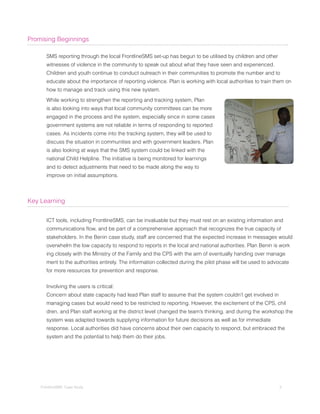
      The team began by conducting two workshops in Benin in
      February 2009 with youth leaders, frontline staff, community
      members, local authorities from the Center for Social Protection
      (CPS) and representatives from the Ministry of the Family.


      The workshops sought to introduce the idea of using SMS
      reporting (FrontlineSMS) and digital mapping (Ushahidi) to
      strengthen local and national systems for reporting, tracking
      and responding to violence against children. They used the
	     time	to	share	and	refine	a	basic	idea	of	how	the	system	might	
      look.


      The team followed up with participants and local authorities, and conducted awareness raising activi-
      ties including promotion of SMS violence reporting in a youth radio programme, and tacking up posters
      around the community. Henri da Silva, Plan Benin’s ICT Director who facilitated at the Benin workshops,
      went to Togo to replicate the training with staff and youth there, while watching the Benin pilot unfold and
      making adjustments to the set-up.


      FrontlineSMS: Case Study                                                                                   2
Promising Beginnings

       SMS reporting through the local FrontlineSMS set-up has begun to be utilised by children and other
       witnesses of violence in the community to speak out about what they have seen and experienced.
       Children and youth continue to conduct outreach in their communities to promote the number and to
       educate about the importance of reporting violence. Plan is working with local authorities to train them on
       how to manage and track using this new system.
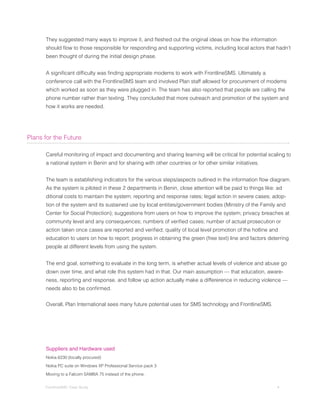
       While working to strengthen the reporting and tracking system, Plan
       is also looking into ways that local community committees can be more
       engaged in the process and the system, especially since in some cases
       government systems are not reliable in terms of responding to reported
       cases. As incidents come into the tracking system, they will be used to
       discuss the situation in communities and with government leaders. Plan
       is also looking at ways that the SMS system could be linked with the
       national Child Helpline. The initiative is being monitored for learnings
       and to detect adjustments that need to be made along the way to
       improve on initial assumptions.


Key Learning


       ICT tools, including FrontlineSMS, can be invaluable but they must rest on an existing information and
	      communications	flow,	and	be	part	of	a	comprehensive	approach	that	recognizes	the	true	capacity	of	
       stakeholders. In the Benin case study, staff are concerned that the expected increase in messages would
       overwhelm the low capacity to respond to reports in the local and national authorities. Plan Benin is work
       ing closely with the Ministry of the Family and the CPS with the aim of eventually handing over manage
       ment to the authorities entirely. The information collected during the pilot phase will be used to advocate
       for more resources for prevention and response.


       Involving the users is critical:
       Concern about state capacity had lead Plan staff to assume that the system couldn’t get involved in
       managing cases but would need to be restricted to reporting. However, the excitement of the CPS, chil
       dren, and Plan staff working at the district level changed the team’s thinking, and during the workshop the
       system was adapted towards supplying information for future decisions as well as for immediate
       response. Local authorities did have concerns about their own capacity to respond, but embraced the
       system and the potential to help them do their jobs.


    FrontlineSMS: Case Study                                                                                 3
They	suggested	many	ways	to	improve	it,	and	fleshed	out	the	original	ideas	on	how	the	information	
	     should	flow	to	those	responsible	for	responding	and	supporting	victims,	including	local	actors	that	hadn’t	
      been thought of during the initial design phase.


	     A	significant	difficulty	was	finding	appropriate	modems	to	work	with	FrontlineSMS.	Ultimately	a	
      conference call with the FrontlineSMS team and involved Plan staff allowed for procurement of modems
      which worked as soon as they were plugged in. The team has also reported that people are calling the
      phone number rather than texting. They concluded that more outreach and promotion of the system and
      how it works are needed.


Plans for the Future

      Careful monitoring of impact and documenting and sharing learning will be critical for potential scaling to
      a national system in Benin and for sharing with other countries or for other similar initiatives.


	     The	team	is	establishing	indicators	for	the	various	steps/aspects	outlined	in	the	information	flow	diagram.	
      As the system is piloted in these 2 departments in Benin, close attention will be paid to things like: ad
      ditional costs to maintain the system; reporting and response rates; legal action in severe cases; adop-
      tion of the system and its sustained use by local entities/government bodies (Ministry of the Family and
      Center for Social Protection); suggestions from users on how to improve the system; privacy breaches at
	     community	level	and	any	consequences;	numbers	of	verified	cases;	number	of	actual	prosecution	or	
	     action	taken	once	cases	are	reported	and	verified;	quality	of	local	level	promotion	of	the	hotline	and	
      education to users on how to report; progress in obtaining the green (free text) line and factors deterring
      people at different levels from using the system.


      The end goal, something to evaluate in the long term, is whether actual levels of violence and abuse go
      down over time, and what role this system had in that. Our main assumption — that education, aware-
      ness, reporting and response, and follow up action actually make a differerence in reducing violence —
	     needs	also	to	be	confirmed.


      Overall, Plan International sees many future potential uses for SMS technology and FrontlineSMS.


      Suppliers and Hardware used
      Nokia 6230 (locally procured)

      Nokia PC suite on Windows XP Professional Service pack 3

      Moving to a Falcom SAMBA 75 instead of the phone.


      FrontlineSMS: Case Study                                                                              4

Frontline SMS - Plan International 2011

  • 1.
    CASE STUDY FrontlineSMS atPlan International
  • 2.
    About FrontlineSMS FrontlineSMS isaward-winning free, open- source software that turns a laptop and a mobile phone or modem into a central communications hub. Once installed, the program enables users to send, receive and manage text messages with groups of people through mobile phones. Because it uses text messages, it does not require an Internet connection and all data lives on the computer, rather than on a server controlled by someone else. Users can send messages to individuals or large groups, and reply individually. It is easy to install and requires little or no training to use.
  • 3.
    FRONTLINESMS AND PLANINTERNATIONAL Introduction Plan International, a global organization dedicated to improving the lives of children around the world, is integrating FrontlineSMS, software for SMS reporting and communication, into some of its key program areas. Since 2008, when staff gathered in Kenya to discuss the use of social media and new technology in their program work, Plan has begun using FrontlineSMS in birth registration in Kenya and violence reporting in West Africa. This case study will look at how Plan is using FrontlineSMS for violence tracking, the impact of the tool on this work, what they’ve learned and their plans for the future. About Plan Plan is one of the oldest and largest international organizations focusing on the rights and protection of children around the globe.Through a range of programs and the support of international donors, Plan works with over 3.5 million families and their communities in nearly 50 countries. FrontlineSMS: Case Study 1
  • 4.
    A Need forReporting The UN Report on Violence Against Children (VAC) revealed some shocking statistics on violence against children – yet under-reporting means that we still don’t know its true magnitude. Plan, one of the organizations that participated in the study, is now working with local, national and global partners to share the results and prevent and respond to violence against children. In early 2009, Plan was working to strengthen both local and national reporting of trafficking and violence in Benin, West Africa. They were looking for a way to lower children’s and community members’ barriers to reporting, including the risk of reprisals and stigma, communications challenges, and access to places where violence could be reported. The Plan team theorized that collecting reports via SMS, which is anonymous and low-cost, would encourage reporting and allow for a better understanding of the nature and the quantity of violence that was happening. FrontlineSMS and Plan Start SMS Reporting The team decided to combine FrontlineSMS and Ushahidi, a digital mapping platform that crowdsources information via SMS, to reach their goal. Since Ushahidi does not have an SMS interface, it needs to be set up with another tool to collect the messages sent from a mobile phone; FrontlineSMS provides the simplest tool to do so. The team began by conducting two workshops in Benin in February 2009 with youth leaders, frontline staff, community members, local authorities from the Center for Social Protection (CPS) and representatives from the Ministry of the Family. The workshops sought to introduce the idea of using SMS reporting (FrontlineSMS) and digital mapping (Ushahidi) to strengthen local and national systems for reporting, tracking and responding to violence against children. They used the time to share and refine a basic idea of how the system might look. The team followed up with participants and local authorities, and conducted awareness raising activi- ties including promotion of SMS violence reporting in a youth radio programme, and tacking up posters around the community. Henri da Silva, Plan Benin’s ICT Director who facilitated at the Benin workshops, went to Togo to replicate the training with staff and youth there, while watching the Benin pilot unfold and making adjustments to the set-up. FrontlineSMS: Case Study 2
  • 5.
    Promising Beginnings SMS reporting through the local FrontlineSMS set-up has begun to be utilised by children and other witnesses of violence in the community to speak out about what they have seen and experienced. Children and youth continue to conduct outreach in their communities to promote the number and to educate about the importance of reporting violence. Plan is working with local authorities to train them on how to manage and track using this new system. While working to strengthen the reporting and tracking system, Plan is also looking into ways that local community committees can be more engaged in the process and the system, especially since in some cases government systems are not reliable in terms of responding to reported cases. As incidents come into the tracking system, they will be used to discuss the situation in communities and with government leaders. Plan is also looking at ways that the SMS system could be linked with the national Child Helpline. The initiative is being monitored for learnings and to detect adjustments that need to be made along the way to improve on initial assumptions. Key Learning ICT tools, including FrontlineSMS, can be invaluable but they must rest on an existing information and communications flow, and be part of a comprehensive approach that recognizes the true capacity of stakeholders. In the Benin case study, staff are concerned that the expected increase in messages would overwhelm the low capacity to respond to reports in the local and national authorities. Plan Benin is work ing closely with the Ministry of the Family and the CPS with the aim of eventually handing over manage ment to the authorities entirely. The information collected during the pilot phase will be used to advocate for more resources for prevention and response. Involving the users is critical: Concern about state capacity had lead Plan staff to assume that the system couldn’t get involved in managing cases but would need to be restricted to reporting. However, the excitement of the CPS, chil dren, and Plan staff working at the district level changed the team’s thinking, and during the workshop the system was adapted towards supplying information for future decisions as well as for immediate response. Local authorities did have concerns about their own capacity to respond, but embraced the system and the potential to help them do their jobs. FrontlineSMS: Case Study 3
  • 6.
    They suggested many ways to improve it, and fleshed out the original ideas on how the information should flow to those responsible for responding and supporting victims, including local actors that hadn’t been thought of during the initial design phase. A significant difficulty was finding appropriate modems to work with FrontlineSMS. Ultimately a conference call with the FrontlineSMS team and involved Plan staff allowed for procurement of modems which worked as soon as they were plugged in. The team has also reported that people are calling the phone number rather than texting. They concluded that more outreach and promotion of the system and how it works are needed. Plans for the Future Careful monitoring of impact and documenting and sharing learning will be critical for potential scaling to a national system in Benin and for sharing with other countries or for other similar initiatives. The team is establishing indicators for the various steps/aspects outlined in the information flow diagram. As the system is piloted in these 2 departments in Benin, close attention will be paid to things like: ad ditional costs to maintain the system; reporting and response rates; legal action in severe cases; adop- tion of the system and its sustained use by local entities/government bodies (Ministry of the Family and Center for Social Protection); suggestions from users on how to improve the system; privacy breaches at community level and any consequences; numbers of verified cases; number of actual prosecution or action taken once cases are reported and verified; quality of local level promotion of the hotline and education to users on how to report; progress in obtaining the green (free text) line and factors deterring people at different levels from using the system. The end goal, something to evaluate in the long term, is whether actual levels of violence and abuse go down over time, and what role this system had in that. Our main assumption — that education, aware- ness, reporting and response, and follow up action actually make a differerence in reducing violence — needs also to be confirmed. Overall, Plan International sees many future potential uses for SMS technology and FrontlineSMS. Suppliers and Hardware used Nokia 6230 (locally procured) Nokia PC suite on Windows XP Professional Service pack 3 Moving to a Falcom SAMBA 75 instead of the phone. FrontlineSMS: Case Study 4