A guide to strengthening your child helplineVersion 1
corporate identity manual
www.childhelplineinternational.org
contents
Content
Introduction
Logo overview	

Colour overview
Logo position
Logo and background
Typography
Page
3
4	
5
6 - 7
8
9 - 10
manual CHI 3
introduction
To achieve a consistent identity for CHI, we have developed guidelines for communicating our brand. The guidelines
described in this document will unify the way we communicate the essence of CHI and the strength of our offerings
in the marketplace.
The use of the logo is a primary part of the logo’s identity.
To reach our target and supporters we must take our claim for attention with a memorable, distinctive and consist-
ent identity. We like to communicate our ‘brand’.
manual CHI 4
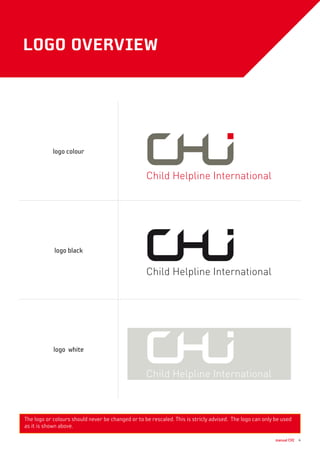
logo colour
logo black
logo white
logo overview
The logo or colours should never be changed or to be rescaled. This is stricly advised. The logo can only be used
as it is shown above.
manual CHI 5
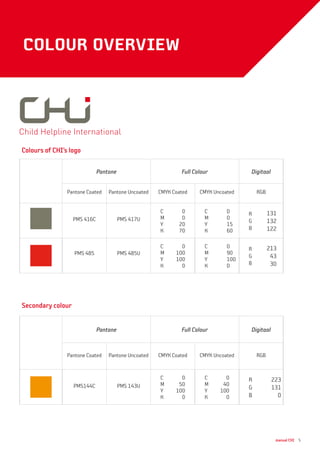
Colours of CHI’s logo
Pantone Full Colour Digitaal
Pantone Coated Pantone Uncoated CMYK Coated CMYK Uncoated RGB
PMS 416C PMS 417U
C
M
Y
K
0
0
20
70
C
M
Y
K
0
0
15
60
R
G
B
131
132
122
PMS 485 PMS 485U
C
M
Y
K
0
100
100
0
C
M
Y
K
0
90
100
0
R
G
B
213
43
30
Secondary colour
Pantone Full Colour Digitaal
Pantone Coated Pantone Uncoated CMYK Coated CMYK Uncoated RGB
PMS144C PMS 143U
C
M
Y
K
0
50
100
0
C
M
Y
K
0
40
100
0
R
G
B
223
131
0
colour overview
manual CHI 6
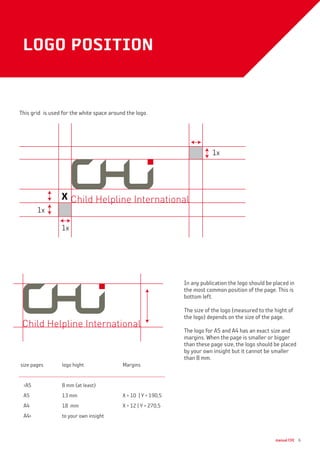
In any publication the logo should be placed in
the most common position of the page. This is
bottom left.
The size of the logo (measured to the hight of
the logo) depends on the size of the page.
The logo for A5 and A4 has an exact size and
margins. When the page is smaller or bigger
than these page size, the logo should be placed
by your own insight but it cannot be smaller
than 8 mm.
logo position
x
1x
1x
1x
size pages	 logo hight	 Margins
A5 	 8 mm (at least)	
A5	 13 mm	 X = 10 | Y = 190,5
A4	 18 mm	 X = 12 | Y = 270,5
A4	 to your own insight
This grid is used for the white space around the logo.
manual CHI 7
logo position
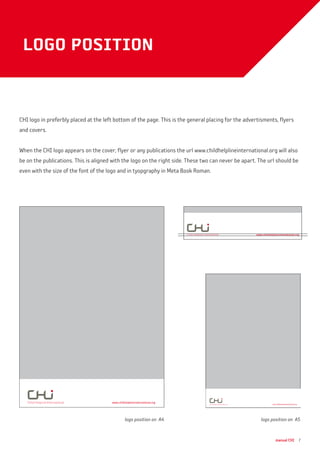
CHI logo in preferbly placed at the left bottom of the page. This is the general placing for the advertisments, flyers
and covers.
When the CHI logo appears on the cover, flyer or any publications the url www.childhelplineinternational.org will also
be on the publications. This is aligned with the logo on the right side. These two can never be apart. The url should be
even with the size of the font of the logo and in tyopgraphy in Meta Book Roman.
logo position on A4 logo position on A5
www.childhelplineinternational.org www.childhelplineinternational.org
www.childhelplineinternational.org
manual CHI 8
logo and background
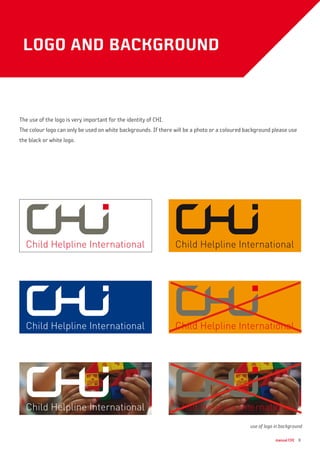
The use of the logo is very important for the identity of CHI.
The colour logo can only be used on white backgrounds. If there will be a photo or a coloured background please use
the black or white logo.
use of logo in background
manual CHI 9
typography
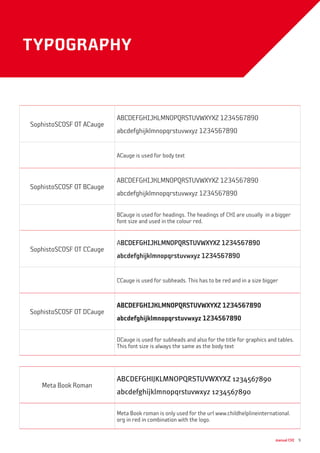
SophistoSCOSF OT ACauge
ABCDEFGHIJKLMNOPQRSTUVWXYXZ 1234567890
abcdefghijklmnopqrstuvwxyz 1234567890
ACauge is used for body text
SophistoSCOSF OT BCauge
ABCDEFGHIJKLMNOPQRSTUVWXYXZ 1234567890
abcdefghijklmnopqrstuvwxyz 1234567890
BCauge is used for headings. The headings of CHI are usually in a bigger
font size and used in the colour red.
SophistoSCOSF OT CCauge
ABCDEFGHIJKLMNOPQRSTUVWXYXZ 1234567890
abcdefghijklmnopqrstuvwxyz 1234567890
CCauge is used for subheads. This has to be red and in a size bigger
SophistoSCOSF OT DCauge
ABCDEFGHIJKLMNOPQRSTUVWXYXZ 1234567890
abcdefghijklmnopqrstuvwxyz 1234567890
DCauge is used for subheads and also for the title for graphics and tables.
This font size is always the same as the body text
Meta Book Roman
ABCDEFGHIJKLMNOPQRSTUVWXYXZ 1234567890
abcdefghijklmnopqrstuvwxyz 1234567890
Meta Book roman is only used for the url www.childhelplineinternational.
org in red in combination with the logo.
Connecting to Children 7
The membership of CHI outlined seven strategic goals at the
first CHI International Consultation in 2003. This section
provides a brief description of CHI’s activities and accomplish-
ments in meeting those goals throughout 2006; the final year
of CHI’s first three-year strategic plan.
2.1 Strategic goal 1: establishing the network
Work with countries interested in establishing a new child
helpline and strengthen existing child helplines so that the
maximum number of children have access to services.
Child helplines as a global movement
At its inception in 2003, CHI had fifty network members and
eleven countries who were interested in starting a child
helpline. In 2006, CHI continued to grow. With more child
helplines joining the network from developing countries, CHI
reflected a much more balanced membership between devel-
oped and developing countries. By December 2006, CHI had
eighty-eight members located in seventy-six countries. An
additional thirteen associate members worked closely with the
CHI Secretariat to start a child helpline. Finally, CHI actively
worked in another fifty-eight countries, securing partnerships
with organisations for the potential establishment of child
helplines.
Establishing child helplines in countries that do not offer this
valuable service to children is one of CHI’s major tasks. By
creating more helplines around the world, CHI and the member
network reach out to ever more children. With realisation that
economically developing countries need special attention, CHI
hopes to establish a truly global network of child helplines and
provide services to all children, especially those most vulner-
able and most marginalised. To this end in 2006, child helplines
were launched in: Bahrain, Brunei, Kenya, Indonesia and
Curacao. For helplines operating locally, CHI provides knowledge
and assistance to take the helpline to a multi-city or national
level. By utilising the declarations and decisions from the
International Telecommunications Union (ITU), child helplines
are also able to advocate for a toll-free number. This enables
child helplines to reach out to more children. Child helplines
based in the following countries were scaled-up/expanded
or received a toll-free number in 2006: India, Indonesia,
Nepal, Egypt, Morocco, Argentina, Colombia, Paraguay and
Trinidad  Tobago.
Technical support – exposure visits (twinnings)
Child helplines in the process of getting started often express
their desire to learn from existing child helplines. Child Helpline
International knows that giving prospective child helplines
written material to help them launch is not enough. To this end,
Child Helpline International arranged two twinnings and
exposure visits in 2006.
Exposure visits are an initiative between two or more child
helplines to gain know-how from each other. Teams from one or
more helplines visit another child helpline for a short period of
time to learn how the other member operates their service.
This involves all aspects of running a child helpline: counselling
services, relationship with stakeholders, awareness campaigns,
involvement of children, outreach programmes, fundraising
initiatives and technical matters.
The child helplines visit each other and exchange documenta-
tion, material and training. For emerging child helplines, this
process has proved extremely effective. The new child helpline
can study operational models used by existing child helplines,
gain experience and know-how on systems of documentation,
telephone counselling techniques, intervention techniques,
outreach etc. Child Helpline International endeavours to find a
twinning partner from the same region or from a child helpline
that faces (or has faced) the same kind of challenges.
Chapter 2: Child Helpline International activities in 2006
2006 Twinnings/Exchanges:
■ Jordan-Philippines
■ Sri Lanka-India
1
1
2
3
4
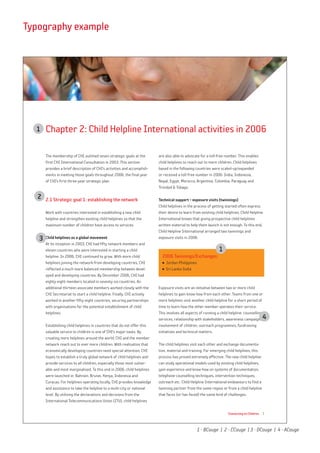
1 - BCauge | 2 - CCauge | 3 - DCauge | 4 - ACauge
Typography example

CHI - coporate identity manual

  • 1.
    A guide tostrengthening your child helplineVersion 1 corporate identity manual www.childhelplineinternational.org
  • 2.
    contents Content Introduction Logo overview Colour overview Logoposition Logo and background Typography Page 3 4 5 6 - 7 8 9 - 10
  • 3.
    manual CHI 3 introduction Toachieve a consistent identity for CHI, we have developed guidelines for communicating our brand. The guidelines described in this document will unify the way we communicate the essence of CHI and the strength of our offerings in the marketplace. The use of the logo is a primary part of the logo’s identity. To reach our target and supporters we must take our claim for attention with a memorable, distinctive and consist- ent identity. We like to communicate our ‘brand’.
  • 4.
    manual CHI 4 logocolour logo black logo white logo overview The logo or colours should never be changed or to be rescaled. This is stricly advised. The logo can only be used as it is shown above.
  • 5.
    manual CHI 5 Coloursof CHI’s logo Pantone Full Colour Digitaal Pantone Coated Pantone Uncoated CMYK Coated CMYK Uncoated RGB PMS 416C PMS 417U C M Y K 0 0 20 70 C M Y K 0 0 15 60 R G B 131 132 122 PMS 485 PMS 485U C M Y K 0 100 100 0 C M Y K 0 90 100 0 R G B 213 43 30 Secondary colour Pantone Full Colour Digitaal Pantone Coated Pantone Uncoated CMYK Coated CMYK Uncoated RGB PMS144C PMS 143U C M Y K 0 50 100 0 C M Y K 0 40 100 0 R G B 223 131 0 colour overview
  • 6.
    manual CHI 6 Inany publication the logo should be placed in the most common position of the page. This is bottom left. The size of the logo (measured to the hight of the logo) depends on the size of the page. The logo for A5 and A4 has an exact size and margins. When the page is smaller or bigger than these page size, the logo should be placed by your own insight but it cannot be smaller than 8 mm. logo position x 1x 1x 1x size pages logo hight Margins A5 8 mm (at least) A5 13 mm X = 10 | Y = 190,5 A4 18 mm X = 12 | Y = 270,5 A4 to your own insight This grid is used for the white space around the logo.
  • 7.
    manual CHI 7 logoposition CHI logo in preferbly placed at the left bottom of the page. This is the general placing for the advertisments, flyers and covers. When the CHI logo appears on the cover, flyer or any publications the url www.childhelplineinternational.org will also be on the publications. This is aligned with the logo on the right side. These two can never be apart. The url should be even with the size of the font of the logo and in tyopgraphy in Meta Book Roman. logo position on A4 logo position on A5 www.childhelplineinternational.org www.childhelplineinternational.org www.childhelplineinternational.org
  • 8.
    manual CHI 8 logoand background The use of the logo is very important for the identity of CHI. The colour logo can only be used on white backgrounds. If there will be a photo or a coloured background please use the black or white logo. use of logo in background
  • 9.
    manual CHI 9 typography SophistoSCOSFOT ACauge ABCDEFGHIJKLMNOPQRSTUVWXYXZ 1234567890 abcdefghijklmnopqrstuvwxyz 1234567890 ACauge is used for body text SophistoSCOSF OT BCauge ABCDEFGHIJKLMNOPQRSTUVWXYXZ 1234567890 abcdefghijklmnopqrstuvwxyz 1234567890 BCauge is used for headings. The headings of CHI are usually in a bigger font size and used in the colour red. SophistoSCOSF OT CCauge ABCDEFGHIJKLMNOPQRSTUVWXYXZ 1234567890 abcdefghijklmnopqrstuvwxyz 1234567890 CCauge is used for subheads. This has to be red and in a size bigger SophistoSCOSF OT DCauge ABCDEFGHIJKLMNOPQRSTUVWXYXZ 1234567890 abcdefghijklmnopqrstuvwxyz 1234567890 DCauge is used for subheads and also for the title for graphics and tables. This font size is always the same as the body text Meta Book Roman ABCDEFGHIJKLMNOPQRSTUVWXYXZ 1234567890 abcdefghijklmnopqrstuvwxyz 1234567890 Meta Book roman is only used for the url www.childhelplineinternational. org in red in combination with the logo.
  • 10.
    Connecting to Children7 The membership of CHI outlined seven strategic goals at the first CHI International Consultation in 2003. This section provides a brief description of CHI’s activities and accomplish- ments in meeting those goals throughout 2006; the final year of CHI’s first three-year strategic plan. 2.1 Strategic goal 1: establishing the network Work with countries interested in establishing a new child helpline and strengthen existing child helplines so that the maximum number of children have access to services. Child helplines as a global movement At its inception in 2003, CHI had fifty network members and eleven countries who were interested in starting a child helpline. In 2006, CHI continued to grow. With more child helplines joining the network from developing countries, CHI reflected a much more balanced membership between devel- oped and developing countries. By December 2006, CHI had eighty-eight members located in seventy-six countries. An additional thirteen associate members worked closely with the CHI Secretariat to start a child helpline. Finally, CHI actively worked in another fifty-eight countries, securing partnerships with organisations for the potential establishment of child helplines. Establishing child helplines in countries that do not offer this valuable service to children is one of CHI’s major tasks. By creating more helplines around the world, CHI and the member network reach out to ever more children. With realisation that economically developing countries need special attention, CHI hopes to establish a truly global network of child helplines and provide services to all children, especially those most vulner- able and most marginalised. To this end in 2006, child helplines were launched in: Bahrain, Brunei, Kenya, Indonesia and Curacao. For helplines operating locally, CHI provides knowledge and assistance to take the helpline to a multi-city or national level. By utilising the declarations and decisions from the International Telecommunications Union (ITU), child helplines are also able to advocate for a toll-free number. This enables child helplines to reach out to more children. Child helplines based in the following countries were scaled-up/expanded or received a toll-free number in 2006: India, Indonesia, Nepal, Egypt, Morocco, Argentina, Colombia, Paraguay and Trinidad Tobago. Technical support – exposure visits (twinnings) Child helplines in the process of getting started often express their desire to learn from existing child helplines. Child Helpline International knows that giving prospective child helplines written material to help them launch is not enough. To this end, Child Helpline International arranged two twinnings and exposure visits in 2006. Exposure visits are an initiative between two or more child helplines to gain know-how from each other. Teams from one or more helplines visit another child helpline for a short period of time to learn how the other member operates their service. This involves all aspects of running a child helpline: counselling services, relationship with stakeholders, awareness campaigns, involvement of children, outreach programmes, fundraising initiatives and technical matters. The child helplines visit each other and exchange documenta- tion, material and training. For emerging child helplines, this process has proved extremely effective. The new child helpline can study operational models used by existing child helplines, gain experience and know-how on systems of documentation, telephone counselling techniques, intervention techniques, outreach etc. Child Helpline International endeavours to find a twinning partner from the same region or from a child helpline that faces (or has faced) the same kind of challenges. Chapter 2: Child Helpline International activities in 2006 2006 Twinnings/Exchanges: ■ Jordan-Philippines ■ Sri Lanka-India 1 1 2 3 4 1 - BCauge | 2 - CCauge | 3 - DCauge | 4 - ACauge Typography example