The document discusses an IoT-based facial recognition door access control home security system using Raspberry Pi, aimed at enhancing security measures for homes. Traditional security methods like keys and passwords are compared with biometric solutions, highlighting the advantages of face recognition technology powered by deep learning. The paper details the implementation steps, including data collection, image processing, and the integration of Blynk for remote access control, concluding with testing results on system accuracy.
![International Journal of Power Electronics and Drive System (IJPEDS)
Vol. 11, No. 1, March 2020, pp. 417~424
ISSN: 2088-8694, DOI: 10.11591/ijpeds.v11.i1.pp417-424 417
Journal homepage: http://ijpeds.iaescore.com
IoT based facial recognition door access control home
security system using raspberry pi
A. R. Syafeeza1
, M. K. Mohd Fitri Alif2
, Y. Nursyifaa Athirah3
, A. S. Jaafar4
,
A. H. Norihan5
, M. S. Saleha6
1,3,4,5 Fakulti Kejuruteraan Elektronic and Kejuruteraan Komputer, Universiti Teknikal Malaysia, Malaysia
6 Fakulti Teknologi Kejuruteraan, Universiti Teknikal Malaysia Melaka, Malaysia
2 School of Electrical Engineering, Faculty of Engineering, Universiti Teknologi Malaysia, Malaysia
Article Info ABSTRACT
Article history:
Received Aug 19, 2019
Revised Nov 27, 2019
Accepted Dec 11, 2019
The home security system has become vital for every house. Previously,
most doors can be open by using traditional ways, such as keys, security
cards, password or pattern. However, incidents such as a key loss has led to
much worrying cases such as robbery and identity fraud. This has become a
significant issue. To overcome this problem, face recognition using deep
learning technique was introduced and Internet of Thing (IoT) also been used
to perform efficient door access control system. Raspberry Pi is a
programmable small computer board and used as the main controller for face
recognition, youth system and locking system. The camera is used to capture
images of the person in front of the door. IoT system enables the user to
control the door access.
Keywords:
Deep learning
Facial recognition
Home security system
Internet of things (IoT)
Raspberry pi This is an open access article under the CC BY-SA license.
Corresponding Author:
Syafeeza Ahmad Radzi,
Fakulti Kejuruteraan Elektronik and Kejuruteraan Komputer,
Universiti Teknikal Malaysia,
Jalan Hang Tuah Jaya, 76100 Durian Tunggal, Melaka, Malaysia.
Email: syafeeza@utem.edu.my
1. INTRODUCTION
Nowadays, home security system is a crucial issue. Indeed, this system is to ensure properties and
loves ones is always safe and protected. For the past few years, it is important to have a solid security system
for home, which can secure in the most ideal and safe way [1]. Many countries are step by step deployed
home security system [2]. The important part of any home security system is the person identification to enter
and exit the house. Previously, people use the traditional method for their home security system.
The traditional security system relies on the use of external things such as key, password and ID card to gain
access [3]. However, due to some limitation, biometric takes place to deliver such a promising security
system. The biometric is a unique and quantifiable parameter for individual recognition [4]. Biometric system
required the used of specialized hardware such as fingerprint scanner, palm print scanner, DNA analyzer and
etc. Furthermore, this specific machine required the target to touch the hardware to acquire data of human
unique features. Biometric technology is viewed as a standout among the most secure verification system
accessible, by giving a more elevated amount of security than conventional method [1]. Face recognition
is the most famous method in biometric technology besides fingerprint characteristics [2]. This is due to more
stability as face contains more features [3]. Besides, it is considered highly secure as face cannot be stolen,
borrowed or forge in order to enter the house. Face recognition is likely the most natural approach to perform
biometric verification between individuals [2]. Face detection is the first step of the face recognition system.](https://image.slidesharecdn.com/46204901570531679-revisededitbagus-210628034548/85/IoT-based-facial-recognition-door-access-control-home-security-system-using-raspberry-pi-1-320.jpg)
![International Journal of Power Electronics and Drive System (IJPEDS)
Vol. 11, No. 1, March 2020, pp. 417~424
ISSN: 2088-8694, DOI: 10.11591/ijpeds.v11.i1.pp417-424 417
Journal homepage: http://ijpeds.iaescore.com
IoT based facial recognition door access control home
security system using raspberry pi
A. R. Syafeeza1
, M. K. Mohd Fitri Alif2
, Y. Nursyifaa Athirah3
, A. S. Jaafar4
,
A. H. Norihan5
, M. S. Saleha6
1,3,4,5 Fakulti Kejuruteraan Elektronic and Kejuruteraan Komputer, Universiti Teknikal Malaysia, Malaysia
6 Fakulti Teknologi Kejuruteraan, Universiti Teknikal Malaysia Melaka, Malaysia
2 School of Electrical Engineering, Faculty of Engineering, Universiti Teknologi Malaysia, Malaysia
Article Info ABSTRACT
Article history:
Received Aug 19, 2019
Revised Nov 27, 2019
Accepted Dec 11, 2019
The home security system has become vital for every house. Previously,
most doors can be open by using traditional ways, such as keys, security
cards, password or pattern. However, incidents such as a key loss has led to
much worrying cases such as robbery and identity fraud. This has become a
significant issue. To overcome this problem, face recognition using deep
learning technique was introduced and Internet of Thing (IoT) also been used
to perform efficient door access control system. Raspberry Pi is a
programmable small computer board and used as the main controller for face
recognition, youth system and locking system. The camera is used to capture
images of the person in front of the door. IoT system enables the user to
control the door access.
Keywords:
Deep learning
Facial recognition
Home security system
Internet of things (IoT)
Raspberry pi This is an open access article under the CC BY-SA license.
Corresponding Author:
Syafeeza Ahmad Radzi,
Fakulti Kejuruteraan Elektronik and Kejuruteraan Komputer,
Universiti Teknikal Malaysia,
Jalan Hang Tuah Jaya, 76100 Durian Tunggal, Melaka, Malaysia.
Email: syafeeza@utem.edu.my
1. INTRODUCTION
Nowadays, home security system is a crucial issue. Indeed, this system is to ensure properties and
loves ones is always safe and protected. For the past few years, it is important to have a solid security system
for home, which can secure in the most ideal and safe way [1]. Many countries are step by step deployed
home security system [2]. The important part of any home security system is the person identification to enter
and exit the house. Previously, people use the traditional method for their home security system.
The traditional security system relies on the use of external things such as key, password and ID card to gain
access [3]. However, due to some limitation, biometric takes place to deliver such a promising security
system. The biometric is a unique and quantifiable parameter for individual recognition [4]. Biometric system
required the used of specialized hardware such as fingerprint scanner, palm print scanner, DNA analyzer and
etc. Furthermore, this specific machine required the target to touch the hardware to acquire data of human
unique features. Biometric technology is viewed as a standout among the most secure verification system
accessible, by giving a more elevated amount of security than conventional method [1]. Face recognition
is the most famous method in biometric technology besides fingerprint characteristics [2]. This is due to more
stability as face contains more features [3]. Besides, it is considered highly secure as face cannot be stolen,
borrowed or forge in order to enter the house. Face recognition is likely the most natural approach to perform
biometric verification between individuals [2]. Face detection is the first step of the face recognition system.](https://image.slidesharecdn.com/46204901570531679-revisededitbagus-210628034548/75/IoT-based-facial-recognition-door-access-control-home-security-system-using-raspberry-pi-1-2048.jpg)
![ ISSN: 2088-8694
Int J Pow Elec & Dri Syst Vol. 11, No. 1, Mar 2020 : 417 – 424
418
Face pictures can be caught at a distance with the use of a web camera. The individual can be recognized
without physical contact on any special hardware to perceive the person's identity.
Face recognition using deep learning technique is used. Deep learning is a piece of the more
extensive group of machine learning methods based on learning data representations, as opposed to task-
specific algorithms. Learning can be managed, semi-directed or unsupervised. With the deep learning,
the system is improved from time to time. Some images of authorizing user are used as the database
of system and the system will train the face recognition automatically. Thus, the accuracy is increased. Home
security is an example of an Internet of Things (IoT) applications. IoT refers to the network of associated
physical objects that can interact and trade information among themselves without the need of any human
intervening [5]. IoT is a futuristic technology where devices and internet is interconnected. It is different
from the internet due to internet exceed connectivity by allowing any embedded circuit to communicate
with each other using the current internet infrastructure. No doubt IoT helps users to control one or more
devices and capabilities to automate with many daily chores. By using IoT, it can help in controlling the door
access and also sent notification throughout the internet. In this system, Blynk apps are used. Blynk apps
is an app that enables us to control the door access by designing the graphical interface in the apps according
to the specific function to perform. It also able to send notification to computer, smartphone and other
smart devices.
2. LITERATURE REVIEW
2.1. Face recognition technology
Currently, the number of thefts and identity fraud have frequently been reported and has become
significant issues. Traditional ways for personal identification requires external element, such as key, security
password, RFID card, and ID card to have access into a private asset or entering public space [1]. Many
processes such as drawing out money from banks requires password. Other such parking in private space
would also need parking ticket. For some houses, the house key is very important. However, all this method
also has several disadvantages such as losing key and forgetting password [3]. When this happens, it can be
hassle to recover back. This method is slowly taken over by biometric methods as it is the possible way to
solve those problems. This technique required to use the special hardware such as fingerprint scanner, palm
print scanner, DNA analyzer to gather information for the vast majority of the biometric applications and the
target objects have to touch with the hardware to acquire information [6]. As biometric is a technique that
distinguishing physical highlights of people accordingly it has an extensive variety of utilization in security
frameworks and it is viewed as one of the most secure methods [1]. Basically, biometrics can be classified in
two categories which are physical and behavioral. Recently, the face recognition technology has engaged an
overwhelming number of researchers and it is gradually supplanting other biometric security frameworks [7].
Face recognition is also known as image matching. It is a rapidly growing field where it is heading in a
direction such that it will replace the traditional method. Face recognition is more stable among others
biometric identification method as it is using the human face that results in high accuracy, lowest false
recognition rate and it does not change in people’s life [3]. Thus, this method is much practical for a lot of
usage, including face recognition for the unlocking house door.
2.2. Method used for face recognition
In this new era, face recognition plays an important role in security and observation. Consequently,
there is a requirement for a proficient and cost-effective system. Face recognition is a technique that is able to
identify and verify peoples [8]. According to [9], face recognition, define as steps to identify, distinguish and
processed face is compared with the images that stored in the database to verify who the person is. This face
recognition has become a significant technique for user identification [10]. There are many techniques that
can be used for face recognition but the Principle Component Analysis (PCA) is one of the most popular
techniques used for face recognition. This method involves a mathematical procedure to transform a number
of possibly correlated variables into a number of uncorrelated variables known as principle component [10].
Generally, the PCA technique for face recognition will utilize the use of Eigenfaces [6]. It is the effective and
efficient ways to represent pictures into Eigenfaces component as it can reduce the size of the database of the
test image. Numerous method is developed and deployed in order to improve the performance of face
recognition technology.
2.3. Deep learning
Deep learning has benefited the human kind for years now. In the modern society, a deep learning
technique, especially convolutional neural network used in many applications such as license plate
recognition , finger-vein identification [6-11], gender recognition [6], face recognition [8-12] , emotion](https://image.slidesharecdn.com/46204901570531679-revisededitbagus-210628034548/85/IoT-based-facial-recognition-door-access-control-home-security-system-using-raspberry-pi-2-320.jpg)
![Int J Pow Elec & Dri Syst ISSN: 2088-8694
IoT based facial recognition door access control home security system using raspberry pi (A. R. Syafeeza)
419
recognition [13] , and other applications. Based on [9], deep learning technique is highly used for computer
vision application. By using Convolutional Neural Network (CNN), it results in better performance for face
detection and face recognition [11]. There are many advantages by using CNN as it can perceive patterns
with high variability and robustness to distortions and simple geometric transformations like translation,
scaling, rotation, squeezing, stroke width and a noise [12]. Besides, Oriented FAST and Rotated BRIEF
(ORB) also as one of the techniques used for face recognition. It is used for feature extraction, which utilizes
a fast binary descriptor dependent on BRIEF and is rotationally invariant. Typically, Deep Learning is based
on supervised learning. The aim of Deep Learning is to make a machine capable to correctly classify images.
Thus, during the supervised learning Raspberry pi are shown an image to produce an output in the form of
vectors scores, with each category one.
2.3. Face recognition in raspberry pi
The first research on face recognition goes way back in 1950 in the field of psychology. The actual
work of automatic machine recognition of faces really started in 1970 [14]. From all the research done, there
two types of face recognition method which are the image-based face recognition and video-based
recognition. Video-based face recognition is the process of finding 3D images from its 2D while the image-
based recognition method, is the process by which human train the machine using a camera by showing the
camera sets of still images. A Face Recognition System is a framework which consequently recognizes and
additionally checks the identity of a person from digital images or a video outline from a video source [15].
Many researchers choose to use embedded device called as Raspberry Pi for training and
identification purpose. The fundamental reasons why they have picked this particular component because it
has high handling limit, low cost, and its capacity adjusts in various programming modes [1]. By using
Raspberry Pi, it helps to resolve the limitation of PC such as its weight, size and high power consumption [3].
Raspberry Pi is a device that can divide the software part into three parts which are recording images,
training and face recognition [1]. According to [1] and [3] as they deployed the used of Raspberry Pi for
image capturing system, the system becomes littler, lighter and has lower power utilization. So it is more
convenient compared to PC-based face recognition system.
2.3. IoT in face recognition
IoT has been applied in face recognition in many applications such as unmanned arial vehicle [16],
smart classroom [17], home security system [2, 18], smart house [19], smart surveillance and many more
applications. The previous implementation of IoT in face recognition are using conventional method such
local binary pattern [20], neural network [21, 22], support vector machine [23], and k nearest neighbor [24].
However, in this research deep learning was being used.
3. METHODOLOGY
3.1. Overview
This project will design face recognition for real-time use. It is integrated with IoT to perform smart
home security system. A deep learning technique is used in this project. In order to ensure the expected result
are obtained, several major steps need to be conducted such as data collections, implementing, testing, and
troubleshooting. These steps are used to analyze the data and output. With these steps, this project are able to
be evaluated.
3.2. Face recognition
The prototype is built by combining the part of face recognition and IoT together. Face recognition
is operated at first place. There are five steps in face recognition, which are collecting images, creating
database, pre-processing images, training images and testing images.
Firstly, images are collected. These images are obtained by capturing using camera and used the
existing images. This image is used for training purpose for the system to be more accurate when dealing
with new images. A total of five persons, each with five pictures is taken from different positions. Each
picture is approximately 268 x 350 pixels of height and width. Images that are collected are stored in the
database as shown in Figure 1.](https://image.slidesharecdn.com/46204901570531679-revisededitbagus-210628034548/85/IoT-based-facial-recognition-door-access-control-home-security-system-using-raspberry-pi-3-320.jpg)
![ ISSN: 2088-8694
Int J Pow Elec & Dri Syst Vol. 11, No. 1, Mar 2020 : 417 – 424
420
Figure 1. Numbered and labeled images
Since face recognition framework a need large number of images, existing images have been
augmented. This is done by using an algorithm. Each picture per person will augment into 100 pictures,
resulting 2500 images stored in database. The images vary in brightness, colour, intensity, and angle. This is
to ensure that face recognition system can detect even in different conditions. Figure 2 (a) shows the
transformation from the original image in the database into the processed photo. The result of each person
categorized into each folder. Next, the cropping process takes place. This process will crop the exact face
from the images. This process is carried out by using an algorithm. The pixel of each picture is reduced to 48
x 48 pixels of height and width. Figure 2(b) shows extract features by separating the face from the
background.
(a) (b)
Figure 2. (a) Data augmentation of Images (b) Exact Face Obtained
3.3. Deep learning
Existing architecture was used in the training process. Images were train using deep learning method
using Convolutional Neural Network (CNN) technique. The current architecture used is AlexNet which
consist of eight layers. This architecture builds with several layer and activation function such as
Convolution, Maxpooling, Flatten, Dense, Activation and Dropout. The entire neural network approach was
implemented in Python language and Keras library [25]. The training involves 100 epochs at first and
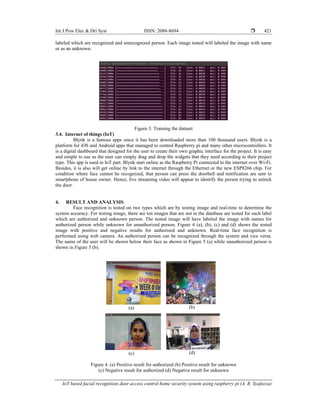
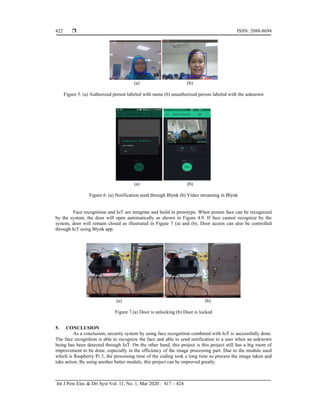
repeated with 20 epochs after the testing phase. Figure 3 will illustrate the training process of the dataset.
After training process was done image testing is required to determine the accuracy achieved by the system.
In this stage, image that are not in the database are used as test images. There are ten images tested for each](https://image.slidesharecdn.com/46204901570531679-revisededitbagus-210628034548/85/IoT-based-facial-recognition-door-access-control-home-security-system-using-raspberry-pi-4-320.jpg)
![Int J Pow Elec & Dri Syst ISSN: 2088-8694
IoT based facial recognition door access control home security system using raspberry pi (A. R. Syafeeza)
423
ACKNOWLEDGEMENTS
The authors would like to thank Universiti Teknikal Malaysia Melaka (UTeM) and Ministry of
Education for supporting this research under PJP/2018/FTK(9D)/S01603.
REFERENCES
[1] Y. Januzaj, A. Luma, Y. Januzaj, V. Ramaj., "Real time access control based on face recognition," in International
Conference on Network security & Computer Science (ICNSCS-15), pp. 7-12, 2015.
[2] M. Sahani, C. Nanda, A. K. Sahu, B. Pattnaik., "Home security system based on face recognition,"" 2015 Int. Conf.
Circuits, Power Comput. Technol. [ICCPCT-2015], pp. 1–6, 2015.
[3] G. Senthilkumar, K. Gopalakrishnan, V. S. Kumar., "Embedded image capturing system using raspberry pi
system,” vol. 3, No. 2, pp. 213-215, 2014.
[4] M. R. Mulla., "Facial image based security system using PCA," pp. 548-553, 2015.
[5] M. H. Jusoh & F. Bin Jamali, ''Home security system using internet of things,'' 2017.
[6] S. S. Liew, M. Khalil-Hani, S. Ahmad Radzi, R. Bakhteri., ''Gender classification: A convolutional neural network
approach,'' Turkish J. Electr. Eng. Comput. Sci., vol. 24, No. 3, pp. 1248-1264, 2016.
[7] M. Sajjad et al., ''Raspberry pi assisted face recognition framework for enhanced law-enforcement services in smart
cities,'' Futur. Gener. Comput. Syst., 2017.
[8] A. R. Syafeeza, S. S. Liew, R. Bakhteri., ''Convolutional neural networks with fused layers applied to face
recognition,'' Int. J. Comput. Intell. Appl., vol. 14, No. 3, 2015.
[9] A. R. Syafeeza, M. Khalil-Hani, S. S. Liew, R. Bakhteri., ''Convolutional neural network for face recognition with
pose and illumination variation,'' Int. J. Eng. Technol., Vol. 6, No. 1, pp. 44-57, 2014.
[10] K. Syazana-Itqan, A. R. Syafeeza, N. M. Saad, N. A. Hamid, W. H. Bin Mohd Saad., ''A review of finger-vein
biometrics identification approaches,'' Indian J. Sci. Technol., vol. 9, No. 32, 2016.
[11] S. Ahmad Radzi, M. Khalil-Hani, R. Bakhteri., ''Finger-vein biometric identification using convolutional neural
network,'' Turkish J. Electr. Eng. Comput. Sci., vol. 24, No. 3, pp. 1863-1878, 2016.
[12] S. Ahmad Radzi., ''A MATLAB-based convolutional neural network approach for face recognition system,” J.
Bioinforma. Proteomics Rev, vol. 2(1), pp. 1-5, 2016.
[13] M. K. M. F. Alif, A. R. Syafeeza, P. Marzuki, A. N. Alisa., ''Fused convolutional neural network for facial
expression recognition,'' in Symposium on Electrical, Mechatronics and Applied Science 2018 (SEMA’18),
vol. 2018, no. November, pp. 73-74, 2018.
[14] T. Tat, M. Student, L. C. Wing, P. M. Number., ''Image-Based Face Detection System,''.
[15] P. Kamencay, M. Benco, T. Mizdos, R. Radil, ''A new method for face recognition using convolutional neural
network face recognition system - state of the art,'' pp. 663-672, 2017.
[16] N. H. Motlagh, M. Bagaa, T. Taleb., ''UAV-based iot platform: a crowd surveillance use case,'' IEEE Commun.
Mag, vol. 55, No. 2, pp. 128-134, 2017.
[17] C. H. Chang., ''Smart classroom roll caller system with IOT architecture,'' in Proceedings - 2011 2nd International
Conference on Innovations in Bio-Inspired Computing and Applications, IBICA 2011, pp. 356-360, 2011.
[18] J. See & S. W. Lee, ''An integrated vision-based architecture for home security system,'' IEEE Trans. Consum.
Electron, vol. 53, No. 2, pp. 489-498, 2007.
[19] L. Y. Mano et al., ''Exploiting IoT technologies for enhancing health smart homes through patient identification and
emotion recognition,'' Comput. Commun, vol. 89-90, pp. 178-190, 2016.
[20] Y. P. Chen, Q. H. Chen, K. Y. Chou, R. H. Wu, ''Low-cost face recognition system based on extended local binary
pattern,” 2016 Int. Autom. Control Conf. CACS 2016, pp. 13-18, 2017.
[21] N. A. Othman & I. Aydin, ''A face recognition method in the Internet of Things for security applications in smart
homes and cities,'' in Proceedings - 2018 6th International Istanbul Smart Grids and Cities Congress and Fair,
ICSG 2018, pp. 20-24, 2018.
[22] S. H. Oh, G. W. Kim, K. S. Lim., ''Compact deep learned feature-based face recognition for Visual Internet of
Things,'' J. Supercomput., 2018.
[23] N. Funabiki, D. Pramadihanto, R. Arridha, S. Sukaridhoto., ''Classification extension based on IoT-big data analytic
for smart environment monitoring and analytic in real-time system,'' Int. J. Space-Based Situated Comput,
vol. 7, No, 2, pp. 82, 2017.
[24] U. S. Shanthamallu, A. Spanias, C. Tepedelenlioglu, M. Stanley., ''A brief survey of machine learning methods and
their sensor and IoT applications,'' 2017 8th Int. Conf. Information, Intell. Syst. Appl. IISA 2017, vol. 2018-January,
pp. 1-8, 2018.
[25] F. Chollet., ''Keras: The Python Deep Learning library,'' Keras.Io, 2015.](https://image.slidesharecdn.com/46204901570531679-revisededitbagus-210628034548/85/IoT-based-facial-recognition-door-access-control-home-security-system-using-raspberry-pi-7-320.jpg)


![[Deck] What's New in Spark-Iceberg Integration via DSV2.pptx](https://cdn.slidesharecdn.com/ss_thumbnails/deckwhatsnewinspark-icebergintegrationviadsv2-260210005337-25955b12-thumbnail.jpg?width=640&height=640&fit=bounds)


